Omer (00:09.760)
Welcome to another episode of the SaaS Podcast.
I'm your host Omer Khan and this is a show where I interview proven founders and industry experts who share their stories, strategies and insights to help you build, launch and grow your SaaS business.
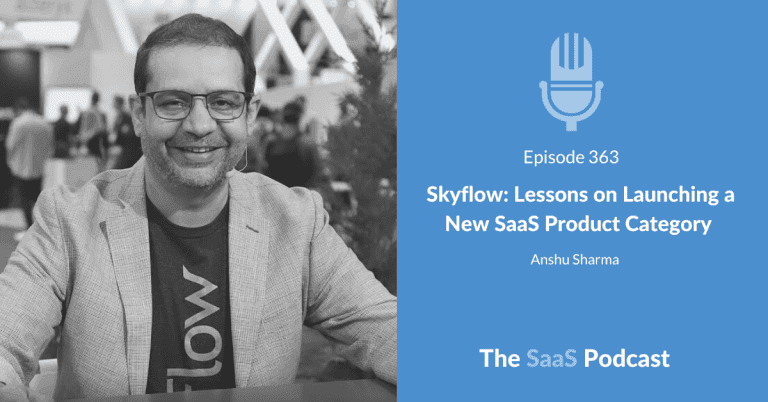
In this episode, I talked to Anshu Sharma, the co founder and CEO of skyflow, a privacy API for securing and managing sensitive customer data.
Before starting Skyflow, Anshu was a product manager at Salesforce and Oracle, where he saw firsthand the need for better data privacy solutions.
After a decade of watching the problem grow, Anshu finally decided to do something about it and launch Skyflow in 2019.
But creating a new product category is very challenging because you first have to educate potential customers on why they even need a different solution.
Anshu and his co founder spent over a year building an MVP before they ever talked to any customers.
In hindsight, it turned out to be the right approach.
In just a few years, they've grown Skyflow to a 7 figure ARR business with over 100 employees and have raised $70 million.
In this episode, you'll learn why it took Anshu over 10 years to start Skyflow and what he did during that time which prepared him for the challenge.
How the founders spent over a year building their MVP and why it was the right thing to do for their business.
Why Anshu didn't rely solely on demos and slides and always did one counterintuitive thing first before showing people the product.
We also talk about how Skyflow got its first hundred customers in large part by the thought leadership content that Anshu started to create.
And we share a story of how a large customer canceling their contract turned out to be a growth opportunity for skyflow.
So I hope you enjoy it.
All right, Anshu, welcome to the show.
Anshu Sharma (02:08.300)
Hey Omer, nice to meet you.
Omer (02:11.660)
Do you have a favorite quote, something that inspires or motivates you that you can share with us?
Anshu Sharma (02:16.070)
Yeah, I think my mentor Mark Benioff has this quote which I think he's borrowed it from someone else, but basically says we all underestimate what we can do in 10 years and overestimate what we can do in a year.
And I know it sounds banal, but every hard thing about building a startup, if you can return to the concept of what does it mean for us in 10 years, even just three to five years, you'll realize that a lot of things just don't matter and you can focus.
Omer (02:47.440)
So tell us about Skyflow.
What does the product do, who's it for, and what's the Main problem you're helping to solve.
Anshu Sharma (02:53.680)
Yeah.
So Skyflow is in some ways a very simple product.
You know, if you think about how when you log into an application, all of your username and password data is stored in something like odd zero and your credit card information goes to something like Stripe, all of your other personal information ends up in like hundreds of databases and applications and such.
And because of the impact of all the privacy laws, like gdpr, cpa, but also just like consumers becoming smarter and smarter, asking like, why are you asking me for my Social Security number when all you have to do is do a one time background check.
People have realized that it's no longer the right thing to do, is to hold your PII in hundreds of different places.
So what if you had a data privacy vault custom built for pii?
It managed its lifecycle end to end, made sure the data was stored in the right country at the right time.
Only the right people at the right time could see or use it and you could still search, analyze and run workflows for it.
Wouldn't that be magical?
Wouldn't that save us from the problems of our Social Security numbers and email addresses ending up in the hands of all the bad people?
That's the core concept.
I applied all the learnings I had at Salesforce, Oracle and built a product that is radically simple and just, you know, you could just get started with an API call.
Omer (04:22.310)
So who is, who is your icp, your ideal customer that you sell this product to?
Anshu Sharma (04:27.340)
You know, it's one of those things.
What's an ideal customer profile for MongoDB?
Well, in some ways every company in the world can use MongoDB or Auth0, but in the early days you have to focus.
So even though we are building a horizontal platform, we focused very intensely on CTOs of high growth companies, especially in industries where they are regulated either because of the geographies they serve like gdpr, or because of the verticals they serve like Digital Health or fintech.
Omer (05:00.940)
Give us a sense of the size of the business.
Where are you in terms of revenue, number of customers, size of team?
Anshu Sharma (05:07.260)
Of course nobody shares details, but you know, we crossed millions of dollars in revenue last year, we're growing now 400%.
We are 105 people, we are Series B.
We've raised $70 million so far.
The core thing to know about our company is it's very, very product and engineering centric because as I said earlier, we're building a fundamentally new building block of how applications are built and as a result getting it right.
Was super important to me.
So that's where we are in our journey.
Omer (05:40.310)
Okay, great.
So one clarification about skyflow and how a customer uses it.
When you said about, hey, you know, they don't want to deal with this personally identifiable information and they use Skyflow instead.
What are they basically doing?
Does that mean they have limited information about the customer, but the identifiable information is stored in some central place?
With Skyflow, is that how it's organized?
Anshu Sharma (06:10.510)
Yeah.
So again, as I said, just think about auth0 and stripe.
Right?
So the password never leaves auth0.
The credit card number actually never leaves stripe.
However, you're able to do all the functions you need to do.
So in case of skyflow, the customer profile information, these sensitive fields essentially get polymorphically encrypted and tokenized.
Inside of Skyflow you end up with something that looks like a real Social Security number or a real email address.
So all of your databases, applications, data warehouses, think they have the real information about you, Omer, except they only are holding format preserving tokens.
The benefit of this is now when a customer comes to you says hey, where is my data store?
Can you delete it?
Or you want to make sure that only certain people in your customer service team or your engineering team can see certain parts of the data, you can set up all of those policies and rules around Skypeflow rather than going into 15 different places.
It's basically a shared services architecture.
Just like today, every company in the world has a shared services architecture around storing secrets in a secrets manager, storing identity in an identity manager, storing credit cards in a credit card PCs system.
Similarly, PII, we believe, belongs in its own PI manager.
And that's what Skyflow offers as a service.
And you can, deployment wise, you can actually run it both in a shared services architecture like SaaS companies, but you can also get your own dedicated instance and run it in your own VPC if need be.
Omer (07:57.190)
So you mentioned your background, you worked at Oracle Salesforce.
I think Skyflow is your third startup that you've you founded.
And this business was founded in January 2019.
So not that long ago.
Where did the idea come from?
Anshu Sharma (08:19.600)
I'm an ideas person, maybe even a little bit ADD if you follow my Twitter account.
But this is one of those ideas that just like stuck around in my head for over 10 years.
The first time I conceived of this idea was when I was working with a large financial services institution and they were trying to do a competitor to PayPal.
Right?
So imagine you are a top three bank in the US and you're like, hey, PayPal is going to end up owning all the banking services.
What if we had peer to peer payment?
This is way before Zen Zelle existed, Venmo existed.
And the fundamental problem immediately becomes like, how are you going to do that?
Right?
In some ways you already have the data.
You know, my bank already knows my email address, phone number and account number.
At the same time, they're not legally allowed to share this data.
Right?
That was the first time I hit a problem like is there a way to use data without disclosing all the information?
And when you start thinking about that, then you start seeing it everywhere.
It's like the game kids play, like spot pink or something and you suddenly see pink everywhere.
Once you spot the privacy plus sharing problem, you see it everywhere.
So it started with financial services, then I ran into healthcare companies.
In fact, if you've been through the COVID crisis last four years, if you deeply think about it, when we say countries like Singapore and Dubai and Netherlands were able to roll out COVID policies overnight and America was struggling, part of it was because they all have centralized systems for managing their citizens data.
We live in a federal democracy, so we don't want that.
But that creates complications.
If you're trying to get on a Disney cruise, how does Disney know that?
Either as a vendor or as a customer or as an employee, whether or not you have had your Covid shots, same problem, almost exactly the same problem as the payment problem, which is I don't need to know omer who you are and what your exact date of birth is.
If you can prove to me that you had your Covid shot or you already been infected or whatever it is.
And so all of these problems fall under the class of what we call zero knowledge systems.
In fact, all of Bitcoin is built on zero knowledge proofs and such.
So I started seeing a pattern, which is a lot of conventional businesses, you know, think about when you walk into a Starbucks, right?
It's a coffee company, but it knows where you live, where you go to work.
In fact, Starbucks knows more about my life patterns than maybe even my spouse does because they have information about literally where I'm spending all my time.
So companies like Starbucks went from being the sellers of coffee, so did Walmart, to being in the business of knowing about us.
We call it sometimes digital transformation.
I hate that phrase.
But if you think deeply about it, Starbucks is digitally transformed.
When it goes from selling coffee to people it doesn't know anything about to you being able to pre Order coffee and send your colleague out to pick up seven cups of coffee.
And they don't have to remember the order, they don't have to punch in a credit card number, they don't have to give a phone number.
The coffee just magically shows up and they get maybe two extra Starbucks points or something.
Right?
So that whole ecosystem has to work in our lives, whether we are buying coffee or you're buying an airline ticket, you're opening a bank account, or you're going in and getting Covid shot.
So something seemed to be missing across all of these use cases around how we handle all of our sensitive information.
It's just insane that today when you file your taxes, you give your Social Security number to everybody you interact with, who in turn puts it into TurboTax, who in turn sends it to the IRS.
Guess what?
IRS already has your Social Security number.
Why are you sending your Social Security number to somebody who already has it?
Well, it's because.
So they can identify you.
Well, you can identify somebody without knowing their SSN if you use modern encryption tokenization schemes.
So it became very clear to me over a 10 year period that if we had this foundational layer which is missing from the Internet today, this service could transform the world in a meaningful way and impact our lives positively.
Omer (13:04.100)
Got it.
So this idea is brewing for like 10 years.
What happened at the end of those 10 years that got you to finally do something about it?
Anshu Sharma (13:14.130)
So there is the logical answer and then there is the real answer.
So the logical answer is, I saw this everywhere.
It's kind of like that movie Sixth Sense.
I see dead people everywhere, but nobody else was seeing it.
So what happened was around 2018, Facebook had this Cambridge Analytica issue and GDPR came out and states like California started talking about privacy.
Effectively went from this problem being what I call a 100,000 problem.
So if you were Equifax or Marriott and you had a breach of every card data, every phone number in your database, maybe you would get fined a million dollars in 2017, 2019.
That's a billion dollar fine.
In fact, as you know, Facebook paid $5 billion four years ago.
They spent another $1.2 billion a few weeks ago.
These billion dollar fines are not limited to just Facebook.
Twitter is paying them.
Companies like American Express and MasterCard were blocked for entire years from doing business in countries like India because they couldn't follow the local laws.
So it went from being, you know, as a nerd, I could see this problem technically for 10 years, but the business person, me, the Product guy in me wanted to see dollars associated.
And it went from a nice to have very nice architecture to oh, if I don't do this, this may be a billion dollar fine for many companies.
And as a founder, you just have to love the problems that have a clean architectural solution, which suddenly go from being a million dollar problem to being a billion dollar problem.
So that's what happened.
The honest answer is I got sick and tired of giving out my Social Security number and date of birth again and again and again.
And I just got fed up and said like, you know, I'm just going to start this company.
Omer (15:08.580)
Love it.
All right, so you, you get started.
What, what did you do?
Did you start building the product right away?
Did you say, okay, now I'm doing it.
Seriously, I'm going to spend more time kind of discovery and talking to customers or potential customers.
How did you approach it to the point where you could get the product built?
Anshu Sharma (15:29.770)
I'm going to give you some unconventional answers because that's what happened here, right?
We actually talked to zero customers from the day we started the company to the day we actually had a beta product that somebody could actually buy.
In fact, the very first customer call I had ended up in a sale.
But if you're listening to this podcast and think I can go out and do the same thing, if you come to me as an investor, I'm not writing that check for you.
Unless you've also spent last 10 years before that over and over thinking about it, talking about it, diligencing about it.
I had seen every pattern, every use case.
I talked to hundreds of CTOs, dozens of CISOs about this problem and why they would and would not use it.
So I knew enough that I could build that first version of the product with an amazing engineering team and co founders and such without thinking about like, hey, what does the customer want?
The other problem with products like skyflow, snowflake, MongoDB is that we are category creation.
And if you're creating a category, solving a new problem in a new way, the MVP for your product is simply a postgres database, right?
What's an MVP for Snowflake?
A Postgres database.
What's an MVP or MongoDB?
A Postgres database.
What'S an MVP for?
Stripe?
You know, I don't know, maybe just using authorized dot net.
So some categories of products, you can't sort of incrementally test and build them.
You have to build enough that you can now say, hey, if you had this thing, would it change something?
Fundamental about your business or architecture or problem space.
And that's why, you know, Snowflake was building its product for many years before going after customers and so on and so forth.
So I think my advice to founders is deeply think about which category you are in.
Don't get confused.
If you're truly creating a new category, a fundamental new building block, you sort of have to build enough to then go test it.
On the other hand, if you're building something that's a better CRM or a better docuSign or what have you, you have to test first and then build later.
Omer (17:54.430)
Great.
Okay, so you didn't talk to any customers.
You explained why.
How long did it take you to build the MVP or the first product?
First version of the product, yeah.
Anshu Sharma (18:05.870)
So we really started engineering in about August.
So for first six months we were building out the team, thinking deeply about what exactly the shape of the product would be.
So even though I didn't talk to customers, the knowledge I had from hundreds of conversations and the core hypothesis had to be distilled down into what is the first end to end use case we're going to solve completely for a customer.
Because one of the worst things you can do trying to build a platform company is to start with building a platform product.
So we narrowed it down to a couple of use cases around PII for kyc, use cases around handling payments data, and then said, okay, if that's the only problem we were trying to solve with version one, what are the feature functions and things you would need so you would be vastly superior?
And so that took us about, I would say, 10 to 12 months to build up the first beta version, enough that I could show something to CTO of a large company or a startup and get feedback about, yes, this would work for me or not.
So 100 conversations before we started building, close to zero while we were building, and again, lots of conversations once we built enough.
Omer (19:23.370)
Can you just explain what you mean by KYC for people who don't know what that means?
Anshu Sharma (19:27.020)
Oh, know your customers.
So every time you open a bank account or you sign up for even some online services, the law requires that the entity that's doing business with you legally know who you are.
In fact, if you're following the whole Twitter versus Facebook war right now going on, a lot of this is around.
Does Twitter know who you are now?
Legally, they're not required.
So you could, they could take a very 4chan like view of the world.
I have no idea who these people are and I refuse to find out.
All the way to a bank where I know exactly who you are, your mom, your passport number, that's a spectrum.
But irrespective of where you lie on the spectrum, think about an airline.
You know, it doesn't legally need to know who you are, but you effectively can't travel without them knowing your passport Number, Driver's License, TSA, PRE, etc.
So most companies that do business with consumers end up collecting some amount of KYC know your customer information.
The easiest example for you guys might be Uber, right?
You sign up as a rider, you need to at least share your phone number and credit card number.
As a driver, you need to share a whole bunch of information so they can do a background check on you.
All of these processes hang around personal information.
Omer (20:48.340)
Great, thank you.
So when you started building the product, were you bootstrapping initially or did you go out and raise some money right away?
Anshu Sharma (20:59.940)
I had had some success at Salesforce.
I'd been an investor in many companies.
Some of them went public.
So I had a little bit of a financial cushion.
So first six months we frankly just paid everybody through our pockets.
And you know, me and my co founders didn't take any salary for the first six months we had access to capital.
I was kind of lucky.
I had done venture before in angel investing, so we knew we could raise anytime we wanted.
But weirdly enough, I know it's not fashionable anymore.
I was very hesitant to take capital till I knew exactly what I wanted to build and whether it was worth building for the next 10 years.
So my commitment wasn't a two year commitment.
For me, the commitment was a 10 year commitment.
And even after starting the company, it took me six months to make a 10 year commitment.
Once I had that nailed, I talked to a few investors.
Most of them absolutely hated the idea of creating a new category, a new kind of store, a new kind of product.
A few loved it because in Ashugarak's word, who did our seed round, most likely this will not work.
But if it works, this could be $100 billion company.
So we found a couple of investors like that and we took a large seed round of $6 million in those days.
Omer (22:15.160)
Yeah, I think you and I were talking earlier and you gave that example of MongoDB and going out and if you asked people if they needed MongoDB, they'd say no to that.
Maybe you can just briefly tell that story, but explain it for people who don't know what MongoDB or Postgres are and what the difference is between relational and A document based database.
Anshu Sharma (22:42.810)
Actually let me invert the problem itself.
Right.
So think about most startups that we all work and read about, invest in.
We feel like we're familiar with the problem.
And a lot of time you will hear advice like, hey, it should be sort of obvious.
It's something that is not too complicated.
Can you explain it in a single line?
And that's fascinating and it's true.
And a lot of, I would say YC class companies come out of that paradigm.
Uber, Airbnb, these kind of companies don't require you to have a PhD in economics to understand why they would or would not work.
It's best to just build it and see if it works.
However, there's a certain class of companies and Sam Altman himself, XYC manager, has come out and said he couldn't have built OpenAI using his own advice.
Advicey.
When you're building something fundamentally architecturally new, there is nothing for you to rely on.
In fact, everything else you rely on is going to make you look like an idiot.
So if you went out and said, I'm building a large language model, first of all, nobody knows what that means.
And you said, well, it's going to be a data system for running AI, everybody would say that sounds like snowflake and databricks.
So you end up with this chicken and egg problem.
And so we can't solve large technical problems or even large business problems sometimes like building an electric car, without having a different paradigm.
And I call this category of thinking intentional startups versus the first category, what I call evolutionary startups.
Right.
New people and ideas just keep evolving, whereas intentional startups tend to be like, you've thought about it, something so much that you figured out truly a fundamental reason why it could be different.
So MongoDB coming back.
Even today, 95% of the world has no idea what MongoDB is.
They still can't articulate why it's different from Oracle or Snowflake.
And yet it's worth tens of billions of dollars.
It's revenue, I think is north of billions and it's one of the fastest growing tech companies.
So what is it about Mongo that allows them to grow so fast even though most people can't explain what it is?
Well, turns out it solves a fundamental technical limitation of relational databases which is implicit in the name.
You can only handle certain kind of relational data there.
So they found a problem that was such of such high value that a certain class of very experienced seasoned people would understand if you tried to solve it differently.
They hyper focused on that and then went out.
And instead of telling the world about MongoDB, which nobody knows anything about, they went out and explained to people why a new architecture for storing data would be valuable.
And it eventually became known as NoSQL.
Right?
So everybody now has heard of NoSQL.
So a similar thing happened, by the way, 20 years ago when BEA became an app server company.
Nobody had heard of an app server, by the way, same thing happened when Elastic came out.
Nobody had heard of an ELK platform or a search index.
We forget that there are fundamental building blocks of how we build applications handle data today, like Kubernetes and containerization, that were fundamental breakthroughs.
So in those categories, you cannot rely on, hey, I'm Uber for X.
You're much better off saying, hey, this is the.
This is how we're building things today, or handling data or using things.
If we think about it differently, here is why, it would be 10x better.
And then you show a whole bunch of use cases around it.
So in case of MongoDB, for example, in the early days, they're one of their earliest best customers, or people who just had a lot of unstructured data in E commerce that tended to be catalog data.
So if you ask somebody in 2011, where should I use mangodb?
They would say, you know, if you have catalog data, you probably better off starting Mongo, because catalogs have this peculiar property that they are very high dimensionality, so you cannot have like three columns.
Like, even a T shirt has 15 features about it.
So things like that, by the way, for those of you who are technical nerds, you're seeing this right now happen with Pinecone and vector databases.
None of us knew what a vector database is five years ago.
2% of you knew about it a year ago, and about 20% of you know about it now while listening to the podcast.
So this pattern repeats again and again.
The key thing is, once you recognize I'm building a new category because I've figured out a new building block, embrace it, accept it, hire people around this concept, build a team around it, set expectations with investors around it, you're not going to have the same journey that somebody building echo sign or DocuSign had.
If you're trying to build Pinecone, OpenAI, Snowflake, MongoDB, Skyflow, and dozens of other companies in that category.
Omer (28:22.320)
Yeah, that's a great explanation and some really awesome examples there.
So how did that play out for you once the product was built and you're going out there and trying to get these, you know, these mythical first 10 customers.
How easy or hard was it for you to sell the product?
Anshu Sharma (28:46.060)
So I think actually the first 10 customers came in surprisingly easy, assuming you had done the 10 plus two years of work, which is by the time we came in, we had deeply thought about the problem, so we knew more about this problem than customers did.
We had deeply thought about the architecture, so we knew more about it than our customers did.
And we knew exactly where and why they would buy it.
So when.
One of our earliest customers was a guy by the name of Bo Hartman.
He was a previous CTO of Goldman Sachs and Capital One and all these banks.
He was at a very fast growing payments infrastructure company.
And he met me and he's like, look, I built this thing before twice in my career and I hated it.
Every time.
I wish Skyflow existed earlier.
It's the easiest buying decision I'm going to make in my career to this day.
He loves our company.
He's our vocal proponent.
He sends me customers, investors, and all he wanted out of us was someone who was 100% focusing on building the thing that he needs over and over again.
But he's reluctant to spend having 30 engineers working on it.
And so when you're building something new, you'll find this set of customers who have the problem so acute that they will basically deal with the fact that your slides suck, your product has gaps, and that you really don't even know how to price it.
And those are the best 10 customers you can have.
It changes after that, by the way.
Omer (30:24.690)
Yeah, we'll talk about that.
So I think most founders, when they're trying to get those first 10 customers or whatever, are very keen to go out there and show customers a demo of the product.
Like, hey, we're solving this problem.
Take a look at the product.
Now, given the context of what you just described about a new category and something like you're creating here, were you initially doing the same thing?
Were you going out and trying to get demos or were you taking that approach that you described in terms of, hey, this is how things are done today.
If you think about it differently, this is how it could be 10x better.
Was that part of your pitch or is that something that evolved after you found people weren't interested in just getting to jumping to demos?
Anshu Sharma (31:10.890)
There are two kinds of products.
One is the first time I saw Echo Sign, I was like, oh my God, why am I signing anything that's not coming in through email?
It's a no brainer.
After you see it conceptually, it's very hard to actually explain to somebody who's never seen any signature product.
On the other hand, even to this day, imagine I asked you to demo me Snowflake or Kubernetes or EC2 or S3.
What are you going to demo?
You're going to run a SQL query and it comes back, well, I can do that on SQLite on my desktop.
Maybe I can even do it faster.
I think people make a mistake, they don't know what they're selling, as in they don't know what is a core value proposition.
They're selling your demo, your slides and your story are in service of the problem that you're solving, right?
So if I sign a lot of contracts every day, my pain is signing.
But you know, a lot of people in procurement don't sign contracts, they just send them out.
Their problem is sending, not signing.
So showing them an E signature demo, actually, weirdly enough, won't do anything for you.
In our case, what do people care about?
So there is a demo that's very powerful from Skyflow, but it shows that if I take a data pipeline or your application built using conventional building blocks, if you don't use Skyflow, how PII and card numbers and SSNs can end up everywhere.
And then I can show you how if you use Skyflow, you can control it.
You can only have it visible to the right people at the time.
I can show you how some of the data is stored in Germany, some in India and some in the US I can show you how that happens with a single API click.
But for me to show those things that I'm describing to you, if I hadn't set the context, they wouldn't look magical.
They would look like, yeah, sure, you're telling me you can store data in India.
Well, you know, I can do that using Google Drive, right?
So figuring out what's the problem that the customer has.
So I'll give two examples.
Some of our customers have a data residency problem, as in, you are a large payments company or you're a large SaaS company, you've been selling your CRM or payments product globally.
Suddenly Frankfurt, Germany has a data residency regulation.
Or Ireland or India or Nigeria, you can no longer sell your product there or people can't use it there.
Well, now you have a very specific problem.
How do I make sure I can continue to do business in Europe or start doing business in Europe?
Well, then the problem is framed as, hey, if you do it the traditional way, you would end up replicating all of your AWS infrastructure in another country and cost you 20% million a year.
But Skyflow, it's as simple as like spinning up, you know, vaults into regions and in like six minutes you can be actually up and running.
That's magical to someone who thought data residency was a two year problem where I can show it to them that it's now a two month problem at best.
On the other hand, if I showed the exact same thing to someone who doesn't do business globally, a lot of companies are US centric.
Showing them a data residency demo is like, basically has no effect on them.
It's like showing Gucci purses to me, right?
I don't buy them, they look like just leather bags to me.
On the other hand, if I'm dealing with an American customer and they are trying to do more with their customers, except they need to partner with another company and do data sharing to say roll out a new payments company or a loyalty card or what have you.
For them, the magic is in sharing data across organizational boundaries without actually revealing the data.
And they will get blown away by that.
And so we have to figure out what we are solving for what customer?
Again, go back 20 years ago if you're selling BEA or 15 years ago, you're selling MongoDB.
If you're selling to the catalog guy, you show them catalog search.
If you're selling it to a supply chain person, you show them supply chain visibility.
So that's how we basically decide when and how to show what part of the product.
Omer (35:56.440)
Many founders in those early days are going out and talking to anybody and everybody and just anybody who will listen.
I'll talk to you and tell you about my business and my product.
How were you able to narrow down your ICP and figure out where you were going to focus on which use cases you were going to pick?
You know, obviously as you said, it's a horizontal product, but you had to start somewhere.
So how did you make those decisions and figure that out?
Anshu Sharma (36:26.600)
So again, there's two ways to do it.
One is if I had just started with this problem anew because I had only had a technical innovation in mind, then I would have to do some sort of breadth first search, right?
And that's what like know YC tells you, like hey, go talk to 100 customers, let them tell you why they need this product.
And I think that's very viable strategy and you should do that if that's where you are.
In my case, I had a thesis.
I knew what the problems were.
I Had to narrow down like hey, should I Focus on SaaS companies or health companies or fintech companies?
So all I did was called up three of each and very soon found out who is most interested and then just prioritized.
Some of it was frankly random.
For example, should we do more SAS data residency or more PCI stuff for FinTech companies was a toss up and I picked based on my personal preference or where I had the most network to begin with.
Omer (37:27.190)
And did they turn out to be the right hunches?
Anshu Sharma (37:31.910)
Yeah, you know one of my learnings after investing in I think over 67 companies now is that we read a lot about pivots and they are glorious stories when they happen.
But for every slack there is hundred dead slacks and 20 successful Salesforce and Zendesk and companies like Salesforce and Mongodb and Snowflake basically can't pivot.
And if you try to pivot you're basically going to end up killing the company.
So you better have a very clear idea.
If you saw our seed deck word by word, four years later, we built the exact same product, we target the exact same customers in the exact right order.
And it's not because you know we are somehow geniuses.
It's because we frustratingly waited 10 years to start the company.
So we had done the work.
If we hadn't done the work instead of doing the work 10 years prior, I would have to basically I would add another two to three years to my journey if we had to basically start the product now.
Omer (38:44.780)
So you describe getting the first 10 customers as relatively easy given the what you described as like 10 plus 2 years of pre work that happened.
What about getting to the first hundred customers?
I mean the first 10 I think were a lot about through your network and finding the right types of customers.
How did you get to the first 100?
Was that still a lot of outbound or what helped you kind of accelerate the growth there?
Anshu Sharma (39:15.030)
I think one of the pieces of feedback you'll hear from second and third time founders and some of the legendary investors, famous names that you might have heard, they will say things like solving a harder problem is an easier path to building a great company counter intuitively.
And the reason I think that's surprisingly true is because when you solve a hard problem meaningfully, there's so much pent up demand for people who had that problem that a lot of those people when they hear for the first time.
So you know to this day 90% of people listening to this have no idea what MongoDB is.
But imagine you were the CTO of ebay or Walmart or Pinterest or FedEx.
And your biggest problem was every time you added a new field to your catalog or one more field to your database, everything went down for days and weeks and it took months.
So you basically never changed anything.
So you literally couldn't evolve your product because you couldn't evolve your schema.
When you heard for the first time what a document database could do, you would line up like, hey, I want to know SQL database.
In a similar way.
I think the problem we were solving was, had a lot of pent up demand.
We got some friendly press because of the ambitious nature of our offering.
That generated a lot of inbound interest, which we obviously were able to take advantage of.
And then we also did a lot of thoughtful content marketing.
I hate the word content marketing because it implies it's more marketing than content, but it's really thoughtful content.
It's really like what we are doing right now, which is, can you from first principles explain why you need a document database?
Can you explain from first principles why you need an application server?
Can you explain from first principles why you need this PII vault?
What are the scenarios?
What are the use cases?
Every time I wrote a blog post about it, we got more hits, we got more users.
Omer (41:29.840)
Yeah, I think you're tackling one of those problems where maybe initially some people like the feedback you got from investors, this will never work, this is too hard and so on.
But when you're talking to somebody who understands the problem or the pains that they're currently dealing with with the current solution and they can kind of, it clicks this paradigm shift of how things could be different or better.
I think that in many ways it's like it becomes a lot easier because you haven't even told them about your product yet potentially.
Right.
You've just helped them to understand, hey, what if there was a better, different way to do this?
And people are like totally like the CTO who's like, I hate building this stuff and if there was a better way to do it, I'm all in.
So I think that that's kind of totally makes sense.
I want to talk about one story that you shared with me about a customer that you sold to.
And then they had a new CTO come in and suddenly it didn't look like they were going to be a customer for much longer.
Can you tell us that story?
Anshu Sharma (42:46.930)
One of our first 10 customers, which was a customer who was very excited, they were very happy with what we were building.
For them, I think we were about three to five months into the contract.
They were not yet fully live because they were building something new using our product.
And they ended up having a leadership change where they hired basically sort of a new chief architect kind of a person.
And this person who had never heard of Skyflow, he had never heard of Data Privacy Vault comes in, his manager CTO says, hey, here is my team, here's 200 engineers to manage and here is our things we are using to build our product.
And his instant reaction a few weeks in was like, who ordered that?
Right?
So it's kind of like imagine you were a contractor building a house and you just got assigned as the new contractor and there is this weird shaped bathtub sitting and you're like, who ordered this thing?
Like, you know, I don't know what this thing is.
I have never thought about this.
And when you ask other people on site saying, what is this thing?
They don't have the words and the language to explain it to him.
So they might just say, yeah, this is some kind of a data security thing we have.
Some might say, well, this helps us with HIPAA and pci.
Someone else might say, hey, this thing solves our GDPR problem.
So whatever words they use, it doesn't sound very appealing, does it?
Right?
Because people on the inside, you know, they're not, it's not their job to sell the product back again to, to themselves.
For us, it would have been a crushing blow, right?
So this is, you know, this is the customer I'm giving references to other customers for.
This is the customer I'm calling up investors like, hey, you know, if you want to invest, this is the customer you should talk to.
They, they are a living legend, blah, blah, blah.
And you know, at that time I would say, you know, we were obviously sub million dollars in er at that point and I don't remember the exact number, but they were somewhere between 20 to 30% of our revenue.
Right.
On a very small basis, that's, you know, if you're doing 300k in ARR, it's very easy for one customer to be like 20% of your revenue.
Right?
Especially our largest customers.
Even this to this day, if you remember when Twitter went public, 20% of their revenue or something like that was coming in from just one customer, Uber.
So there's a lopsidedness to, in all deals, especially early stage companies, especially for problems that we are solving.
So deep pain and there's nothing really to anchor because you had not even built a relationship with this guy also so happens this is COVID 19 days by the way.
So you can't go meet this person, you can't talk to this person.
Their own team is distributed.
Omer (45:57.850)
How did you hear about the problem?
Anshu Sharma (45:59.450)
Well, he called up and said, I want to cancel.
And I said, well, tell me more.
And I said.
And he's like, well, I just took the job and I'm basically going to cancel everything that previous people bought.
And then we'll start with the fresh straight because like, you know, why should I buy whatever the previous guy had bought and which is very fair, right?
That's what I would do in a new job if I was given a clean slate.
When you're given a clean slate, guess what, you come in and first clean slate.
So he just was like, okay, I'm going to use this rag and clean the slate and build my own architecture diagram.
And I think this is where, you know, a critical point.
And you know, when I talk to founders and stuff, I give them coaching comes in.
How you react to that customer in those moments defines you in the eyes of the customer, but also defines you in the eyes of your own team, defines you in the eyes of your investors.
Because trust me, I worked at Oracle in Salesforce.
Even years after going public, you have those moments where you're largest customer just, you know, has a new leadership change or they just lose a contract and they don't want to do what they were planning to do.
So all these things happen.
I'm lucky.
I had a very senior leadership team in place from early days.
You know, there is advantages to youth, but there's one advantage to experience.
You've suffered all the pain that you're going to suffer before at least once before.
So we were like, okay, this is gonna suck, but it's okay.
You know, in five years it wouldn't matter either ways.
Right?
Sort of the perspective comes in.
So we know we did what we, what everybody should do, which is like, hey, why don't we just treat it, you know, again you can legally say hey, I have a contract, blah blah blah.
But we're like, look, why don't we just meet.
Let me tell you what problem we are solving and why your team was looking into using this product.
And let's have a conversation for an hour.
And you know, he was very reluctant because he felt like it'd be salesy.
But through even our first call, I was able to earn his trust back.
That, look, this is fine.
You know, I've run billion dollar businesses before.
Your 60k contract is not going to kill me or my company.
So it's fine.
As painful as it may sound right now, we live through it.
Why don't we just talk to each other and we'll move on?
And that opened the door enough where we started talking to each other.
Me and couple of our senior engineers, we just went there and said, let's have a conversation.
We Talked to him 0times about the contract, about legality, about ethics.
We just said, hey, tell us what you're building now that you are the new architect, tell us how you're building this thing, and let's just have a discussion.
And of course, in the background, what was happening was I knew where he was, what he was thinking.
We assembled the documentation necessary the stories, and then by the time we met him, we had an even more compelling case.
But we heard him out, realized that some of his priorities were very different than the original priorities because companies themselves change.
So imagine you sold, this is not the customer we're talking about, but imagine you sold to Starbucks, a privacy solution for employees, and suddenly they care more about customer data or they're launching a payments application.
You go in there, you say, hey, tell me what your top priorities are.
And it so happens, and I kind of know this, for every business, no matter what you're trying to do, you're going to end up with some privacy or compliance or security challenges.
So we identified a bunch, we offered to help them if they wanted, and we were able to turn that around over the next few months.
And today that chief architect actually is no longer with this company.
Two years later, he's in fact now at a very large financial institution.
And I just got a text message from him a week ago where he says, I just took over as CXO of this bank and the first thing I'm going to look into is using Skyflow for our Snowflake initiative and for our large language model initiative, because I love this product.
And that transformation, in some ways is a defining journey for every customer facing purpose person in the company.
When we do our sales enablement, we talk about customer success.
We don't talk about, you know, renewal rates and churn rates.
We talk about how do you stay customer focused intensely.
How do you actually think through their perspective?
How do you have more empathy for them?
You know, the guy is taking on a new job.
He probably has a bunch of stresses, why, you know, what's going on in his mind and through that process.
And again, we've seen this happen again and again, both in great scenarios and some negative scenarios.
And it always works out best if you focus on your customer's problem rather than your own problems.
Omer (51:28.180)
I love it.
That's such a great story and I think, yeah, you just nailed the big lesson from there, like focusing on the customer's problems.
And I think when you talk about customer success, really authentically talk about customer success and not just, you know, activations and renewals and stuff, those, you know, important metrics.
But that's not, you know, customer success.
All right, great.
We should wrap up.
Let's get onto the lightning round.
I've got seven quick fire questions for you.
Just try to answer them as quickly as you can.
What's one of the best pieces of business advice you've ever received?
Anshu Sharma (52:08.300)
Have a beginner's mind.
Marc Benioff talks about it in some ways.
Everything I just said, if you focused, I said the opposite things too.
And that's for a reason.
Every new business has its own unique constraints.
So learn everything, but don't blindly follow it.
Omer (52:25.100)
That's great advice.
What book would you recommend to our audience and why?
Anshu Sharma (52:28.780)
I love Good to great.
It's a 25 year old book about how great companies are built and they're usually around a core principle.
What's amazing about it is you learn some of the best strategies to grow a company.
But what I love about it is ironically, you'll also learn that most of those companies are now dead or dying.
And that speaks to how what worked for GE 1980s and 90s actually killed them in 2000s.
What worked for Honeywell in 2005 won't work for them in 2023.
So it's great because you learn and then you also learn that no learning is permanent.
Omer (53:10.710)
Yeah, I think that's an unintentional benefit of that book.
After all these years of seeing what's happened to those companies, what's one attribute or characteristic in your mind of a successful founder?
Anshu Sharma (53:23.270)
Insight.
Omer (53:24.630)
What's your favorite personal productivity tool or habit?
Anshu Sharma (53:28.790)
Setting aside time or having two distinct modes of operation, execution and strategy?
It's not a spectrum.
They're fundamentally two different modes.
You have to make time and space for it.
Think differently in those two modes.
Omer (53:43.790)
What's a new or crazy business idea you'd love to pursue if you had the time?
Anshu Sharma (53:48.750)
I have 45 of those.
If anybody wants to start a company, I can give you one of them.
I think one of the most more fun ones for me would be redefining how we help people find jobs and go through college.
I think there are ways to apply LLM kind of stuff and predictive analytics and fundamentally change how you decide what loans to take, what colleges to go to, what courses to take.
And a lot of things you don't have to do today because things have changed that could lead to you being successful in a career.
I think there's lots of brilliant ideas there that are aspirational for me today and maybe I'll go build them next.
Omer (54:34.750)
What's an interesting or fun fact about you that most people don't know?
Anshu Sharma (54:38.270)
I think I am 100% as nerdy as I come across on Twitter, and also 100% as irreverent and trying to be funny.
Omer (54:50.370)
And finally, what's one of your most important passions outside of your work?
Anshu Sharma (54:54.530)
I think I deeply care about friends and family.
I think relationships are extremely important to me.
In fact, weirdly enough, that ties back to work too, because even at work I care about relationships a lot.
And then obviously, reading and learning.
Omer (55:09.810)
Awesome.
Well, Anshu, thank you so much for joining me and sharing the story of Skyflow.
I think it was a great conversation.
I think you shared some very useful insights on not just your journey, but some of the experiences of a whole bunch of other tech companies.
If people want to learn more about Skyflow, they can go to skyflow.com and if folks want to get in touch with you, what's the best way for them to do that?
Anshu Sharma (55:37.580)
My email is ceouskyflow.com and then I'm on Twitter.
Anshu Blog.
Omer (55:43.500)
Awesome.
We'll include a link to your Twitter handle on the Show Notes page.
Awesome.
Thank you so much.
It's been an absolute pleasure and I wish you and the team at Skyflow the best of success.
Anshu Sharma (55:53.980)
Thank you, Omer.
Omer (55:55.100)
My pleasure.
Cheers.