Omer (00:09.760)
Welcome to another episode of the SaaS Podcast.
I'm your host Omer Khan and this is a show where I interview proven founders and industry experts who share their stories, strategies and insights to help you build, launch and grow your SaaS business.
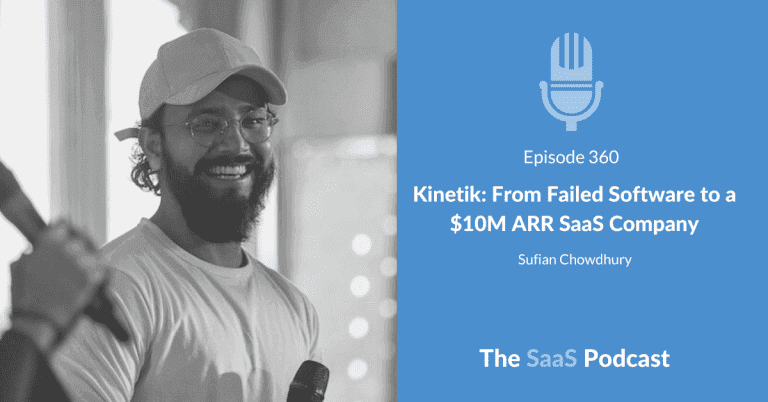
In this episode I talk to Sufian Chaudhary, the co founder and CEO of Kinetic, a company that's built the first integrated software for non emergency medical transportation.
Back in 2016, while working on a different startup idea, an old buddy of his who was running a transportation business came to Sufian in a panic about a database problem which was really just a huge out of control Excel spreadsheet.
While trying to fix the database problem, Sufian discovered a whole bunch of problems with the actual transportation business that was helping Medicaid patients get to their medical appointments.
Growing up in a low income family that relied on Medicaid, Sufian felt an instant need to jump in and solve these problems with the transportation business.
Together with a couple of friends who later became his co founders, they started hanging out in the back office of this business.
They wanted to get a handle on how the business worked and wondered if they could develop software to replace the Excel spreadsheet.
In time they figured they'd be able to help other businesses too, dealing with the same issues.
But six months down the line, they realized they'd built the wrong software.
Worse still, Sufian had already burnt through $80,000 of his own money on this venture, so they had to hit reset and basically start from scratch on the product.
But this time they decided to actually talk to folks in the transportation companies, making sure they really got what they needed and could build the right product.
Fast forward 18 months, they finally launched their product and started getting paying customers.
Things were finally looking up, but then the pandemic hit and they lost a whopping 70% of their customers.
Instead of giving up though, Sufi decided to double down on the software business with an even bigger and bolder vision of what they were going to do next.
Today, over 7 million rides a year are handled through their platform and they're on the verge of breaking 10 million in ARR this year.
This is a great story about the ups and downs of being a startup founder and there's some solid advice on getting through the tough times too, so I hope you enjoy it.
All right Sufiyan, welcome to the show.
Sufian Chowdhury (02:25.100)
Thanks Omar for having me.
Omer (02:27.020)
So do you have a favorite quote?
Something that inspires or motivates you that you can share with us?
Sufian Chowdhury (02:31.020)
Yeah, actually I do.
I have not failed.
I found 10,000 ways that don't work.
Tom said, is it, And I think it's.
Throughout this podcast we're going to talk about all the ways we had to survive and figure out how not to fail to get to this point.
Omer (02:46.660)
Great.
Now we have a bit of an audience, a live audience for this show.
Do you want to just embarrass everybody and just switch your camera around and show them?
Sufian Chowdhury (02:56.580)
Yeah, sure.
There you go.
Come on.
Look at this.
Hello.
Omer (03:01.940)
All right, Just wave and say hi, everyone.
Okay, great.
Sufian Chowdhury (03:05.780)
That's funny.
You guys made it.
Omer (03:10.740)
All right.
You're on the show.
Okay, great.
So for people who aren't familiar with Kinetic, tell us, what does the product do, who's it for, and what's the main problem you're helping to solve?
Sufian Chowdhury (03:23.660)
Yeah, absolutely.
So Kinetic is end to end healthcare transportation platform.
We have multiple products.
We have a payments product for transport companies and a scheduling platform for health plans and their members.
The industry that we service, it's called non emergency medical transportation.
That's the industry.
There are about 400 million rides that take place every year across 20,000 transport providers.
These providers are not drivers.
These are transportation companies, local transport bases that employ drivers.
And so these 20,000 transport companies will employ roughly half a million drivers across the country to fulfill roughly 400 million rides throughout the year.
It's primarily rides to your medical appointment that's fully covered by your insurance company.
So if I'm a member, if I'm a patient and I need a ride, I call my insurance, the insurance calls a broker.
A broker then calls a transport company who then has a driver, and that driver will come pick me up, drop me off.
So the spirit scheduling side is a nightmare.
And so we simplify it through a mobile app that allows the members to request in real time.
You get to see how many rides are allotted to them by their insurance company.
They request the mode of transport, wheelchair, ambulance, Ambulette, Lyft, Uber, whomever it is selected, they get the ride.
And then once the ride's completed, we build their insurance in real time.
So we're in the intersection of, you know, fintech and healthtech.
They're very cool product that we're building out here.
Omer (04:59.040)
So who are your customers?
Who pays you?
Sufian Chowdhury (05:01.600)
Yeah, so it's a multi sided network place.
So that means you have a network in one side.
But we charge the transport companies for the payments platform, which is the revenue cycle management platform.
So those 20,000 transport companies are our customers that we target with our RCM product and that's on one end.
Then we have a scheduling platform that's for health plans and health systems, and that's a booking platform that allows care coordinators and health systems, or member services, team members within the health plans to request rides on behalf of the.
Of the members through the scheduling platform.
So health plans, health systems on the booking side and then on the revenue cycle management platform, transport companies.
Omer (05:49.320)
Got it.
And so the health plans are also customers.
They're also paying you for access to this system?
Sufian Chowdhury (05:57.520)
Exactly, yeah.
Omer (05:59.200)
All right, that's interesting.
Okay, so before we get into the story, from how you came up with the idea for this business and have gotten it to where it is today, give us a sense of the size of the business.
Where are you today in terms of revenue, size of team, number of customers, anything you can share with us.
Sufian Chowdhury (06:21.170)
So we're approaching eight figures in revenues in ARR.
So this is all recurring revenues.
It's a pure SaaS product.
So we're approaching eight figures in ARR, and we're approaching about 100 employees across three countries.
So we have employees here in the States, and then we have employees in Bangladesh as well as Serbia.
Omer (06:40.530)
Okay, great.
So let's talk about where the idea came from.
So the business was founded in 20, 2017.
How did you come up with the idea?
Sufian Chowdhury (06:49.980)
It was six years ago.
They're gonna laugh.
Cause they've been hearing this pitch the whole month.
So it was six years ago.
A friend of mine, he calls me, he's like, hey, I need help with the database.
I go by.
I'm in Queens, New York, so he's in Brooklyn.
He's like 10 minutes from me.
I go out to his office.
It's a local transport company.
Sit in his back office.
He opens up this Excel sheet.
It's the largest Excel sheet I've ever seen.
It doesn't even make sense, Dan.
Data's all over the place.
I'm like, what do you do?
I have no idea what this market is, where he.
What he does.
All I knew is that he was the transport company.
Come to find out, he provides rides for these Medicaid patients to and from their appointments.
That's, you know, he has a hundred or so drivers that go around picking folks up and dropping them off.
And then at the end of the week, he.
He needs to bill insurances because these.
The members don't pay out of pocket for these rides.
It's fully covered by their insurance.
It's Medicaid.
So again, audience members, like Medicaid, is anyone below a certain income threshold qualify for government insurance.
So they're on Medicaid.
And come to find out I spent about 12 months by the way, I drove for him because I was so curious to figure out why this industry exists.
One thing led to another and I was working full time on different innovative products and I dropped everything I was working on because it seemed like this is a white space.
I did healthcare consulting prior to this.
It's all broken, especially on the revenue cycle side.
So I saw a huge need for a payments platform because I asked him how does he even get paid for these and how did this Excel sheet even become come about?
He's been putting data into this for about half a decade.
It's all pen and paper.
So after the completion of each ride, they, they fill out these HIC 1500 forms and send it out to the payers.
And then somebody's just jotting it all down on Excel.
Wow, 60 days to get paid.
So I was like, this is ridiculous.
You're getting paid 60 days.
How often do you pay your drivers?
How do you keep them?
He goes, I pay them every seven days and they have to take loans and credits.
I was like, this is a mess, this can't be real.
So then my idea at that time was, okay, there's gotta be a payments platform here that gets these folks paid on time with or really just in close to real time as possible.
And so that was the initial thesis that we were building towards.
And so those 12 months, when I say we, my two co founders, myself, Atif and Mahboob, we would sit in the back offices of these local transport companies, analyze how they operated and build the nation's first revenue cycle management platform.
It took us about 18 months to build it.
It was just three of us, so we integrated with 3,100 payers on one end.
So for the first time they could bill insurance companies.
It didn't take 60 days, it took them 21 days through our system.
On the other side, these transport companies have Uber and Lyft, like dispatch products.
So I'm a transport company, I'll have four or five operators.
They're dispatchers and constantly talking.
This is like 1990s taxi company, right?
It's constantly talking to drivers, but the drivers have a mobile app and they enter the data from this dispatch platform, the dispatchers.
And so what we decided to do is integrate with the dispatch platform so once the rides are completed, you can just auto generate the claims without the need for a medical billing company.
Because the transport companies are paying 5, 7% top line revenues to these medical billing Companies, we're like, okay, if we automate it, they could get rid of the medical billers.
And so that's what we did in those 18 months.
We automated medical billing in this space.
We were the first company to do this.
We're the first company to build out the revenue cycle management platform.
So what used to take 40 hours took 30 minutes.
What used to take 60 days to get paid took 21 days to get paid.
And that was really how the company started.
And obviously we went various iterations and pivots to get to where we are today, but that was that.
That's.
That's how the company started.
Omer (10:48.980)
Okay, so before the three of you decided, okay, we're going to go and spend the next 18 months building this product, what kind of validation did you do?
Did you go out and try to see if there were already products on the market that could solve this problem?
Did you kind of go out and have customer interviews?
What did you do to get to the point where you felt confident enough to say, we're going to go and spend a year and a half building this product?
Sufian Chowdhury (11:17.790)
Yeah, we realized that we're not, in retrospect, we're probably not the brightest people who did this because we spent the first six months with one customer and built the wrong product.
We did no market research whatsoever.
So whoever's starting, please do, like, comprehensive market research.
There was no such product as a billing product, but we realized very quickly that the need, even if it's a product of, you know, let's say a billing, the need of a transport company of his size is very different than a larger one or a smaller one by us relying on him only for six months.
We built the absolute wrong customized product, and that was just not cost effective.
Burned through a ton of money.
You know, initially invested a decent chunk of capital into it, about $80,000.
The first six months.
Just blew through it because we were hiring employees, we were trying to figure out how to build this thing.
It was very complex.
You're signing deals with clearinghouses and all the rest.
So didn't do enough research.
Omer (12:17.630)
And that was your own money, right?
Sufian Chowdhury (12:19.300)
Yeah, own money.
Own money.
And the next 12 months, we had to invest more of our own money to get it to a point where it made sense.
So the next 12 months, I asked him, hey, are there other folks in the industry that I could sit with and learn from?
And then spoke to about a dozen or so.
And then we started building a more standard product, which was the product that we ended up scaling.
So first six Months.
We were not smart about it at all.
Omer (12:50.320)
Okay, great.
So 18 months, you've built the product.
How did you go and start finding customers?
Sufian Chowdhury (13:00.720)
So initially the first 18 months is just word of mouth.
I was going from whoever knew any transport company.
I found myself in the most rural pockets in America because somebody had a friend in Oklahoma that did it and I'd literally get on a plane, go to Oklahoma.
Turns out this person has three vehicles and you can make $99 a month.
So my plane ticket in the hotel costs more than I could ever the lifetime value of that customer.
But you're just trying to get customers.
Omer (13:29.910)
Okay, wait, but, but why, why weren't you calling these people?
Why are you jumping on a plane?
Like what was the rationale?
Sufian Chowdhury (13:36.470)
Because you're eager.
Like for me it was, I didn't care.
I wanted to show market validation.
Right.
So the cost of showing market validation and raising capital, it was justified.
Right.
So you could go there, meet people, understand it.
And I, to this day, that's the one thing that I, no matter how much it cost, I would do it over and over again.
You've got to just sell your idea and yourself to the industry.
They've got to believe in you.
They will not change.
If you call, you know, just via phone.
We're dealing with a subsect of the health care marketplace that nobody really knows of.
These are mom and pop shops who don't adopt technology.
And so you've really got to sell vision to them and you can sell.
And this is prior to Zoom being as, as great as it is today or some of these online virtual platforms because this is 2017 and everybody met in person.
So yeah, I met everybody in person.
I go to Buffalo, rural parts of Buffalo.
Everywhere I'd go, I'd be like, why does anybody live here and what am I doing here?
Why am I building this?
So yeah, all across 18 months, a lot of self reflection and how easy
Omer (14:46.650)
or hard was it to sell the product at the time?
You're solving a problem that clearly is solving a pain for these businesses.
But you're probably also dealing with potential customers who are very price sensitive.
Sufian Chowdhury (15:03.910)
Yeah, they are quite sensitive.
But also you're dealing with folks who, when, when you don't understand the value of tech, doesn't matter.
It's just a different generation of folks you're selling into.
And these are of all things, transport companies, hard headed.
This is how I do it.
I've always done it, I'm never going to change type of mindset.
I mean the stories I have is crazy.
Like I'd be selling into.
There are parts of New York, it's all like mafia owned transport companies.
They're not here to service patients, are here to wash money.
So you're dealing with absurd, weird thing that you started building for.
But the vision made so much sense that anybody that was on Medicaid should not wait 72 hours to get it right.
Growing I grew up on Medicaid.
We didn't have much.
And then you just didn't have a lot of resources.
And to wait for 72 hours to get a ride just didn't make sense.
And I think those are the things that kept me going and trying to make sense of a market that just didn't make sense because just so corrupt in every way you could think of.
But yeah, it was just you had to keep going and get in front of these people and go door to door and sell into them the vision and the product.
And eventually they bought in.
They were less than price sensitive.
It's an ideology, you know, for them.
I go and be like, hey, want to buy this product?
And be like, no, why would I do that?
My son is doing it for free.
I'm like, your son's not doing it for free.
You're getting paid every 60 days.
I'm a finance major, so if every day you don't have a dollar, there's interest associated with it and it's expensive.
So if you get $35 days in advance, that's $35 worth of interest you're saving.
So I think lack of understanding of the cost of capital, rudimentary understanding of capital is a massive challenge in any market, especially a market that doesn't get the value that, hey, you're getting paid every 21 days.
Now you can pay these drivers, retain them, improve network, get more rides.
Very, very simple approach to business is what we were going.
And it's hard, it's hard to sell into folks who think they know how the whole system works when in reality that's not the case.
Omer (17:16.210)
So you focused on that product for I think about five years or so, which is how long it took you to hit the first million in ARR.
And when was that?
Sufian Chowdhury (17:31.770)
Okay, so that was last year.
But some more context around that.
So we sell this product, we talked about it earlier, 18 months, you finally get some initial customers and then you have some outbound sales and all that stuff.
Q1, 2020, we're ready to scale this thing.
Get a couple of salespeople, let's scale this.
Bam.
March Hits Covid world shuts down.
Nobody's doing rides.
I call them, I call these transport companies and they would curse me out.
They'd say, what are you talking about?
I don't have any rides.
Why would I use a billing?
What am I gonna bill?
And I'm like, man, I think this company is no more.
We had two choices there.
Either shut the company down or say, you know what, we're going to build a bigger company with a bigger vision and we're going to go after the entire market, not just payments, both scheduling and payments.
And this is the best time to strike because everybody was being very, very conservative in their approach.
The whole market was super conservative.
I talked to players in the marketplace.
The approach to sales is conservative.
And I was like, let's use the next two years as the market will take a couple of years to bounce back to build the most robust technology that can be completely stopped sales at the 35 customer mark.
And went back and we built a tech team of like 20 people, raised capital on a larger vision and built out this robust product.
And as Covid subsided, numbers just ballooned up.
So last year was our first million year and that's because it was the first real normalized year of rides.
So we grew from prior to that.
We had 44 customers at the end of 21.
We had 250 customers by the end of last year.
So the market bounced back.
We doubled down on sales.
We did not have a sales team at all.
I was selling for the first four years, doubled down on sales team, grew that to like 12 sales folks, all outbound sales to these mom and pop shops and calling and showing up in front of their offices.
And then we achieved that million dollar mark last year.
Omer (19:43.720)
When you talked about the impact of COVID what kind of impact did that have?
Like you mentioned, like it was hard to sell the product, like nobody wanted to buy.
But you, you lost a lot of customers as well, right?
Sufian Chowdhury (19:56.320)
Yes, because naturally there's a churn rate.
And then that was exasperated by the fact that the transport companies just didn't have rides and they'd naturally go out of business.
So we saw a bounce back last year, hence the growth in the number of transport companies as customers.
But simultaneously we were fulfilling the vision we came about, started building towards in 2020 during COVID we made that hard pivot and started building out the scheduling platform.
That was completed towards the end of last year.
Before COVID had one product, small market segment, $150 million TAM that we were going after post Covid larger vision became an infrastructure play, end to end product scheduling.
And now we have a $3 billion market to go after.
In terms of TAM, most people have
Omer (20:47.510)
a hard time building a product and getting product market fit when they're just focused on one customer, one icp.
And so you were here in the middle of COVID and saying, yeah, we've got this product that we hope we're going to bounce back after Covid and be able to keep selling this, but why don't we go and build another product selling to a completely different customer as well?
I mean, the big picture all kind of makes sense, right?
Because you're trying to kind of integrate and put this thing together.
But it sounds like you've just made life even more complicated and difficult for yourselves.
Sufian Chowdhury (21:24.130)
It naturally went that way because your company's TAM relative to how much capital you raise matters.
So if you, you know, by the time Covid hit, we had raised, you know, 2 or 3 million dollars.
We only had 3, 35 customers and then you had 70% of the customer base either going out of business or there are no rides.
The alternative was to pitch a larger vision with a larger TAM to raise more capital.
Right.
So that, that was the biggest difference in how we approach the market.
You either go down because no investor is going to say, hey, here's $1 million, $2 million, keep everybody on the books, wait for the thing to come back, wait for the right volume to come back.
It was, we're going to go after it all now.
Prior to Covid, we were very hesitant, very careful, very, you know, just, we didn't want to just go after too many things at the same time.
Covet forced our hands to say, either you're going to be the biggest thing that's happened in this industry or you're just going to go down.
And we chose the former and we were going to become the biggest tech companies.
Omer (22:32.230)
Why do you think that this opportunity in the 21st century, in, you know, 2020 or wherever, you know, the 2019, I guess, right?
When kind of COVID time.
Why do you think nobody had solved this problem before you guys came along?
Sufian Chowdhury (22:48.960)
People have tried when you work in, it's healthcare first off.
So software and healthcare is still software in the private market from the 90s.
Health care is heavily bureaucratic and very relationships based buying and selling and things of that sort of.
Historically, innovation comes to health care to die because of bureaucracy and because of just the government regulations.
And you've just got to learn to survive in health care to bring Innovation.
So innovation does not exist, has never existed.
And I'm hopeful that the next 10 years brings about a different level of innovation that the industry has never seen.
So that's one second you have historically these operators.
So remember the Transit in the 90s and the 80s and the 90s was all the tech was not as easily available.
So these were still call centers that people were leveraging.
And so those who owned the market started building tech to make their operations more efficient.
So they were trying to increase their margins by introducing tech and building it out.
That was the approach to technology build in health care and especially in this market.
So you have these big brokers who are building out tech internally for operational improvements, but there are hundreds of brokers who are doing the same thing.
So that leads to technology silos.
That means you have 100 brokers with 100 different technology platforms.
And now if I'm a health plan, I need to now integrate one at a time.
And that became a very big problem.
So the folks who are building tech weren't tech companies here.
These were service providers building tech.
And so for the first time, they had a pure tech company come in and go after the service providers build tech.
The service provider's expertise was not tech.
It's the domain that they're familiar with.
For decades, a tech company's expertise is tech.
But we knew that for the first couple of years, we needed to become domain experts, hence even driving for my friend's company and then getting to the point of sitting in the back offices of everything from local health plans to health support systems.
Omer (24:57.060)
How long did you guys sit in the back office while you were building the product?
Was it like kind of a few weeks, or were you spending like most of the 18 months in there?
Sufian Chowdhury (25:04.900)
The RCM pretty much every day, every working day, Saturdays, Sundays, whenever they were open.
You just needed to analyze these folks.
It's a very robust and comprehensive product.
When we built out our rcm, our initial vision was to build out automation in billing and really on a national level across health care.
And that has like a $200 billion tab.
So we wanted to go after a niche market perfected and grow that way.
We changed that, obviously, when Covid hit and said, you know what, there's just too much going on.
Let's go double down here.
So naturally, for us, it just made sense.
The market dictated a lot of those decisions.
That that plan point and those 18 months were pivotal to kind of understand the market and where it needed to be.
It's not a few weeks of Just learning.
And what we learned in those 18 months was that each company operated so differently and you needed to create a standard product that just never existed in this marketplace.
And so it's really important to kind of see a day by day, customer by customer, to create a more standard product.
So we took a very aggressive product building strategy.
Sit there, but most people probably don't have to do that.
You probably have weekly touch bases or monthly touch bases.
When you're obsessed with something, you just keep.
Omer (26:26.440)
Yeah, yeah.
No, I think that's the danger that we all fall into.
Right.
Like if you can code and you see a problem on the face of it, kind of you get a superficial understanding, it doesn't look that difficult.
And, and I can go and build a product.
Sufian Chowdhury (26:42.360)
Great.
Omer (26:42.760)
Right.
But there are like so many nuances that you have to really kind of peel back to understand how customers are using it, how, you know, how they would adopt it or not adopt it.
And these are the kind of things that you can't just figure out by, you know, spending a couple of days talking to customers.
Sufian Chowdhury (27:02.920)
Yeah.
Like theoretically you could read stuff, you could try to build it.
It's not going to work.
Right.
So like the real gems are hidden in the practical world, in the practical day to day world.
And if you're not there, you're not going to see it.
You're going to build the wrong products.
First six months were huge learning lesson for us.
Omer (27:20.660)
We talked about the transport companies.
Let's talk about this second product, the scheduler.
So what was the process you went through there to again, kind of validate, build the product and kind of make sure that you were doing the right things.
Sufian Chowdhury (27:36.700)
Yeah.
So initially how it started was just, you know, when we pivoted towards a bigger vision, we knew that we had to get in front of front of health plans.
So a lot of the health plans were sending out requests for proposals to see what's out there, you know, if there's a broker out there.
And so we started applying to a lot.
It was really funny because the company that we ended up closing the first deal with, they rejected us.
They didn't know who Kinetic was.
This is 2021. Who is this company?
So initially, out of the dozen folks who got in, get rejected right away.
A couple weeks later we get a call and from the health fund, like, who are you guys?
We're a technology company based out of New York.
They're like, well, that's funny because the two brokers that are finalists have named you as their technology partners.
And I was like, oh, I'm not familiar with those.
People were using Kinetics, like tech or whatever.
You know, we were like, we go to conferences and people like the brand and the colors and all that stuff.
I guess they like to associate.
But somehow they put Kinetic as their technology partners because these brokers did not have proper tech.
They said, why don't you guys reapply now that we know that you are the tech that's gonna be used by these brokers.
And then we re reapplied and we won the rfp which is a massive contract.
It was like a multi year eight figure contract.
And that just changed everything.
It expedited growth.
We set in their back offices to learn their processes and did comprehensive gap analysis between what we were thinking the product should be and what they needed the product to be and started building that out.
So a bit of luck favored us there to get industry players to advocate for us without us even knowing they were advocating for our tech.
Omer (29:28.270)
So why do you think they were doing that?
I mean, what was this like?
Had you spent a lot of time with these brokers, getting them excited about the technology?
Sufian Chowdhury (29:38.270)
So initially, even when we were building out the scheduling platform, we were going to sell it directly to the brokers.
So we were going to say, hey, here's a better product than the ones that you've historically used.
And so that was the idea.
And so they were familiar with it.
Even in 2020 when we changed that vision, a larger vision, I was doing market research with the brokers at that time.
I had no involvement with health plans.
And so they naturally said, okay, if you're going to build it, then we're going to talk about it, I guess.
And they started putting us in without our permission.
And it was funny, I didn't know that they were doing this, but it kind of favored us in a very, very big way.
We ended up beating them to the contracts.
Omer (30:16.560)
I want to get this because my head's spinning a little bit here trying to understand.
So you've got, you've got the brokers and initially you were trying to sell the product to them.
Sufian Chowdhury (30:26.480)
Right.
Omer (30:27.280)
And they were, they were basically bidding or kind of, you know, responding to these RFPs with the health plans help plan companies.
Right.
And so you end up talking directly to these companies.
Sufian Chowdhury (30:39.440)
Yeah, brokers are putting our names in the RFPs with, without us knowing about it, to the point where the health plan was like, hey, if they're going to use you, what's this added cost of you being in the picture?
And the Broker being in the picture, can we just use you?
We're like, yeah, absolutely.
And that's how we got in front of the health plans.
Omer (30:56.350)
So they basically went and sold the product for you and shot themselves in the foot as well.
Sufian Chowdhury (31:01.790)
Yeah.
And you know, they might be listening to this, but I'm sorry, it'll be
Omer (31:08.350)
worth it in the end.
Yeah.
And then, so what happens?
So then the health plan company basically says to the brokers, hey, this is the platform you've got to use now if you want to work with us.
Sufian Chowdhury (31:17.290)
No, they basically said we're not going to go with the broker system.
We're going to use them to connect directly to transport companies.
Omer (31:23.610)
Ah, I see.
Okay.
This gets kind of funnier because you basically went in and they're talking about using your technology and you kind of went in and basically disrupted the whole, whole thing.
Sufian Chowdhury (31:35.370)
And it expedite like we weren't going to, in our 2020 plan, we're not going to sell to health fund until 2025.
So it kind of.
You got to stay long enough to have luck favor you.
You know, you just got to keep fighting.
Omer (31:50.920)
Yeah.
And this was what, like year six of the business?
Sufian Chowdhury (31:53.880)
Year five.
Year five, I mean.
Yeah.
Is when the major contracts started falling.
Omer (31:59.480)
All right.
So you get this unexpected deal.
How, how easy or hard was it to land the next one?
Sufian Chowdhury (32:08.040)
It gets easier, but it's still hard because it's a very disruptive technology and it requires the buy in of health plans.
And health plans inherently are risk averse.
If it works, even if it slightly works, they keep it and they take into consideration the cost of inefficiencies and that's how they price it with the states.
So for health plans, it's status quo is fine even if it's bad.
And that's what's led to a lot of lack of innovation in technology.
So what we're doing is challenging ideology and status quo.
It's that you can't innovate by thinking about the model as it works today and as it's worked historically.
You have to really just put a whiteboard in front of you and reimagine this thing.
In the 21st century.
In the 21st century, if you were going to reimagine it, what does it look like?
It doesn't have call centers, it has a mobile app front of a member.
They see how many rides they're requesting, they request it, the driver comes and picks them up instantly, not 72 hours and the payment happens instantly, not 60 days.
So reimagining this and convincing plans to reimagine this for the first time.
They were looking at this program through a very different prism.
And because we proved it out, they gained confidence in our ability to deliver.
And that's how we started scaling that side of the business.
Omer (33:28.860)
Now I think you told me that when it came to selling to the transport companies, it was pretty straightforward.
Once you can get these people's attentions, you give them a demo and you can sell the product fairly quickly.
What does it look like with these, these health plan companies?
Because you're talking about number one, like what does, what does a typical sales cycle look like to get them to a point where there's buy in and, and serious, they're ready to make a serious decision here.
But I assume that they were using something before and they don't, I'm guessing these companies don't pay monthly subscriptions, right.
So they invest in kind of year long, multi year type investments.
So how, first let's talk about the sales cycle and then I want to figure out like how long would it typically take this type of company to kind of untangle whatever they had to be able to use your product, right.
Sufian Chowdhury (34:22.160)
So because they weren't managing this program in house, they were just outsourcing it to a broker.
So if I was a member and I called my insurance, they'd redirect me to a broker.
So what it takes to untangle it is severing ties with the broker and going live with Kinetic.
That's really how you would untangle this program.
Now if they were managing it in house, then there's a lot of untangling because it's an in house operations that you're replacing or fixing, etc.
They're basically saying we're no longer going with you.
We're going with these folks here.
For us, the work that we had to do was training and educating the payers, have them to build out their member services team even more because you need more support staff because you're bringing this program in house.
We then train the member services team on our product.
We then onboard transport companies in that local area that they already work with, that the brokers used to work with.
We get them on our system because it's a marketplace.
They have to request it and other folks have to accept those rides, accept reject rides in real time.
Right.
So that there's a lot of onboarding.
On the scheduling side, it's a product that's getting rid of massive service providers just via pure tech.
So the training and implementation can take upwards of six months and you're signing, you know, four or five year contracts because it's very sticky.
Once you're in, they're going to stick with you for a while unless you really mess things up.
Omer (35:53.530)
So why, why is this solution more sticky than working with a broker?
Can you just kind of explain the differences?
Like why are they able to kind of walk away more easily from that situation?
Sufian Chowdhury (36:06.090)
It's like doing the same thing over and over again while knowing you're very frustrated.
And brokers are a sticky system.
They've been around for three decades.
So I think brokers are sticky and it makes a lot of sense for health plans.
It takes payers to get to a level of frustration with the brokers where 15% of the rides aren't being fulfilled, 20% of the rides aren't being fulfilled.
Those members then complain to their local government.
Governments have a huge impact on who wins these Medicaid contracts.
They started losing hundreds of millions of dollars worth of contracts because their transportation program is so bad.
They have no idea what's happening there.
So they've reached a point, a boiling point.
They've lost so much money going through brokers that it was more of enough of an enough is enough and we're going to take this thing in house no matter what it costs.
And so we got lucky being in the right place, right time in an industry that's just suffered from the broker system.
Omer (37:08.740)
So does that mean it was fairly easy once you got get your foot in the door, was it fairly easy to sell the product?
Sufian Chowdhury (37:14.740)
No, there's still a lot of buy in because again, risk averseness kicks in.
Right.
As much as they want to do, there's always an executive who's like no, this is too risky.
There's just a lot of personal stuff going on there and decision making.
It's like everybody has their own agenda.
Especially on an executive level.
You have relationships with folks you might have brought in the broker who might have been a relationship of yours.
Right.
So you're dealing with, it's far more complex where in a world of enterprise sales, a lot of it is who you know.
And a lot of these executives know others who run these broker programs.
And so you're fighting with that as well.
So the cost of your program meets the to beat the relationship that they've established over the course of decades with some of these brokers.
So there's a lot more than just hey, here's my product, here's a value prop dealing with ideology.
You're dealing with human psychology, you're dealing with money.
So it's not that easy.
But once you get there, it could be, you know, so our product is unique in the sense that you have Medicaid, national Medicaid managed care organizations that are across 20, 30, 35, 40 states.
And the way you sell to them is very different.
So a United might have, you know, 20 CEOs across 30 states, but you can't sell to those CEOs because you might have to sell to their chief innovation officer on a global level.
Whereas there are local Medicaid plans in states like California, Oregon, where you just go in and sell locally.
And then the executive leadership team, the C suite, knows the pain points of this program and they're the decision makers.
So the decision makers vary based on who you sell it.
So if you're selling to a national player, you're selling across two years.
It takes a lot of buy in.
Maybe on a local plan level it's six months, you know, getting the sales done.
And then we also have the product that we're selling into health systems, which takes about three months potentially to just go in front of them and sell, sell it once you find the right person.
And then we have the transport product, which is the rcm, could take about a month to sell.
So different customer base, even health plans, there are different types of health plans.
Managed care organizations or Medicare Advantage organizations, they operate very differently than local health plans and local health systems.
So each of those buyer profiles and Personas just have different buying habits.
And it could be anywhere from one month on the RCM side to two years for a national deal.
Omer (39:41.190)
And, and so when you started out, you, you were focused on Medicaid patients and you talk about kind of your, your personal motivation around that, but today is it kind of basically everybody?
Sufian Chowdhury (39:53.190)
No, it's not everybody.
It's still primarily Medicaid patients.
There are about 90 million members.
I know there's a ton of folks losing coverage now, but a few months ago there were upwards of 90 million people that were on Medicaid.
31 or so million people on Medicare Advantage that also qualify for this program.
So it's about a third of the country that we're targeting and that's a very big population to go after at some point in the future.
You know, our vision is that this is, this expands beyond non emergency medical transportation and we get into dme, which is durable medical equipment and RX delivery pharmacy.
Right.
You get to transport prescription drugs to the members themselves or bring physicians to the Homes of patients.
So lots of things you could do once you have a digital network that has drivers in the middle, a scheduling platform that allows the members to request, and the payments platform that allows for reimbursement.
Omer (40:48.040)
So if we kind of look back, it was, you spent six months building basically a custom product for one customer, realized it was the wrong product and had to go back to the drawing board.
You lost basically, what, 80,000 of your own money through that process and had to put more money into the business.
It took five years to get to the first million in ARR.
And within the space of a year later, which is kind of where we are now, you're on the threshold of crossing eight figures in ARR.
Sufian Chowdhury (41:25.630)
Exactly.
Omer (41:26.350)
And maybe this wouldn't have happened if that guy hadn't called you and asked you for help with his database and his Excel spreadsheet.
Sufian Chowdhury (41:33.390)
100% I'd be, I don't know where I'd be, but I know I wouldn't be on this podcast.
But it's just crazy how life works.
Omer (41:43.150)
Yeah.
And I think there's a great lesson there in terms of there are opportunities all around you.
Like, I've lost count the number of times people ask me, hey, how do I come up with an idea for a SaaS business?
It's like, go and solve a problem that you're seeing around you.
Right.
Because there's so many.
Everybody has problems.
You just got to talk to people.
And maybe that's not going to be the thing that turns into an eight figure business, but it kind of almost builds that kind of muscle to be looking for problems and figuring out solutions and seeing if you can kind of help.
And I think the other thing here is, I think it's just a really valuable, maybe inspirational thing for other founders is that you had several times in the early years where you're very close to the business just dying.
And it was really about you figuring out how you could keep going.
And it was like, hey, almost.
It kind of feels like very little happened in the first five years and an incredible amount has happened in the one or two years after that.
And I think if someone's maybe listening to this and kind of in that space now where growth isn't happening as fast as they would like, or if you were going back and kind of talking to yourself back in those early years.
Sufian Chowdhury (42:56.130)
Right.
Omer (42:57.330)
Is there kind of any advice you'd be giving yourself about how to think about the business?
Sufian Chowdhury (43:01.490)
There's a cool backstory to Kinetic.
I'll just quickly say the name Kinetic Comes from energy of motion.
I was working on a very different company prior to my friend calling me.
For about a year I was building out this product that would feed data into Waze.
And I'd get frustrated sitting behind school buses.
So I wrote this idea like, how do you connect these traffic causing vehicles to Waze?
And so that was.
I was working on that for about a year and I needed pilots.
And one of my, one of the pilots that I was going to have is my friend using his transport companies as patients to kind of see where the cars are.
And I want to raise money off it.
That's how it really.
So I called him and he said, you know what, I'll do this for you, but you need to come to my office and build me my database.
So it's like bartering with me.
And I said, sure.
I go to his office, I'm like, you know, what about a few weeks of research later?
I'm like, what I was trying to solve for, for that one year.
And I named it Kinetic.
Energy of motion was my problem.
Like a problem that only people in, you know, spoiled New Yorkers face.
What he was facing was a national problem.
And I dropped my idea and I took on this new RCM platform.
Inherently lazy guy.
So I kept the name.
It's very hard to come up with a good name.
So I said, you know, I'm gonna call this Kinetic, but it's not being obsessed with an idea.
Just start anywhere because the great ideas don't come to you.
Great ideas are built over time, over the course of decades.
So, you know, you don't just come up with a great idea.
You just start and just kind of let the market feed you into.
Don't get obsessed with your initial idea.
Keep moving.
Listen to the market.
Have a really good understanding of how the world works, how money works, macro economy and how that works and how that goes into the microeconomic elements of you and I and how we interact with society.
Just get being very in tune with how those things work and just go from one thing to another and constantly pivot.
Listen to the market.
Don't be obsessed with your ideas.
And then getting to a point of scale, cannot give up if you truly believe in it.
If you give up on this idea, you're going to give up on the next and give up on the next and you're going to give up on everything.
So you cannot give up.
That's why I said the quote initially.
You just got to figure out a million different ways how not to fail and eventually you'll succeed.
You cannot think.
You'll figure it out.
The first time around takes enormous amount of patience.
Seven day work week.
You got to put your whole life on hold.
You, you just don't have a life.
That's the sacrifice that comes with building something great.
And it's always, for me, it's worth it.
I do it all over again.
Love it.
Omer (45:39.940)
All right, we should wrap up and get onto the lightning round.
So I've got seven quick fire questions for you.
Just try to answer them as quickly as you can.
What's one of the best pieces of business advice you've ever received?
Sufian Chowdhury (45:53.200)
Hiring the right people is paramount and putting them in the right seats.
Initially for me, I would, I hired people and I'd become very close.
It's so easy in a startup to become very close to people and they have these high level titles and so on and so forth.
You're overcompensated for everything.
And then as the time grows, if you're not honest with your employees about what their skill sets are, you take on more and more burden.
At some point you collapse.
And I didn't take, I didn't heed that advice.
And I learned it the hard way years later in building the company as it started scaling where the skill set that was needed the first couple years.
Those skill sets were not needed the last couple of years.
And so I should have been very honest with people.
People's skill sets and what they're capable of doing and kind of telling them, hey, when it gets to the scale, expect that there will be somebody above you and you know, so yeah, I should have been more careful with how I approach growth in people and my relationships.
Omer (46:54.070)
What book would you recommend to our audience and why?
Sufian Chowdhury (46:56.790)
How to Win Friends and Influence People.
Incredible book.
It teaches you just how to empathize with humans, how to see the world through other people, and how to get the attention of people.
You're a storyteller as a leader and that's just a book that you must read.
I think anybody that wants to be successful.
Omer (47:19.470)
What's one attribute or characteristic in your mind of a successful founder?
Sufian Chowdhury (47:24.670)
Empathy.
Omer (47:25.550)
What's your favorite personal productivity tool or habit?
Sufian Chowdhury (47:28.750)
Slack.
Slack is an incredible productivity tool and I'm on it all the time.
Omer (47:35.110)
What's a new or crazy business idea you'd love to pursue if you had the extra time?
Sufian Chowdhury (47:38.470)
You know, we're getting to a world, especially with AI, where you know, coding can be done.
A lot of coding can be done with AI.
So for us to get to A point where technology and technological innovation really becomes vertical is I have an idea.
I could command it to build a product for me to try it in the market.
That's something I would focus on any person who right now, the barrier to entry in the tech world is knowing and having technical knowledge.
If I could just be like, hey, I need an RCM product.
This is how it works xyz.
You have it, you take it to market.
I think getting to a world of building products with just command would be huge.
Omer (48:16.710)
What's an interesting or fun fact about you that most people don't know?
Sufian Chowdhury (48:21.290)
Yeah, I have five sisters.
I have five sisters who raised me and probably the reason I've become the leader I am today.
Omer (48:28.970)
Awesome.
And finally, what's one of your most important passions outside of your work?
Sufian Chowdhury (48:33.370)
Reading and writing.
I love writing.
I love ethics, philosophy, human behavior, anthropology, culture.
That stuff really interests me and a lot of it.
You get to see as you scale your company, the different types of people that come in.
So just reading and writing and understanding human beings and the way they think.
Omer (48:53.480)
Awesome.
Well, thank you for joining me and sharing your story and some of the lessons you've learned along the way.
It's a fascinating business that, you know, like, for me, I told you, I know nothing about this business.
And it's kind of raised more questions for me from this conversation in terms of, you know, kind of figuring out where you're taking this.
But if people want to check it out and learn more, they can go to Kinetic Care.
That's kinetic with a K on the front and the back.
And if folks want to get in touch with you, what's the best way for them to do that?
Sufian Chowdhury (49:34.520)
LinkedIn.
I'm very active on LinkedIn.
Add me on LinkedIn Sufyan Chowdhury and I'll accept your request.
Omer (49:42.930)
Sweet.
We'll include a link to your profile in the show notes as well.
Awesome.
Well, Sufian, thank you so much.
It's been a pleasure.
Appreciate you taking the time and for bringing an audience along for this mini live show.
Sufian Chowdhury (49:57.890)
Thank you so much.
Nori, this is incredible.
Omer (50:00.530)
I wish you and the team the best of success.
Sufian Chowdhury (50:02.290)
Appreciate it.
Omer (50:03.170)
Cheers.
Sufian Chowdhury (50:03.970)
Cheers.