Omer (00:09.760)
Welcome to another episode of the SaaS Podcast.
I'm your host, Omer Khan and this is the show where I interview proven founders and industry experts who share their stories, strategies and insights to help you build, launch and grow your SaaS business.
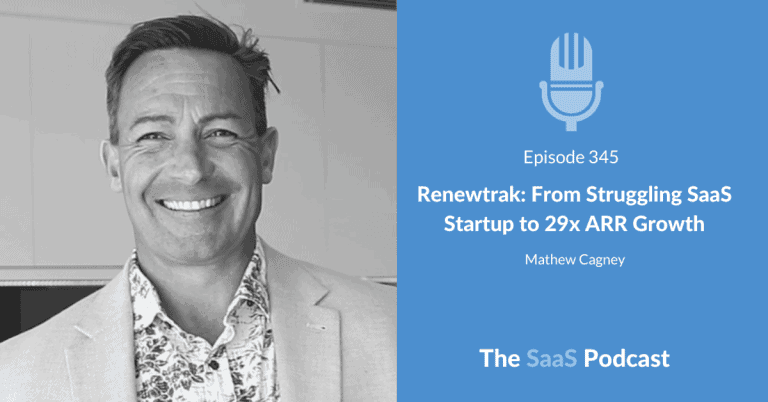
In this episode, I talked to Matthew Cagney, the CEO of RenewTrack, a platform that manages the renewal process for global tech companies like VMware and Lenovo.
Matthew became CEO of RenewTrack in 2020, taking over a startup that had been founded six years earlier in 2014, but had failed to get any real traction.
The original founders had built a beta solution, secured initial funding, and managed to get two small customers, but things had pretty much stalled there.
Although Matthew isn't technically one of the founders, he still had to think and act like one and figure out how to find product, market fit and do it fast.
When he joined, the company had a high churn rate, no new customers coming in, and was quickly burning through the money that it had raised.
So it was a tough situation.
In fact, Matthew told me that the first two years at RenewTrack were probably the most difficult and stressful years of his career.
But things eventually paid off and today RenewTrack is doing around $6 million in arrival.
In this episode you'll learn what Matthew did to revamp a product that had multiple code bases, scaling issues and a lot of complexity, and onboarding new customers.
How Matthew and his team over invested in customer service while the engineering team worked for a year to resolve the product issues, the pricing challenges the company faced which almost put it out of business, and what Matthew did to fix that situation.
And we talk about how Matthew decided that he couldn't ask his sales team to close more deals until he personally could go out and sell the product.
So I hope you enjoy it.
All right Matt, welcome to the show.
Mathew Cagney (01:53.060)
Great to be here.
Omer (01:54.020)
Do you have a favorite quote, something that inspires or motivates you that you can share with us?
Mathew Cagney (01:58.660)
I think my favorite quote is time kills all deals or the other one.
The other favorite quote in a similar vein is actually the selling only starts when the customer says no.
Omer (02:10.340)
Love it.
So tell us about Renew Track.
What does the product do, who's it for, and what's the main problem you're helping to solve?
Mathew Cagney (02:16.490)
Essentially the contract renewals process for tech vendors around software support and subscriptions is broken, completely broken between the tech companies, their customers and their sales channels.
Essentially what this means is it's fragmented, heavily dependent on humans, heavily dependent on spreadsheets, heavily dependent on email and what that means is it results in unnotified customers, unnotified channel partners, which essentially results in the end customer actually losing out on that product or service.
Or from a CFO's point of view, increased customer churn and very, very, very low net revenue retention or net dollar retention levels.
Omer (02:58.550)
Can you give us examples of some of your customers today?
Mathew Cagney (03:01.270)
Yeah, some of the better known ones are companies like VMware, the big virtual software provider.
Lenovo, the largest PC manufacturer in the world, HP, Cisco, down to some smaller data companies like Precisely.
Omer (03:19.140)
And can you give us a sense of the size of the business?
Where are you in terms of revenue, number of customers, size of team?
Mathew Cagney (03:25.380)
We are at 34 staff globally.
We're just about to hit 6 million ARR.
And our customer numbers would be about 16 to 18.
Omer (03:36.820)
That's a nice chunk of revenue from a fairly small set of customers.
Mathew Cagney (03:40.930)
Yeah, look, it is.
And if you're talking to the VC community around the world, they might say your customer concentration is too high.
RenewTrack, continue to build out your growth engine and your customer onboarding.
Reduce your CAC to and improve your CAC LTV ratio.
But we've got some really awesome long term customers that we're continuing to grow and expand rapidly with.
So one of the things I measure our success on is actually just customer growth and expansion.
Omer (04:08.660)
Let's talk about what you were doing before you joined Renew Track.
What's your background and what were you working on?
Mathew Cagney (04:16.580)
Yeah, look, I come from essentially a sales, marketing and product background, strong kind of entrepreneurial background.
I developed the first KYC AMLCTF compliant electronic identity verification platform in Australia.
Then I developed a number of mobile banking apps, personal financial management solutions.
Some of your listeners might recognize them as a competitor to Yodlee.
We managed to help keep Yodlee at bay here in the Australian market with our own developed personal financial management platform.
Prior to RenewTrack, I was at a buy now, pay later company called afterpay.
Actually in one of the things you pointed out when we were prepping for this podcast is they were founded the same year as RenewTrack.
Omer (05:00.160)
Yeah, and with very different trajectories and we'll kind of compare those as we go along.
But Afterpay founded 2014, I think the company raised just shy of $450 million and then was acquired by Square in the later half of I think 2021 for what, $29 billion?
Mathew Cagney (05:20.880)
Yes, absolute amazing story.
I was there from some of the early days.
Afterpay was founded by Nick and Anthony.
They had an Amazing idea.
But they weren't sure how to build the tech and product and they knocked on the door of a company called TouchCorp.
I essentially was within the TouchCorp team and what TouchCorp had developed was a product and software technology that actually allowed them to make a real time assessment of a customer and whether they were prepared to take the credit risk on that customer in an online environment without a credit check.
So really looking at digital fingerprints, the merging of those digital fingerprints and PCI compliant credit data and quite an interesting library of data in the background which enabled them to take on that risk on behalf of large telecommunication companies.
And that was really the foundation tech stack for afterpay and allowing them to take the risk of for new customers that they'd never seen before.
Omer (06:16.180)
So RenewTrack, you joined in 2020, I think as the CEO.
The company had actually been founded almost six years earlier in 2014, same time as Afterpay.
Tell us a little bit about what was going on with the business when you joined.
Because the majority of my conversations about founder stories and you know, you want a founder of Renew Track, but as we looked into this and we talked about your journey and your experience, it's very much like founding a business.
And so if you can help us sort of set the background on what happened in those first five or six years before you joined.
And you know, what was that, what was the situation like when you came on board as CEO?
Mathew Cagney (07:01.860)
One of the things during those first couple of years of the organization, the original founders developed an amazing concept, was brilliant and it addressed that fundamental renewals problem which was completely and utterly broken.
Amazing concept, amazing sales guys very, very early on and they managed to convince a number of angel investors to support their particular vision and pursuit to solving this problem.
And what they did is they actually repurposed an existing technology tech stack.
So you imagine collection software, which is a workflow and a series of routines that communicates with a customer who's not paying you.
They turn that software around to actually communicate proactively to the end customer about an upcoming contract expiry about, hey, let me remind you, let's make sure we give you plenty of advance notice and let's actually give you an E Commerce checkout so you can commit and pay to that renewal.
So they repurposed that amazing concept, got them to market very, very quickly and since they were such good salespeople, they managed to get two early customers on the hook and start proving that.
I think that's where it started to get really complex though.
A lot of technology vendors are constrained by their own data.
And the reason they're constrained by their own data is a lot of them, to scale, actually engage third party channels.
And when they do that, that third party channel starts to obfuscate.
Who is the end customer, how do we get them?
Product and pricing is slightly obfuscated.
And so we had to solve the data issues between the tech vendor, their sales channel, and the third party sales channel and the customer about how do we communicate with our customer on time, regularly and proactively.
Now that's easier said than done, especially when you consider just the general data hygiene practices and how old that data might be with that vendor.
I think that's probably where we started to come unstuck.
And what that meant is we had to create individual products for each one of these customers, which merely meant when I joined, we had six core individual products and individual lines of code.
So it was like managing six individual products.
It was just too hard.
And the team was spending a lot of money just supporting the BAU process.
But what I personally loved about the business is it was solving a problem that I'd experienced in afterpay when we hadn't been notified about a renewal.
And the vendor shuts off our platform.
And I get woken up at 3am on a Sunday morning and our customers are screaming at me saying, hey, we can't transact what's happening.
And we said about our dev team to investigate what happens.
Four hours later, we find that actually the vendors shut down this key piece of software to run our tool.
That frustrated me enough to actually invest my own money in the company behind the idea and concept.
And that's how I got involved.
Omer (09:45.880)
So you mentioned six variations of the product, but if there are only two customers at the time, why six?
Six flavors of the product?
Mathew Cagney (09:53.560)
Well, yeah, we had probably another four POVs going on in parallel.
If you break that down, maybe one of the customers had four different vendors under them.
So it was a separate product for each one of those to ingest their data.
So we had an early customer called Ingram Micro, and we had enabled four of their individual vendors on our platform.
But that data ingestion process was broken.
Just created too much overhead for us to manage as a company.
The way I look at it is how much of our development team capacity are we spending on BAU putting out FIs or developing new features that we can actually monetize.
When I got in, I did an assessment.
We were spending 95% of our time on purely putting out fires.
You can't run A high growth startup.
When you're spending 95% of my dev effort looking backwards, I want to dig
Omer (10:44.360)
into what you did to try and turn things around.
There were a number of issues here.
So obviously product, you've just described that and some of the challenges that you were facing there, what was going on in terms of customers and growth.
Mathew Cagney (11:03.450)
So I think if you look, if you look at it, a couple of areas, why was I brought into the business?
One is we had high customer churn.
We had, you know, so if we did secure a customer, they'd be gone in three months time.
We weren't securing any customer growth.
So those two customers we had were not growing any further and we were unable to really stick and land any new customers at all.
And what that really meant is we were burning capital as a company.
And so if we break those three areas down, new customers, we were unable to convert a new customer.
Our product and technology stack.
We were spending all of our time on putting out historical issues rather than helping to solve the real issues of our customers that we're identifying.
And the third area is we weren't proving customer value enough to get those existing customers to expand or a new customer to sign up with us.
Omer (11:59.370)
Okay, got it.
So it sounds like this is a business with some potential, which is probably why you agreed to take on this role.
But it feels like a messy situation.
It's like you're burning a lot of cash trying to keep this product development going.
It doesn't really sound like a product business.
It sounds more like a dev shop building different software for different customers.
And so you've got to come in and say, okay, well, we're spending all of this money, but at the same time, we need to invest more in the product and get this right and turn this into a product business.
But at the same time, you don't have that much, you don't have revenue coming in beyond what, what is already there.
And so it's like, well, we also need to go out and get new customers, but if we get those customers, are they just going to churn?
Because the product situation is, you know, it is what it is.
So it sounds like a pretty messy situation.
So, you know, as you sort of took the job on, you know, the first 30, 60, 90 days, how did you try to make sense of all of that and figure out how to prioritize what you were going to tackle?
Mathew Cagney (13:06.070)
Yeah, and probably on top of that, the angel investors had been very supportive in the initial days, were probably just getting a little bit frustrated they couldn't see any light at the end of the tunnel.
So that also made it a lot more complex.
And so when I came in, coming from a sales, marketing and product background, the first thing I want to do is talk to customers, understand where the pipeline is, what they value in the product and what they don't.
And really looking at why couldn't we sell?
When I dug into that a little bit more deeply, obviously because we'd hypothesized that we'd had really good true product market fit.
The team had actually scaled up our sales and marketing arm, which meant we were expending a lot of money on salespeople who weren't able to convert.
We'd also brought on third party sales channels and were hoping that they could also sell and convert.
And we were paying a third party sales organization to develop leads and prospects for us.
So all of those aspects, they created a lot of noise.
Right.
And a number of them created a significant level of cash burn as well.
So one of the things I quickly realized is that one, the third party channels that we'd engaged, they weren't being successful at selling.
So they were frustrated.
So what we had to do is terminate those relationships so we didn't burn them any further.
We had to look at.
Right, okay.
And my principle is if our own team can't sell, there's no point engaging a channel or a third party or setting up a channel sales team because you obviously haven't proved product market fit, what your value proposition is and how you can continue to scale therein.
And we also had to shut down a third party call center that we had overseas, that we're investing some significant money and we're also investing money in marketing and pr, but without demonstrating true product market fit and that we could continue to convert customers, we had to put that on hold.
So we stopped burning cash.
Then we started to have a look at, right, what was happening with our existing customers and the ones that were at pov.
If I break it down from a sales process, we probably had an inflated expectation is once you got a customer to proposal stage or statement of work, they were naturally going to sign.
That's not the case.
That's where a lot of deals fall over at proposals, statement of work and RFP stage.
So we had to go back to the drawing board and figure out, right, how are we proving value?
And the way I've always looked at it is do we compete on product price or service?
Now, price wasn't really the issue right then.
We obviously didn't have a product, so we had a couple of customers, so how could we wrap our arms around them with a service based organization, not selling professional services, but just better support them to get the most out of our platform and ecosystem and actually learn to bring that back into our product and product tech function to go.
These are the features that we need to develop.
So we went about that stream of work.
So wrapping our arms around our two customers and we were doing one and pov.
Now the issue with the one and POV stage, big global organization, but there was so many detractors in that organization that we were being set up to fail.
So we essentially had to go into Hypercare, wrap our arms around that when we'd meet that customer maybe twice, three times a week, to continue to make sure that we were better understanding the value our platform was providing to them.
How do we continue to articulate it back to them to create stakeholders that wanted to continue to invest with us and provide them with the tools and artifacts that they could start messaging more internally around that organization?
And in parallel, we had to look at where we're spending our time from a dev point of view.
As I mentioned, we're spending 95% of our time putting out fires.
And you can't just shut that tap off because if you shut that tap off, we're going to lose those, those two customers and the one in pov, right, because we're not servicing them.
So that's a really hard conundrum.
So the first thing I looked at was, right, I need to bring in a CTO who I'd worked with before, a technologist that I could trust because I could see that having 25,000 lines of code across one product and then another product and another product was just completely unmanageable.
So I brought in Andrew, a CTO I'd worked with at a company called Sandstone before, and he joined me.
And one of the first things we identified together is that actually we need to re engineer our entire data ingestion capability to free up our dev capacity to start looking forward.
That process probably took a little bit longer than I would have thought.
But at the end of that process, when you do invest in that, you do build from the, from the ground up and do it right.
We've got an amazing data ingestion engine now powered by AI and machine learning.
Probably didn't want to build it back then, but it's serving us really well now.
We've got the really good foundations to continue to scale and grow.
The other aspect I did Was because of from a product perspective.
I had to bring in someone I trusted, from a product perspective who could wrap their arms around what was our product doing back then versus where did it need to get to.
So I brought on a guy I worked with at afterpay, guy named Alex Wood, and we set about also re engineering how do we prioritize features from a product perspective and how do we rationalize down to that one single code base.
That took also a lot longer than I would have thought.
I would have thought we could do that in sort of three to six months.
To be all honesty, it probably took a year because at the same time we've got to fund the business and bring on new customers.
So it probably within those first six months we won Lenovo.
Now Lenovo is a very, very big customer.
They had massive amounts of data, you know, stuff that would break us immediately.
And in parallel we had to re engineer our whole tech stack to cater for their volume while bringing them on board.
So that also derailed some of our plans to merge down to that single code base.
But it's really just about going right.
I've got to continue to win customers, improve my product because we're on a limited funding regime.
How do you do that while onboarding customers and setting your product and proposition up for scale?
And a lot of that's about how do I manage cash flow, how do I get Rockstar talent on board?
Like I'm a big fan of, when you're hiring devs, hire one rock star because one Rockstar will equal four to six normal devs.
So if you get the right one, I call them a one man army.
And I'm sure there's a lot of other different terms that many, many SaaS founders call them, but if you spend the time recruiting them and it might take you three months to four months to five months to find them and you've got to sift through 400 different applicants.
It's worth it in the end.
It is really worth it in the end.
And they pay dividends later on.
Like I remember looking at how many story points we used to do a sprint might have been, you know, 6 to 8 back then that was including bugs, which is really low.
Right.
And now we're up to well over 101 particular product area.
So I think keeping a real lens on where are you spending your time and effort from a dev perspective is really, really important.
Omer (20:19.010)
Okay, so I had three issues there.
One was around the data ingestion and having a better capability there to onboard and Manage this data from all your customers.
Number two was trying to get to a single code base as quickly as possible.
And the third one was having a scalable product that could handle some of these big customers.
You know, like signing up a Lenovo is great, but if we can't scale and actually deliver on that, then, you know, we're still kind of a little screwed.
So all three are like significant pieces of work and as you said, they, they take time to, to get done.
How are you funding all of this investment in, in the product engineering?
I mean at 6 million ARR and you know, 16, 18 customers, I'm, you know, I'm guessing the average contract value annually is probably, you know, multiple six figures per customer.
Were you using the revenue from existing customers to fund all of this?
How much money had been raised prior to you joining and then also did you go out and start to raise more money at that time?
Mathew Cagney (21:28.810)
Yeah, really good question.
So pretty much within the first, first three months of the role, we realized that we had to go out and raise money very, very quickly.
And so that was about, there's obviously that's quite a time consuming process whereby you're getting to understand the business, you're trying to recruit the right people, reduce costs and then telling the right story to investors to make them feel confident.
Confident, especially the ones that already been on the journey.
It's important not to.
You don't want to burn them.
They've, they were the early guys who saw the vision.
So that was, that was a really hard time for us.
A lot of sleepless nights.
Probably, probably the hardest time of my whole career actually was in that first year going what have I done?
What am I doing?
Are we doing the right thing?
And I think, you know, I'm not technically the entrepreneur of this company, but I feel like I've got that entrepreneurial spirit.
And deep down I knew that I could turn this around given enough time.
Not only bucket loads of money, just give me the time and I can prove I can make this work because I'm really good at hunting down to find out where the value is and actually starting to extract value both for the customer and us financially.
So we managed to do a raise which got us another year's Runway in parallel.
Remember, during this whole time, our product wasn't up to scratch.
Right.
There's no way that you can rebuild your product, merge all the code bases and support the growth of bringing on a Lenovo and scaling with other customers.
So what we did there is we're not competing on product or price.
At that stage, we wrapped our arm around service and so we were fortunate to have a really amazing customer success team with a really deep pedigree at quite a senior level.
To be honest, we over invested in servicing our customers and probably even still do today.
And one is that's kept us alive and that's kept our customers very, very close where we've just got that really intimate dialogue and we're starting to architect their own technology roadmaps and strategies moving forward because we've just got such an intimate understanding of their business.
Omer (23:37.189)
Tell me a little bit more about what you mean by service because I think the situation is still, you know, you're trying to fix this product, you got the, the plane in the air and you're trying to basically build a new plane while it's still going with customers in it.
And at the same time, I guess in an ideal world you'd want to not bring on new customers until you'd resolved all those situations because you know that bringing on customers and you already have a churn problem.
And so was the churn mainly driven by the product issues that you described?
Is that the main reason you saw customers churning?
Mathew Cagney (24:15.580)
Yeah, look, the main, main problem was product issues and we weren't proving value because the product was unable to prove the value.
So, and you're right, it was, it was insanely hard for that first year.
And you're right, we would have loved to go and write, okay, let's, let's get a 10, $20 million raise away and let's just go to ground and build our platform and product.
Right, and the interesting part about that is you still don't understand the market as well.
So building the plane while we're flying it, while we're selling it was actually quite probably quite beneficial.
And I should talk you through some of the pricing problems I had during that journey because coming from afterpay, we had such an amazing growth very rapidly where we priced on the successful outcome of a transaction for our merchant.
I thought, right, let's just price solely on the successful outcome of a renewal.
What I learned very quickly is some of the projects might take three to six months to get off the ground, where we're getting really good data from our vendors and we're issuing a renewal 90, 120 days out from expiry.
So the transactions 90, 120 days out anyway, once you're live, the time to cash was too far away.
And you know, I sort of said, right, let's live and die by the value Our product provides, we'll charge between 1 to 3% per converted renewal.
Sounds great.
And what I realized really quickly is that this wasn't bringing cash in the door.
And luckily we brought on a really cool investor called Title Ventures and they said look, you just need to move to a subscription element of the business.
And so pivoted very, very quickly to using the same rationale, 1 to 3% per converted renewal.
But we just happened to split that between a subscription fee and the success component.
So actually early on when the customers resigned, most of that just happens to be a subscription fee until we get a really good understanding of their data quality, their renewals book and how they're embracing it.
But really that was a bit of a, bit of a learning for me actually.
It's just how critical cash flow is.
And notice noting that was billed and arrears.
Now we're billing quarterly in advance our subscription fees which just so helps with cash flow.
Right.
And manageability.
Omer (26:28.130)
Let me show I got this right.
So with the initial customers, the revenue you were generating from them was all based on transactions.
There was no subscription.
Mathew Cagney (26:39.680)
There was a couple were subscription when I joined, but very, very small.
We're talking, you know, five grand a month or even less, actually maybe three and a half grand US a month.
And there were some overs if they went over that, you know, and we'd hope to get the upside when they bring on additional geographies and additional products.
But our product and value proposition wasn't up to scratch, so that wasn't happening.
So I thought let's go back to the drawing board.
Let's just charge purely on success.
And that's what I did for a couple of the new customers.
But I learned very quickly you can't sustain a business like that until you've got real proof or unless you have a big funding book like afterpay did.
Omer (27:14.130)
Let's go back to the service piece.
So you mentioned that while you were trying to fix the product, you over invested in service to make sure that the customers you were bringing on were happy.
Can you give us some examples of what that looked like for a customer?
You know, was this about, you know, high touch onboarding?
Was this more about, you know, once, once they're up and running, what are you doing service wise to, to drive that, you know, the value up?
Mathew Cagney (27:44.990)
A lot of our initial success was with companies that sell through a channel, you know, like companies like VMware.
So we, we spent an inordinate amount of time enabling their channel partners, getting them to use our Platform taking feedback from them.
We realized very quickly actually, you know what, we don't want another platform.
We don't want to use your platform.
So we had to bring in what I call zero touch workflow, which is essentially set and forget automation.
You know, add your margin, add your branding, add your bank account details, add those or your discount, set it once and forget it.
And we have to do a lot of onboarding and selling for our own vendors to help their channel embrace the tool.
So that was one area.
So nothing specifically in our own application, but driving adoption from within our own application.
Another one was our platform does an amazing job.
But how do we take the insights out of that?
And it's great to have all these reports produced in Microsoft BI or whatever sort of technology you're using, but unless they're actual actionable and you review how am I going to change my behavior next quarter or the following quarter?
Nothing matters, right?
So our team spent a lot of time developing pine or piloting unique actionable intelligence report that goes to the vendor that says hey, in order to reduce customer churn this quarter and grow your renewal rate, which grows ARR and grows your ndr, we are going to run your renewals campaign like this.
And the renewals campaign changes depending on what country you're operating in.
Like the Netherlands shuts down in July.
Spain and Italy shut down in July, August.
And how do you manage that?
Especially when you've got a vendor's quarter to hit.
And so what we would, we would provide them with one actionable insights, how to get the most out of that.
And actually instead of saying here's a list of all your renewals, we just, we'd send their channel, these are the ones you need to action now to exceed your quarterly renewal rate.
And so we doubled down on that area and making I guess creating more visibility around what our platform was doing but dumbing it, dumbing some of the insights down.
So it was, was action orientated.
Omer (29:54.630)
Okay.
One component of service was we're going to provide high touch.
We're going to make these people, these customers feel special.
And then the second part of this was we're going to basically supplement the lackings in our products in our product as it is today, or is a product that is becoming one product by getting people to work with customers and help them better understand insights and opportunities and how to derive value while the product was kind of evolving and getting better.
Is that a good way to summarize what you just said?
Mathew Cagney (30:35.100)
Yeah, absolutely.
Essentially we just had to over invest in helping the customer get the most of our product.
And we were using humans to do that and over investing in customer success until our product caught up.
And I must admit we're still doing that today.
But what that allows us to do is test and pilot certain innovations before we actually invest in product to see if they're going to work.
Omer (30:58.530)
Yeah, that's a really smart way to do that.
Yeah.
I want to talk about growth and how you've been able to, you know, bring on more customers, grow closing in what, 6 million ARR.
The first six years that this business was around before you joined, as you said, they only had two customers signed up, maybe a few in the pipeline.
What was the problem?
Mathew Cagney (31:22.130)
Why?
Omer (31:22.930)
You know, you also said that the business had overinvested in sales and yet they weren't able to close these deals.
What did you do to diagnose that situation?
What conclusions did you reach about the sales problem?
And then how did you go about figuring out how to solve it?
Mathew Cagney (31:42.580)
Essentially it was, you know, if I dumb it down and said if I couldn't sell the product myself, nobody else should be able to.
And so until I could sell a deal, we weren't going to hire any more salespeople, we weren't going to do too much more investing, et cetera, et cetera.
So doubled down in that area there about doing a lot of the cold calling the outbound myself and starting to uncover the market pain and creating those opportunities both with our customer success team and myself.
And we had one salesperson at the time just spending an inordinate amount, inordinate amount of time in that area.
Probably 60% of.
Of my time outside capital raising was probably spent in that area there.
Right.
And I think there's a lot of aspect around timing as well.
I think the early founders probably just maybe just missed out on timing slightly ramped up slightly too quickly, and it all compounded.
So the other part we were really fortunate is when I came on board is to, you know, one of our.
Maybe the second customer I won, we won together was Lenovo.
It's like, holy heck.
You know, you sit here in your wildest dreams and go, how do I win a Lenovo?
We never would have thought I'd win them in the first two or three years.
So there's definitely a market problem and a need out there.
We just have to step up to a different level to close those type of opportunities.
And I do come from an enterprise sales background and I understand that discipline.
I think it was timing, luck, and just perseverance and you know when I, when I mentioned what motivates me, it's the selling only stops when the customer says no.
Right?
That's when you double down.
Omer (33:21.970)
Tell us what you mean by that.
Because most people will be like, no customer says no, I'm done.
Mathew Cagney (33:26.690)
Yeah, look, I think it means that you don't really understand what their problem is.
You need a specific reason is why am I done?
Why not now?
Have I uncovered the pain?
What's the real pain?
And how do I create a compelling event around that?
And I guess probably early on, even myself was probably guilty about trying to sell a big global deal originally.
And what that means is you're trying to embrace a big global program at the same time and you're setting yourself up to fail.
I think some of the other coaching we got from title and early investor was just narrow the guide rails, keep the scopes, narrow the scope, try and prove value quickly.
So instead of doing global deals, we looked at.
Right, okay, let's pick a geography, let's pick a product, let's prove it.
Once we've proven it, then we'll expand geographies and product.
Omer (34:16.890)
Yeah, that's, that's a really good point.
You know, the thing about you going and closing the Lenovo deal, you know, I kind of like picture, you know, your dev team going, you know, great job, Matt, but did you have to get such a big customer that's really going to push this thing to the limits?
Like, couldn't you have gone for like a slightly smaller deal or something like that?
Mathew Cagney (34:38.460)
One of my colleagues, Randy, you know, our sales guy, you know, he had a relationship with, with the Lenovo team which really, which really helped.
So it was, it was co created by, you know, Randy and myself, but also going into a deal like that, there's a whole lot of unknowns in that and they create a lot of complexities around scale and you know, different countries, different jurisdictions, which brought a whole lot more complexities to the table.
Omer (34:59.900)
You focus purely on outbound cold outreach, Right.
That's been your primary main channel for acquiring customers, right?
Mathew Cagney (35:10.860)
Yeah.
So LinkedIn, emails, I guess we started to use referrals and found referrals were working quite well.
We did invest in one conference, which is the Technology Industry Services association conference.
But when I joined the company, the whole world had just shut down via Covid.
So everything was still done remotely.
So there was no face to face networking.
But yeah, just hard graft trying to figure out what's the message, what's the call to action to get one of these executives at one of these big tech companies or these tech companies to talk to us.
Omer (35:44.960)
You talked about kind of putting on the guardrails, narrowing your focus on the customers you were going to go out and try to win.
And I've seen this over and over again.
When somebody has a product that can potentially help all sizes of customers in numerous verticals across multiple geographies and they're trying to reach out and close deals across the board and the message just isn't resonating and there's no focus.
And you know, being able to limit the scope and get hyper focused on the type of customer you're going to go after obviously has its benefits, but it's really hard to figure out who to focus on, which vertical, which geography, which type of business.
Right.
So how did you figure that out?
And you know, hopefully there's going to be some nuggets in there that maybe somebody who's struggling with that similar type of issue today can think about, you know, how they can get a little bit more focused with their outreach.
Mathew Cagney (36:49.360)
It's really interesting.
Like if you look at the tech market, the one that we focus on, maybe 40 to 50% of their businesses a lot of the time based, you know, American based might be 40% is EMEA based in the other's APJ, what we'd found was actually there was a real problem in EMEA across, you know, we're talking 45, 50 countries.
But what that also brought was a certain level of complexity around those 40 odd different languages.
You've got to deal with the 40 odd different currencies and the 40 odd different tax jurisdictions and then the 40 odd different ways that they run their calendar year compared to, you know, North America and apj, which were kind of foreign to me and foreign to an Australian based company.
So we'd found a strong appetite for these tech companies, go, let's go and do EMEA first.
But that's also the complicated market and our preference to go, can we not just go for North America first?
It's English, English speaking US Dollars.
Okay, the tax is a little bit complex, but it's not too complicated.
So you actually got to quantify the problem.
So then we would get down to going, okay, let's go through each geography and see where your book is as a vendor, where your pain is and right.
How many renewals do you have across here?
What does your renewal rate look like?
Who are the best channel partners and where do we think we can add the best bang for our buck and so what we quickly looked at was, okay, maybe the areas where there was the worst renewal rate, we could actually affect that quite positively, quite quickly.
You know, if we've only got a 50% renewal rate, there's an hypothesis that we might be able to prove that 10 to 15%, rather than another country where the renewal rates already 85 or 90 over and above that there was.
We probably have only just really uncovered this complexity.
Is a lot of vendors only quote a like for like opportunity, but like for like is like for like.
It's like most salespeople don't get rewarded on keeping my hundred dollars I had last year.
This year they've got to make that 120.
So we want to quote every single variation to the customer digitally.
And that means every upsell cross sell different term, different support level, plus maybe a transition to SaaS.
And that gets really insanely complicated.
And a lot of the time the vendor doesn't have those product rules in a central location, they're in different silos.
So we even have to build that product and pricing engine in our own system.
So we could do that on behalf of the big guys at scale, because not even the CPQ systems do that.
And so taking that on board and we've had to sort of temper that enthusiasm sometimes because we have to, we suck up the creation of all of those rules and there's a lot of extraction and understanding how should we pitch this particular product or service Anyway, Cut a long story short, the answer is always in the data.
Go for the biggest market, the biggest opportunity, where you believe you can affect the biggest value quickly or you can prove value quickly and then maybe expand to another market.
With VMware, our first foray with them was into France and Turkey.
Now, we didn't know anything about France and Turkey, the way they spoke and their language or their currency.
And we went live with US dollars and English.
Right.
And that very quickly puts our, our French and Turkish friends off quite quickly.
Right.
So we, we learned very, very quickly have to take that feedback and iterate quickly to sort of turn that around.
And what we found is once we'd embraced that, we proved value quickly.
And then we expanded into the uk, Ireland and then to the Nordics, et cetera, et cetera.
Omer (40:20.240)
Good advice.
Yeah, It's a fascinating turnaround story with, with Renew Track.
And as we were talking earlier, you know, you were at afterpay, Renew Track founded both companies founded at the same time.
2014, you get to 2020, 2021, one is being sold for 29 billion.
And the second one is basically still at startup stage.
And you're coming in almost as a founder trying to get this business off the ground.
It just goes to show you, you never really know, right?
Like when, when, when you're looking at a business, when it's starting out, like where it, where it's going to be.
And I think most people would have probably looked at renew track and said, look, this thing hasn't been able to get off the ground for five, five, six years.
There's nothing here.
Mathew Cagney (41:04.730)
Right?
Omer (41:05.450)
But you still saw something.
You were willing to make a bet and come on board.
You had people on the team who were willing to stick around and continue.
You were able to recruit people who bought into the vision, and now the results of that are paying off.
So props to you for that and it'd be great to see what continues to happen over the next few years with this business.
We should wrap up, though.
Let's get onto the lightning round.
I've got seven quick fire questions for you, so just try and answer them as quickly as you can.
You ready?
Mathew Cagney (41:34.600)
Yes.
Go.
Omer (41:35.880)
What's one?
One of the best pieces of business advice you've ever received.
Mathew Cagney (41:39.640)
As I mentioned early on, the selling only really starts when the customer says no.
Omer (41:44.440)
What book would you recommend to our audience and why?
Mathew Cagney (41:47.400)
Look, to be honest, I don't read any books and I guess that's bad.
But unless I'm on holiday, I listen to a lot of podcasts.
Obviously yours, and my other favorite one is all in with Chamath, Jason Sachs and Freiberg.
I just, Yeah, I love listening to podcasts.
Love it.
Omer (42:03.960)
We will accept that as a, as an alternative to a book recommendation.
What's one attribute or characteristic in your mind of a successful founder?
Mathew Cagney (42:11.560)
It's look, it's hustle, hustle, hustle.
Get things done now, get it done today.
And my other favorite motto is time kills all deals.
Whether it's recruiting staff, whether it's winning a deal, whether it's launching a feature, whether it's.
Whether it's talking to an investor, it doesn't matter.
Time kills or deals.
Omer (42:28.520)
What's your favorite personal productivity tool or habit?
Mathew Cagney (42:32.520)
My Peloton bike.
I think I'm an absolute EDM junkie and I love the endorphin rush first thing in the morning.
I just love it, love it.
Omer (42:41.000)
What's in your crazy business idea you'd love to pursue if you had the extra time?
Mathew Cagney (42:44.440)
Look, it's interesting.
I really love building something and I think I'm a glutton for punishment.
Coming from afterpay to here.
I'm a glutton for building something from nearly scratch and being really proud of that.
And I'd honestly love to be a home builder because you get to interpret the architect's plans but build the couple's dream home.
And I would love to do that when I get time later on.
Omer (43:06.720)
You know, I would love to do something like that too.
There's just, it's something I think about a lot.
It's probably harder than building software, I think.
What's an interesting or fun fact about you that most people don't know?
Mathew Cagney (43:17.810)
I love volunteering at our local beach as a lifeguard and have saved a couple of people from rips in my time.
And I must admit I've also had to be saved myself a couple of times as well.
Omer (43:28.770)
And finally, what's one of your most important passions outside of your work?
Mathew Cagney (43:31.970)
Look, as I mentioned, I think it's in no particular order, so my wife and kids won't thrash me here, but exercise.
Love my exercise family.
And I'm also a self proclaimed MasterChef.
Omer (43:44.780)
Wow, you're a man of many talents.
Mathew Cagney (43:48.300)
Maybe.
Yeah, maybe.
Omer (43:50.940)
Awesome.
Well, thank you so much for joining me, Matt, and sharing your story.
I think it's really fascinating, as I said, for a business that really seemed to be going nowhere for five, six years and what you've been able to do to try and turn that business around.
And we're seeing the results of all that hard work.
Now if people want to check out Renew track for themselves, they can go to renewtrack.com that's track with a T, R a K, not CK.
And if folks want to get in touch with you, what's the best way for them to do that?
Mathew Cagney (44:23.890)
Probably just via LinkedIn.
Omar.
Just LinkedIn Matthew Cagney with 1T Matthew Cagney.
Omer (44:30.130)
We will include a link in the show notes for that.
So awesome, Matt, thank you so much.
It's been a pleasure and wish you and the team the best of success and would love to catch up and see what the business is doing in a couple of years time.
Mathew Cagney (44:44.350)
Likewise mate.
And love your podcast.
Thank you.
And as I was saying, I had to stop and call all my colleagues the other day when I was listening to your podcast and say we've got to get this done right now.
Omer (44:53.630)
Love it.
Thanks man.
I really appreciate that.
Cheers.
Mathew Cagney (44:56.270)
Thank you.