Omer (00:09.280)
Welcome to another episode of the SaaS Podcast.
I'm your host, Omer Khan and this is the show where I interview proven founders and industry experts who share their stories, strategies and insights to help you build, launch and grow your SaaS business.
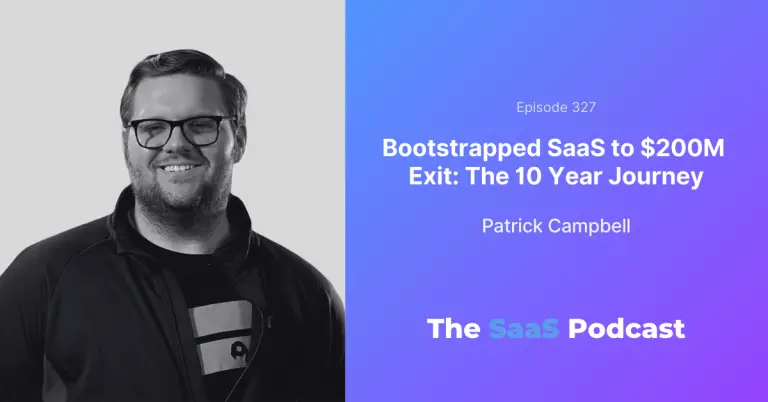
In this episode, I talk to Patrick Campbell, the founder and CEO of ProfitWell, a suite of subscription revenue products that help to reduce cancellations, optimize pricing and get accurate revenue reporting.
I originally interviewed Patrick in 2017 on episode 134, at which point he'd been bootstrapping ProfitWell for about five years and had grown it into a team of about 30 people.
Since then, Patrick and his team have grown ProfitWell to eight figures in Arrival and the company was recently acquired by Paddle in a deal worth $200 million.
In this episode we chat about how Patrick bootstrapped his business with a personal Runway of nine months and managed to get enough traction in that time to keep the business going.
How he figured out the right positioning for his product so he could effectively compete with well funded competitors that were building sexier looking products.
And why Patrick feels that bringing on part time co founders was one of the biggest mistakes he made and how that created an incredibly difficult situation for many years.
It's a great interview and Patrick talks openly about several mistakes and regrets that he hasn't talked about publicly before.
It'll give you great insights into the reality and challenges of what's often really going on behind the success story headlines that we often read about.
So I hope you enjoy it.
Patrick, welcome to the show.
Patrick Campbell (01:48.810)
What's up man?
It's been, you were telling me it's been five and a half years.
Omer (01:52.890)
Five and a half years.
Patrick Campbell (01:54.010)
Yeah.
And it's funny because we haven't really talked since then, but I've listened to the podcast since then and so it's like five years of me learning more about you and me not really talking to you.
So that's an interesting world to live in.
Omer (02:06.570)
Well, it's my turn to catch up now, so it's great to have you back, so thanks.
Why don't we start by just.
I mean, I think most people who listen to this show are familiar with Profitwell, but why don't you just start by telling us what does the product do, who's it for, and what's the main problem that you're helping to solve?
Patrick Campbell (02:23.830)
Yeah, 100%.
So ProfitWell is.
It's kind of funny because of the acquisition, this is all changing a little bit, but we exist basically grow subscription businesses automatically at ProfitWell and so essentially we plug into your billing system, Zora, Stripe, Braintree, Recurley, chargebee, Chargify whatever you're using and basically give you access to all of your financial reporting for free.
We have about 30,000 companies using that subscription metrics product and then we make money by putting all that data through our algorithms and then give you tools that automatically lower your Churn or optimize your pricing.
And we have since sold the Paddle and Paddle does basically everything to run a subscription company automatically.
So this whole run and grow automatically and the automatically is the operative word there has been kind of interesting of why we came together because what we do for Churn, they do for taxes and chargebacks and all this other stuff.
So you don't have to deal with any of that stuff.
So yeah, that's kind of the little bit of background and I'm sure we're going to go deeper on a couple of those things.
Omer (03:33.550)
Awesome.
So we'll talk a little bit about the acquisition, but give listeners a sense of size of the business today.
So where are you in terms of revenue, customers, size of team?
Patrick Campbell (03:42.590)
Yeah, so it's a little different now because I'm no longer just a bootstrapper.
I'm at a venture backed company with like a proper board and everything.
We were eight figures in revenue at ProfitWell.
That's something I could say.
I can't tell you what paddle's revenue is.
We're just not public about that.
But prior to acquisition we were about 85, 90 people.
Post acquisition we're about 350 people raised.
275 million at paddle total.
Didn't raise anything at ProfitWell, but now we're all one big happy family.
So that's kind of the structure of things.
Omer (04:16.250)
First of all, congratulations on the acquisition.
Patrick Campbell (04:18.250)
Thanks, man.
Omer (04:19.050)
So this was a deal worth I think like 200 million in, in a mixture of cash and equity.
So.
And you've now joined PADDLE as its Chief Strategy Officer?
Patrick Campbell (04:30.890)
Yep.
Omer (04:32.010)
Tell us a little bit about like, how did, how did the acquisition come about?
Were you looking to sell the company?
Was this like Christian or somebody just reaching out to you?
And how did it come about?
Patrick Campbell (04:42.760)
Yeah, so we were definitely not looking to sell.
We were heading into a stage of the business where we needed to raise, we knew we needed to raise money for the first time and we didn't really think about, oh, getting acquired is another way to get the resources that we want.
And so we were prepping for a raise and then Christian and I were chatting and Christian was like, well, what if we join forces and we bought you.
And we were like, no, you can't have our baby.
Blah, blah, blah, like the natural feeling.
But then it kind of became like, well, if all of these things are true, then, like, it was just ego lot selling.
And then we were like, yeah, but they're not going to fill all the checkboxes.
Right.
And then we went through, like, a whole process and ended up, you know, paddle was the beginning and the end of that process, which is kind of cool to think about, but, yeah.
And so we kind of came to terms with it really quickly, and then all of the checkboxes were fulfilled, and we actually did.
We did a documentary on it.
Wesigntomorrow.com, i don't know if you saw that, but it kind of goes through how it came to be and all that kind of stuff.
Obviously, it's from us, so it's not like a.
There's some interesting things, like my voice memos to him going through the numbers and stuff.
They're all real, they're all shared, which is kind of cool.
But, yeah, that's kind of the quick and dirty way that it kind of came to be.
Omer (06:02.250)
You have an interesting story, and there's so much to try and unpack, and we're not going to do it justice in the next 30 minutes or so.
But I want to try and at least get people to walk away, to want to understand, you know, just how you started this business and have basically took it from a bootstrapped idea, which you are building on your own, to this acquisition, and then also about some of the.
The mistakes you made along the way, some of the lessons you've learned, and then hopefully we can inspire people with this.
You know, there's.
There's lots of opportunities if.
If you kind of build the right type of product and company.
But, you know, even Patrick, you know, had that great outcome, but he's also made a lot of mistakes along the way, and there's a lot of stuff that people can learn from that.
Patrick Campbell (06:51.270)
I've made a lot of mistakes.
Yeah.
Yeah.
Omer (06:53.270)
Let's go back to, I guess, 2011, 2012.
Like, how did you come up with the idea for this.
This business?
Patrick Campbell (07:01.100)
It's funny how linear we explain things.
Like, it's funny how it's like, oh, it was just A plus B and that equals C, and we're a giant company.
You know what I mean?
And it's.
It's.
It's actually so.
It's more stutter steppy.
And I think that what I kind of found, which is very similar to a lot of people.
Like, you know, find is like, there wasn't like the stroke of genius, right?
Like in the back in.
In the back end, it looks like, you know.
Oh, like, of course this was the obvious thing, but I.
My personal background's in math and econ.
I started working in the government and then I went and worked at Google.
Two very large organizations, obviously.
And then I worked at a startup in Boston.
I started working on pricing for the first time.
They gave it to me just like this entry level plus kid.
We would see these big swings when we adjust pricing.
So I kind of started putting two and two together where it was like, oh, they don't take it seriously, but it has a huge impact and it's really necessary.
I don't love the culture here.
I'm young, I might as well try to do something.
So I cashed out my 401k and gave myself, I think it was nine months of Runway to try and figure it out.
And there's a lot of naivete.
And that's kind of what I fear a little bit about starting something new or eventually starting something new is I appreciate so much in hindsight how dumb I was.
And I'm not complete idiot, but I was so dumb in the sense of I didn't waste time trying to go raise money on something that was like just a hollow part of an idea, right?
I like, went after the idea.
I started like, doing content because we had a free HubSpot account, right?
Like, there was all these things that I was doing that paid off in the end that I just thought, I guess instinctually, but maybe there was some, like, intelligence going after it of like, why this market?
And it's just a really interesting thing to think about.
Depending on where your journey is, it's not going to be linear.
It's always going to be start and stop.
And when we talk about it, we paint a thread amongst all the things to make it seem like it was linear and very intentional.
Omer (09:10.450)
I think we should probably explain to people the difference between price intelligently and profit.
Well, because there was a bit of a naming thing, but there was also.
There's a product component.
There was also a services component.
Can you kind of just help explain that?
Just so people understand how they fit together.
Patrick Campbell (09:26.620)
We used to be price intelligently the name of the company and the product.
It was a pure software product.
Then we found that everything was better if we put service on top of it.
Like the customer experience, our amount we could charge all these other things.
And then we knew we wanted to get to a pure software product, so we started, like, learning about, you know, where we could go.
We were helping a company that was about IPO with their pricing.
We figured out they were calculating MRR and Churn incorrectly, which was kind of like, holy cow, like a CFO taking a couple other companies public.
And all of a sudden he's like calculating these numbers wrong still.
And so that plus wanting to get to this better data product started us building the metrics.
And then as a bootstrap company, you have all this fear of over, you know, like, well, it's already hard enough to build this first thing.
Now we're going to start to try to build the second thing.
What if it doesn't work and it, like, takes away from the brand and everything that we're doing?
Well, let's start a separate site.
And then all of a sudden this two sites started getting better and better, one at different speeds.
And we were like, okay, like, what are we going to do?
Like, are we going to combine these things?
Is it going to be separate?
And it was.
It was never like, we did have some conversations about, like, spitting these out into two separate companies, but that never really made sense to us.
It was like, no, it's all part of this overall mission of revenue automation, automating your growth automatically that we talked about.
So it was just one of those things that we started kind of putting it together.
And then we were like, well, the name that grows is not price intelligently.
It's too long.
It's too pricing focused.
Our mission is starting to expand.
And we were like, all right, let's change the profitable.
Which changing your name is so hard because it's not.
You think it's, oh, we'll just change your name, send an email, do good branding.
It's like, no, it's two years of explaining everything.
And then you get this kind of fun kind of moment where there's some people who always will know us price intelligently and don't even know this profitable thing, even though the profitable thing gets bigger.
And then there's another group of people that they only know us profit well.
And they're like, what's this price intelligence thing?
And then there's people who are just kind of confused because they know both, right?
And now we're kind of going through it with Paddle, where we're maintaining the profitable brand for a while.
But I would say, like, next five years, the profitable brand probably goes away.
Right?
And so it's just an interesting phenomenon that is just funny to think about.
Yeah, I think I heard you say
Omer (11:49.880)
somewhere that, you know, don't do that and get it right the first time.
But even that's.
That's hard.
And I think a lot of times you have founders who kind of get kind of hung up there, right?
In terms of like, I can't build a product until I get the right name.
And so it's like, I don't know if there is a good answer on how to handle that.
Patrick Campbell (12:07.710)
Yeah, it is hard.
It's really interesting.
Omer (12:10.030)
What was the first version of the product?
Like, what did it do and how did you get it built?
Patrick Campbell (12:18.190)
Yeah.
So the first ever product was this.
Well, I think I'll talk about the metrics product because it's a little bit more interesting, the metrics product.
We were kind of going along.
I was just alone for the first nine months.
Then we hired Peter Zotto, who's still with the company, and he ended up kind of taking over sales in the revenue part of the business.
And then it was like, the original idea was, well, what if we hosted every pricing page on the Internet?
Interesting, right?
That gives us an in that allows us to do a bunch of stuff.
And it's an idea we might come back to, actually, because there's some really interesting implications given what we do now.
And then it kind of became like, okay, well, let's go for this metrics data.
Well, either way, we're going to need development.
And I'm.
I can poke around code, but I'm not an engineer by any means.
And so got introduced by a guy named Chris Bolger.
I like to shout him out because he introduced us to Facundo, who's still with us.
And he started off as a contractor and the idea was like, let's just build this metrics product and figure out how that could look, build that out.
And then slowly, over time, as we started getting traction, he was like, oh, I want to come on full time.
So got him on full time, all these other things.
And then what was really difficult being a bootstrap company is like, we're kind of building two product lines, two companies, as I was kind of explaining, right?
So it becomes this weird trade off, weird prioritization exercise, right?
Because all of a sudden, like, Facundo is kind of building this metrics thing.
We're not giving it enough, like distribution and growth love, because we're worried about, like, cash flow over here by, like making sure we hit our quarter and do all these other things, right?
And so we kind of like built these in parallel and then products got really far ahead because all we were doing is we were reacting to make sure the business KE kept afloat.
And he was kind of building on his own island, right.
And so he could like develop everything, develop the planning cycles, do all that stuff.
And so he got so far ahead.
And this was another mistake where it worked out, but it was like it got so far ahead that we had to make sure that we caught this up, which is not the easiest thing to do while you're trying to obviously make sure you hit the quarter as well.
So you kind of like two steps forward, one step back, which, you know, you're still making progress, but it doesn't make it easier, if that makes sense.
Omer (14:31.130)
You said you had a Runway of about nine months, personal Runway.
And so you hadn't raised any, any money.
How long did it take to get the product built?
And then how long did it take to start selling it and getting customers?
Patrick Campbell (14:44.890)
Actually a lot longer than you think because the MVP was terrible.
And it wasn't terrible because like, if, if, if it had been like a basic space that didn't have any competitors, it would have been fine.
The problem was is we were literally about to.
We started actually sending.
We weren't going to just launch and be flashy and send it to a bunch of people.
We were going to try to get 10 people on, learn from them, be happy, then go to the next hundred.
So we had gotten the ten, made them happy, figured out a bunch of stuff.
We were about to go to the next 50.
As soon as we started sending emails, Barometrics launched like bare metrics and they had all these graphs and everything was pretty and the website was pretty and all this other stuff.
And so the hacker news and the indie news crowd, like loved them.
And then like shortly thereafter, chart mogul and first officer and like, and barometrics raises from stripe.
Chart mogul raises like a bunch of money for the time.
And so all of a sudden we're sitting there and we're like, okay, we thought we were billionaire idea.
We were like, oh, analytics, like that'll be a billion dollar company, right?
Well, no, but also we were sitting there and we went, okay, okay, what do we do?
And so we went and started kind of thinking about the product and what we came up with based on some data and we collected a bunch of research on pricing and stuff because that's what we did for a living at the time was we started realizing like, oh, this is a terrible business minus the competition people aren't willing to pay that much for analytics.
Even the larger companies like normally you want to see like a 20x difference or more between like your largest customer, your smallest.
At most we were getting 5x.
And so it was one of those things where it just didn't make sense.
And the result of that was like, oh well if we're going to build this, it should be free, right?
And that was like the kernel of making this free.
Well, you're a bootstrap company now has venture backed competition, you have this other product that's funding the business and you're going to do a free product that needs to be 100% accurate.
Way too many like, like areas there to like focus on and that, and that's probably like in hindsight and you know, it all works out and maybe weren't mature enough at the time to like take advantage of this, but we probably should have raised money at that point because that's when like it would have been useful.
It would have like helped us a bit.
But like obviously it worked out and so there's probably like it's gotta be two years before we had a monetizable product on that free product.
We basically went after keeping the price intelligently, product moving and growing thankfully and then expanding the team slowly but surely to like build out this, this free product.
And then you know, we woke up and we're like cool, now we can monetize.
And then those first dollars, like you know, we, we had one sales guy doing everything right on that product and then it was like, oh, we gotta fix it, do this.
And then we were building out marketing which we didn't really have.
And so there was just a lot of stuff that came from that.
Omer (17:46.040)
How did you figure out how to deal with the competition and how to position profit?
Well, because you're right, it's a tough place to be, especially when you've got competition is venture backed, they're investing in it, they've got money, the product looks, you know, sexy and you're kind of having to say, well you know, we believe we have a better product but you've got to kind of convince the market about it as well.
And making it free is I guess is one way of doing it.
But that can also work against you.
You know, you may not attract the highest quality, you know, types of customers and people may not value it as much.
So how did you think about that and how did you figure out the best way to position profit?
Well, in what was happening in that competitive Landscape.
Patrick Campbell (18:37.450)
So there were a couple of bets that we made, and these were kind of bets on the market.
So for one, accuracy.
We would have these conversations with folks and we'd be like, yeah, but their numbers are inaccurate.
It's wrong.
We know it's wrong.
Yeah, but they have this graph, like, additional graph, right?
Because they were expanding their product.
We were deepening our product, right?
We'd be like, yeah, but it's wrong.
And they're like, yeah, but they have the graph.
Right?
And so that was hard because we were like, do people just not care about this?
But what we noticed is, like, as the company got bigger, they really cared about it, right?
Like, they cared about it more and more.
So we were sitting there and we were like, interesting.
Okay, so we're making a bet that accuracy is important.
Second bet.
If there can't be a 10x product in a space, like, if there only can be, like a 3X or a 4X product, or like, if that, like, free is a really good way to undercut the market.
As long as you have a philosophy of free, that it should be better than the paid competition, or at the very least, on par with the paid competition.
I think freemium, that's worse than the competition is like, just, you can't really do that anymore unless it's in a really commoditized space.
But, like, for us, it was very much like, all right, well, if we're gonna make it better, then all of a sudden you confound those expectations of like, wait a minute, this is free.
And that was our favorite thing is like, I feel bad for not paying you.
I feel bad for not paying.
That's like the trigger.
We get that all the time, where you're like, oh, don't worry about it.
Well, can I just, like, pay you for this?
No, don't worry about it.
Well, I can't use this thing because I can't use your paid product because of xyz.
That's fine.
Like, we'll build something eventually that you'll buy, right?
And I think that's.
That's the thing that it's.
It's a very long term bet that I think a lot of people don't appreciate that, like, freemium has to be a strategy.
It can't be a tactic.
And so I think those are the two things.
And I think what happened is our content marketing, which was really strong and a lot stronger than, I would argue, the other competitors we had, what we ended up doing is like, talking about these things in, in our ads.
Talking about these things, our content, like, yeah, like accuracy is super important.
You should make sure your metrics are accurate.
Like you don't want to like live in a world where it's 5% off and you didn't hire fast enough.
Right.
And all of a sudden you see the doubt.
And this is why all three of these, the, the big competitors and all the like other competitors basically talk about accuracy now.
It's because we just hammered them on it.
Right.
And I, and I think that's the answer is like being smart about, you know, what makes the most sense.
Omer (21:17.690)
So how were you generating revenue at the time?
If the product is free, where was revenue coming from?
Patrick Campbell (21:24.770)
So from price.
Intelligently.
Yeah.
So that product was still going and so that product was growing and the margin on that is thankfully really good.
And so that margin allowed us to pay for the free product or the development of the pre product, if that makes sense.
Omer (21:40.980)
Got it.
Let's talk about one thing that you have spoken about before.
One of the first mistakes that you say that you made when you started this business was bringing on part time co founders.
And this is something that initially when, when I heard about this, I was like, oh, that, that sounds a bit of a mess, but how bad could it have been?
And then once I kind of unpacked it and realized what you went through for about I think four years, I was like, wow, we have to talk about this.
Patrick Campbell (22:13.220)
It's interesting because everything's good now.
Like those guys made a good amount of money.
Everything's like good.
I think it was good before that too.
But like the first few years, what happened is I got introduced to a couple of local Boston tech guys and they're great, they're smart, all that kind of fun stuff.
But I didn't really know them and I just kind of trusted and not saying they like, like I have to assume no one knew anything and they were ignorant because if I don't assume that, I have to assume that they're like trying to screw me over and then like my decisions and how I act with them has to change.
Right.
And so I think what happened is like they, they were thinking, oh well, let's start something on the side of our jobs and if it takes off, we'll join that thing in the most negative way.
They were thinking, let's get this guy to like go run it and like we'll like give him a bunch of help and you know, go from there and we'll have sizable positions because like we'll give a bunch of Help, Right.
And I think the reality was, okay, like, I'm doing all this work.
They're not really helping that much.
They're helping a bit.
And they probably, like, they probably think they're helping more than they were.
I probably think they're helping less than they were, so on and so forth.
But there was no, like, proper vesting set up.
There was no, like, I was like, they theoretically could fire me.
Like, on paper, these two guys that aren't in the business at all.
And it was like, anything that affected them, it would.
That would be a drag on me.
What I mean, but, like, all our taxes weren't filed or, like, we're doing an extension.
Oh, I don't want to do that.
And it's like, oh, you should hire an OPS person.
It's like, well, we're not even there yet.
You know what I mean?
We're not even at a place where that even makes sense.
But because that's the squeaky wheel for them, that's the vice I'm getting.
Right?
So it's just one of these things where it was such a breeding ground for distrust and consternation and just emotional terribleness.
And the problem was there was no leverage I had besides saying I was going to tank the business.
And this put me in a really tough position where I'm like, well, I need to grow, because that's what you do.
We want to build something big.
But I also, every time we grow, I'm making it harder and harder to fix this wrong.
And I think what I should have done, and I didn't say this in the previous episode because I didn't know this.
I think what I should have done is I should have sat down with them, and I would do that.
Now it's just like, hey, guys, when we did this originally, this just didn't make sense.
Like, you guys thought you were going to do this.
Great good intentions.
This changed.
Here's where the new cap table should look like.
Here's what we should look like, all these other things, and this is what we need to do to move forward.
And instead, the approach that I had was incrementally diluting them over time in their, you know, with.
With their approval, obviously, by, like, hiring on Facundo, making sure Peter got more, every single revenue milestone, getting things.
Like, I did have to threaten to tank the company a few times, like, to get.
Because again, there's no incentive.
Like, once they have something and that thing is growing, it's basically a game of chicken of, like, if Patrick's really going to leave, like facundo.
We like for the longest time didn't sign his employment agreement because we were like, worst case scenario, like, or just going to copy and paste the code base and leave.
Right?
Like it got that bad, right?
And so it's just a really hard thing because again, like if I assume the worst in them, they were trying to screw me over and like they were trying to.
It was called a Dave Bolter deal in Boston.
Dave Bolter is this guy who like he'd start companies but he would, I think he like, he would end up like going in and taking over again, but he would like start it as a part time thing and then all of a sudden was like, you know, he's just got the itch because it always like makes sense to start part time and then you're like, no, you're in or you're out and if it's valuable you have to go in.
And you know, one of the guys, it was like, hey man, like you said you were going to come on board and it was like, well, I'd be crazy to leave my current job right now.
Like, yeah, but you're, you know, this is where you have ownership and all this other stuff, right?
And so I think at worst they were trying to screw me over.
But like, I don't know, I think we were just naive.
They had never founded companies before all that kind of stuff.
And so I think it was more of a like trying to work through that.
And I could have handled it a lot better in order to.
Probably wouldn't change the outcome much, but it would have changed a lot of those calories and a lot of that consternation over the past or the first four years basically.
But then the past like five years they've been super helpful.
They like, you know, like, not, not like, oh my God, they changed the direction of the company, but like advice and that type of thing and you know, everything's good and Gucci and made them rich and all that kind of stuff.
So it's good.
Omer (27:03.210)
Did they ever come on board full time or was this always a part time thing?
Patrick Campbell (27:07.130)
No.
Yeah, they did.
They never came on.
Omer (27:10.010)
I mean, I know you say everything's kind of all good, but is there any kind of resentment from that that, you know, you were the guy who is kind of having to basically do it all and drive and put this together and they still kind of got the benefits of the acquisition.
Patrick Campbell (27:27.730)
I will never fully trust those guys.
And I've never said this publicly.
I don't know if I've ever said this to them, so maybe I shouldn't say it publicly.
But like, I've never, I will never fully trust these guys ever again because it's.
And I don't know if it's fair to put that on them or maybe it's on me.
But the situ.
It's kind of like one of those situations where like, you know, I The only.
This is such a dramatic metaphor but like if a child dies, the spouses, even if neither spouse had any fault in it, like the relationships, a lot of times the relationships break up in the modern age because there's just so much pain around the thing.
And so for me it's like my life was hell for the first four years and a lot of that was on me.
But they didn't make it easier, right.
And they were also maturing as human beings.
And so like, I think that they might not remember like how they acted back then, but I also don't remember perfectly how I acted either.
And so the way I looked at it and going into the deal, like there were a couple things where I was just like, hey guys, like it, you know, if this doesn't happen, like, I don't want to deal, like I'm willing to like walk away.
And it's not that they weren't for that, it's just they don't think in that manner because again, there's like, no, like there's different information on how they look at the business and how I look at the business.
Like in terms of like, I think there's a world where they look at the business where like, we wouldn't be here without me.
Like that type of thing, which I don't know objectively is insane, but also, I don't know, maybe that's how they look at it.
Right?
And who am I to judge?
So I think I've matured a ton on this and I kind of look at it as like when I look at the final numbers, I'm like, could I have had more?
Should I have more?
Probably.
But like, it's my first time doing this.
I hit a home.
Like I don't know how you like a bootstrap home run.
A triple for a venture backed company or a double for a venture back company.
I don't know, like I'm not going to complain because I've learned so much that like I'm going to keep going.
And these guys have been helpful and I think they're going to continue to be helpful.
Like they're they're stakeholders in paddle now on some level as well.
And so, yeah, it's just a weird.
It's a weird feeling because it's almost like I have to give them what I like to call the most charitable interpretation, because if I don't, like, what am I going to do?
Like, curse them out?
That's only going to make me feel better.
It's not going to pragmatically do anything.
And it's all in the past.
So I don't know.
Like, it's.
It's interesting.
It's a really interesting thing.
And I did.
I did make sure the team got taken care of as well.
Like, that was one of the things.
Like, if I got it a lot and they got some money and the team got screwed, that would have weighed on me.
And a lot of things over the past, like, eight, nine years, it's been like, I have to choose myself or the team, like, in terms of comp and stuff like that, when it comes to, like, stock.
And it just.
At the end, I was like, I don't want to have to choose between the two.
I want both.
Right.
And so those were some of the, like, last conversations.
But, yeah, I mean, I love those guys.
They're like brothers, but they're like brothers that, like, you.
You've had, like, deep fights with, and so you're family, but, like, there's still something underlying there.
And, you know, we'll.
We'll always love each other, but it's.
There'll be like a.
Almost like a film of like.
Like something that.
That.
That was there.
Like, we'll never be truly over it.
We'll always remember it for better or worse and everything in between.
So, yeah, it's a good question.
I'm at peace with it.
I look at it as, like, that's my naivete tax and everything worked out and, like, let's go.
You know, that's kind of how I look at it in the end.
But, yeah, thanks for asking, because this is.
You could kind of hear me thinking through it, and I think that it's one of those things that, like, I am at peace with it.
And it's kind of cool to be at peace with it, because I think, like, six years ago, if this would have happened, like, I wouldn't be at peace with it.
I'd be like, fuck those guys, right?
Like, I would just be, like, very aggravated about it, but I feel good about it.
Omer (31:18.040)
I'm big into these days.
Like, the idea of just letting go, like, we hold onto so much stuff.
Emotionally and, and you're kind of like what good is it doing anybody?
Right.
And you know, I'm probably suffering more by just kind of holding onto some of these things.
Patrick Campbell (31:33.080)
And I think with those, with the situation it's like there's no right or wrong.
Right.
And like when I was saying like what I should have done is X, like that would I think would have solved a lot of things and then it would have been very obvious that they were like either being like assholes or like we would have thought we would have gotten to the same, same result without all the like pain.
And they, I think, I don't know if they realized the pain that they put us, put me through and put us through.
Right.
Because I wasn't having those conversations.
Right.
And so that's, that's what's really hard about it is like, I think it's really important when you have co founder disputes, team disputes, personal disputes, whatever it is, having this idea of your interpretation, your interpretation of the situation is very self centered and is definitely wrong, but theirs is also wrong.
And so it's trying to find where do you have that balance and where do you have that communication.
And yeah, it's just interesting, it's just interesting how you handle this type of stuff.
Omer (32:28.470)
So that was the first four years I think you said it took to
Patrick Campbell (32:31.750)
kind of, to get out from underneath.
Yeah.
And like worked through even up to the sale.
Like there was stuff being solved on that axis.
But yeah, it was definitely like, you know, it took, it took a long time to kind of get over the major hump and then to, to kind of keep going from there and then,
Omer (32:48.590)
you know, I don't want to kind of keep going down sort of a downer path.
Patrick Campbell (32:52.270)
That's fine man.
Omer (32:52.910)
I think this is important to talk about that you, you were at Google when you were diagnosed with cancer and then two years into launching this business when you don't have all the benefits of, you know, great health care and, and you've cleared out your 401k and you're trying to build this business.
You, you got diagnosed a second time,
Patrick Campbell (33:17.580)
the hard C came back while all
Omer (33:19.900)
the other stuff that we were talking about here.
Patrick Campbell (33:21.820)
Yeah.
Omer (33:22.810)
So I don't think anyone can even understand what it's like to go through something like that.
But in the middle of all of what you just talked about with the situation with these part time co founders trying to get this business off the ground, was there a time there that you just, you just thought about just kind of packing it in and doing something else.
Patrick Campbell (33:43.250)
Yeah, that's a good question.
Thankfully, depending how you look at it.
When I was at Google, like, that was the hard.
I had, like, stage one, which is not, you know, it's not something to be like, oh, it's nothing, right?
But I, like, I. I had a very treatable, like, you know, quote, unquote, relatively easy cancer, right?
I had chemo, I had surgery, some more chemo, and it was.
It was good, right?
And then I was about to be.
And the best place to get sick.
I think I said this in the first episode.
Google, best place to get sick.
I didn't even see a bill.
Not only, like, did I pay anything, I didn't see a bill, right.
Which is kind of cool.
So that's why, like, I wanted to make sure once we had health insurance that we always.
We had great health insurance.
And so what ended up happening at ProfitWell is, like, I had decent health insurance, as much as great as we could afford as a bootstrap company, which was not amazing, but, like, good.
I was just about to be out of remission or in remission, and then, like, it.
It popped back up, right?
And so thankfully, it was just radiation.
So it wasn't like, going back to full chemo and everything like that.
And it was very contained, but it was a mind screw, obviously.
I have a team of like, 15 people.
Those 15 people, like, you know, like, now there's like, obviously, like, are we going to survive?
And then there's like.
Even though Patrick says it's okay, like, is he okay?
You know, that type of a thing.
So there's all this, like, indecision and, you know, that kind of stuff that I was describing before with the team dynamics and then just trying to survive.
There's all these distractions, right?
So it sucks.
But it wasn't.
I never wanted to quit.
Not because I'm some.
I am very resilient.
I know that.
But it's kind of.
I've just learned.
It's not like the founder way, right?
Like, it's more.
There's a problem.
Like, it's really funny because other podcasts are like, what are the biggest mistakes?
Or what was like, the oh, crap moments, you know, in history?
And it's like, well, it couldn't have been that bad because we got through it, right?
And so it's really hard to think of those mistakes, not because there's plenty of them that happen.
And we talked about a couple of them right now, but it's like, okay, cool.
So I have to go to radiation this many times a week at this location.
That means I can't have meetings before then.
And then I have to do this.
And like, it's just like, it's just part of the calendar, which I don't know, in some ways is very healthy and in some ways is like not healthy at all.
So I think that's the thing to kind of think about is like people who just want to break through walls, or at least handle walls and get through them.
It's like a very foundry thing.
And that's where it wasn't like, oh my God.
And yeah, I don't know.
I've had five days in the history of the company where I haven't wanted to go to work.
And those were mostly major arguments with Facundo.
Facundo specifically Peter a little bit.
But those are the five days I haven't really wanted to come to work.
And it has nothing to do with the company or the business.
It was just loving business partners so much and dealing with stupid interpersonal bullshit with them.
Omer (36:51.230)
You talk about the founder's way, but you were a first time founder, right?
So you were just learning everything along the way.
Patrick Campbell (36:57.310)
And like that's the naivete, right?
Like I don't know that like, like I know getting cancer and like dealing with this stuff is not like normal, but I'm also like, okay, well there's plenty of people must have gone through this, right?
Like, okay, let's just keep going, right?
And you don't really know until hindsight where you're like, oh, like even, even just this conversation, I'm like, oh yeah, we could have, we could have like died then like, because there was, there was definitely like at least eight hours a week that I had to be, you know, I had to be in like a location plus an hour of travel time, all that kind of stuff.
And then, you know, doing with this.
And I was running this team at that point and that team was kind of screwed.
Like there's definitely that.
But like the founder way is like, all right, let me figure it out, let me figure it out, you know, and kind of go from there.
Omer (37:47.580)
When we, when we talked last time, he was around early 2017, I think the team was about 30 people at the time.
Do you remember like roughly where you were in terms of revenue?
Patrick Campbell (38:00.890)
I couldn't tell you.
I honestly couldn't tell you.
Yeah, it's a good question though.
I have an app that I could look it up in, but.
Omer (38:07.570)
Yeah, yeah, I'm sure you do.
What we just talked about was I guess the first five years.
And so then what's happened in the, in the next.
In the sort of the last five years of, of this business because you've gone from a team of about 30 people, I think you.
The, the.
The team's probably like triple that size now, right?
Just, I guess at least was before the, the acquisition, close to 100 people, eight figures.
ARR.
What were some of the, the biggest drivers of growth?
What happened that helped you to build some momentum and start to get more traction with this business?
Patrick Campbell (38:50.070)
So the last five years, probably three or four things.
One, we, we did.
We kind of were the.
I think we were the first B2B software brand to do media.
So inbound media, basically where we built our own network called Recurring.
And so we have eight podcast shows or video shows.
That was a really big thing.
And that came from studying the market and realizing inbound marketing is just becoming really good SEO.
Some people would quibble with that definition, but just for the sake of time.
And then inbound media was about building audience, doing.
It's been five and a half plus years you've been doing this, right?
And you built an audience and you build relationships.
And so that was something that worked out really, really well for us because as soon as we started putting a video on each blog post, if I went and talked to a room of people before we did that, and I said, hey, have you heard of profit well or price intelligently?
A couple people raise their hand and be like, yeah, you guys write a lot of good content.
As soon as I did that after we started publishing videos, it was like the whole room shut up.
Right?
Because it's just different type of content that people share.
So that helped a lot.
The free product got to parity plus with the market.
And so that helped a lot because all of a sudden, every time one of our competitors would raise their prices, we would get an influx of users because they would be like, well, there is this one feature they don't have, but they have all these other features that this other tool doesn't have.
And it's free, like, and I can pay for this other thing that's going to help me make money.
That's cool.
So the free product really started compounding.
Like our word of mouth we built Retain, which first solved payment failures automatically.
And I think this is the thing that's really interesting is when I say automatically, here's what I mean.
And this is some magic that I think is going to be really helpful over the next decade.
When I say automatically it's not inbound marketing, marketing automation HubSpot automatically where you log in and here's a WYSIWYG editor and let me connect that email to that email or that sort of stuff.
What I'm referring to, and I said this in the beginning of the episode, is you just plug it in and it does it for you.
All the decisions around copy, all the decision within a set of parameters, all the decisions about when to send, where to send, translating to stuff, what the offer is, all that stuff, all of that is taken off your plate.
And I think that this really helped us because not only was our pricing pay for performance on that product, but it was also like, and you don't have to become an expert in it and you don't have to do any work.
Right.
And this is that suite of products that's coming up right now, which is like, you know, why Paddle and profitable came together too.
Which is like we do that for not just payment failures, but also for active cancellations and other parts of retention.
But we also, you know, with paddle, do that for chargebacks and taxes and all those other things.
Right.
And so I think that was a really big thing that we probably don't appreciate yet because I think like we're still early in that part being in the market and then we started building out a proper sales org.
That was the other thing.
Past five years, it's just like getting, I think our brs.
Their yield right now for contacting accounts to calls is like 15 to 20%, which is insane.
But that was really growth mindset that we thought through those things.
Yeah, I think those are a couple things that pushed us.
I can get into the problems too, but those are the things that really pushed us forward.
Omer (42:18.780)
Talk about problems.
Because when we were talking earlier you said, you know, people warned you that people were going to be one of the biggest challenges in terms of the success of the company.
And you were, you kind of had different views.
You were kind of like thinking about now it's going to be the product, it's going to be the marketing, it's going to be whatever.
So tell me a little bit about that.
What was the problem?
Why were people the big issue for you?
Patrick Campbell (42:47.260)
The one problem of the past five years has been people.
And that problem breaks down in a couple of ways.
And it's really funny.
Kind of like the part time co founder thing.
It's funny reflecting on this now.
I think people tell you in the beginning culture is everything that matters.
Your people are everything that matters.
And you Kind of hear that and you go, yeah, okay, right.
And you're like, yeah, it's really the product, it's really the marketing.
Those are the things that are going to make or break us, right?
But then it's just a logic problem where all of a sudden you grow to a certain size and it's like the organization, the very nature of the people, that is the product.
That's the thing.
I think that the way we started Profitwell because we couldn't afford really expensive people who could go somewhere is kind of selling the mission, right?
Like, here's this mission, you get equity, the equity is worth a lot more because we're bootstrapped, blah blah, blah, blah, blah.
And that's how we attract a good number of people.
And what it really helped with was attracting really young talent.
And what was a beautiful thing, but also a really painful thing is we got a false sense of accomplishment by taking a lot of young talent who was really hungry, wanted to work their butts off, get feedback like a fire hose and developing them.
Like this guy Eric, who's still with the company he's been with, he was technically the like third employee.
He was a marketing intern, he's now like a director of engineering.
And he's done that in 10 years, which is unheard of, right?
And so it's one of those things where we got really good at that.
So we just kind of assumed, very well intentioned, oh, we can help anybody, we can develop people, right?
And what's different between like a young kid who is a blank slate and like someone who's seven to 10 years into their career is that person who is seven to 10 years in the career.
They either assume they're good at everything, which, you know, maybe they're, they're good, but like, or like baked emotionally.
And so the problem is, is that the way they handle conflicts and feedback is like so baked into them that we would be like, you know, or let's just say objectively they're at a 10 out of 100 on critical thinking.
And we're like, okay, let's get them, they need to be at a 50 out of a hundred.
We're gonna, we're gonna get them there in six months.
And it's like, that's so hard, like it's so hard to get someone there in six months in general.
But like that means constant feedback and that means them rolling with the feedback and us helping them and then refining some six or seven times that they only want to refine three times.
And that would just cause a lot of resentment.
And so one of the first things we came to terms with, which I think something that everyone comes to terms with is you, you.
If someone doesn't have the skill set and there isn't a path, like it's not a form thing or a style thing, it's truly they don't have that skill set for that role.
They got to go, right?
And there's a number of people that we would move them into roles because we had such success with that where they were a really high performer in one role and they'd go to another role and they would be a really low performer.
And then it ruined the relationship because we were like, well they were good over here, let's make them good over here.
But they didn't want to go through those feedback cycles.
And so we got really quick at firing really quick BDRs if they're not working out, gone within six to eight weeks, probably six weeks.
We made so many poor decisions with director on UP levels because again we thought we can develop them.
But as a bootstrap company, you think, oh, I'm going to get this director for 150.
Well the venture backed company down the road is giving them 300.
So do you really want the person who's okay with 150 unless they're a missionary?
Probably not.
And so that was a big thing.
And then I would say the third thing that was really kind of tough was kind of similar to the first piece which was I think we learned to be just unapologetic about our culture which took six, seven years.
And what I mean by that is we would talk about things like feedback is non negotiable or transparency or the most charitable interpretation principle that I was talking about before.
And we would talk about those things but we wouldn't necessarily fire on those things.
We would have someone who would struggle with it and instead of going hey, it seems as if you struggle with this, that's totally fine.
It doesn't mean we're better, you're better, anything like that.
But this prob, like we're not going to change this and this is how we're going to make decisions.
Let's find you another job, right?
We'll give you plenty of time to find another job, we can part as friends, all that kind of stuff.
We didn't get to that maturity until a couple of years ago and it cost us in a lot of ways because plenty of terrible glass door reviews of people who just don't think the way we do.
And that's fine.
Plenty of terrible experiences of people that were brilliant for the business, but moved into another role, and the relationship just got frayed because we were trying to help them, and they just didn't see the way the world that we saw.
And I think as soon as we started doing that, not only emotionally did it feel good, because all of a sudden we had alignment, but we started to get confident that, oh, no, it's okay to believe these things.
And we're not talking about anything dramatically.
We're just talking about.
Feedback's really important.
It's important to share it.
We're talking about this most charitable interpretation thing.
We're talking about.
HR is the last place you go unless it's a dramatic thing, not the first place you go, those types of things.
And it's not that we're better than another company that believes the opposite of that, but we got comfortable being.
Being in our own skin with this is how we think.
It's not better or worse, it's just how we are.
And we want to hire people who align with that, if that makes sense.
Omer (48:28.190)
Yeah.
Yeah, totally.
What's next for you?
You've joined paddle.
Are you still focused on profit?
Patrick Campbell (48:35.710)
Well.
Omer (48:36.030)
And kind of.
Is it just more about thinking about integration and what the future looks like, bringing the two together?
Patrick Campbell (48:42.030)
Yeah.
What's kind of funny is I don't have an earnout, but I intend on being here through the ipo.
That's kind of how I think about it, because I think there's an enormous amount of leverage that I have as a leader and an enormous amount of leverage just this company has in order to succeed.
And I think what's interesting is the way that PADDLE thinks about the world, and this is what made the acquisition so easy from a decision standpoint, which is obviously incredibly hard, but relatively easy.
Easy was PADDLE sees the world very similarly to what we do.
And I remember I actually interviewed Christian for a podcast six years ago, and that was the first time we met.
And the minute got off the phone, I called Facundo and I said, this is the only person in billing who thinks the way we do.
And the way that we think is very do it for you.
Right.
You should just plug it in.
And it automatically takes care of your currencies, it automatically takes care of your tax, those types of things.
And so, yeah, what's next is trying to scale 350 person newly unicorned company to an IPO and maybe beyond.
And I'm really excited to go through that experience because there's a lot of opinions about growing a company.
There's a lot of opinions about growing a public company.
Those types of things.
I just kind of want to experience those to see do I like it, do I want to do that again, do I want to try to do something else, or do I hate it and want to build a base camp or something.
Which it's easier said than done, but hopefully get the gist of it all
Omer (50:21.310)
right, let's wrap up.
I'm going to go to the lightning round.
Got seven quick fire questions.
You've done this before.
I'll compare your answers later, see if they're the same or not.
Ready to go.
Let's do it what's the best piece of business advice you've ever received?
Patrick Campbell (50:33.590)
Nothing is binary or like very little is binary.
Me Best business of advice what book
Omer (50:39.180)
would you recommend to our audience and why?
Patrick Campbell (50:41.860)
It's probably the same book I recommend because that's the answer to this question.
High Output Management by Andy Grove I read the book at least twice a year.
I used to read it four times a year.
It's so good for not only management but also understanding how to train and how to go after that group of people who make or break your business, which is your middle management core.
And so I think it's a really powerful book to read.
Omer (51:07.800)
What's one attribute or characteristic in your mind of a successful founder?
Patrick Campbell (51:11.680)
Resilience.
Omer (51:13.160)
What's your favorite personal productivity tool or habit?
Patrick Campbell (51:16.680)
It's really hard.
I wake up every morning at like 4 to 4:15 that past couple years.
I'm not a morning person.
I'm not naturally built this way, but I just found when I do it I'm both happier and more productive and so I just committed to do it and now it's a pretty good habit.
Omer (51:34.900)
What's a new or crazy business idea you'd love to pursue if you had the extra time?
Patrick Campbell (51:39.300)
There's like two or three One I have an idea in the defense world that I don't have enough time to go into.
There's something in debt.
Like figuring out how to both make it a profitable business but also reduce everyone's debt considerably I think would be really cool.
And then the third one I've been thinking about is a way to solve money and politics problem, but through a business lens rather than relying on politicians to decide to give themselves less money basically for their elections.
Omer (52:16.510)
Interesting idea.
What's an interesting or fun fact about you that most people don't know?
Patrick Campbell (52:20.990)
I think it's the same one I used last time because it's kind of what I answer.
I don't have a sense of smell.
I was born without one, so that's kind of fun.
I do have a sense of taste, but I don't get aroma like everyone who has a smell does.
I get just my taste buds, which is kind of a blunter kind of taste.
Omer (52:40.040)
And finally, what's one of your most important passions outside of your work?
Patrick Campbell (52:44.760)
I don't really have any, unfortunately.
I think I'm starting to produce personal content.
I like hanging out with Jenny, my better half and our dog.
Those are probably the answers, the real answers.
Omer (52:59.770)
Thank you for joining me again and for being such an open book.
I think there's so much more we could have talked about and I need to make sure that I don't take another five years to get back to you and we have a follow up at some point because I think there's so much that I think other founders can learn from your experience.
And just the way I think you, you know, you think about things and the way you've reflected during this conversation, I think it's, it's the type of stuff that we don't always talk about.
So I, I think there's a lot of value and I appreciate you you're doing that here.
If people want to learn about more about ProfitWell, if they don't already know it, go to profitwell.com and paddle.com now as well.
And if people want to get in touch with you, what's the best way for them to do that?
Are you hanging out?
Patrick Campbell (53:50.430)
I'm just Patakis P A T T I C U S on Twitter.
I'm also on LinkedIn, but I don't really reply to LinkedIn messages.
But yeah, happy to help.
Omer (54:00.030)
Awesome.
Thanks man.
It's been a pleasure and congratulations again and enjoy your time in, in Puerto Rico.
Patrick Campbell (54:08.590)
Will do.
Awesome.
Thanks man.
Omer (54:10.750)
Cheers.