Omer (00:09.280)
Welcome to another episode of the SaaS Podcast.
I'm your host Omer Khan and this is the show where I interview proven founders and industry experts who share their stories, strategies and insights to help you build, launch and grow your SaaS business.
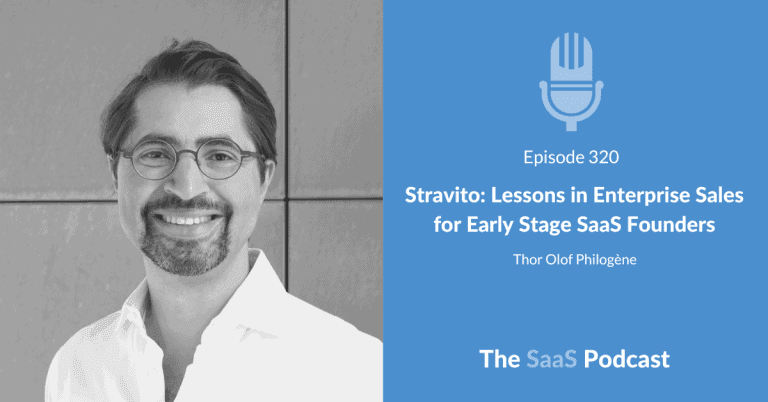
In this episode I talk to Thor Olof Filozian, the co founder and CEO of Stravito, a knowledge management platform that gives organizations a secure and central hub for all their marketing knowledge and insights.
Stravito is a Swedish based startup that was founded in 2017.
The company has raised $23 million to date and its customers include brands such as comcast, Electrolux and McDonald's.
In this episode, Thor and I talk about the founder's story of how they came up with the idea for Stravito and have grown IT into a SaaS company doing multiple seven figures in ARR.
We also cover some interesting topics including how they spent six months validating the problem and the solution without writing any code.
The lessons the founders learned on selling to enterprise customers as an early stage startup, why founder led sales is critical for startups, and how founders can get better at sales and how one simple strategy helped them get traction with enterprise customers and why.
It's something that you should probably be doing too, so I hope you enjoy it.
Thor, welcome to the show.
Thor Olof Philogène (01:30.610)
Thank you so much for having me.
Omer (01:32.010)
Do you have a favorite quote?
Something that inspires or motivates you that you can share with us?
Thor Olof Philogène (01:36.290)
God, yeah.
I think one quote comes to mind.
Jim Collins, the author of Good to Great, once said that great vision without great people is irrelevant.
And I really like that quote because at its core, it's really at the core of the startup challenge, the importance of finding and motivating the right people for each stage of the business.
So I really like that quote.
Omer (01:59.210)
So tell us about Stravito.
What does the product do, who's it for, and what's the main problem you're helping to solve?
Thor Olof Philogène (02:05.850)
Stravito was founded in Sweden in 2017 by a team of market research and technology entrepreneurs who we are now present in Europe and North America.
We're approaching 70 employees.
We have 25 nationalities on the team.
And the way to think about Stravito is we allow global organizations to centralize all their market research and democratize access to that research throughout all of their organizations.
So we're actually evolving in a massive market.
So as a reference point, Spotify, which is an amazing company, operates in the recorded music market, which is a 25 billion US dollar market, whereas market Research, which most people don't know of, is a 90 billion US dollar market.
And knowledge management is actually increasingly important as we live in a world where customers demand a lot and those demands are constantly shifting at often an increasing pace.
Omer (03:04.080)
So who are your customers?
Who are the companies that really need a solution like Stravito?
Thor Olof Philogène (03:10.050)
Right.
So the way to think about it is it's mainly targeting global organizations.
And what we do is we help those global organizations to search and discover consumer insights in seconds, no matter where they are in the world.
If I take a look at our clients, we count a number of Forbes Global 2000 companies.
Customers include the likes of Comcast, Electrolux, Carlsberg, McDonald's and yeah, we're growing at a really fast pace.
Omer (03:38.570)
I came across a TechCrunch article which described Stravito as the Netflix or Spotify of knowledge management.
And I was like, that was an interesting to use.
Why do you think they made that comparison?
What is it about the Stravito experience that leads people to make that comparison?
Thor Olof Philogène (03:55.530)
I think that there's a wider trend which many call the consumerization of the enterprise.
I think that one of our core differentiators is that on a product level is that we provide usage and adoption at a completely different level.
So the analogy to Netflix or Spotify is that we've actually built a system that users enjoy using and that kind of drives usage.
And that's tied to one of our foundational beliefs that at some point enterprise software will eventually become as simple and and intuitive as consumer software on a company level.
However, what I think separates Stravito from the crowd is the fact that we have a very diverse workshop.
I mean, I mentioned we're almost 70 employees.
We have more than 25 nationalities.
But we are all united by a simplicity first mindset and really strong emphasis on collaboration.
Omer (04:51.320)
Right, and what about revenue?
Where are you guys right now in terms of equity?
ARR.
Thor Olof Philogène (04:55.560)
In terms of ARR, I think as a young company, we don't discuss our revenue publicly, but we're growing at a very healthy rate.
We've doubled our revenues last year and we secured a 14.6 million USD Series A to accelerate our growth.
So that has allowed us to double the team and to hire stellar people, just like a Chief Product Officer that we brought on recently.
Omer (05:21.970)
But it's fair to say that you guys are doing multiple seven figures in ARR right now?
Thor Olof Philogène (05:27.810)
Absolutely, yes.
Omer (05:29.410)
Great.
And you've raised, I think it's about 23 million in total.
Is that right?
Thor Olof Philogène (05:33.970)
US dollars?
Yeah.
So 20 million euros, approximately.
Omer (05:37.810)
All right, so let's talk about where the idea for this product came from.
And I know you have three co founders, so there's four.
Thor Olof Philogène (05:45.570)
We're four founders.
And of course, three of them are my co founders.
I think two of us really came from.
I mean, I used to be the VP Growth and Chief Revenue Officer at a company called Izetto.
I had the privilege of joining that company very early on and had the privilege of starting their data and analytics function.
And if I take a look at that journey, what I realized was that I got to see how as we grew from 50 to 100 to several hundred employees, to 500 and beyond, I started seeing how we started to reinvent the wheel in terms of analysis and research.
And it became increasingly complex to distribute information internally.
So when I met my two other co founders who had been running a research agency for 15 years, a research agency called NORM, that is now owned by Ipsos, which is acquired by them, which is the world's biggest market research firm, and they told me how these large organizations, companies like Unilever, Procter and Gambler, how they experience these problems at scale.
I had no difficulty in relating to it, because if we started experiencing this with 500 employees, I can't even imagine begin to imagine how complex it is when you have 50,000 or 100,000 employees.
So that kind of was the starting point to want to solve that problem.
Omer (07:10.070)
Okay, so you've got a problem identified.
How did you guys go about getting started?
Thor Olof Philogène (07:15.340)
So I, having been an entrepreneur in the past, 15 years ago, I started a social media company for the Metaverse, which is, of course a very hot topic today.
But.
And I had the privilege of having a couple of learnings.
Generally speaking, it's the mistakes you make that teach you the most.
And I think one of the things that.
That I really understood was super powerful was to whenever you have an idea is effectively to validate your learnings.
So we set out to interview people that were working in this space and that we'd be potential consumers and buyers.
And we did a series of.
I think we interviewed people from 10 different companies, including Marks and Spencer's, Coca Cola, Johnson and Johnson, and we interviewed them to truly dig deeper into this problem space.
And was this a big problem?
Was it a vitamin or painkiller?
What level of pain did they experience?
And how important was this for the business?
And doing those interviews and doing those conversations, we found out that this was actually a massive problem that was omnipresent.
It was a problem that all of these organizations faced, which then led us to start the company in the middle
Omer (08:22.960)
of 2017. Who did you target in those companies?
So you've got these massive organizations.
Anybody could have that problem, theoretically.
Thor Olof Philogène (08:31.760)
So.
Omer (08:32.250)
So who did you focus on and why were those the people that you felt were the most important to talk to?
Thor Olof Philogène (08:40.090)
That's a tough question.
And I think that the way I would think about it is we very consciously decided to focus.
And I think focus is always your friend as a startup founder because there are so many opportunities that pop up and in the very beginning you want to do everything.
But we very quickly decided to narrow down and focus on a limited set of use cases, even though the applicability of the technology was fairly universal.
So we decided very quickly to focus on the market research use case and to focus on very large organizations.
So organizations that would be Fortune 2000 equivalent type sized companies.
So having made those initial focus decisions, that led us to focus on the teams that then run and sit on top of data, the consumer Market insights team in those organizations, which narrowed the scope quite radically in terms of who we would build the product for, who we would then design the marketing material for, et cetera, et cetera.
Omer (09:38.510)
And these people that you interviewed, were these warm intros you got through your network or was this cold outreach?
Thor Olof Philogène (09:45.310)
I would say that we had the benefit of having two founders that had spent 15 years running a market research firm.
So we had the benefit of being able to tap onto that network.
But then of course, we could then benefit from those initial conversations to find additional people.
And that was also a very strong signal, which was that people were very engaged in wanting to tell us about this problem because obviously they didn't feel that it was solved.
So we saw that as a strong signal to, you know, that we were actually working on a problem that was worth spending more time on.
Omer (10:20.720)
So you've done these interviews, you realize that this is a massive problem across these types of organizations.
How did you go about building the product?
Thor Olof Philogène (10:31.410)
In the beginning, it's really about identifying what is going to be the minimal viable product.
So again, what we did as much as possible was to try and come up with concepts of products and put them on a slide and then go and talk to prospective clients and get them to validate if that our ideas on how we would solve their problems would make sense.
And then in parallel also have a discussion with people on the technical side, product and design side, to see is this feasible.
And I think there's a lot of talk of machine learning and back in 2017, of course, technology stacks available weren't at the same level as today.
A lot has happened.
So always making sure that whatever we would go out and ask people they would be interested in was actually feasible to do technically.
And throughout that iteration cycle, we met with people at companies that had very clear views and very clear on what would actually make sense and what would actually make their lives better and improve their workflows.
And it's through that iteration cycle that we've eventually narrowed and decided what the minimum viable product would be.
One thing that we did very early on was to make sure that we would have a buyer for whatever we would actually set out to build, which means that you.
And this is, again, like a lesson from having been an entrepreneur in the past that it's.
It's very easy to confuse yourself with the customer, and it's very easy for yourself to have an opinion on what the customer wants and needs.
But really what you need to do is to spend more time talking to customers and doing what is generally called this product discovery, so you truly understand what will make sense to them before you spend valuable and expensive engineering time building.
Omer (12:24.210)
So when you talked about concepts, this was just slide deck images.
There was no code that you were going out and validating and getting feedback on?
Thor Olof Philogène (12:33.170)
Absolutely.
Initially, we tried as much as possible to effectively validate elements on a slide level, to effectively create a slide that has a concept.
And you maybe have spent design time designing a concept, but being very clear about what the product would do before you actually decide to commit engineering resources to building anything.
Omer (12:53.960)
Okay, and what was that period of time?
How long did you go through these feedback loops until you got to a point where you were confident that, okay, we know what that MVP needs to be.
We have that clarity on the product we need to go and build.
Thor Olof Philogène (13:10.130)
Having started the company in summer of 2017, it took five months, maybe five and a half months before we actually wrote a line of code that is still part of the product today.
So, effectively, it took almost six months of just iterating with slideware before we had anything that would be part of the core, the product that we would, you know, eventually have and still run.
Omer (13:34.050)
And the product that you ended up building, the mvp, was it pretty much aligned with the vision that you, as the founders, had, or did these conversations lead you in a different or surprising direction in terms of the product?
Thor Olof Philogène (13:51.970)
Surprisingly, and I actually.
And we did an off site some time ago, I went back to some of our initial decks, and surprisingly, it is very much aligned with the initial vision and the initial concepts of what we wanted to do.
So we have a mission statement that is we want to simplify knowledge discovery because that's the big problem that these organizations face is that there's massive amounts of information that's increasing at a rapid pace and that's furthermore siloed and distributed across everywhere.
So that was our mission statement and that still is.
And we wanted to bring that data and to make it alive and in use.
And honestly I still think that initial data gathering that we probably spent more time than most people would do just interviewing people is still very much true even today.
Omer (14:42.970)
And then what was the competitive landscape?
Were there other products out there at the time?
Was this a new category that you guys were creating?
How did things look back then in 2017?
Thor Olof Philogène (14:54.410)
I would say that the biggest competitor is a lot of these legacy solutions.
And I think what one needs to remember is enterprise software is selling to people that are very risk averse.
They're very afraid of nobody gets fired for buying IBM.
And so it's a situation where you need to convince people to put their careers at stake in buying a software.
And then if on top of that you're hosting sensitive data is worth millions of dollars, then the risk of a leakage of security flaws.
There's so many elements you need to convince for them to actually want to buy your software.
So I would say that it's, it's a very long process and it's.
And it's further more complicated when you do it on the enterprise level.
Omer (15:37.760)
Now you mentioned that it was really important for you to make sure that you actually had customers for this product before you started engineering work.
What did that mean?
Did you pre sell the product?
Did you get commitment from potential customers in various ways?
Yeah.
Thor Olof Philogène (15:53.650)
No.
What ended up happening is we were at a phase where we were fortunate to meet a couple of companies that were early.
If we take a look at the Geoffrey Moore and the Crossing the Chasm, early adopters that saw how the vision we had ahead of us matched what their vision of the future.
Going back to your question, what are your competitors?
Are you creating a new category?
I think to some degree we had a perception of the future was a service that was simply not available in the market.
And we met some people that believed, let's say believed that the future would be the way we also thought it would be.
And those visionary customers because I really want to applaud them and thank them.
They were willing to take a certain gamble in allowing us to be part of a Competitive bid where we effectively bid against legacy solutions and had a shot at winning a bigger contract.
But from the very beginning, from the get go, those would be paid proof of concepts, so we actually could have some level of revenue.
And I think that revenue is one of the best ways to validate product market fit.
It's a science and it's absolutely not everything, but it's one of the core elements is, are people willing to pay to get that problem solved?
Omer (17:10.350)
And this is.
You were charging for the mvp.
Thor Olof Philogène (17:12.390)
We were charging for the mvp.
And, and, and honestly, I mean I there, there's a Reid Hoffman quote which is, if you're not ashamed by the first version of your product, then you're shipping too late.
And I think we had a lot of reason to be ashamed of the first version of our product.
Omer (17:26.630)
Okay, and then, so how long did it take to build the product?
So you've done all the right things when it comes to, you know, customer discovery.
You validated there was a problem, you took different ideas and concepts and the solution and you validated that before you started building an actual product.
Then once you had that clarity, how long did it take for you to build this MVP and get it in in the hands of your customers?
Thor Olof Philogène (17:50.390)
I believe we ended up signing, we ended up being part in a competitive bid with other actors that was a paid poc.
And we then had five months that were pure hell, which was having to effectively deliver on a roadmap that, where we had 2 week check ins where we had to effectively prove that all the things we had said in those slides would actually materialize.
And every two weeks we had a check in where we were asked and effectively had a shot at being thrown out of the whole PoC and a large part of this dream.
But we survived and eventually won that contract.
And I think I would say that the first version of the product was complete version of the MVP was shipped eight months later in August.
So before that I would say it was an alpha version.
So, and then afterwards it moved on to beta version.
Omer (18:42.460)
Why was it held during that period?
Was it just simply because of how much you needed to go, how much work you needed to do and deliver?
Or was this because once you got started there was more in a higher expectations, more requirements coming in?
Thor Olof Philogène (18:59.020)
I think it was very clear that what the buying companies wanted to do was effectively compare us against other solutions and do surveys among internal users and get the end user's opinion on whether our service actually was better and perceived better.
And because it involved multiple regions, a longer Period of time was required.
But I think this is a classic example of effectively jumping off a cliff and building the airplane.
It was like we literally did not have a product when we started out and we had to build it and effectively prove it at each checkpoint.
Omer (19:31.490)
Okay, great.
So you go through this process, you eventually, you know the proof of concept, you win the contract, you have a product that you're embarrassed about, but it's good enough that customers are willing to pay for it.
What did you do next?
How did you go and find your next few customers?
Thor Olof Philogène (19:47.730)
I think that we, what we set out to do was effectively to, to understand how, what is the go to market motion that we need to have.
And again, having had two co founders who had experience in the industry on the research side, we init were very much depending on their understanding of the space of these big organizations.
But really what happened in the first two years, if I summarize it, is Renaissance salespeople and we as founders, myself included, had to go out and really meet customers and close a lot of those deals.
There were other people involved.
But I think that you should never underestimate the importance of the founders actually being part and driving a lot of the sales, especially for enterprise in the early days.
And that was definitely true for us.
And I think there are a lot of benefits to that.
And I think one of the benefits is in the early days, really what you're selling is a vision, because the product will never be able to live up to your view of what it needs to be in the beginning for the simple reason that you haven't had time, you haven't had the resources, you might not have raised the capital to actually materialize that vision.
So the vision becomes a big part of what you're selling.
The other part is you also need somebody that can influence the product roadmap to be really close to what the prospective clients and the actual clients are saying.
So as a founder salesperson, you get the benefit of both.
You can very easily convey the vision and you can make that part a core part of the sales process.
But you can then also make sure to fully understand, if you allow your ears to be open, the client's problems and effectively make sure that feeds back into the product development cycle.
And in many cases, founders remain chief product officers for very long.
So that's super helpful.
Omer (21:40.290)
When you were going out and doing this founder led sales, what were some common objections that you were hearing that you had to figure out how to overcome?
Thor Olof Philogène (21:50.290)
I think that there are a lot of objections.
I mean, I can mention a few.
I think one is that there's a very small structure that you're very few employees that you might not feel as financially secure as, because some of these groups have policies internally where the guidelines are that they need to be well capitalized, et cetera.
And so that's one objection.
And I think there are other objections in terms of wanting a level of customizability that was simply not available.
Again, you're selling to large enterprises and they don't want to buy off the shelf.
That's not what they want to do.
That's something you can easily do when you're selling to SMEs, but it's more hard to pull off when you sell to the enterprise.
So I think as a founder, what you need to do is really understand what is within the realm of the possible at the phase in which you are, which is who are the early adopters, who are the ones that are early in the adoption cycle and really double down on those.
And that's something I'm sure I could have done even better is truly understanding the ones that probably wouldn't be interested and relevant to sell to in the very beginning at all and get back to them a couple of years from now.
If I take the case of Stravito, I mean, we are now ISO certified, we have a chief Security officer, we're at a completely different stage.
So it's, we can now approach many of those customers and oddly enough, many of them actually reach out to us and say, hey, we spoke to you a couple of years ago and really loved your vision.
And now we're seeing that you're a much bigger structure, maybe we should talk.
So, but I think it's again, it's focus is your ally.
So try and identify who you should focus your resources on.
Omer (23:27.270)
Yeah, that's a great point because I think a lot of startups face this problem when they're selling to enterprises that number one, you guys are, you're a startup, you don't have a lot of people you might not be around tomorrow.
And we're, we're a large enterprise business.
Why should we trust your product?
And I think a lot of founders try to figure out how to overcome that objection, how to maybe create the perception that they're more, they're a larger organization that they've been around for longer or whatever.
But I think it's so much more effective.
The way you talked about it is that you can either push that rock uphill or you can say, let's find the People who may have those similar concerns, but they are the early adopters, they are willing to take more risk and they have enough of a pain that they want, they're interested in enough in working with you.
So that I think is a really good lesson in terms of finding those early adopters in any market.
And again, going back to Geoffrey Moore's book, it's those early adopters that are going to be your most valuable customers in the early days.
Thor Olof Philogène (24:28.800)
Absolutely.
And then gradually you effectively build up different elements that play to your favor.
As an example, today when I talk to a telco, we can easily say, well, when we work with Comcast, if I talk to say a fast food chain, I say, well, when we work with McDonald's, it's much easier to build confidence in those prospects that you can actually understand their problems because that's really what they are concerned about.
They simply want to understand and feel confident that you'll be able to solve their problems.
And similarly, once you are ISO certified and you have done other things that are say, security related, you can also bridge that confidence gap.
And for us, as an example, when we started getting picked up by great publications like Forbes and we could refer to a Forbes article that talks about Sterito, of course, that plays in.
And all those things combined eventually become core elements that drive confidence.
Because ultimately confidence is a very important element that you need to be able to convey so that these people feel secure in trying and using your software.
Omer (25:32.780)
Now one of the things that you did to grow the business, acquire customers was to identify sub segments in the market that you could focus on.
Can you tell us a little bit about that?
What, what did you do?
How did you figure out where to focus your efforts?
Thor Olof Philogène (25:47.900)
Absolutely.
I think that this is something that I've had the benefit of working with at multiple companies.
But I think that understanding, again this is connected to product market fit.
It's, it's understanding what segments and what subsegments does your product actually bring the most value.
So it forces you to think about what is the value that you're prospects and your customers are getting and how does that translate into their reality.
So as an example, one of my, one of my lessons learned is sub segment specific campaigns.
So a common error that I have seen and I have done is that you, that we as companies, we talk about customers in the way that we talk about them internally.
So for instance, if you have a webpage, you might talk about say SMEs, but a hairdresser sees himself or herself as somebody that runs a Hair salon and baker will see himself as such, not a small business owner.
So what I think is important is when you define a compelling offer and you talk to the prospect, you need to make sure that you use words and terms that resonate with their perception of themselves and the jobs to be done that they expect to do in order to get results.
Omer (27:04.540)
Now, when you talk about subsegment, just give us one example of that.
How deep were you going?
So we can look at and maybe say, all right, there's retail or manufacturing or whatever, but when you talk about sub segments, you're saying you segmented those larger categories even further.
Into what?
Thor Olof Philogène (27:22.020)
Absolutely.
I think one example is just not.
I mean, I mentioned small medium enterprises.
SMEs don't talk about SMEs in general.
I think there's a huge difference between, say, retail SMEs and hospitality SMEs or transportation SMEs.
They're very different.
They have different needs and different workflows.
So it's really having one level of granularity.
So it becomes more tangible and less abstract.
Omer (27:45.890)
Was there a short list of sub segments that you had identified to focus on and how did you figure those out?
Thor Olof Philogène (27:53.330)
In the case of Stravita, we very early identified that companies that work within fast moving consumer goods would be the earliest adopters.
So in the beginning we had a very strong focus on that subsegment.
And as we grew, we benefited.
We were, I would say, opportunistic on the inbound and were able to actually see that what we had on offer actually served completely different segments.
But again, going back to that, you really want to lower the risk for the, for the perceived risk on the buyer side.
Meaning that if you, as an example, I mean, going back to the retail company, if you're a retail company and you can see that other retail companies are using that software and are happy, that gives you so much more confidence than if you see that there's a hospitality or transportation company that uses it.
So it also feeds into.
It's a positive, it's a positive loop that effectually allows you to then instead of simply relying on inbound, actually including that in your outbound and in your campaigns and your way to drive growth.
Omer (28:56.710)
Okay, and so when you talk about fmcg, you're talking about companies like Procter and Gamble, Unilever, those types of organizations.
Thor Olof Philogène (29:04.190)
Right, Exactly.
So goods that effectively.
Yeah.
That move quickly off the shelf, whereas.
And then you have broader categories that includes, you say, consumer electronics.
So we work with Electrolux as Example, you will not buy a washing machine every week, whereas you will buy milk every week.
Omer (29:20.150)
Okay, so you've identified these sub segments.
What did you do with this?
How did this translate into campaigns?
Was this online ads?
Was these sort of landing pages, SEO?
Where did you, how did you implement this focused strategy?
Thor Olof Philogène (29:34.370)
So you really need to put yourself in the mind of the prospective buyers.
So what is it that person is looking to do?
So can you talk about the problem in a compelling way that is not too abstract so that the person can actually relate to it?
And then what we did is we made sure that all of our marketing assets, meaning our landing page, we initially started a lot with content marketing, reflected those things.
So we talked about the customer, the way the customer saw him or herself.
We talked about the problem, the way the prospect perceived that problem themselves.
And then we also made sure to include a lot of customer use cases, which is effectively x person at McDonald's had this problem and through the solution was able to solve it.
And again, using the client's words.
So you are actually not doing, you're effectively helping the clients explain how they benefited from your solution.
So as much as possible, we tried to, I would say, not talk about problems on an abstract level, but rather a concrete level.
And as much as possible, make it very tangible.
So whoever would land on your page or click on the ad would be able to see exactly how that would impact their day to day and exactly how the software would work or interact with them.
Omer (30:50.820)
The other thing that, from what I understand, worked well for you, were referral programs.
So tell us more about that.
Thor Olof Philogène (30:59.060)
Absolutely.
So I think if we talk about referral programs I have from multiple companies experienced, and that referral programs are often a great idea.
And a lot of people say, how can we tap onto our existing network of clients and how can we allow them to help us fuel our growth?
And what I have seen, not specifically for Stravito, but at other companies, is that it can sometimes make sense to remove the proverbial safety belt for the incentivization of users.
And because what tends to happen is you drum up these very complex referral scope programs where you promise reward X, you know, a reward if X happens before Y time on condition Z.
And in my experience, I have actually two cases that I think about where removing some of those rules, effectively removing some of those safety belts and taking on more risk has yielded greatly.
Meaning that you can multiply several times.
In one example, 5x the outbound, without necessarily seeing none of that negative behavior like the moral Hazard behavior that you of course should be mindful of, but that sometime is overblown in the conceptual when you're iterating on the proverbial whiteboard.
Omer (32:14.910)
So give us an example of that.
How did you simplify that referral program?
Thor Olof Philogène (32:18.590)
So I think typically you have rewards associated.
You have, if you do, if you sign up and you do a certain behavior for us that can be activate a certain service or purchase a certain product and once you have invited say 10 people and they have also bought this product and done this, then we will give you a voucher for X amount or we'll deposit this amount on your account.
And in my experience in the beginning, and again there are two companies where I draw this experience from.
You effectively see that in the beginning it was really hard to get traction.
Whereas if you remove the safety belts, none of the, I would say 90% of the moral hazard doesn't happen.
However, you see a much stronger growth in terms of people wanting to actually engage in this because it's a tricky thing and you're asking people to do a lot of.
Omer (33:08.630)
Right.
So the, so the, basically it was like simplify the offer so people understand that more easily and take away some of these, all of these requirements to just remove, remove the obstacles that typically people have.
And you can always go back and create a more complicated referral program in the future.
Thor Olof Philogène (33:30.710)
Absolutely, absolutely.
Omer (33:32.870)
Now, the subsegment, focusing on sub segments was a successful strategy for you and helped you to speak more directly to specific customers or customer segments.
But you also experienced some downsides with sub segments and maybe trying to scale them, some of them too fast.
Can you tell us about.
Thor Olof Philogène (33:53.930)
Definitely.
I think there is, there is also a big risk which is when you start to, I mean in the beginning of a startup it's a lot about getting to product market fit.
And I think what can happen is you get almost a bit too excited about your own early success and you can start scaling before you actually have product market fit on a sub segment level.
And what I have seen and experienced is that can be very costly.
So it's really important that you continue to validate elements before you scale.
And remember that product market fit can be at a subsegment of the market you are addressing.
So to be a bit more concrete, your product might be very well received for customers in pharma, in pharmaceuticals, but not financial services, or very well received in hospitality, but not in retail.
And I think that what then if you're not aware of and you don't.
And I think a Good way to understand how you are actually performing forming is to go on the cohort level and see how usage is not necessarily on the revenue level because those numbers can be misleading.
And basically look at that and understand are we ready to scale our efforts regard in targeting that segment.
Omer (35:05.170)
So give me an example.
Which sub segment did you have challenges
Thor Olof Philogène (35:08.530)
with in the beginning?
As an example, if I take a look at where we stand today, we were very ambitious when we started Servido and I think we, I think had we started looking at segments that we definitely did not or we had no ability to convince in the beginning and then, and that's why we doubled down on fast moving consumer goods for I think the first two years.
But in the beginning it took us at least a year of understanding that we were not ready to go beyond that.
And, and that was, I mean in hindsight we, we spent a lot of time and resources and effectively money doing things we should just have been a bit more patient about and, and allowing the market to take us there over time and not be as eager.
Omer (35:51.650)
So you were focusing on fmcg, that was working.
You're seeing some traction there.
And then you're like okay, let's, let's do the same thing in a bunch of different other segments and then getting completely different results there.
And so a lot of time and focus going into those sub segments where potentially you could have just said okay for those two years let's put more energy into FMCG and see if we can grow that even faster.
Thor Olof Philogène (36:17.560)
As an example.
Yes, and I think that, I mean this relates to something I alluded to previously which is, is very easy to, and this is a common mistake that I personally made is that you to a larger degree believe that you understand the customer or even worse that you think that you can think like the customer, which even worse.
And I think I just want to highlight that product discovery is an art.
It's something that you really need to take seriously.
And the lack of product discovery can be extremely costly.
Omer (36:45.040)
You also spent a fair amount of money at online ads and didn't really see a good ROI there.
Can you tell us more about that?
Thor Olof Philogène (36:54.490)
I don't think there's one company I worked at where that what I haven't experienced this but I think that throwing money at odds is, I mean is something that you can be encouraged to do by people that might not necessarily be knowledgeable or if for instance you end up being maybe short, you see that you have a gap to fill in order to hit the yearly targets and you have one and a half more quarter and you desperately want to drive the numbers.
But ultimately I think that is very much of a media gamble tactic and that is very much based on hope.
And I have several of those under my belt and I think it's very easy to rationalize them for one off events.
And I think a typical example if I'm going to be a bit more concrete is a launch.
So you're going to launch a product category or you're going to launch a new market or and you're very excited and you want every, you want the world to know and.
But ultimately it's as Frank Slootman, who's the current CEO of Snowflake said, hope is not a strategy.
And one important thing here is that the best case scenario you should really take a look at the unit economics.
And if they are shaky then guess what, if you spend more money and it's an advertising service, they will only get worse when you scale it.
So don't expect them to hold and worse, don't expect them to get better.
Omer (38:13.680)
Where did you invest your ad dollars?
Was it AdWords, LinkedIn ads?
Where would you try?
Thor Olof Philogène (38:18.890)
So I have this experience in affiliates.
So as an example, so affiliate services where you effectively find a partner that has a lot of traffic and then you for somehow convince yourself that traffic is going to convert into users.
I've had that in events which is like big events that you want to capitalize on and get people's attention on.
I've had that on paper ads.
I've had that.
So I think it's.
And of course online ads, which is where I had that experience the most.
But I think it's very easy to get tempted by it.
But I think it's.
You need to force yourself to be rational about it before you invest too much in it.
Omer (38:56.340)
Yep.
Okay, we, we should wrap up.
I'm gonna get onto the lightning round but before we do that, I have one more question for you.
From looking at the website, you have both a product and then you also have a services side.
What does the services piece do?
Is that an add on for the product or are you running that as a standalone business alongside the SaaS business?
Thor Olof Philogène (39:16.190)
That that's actually one of the core learnings from being in enterprise is that I think I underestimated the difference between SME where I came from and then of course mid market and enterprise.
And I think that what I realized, and it took me several years to understand is the need to go beyond software as a service, but actually Provide software as a service and service.
So because what ultimately these people are buying is a solution to a problem and whether you are thinking about solving it with software is or not, they don't really care.
So I think in our world and in my in our reality, what we have tried to do is effectively provide a service component and a software component and make sure that they combined do as much as possible to serve our clients and problem.
Omer (40:04.670)
And what's the breakdown between subscription revenue versus services?
Thor Olof Philogène (40:08.750)
The vast majority is software.
But really what I'm saying here is you need to go beyond just cloud service in order to successfully scale when you work with the world's biggest brand.
Omer (40:18.910)
Yeah, good point.
All right, so let's, let's wrap up.
I've got seven quick fire questions.
Just trying to answer them as quickly as you can.
Ready?
Thor Olof Philogène (40:25.310)
Yep.
Omer (40:26.120)
What's the best piece of business advice you've received?
Thor Olof Philogène (40:29.000)
Not advice, but it's a quote.
So Steve Jobs had ended one of his speeches with stay hungry, stay foolish.
And I think the importance of that, the continued growth, the continued development even after initial goals are met, is particularly true for software as a service where you need to constantly create and improve.
And as an example, we just recently launched something groundbreaking at Stravito, a visual search solution that we call Atlas.
And that's a great example of how we stayed hungry and foolish and listened to the market and the customer needs and went beyond what the market expected to innovate.
Omer (41:07.620)
What book would you recommend to our audience and why?
Thor Olof Philogène (41:10.260)
So earlier today I mentioned the importance of product discovery, and Teresa Torres has written an amazing book called Continuous Discovery Habits.
I think this is crucial because product discovery is an area where failure can actually cause your company to fail.
Omer (41:27.390)
What's one attribute or characteristic in your mind of a successful founder, if only one?
Thor Olof Philogène (41:32.510)
I would say grit.
Building a startup is a marathon.
It's really not a sprint.
And for most of us founders, it's even worse.
It's more akin to an Ironman style triathlon.
So I would definitely say grit.
And if I could say a second one, I would say integrity.
Because ultimately startups and companies are about leading and motivating people.
And it's really hard to ask people to follow you if you do not stay true to yourself and your values and your beliefs.
Omer (42:00.010)
Very true.
What's your favorite personal productivity tool or habit?
Thor Olof Philogène (42:04.090)
Evernote.
I've used it for 10 years and it never fails me.
Habit, Sports, exercise.
It's how I replenish my batteries.
It's how I recharge my motivation.
It's how I clean my brain.
Omer (42:17.070)
What's a new or crazy business idea you'd love to pursue if you had the extra time?
Thor Olof Philogène (42:20.510)
I'm very inspired by the boom we are seeing in technology to help us address climate change and on a societal level.
And if I were to venture in something new, I'm very curious about software playing a bigger role in solving other types of societal problems.
And so I'd love to spend more time thinking about that.
Omer (42:38.670)
What's an interesting or fun fact about you that most people don't know?
Thor Olof Philogène (42:41.910)
I'm a language nut.
I speak four languages fluently.
Omer (42:45.110)
Nice.
And finally, what's one of your most important passions outside of your work?
Thor Olof Philogène (42:49.910)
Hanging out with and finding great things to do with my two daughters.
And right now one of those is playing Animal Crossing on Nintendo Switch.
Omer (42:58.550)
Love it.
All right, well, Thor, thank you so much for joining me and sharing your story so far with Stravito.
If people want to find out more about Stravito, they can go to Stravito.
That's S T R A v I t o.com and if folks want to get in touch with you, what's the best way for them to do that?
Thor Olof Philogène (43:17.000)
You can reach out to me on LinkedIn or they can email me@thorstributo.com awesome.
Omer (43:22.840)
Thank you so much.
It's been a pleasure and I wish you and the team the best of success.
Thor Olof Philogène (43:26.280)
Thank you so much for having me, Omer.
Omer (43:27.920)
My pleasure.
Cheers.