Omer (00:09.280)
Welcome to another episode of the SaaS Podcast.
I'm your host, Omer Khan and this is the show where I interview proven founders and industry experts who share their stories, strategies and insights to help you build, launch and grow your SaaS business.
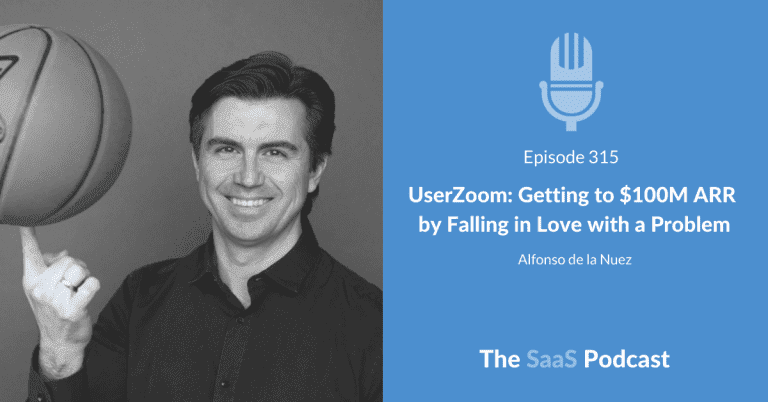
In this episode, I talk to Alfonso de la Nuez, the co founder and and co CEO of UserZoom, a SaaS product that delivers actionable UX insights to help businesses design and deliver better digital experiences.
In 2001, Alfonso and his partners started a user experience research consultancy in Spain.
But doing research in a physical lab was slow, manual and expensive.
After several years of doing user experience research that way, they decided that they'd build a tool to help them automate the process and become more efficient.
And the tool, once it was built, helped them run the consultancy better.
It was only when a client asked if they could use the tool to conduct their own research that Alfonso and his partners realized that there was an opportunity for them to become a product business.
In this interview, we share how they transitioned from a consultancy to a SaaS company, some of the struggles they faced in finding customers, and how they've gone on from a humble start as a consultancy in Spain to a SaaS business that is now doing almost $100 million in annual recurring revenue and has raised $136 million.
So I hope you enjoy it.
Alfonso, welcome to the show.
Alfonso de la Nuez (01:35.760)
Hi, how are you doing?
Thank you for having me.
Omer (01:37.760)
It's my pleasure.
Do you have a favorite quote?
Something that inspires or motivates you?
They can share with us.
Alfonso de la Nuez (01:42.720)
I have three for you if that's okay.
So the first one, culture Eats Strategy for Breakfast by Peter Drucker.
And I firmly believe in it and we actually exercise it at userzoom every day.
The second one is luck is what happens when preparation meets opportunity.
So I don't believe much in luck, although there is certain amount of luck, but I just don't believe it.
I think you find it and that's from Seneca, the philosopher.
And the third quote is every company is a digital experience company today, and that's by somebody by the name of Alfonso de la Nuel.
Omer (02:22.520)
So tell us about UserZoom.
What does the product do, who is it for, and what's the main problem that you're helping to solve?
Alfonso de la Nuez (02:29.240)
So UserZoom empowers businesses with actionable insights, user experience insights to help businesses deliver great digital product experiences that actually result in measurable business performance metrics.
Right.
Essentially, we're helping our customers, which typically are mid sized and large enterprises, really understand the end users, the customers, even the users before their customers, how they use their properties, their websites, their apps, and really try to collect the quality of that digital experience and then serve that so that they can make product decisions.
And by creating phenomenal digital product experiences, you increase conversion rates, you reduce churn, you increase customer satisfaction, you increase productivity, development shops, your development teams, you reduce customer centered calls, et cetera, et cetera.
I'm a big believer in convenience and ease of use of digital products.
And that's what UserZoom does by helping our customers collect insights directly from the end users.
The problem we're trying to solve is that I can see in the last few years there's been this kind of digital transformation journey that a lot of companies have started or continued on since they started many years ago.
And it's now becoming absolutely imperative, it's become actually a competitive advantage to be great at user experience design.
It's a decade of design, right?
This was even accelerated even more with the pandemic because most interactions now are through some sort of digital interface, right?
But everyone would say, yeah, of course it's important to have great product, great digital product experience and make it easy to use.
However, I always say easy is hard, it's very difficult.
It's not only just not only a team sport, you can't just assign some team to like a design team to do it.
It really is a culture, a different way of building software.
And so one of the best things you can do is be very customer centric.
And being customer centric means that you need to collect all sorts of insights, all sorts of data, not just analytics, not just running surveys, but also combine qualitative and quantitative data and run, for instance, one on one interviews with the end user and use moderated testing techniques or, or have the users interact with the product and collect behavioral data.
Like where do they go and how do they behave and what do they say and why are they doing what they're doing?
A lot of those things.
Those are very hard questions to answer for product managers, designers and researchers.
And so that's what we intended to do with UserZoom when we launched is automate the process of collecting this type of data.
It's called user research.
Yeah, it's not market research, it's user research.
And today we talk about usability testing and user experience research.
So UserZoom uses software and the Internet, methodology, et cetera, to connect those end users, potential end users, they may not be still familiar with the product.
And so what we do is we help Businesses find those participants first of all, for those people that may be end users to participate in this type of studies and then via an online application, an on demand application with a SaaS model, we enable our customers to run all these studies in a very scalable, cost effective way so that they can actually do that every day or every week and throughout all stages of the product development life cycle.
So that's what UserZoom is all about.
Omer (06:08.709)
Got it.
So there are different ways to get these insights about UX and it sounds like UserZoom is providing these companies one solution to go end to end throughout that journey.
Is that a fair way to think about it?
Alfonso de la Nuez (06:20.550)
It's a one solution.
However, we actually call our platform an all in one comprehensive solution because there are multiple ways to collect data and there are multiple types of data or insights.
For instance survey data, you typically sample 100, 200, 300, sometimes 3,000 people to collect what we call attitudinal data.
What do they think about something?
We give them a 1 to 10 rating or ranking or a response to a certain question.
Right.
But then there's other methods.
For instance, when you're asking them to complete certain tasks, the participants, you need to complete certain tasks and maybe you're actually observing how they do this and you're doing this through a moderated testing session.
And what we want to do there is not maybe ask them like you would do in a survey, but observe their behavior, observe how they go about finding something.
And that's what you typically don't get in analytics or you don't get in surveys.
Right.
So the combination of all those really create this rich picture, rich set of insights that help designers, researchers, product managers and digital marketers to make decisions.
And that's what we do.
We have it all packaged under a all in one UX research platform.
Omer (07:35.660)
Can you give us a sense of the size of the business?
Where are you in terms of revenue,
Alfonso de la Nuez (07:39.980)
number of employees about to hit 100 million?
ARR.
We're very close.
I expect us to hit that sometime mid year and then about almost 400 employees.
Omer (07:49.710)
And you've raised about 130, 135 million I think is the number.
Alfonso de la Nuez (07:54.750)
Yeah, yeah, approximately from two different types of investors.
What we did is we bootstrapped the business back in 2007 out of Spain, where I'm from originally.
I call this the users in 1.0 phase of the business product market fit.
Trying to understand if there's a market out there for these type of solutions.
And then we raised the first Round about seven years later from Sunstone, it was a large first round, 34 million.
We'd already brought the business to 15 million in bookings and Ebitda positive growing at a healthy, I think 30% or so if I remember correctly.
So it was really interesting because typically you would go out and pitch to investors, but if you're able to bootstrap your business and get going and pass the $10 million mark, which obviously everyone hearing this will say, easier said than done.
But if you're able to do it, then honestly you put yourself in a situation where the investors will pitch to you because they're looking for great stories and great opportunities.
If you combine that with the market opportunity, because that's also what investors look for as well.
Large market opportunities.
That's what happened to us.
Right.
Again, we didn't think that, we really thought it was a niche market, but then it became much, much bigger.
And yeah, we raised that first round in late 2015 and then we raised another small round to do one of the acquisitions.
And then in 2020 we received another 100 million from Al Rock.
This was literally during the pandemic because everything was going remote and we enabled that remote economy, so to speak.
So we raised that to continue the growth.
And now we're in this kind of users 3.0 system situation here where now we're partnered with Thoma Bravo to continue growing the business.
Omer (09:38.550)
Awesome.
I definitely want to talk about how you viewed this business in the early days and you touched on it just now that you thought it was a niche opportunity.
Probably never imagined that you'd be sitting here talking about a hundred million, you know, ARR type business.
So definitely want to get into that.
But let's start at the beginning.
Like where did the idea, this product and business come from?
Alfonso de la Nuez (10:01.380)
Yeah, it's an interesting story because we didn't just come up with the idea of user zone.
Every time that I talk to entrepreneurs, I always tell them, fall in love with the problem.
Right.
Understand the customer and the gap, the potential gap in the market.
Because if you just come up with something entrepreneurs, you're going to make it happen no matter what.
But that doesn't mean that you can actually make it a successful business.
Right.
So in our case, Users was born out of the, the realization that companies wanted to do testing, they wanted to do usability testing in what we call today UX research, but they were doing it in a lab, in a physical environment.
These labs that have one way mirrors and you bring in one by one these prospects, these Participants and you have these interactions with them.
Well, we had actually the three co founders of Usersum.
We actually co founded consultancy, user experience, research consultancy before userzoom in 2001-2007.
But then we actually continued on and they overlapped for a couple of years until Userzoom started taking off.
But what we were doing is, and I'll go back to the late 90s when I, when I began my career is companies were designing websites without any guidance whatsoever from the end user.
It was all about the designer, the engineer, and lots of times it was all about the manager, the CEO or whoever saying hey, I want it this way, right?
Nobody was really paying attention to the end user.
And the result was websites or back then we didn't have apps, but they just sucked.
I mean they were hard to use, they were slow, they were confusing.
And I really believe that the bubble burst that we know, we lived through in the, you know, early 2000s had a lot to do with this, among other things.
So it was in 2001 that we got together and said, hey, why don't we focus on making it clear to the customer, to the website owner that the website sucks and how do we do that?
And so we came up with this usability testing concept that was actually not ours.
It was already in place for actually decades.
It's related to ergonomy and market research, but very specific for websites.
So for what happened was that we noticed it was very valuable for our customers.
It was very interesting to be able to collect feedback and hear and watch those users actually interact with their products, with our customers products.
But it wasn't scalable, it was slow, it was manual, it was costly, it wasn't scalable.
So we lived through about seven years, six, seven years of being in the lab all day.
And what we said is, can we automate this?
Can we make it scalable and cost effective so that our customers can run studies more often?
And actually that's related to the business model as well.
Omer.
Because we didn't think that UserZoom would be a real pure SaaS company because the way that our customers used to work with us was more episodic, more on a per project basis.
And so I always questioned, are we a SaaS business?
You know what I mean?
Omer (13:04.520)
Is there the recurring revenue opportunity there, you mean?
Alfonso de la Nuez (13:06.920)
Exactly.
Is there recurring revenue?
Are they going to sign up?
And then of course the top metric that I always have have had in my mind, which is retention, right.
Are we going to allow, are we going to build a business Here that has recurring revenue opportunities and also not just recurring, but also at high retention rates.
And so back then, because everything was so slow and so manual to be in a lab, lots of companies were running studies once, twice, maybe four times a year.
Right.
Today companies are running four studies a week.
They're testing everything.
Everything is automated thanks to the technology, thanks to users on in this case.
So those were the early days when we said when back to your question with a gap.
And the issue in the market for our users was we want to test.
We would love to get customer feedback, we would love to make a product and develop a product that's easy to use and has great design.
We just don't have the time or the resources to do the testing that you are suggesting.
So if you can make it easier, more affordable and scalable, yeah, we'll go for it.
And we took the chance to productize part of that process and automate it and kind of cloudify the lab, so to speak, is how I like to talk about it.
And then within, I would say two, three years, 2009, 2010, we started seeing that our customers were asking us for actual for the login and password so they could run it themselves for a do it yourself model versus hiring us for the consulting services, you see.
Omer (14:48.280)
Oh, I see.
So for the first couple of years it was a tool to help you automate the work you were doing in the consultancy.
Got it.
Alfonso de la Nuez (14:55.480)
We went from a consulting company before userZoom, this was a different company called Experience Consulting and that was with the lab.
Then we went to User Zoom.
But User Zoom was a tech enabled services company for two, three years.
So then after that UserZoom became a real SaaS business two, three years later.
Omer (15:14.110)
And so what were the size of the clients that you were working with at the time?
One of the things that I've seen is if you've got a larger company, they probably have a dedicated UX discipline or some people there who are thinking about this stuff.
But it's still surprising to me how UX and UI are often used interchangeably in terms of, hey, if I just do good visual design, I'm going to have a great product.
But UX is so much more than visual design.
Alfonso de la Nuez (15:44.300)
I'm so glad you bring this up.
This is one of my favorite topics.
I am a big design person, Big, big design person.
And when I think about design, I think of design with, with a Cap Capital D. There's three main things in design.
There's the visual design, that's UI and that's all about look and feel, logo, colors, pictures.
Design language tends to be about, again, the colors, the visual aspect, but then there is the functional design.
Functional design is how things work, how it's all about flows.
Right?
And then there's something called interaction design.
How do people actually interact with the product?
So there's three areas of design in my mind, actually, you could summarize it into two, which is again, how it looks and how it works.
Right.
And I know that Steve Jobs, for instance, was a big advocate of how things work, even more important than how they look.
But of course, Apple was able to combine both of them and they became the biggest company in the world.
But to your point about companies.
Well, first of all, that's the distinction.
I mean, I just want to make it clear that's the big distinction.
And yes, there is still, I can still see and hear a lot about confusion out there.
But I can tell you that we are so much better right now than we used to be.
Where people would think or hire creative designers and UI designers without understanding that there's a need for UX design.
And today I think that over time, it's just a matter of time, companies, the market already understand the difference.
Now the question then is one thing is to understand the difference.
Another thing is that you actually are.
We call this the maturity curve, the UX maturity curve.
Some companies understand the difference, but they don't actually act upon it or they don't do much about it, or they don't invest.
They don't even have the management team involved in these things and they just give it to a team of UX people.
That's just, that's not the way things work.
And companies that have high maturity and the way things work is that UX is, or customer experience and user experience, they're used interchangeably, actually starts from the top.
It's in my mind, it's a cultural thing, is you need to start with the customer experience and that's your strategy.
That should be part of your strategy, particularly if your product is a digital product that is all about the experience.
The experience is the brand.
So back to your point about the companies we worked with.
Well, we decided, and this was one of the reasons I think we were successful is we were really very, very careful in focusing on the right user Persona and the buying Persona.
Buying Persona, both of them.
We actually went to the enterprise market right away.
We knew that's where the big money.
And also think about it, if you're a Google or PayPal or we worked with companies like IBM back in the day, these guys have multiple properties and a lot of traffic.
If user experience.
And we always had the connection between great design and business.
If user experience can actually move the needle 0.01% in a company that has a property that is, has millions of business every day, then guess what?
They'll be glad to pay us 50, 100,000, 200,000 or even more.
Like we see today, we have multiple million dollar accounts because it's really impacting their business performance.
Omer (19:12.800)
Okay, so 2009, 2010, you said your clients started asking you for a login and password so they could start using this tool themselves.
At what point did you turn it into a standalone product that you were going out and selling or was it always coupled with the, the consulting services for, for the early days?
Alfonso de la Nuez (19:34.210)
No, we, we actually kind of, we went from consulting to zero consulting for a while and then we came back and kind of used a hybrid model.
It was 2010 when I remember that we had already enough licenses that we felt like what we wanted to do is kind of offer this customer success, let's just say high end support.
But we didn't have so much of the consulting or professional services.
I remember having a conversation with Google who said, look, you guys are great, we love the way you work, but give me the keys, I want to drive the car.
We have enough people internally and we want to run the show.
And I remember when I heard that that was incredibly important in the history of the company because we went back to back then, by the way.
Well, still today.
But I mean much of the team was in Barcelona and I was just here on my own with a few people trying to grow the market.
Right?
More of a go to market function.
But we would go back to Barcelona and say, hey, it's time to launch a SaaS business.
It's time to really invest in product and become a product company.
So that's what it was.
Omer (20:39.330)
Your first 10 customers, were they all clients from the consulting business or Netu?
Alfonso de la Nuez (20:46.140)
Now we did have quite a few that had initially hired us to create.
Let's put it this way, they were not.
However, it helped, right?
It helped to get going because as the first 10 customers, first three customers are the hardest, right?
So in that sense it was easy to get the first customers for UserZoom because of the work that we had done previously.
However, UserZoom was very much a US international play from the very beginning, whereas the consulting company was much more local in Spain.
So actually we didn't really have Spanish corporations working with UserZoom until much later.
It was us really going to those conferences that I mentioned earlier in our conversation, doing content marketing here in the US and pushing that and going after those mature companies like Google and PayPal and IBM.
That's how we went to them and we told them, you're doing a lot of studies in the lab, aren't you?
Would you like to do this using this technology?
And that's how we got the first customers going.
Got it.
Omer (21:49.460)
So from the time that you launched the SaaS product to getting those first 10 customers, how long did that take?
Alfonso de la Nuez (21:56.740)
Yeah, I think it was like three years, more or less.
I think, if I remember correctly, I think we sold probably four or five licenses in 2009.
We were running services in late 2007, 2008, then 2009, we started selling some licenses.
But to get to 10 licensees, I think it was 2010.
Omer (22:15.190)
How did you figure out what to charge for the products?
Alfonso de la Nuez (22:17.270)
Combination of things.
Such a great question.
Because pricing has been such a huge part of our Strategy As a SaaS business, it's underestimated how important it is to get that price right.
But in our case, we had a combination of one, we knew what customers were paying for the lab, studies, running studies in the lab.
So that's why it's so important to fall in love with the problem, is because if you can really understand the problem, then you know what customers are paying for a specific situation, and that's where the problem is.
Right.
So we knew that typically customers would be paying anywhere in the vicinity of 20,000, 25,000, sometimes 15,000, but, you know, somewhere between 15,000 to 25,000 was a very typical one study with 10 participants.
The output was 10 videos and a report, and it would probably take anywhere between two to four weeks.
The other source for us, in terms of coming up with the right price was our competitor.
We had a competitor back then.
It was only one.
It was a company called Keynote Systems.
And they acquired a couple of companies that were doing similar stuff.
And to be honest, we just went out.
Imagine a Spanish company that comes in to the US and trying to be aggressive, and we say, how much are they charging you?
And so they told us.
So we used those two points of references to say, well, can we do this and can we run the business with these prices?
And sure enough, for a 25,000, $35,000 annual license, you could run as many studies as you wanted using user zoom.
We separated the cost of the participants at that point, but we said, hey, you have a cloudified lab here where you can run a lot of studies.
But of course, easier said than done because back in the day, not a lot of companies were doing remote work.
Right.
People wanted to see and touch and be next to that participant.
So we faced a lot of adversity and had a lot of challenges to get going, but we stuck to the idea from a pricing perspective.
Those were the two main, I guess, sources for us to make the decisions.
Omer (24:21.090)
Were you bootstrapping?
Had you raised any money at that time?
Alfonso de la Nuez (24:24.690)
Yeah, we raised.
So there was two or three business angels or local business angels.
One was the marketing professor at the university.
Even my own older brother invested in the company.
And then we did get from a family office with small boutique family office, not a VC really, but a family office and in Barcelona.
And they also wrote a check for us.
And then, I mean, it was a combination of things.
Omar, because we also got a government grant because we won this contest of innovation, innovative technologies.
We won.
We got a nice check from them.
And then lastly, we obviously had bank loans.
And then last but not least, there was again those two years that I mentioned earlier where we overlapped with the consulting business.
We actually used quite a bit of that money as well to fund the MVP and the original user Zoom.
So a combination of ways to raise capital.
We were very capital efficient for sure.
Omer (25:20.400)
So I'm curious, we talked earlier about not thinking big enough at the start.
At that point, if somebody had asked you what were you hoping for would be a great outcome for that business?
Alfonso de la Nuez (25:30.400)
$30 million.
I mean, think about it.
I don't know, I just threw a number there, 30 million.
But we didn't even have an idea that maybe we would sell the business.
We were just trying to make.
We were.
This was the old fashioned, very typical European standards or style.
You create a company and it's given it's.
The consulting business was profitable the first year and this was a software.
We weren't thinking SaaS and capital and those things.
We were thinking we're going to sell and we have our Excel spreadsheet that should show that we're making more than we were spending.
It was just as simple as that.
Right.
So from an outcome perspective, we started thinking about it a little later and we said five years in, you know, it became, I think we were doing somewhere between five to seven million dollars.
And we were thinking maybe it's time to get some return on investment for business angels and for the family office and for ourselves.
We thought about it and yeah, sure, if somebody I mean think about it, we're just, just kids and, and we didn't have this high expectations.
If somebody had offered us a nice check, why not?
You could have made some good money.
I'm very glad it didn't happen.
I'm very glad that we never found a buyer and nobody came in and suggested it or anything like that.
And we kept growing the business and then 2015, user experience and usability becomes a very important part of the strategy.
And what we did is we raised money to a small boutique private equity firm and we actually got the best of both worlds because we actually sold the majority to them and there was some liquidity for everybody.
So we got that return on investment that we were looking for that we would have looked for right in an exit.
But we kept a lot of skin in the game so we kept going.
And guess what happened a few years later.
Here we are, $100 million business.
Thoma Bravo valued the business 800 million.
And we're living the American dream.
Omer (27:17.110)
So there were two main channels that have helped drive most of this growth from what I understand.
Number one was content marketing and number two was events.
So I want to spend a little bit of time just digging into those and try to unpack as much as we can learn from that.
So with content marketing like that's kind of more of a longer term play.
It's not like when you're trying to get your first 10 customers, you're writing stuff that's going to rank in Google and somebody's going to find it or something like that.
But the sooner, obviously the sooner you start, the sooner you're going to see the payback.
So when did you start and, and what was the approach you took to doing content marketing?
Alfonso de la Nuez (27:56.940)
So the first thing is that we never, since we didn't raise a lot of capital or any, we never hired a marketing professional.
Early on it was us just doing whatever we could, the co founders.
And so we felt like, and we didn't have marketing automation either.
We didn't buy a marketo HubSpot or anything like that.
Right.
So we felt like we would just send emails and say, hey, I wrote this piece of content.
And by the way, back then we knew already like what portals or websites, what magazines were read by these professionals.
Right.
We also knew that there was a big community and so if somebody had a good experience with the product, they would tell others.
And last but not least, we felt like education was important.
So for instance, your question or your comment on UX and ui, we will write about that we would write about, hey, don't just focus on the look and feel and the ui, but you have to look, focus on how it works.
And this is a case study.
And we would just like write a case study.
And sometimes it wouldn't be about users, it would just be about the industry itself.
Right.
Also, guess what, writing an article in some specialized magazine is not that expensive, right?
We didn't have to spend, we would just have to write.
So I personally wrote a lot back then for our blog and for all those magazines and those were the early days of writing and then being able to send emails, email campaigns, which again were not automated.
They were very much manual with a link to the article.
And then what we would do is also we would print out these articles, we would put them in a nice laminated format or something like a PDF format, nicely laminated.
And then we would go to the conferences.
It was the second big investment which was to go to these conferences.
We would bring our own booth.
I remember taking the big box with me from the hotel to the event place to the facility and setting it all up at 7am in the morning.
We were setting it all up because.
And then at that point we would have on the table, we would have the articles and the case studies and then we would also add content around how to use the product and how the product works.
Right?
Because we just felt like there was this need to, to communicate and it wasn't product led growth wasn't a thing back then.
We did invest in product and it was definitely one of the reasons we were successful because we were very customer centric and we built a product for our customers.
But the fact is that there wasn't that many customers.
We were literally going after enterprise accounts and we were happy to have 10, 50 of them.
So we were very, very picky.
And I guess content marketing and the conferences, and again spending time, quality time with those prospects was more of the model that we chose back then.
Omer (30:38.430)
So the content was more of a thought leadership play where you're educating the market about some of these challenges they're dealing with.
And I think it goes back to what you said about falling in love with a problem.
If you've been spending a lot of time solving that problem yourself and the problems that your target customers are struggling with and you're also pretty intimate with where they're hanging out.
So, so you know where to go and publish content.
That's, that's useful insights to have.
Alfonso de la Nuez (31:03.310)
That's exactly what happened.
Omer (31:04.750)
And then, so when you started Interacting with potential customers at the events.
What was going on there?
How easy or hard was it to move somebody to, to a sales conversation?
What were some objections you might hear from people in, in those days about using a product like User Zoom?
Alfonso de la Nuez (31:23.470)
Well, many of the objections came from in the form of I don't believe in remote, I don't believe in doing this thing remotely.
I think it's important to be on site.
We faced a lot of objections around that, to be honest with you.
So you know, what we did is we said, hey, let's do a trial, let's just do trials.
We'll set you up for one and we'll do a study for you and let's see how it goes.
Often in the booths in these conferences we would have the computer with a demo so that we can actually show them.
It was very like the opposite of automated, right?
But it worked because we got a few.
I remember the one anecdote that I think you like is we came from Spain.
Now I had gone to university, San Jose State here in Silicon Valley.
But then I went back to Spain after I graduated and then 11 years later I came back with the business.
So we went to this conference in San Jose and I knew who was going to be there because you had seen the sponsors and, and the list of attendees.
And so then once we had our booth there, I literally waited for one of the breaks and I literally went straight across to talk to the eBay team.
EBay and PayPal have been investing in UX for a long, long time.
They're one of those believers, right?
And so I went straight to the person like I walked across the room and said, hi, I'd like to tell you about my product because I think you're going to be interested and you're going to be able to get a lot of productivity out of it.
And I know that you're running a lot of studies, so I did my research and the way that they reacted was again back to the remote versus on site.
But they were open minded.
That's one of the awesome things about the American market, especially when you come from Europe and you see that people tend to be a little more narrow minded.
This market was all about trying new things.
So they were like, okay, yeah, let's give it a try.
And if you do well in that trial, which happened to us because ebay ended up asking for seven more.
Omer (33:25.310)
Seven more trials.
Alfonso de la Nuez (33:26.910)
No, seven more projects in those cases were well paid, well paid.
The trial went really well.
And then the first project came in and Then after that, they asked for this other one.
This other one, this other one.
And ebay became one of our best customers back in the day, in the early days.
But what I remember from those days is that you're literally walking over, you're hustling, you're walking over with your laptop and you're talking and you're trying to make your pitch, and you know exactly who they are, where they are, and what is their problem.
That research is.
That's why I believe that luck is what happens when preparation meets opportunity.
You prepared?
Yeah.
And so then we would walk over and of course the product had to work and the service had to be.
Had to be good.
But the fact is that that's how we got and.
And once we did ebay fairly well, what happened is somebody from ebay moved over to Google, PayPal, this and that, and that's how we got going.
Omer (34:21.100)
Got it.
So one of the things you mentioned before we started recording was, you know, hey, we built this product and we're focused on helping our customers build better products, better user experience, so on.
But that.
That was something that you felt that you perhaps neglected with your own product for some time.
Can you talk a little bit about that?
Because that's always an interesting.
It kind of reminds me of this quote about it's hard to read your own label from inside the jar, right?
I think it was David C. Baker or somebody who said that quote.
So was it that kind of situation?
You're so focused on customers and at some point you looked at your own product and went, wait a minute, yes, there's work to do.
Alfonso de la Nuez (34:56.680)
We still did a good job.
I feel very proud of what we did.
And obviously we wouldn't have been able to scale, but if you think about, okay, what would you do better or optimize it or whatever that would have been to actually realize how important it was and invested in design and research.
Much earlier we did it a little bit late, but we did it.
And so I think that if we had, you probably would have.
Would have benefit from it.
The three co founders, we were in the space, so we were building a product and we felt like we were getting it right.
You know what I mean?
And so, and by the way, we're talking 2007 to 2015, it wasn't yet that great user experience was going to really define the business like it is today.
Today you literally can define the success of the business with a great design.
And examples are companies like Airbnb or Uber.
All those guys are investing heavily on this doordash, et cetera.
But back then for us, it's like we don't have a lot of money for design and a lot of research.
We're just going to do it ourselves and hope it works again.
We still did a good job.
We still did a good job, but I wish that we.
And I'm sure if I was to talk to my founding partner, he'd say, of course.
Yeah, of course.
I wish, you know, that we would have had the way that we're building software today, which is to me, one of our biggest competitive advantages for userzoom is how agile and how we're building with a combination of design, research, product marketing and certainly engineers.
I wish we had had that a little earlier in the business.
And I would highly recommend, if I can say Omer, if I can just finish this thought with this as of today, and I'm sure a lot of entrepreneurs are listening, I would highly recommend that you get that going as soon as possible.
You're tempted to say, ah, I'll just get going with this and see what happens.
Well, it's going to cost you.
It's going to come back and bite you.
And if you can hire great UX professionals, designers and researchers, actually it may be the best marketing campaign you could ever launch.
A great product experience.
Omer (37:00.440)
Yeah, maybe I'm the exception, but I obviously try a lot of products.
That's what this podcast is all about.
And the number of times I have signed up for a product, started a trial and within minutes I'm done.
And it goes down to those two things you said earlier.
Number one is aesthetically, if it's not a nice looking experience, I kind of feel a little bit undersold from what I saw on the marketing website.
Wait a minute, I thought the product was going to look like this and it kind of looks like 10 years behind the website.
The other thing is how it works.
And I'm pretty savvy.
I can figure out products and use them and if I have to spend a lot of time getting my head around how to use a product, that for me is a bad sign.
If I'm getting overwhelmed with, hey, do this tour, do this, here's an in app notification, blah, blah, blah, whatever, that's great.
But even without those things, if you've thought about ux, your product should be fairly easy to use.
I wonder, is it just me being like particularly critical about this or is there a lot of people out there who are going through exactly the same thing?
Alfonso de la Nuez (38:00.160)
You're not alone, most certainly.
And There are probably a lot of things that you're not even realizing consciously because you maybe saying, I'm going to move on.
But then if you do the studies that we do, and if you study behavioral science and cognitive psychology, lots of things pass through the brain immediately in a matter of second, you already trust or not trust the brand.
You already feel like you're in the right safe place or not.
You already like something or not.
You're already getting positive vibes or not.
And then there is the more logical conscious, oh, I can't stand this because it's taking me five minutes to do something or I'm full of questions.
There was one great book.
We can talk about it later.
But Don't Make Me Think, Right, Don't Make Me Think is the book by Steve Krug.
Don't make users think because if they have to think and wonder, then they're going to be lost or they're already lost.
So you're not alone.
And I would say this, there's one really, really big reason why product user.
Two, let me product user experience is absolutely key to success.
One is what I would say.
SaaS, the subscription economy, you no longer.
And it is particularly true for B2C, but definitely for B2B.
How do we buy software today?
We buy software through the user, a credit card, and then from there maybe you expand, right?
But how was it before in the Oracle days, in the Microsoft days or the enterprise days, they would install all over the machines, all over the organization.
Best of luck.
So the salespeople would just go, they would drive their Porsches with their commissions and that's it.
Well, today you have a subscription economy.
If you're not pleased, if you're not having a great experience, if you don't have great adoption, usage and customer satisfactor or user satisfaction, they're canceling, they're canceling your product.
And if you don't have good retention and you're a SaaS business, guess what?
This is a SaaS podcast.
I don't have to talk about retention as the absolute top metric, right?
So this is where usability and user experience comes in.
To me, it's, it's one of the best things you can do to increase your retention and to reduce churn.
Right.
It's also about converting and reducing the cost of acquiring customers and retaining customers.
And then the second big thing is this pandemic that has basically shifted everything to digital.
In physical products or physical environments, you go shopping and you go to the store.
And then if you're not having a great experience, but you already gone there, right?
So you try and you ask for help.
Somebody's going to be there, you're online, you're on your own, and you're with a website.
If you can't find it, if you don't have a great search experience for the product, definitely great comparison experience or then shopping experience where you actually go through the checkout.
I mean, this is basic stuff.
You can break it down into millions of interactions, but if you don't do that, then you're just literally opening a new tab.
You're not even having to go back to the car and drive.
You're literally a tab away.
So all these trials that you were saying, all these experiences, this is happening to people that are conscious about it or unconscious.
And then think about B2B and productivity tools.
This doesn't even have to be to consumers.
This can be to employees and productivity tools.
If it's productive, if it helps you get through your day and do your things in a productive way, it's going to be adopted in the organization and therefore it'll be sticky and companies will be happy to pay for the value.
So, yeah, UX is just critical for product experiences.
Omer (41:41.340)
I love it.
Yeah.
I feel like we could spend an hour just talking about ux.
Alfonso de la Nuez (41:46.820)
Yes.
Yes.
Omer (41:47.900)
All right, so we should wrap up.
We're.
I've been talking for quite a while.
Time's gone really quick here.
Let's move on to the lightning round.
I'm going to ask you seven quick fire questions.
Just try to answer them as quickly as you can.
Alfonso de la Nuez (41:59.780)
Okay.
Omer (42:00.580)
What's the best piece of business advice you've ever received?
Alfonso de la Nuez (42:03.630)
I think the best advice would be to, as a leader, make yourself dependable.
Right.
Be able to, as you grow, delegate, hire the best team members, even the ones that are better than you, and delegate so that you can scale the business and not be dependent on you.
Omer (42:20.270)
What's one book you'd recommend to our audience and why?
Alfonso de la Nuez (42:23.070)
So I mentioned, don't make me think that would be for specific ux, but for business perspective, my favorite book is Good to Great by James Collins.
Omer (42:32.360)
And you have a book coming out as well, don't you?
Alfonso de la Nuez (42:34.440)
Oh, yes, if I can actually talk about that.
It's not public yet, but I've written a book that will be published real soon and it's called the Digital Experience Company.
It's all about how in order to succeed in the digital marketplace, you have to get experience insights to be able to deliver great digital product experiences.
Omer (42:53.400)
Maybe we should Invite you back when that book is out and gives us an excuse to talk about UX for more.
Alfonso de la Nuez (42:58.680)
My pleasure.
Omer (42:59.560)
What's one attribute or characteristic in your mind of a successful founder?
Alfonso de la Nuez (43:03.720)
I'll talk about mine.
I think you have to be a visionary.
I think you have to kind of figure out where the puck is going.
It's hard obviously, to do that, but if you can understand the market really well and be a good strategist, I think you have to be a good strategist.
The other one is clearly be a people person and be a motivator.
The new leaders in this age are not just great product people, but they're people people leaders that can work with people, have the social skills.
So I think if you can be a good visionary, good motivator, have your passion and inspire that, I think that's what a good leader should have.
Omer (43:35.630)
What's your favorite personal productivity tool or habit?
Alfonso de la Nuez (43:38.990)
I'm in love with everything Google apps.
I think they are phenomenal, not just because they're a customer.
I've liked Google ever since the start.
So I love Google Ads.
I love Gmail.
Omer (43:50.520)
What's a new or crazy business idea you'd love to pursue if you had the time?
Alfonso de la Nuez (43:53.960)
Yeah, it's hard to think about anything.
I'm just focused on 100%, on the business opportunity we have ahead of us.
And I just think that the crazy idea, I guess, would be that we started in Spain with zip and with just a very small idea and we want to go public within maybe one to two years.
Omer (44:10.920)
So you're thinking bigger now than you were when you started out.
Alfonso de la Nuez (44:13.280)
Oh, yes.
I like that Silicon Valley virus.
Omer (44:17.600)
What's an interesting or fun fact about you that most people don't know?
Alfonso de la Nuez (44:21.440)
I'm not sure if most people don't know, but I do advertise it with my picture everywhere.
So I played collegiate basketball, NCAA Division 1 basketball back in the day.
I got a full scholarship.
And I think if I'm sitting here with you, it's because of that scholarship that enabled me to get a business education, experience the life here in the Valley, because I went to school at San Jose State University and eventually become an entrepreneur here in the Valley.
Omer (44:46.980)
That's awesome.
And finally, what's one of your most important passions outside of your work?
Alfonso de la Nuez (44:51.540)
So outside of the work and basketball.
Basketball is still my biggest passion.
I still love the game.
I love to go to the Warriors.
And then the other big passion for me is motorsports and Formula one racing.
I grew up in Spain and actually before Spain, Italy and There's a big culture of motorsports, so I love racing.
It's also very competitive together with basketball.
That's.
That's my other passion.
And of course, my family.
My family.
I'm a big family guy and I'm blessed with a great family.
Omer (45:21.260)
Awesome.
Well, Alfonso, thank you so much for joining me today and sharing your story.
I think it's being able to talk a little bit about the earlier years, even though I guess that's what, 12?
Alfonso de la Nuez (45:32.140)
A long time ago?
14.
Omer (45:33.660)
Yeah.
I think there's so much there that you unpacked and shared and some of the lessons and the mistakes that maybe somebody who's struggling with similar issues today, maybe they can also think a little bit bigger and what they might be doing in a few years down the road.
So thank you so much for sharing that.
If people want to find out more about User Zoom, they can go to userzoom.com and if folks want to get in touch with you, what's the best way for them to do that?
Alfonso de la Nuez (45:59.200)
I use LinkedIn every day.
I'm big on LinkedIn, so they can find me on LinkedIn and message me or connect with me.
Or the other way would be just simply alfonsoserzoom.com Great.
Omer (46:11.290)
We'll include a link to the LinkedIn profile in the show notes.
Alfonso de la Nuez (46:14.570)
Excellent.
Omer (46:15.290)
Muchas gracias.
Alfonso de la Nuez (46:17.530)
Thank you so much.