Omer (00:09.280)
Welcome to another episode of the SaaS Podcast.
I'm your host Omer Khan and this is the show where I interview proven founders and industry experts who share their stories, strategies and insights to help you build, launch and grow your SaaS business.
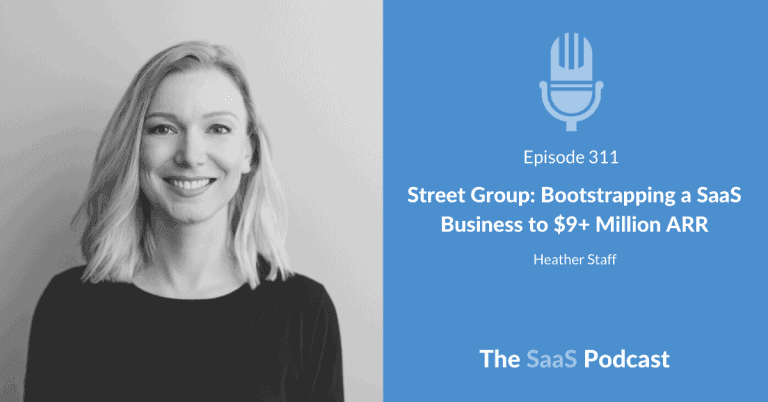
In this episode, I talk to Heather's staff and the co founder of street Group, a UK based B2B SaaS company that's modernizing the real estate industry and the process of moving home.
Heather and her co founder and brother Tom founded the business in 2016.
When Tom realized how much manual work his father was doing to run his real estate agency in the uk, he decided to build a software solution.
The only problem was that Tom didn't know how to code.
So he bought a book to teach himself PHP and started figuring out how to build a solution.
What Tom created for his dad was pretty basic, but it made a huge difference to the business and saved his father a ton of time.
After seeing what Tom had built, Heather decided to join him and see if they could sell the product to other real estate agents in their area.
Today their business does over $9 million in annual recurring revenue and they have a team of 85 people and the business is 100% bootstrapped.
In this interview, you'll learn how Heather and Tom went from 0 to over 800k in monthly recurring revenue.
Some big mistakes they made along the way, what Heather would do differently if they were starting over today, and why they chose not to raise funding and bootstrap the business instead.
So I hope you enjoy it.
Heather, welcome to the show.
Heather Staff (01:49.780)
Hi, thanks for having me.
Omer (01:50.980)
Do you have a favorite quote, something that inspires or motivates you or just gets you out of bed that you can share with us?
Heather Staff (01:55.860)
Yeah, I think one of my favorites is actually from Ray Dalio where he says in order to be successful, you have to be an independent thinker and bet against the consensus, if that makes sense.
And that's something that's always sort of resonated with us because when we started the business, a lot of people said, what are you doing?
It doesn't make any sense to me.
And you have to, you have to back yourself thinking, yeah, okay, we might be in the minority, but you know, independently thinking, you'll hopefully strike success.
Omer (02:25.170)
So tell us about the Street Group.
What does the business do?
Because it's not just one product.
Who are the products for and what's the main problem that you're helping to solve?
Heather Staff (02:34.530)
Okay, so in Street Group, we've got three main products, we've got two prospecting products.
So we build tech for estate agents and in the uk, so prospecting is basically a marketing tool.
So it's tech to help them market themselves.
And then we have a CRM or a state agency software which is called streets.co.uk so we have prospecting systems which are Spectre sales and Spectre lettings.
And then we have streets.co.uk, which is the CRM.
Omer (02:58.980)
And can you give us a sense of the size of the business?
What are you doing in terms of revenue?
What's the size of the team?
Heather Staff (03:04.660)
Yeah, sure.
So we're doing just over 600k mrr at the moment, actually slightly higher across the group now, so probably closer to 650.
And we've got 85 people at the moment with quite a few in the pipeline due to join soon.
Omer (03:18.870)
The 600k MRR is pounds.
Heather Staff (03:21.750)
That's pounds, yeah.
Omer (03:22.790)
So let me just do my quick conversion.
That's about 800,000 in US dollars.
The interesting thing is that you founded this business with your brother Tom and I did.
You basically put no money into this to get started.
So tell us about, like, how did you come up with the idea for this business and then how did you go about getting started?
Heather Staff (03:45.790)
Okay, cool.
So, yeah, me and Tom are brother and sister and I guess the first thing to say is that both of our parents had their own, and one of them still does have their own estate agency businesses.
So we sort of grew up, had our entire childhood surrounded by estate agents basically, or real estate agents you call them in the us.
So we knew the industry inside out.
I'd spent every summer when I was a kid and through university working in my mum and dad's businesses.
And I sort of followed a different path and ended up going to work for KPMG for 10 or so years, whereas Tom was always.
He set up various businesses and did a few things.
And Tom spent some time in my dad's business doing some consultancy work for him to try to implement tech to get them basically into the 21st century.
And it's while he was there he spotted something that they were doing manually, which was basically marketing in a very, very manual way to try to attract more business.
And in a nutshell, Tom thought, pretty sure I could develop this into a product.
So he spent his evenings essentially teaching himself to code and built what is now Spectre, which is the prospecting tool.
And yeah, he built that tool himself in his evenings.
And one Christmas, I was home for Christmas and he showed me what he's built and I've sold.
Oh, my God, that's brilliant.
That's absolutely brilliant.
It's going to save hours of somebody's time every day.
And I was like, yeah, can I come on board?
I think this is going to be huge.
So Tom was like, yeah, okay, let's do it.
And as you can imagine, everybody in our lives were a bit like, you've built what for who to do what.
But it was brilliant and it worked.
And we obviously had the luxury of being able to test it in our dad's business and we knew it was generating him instructions and that's what matters for estate agents, tech that works, easy to use, that generates more business.
Omer (05:29.040)
Had Tom built anything before?
This was the first time he decided to go out and learn to code and build a product.
Heather Staff (05:35.360)
Yeah, he's just got one of those brains.
He just bought a PHP textbook and thought, I'll give it a go and did it.
And I mean, he looks back now and he jokes about how awful it is and it's now been essentially rebuilt.
I'm not sure there's much of his code left, but he did do it and it worked.
And it was very simple system, but it generated results.
Omer (05:54.290)
How long did it take him to build that, that first version of the product and what was the experience when he started using it with your dad's business?
Was this like something that immediately, I mean, if it automated what they were doing manually, there were some benefits there.
But I'm trying to figure out what point did this become, oh, here's a tool for dad to run his business.
Better to wait a minute, there's a business opportunity here.
Heather Staff (06:17.170)
I think he tested the concepts basically at the start using Excel and a few of the things and thought, yeah, okay, I could actually automate some of this, Started building it, got it to run and generated.
It actually generates letters, the prospecting tool.
The end product is letters and postcards.
So he did that, it worked.
And then as soon as he knew it worked for one agent, there was absolutely no reason why it's not going to work for every agent.
So at that point we sat down and we wrote physical letters.
We just picked some agents in the northwest of England and wrote to them and said, look, we've, we've developed this tool, we've tested it, we think it works.
Would you like to beta test a new product?
And an amazing amount proportion of those agents actually came back to us and said, yeah, we would, we'd be interested.
And that was essentially the start.
And then, yeah, looking back, it was, you know, version 1.1, it wasn't the most sophisticated, but we quickly built on it and carried on building.
And as with every tech product, what it looks like now is very different.
But that was the version one, basically.
Omer (07:15.900)
Had either of you run a business before that?
Heather Staff (07:18.300)
Tom had.
Tom had run an inventory business which is related to the property industry, so he'd been doing that for a few years and we'd both set up sort of little businesses whilst we're at university, but nothing particularly serious.
So this was the first one where it really took off.
Omer (07:33.500)
Now, most founders, when they build a product like this and they're thinking about how to go and get their initial customers, some of them are going to build a landing page and try to get Google Ads to drive some traffic there, or they're going to build an email list and try to do cold outreach or a whole bunch of other things.
I think nearly all of them wouldn't think about doing direct mail and handwriting letters.
So why was it that that was the route that the two of you decided to take?
Heather Staff (08:02.250)
Yeah, I think that's a fair question.
Well, the first thing is it was a new product in a new category.
So it wasn't like estate agents were googling, how do I automate this?
Or they were doing it very manually.
They literally, most agents back in the day used to have people who would drive around the streets and they would spot state agency for sale boards and they would write down the address and then they would manually market to those properties, which probably wasn't great for the environment either, but that's what they were doing.
So we knew that agents weren't searching for a prop tech or a tech tool to replicate that because it probably.
Well, it didn't exist until we built it.
So Google and the traditional avenues we knew weren't going to be as effective for us.
But also we didn't want to choose a channel, a marketing channel that was already saturated.
There's a famous book called Traction, which is all about trying to pick a channel that your competitors or other people in the industry aren't doing.
And direct mail, at that time, seven years ago, people were all about digital and we just thought, you know what, we'll just do a handwritten letter and hopefully it will catch their eye.
And the beauty of estate agency is most estate agents are small independently owned businesses.
And so if you write to the owner at an address, it could hopefully get into the hands of the decision maker.
And that's exactly what it did.
And we just spent hours and hours into the Night handwriting these letters and sending them.
Then once we knew we got the response rate that we were hoping for, then I remember it was a massive decision for us to try and buy an envelope stuffing machine, which we called the Dragon.
And we found one on ebay.
We went and we picked it up from somewhere like two hours away, drove it back, and that was the first big purchase we made.
But it enabled us then to send out a lot more letters.
And we were getting, you know, around a 5% response rate, which if you think about the cost of a letter, it's barely anything.
So we just carried on doing it because it was working.
Omer (09:49.150)
You weren't building this product in the 1990s, right?
This was like 2015, 2016.
So why do you think this was still a market opportunity?
Like, why hadn't anybody gone out there and tried to solve this problem before?
I mean, obviously I don't know what the right answer to this is, but what's your opinion on this?
Heather Staff (10:08.220)
My view is that the estate agency industry as a whole had been a little bit neglected from a technology point of view, because you don't get a lot of agents.
The crossover in skill set between estate agent and developer is actually pretty rare.
So there weren't a lot of people in the industry who I think had the skills that were in that industry to then go out and build a product, to automate something.
So I think that was part of it.
And then I also think the estate agency industry has got a bit of a bad rep. Well, it's definitely got a bad rep in the uk and some of that comes from people thinking that industry is simpler than it actually is.
Estate agents, good ones, do actually do a lot of work and can add a material amount to the, the amount that you get for the sale of your home, which is typically somebody's biggest asset.
So I think there were a lot of people who sort of outside the industry looking in, thinking, I can build tech to solve this problem or this problem without necessarily knowing what it was like for an agent day to day on the ground.
And that was something that me and Tom knew inside out because we'd grown up with it.
And seven years ago, almost half the number of people that put their property on the market switched estate agent before they managed to sell.
So even that most people outside the industry wouldn't have any idea that that was a thing that people did.
But we knew that it was really important for good estate agents to keep in contact with people who were on the market because if their agent let them down they probably would look to switch.
And that's, again, something that you have to sort of be in the industry to know.
So I think it was being in the industry and knowing what agents needed and then having the expertise with Tom to actually build something to solve that problem.
Omer (11:42.860)
I think the UK is a very unique market in terms of real estate, and I've experienced that in buying and selling a home in England, buying and selling a home in the us, and they're completely different.
So I think even a US company that's in real estate would have a hard time figuring out how to navigate through some of the differences and challenges that you get in the uk.
Heather Staff (12:03.860)
Oh, absolutely.
It is complicated.
And you do want somebody who knows what they're doing to manage that for you would be my advice.
Omer (12:11.620)
So once you got this response from these handwritten letters that you were then using this Dragon to send them out, what would you do next?
If somebody replies and says, yeah, I'm.
I'm interested, how many people did you start getting to beta test the product?
Did you charge them right away, let them use it for free?
What was that process that you went through?
Heather Staff (12:32.790)
No, we charged them straight away.
And we were actually really expensive because what we did.
So we went out and the first few, we met them face to face and we sat down with them because they were all near where we were based at the time.
So we sat down and we showed them the product, and then you could visibly see them getting excited about it and you'd walk out.
And I remember the first one I ever did was actually in London and I walked out and I'd never felt so happy.
You know, when you build something and somebody's excited looking at it.
And I remember meeting a friend in the pub and I was like, I can't believe it.
They absolutely loved it.
He just signed it off.
So we knew we were onto something from the reaction of the agent seeing it.
And then we used a strategy of being exclusive to one agent in one agent per area, basically.
So if you were that agent and you saw Spectre, you could secure your area straight away if you signed up and started paying straight away.
And because we were bootstrapped, that was incredibly important because, A, we were able to charge a premium price, B, the sales cycle was incredibly short.
You know, they would hear about it, they'd see a demo same day and they could be paying an hour later.
And that is typically what they do.
And some of them would land grab, they'd be like, oh, well, I'm planning on opening a Branch in the next town.
So I'm going to get that as well.
And so that just fueled this huge growth for us, which came with its problems further down the line.
But that's how we grew initially basically getting in contact with agents via direct mail.
And then a lot of it came from word of mouth.
So we'd go out and we were exclusive.
So one agent would say to another agent in a non competing area, oh my God, you need to have a look at this because you want to secure your area before somebody else does.
So that word of mouth actually spread pretty quickly.
Omer (14:07.660)
How much were you charging them?
Heather Staff (14:09.100)
So we charged back in the day, 39 pounds per postcode sector per month.
And a postcode sector is a small subsector of a postcode.
So a typical agent would have probably 10 or more sectors.
So you'd be looking at 390ish pounds a month for them to secure their area.
And that was seven years ago.
Omer (14:27.070)
Got it.
This sounds like a very low tech operation and I love that because in this business of building products and software, we have this.
A lot of founders have this tendency to overcomplicate things and the hand letter approach is great.
But then when it came to actually getting payments, how are you doing that?
Heather Staff (14:47.610)
Well, yeah, I guess in one way you could say we were low tech with our marketing, but in everything else, we employed every bit of tech you can imagine.
So we automated everything we could from a back office point of view.
We obviously used things like Xero, we from day dot, we integrated with GoCardless.
So everything was paid by direct debit.
So when the agent signed up, they signed up to a direct debit.
The payment was taken automatically, they paid monthly in advance, which again, from a bootstrapping point of view, funded everything because payment in advance meant we could fund the growth.
So all of that was automated, the invoicing was automated, collections were automated.
Once they'd signed up, it was a case of giving them their login details and doing an hour's training call and off they go.
And then we used as much tech as we possibly could in the background.
So yeah, everything we could to make sure that we had as few people as possible.
And we relied more and more on tech as we grew.
Omer (15:39.960)
How long did it take you to get to your first 10 customers?
Heather Staff (15:42.360)
Probably about two or three months, I would say maybe two months.
Omer (15:46.040)
That's a pretty strong signal that you're onto something there.
Heather Staff (15:49.880)
One of the first ones was a huge agent actually that has 16 branches and they're still a client Today.
And we're never forget that, because he took a massive gamble on us for such a big company.
So we've tried to look after him ever since.
Omer (16:02.460)
Okay, so you got to your 10 customers.
You've been taking this manual approach with your marketing.
The product's clearly resonating with people.
You're getting a good response rate.
Did you just keep doing more of the same to get to 50, 100 customers?
Was it as straightforward as what you experienced with the first 10?
What did that trajectory look like as you went beyond the first 10 customers?
Heather Staff (16:25.600)
We carried on doing direct mail.
We always have.
We still do to this day.
But we did branch out into different things.
So we started doing industry E shots through the industry press.
We went to the trade shows and exhibited and we went for very, very different type of branding than every other company at the time.
So we really stood out.
We were dark branding with what we called Spectre, which was before the James Bond film, but people hated that it's a good or a bad thing.
We did get a cease and desist letter from MGM at one point.
Omer (16:54.620)
Wow.
Heather Staff (16:55.740)
Yeah, thankfully we won that.
So it is our risk to trade now.
Yeah, yeah.
Only because here's a tip, we had business insurance that covered our legal fees to fight that.
So thankfully we were covered and we fought it and we won.
So, yeah, we can use Spectre.
But, yeah, so we did the usual thing.
So trade shows, industry eshops, cold emailing, cold calling, not that much cold calling, to be honest, but we did a bit of it.
I walked into some branches sometimes and just said, hey, can I talk to you about a product we've built?
And that worked.
So we did a little bit of everything.
And then as we got a little bit more sophisticated, one of the most successful marketing campaigns we did was actually we sent boxes to agents branches, and inside the box it said, the game has changed.
And then there was a poker chip.
And the poker chip had a unique number on.
And we said, head to this and enter in your poker chip number.
So they did.
And then there was a bespoke page for them and we'd linked it all up to the area so they could see all this really great detailed data about properties on the market in their area and it's personal to them with their competitors and all this.
And it was just that.
That worked really well.
We got.
We used a marketing company actually, who came up with us and came up with that idea for us, and that did get an enormous response.
Omer (18:08.460)
So today you're doing.
What did we say?
About 800k k US.
So over 9 million ARR.
How long did it take you to get to your first million from when you launched the product?
Heather Staff (18:21.070)
Good question.
Probably a couple of years, I would say.
We, we had a. I mean, we grew very, very quickly with the exclusivity and the premium price.
But after about a year and a half, we reached saturation pretty quickly in terms of, oh, you know, it was inevitable and it funded the rapid growth and got us out there in the market.
But there came a point where we were like, oh my God, we've now got competitors or copycats coming into the market and we really are punishing ourselves here because we've limited our growth.
So we had to make the really painful decision to get rid of the exclusivity, drop our prices and communicate that to our clients, which obviously was not fun at the time, but had to be done.
And we did it in the best way we could, gave them loads of advance warnings, said, this is how much your invoicing is going to come down.
This is why we're doing it.
And we were really transparent about it.
We said, there's other people coming into the market trying to do what we're doing.
So the exclusivity that we're offering you is only really exclusivity with us, where there are other products out there, and explained everything and gave them enough warning as possible.
And we only lost one client off the back of it.
But that obviously meant that in that month when that dropped, our MRR dropped significantly because we dropped our price by about 35%, I think 40% maybe.
So we took a hit on that month, but then obviously it grew very quickly after that going forward.
So painful decision at the time, but best thing we ever did.
Omer (19:45.770)
So there are two issues that I had there.
One was this was effectively a new category when you started out and after a couple of years you're seeing these copycat competitors coming through.
Let's talk about that one just a little bit.
Because some of these were like literally copycat competitors.
Heather Staff (20:01.030)
Yeah, the first one we ever heard of, I was actually out for a meal at the time and one of our clients emailed me and it was a really not nice email and said, I can't believe you're charging me for exclusivity where you've clearly rolled out another product and just changed the colors under a different name.
So I was like, what are you talking about?
Of course we wouldn't do that.
And then he sent me the link to this website and they had Literally copied and pasted the wording from our website and the look and feel of our website, the screenshots of the software itself, it was laid out identically with the same menu items, literally just different colours.
Yeah.
And it was one of those moments where you just say, oh, my God, who is this?
What are they doing?
And we just went straight to the lawyers and we were like, is there anything we can do about this?
And we got Barrister involved in all sorts.
So we desperately tried to fight it and we did get some victories.
So she had to change her wording on the website and she had to change various things, but fundamentally she could carry on doing what she was doing.
So that was the first time we were like, obviously people now who are going to try and do the same thing.
Omer (21:04.780)
Yeah.
Tell me a little bit about what you went through, you know, emotionally, when something like that happens.
I think a lot of founders have this fear that what's going to happen with competitors, and especially if you're into a new market, a new opportunity, a new product category, it's inevitable that it's going to happen at some point.
But when it happens, it's still not a very pleasant experience.
Heather Staff (21:28.330)
It was awful.
I think every business owner must feel this, because you do feel things personally and you can't help but let it affect how you feel.
And the emotional side of it is really tough.
I mean, there was two things with that.
Firstly, I thought, oh, my God, our clients are going to think that this is what we're doing, because that was the first instance that we'd heard about this at the website.
And I was thinking, oh, my God, I really hope people don't think that is what we are doing and that we lack the integrity of actually doing that.
Because we'd actually had approaches by that time from other companies who said, look, I'll just buy the data from you, but I'll buy it with my mortgage arm, so you're not selling it to other estate agents and you can just get it around it that way.
And I'd said, well, no, because that's not what we're about.
And I understand what you're saying.
Technically, yes, we could do that, but that's not who we are.
And I remember his exact words.
And he said, fine, but I think you're being, frankly, uncommercial.
And to this day I remember it because I was like, yeah, but at least I'm acting with integrity and whatever.
And then this happened and I thought, oh, my God, this is major and you can't help but feel it.
So we probably reacted, anyone would.
And it was like, we're going to fight this.
We'll go to the lawyers, we'll get it shut down.
And then over time, you realize that, no, you can't.
You've just got to deal with it and compete on your own merits.
And whilst our system looked simple from a user interface point of view, in the background, by this point it was actually a very sophisticated system.
And we'd had a good 18 months, two years of learning and developing behind the scenes in terms of the integrity of the data and the accuracy of the data, which is incredibly important with a product like ours.
So after a while you got used to it and you just thought, we've had so many competitors.
Cuts spring up over the years and they come up and then they fade away because it is more complex than it looks from the outside.
So I've got used to it now, and I don't feel it as personally as I used to, but I definitely did at the time.
Omer (23:17.910)
So this was one sort of dynamic at play here where you've got these competitors coming along.
But even if that hadn't happened, I'm guessing at some point growth would have plateaued anyway, because offering this exclusivity meant that there was a ceiling that you were going to hit at some point and you couldn't go go beyond that.
And I'm assuming that offering the exclusivity at the beginning was probably because, hey, here's a great way to further incentivize people to be able to charge more of a premium.
Was it also because maybe you and Tom were not really sure how big this business could be.
So if you could get a hundred state agents to sign up, that would have been a great place to be.
Heather Staff (23:58.680)
A hundred percent.
I think we look back and where we were back then, we thought, is this going to work?
How big could it get?
And then we were like thinking, well, if we reach that saturation, God will be laughing.
You know, that was a nice problem to have.
Ha, ha ha.
And then actually gets there and you think, actually it is a problem now, so we are going to have to do something about it.
And I think that's one of the biggest regrets that I think I have, or biggest mistakes that we've made.
Was thinking quite small in the early days because we were bootstrapped.
I think it was our own money.
So we were like, we'll target this area first and then we'll grow into this area and this area.
In hindsight, we should have gone nationwide.
And we should have done it straight away and we should have hired people straight away.
But we didn't.
And we were very cautious and considered with our growth and I would definitely not do that if I was doing it again.
Whilst you one of one, you might as well go big and yeah, definitely.
What you've just said, I think is spot on.
I think we had a smaller mindset than we should have done and that's why we had the exclusivity.
Would I have not had the exclusivity?
I did it again, I'm not sure because it did make us go viral, if that makes sense.
With very little marketing.
Omer (25:01.750)
Right.
So there was scarcity and it was like, you know, people buying like.com domains.
I don't know if I'll ever use it, but I'll buy it anyway.
There's a deal here.
Heather Staff (25:09.720)
It was exactly that.
Yeah.
Which worked really well for us.
So pros and cons, I would say.
But I would definitely have still grown faster if I did it all again.
Omer (25:18.960)
Okay, so yeah, I want to talk about the growing faster.
But when you started to communicate to these people who had bought into this exclusivity, you said you lost one customer.
Were people, even the ones that stuck around, were people upset about this?
Heather Staff (25:33.610)
Yeah, we did have some emails back to say that they were disappointed and this is one of the reasons they signed up.
And we just tried to over communicate because we thought we can't shy away from it.
We're going to have to hold our hands up here that we are changing.
So we wrote basically a letter and it was an email, but in the style of a letter signed off by me and Tom.
And we just tried to be as transparent as possible.
This is why we're doing it.
We're now unfortunately not the only product in the market, which was a risk in itself.
We didn't really want to highlight that there were other products coming in, but that was the truth.
We weren't an exclusive product anymore.
Here's what we're going to do.
Because our hand has been forced, we will reduce your price and we hope you can understand.
And we're giving you, I think it was three months warning.
So if you don't want to continue with us, we totally understand.
Then blah, blah, blah.
And then there's only one client who really spies this dummy out.
Omer (26:24.680)
Okay, so let's go back to what you just said earlier about if I was doing this again, I would have done this a lot faster.
Now you bootstrapped this business.
You've never raised Any money and you are pretty close to hitting the eight figures in terms of 10 million.
ARR.
What do you think you would have done differently to grow faster than you did?
Because it doesn't seem to have hurt your business.
Heather Staff (26:44.360)
I think in hindsight we, we open or we left the door open for competitors to come in and enter the market because they were thinking, okay, here's this business, it's clearly doing well, but they're not everywhere yet.
And that's probably quite appealing to people on the sidelines who are looking in.
Whereas if we had have grown faster and would have just gone for it, recruited faster, spent more marketing, stopped hand signing letters and just done it, I think we could have tied up the market a lot quicker and made it more difficult because there are certain things where people talk about the moat that you get in certain things.
And one of those things for us is, is that the end product of Spectre, the prospecting tool, is physical letters and postcards.
More letters and postcards that we send, the better the postage rates we get.
So the volumes that we were doing meant that we could pass on enormous savings to agents with their marketing and we could have made that so difficult for somebody else to come in that actually maybe we would have had fewer competitors.
Now, it might not have been the case, but 100%, with what I know now, I would have put grown significantly faster, recruited earlier, recruited more, spent more on marketing and just gone for it.
Omer (27:53.310)
But as you and I were talking about this before we started recording, in hindsight, that's a lot clearer.
When you're in that situation and it's your own money, it's much harder to actually pull the trigger and do those things.
Heather Staff (28:04.550)
Right?
That's exactly right.
And I think there are obviously benefits of bootstrapping in that we've retained all the equity, but that's the downside.
When it's your own money, you think about things a lot more and you're a lot more cautious with what you do.
And there are downsides to that as well.
And it is that if there was somebody else's money there, early doors, would we have been as cautious?
Probably not.
We would have just, you know, gone for it.
So I think there are pros and cons, and that was.
That's the con of bootstrapping, is that you are much more cautious or we were.
Omer (28:34.290)
Why did you decide that you weren't going to raise any money?
Because potentially the business is in a great place right now.
Bringing in some VC funding could help fuel that growth even faster.
And Maybe you'd look back in another five years time and say, oh, maybe I should have grown faster.
But what's been the driver for you to stay as a self funded business instead of going out and raising funding?
Heather Staff (28:58.150)
I think the honest answer is that we've not had that need for the cash because of the way the business is structured.
Monthly recurring revenue, paid in advance, high margins.
Particularly in the early days, we didn't need the cash.
We weren't consciously thinking we're not growing fast enough or we would be growing faster if we had more cash.
So it was never something that we thought we need to do.
It's not something that I'd say we'd never do.
It depends on because obviously we've got street as well now, which has got enormous potential.
So I'm not saying we would never ever do it.
But whilst we haven't had that burning platform, it isn't something that's been high priority for us.
And the other thing is we've got a great culture and I'm not saying VCs or PE would change that, but there have been certain advantages to it just being me and Tom running the business in the way we want to run it, and there have been certain times where we've pivoted, we've changed direction really, really quickly and that's definitely been an advantage for us.
So for example, that new competitor springing up on the scene and us deciding to get rid of the exclusivity, we were able to do it, make that decision within a day and implement it.
Whereas I imagine if we had people that we need to sign off such a fundamental decision with, it would have taken a lot longer and they might have said, absolutely not, don't do that.
There have been other things as well, like in the middle of lockdown, we'd outgrown our office and we desperately needed to find an office that was big enough for us all.
So we started looking around offices in Manchester, couldn't find anywhere.
Eventually found somewhere, was looking at about 15 grand a month rent.
Ended up having a conversation with the landlord who owns the building that we're in.
And he basically said, look, if you buy this building off me before March, because he thought there was going to be a big capital gains tax change coming in, he said, I'll give it you at a discounted rate.
We made what could turn out to be a really bad decision, but at the moment it feels like a brilliant decision to buy the building that we're in and refurbing it plenty of space.
For us all and paying less in the mortgage repayments than we would be if we'd have taken the building that we were going to in terms of rent.
So things like that, we were able to just make quick decisions.
Other things that we spent a long time last year building a freemium product, and we were just about to roll it out and we thought, sorry, this is the year before last time.
We were like, property market's looking a bit weird.
Let's just hold off.
And then the property market in the UK has been.
I think it's the same in the US has been crazy.
So for the last 12 months, and thank God we didn't make that decision.
So there's just certain things that I think just being me and Tom would be able to make quick decisions, change direction.
If we needed to buy buildings if we wanted to, that served us quite well.
But that's not to say we wouldn't look to raise in the future.
We may well do that.
Omer (31:31.130)
So we talked about the challenges of the competition and the copycats, and we also talked about how some of the difficulties you went through in terms of moving away from this exclusivity to help grow the business and be more competitive as the market changed.
As a founder, what was one of the hardest parts of building this business and a business that's grown pretty rapidly.
It was only a few years ago where you hadn't run a business before, and now you've got a team, nearly 100 people.
So there's been a lot of changes going on there.
And what's been one of the biggest challenges for you over the last few years?
Heather Staff (32:07.040)
But we've touched on not growing fast enough.
I think we've covered that.
I think the other thing is, I think we made mistakes along the way, hiring for the tech experience or technical experience in growing the team, where we prioritize that above, whether there'd be a good cultural fit.
And I guess everybody goes through this and maybe it's one of those things that you do have to live through and make those mistakes to learn from it.
But, yeah, picking the right people, early doors, we got really, really lucky.
And with some people, but we made mistakes with others.
And then you have to go through the pain of undoing that.
I think the emotional ups and downs for any founder is always.
I mean, the highs and the lows are amazing.
The highs are amazing.
The lows are painful.
When it's your own business and things like copycats coming up and competitors entering the market, you just have to get used to it.
But every time you do feel it a little bit, I'd say those are the hardest things.
Omer (32:56.410)
So one other question, in terms of product strategy, we often hear founders focus the one thing, all of that stuff, and you guys decided, we're going to build Activity 3 products.
So one, like, why do that?
Why not focus on one thing?
And then secondly, why are they even marketed as three products?
Why isn't it just one uber product that does all of the things that you offer today?
Heather Staff (33:25.890)
Yeah, I think that's a really valid question.
And I think truthfully we have made mistakes with certain things here because Spectre grew and it grew really quickly.
And the first product that we then started to.
The second product we started to make with Spectre Letting.
So the first product was all to do with the sales market.
And then one of our biggest clients, in fact the biggest client we had at the time, and a very well known top end of the market estate agent said to us, why have you only built this for sales?
We want it for our lettings team.
And we feel like lettings is always like the forgotten child of estate agency and we'll help you build it if you build it.
So they forced our hand with that one because they offered us up time with their director of lettings to shape what this product would look like.
And so that's how the second product, Spectre Lettings, came into being.
And that again, like one of the best things we've ever done because it's a different market.
We had the sales market and then we developed this product for the lettings market with the help from one of the best agents in the country.
And that worked very well.
So that was natural.
But we did make other mistakes.
We made the mistake of trying to launch a product into a different industry because we had this data that we knew was really valuable and we were only selling it to estate agents, basically.
Whereas we thought actually there's loads of other industries that would get enormous value from this.
So we set up this new product, we had a different name, we hired different people and it was just, it just didn't work anywhere near as well.
Massive diversion of our time, massive distraction and waste of time ultimately.
So we did make mistakes along the way as well.
Then we did another product called hello Again, which was all about helping agents keep in contact with their past purchases.
So getting repeat business basically launched, that should have been massive.
It was a brilliant product and it worked really, really well, but just didn't grow anywhere near as how we, how we expected it to.
So we then made the decision to move that product into Spectre Sales and just have it as a new feature in Spectre Sales.
But again, if we'd have done that from the offer, to save a lot of time, marketing effort, expense, admin, blah, blah, blah.
So we did make mistakes.
But then one of the biggest things that we basically, in this industry, there's lots of little prop tech suppliers that have grown up in the last 10 years that are solving niche independent problems for estate agents.
And Spectre is one of those things.
But over time, and this is almost from day one, me and Tom were getting increasingly frustrated that there was no one or innovating in the space of the software that they're actually using to run their business on a day to day basis.
And that's when we made the decision to start to build street, which was an enormous investment.
It took us three years.
This is another benefit of bootstrapping, by the way, because if we'd have gone to a VC or a PE and said, hey, we've got this product, it's doing really well, it's growing really fast.
But actually what we want to do is sink three years into building a new product that's going to cost us millions of pounds.
Can we do that?
I imagine most of them would have been like, no, absolutely not, stick to what you're doing.
But we just saw that the future was that somebody has got to take the space and build a product that's fit for today and tomorrow.
And if you looked at the incumbents, they were, they hadn't innovated for a long time.
So we made that decision.
We started to build street.co.uk for agents which build, which makes them incredibly more efficient.
It's modern technology with an open API, so it can plug into all the other tech suppliers if we want.
But crucially, it also has an interface for the consumer, so it makes moving a lot easier for home movers as well as for estate agents.
So you can log in, you can do the things and see the things that you would want to do when you're moving house, which, let's face it, is quite a daunting prospect for most people because it's a big thing.
So actually having some transparency and help and guidance through that process and being able to do things online is, I don't want to say a game changer because it's overused, but it is a game changer for this industry because it's not been done before.
So it was a massive project for us to do, but naturally we've launched it and it's gone down incredibly well.
So that's growing really quickly.
And the power of street, the CRM and the property software with the marketing tool Spectre is amazing.
It's like HubSpot where you've got your CRM and your marketing in one tool, but it's this but for estate agents and specifically for this industry.
So that's why we did it.
And yeah, we have made mistakes with certain products along the way, but other products have done really, really well.
Omer (37:43.780)
And I think it goes back to where we started this conversation, which was where you said this idea of being an independent thinker, that sometimes not following conventional wisdom and instead following your intuition or your gut on what you believe is the right opportunity.
Even if everybody tells you you're crazy or what the hell are you doing, maybe that's often the right way forward, but it's always hard to innovate if we're just doing what everybody else is doing.
Heather Staff (38:09.350)
I honestly think there's not many industries left where pretty much everyone can identify the pain in this industry and how painful it is to move or to rent or to go through that process.
You don't normally find somebody who says, yeah, I had a really nice easy moving experience and unfortunately I think estate agents get a lot of the flak for that, but actually they often don't deserve it.
Sometimes they do.
I'm not saying all of them are perfect, but a lot of them are trying to do this with very old technology.
I mean on premise tech that is like looking at some sort of 80s submarine.
Whereas what we're doing is introducing modern technology that the consumer loves, it guides them through the process.
You get that transparency, you get the help doing what you want to do.
And I think there's a genuine opportunity to make a difference in an entire industry, but also for every single person that ever has to buy or rent or let or sell.
So, yeah, it's exciting.
Omer (39:01.190)
Yeah.
I remember when we sold our place in London back in 2000, I don't think anything was happening over email or online.
It's mind blowing that it's an industry that's kind of lagged for so long.
Heather Staff (39:15.590)
It has.
And I think one of the reasons for that is because who is going to build this technology for estate agents?
It's complicated.
You do need to understand the industry and there's lots of parts to it.
You don't just have the estate agency part, you have the whole sales progression part through to sell, which is complex.
So other than us, where we had the luxury of Having a profitable product and all the relationships with estate agents and a good reputation in the industry, it would be very difficult for somebody outside of the industry to come in and say, hey, I'm unknown, but I've built this product.
So estate agents, do you want to trust me and put your entire business on it?
Because they'd turn around and say, absolutely not.
Who are you?
And then within the industry, who would have had the luxury of spending three years and millions of pounds building a product to the point where it was ready.
Because in tech, with Spectre, we definitely had an MDP and a minimum viable product.
But with street, we couldn't do that.
We said it had to be a minimum lovable product because you couldn't have issues with the software that estate agents use all day, every day that is absolutely mission critical for what they're doing.
So we did have to take our time with it and we had to get it perfect.
So we recognized that opportunity.
We recognized that we're very few people who could come in and actually build this and genuinely make a difference to this industry.
But we had that platform, so we decided to take it on.
Omer (40:31.940)
Awesome.
And on that note, I think we should wrap up and get onto the lightning round.
So I've got seven quick fire questions for you.
Just try to answer them as quickly as you can.
Okay.
What's the best piece of business advice you've ever received?
Heather Staff (40:47.350)
Read books.
Read lots of books.
Why learn from your own mistakes when you can learn from somebody else's?
Definitely, definitely do that.
Omer (40:54.150)
What book would you recommend to our audience and why?
Heather Staff (40:56.710)
Best sort of people management book I've ever read is Radical Candor.
I'd recommend that to anyone.
Really, really, really good in terms of how to manage people, how to talk to them and get the most out of them.
From a SaaS point of view, predictable revenue.
God, that helped us loads in the early days and there's still some principles of that that we follow today.
So yeah, those would be my big two.
Omer (41:15.600)
Right.
What's one attribute or characteristic in your mind of a successful founder?
Heather Staff (41:20.240)
I think striving for the next thing.
So you're never happy with what you've got.
You looking for the next idea and the next opportunity.
You can't ever be happy with standing still.
You've always got to be thinking about the next thing.
Omer (41:33.460)
What's your favorite personal productivity tool or habits?
Heather Staff (41:36.300)
I think I've tried every single productivity tool there is going and I always come back to a physical to do list.
But one thing my mentor told me that I've used and it's stuck with me is have a column on your to do list where every morning you scan down the to do list and literally write the initials of who you can delegate any of those things to and do it and delegate.
Because I think that's one of the biggest issues I have is I would just not delegate.
And that's exactly what I did.
So physical to do list, but a little delegation column.
Omer (42:08.669)
What's a new or crazy business idea you'd love to pursue if you had the extra time?
Heather Staff (42:12.430)
Oh, do you know, this is actually a really stupid one, but it used to really annoy me when I used to go out and I get red wine stains on my teeth.
So I started doing some research into could I come up with a product that would get rid of Italian stains on your teeth?
And I did.
I developed it.
This is when I was in uni and then when I was in Japan a few years ago, I saw that they are a thing.
So I'd like to bring those things to the uk.
They're called the Wine Wands.
Omer (42:38.940)
Love it.
What's an interesting or fun fact about you that most people don't know?
Heather Staff (42:43.420)
I would say that I used to play for Manchester United girls team.
Most people don't expect that.
Omer (42:47.620)
Wow.
Yeah, you've got some interesting facts there.
Like the MGM thing and that was a pretty fun one as well.
And finally, what's one of your most important passions outside of your work?
Heather Staff (43:01.320)
I think the biggest passion I have is actually learning.
I love reading business books, any sort of books where I can learn from other people.
I think that has become my passion over time, which might be a bit sad, but it's true, unfortunately, learning new things and implementing them.
Omer (43:16.940)
Love it.
All right, Heather, thank you so much for, for joining me today and sharing your story is.
I think there's a lot that's happened over the last six years of building this business.
I think it's also really useful for people to hear how you've gone on this journey and some of the.
The non conventional things that you've tried and not following conventional advice in terms of how you build the business.
I think that's really always useful for a lot of people who maybe just need to think a little bit differently to get that next breakthrough.
So.
So thank you for sharing those lessons with us.
If people want to find out more about Street Group and all your products, they can go to street group.co.uk is that the best place to send people to?
Heather Staff (43:59.190)
Yeah.
And they can see all of our products from there.
Omer (44:01.430)
Right.
And if folks want to get in touch with you, what's the best way for them to do that?
Heather Staff (44:06.480)
Just heather street.co.uk.
Omer (44:08.560)
wonderful.
Thank you so much, Heather.
Heather Staff (44:11.280)
Thank you for having me.
Omer (44:12.320)
Yeah, it's been my pleasure.
And I wish you and the team the best of success.
Heather Staff (44:15.280)
Cheers.
Really enjoyed it.
Thank you.
Omer (44:16.720)
Cheers.