Omer (00:09.280)
Welcome to another episode of the SaaS Podcast.
I'm your host Omer Khan, and this is the show where I interview proven founders and industry experts who share their stories, strategies and insights to help you build, launch and grow your SaaS business.
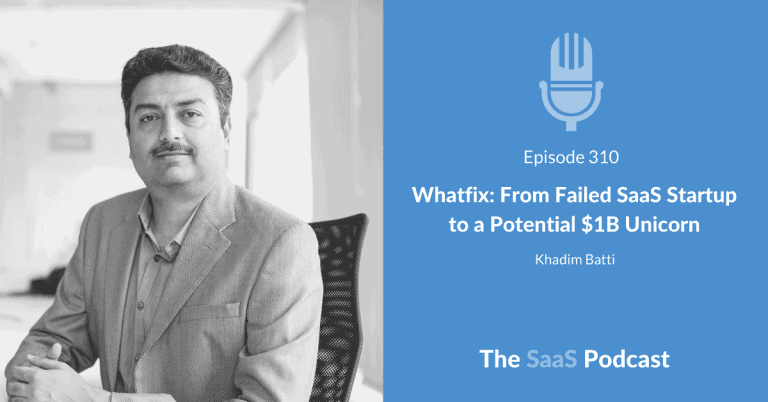
In this episode, I talk to Khadim Bhatti, the co founder and CEO of WhatFix, a digital adoption platform that helps businesses simplify training and support.
In 2014, Hadim and his co founder Vara launched a new SaaS business called WhatFix.
In eight years, they've grown their company to multiple eight figures in ARR, hired over 600 employees, and they've raised $140 million in VC funding.
It sounds like another great Silicon Valley startup story, but it isn't.
Both these founders were based in India.
Prior to founding what Fix.
They spent three years building another product that never really got traction.
Both founders came from an engineering background, so they ended up spending too much time trying to build a great product and not enough time talking to customers.
During those three years, there were many times when they wanted to quit and go back to their corporate jobs, but they just kept going.
At one point, they realized that there was one feature in their product that their customers seem to be most interested in.
In fact, it wasn't even a product feature, but a tool they'd built to help their customers learn how to use their product.
So they decided to shut down the product they'd been working on for three years and instead focus on turning that tool into a new product.
But this time they took a very different approach.
They spent most of their time talking to customers and validating their idea.
And they didn't start building the product until they made their first sale.
In this interview, Khadim shares his lessons on the mistakes they made in building their first product.
And we dig into how they took a very different approach the second time with what Fix and how they've gone from zero to a company valued at about $600 million.
So I hope you enjoy it.
Khadim, welcome to the show.
Khadim Batti (02:13.900)
Thanks, Omer.
Happy to.
My pleasure.
Omer (02:15.740)
Do you have a favorite quote, something that inspires or motivates you that you can share with us?
Khadim Batti (02:19.980)
Yep.
I like one of the quotes from Jim Rohn, a motivational speaker, that you are average of five people you spend time most with.
So I think that indirectly actually helps me to keep looking for for to hang around with people to hire people who actually bring a lot more value or who are more capable than me and actually keep help me keep growing
Omer (02:42.390)
and so tell us about what fix, what does the product do, who is it for and what's the main problem you're helping to solve?
Khadim Batti (02:49.110)
Sure.
So let me talk a little bit about the macro.
As per Gartner, there is going to be around $600 billion worth of enterprise software getting sold a year.
And if you look at enterprises which are buying them, it translates into having more than 900 softwares inside an organization.
Now further, if you deep dive like on an average each employee has access to 1520 software applications which they have to use on a day to day basis to be more effective or productive.
Now if you look at employees again or any individual, like in last decade or so, everything has become on demand, be it doing some purchase or shopping on E commerce like Amazon or movies like Netflix or Uber.
When it comes to onboarding, it comes to learning or being more productive, we have still been asked to go and look at the documentation or look at support or raise the support tickets for getting stuck.
So that's the problem we are trying to solve.
Like can we create a layer of experience or adoption where we can make an employee more effective and productive by helping them utilize the power of underlying technologies.
And for the enterprises which are spending hundreds of millions of dollars every year, can they get extract more ROI or can can get, they get better ROI in terms of digital transformation.
What they have in a layman term, if I have to explain what fix is nothing but a GPS layer on top of underlying systems which will help employees or any individuals to complete their task by providing them step by step in context, navigations, tips and actually empower them to learn in the flow of work.
Omer (04:27.160)
Basically this, this category of digital adoption platforms which I wasn't familiar with, familiar with what that actually meant.
So thank you for the context that really is helpful to understand what problem or your challenge you're trying to help organizations with.
Can you give us a sense of the size of the business today in terms of revenue, employees, customers?
Khadim Batti (04:47.500)
We are more than 600 employees globally.
We started from India, Bangalore, we have an office here and we expanded having a couple of offices in the US primarily in Bay Area and Atlanta.
So I have a co founder, colleague sitting out of Bay Area along with several of my leaders in product marketing, design, sales and so and then there is product engineering, other leaders sitting in India and I keep shuffling around.
Apart from that we have an office in uk, Germany, Australia.
So we spread across in terms of market and customers.
We have close to 600 customers which counts off all key players across industry.
We are, we, we cater across industry segments, we are agnostic 100 plus of top 1000 companies.
Our customer, they use what fix on several applications like CRM, hcm, ERP and so on.
So typically they start with one and then they start in terms of market size and all.
Digital adoption category is pretty huge.
As I was mentioning earlier, every large Enterprise has 900 plus software applications which translates into each enterprise be potential of few million dollars to us and overall pocket size of 20 billion plus.
Omer (05:50.740)
What are you doing in terms of revenue?
Khadim Batti (05:52.140)
We don't disclose the exact number, but we are in several multiples of eight figures in billion dollars.
Omer (05:58.830)
Okay, great.
And you recently raised.
Well, you've raised a total of about $140 million to date.
And earlier in 2021 you raised a Series D round for about $90 million, right?
Khadim Batti (06:14.029)
That's right.
SoftBank Vision Fund 2 led our last funding round.
Prior to that we had Sequoia capital leading our CDC round of 32 million.
And apart from Sequoia and SoftBank, we have Dragon Year, Cisco Investments, 8Roads f other Indian investors like Elyon Stellarace on board as well.
Omer (06:33.370)
Great.
So let's tell the story of how you and Vara built this business.
It was founded in 2013, but I think the story starts in 2010 when you launched a different business called Search Enabler.
So tell us just briefly what that business was and how you came up with the idea for that.
Khadim Batti (06:52.330)
Yep, sure.
So me and Vara have been working together now for 19 years.
So prior to that, prior to this starting up, actually we were building a business intelligence product line for Huawei Telecom.
We came out and we started this company and as you mentioned, we started building a new product, a product called Search Enabler.
So the idea there was globally small businesses were actually coming online rapidly and they wanted to leverage the social media and search for increasing their online presence and online business.
We thought we'll try to cater to this particular need by helping the small businesses who on how they can leverage their online presence better.
So we created the search and above platform which would crawl the web crawl the competition of this businesses give them a lot of recommendations in terms of how they can have a better presence on search, how can have their better presence on social media.
We got several customers or in fact like little over 100 customers.
Again, it was global.
We were not specific to region, it was global but focused on small businesses only.
The hypothesis went wrong here a little bit like we since it was a small business product had to be do it yourself.
Price points were 30, 40, $50 a month.
And the customers which we were catering to, the owners of the small businesses, they were not very.
They wanted a lot more handholding on the recommendations, what we were providing and if we wrapped up with services, we would not have scaled our search enabler solution at that point.
So we wanted to solve that self service capability problem or make our solution through diy.
And while trying to figure out different ways of helping customers, we tried creating some plugins, we tried creating a lot of tutorials, videos and so on.
But the one which resonated well with them was giving them step by step guidance inside their platform where they build their websites like WordPress, Magento or Jupna.
And that became what today is what fix.
So if I were to give you some small again detail, when we used to give a recommendation, there used to be a button along with them alongside called Fix it.
And when they used to click on a fix it button it would open their dashboard or a console and show them exactly what problems how they can fix those recommendations.
And even the name we derived from there from Fix it to what Fix.
Omer (09:09.810)
Got it.
Okay, so you worked on this product for about three years and you got some early traction.
But what was it that made you realize that you needed to pivot?
Khadim Batti (09:22.320)
Yeah, so I think it was unit economics.
The customers mostly were small businesses.
As I mentioned the price points we were looking at around 30 to $50 a month.
And the customers were expecting a lot more hand holding.
So we had.
It was not like a do it yourself.
It was like the expectations were do it for me.
Now if I have to start helping them to implement those recommendations for them to see their results, I would have had to wrap services around that.
And even though if I would have asked them to pay for few hundred dollars for that, it would not have been, it would have been really hard to scale and make it unit economically viable.
And also the folks which were actually resonating well and actually making use on a DIY basis were the experts of social media or SEOs professionals and all.
And we didn't build with the platform was not intended for them.
So either we had to pivot to go for that particular Persona which I which we thought the market is not that big or we or or for the Persona which we had built it was not unit economically viable.
The CAC and the gross margin would have been very difficult for us to navigate and build a large.
Omer (10:28.230)
Okay, got it.
So this, you've got some traction, but it doesn't look like this is going to be a big or interesting Opportunity and the economics of this are questionable.
And then you, you talked about this fix fix it component that you were using to help those customers.
Tell me about how did that one piece become the.
The effectively the product that you were then going to go and build.
Khadim Batti (10:53.080)
Yep, very interesting actually when we experimented with that fix it button and we implemented several flows which were like kind of we coded or we hot or we built ourselves like how do I fix a broken link for example on a WordPress or if I how do I add a meta tag or meta description in my Magento or WordPress so it would be open those applications, preserve Magento and start showing the step by step guidance in terms of fixing those.
When we actually launched this as a tutorial or as a helping our customers to fix those recommendations, some of them came back to us saying that can we use this capability for my customers?
Because I am facing some hand holding problems where my customers keep raising a lot of support packets or keep asking a lot of queries.
They're not able to use some of my features and this looks interesting, can I use it for that?
So that actually started made us thinking like we initially built it to make sure our platform becomes a diy but actually we ended up creating some kind of early concept which could be disruptive, which could actually solve a larger problem which customers a lot of companies face in terms of handholding the users, making the support more interactive or better or simplifying the onboarding and increasing the adoption of their own solutions.
We debated for three to four days because we learned at least we don't want to ride into two boats, we don't want to have two products because we were only two people company at that point we were very clear that we have to either continue with Search Enabler or we have to shut down and pursue another one.
Which was again a hard decision because we had already spent three years in Search Enabler.
But then finally after a long debate, we decided, okay, this looks disruptive, this can really become bigger.
And we formed all of our existing customer of Search Enabler.
We shut down and we started focusing on what fix.
And since initial traction or initial feedback came from small businesses, that's how we started actually focusing on what fix for small businesses.
Omer (12:46.600)
Now it took you three years to get to that point.
In hindsight, do you think you could have got there faster?
Khadim Batti (12:54.840)
For sure, I think we should have done this in a year.
But there were several mistakes we did.
Coming from a large enterprise, being me and Vara both being engineers, we were always on building solutions we were never, we never had a great opportunity to face customers during our initial jobs.
So we had a myth that solution has to be complete, solution has to be full fledged before we launch into the market.
So when we launched Search Enabler, it was already 14, 15 months of coding actually, or adding features.
We did actually.
That was a big mistake.
We should have actually validated the problem statement with the customers first.
With a mock up, we could have just built few features or a quick MVP in a couple of months or 3, 4 months at max and then gone to market.
When we went to market after 14, 15 months, we had built like a large, so many features and the features what we realized that customers were not even using them and they were not even getting onboarded correctly.
So we started cutting down features so that we ensure that customers use our product properly.
And when we saw the results like customers were using our system, we had by then thrown 40% of the features.
So imagine the amount of effort went into building those, validating those and throwing them again.
So actually we literally, we would have wasted one and a half, two years.
Omer (14:08.070)
Oh yeah.
And it's a difficult thing because on the one hand, rationally, we all know that the less time you spend coding and building the product and talking to customers and, and getting the idea validated is probably the right thing to do.
But there's just something about, I don't know what it is about.
Maybe it's just a product or an engineering kind of mindset that if we build this product and we just get it really polished, people are going to love it.
I don't know where that comes from, but you're certainly not the first ones to have gone through that.
Okay, so one of the things about this fix it button that I want to understand is that it sounds a little bit like what we see today with onboarding products where they're basically integrated into a product and sort of help and guide you through using a SaaS product.
But I know this is a little bit different.
So can you, can you just help us understand the distinction?
Khadim Batti (15:01.410)
Yeah, yeah.
So I think this whole onboarding momentum started in last three, four years.
And there are several different ways companies try.
But now for the specific use case, like for a, take an example of an employee who is trying to use a CRM or an ERP or CLM or cpq, some kind of an enterprise software.
Now there are multiple stages in the lifecycle of a user when they interact with an application initially when they are new, either application is new or employee is new, or a User is new, they want to understand first few features which will get them started.
So now here the number one, the first widget which what fix helps is actually onboarding with a task set of introductory features like let me hand hold you and show you around, I'm just going to introduce them.
So that's the number one thing which what fix does which few of the other onboarding tools that you mentioned also do that.
Once the person get accustomed to the application and they start working on the software they might need reactive based support.
Now the traditional support is documentation or tickets and all or the help knowledge base.
All those knowledge base are like verbose articles where they have to read and then perform.
So instead what fix again has an help embedded inside the software which the user clicks and as and when they need what fix will show them contextually based on the role of the person.
If Omar is a sales manager and if you're working on let's say on a sales cloud in a CRM I would show you or in Opportunity tab for example I would show you your most relevant help or most relevant content what you're looking as a manager in Opportunity tab.
And once you click that particular content or a help what fix will not show you an article, it will start telling you exactly what you're supposed to do.
So if you want to remove duplicate opportunity what fix will tell you how to navigate there and delete that.
So that's the number two reactive the third one when you start filling up the forms for example because most of the applications are system of records and you have to fill up a lot of information what fix helps in terms of helping you automate a lot of stuff and also ensuring that you fill up the correct information.
So we call it smart tips or which can be overlaid on top.
So for example if Homer is a sales rep working in New York for specific product line so I can and when you create a new opportunity what fix can actually fill up a lot of information automatically?
Okay, your region is New York, you typically sell product X, your dollar value will be always in USD and so on.
So it just helps you to become more productive.
And when you start filling up the information what wix will keep giving a nudge what is the typical information is expected here?
Fourth process compliances and new feature rollouts like Continuously Enterprises roll out new features.
Software vendors keep upgrading their softwares so you are a very professional user.
You have logged into the system the but now what fix will actually start nudging you saying okay, a new dashboard has been rolled Out Let me help you setting up those or these are the new release notes where four new features have been rolled out.
I can help you with those.
Finally, if you are let's say a call center employee or a sales or any employee, which you do some of the tasks very frequently, you can actually use same what fix flows in automated mode.
What fix will execute let's say for six or seven steps quickly get you to the form and you can actually nudge you there wherever some information is needed from you.
So you can even use what fix in an automated way.
So throughout the cycle, right from onboarding to ensuring that you are you get the help what you need in interactive way to making you more productive with automation.
Data validation.
What fix completes the whole life cycle.
Omer (18:42.910)
Okay, now so you've gone through the three years with search enabler.
You even make the decision that you're going to shut up that business down and you're going to focus on this fix it button and turn that into a product.
Do you basically start with zero customers again?
Khadim Batti (19:00.250)
Yes, that's right.
We started with zero customers but with better learning from a previous initiative.
Omer (19:04.890)
Okay, and so tell me about what you did next.
So you've had the experience of three years of some of the things not to do.
So how did you guys approach it differently this time with what fix in terms of finding those first customers and getting feedback?
Khadim Batti (19:20.510)
Yeah, so the first protocol between our first learning we had was like let's not build anything until we validate from the customers, potential customers.
So we already had some basic features fix it implemented.
So we brainstormed on what should be, what should it should look like when we pitch to customers.
So we created based on that landing pages with some messages.
We again did two or three landing pages based on Persona.
We want to target like product managers of a SaaS company or something and listed some features or some benefits or value value props.
When I actually started identifying email IDs and some use cases which we should pitch, I used to actually compose a personalized email and start sending them in a month.
Actually we did 500 primarily to small businesses, SaaS companies and all taking really relevant examples from their support pages.
How it can become more interactive, how it can help.
Actually I created some samples for each one of them and actually sent.
We used to do almost like 20, 25 a day.
We used to get one or two responses in first three months.
We got four to five commitments.
In fact the first commitment, if I have to say we had one hospital management system.
They really liked the product and they said, okay, we would like to sign up for this.
But we didn't have a full, we didn't have a working solution yet.
Actually it was a lot more prototype or some of the features what we had built for Search Enabler.
We told them, okay, we are actually working on, we are doing in a qa.
We are, it's in the testing phase.
It will take us three weeks to deliver.
We asked them to sign, we brainstormed with them, we pitched some pricing price points, they committed, we signed the agreement and actually we started building after that.
Omer (20:50.710)
Very different to what you did the first time around.
Khadim Batti (20:53.110)
Yes, in fact, what fix?
We were always running behind Search Enabler.
We were ahead in engineering, but here we were running behind based on customer request.
And again here actually we started building with the first one or two commitments.
But in now actually at that point we had another protocol between us.
Like we will not implement any features unless four or five customers ask.
Omer (21:11.620)
And do you remember how much you charged that first customer?
Khadim Batti (21:15.460)
So again, that's interesting.
So whenever we were used to give, we used to get a potential yes.
From our outbound saying, okay, we want to like to see the product.
We would like to talk to you guys.
This sounds interesting.
We used to validate different price points.
Like we actually validated from $10 a month to $1,000 a month.
We tried to validate and bounce different numbers and see the reaction on their face.
So actually we used to run wherever there was a possibility.
We used to run and meet them in person.
We just wanted to see how they react.
We thought, okay, the sweet spot would be around 100amonth.
And that's how we started.
And the first customer was around thousand dollars ARR.
Another thing was we thought, okay, let's charge them annual upfront.
Omer (21:54.200)
And the reason for being so broad with your pricing was it because this was a new category and there wasn't a bunch of established players that you could look at to get a baseline or what was going on.
Khadim Batti (22:07.090)
That's right, actually because we were still figuring out the value prop.
We were still working on identifying the right Persona, the segment, what would be the ROI for them, what would be their budgets.
So I think it was all unknown.
And we wanted to by evaluating, by throwing different numbers and so on.
Actually today it's quite different.
When we look back, we started at around approximately $1,000 ARR.
Today we have like average we land at 60, $70,000 ARR.
So 60 x 60 folds we have grown.
There are companies which are paying us like a quarter Million, Half a million million dollars plus in terms of ARR.
Omer (22:44.400)
And it's all upfront.
Khadim Batti (22:45.840)
Yes.
So again, that's a good learning.
So when we got our first few sales guys, many of them came from a background that they were used because we hired them from a small other startups or SMBs and all.
So many of them were comfortable asking for quarterly price or monthly price and all.
So we had to put a spiff so for them to actually start pitching annuals.
And later on, once annual became table stake, we started giving them spiff for multi years.
So today 95% are annual and 5 or actually 90% are annual and 10% have already started going to multi years now.
Omer (23:16.740)
And in terms of getting the first 10 customers, was it all outbound?
Is that what you were doing just to find those first 10 customers?
Khadim Batti (23:23.900)
Yeah.
So first 10 customers year.
Right.
Actually out of that, seven to eight would be outbound.
A couple of them started coming in some Google Ad.
Eight of them were in India.
Out of first 10, I remember eight were in India because we, as I was mentioning, we used to do outbound within the region so that we can go and meet them in person and see the reaction.
Some came inbound and from Google Ads.
9th and 10th customer I say would be one from library from France and one company in Boston.
Omer (23:50.460)
Had you raised any money or was this all bootstrapped at this point?
Khadim Batti (23:53.420)
This was bootstrapped.
Omer (23:55.100)
I know one of the things that we talked about before we started recording was figuring out your, your target market.
And you, you'd mentioned that you felt you spent a lot of time going very horizontal, too horizontal.
And it took you longer than it should have to figure out how to segment and define your target market.
So tell us a little bit about what was initially going on when you were going horizontal and some of the challenges that you were facing there.
Khadim Batti (24:24.250)
Yeah.
So when we initially created the pitch for the what fix product we wanted to, the pitch was like, I can help you reduce your support ticket.
I can make your users onboard much faster.
So this can actually or in a short, wherever there's a need for hand holding, what fix can actually work.
Now there are several use cases here.
I can actually target product owners of A, B2B and B2C companies.
B2C companies like banks or consumer companies can use to onboard their customers.
These are consumers primarily or B2B product managers can actually onboard their SaaS customers or enterprise customers.
So again, two different use cases, a consumer as well as B2B.
Now there are other use cases where I Can go to enterprise, I can go to sales enablement and say okay, I can help you or sales operation, I can help you onboard your reps on Salesforce.
I can go to IT and talk to them about other applications.
I can go and talk to HRIS or HRIT for workdays or success factors or there are hundreds of custom application inside so third party applications or so there are several use cases, several different Personas involved.
So the messaging was very horizontal.
Again there was a small businesses, mid market and enterprise.
So we didn't even distinguish very clearly where actually we want to sell because there was.
Everything seemed to be very wide open there.
So we thought okay let's, let's keep trying.
So after, after, after a couple of quarters, three, three around three to four quarters we realized we got around 20, 25 customers.
A majority of them were small businesses.
We realized that small businesses this was, they were focused on their own growth.
They wanted something which can help them accelerate their GTM and helping on support or onboarding actually it was secondary to them.
So what fix came out to be like nice to have.
Now actually industry is very matured and even small businesses are rapidly adopting.
But at that point it came out to be nice to have, I'm talking about six, six and a half years back.
And so we decided okay, let's go a little upmarket mid market and enterprise.
Again their use cases were so varied that our messaging was taking a while to resonate also GTM prod.
So we thought okay let's not, why don't we narrow down some use cases.
So initially we narrowed down okay, let's go to enterprise employee use case.
Within that instead of going across several applications, why not just go behind CRM or scm?
Just we figured out two because every company would have a CRM or HR application.
So primarily CRM would be let's say Salesforce or dynamic HR application would be either Workday SuccessFactors or Oracle.
So then we did, we narrowed down the pitch very, very very clear for this particular applications and try to land in them.
It you can say the whole journey was like hourglass analogy.
I can give where you start very broad with different use cases, different Personas, different market, different segment.
But as you start iterating, you start narrowing down and then you reach that strip where your sand flows really fast.
I think that's where your product market fit is.
Omer (27:12.970)
And where did you land?
Who did you identify as your sweet spot?
Khadim Batti (27:17.930)
So we used to get customers in multiple places but to ensure that our GTM is very clear we said okay, we'll go with the companies which are thousand plus employees.
When company has at least thousand employees they would have a sales marketing department of at least couple of hundred and two hundred seats would be good enough to show a decent ROI on a CRM.
So we took that assumption and went behind those size, thousand five thousand employee company and go behind a CRM department which were responsible for CRM like going behind a sales operation, sales enablement or sometimes even reaching out to VP sales if they are facing the problem of adoption of their CRM stack.
So that started resonating well.
So when we did this the Google Ads became very clear where we need to target the content, became very clear what we should write the events like where do we participate, for example Dreamforce from Salesforce.
So everything became very clear and the motion started accelerating.
Omer (28:14.180)
How long did it take before you raised money?
Khadim Batti (28:16.740)
Yeah, it took me around 14, 15 months to raise our seat on of a million dollar from Helion Venture.
Omer (28:23.150)
And then your first employee, when did you hire that person?
Khadim Batti (28:26.990)
Yeah, so as soon as we signed the term sheet we by the time I think we had around 14, 15 customers, maybe you can say around 15, $20,000 ARR we as soon as we signed the term sheet we hired the first employee again here.
Because we both came from engineering background, we were very sure that as long as we know the expectations of a customer we can build anything.
But we need some more support on go to market.
So our first hire was sales, our second hire was sales, third hire was marketing, fourth hire was an engine and
Omer (28:52.700)
then you started investing more in inbound marketing.
So what kind of things were you doing?
Is it mostly just putting content out there?
How, how are you?
What, what did that content strategy look like that helped you reach that target market that you'd identified?
Khadim Batti (29:07.700)
Yeah, so very early stage, first eight to 10 customers we did that.
Outbound strategies, we discussed and then post that.
Basically we wanted to scale.
When we got our marketer also on board we thought okay let's target continue targeting that small business segment.
And SaaS was one of the areas SaaS startups or SaaS companies we were looking at.
So we started writing a lot of content on SaaS onboarding also how do we engage the customers?
Started doing some Google Ads on those keywords around that.
So that started giving us around few opportunities, a few leads a day and we started converting a couple of them a week.
So we started building some kind of a predictable channel there.
But as I mentioned after 3/4, 4/4 we realized there was a Higher churn in that particular category and it was nice to have for them.
And then gradually we had to go up.
Omer (29:51.600)
You also used events as, as a way to.
To acquire customers.
How.
How effective was that?
Khadim Batti (29:58.320)
Yeah, so initially actually in the first time when we attended event it was not very effective in terms of customer acquisition.
In fact, when we went to our first event, it was a dreamforce and we were around five people company at that point.
So we were actually debating how much we should invest in getting the booth and all.
But anyway, nevertheless we went there the most.
The takeaway for us was like in three days which we spent in the event, we were able to bounce what fix as a concept or as a value prop to almost like 300 visitors or contacts who came to us.
They were from different industries, some as from window cleaning industries to pharma to tech companies to oil and gas across the sector.
And we were able to, the way we started the first day and we ended the third day, our pitch had completely changed.
Like we continuously iterated those three days on our pitch value prop how we should communicate to that particular the people who we are meeting.
We tried those 300 contacts.
After that we could only convert two customers.
It was.
So it was not a great outcome, but it was a really definitely great outcome to validate our pitch and iterate very, very quickly during that three.
Omer (31:05.480)
So that was the first experience and then what did you do differently?
Khadim Batti (31:09.880)
So, so I think after a few events, I think the whole model changed how we approached the events.
So it was not only for getting new contacts or new leads.
Events also started.
We started looking at getting our existing potential customer which are in the funnel to engage them.
Because many of them we couldn't meet in person or they didn't want to meet.
They were in different cities.
We used to actually check with them if they are visiting this particular event and ask them to come at our booth and talk to our head of sales or meet me or someone.
So many of the customers which were potential customers which were in the funnel, we used to try to engage them at the event.
Some of the customers which we already had and had a good rapport or good champions, we used to ask them to come to our booth, we used to discuss on new features, our roadmap and many of those customers, we used to talk to them for half an hour, for an hour, we used to engage them and then the new potential customer in the funnel used to come there.
We used to say okay, by the way, met this particular person who has been using what fix for like few quarters they've been seeing some results.
So that started helping us a lot.
Moving the customers which are already in the funnel or the potential customers on the funnel to move them fast to the closure, build that so that give that face to that engagement.
Also apart from that, of course the lead generation which was happening, that also became much better because there was some customer presence, there were more stories to say, better pitch or over a period of time we became much better and started engage, started converting in fact after one or two events, a few, couple of events, couple of years actually in the events we started doing panel discussions, we started doing customer case stories, some small event, we did some parties around that.
So it changed a lot.
And now I think the ROI is phenomenal for us.
Omer (32:50.970)
So you know, talking to you now, you obviously sound very comfortable talking about sales, but I know that you mentioned that both of you came from an engineering background.
What was some of the challenges that you faced in the early days?
You'd started to hire sales people, but did that take away your sales problems?
Khadim Batti (33:10.090)
This was a good and good thing actually for us was since we didn't know sales, we didn't hire very tenured person.
At least we had some understanding saying we should hire somebody who can hustle, who can roll up the sleeves, who can learn along with us.
So we were looking for somebody who is like three to four years basic sales DNA, but of course doesn't come with a lot of muscle memory and would like to try to replicate something that worked.
Actually the first salesperson which we hired actually he's still with us.
It's been seven years.
Yesterday finished his seventh and he's a senior director of Salesforce managing the globe new logo acquisitions.
So he's, he's done phenomenal.
So he was on Hustler who used to initially first few sales I continued to do actually and he used to shadow me, learn along.
And after that he is naming.
So he started doing his sales and I used to shadow him.
So it was a lot more like pairing and learning together rather than getting a sales guy and saying, okay, now it's your problem.
Omer (34:04.970)
Yeah, I think that's, that's so key that many founders think that hiring a salesperson is going to take those problems away.
But if you haven't figured out how to sell your product yourself, you're kind of expecting a lot for somebody to come in and figure all that stuff out, especially as a first hire.
Khadim Batti (34:22.070)
When we hire the salesperson, actually it's very important to know that whether we have achieved PMF or not.
So we still were not at product market fit.
We did have 1012 customers as we were still iterating with the price points, we were still iterating with our store, our value prop.
We were still iterating with our pitch, our WOW factors within the demos and all.
So it was very important to actually keep working very closely rather than just delegate.
Omer (34:46.300)
So at what point did you feel that you'd got product market fit?
When did that happen?
Khadim Batti (34:50.540)
So I think that product market fit is I think a moving target.
With every stage I think the expectation changes.
The maybe at that point getting few hundred dollar customers would have been 10, 20 customers.
We think there's a product market fit which can get us million, right?
But today like getting a 10k or 5k customer is not going to move a needle.
We need a customer who can pay us quarter million, half a million million dollar ARR.
So the expectation and the Persona changes at that point selling to a operations director who can give us $10,000 what are the product market fit.
But today I think we need to navigate to a VP of employee experience or CIO and the messaging for them is completely different.
So are we there?
So there's a different question mark complete in the product market fit at this stage.
So I would say it's a moving target at a different scale or different stage of the company.
But then I think once we got that 20, 25 customers which were paying us thousand, $2,000 a year, the pitch was repeatable.
As a sales guys, things become predictable that okay, I have 10 customers, potential customers in our funnel.
I know I'm going to close two of them with this particular page.
The Personas are repeating, the story is repeating, the use case is repeating.
I think that's where I thought, I think we had achieved a product market fit or even to a certain extent go to market fit.
Omer (36:01.140)
And when did you hit your first million in ARR?
Khadim Batti (36:05.380)
The first million took us actually two, two and a half or two around two years.
I think it took us around two years to get to first million because we were looking at small businesses.
Category was new so there was not tons of out inbound.
Inbound was slow.
So we had to start looking at events and other mechanism as I was mentioning.
So the first million took a while.
After getting the first million I think our trajectory was good from 1, 2, 3, 3 to 8 and I think
Omer (36:26.860)
that was like top Tier and then first 10 million.
At what point did that happen?
Khadim Batti (36:32.310)
I think 1 to 10.
I think we would have reached again in nine quarters.
Yeah.
So that was fast because that's where I think the real go to market fit and product market fit was there.
We had by the time started resonating with enterprises, larger deals, larger tickets, and that helped our sales and everything was scaled.
Omer (36:49.830)
So it's a really interesting story that you guys started out not in an unusual situation of building a product and then realizing that maybe it wasn't the right thing to pursue and then pivoting into an opportunity which effectively emerged from, you know, helping customers with another problem.
Right.
And it was just, it was market feedback that helped you identify that.
That new opportunity.
And then over the last seven years, you've taken that idea and built that into a sizable business with hundreds of employees, hundreds of customers, raised a ton of, I think in terms of the series devaluation.
I know you didn't talk about specifics, but you sort of said that in the.
It was in the ballpark of about a 600 million evaluation, right?
Khadim Batti (37:37.200)
Yep, that's right.
Omer (37:38.720)
Yeah.
So I guess what fixes another unicorn of tomorrow?
It's a great story.
And then obviously the last seven years, you've really, you know, grown this business.
When you look back, what's been one of the hardest things about this journey for you guys?
Khadim Batti (37:53.660)
Yeah, I think the hardest part, I think for us was like coming from a large enterprise in our carrier.
As an engineer, actually, we had not seen the go to market motion before.
So I think discovering that actually we did spend three, at least three and a half years extra, that was really tough.
And when you bootstrap for three years, you tend to run out of cash, you have family problems, family pressure in terms of finances and so on.
So we both founders went through that.
There were several moments where we thought, should we shut down?
Should we go back to jobs?
So those were really hard times.
That initial three to four years, what kept you going?
Omer (38:30.550)
What was it about the idea that pushed you to keep going another day and another day instead of going back to the, I guess the comfort of a corporate job.
Khadim Batti (38:42.070)
Yeah, I think more than idea, I think it was, I think co founder.
So if I was alone, maybe I would have.
But having a co founder looking at him like he's putting 100% of his effort, I think I should actually, I should not demotivate him.
I should support him because maybe there's a success just at the horizon.
And actually when we got to the first million, I did ask him actually what made him going.
He exactly put it the same thing, like you were working.
And I didn't want to disappoint you.
Even I had lost hope in between sometimes.
But then I saw you been putting, trying to put an effort, trying different ways.
I thought okay, let's give it a chance for another couple of quarters.
Let's give it a chance.
So I think having a like minded co founder who is actually working with you throughout the journey, I think that helped.
Omer (39:24.940)
Yeah, yeah.
I think that it's a really difficult journey to take on your own.
It's also a really difficult journey to take with the wrong founder.
But it sounds like you guys have been pretty lucky and you've been working I think you, you said for almost two decades together, right?
Khadim Batti (39:38.780)
That's right.
That's right.
So we actually almost like from campus we joined our initial first job for me it was a second job.
I was like one and a half years experience experience and when Vara joined the company and almost like from there like last two decades we've been working together and good thing is we complement each other very well.
Omer (39:54.710)
Yeah, that's so super important.
All right, we should, we should wrap up so let's get on to the lightning round.
I've got seven quick fire questions for you.
Khadim Batti (40:03.670)
Yep, sure.
Omer (40:04.870)
Okay.
What's the best piece of business advice you've ever received?
Khadim Batti (40:08.070)
One of my earlier advisor investor who is also on a board, Alok Goyal.
So when we used to initial hiring he used to say that think company as a magnet.
As it grows, the power of magnet to attract would increase or compound.
So don't get too excited with initial talent and don't over designate them.
Over a period of time you will be able to attract much better talent who will be able to take you from let's say 10 to 100 or 100 to 500 and so on.
So I think that really helped us in terms of not over designating people or not getting too excited and which I've seen a lot of founders do.
That mistake and that Alok's advice was really, really and I still keep giving same thing to many of the startups.
Omer (40:49.010)
What book would you recommend to our audience and why?
Khadim Batti (40:51.410)
Two books.
Stay Hungry, Stay foolish.
It's written by Rashmi Bansal.
It's a book primarily you get in India, Amazon and all.
It helped me to realize that even somebody from ordinary background can build something which is everlasting.
That actually made me, that was a book actually made me quit my job.
And the second one is the Hard thing about Hot Thing by Ben Horowitz actually.
So ups and downs, the resilience really Resonates very well with the journey.
Omer (41:17.970)
Two great recommendations.
What's one attribute or characteristic in your mind of a successful founder?
Khadim Batti (41:23.330)
At least for my journey I would say because I think sometimes the success takes time.
If you keep on iterating, if you keep on improvising, I think the success would be at the horizon.
So apart from risk taking, perseverance is very, very crucial.
Omer (41:36.170)
What's your favorite personal productivity tool or habit?
Khadim Batti (41:38.810)
I actually last two years I've been using because I have so many meetings actually and it's very.
I have to jump different with every meeting.
I need to have some context and also so I use cheap to keep mine.
Just before the meeting I go through the notes.
So if I have a one on one with someone I go through the notes for three to four minutes.
It brings up the speed for last three or four conversations and that's helped me a lot in terms of make being more productive.
Omer (42:03.830)
What's a new or crazy business idea you'd love to pursue if you had the extra time?
Khadim Batti (42:08.390)
I think zero to one is really a hard journey.
Right.
I've gone through that.
So I think it's.
I feel building from 10 to 100 to a billion would be more easier.
So I stopped thinking of more ideas and want to continue and focus on building what fix.
So we do have a lot of ideas and a lot of stuff which we can build on top of what fix.
So that's what occupies most of our mind share.
Omer (42:25.910)
Yeah, and we didn't get a chance to talk about that.
But there's a lot of that happening inside your company anyway.
A lot of these new kind of businesses emerging inside there.
Maybe a conversation for another time.
What's an interesting or fun fact about you that most people don't know?
Khadim Batti (42:43.220)
Yeah, I think a lot of people don't know and they get surprised when I tell them off late.
So it's been like 18, 20 years in my professional journey.
I learned car driving just a couple of months back I bought my first.
Really I just bought my first car around six weeks back.
That too because my family now said okay, we can't do without this.
You should.
I was so used to Uber and Olas in India and all.
Yeah, but a lot of people don't know that.
Omer (43:06.080)
And finally, what's one of your most important passions outside of your work?
Khadim Batti (43:10.320)
I love to help entrepreneurs.
As I was mentioning earlier, like I've been also angel investor.
I've invested in 21/ companies so like to talking to them.
It energizes me.
Plus keeps me updated.
What's happening around.
I spend almost like every weekend, Saturday, Sundays at least, I meet two or three founders.
Omer (43:27.630)
All right, thank you so much for joining me.
If people want to find out more about what fix they can go to what fix.com and if folks want to get in touch with you, what's the best way for them to do that?
Khadim Batti (43:40.350)
They can connect me at LinkedIn Kadhim Bhatti, or they can reach out to me, Kadim at my first Name@What Fix.com K H A D I M what fix.
Omer (43:48.030)
Awesome.
Kadim, thank you so much for, for joining me.
I know it's pretty late for you there, so appreciate you staying up to, to have this conversation.
And thank you for taking us through the story and some of the lessons and the hard times that, that you went through.
And I know that's going to be very, it's an inspirational story and I think there's lots of, lots of great ideas I think that you shared today that could help a lot of people out there who are maybe in, in the earlier stages or maybe are building their own search enabler and figuring out how they need to pivot and maybe listening to your story might help them to find that, that idea that they need to move on to.
So thank you so much.
I really appreciate you making the time to do this and I wish you and the team the best of success.
Khadim Batti (44:33.680)
Thanks.
Thanks.
It was great talking to you and going through the journey.
It was my pleasure.
Thanks a lot.
Omer (44:39.280)
Cheers.