Omer (00:11.840)
Welcome to another episode of the SaaS Podcast.
I'm your host, Omer Khan and this is the show where I interview proven founders and industry experts who share their stories, strategies and insights to help you build, launch and grow your SaaS business.
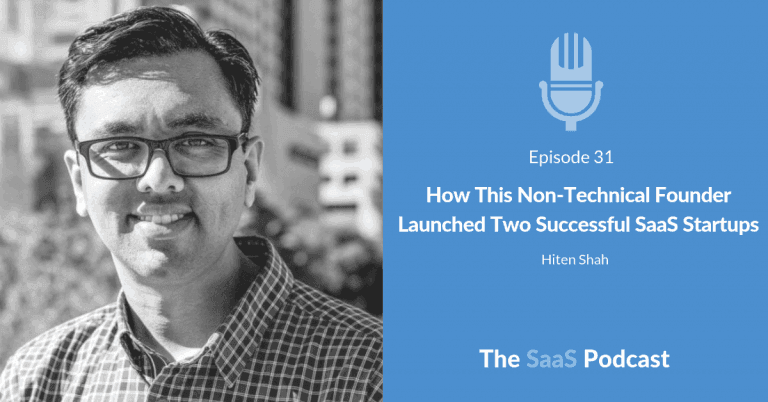
Today's interview is with Heaton Shah.
Heaton is the co founder and president of analytics companies KissMetrics and Crazy Egg.
He founded KissMetrics with Neil Patel back in 2008 and the company has raised over $10 million in funding to date.
It's used by thousands of companies around the world.
Hiten is also an advisor and investor who's actively involved in the startup community.
Hiten, welcome to the show.
Hiten Shah (00:53.020)
Glad to be here.
Omer (00:54.540)
Now, before we talk about Crazy Egg and kissmetrics, tell our audience a little bit about yourself.
Personally, who is hidden when he's not working on the business.
Hiten Shah (01:05.180)
Sure.
I tend to enjoy helping other people, maybe to a fault and more than most other people.
So my hobby tends to be just actually meeting with other entrepreneurs, whether formally or informally, and advising them more than anything else.
That's been what gets me sort of excited and gets my blood going.
Great.
Omer (01:29.180)
Now, before we dive into more details and talk about the business, we like to kick things off with a success quote to better understand what drives and motivates our guests.
What is one of your favorite success quotes?
Hiten Shah (01:42.220)
Yeah, so I have a quote right in the footer of my emails.
They're in every email and I call it the words I live by.
And it's a quote by Zig Ziglar.
And it basically says, you will get all you want in life if you help enough other people get what they want.
Omer (01:57.550)
Can you give me an example of how that quotes helped you in your life?
Hiten Shah (02:02.510)
I think a lot of times people will.
It's a little bit different when you're a founder and you start companies, but generally speaking, helping other people isn't a normal thing for people to do on a regular basis.
I know that sounds kind of weird, but you're so like in tune with what you want to do and what you're trying to get done.
And so the way this has helped me is just, it's just a reminder that I, in many experiences of my own, whether it's, you know, just randomly helping a stranger all the way to.
You know, I was actually at a conference yesterday and speaking and we were at a sort of mentor session where there was like speed mentoring.
Basically you meet with entrepreneurs for 10 minutes and before that one of the other mentors was sitting there and he now works at a startup.
And he's like, do you remember me?
I'm like, I remember your face.
I'm actually very good at faces, very bad at names.
And he.
And it's probably just because I meet so many people and I'm a very visual person when it comes down to it.
And basically he said, well, you had coffee with me five years ago and you gave me some advice on, like, my starting my career here in Silicon Valley.
And so, you know, I'm sure he's remembered me.
Obviously he remembered me and he made it a point to tell me that.
Now, honestly, I barely remember the meeting.
I remember like a little bit about it because we actually ended up going to the Verizon store and stuff like that.
But, like, it's not something I would have recalled any other way except the fact that he reminded me.
So I think that just this fact that people remember when you help them, that leads to a lot of good things that are derivative of that.
And if you're going into meetings or going into meeting people and thinking that you want something from them, it's typically not going to be as fruitful as just going in with a more open mind.
Obviously, the caveats are there can be specifically business meetings and other things that you have some kind of mutual agenda or whatever, but most of the time I go into meetings, pretty open, even business meetings for myself, at least, just to see kind of where things go.
Omer (04:19.330)
So you said that you love to help people and sometimes to a fault.
How does that work out for you?
I mean, I'm sure you're a busy guy anyway, just with running your own business and the more people you help, I guess it attracts even more people.
Right.
So how do you manage your time?
Hiten Shah (04:44.460)
Yeah, that's a great question.
I think I know a lot about myself at this point, so that's probably one of the keys, managing my time.
So, yeah, I'm going to tell another story because I actually met someone else yesterday, one of the people I was mentoring, although he could have been a mentor there.
And I have a lot of different businesses that I work on at the same time.
And we were just talking and I was sort of explaining to him my philosophy about things, and it's very similar to his.
He didn't describe it the same way, but basically, and it's just nice to know that someone else thinks the way I do.
And he has about five different businesses that he runs.
I'm probably somewhere in that range of three to five that I'm involved in or running or whatever.
And the one thing that I basically said was like, I actually try to keep my time as free as possible.
And the reason I try to keep my time as free as possible is just a few tenants or a few.
Not even rules, just concepts.
And obviously these kind of things are meant to be broken, but one of them is the idea that if I'm doing work, like actual real, sitting down in front of a computer and doing work, it's likely that somebody else in my company is not doing work.
And what I mean by that is there's always going to be somebody better than me at doing the work.
And that's the conclusion I've come to.
So I think this question has more to do with someone's personality.
And so my personality type is more, like I said, the helper.
So if I want to help somebody and that's what I'm optimizing for, then what I try to do is keep my time free so that if any of those people that are working in my companies, and it could be someone as like, you know, a marketing person in one of my companies or one of the VPs or our CRO or whatever it, whatever it may be, and I just try to keep my time as open as possible so that when they have a problem they can't solve, I can help them think through it.
And, you know, this is one of the debates that this guy and I had yesterday, but I was just saying that I can help them solve any problem.
He's like, well, you can try.
I'm like, no, I can help them solve any problem.
That's my goal, you know.
And so to me, it's like, I think every problem solvable.
A lot of times when these people and companies are sort of actually working on the work, they tend to be really deep in their work and they just need somebody to help them think about it.
So I optimize the way I think about things, the way I do things, the way I work with people around this idea that their hardest problems are my problem.
And they just need to be able to bring those to me and understand that I am available for those at any time.
And that's the sort of way that I've optimized the work I do and how I do these things.
Omer (07:28.420)
I love that philosophy.
All right, let's start by giving the listeners a better understanding of kissmetrics and Crazy Egg.
Who are your target customers for these products, and what are the top pain points that you're trying to solve?
Hiten Shah (07:46.970)
Sure.
So Crazy Egg was actually the first business that we Tried my co founder Neil and I tried in 2005.
That actually worked.
We tried many others before that, but this one is the one that worked and worked, meaning customers loved it and they started signing up for it and paying us.
What it does is it creates heat maps for people are clicking on a page.
So it gives you a visual representation of.
And at that time, there weren't any other tools that gave you this kind of sort of visual representation of data.
There were a few others that started around the same time as us, but they all went in different directions.
We've stayed true to the fact that we want to help people understand data visually.
See, where people are clicking on top of a sort of webpage is kind of the quick sort of pitch.
But the the target customer originally was actually web designers because they tend to not necessarily pay attention to analytics too much, at least historically, and also were an opportunity for us to get an early audience.
And since then, the company's progressed, the product progressed, and I think the world has also evolved where many people care about web pages and where people are clicking and are trying to make these pages better, optimize them, test them, et cetera.
So it's expanded from designers to marketers to even product people.
Anybody responsible for a website is basically where we're at now.
So, yeah, that's Crazy Egg.
And then with KissMetrics, we were essentially building a second product outside of Crazy Egg or as part of Crazy Egg.
And we decided to spin it out and make it a separate company and it ended up being kissmet Story before Crazy.
And kissmetrics is probably will give you a good idea of and your audience a good idea of kind of how we thought about things.
But we were running a marketing consulting company and we would basically do marketing for other people.
And so our initial audience for kissmetrics ended up being marketers.
And our whole goal there was to help people measure their marketing better.
And the premise, which I'm happy to say is what a lot of products do now is at the time it was we noticed a pattern that people were building a lot of analytics tools in house and so.
In house meaning like they were just building them themselves with their own engineers.
And we were wondering why they were doing that, considering the fact that Google Analytics existed, Omniture existed and all these tools existed.
And in the case of an alternative like Google Analytics, compared to building it themselves, Google Analytics didn't tie the data to their users, while Omniture did do that.
But it made it very, very difficult.
And it was also a Very expensive solution.
Our whole thesis was there's a very large market of people, website owners or even marketers that are looking for a better solution and are willing to pay more than free, which is what Google Analytics was at the time.
The advantage we had was we would tie the data to individual users so you can understand things like the lifetime value of your customer and, and everything that a single person did and interacted with in your sort of on your website or even with your business outside of just your website.
So that was the thesis, which is a sort of person based analytics tool.
Omer (11:11.470)
So I want to talk about how you guys, you and Neil got started.
Probably initially with Crazy Egg, but before we do that, you know, it was interesting.
You said that Crazy Egg was the
Hiten Shah (11:25.430)
first
Omer (11:27.700)
product or business product.
I think that that actually worked.
Can you give me one example of a product that you try to build before that that didn't work?
Hiten Shah (11:39.780)
Sure, we've had a bunch, but one was failed web hosting business.
We spent about a million dollars trying to get a web hosting business running off the ground and it never launched.
So that was probably one of the bigger failures from a monetary standpoint.
Another one was a podcast advertising network.
And the story there is like this was when podcasting was, I think it's making a resurgence.
But this was like 2007, 2008, maybe 2006, even around that time.
And it was just people thought all kinds of things would be awesome.
And so we tried doing it and what we learned after spending like I think 50, $60,000 in like six months, we actually found out that it wasn't gonna, it wasn't going to work monetarily.
So.
Yeah, so as a result we basically shut that one down.
We shut down the web hosting company as well.
And one of the biggest lessons from that was just that you shouldn't invest so much time and energy, whether it's engineering resources, money, whatever, until you've actually figured out whether it's to good idea.
And a good idea isn't like because you think it's a good idea.
A good idea would be a good idea because customers are actually willing to buy something from you.
And so.
And because you're generally solving a problem for them that's not just like a vitamin, but actual painkiller.
Omer (13:07.040)
Did you get funding for the web hosting business?
Hiten Shah (13:09.920)
No, we did not.
It was all of our own money.
Omer (13:11.920)
So you guys personally lost $1 million?
Hiten Shah (13:14.320)
That's correct.
Yeah.
Omer (13:15.760)
Now that's, that's sure is an expensive lesson.
Hiten Shah (13:19.410)
Yeah, that was the most expensive one.
But Cumulative, it's probably somewhere in the 2 to 3 million range of our own money.
Omer (13:26.690)
Okay, so let's go on to where the idea for Crazy Egg came from.
So you and Neil were working on this consulting business.
You're seeing a potential opportunity around you for this product.
Just tell me a little bit more about where that idea sort of evolved.
Hiten Shah (13:46.430)
Yeah, sure.
So in Google Analytics and Omnishare, they had this thing called a site overlay.
And it basically, if you had.
And there's a big problem with it, if you had dynamic things on the page.
So this is when we used to call like some, you know, like all the fancy things we could do on a web page with JavaScript, we used to call it Ajax.
And so I'm sure you remember being, being a product manager or program manager.
But yeah, so we used to call it ajax.
And the overlays didn't work well with ajax.
So they couldn't really understand that people were clicking on things and they weren't going to a new page.
So that was one problem.
Another problem we noticed is that, and these are technical problems, but they made the overlays inaccurate.
So that's.
If you're working on a product and you see a lot of inaccuracies in existing products, it is an opportunity to think about it a little bit deeper.
And so another thing that we noticed was that if you, if you had two links on a page and they went to the same next page, the site overlays would make the data for the links cumulative.
So if the top one got 30 clicks and the bottom one got 10, the data in the site overlays would show 40 for each, which is very deceiving and wrong.
And so we started building technology to actually differentiate which one was clicked on.
And if you fast forward to today, this is like trivial stuff to do.
Back then, though, it wasn't even trivial to do.
So I'm not saying it was rocket science, but it was definitely not as easy as it is today.
And it has a lot to do with modern browsers and all these other technical things I won't get into.
But so we just noticed those two problems that were more of a technical problem, which made the site overlay grossly inaccurate.
We were able to understand this because we were using the products, but we also had a lot of friends as well as customers and other folks that were using the products and complaining about this.
So I think complaints from existing products is always a potential good way to start a product.
That's not the only way.
But it's definitely one that we used in that case.
And then the other third thing was this higher level sort of issue where people had a hard time understanding numbers and data and tables.
And that's all the analytics tools would show you.
And even those site overlays were very data heavy.
And so what we did is we actually first started by building a better site overlay because we knew that the technical risk of being able to actually do all that stuff I mentioned accurately was a key to the product.
And so we started building that, built a better site overlay.
And then we were like, in what I like to call early access period, I don't really like beta and alpha as terminology because it's very geeky and also inaccurate.
And so we basically called it early access and had a bunch of designers from a community that we knew really well, which is a nine rules community.
It's a really large design community.
And we had a lot of those folks trying the product.
And what we realized at the time was that we needed something better than just a site overlay.
And that's where we sort of invented the heat map, because we wanted to come up with a better way to represent that data, not just a site overlay.
And so it was actually the overlay that was first and a concept from other tools that we took and made it better and then we extended it from there.
So now that was literally how this whole category of heat mapping and stuff like that was created.
Omer (16:58.030)
Okay, so you had this idea.
How did you go about building the product?
Now neither you or Neil are developers, right?
By trade?
Hiten Shah (17:06.720)
That's right.
Omer (17:07.920)
So how did you get the product built?
Hiten Shah (17:10.960)
Yeah, we'd already worked with a bunch of designers, so we had some designers helping us, so that was relatively easy.
And then we had some engineers that they actually knew at the time.
And we also knew enough about engineering to be pretty dangerous at this point.
At this point I'd say I'm very dangerous, but at that point I was a little dangerous.
And so we found some engineers and they actually started building it.
And we actually ran into a pretty big issue with the way they were doing it.
So what they were doing is if you clicked anything on the page that went to a new page, it would actually redirect directly in the browser the data to our server.
So it would basically go do a redirect to a crazy egg URL and then take you back to where you were supposed to go if you were visiting these sites.
And that was pretty inefficient way to do it.
And also Caused some issues when we had downtime and other things like that.
And this was very early.
And so what we did was I went on a hunt to find engineer or set of engineers and I got very lucky.
And the engineer that's working on Crazy Egg has been with us since then and he actually owns a percentage of the company and everything now.
And yeah, so we have, we got lucky finding somebody.
But I did put the work in to get lucky.
So I probably talked about 100 engineers that knew Ruby on Rails just because that was a hot thing at the time.
And there was on Ruby on Rails.org, there probably still is, but there was a directory at the time and I could just go down the directory and find a way to contact those folks.
And that's what I did one by one.
And I told them my problem and I told them I needed help.
And I tried to figure out if they had any time to help me or could even talk about it intelligently.
What I was looking for was someone that could basically talk to me about the problem in my terms, being a non engineer based on my description and taking a quick look at the product.
And we found somebody who said he could do it better and he could do it better in a very relatively fast amount of time.
And he took over that whole product.
Omer (19:13.860)
Okay.
So you know, I think a lot of people who are maybe non technical, I kind of held back by building a software product because they just, hey, I just don't know that stuff.
I can't write code, I can't do all of these things.
That clearly hasn't held you back.
What advice would you give those people?
Hiten Shah (19:41.390)
Yeah, so you have a few options.
One, you can learn to code or two, you can find a.
Actually, yeah, so two, you can find a co founder who can code.
If you have a friend from college or anything like that.
Those are always great options.
And then three, you can just, if you have money or know how to make money in some other way like consulting or whatever, you can pay outsourced or insourced, whatever, you can basically pay a development shop to work with you.
So those are the sort of three options.
And from my perspective today, I might do a combination of them.
If I were to start today, just because it's really easy to learn to program now.
You could even go to these boot camps and stuff like that.
It's also pretty easy to learn on your own online because there's just so many things like Codecademy and all these tutorial sites and all that stuff.
It was Much harder when I started to even learn how to program.
So I would do that for sure.
Cause then at least you'll get a faster ramp up to the terminology.
But you know, the part I didn't say earlier was like when I was talking to these people, I was in front of my computer and I was googling all kinds of crap.
And the reason I was googling this stuff is because I was trying to understand what they were talking about really fast.
I would just start googling.
And I'm really good at using Google at this point.
But at the end, at that time I was pretty good.
But yeah, so I would, you know, I guess the high level thing for me is like, you know, we're all, I mean at the end of the day we're all human beings, right?
We all have some base level of intelligence.
There's no reason you can't figure something out just because you're a non engineer.
What you really need is you need to be able to know how to ask the right questions, Google things obviously and get a good understanding of the basics of engineering no matter what.
Right.
And I wouldn't even say my understanding is formal, my understanding is very loose.
But like you put me in front of any engineer and I can ask them the right questions to understand what the hell they're talking about.
And I can, in a lot of times, a lot of cases I can even help them with their problem even though I know nothing about how to write code.
I can read a little bit of code, but I can't really do much with it.
I don't know how to make my own code from scratch.
I made multiple attempts to try to code and I don't know, it doesn't stick for me right now.
It's not even because I can't, it's because I don't have the patience to be honest.
And so, you know, my advice is like don't get over yourself and don't think you can't learn it or don't think you can't have a reasonable conversation with an engineer.
At the end of the day, the best engineers are the ones that can talk to non, non engineering people.
Omer (22:08.560)
That's great advice.
Okay, so you've got the Crazy Egg product built.
What kind of validation did you do at that time before you built the product?
Hiten Shah (22:20.560)
Yeah, we did what a lot of people do now and that I didn't really see a lot of people do back then, which is we threw up a landing page and we have, yeah, so we threw up a landing page and then we had a lot of people sign up with just their email address.
And basically we had a big pool of early access folks.
We also happened to have money because we had our consulting company and we basically bought some traffic from the CSS galleries.
You might remember those if you're looking around back in the day, this is when CSS.
I don't mean CSS3, HTML5, I mean CSS.
And this is when, like Zen Garden and all these sites were really popular and they had a lot of traffic.
And honestly, the advertising on those sites was very inexpensive.
Like it was like a couple hundred bucks a month and we would get thousands of visitors to our website.
And so we bought a few ads and we also just promoted it during in the 9rules network.
And we basically got about 23,000 email addresses for early access before we even launched the product.
And we used that pool to get people to start using the product early.
Omer (23:31.400)
Did you charge for the product when you launched?
Hiten Shah (23:34.840)
Yeah, we had.
Yeah, actually we did.
We had a free plan for a while.
That was when we were in early access, so not everyone could.
We weren't letting everyone sign up then.
And then literally when we launched, we had a free plan and paid plans.
Omer (23:47.480)
All right, so you've got this product in market and as you mentioned earlier, you started to sort of work on the next.
Initially.
Did it start out as kind of like the next version of Crazy Egg, what eventually evolved into KissMetrics?
Hiten Shah (24:06.640)
Yeah, I mean, we.
We at that time, like, it was a trend where a lot of the SaaS businesses would create multiple products instead of doubling down on a single product.
And so we had the same notion that, oh, let's create more products because we have this user base and they'll use other product too.
So we just literally.
We just literally started building that other product and trying to think about it.
And it wasn't really out of Crazy Egg.
It was just the idea that we got pretty good at building analytics products and with Crazy Egg and knew a lot about JavaScript and stuff like that and big Data or whatever you want to call it before it was called that.
So, yeah, that's kind of how we thought about it.
Omer (24:49.320)
Now for KissMetrics, you actually decided to find investors and get funding for the business.
What was the reason for taking a different approach here?
Hiten Shah (24:59.000)
Yeah, Crazy Egg always, and even to this day fits in a relatively small market just because it's just a heat mapping tool.
It is in the broader analytics market, but it's sort of a niche tool at the moment.
It still Is.
And we like it that way because it's really simple.
People will sign up online, we have no salespeople.
And it was a self service product back then in 05 when nobody was really building those, very few people were.
And so we, yeah, we just sort of wanted more things out there like that and we sort of just started building something else.
Omer (25:42.730)
And so how did you go about finding your investors?
Hiten Shah (25:45.880)
Yeah, we had talked to investors In, I'd say 2006, a lot of them.
I actually have old decks of Crazy Egg that I saw the other day where we were pitching them and nobody would give us money because it was a niche product.
And so when we started building kissmetrics, either we got smarter or we got lucky, however you want to look at it.
And just people felt like it was a broader opportunity and so we were able to get money.
Actually, the same people we pitched for, the folks at True Ventures that turned us down for Crazy Egg ended up funding us for KissMetrics on our first round and a bunch of other folks.
But they were the first.
Omer (26:25.650)
Okay, so tell me a little bit about what happened with, with sort of the kissmetrics early days.
So you've got the idea, you've got, you know, investors on board.
Did you build out a different.
A separate team as well?
Hiten Shah (26:42.680)
Yeah, so there were some people.
We took over from Crazy Egg.
We also had our consulting business still running at the time.
We took a bunch of people over from there and we had a founding team of about four or five people for KissMetrics.
And once we raised the money, we focused all of our energies on that business and all those people's energies on that business and then obviously started hiring new people too.
Omer (27:04.850)
Okay, how did you go about acquiring customers for KissMetrics?
Did you guys bring on a salesforce for that or were you focusing on sort of inbound marketing?
What were the things that worked for you guys?
Hiten Shah (27:18.610)
Yeah, first couple years, we're actually just trying to figure out what the right product was.
So we actually started with Facebook analytics.
So for Facebook applications, because we saw that they didn't have anything, we moved away from that pretty fast because we didn't see that as a long term market.
And we were very dependent on Facebook.
I'd rather be dependent on the Internet than Facebook.
So that was.
And it's proven to be the right call because there is no Facebook analytics tool now, at least for the applications, because they killed applications.
And so that was just in flux.
We noticed that.
So we stopped doing that.
And then we pivoted to Something that looked more like a business intelligence tool.
There's a bunch of other tools on the market like that, but what we realized about that is it wasn't really solving that person based analytics problem.
And so that's when we hit the current version of kissmetrics that actually in a very similar way to Crazy Egg started out as, oh, the funnels in analytics tools really suck and we can make them better.
And so KissMetrics actually started out as a funnel funnel tool.
And we did funnels again, just like with heat maps.
And I'm not tooting my own horn, this is what people said, but we did it better than anyone else at the time.
And that whole model of how we did funnels has been adopted by a lot of analytics tools.
And the idea was most people think of a funnel as top to bottom.
We actually invented the idea of a left to right funnel and the ability to add steps at any time and basically just track data and you can build out as many funnels as you want.
And at the time, the way that funnels were built was much different where you would have to track the data, hope that it worked, set up the funnel and actually set up the funnel, track the data, hope it worked.
And there was like this whole seven to ten day period just to figure out whether you had an accurate funnel or not.
A lot of the way Google Analytics still works is like that.
And we just thought that was pathetic and so we decided to do it better.
So in our case, we made it so that you just track data first and then you can build out the reports on the fly after you've tracked the data.
And that's how the system works.
That's how the whole, I think the whole industry has gone in that direction, especially the new players and the new companies like us.
But to answer your question about how we started, the way we always thought about it is we will know when our customers are raving about something we've built.
And we were able to get a lot of early customers that are not paying into early access programs just because we were marketers and we knew how to get people's attention and get them to start using our products.
So we actually started out, we always tend to start out with a small number of customers, make them very happy, and they might not even be paying for a period of time, keep iterating the product until it gets to that point where people love it.
And then we would sort of, at the same time we'd have the landing page and getting more and more emails and more and more information about people that are interested, learning more about them.
And then once we knew that we had a resemblance of something that was early and that people would be happy with, after we iterated it quite a bit, we would then put it out and start getting more customers.
And so early on, it was just very similar to Crazy Egg.
And then over time, that business has evolved so that we actually started doing inbound marketing, if you want to call it that.
I would just say all we did was start a blog and had a really strong Twitter presence.
I don't know if I'd call it inbound marketing or not, I don't really care.
But we wanted traffic, we wanted attention, and we knew that we could be a top marketing blog and that's why we did that.
And it's still a top marketing blog today and it is the way we get most of our leads.
So it was a early strategy that we started, I would say about 18 months to two years into the business and it'll continue for a very long time because it is the way to do it.
So we generally try to find these emerging trends in marketing and try to be early in them.
And I think blogging, business blogging, and especially this marketing blog was an easy big trend for us.
But for us, actually, the story people don't really know too much is that it actually started with a Twitter account.
So we found that the KissMetrics Twitter account, we could share links about analytics and marketing and people would retweet it and then we'd get more followers.
This is when Twitter was still in a high growth mode.
I wouldn't say they're in high growth right now.
And so a lot of new people were coming on.
They were all very tech oriented people.
And there was this hashtag, the measure hashtag.
So it's measure M E A S U R E. And that's where all the marketers and analytics folks would hang out.
And so we would start hashtagging that, sharing a lot of their content.
And then over time we built our own blog and then we started sharing our own content.
And now the blog trumps the Twitter account in terms of the influence it has.
But it actually started with Twitter for us.
So I would just say that your potential customers are hanging out somewhere.
And the strategy we tend to use is obviously keep working on your product.
And we like to do that somewhat behind the scenes in the sense of not trying to get thousands of customers before the product actually is awesome.
Just try to get hundreds and test it with them.
And these Are your sort of early evangelists, people that really want to solve the problem badly and will deal with your bullshit like bugs and stuff like that.
And from there, when you're ready, just blow it out and be ready to.
And if you've engaged with these communities online, you'll be sort of ready to do that and ready to get more users once the product's there and people love it.
Omer (32:38.450)
I'm glad you mentioned about the Twitter account.
Right.
In terms of just being very, very agile and lightweight as you started your marketing efforts, I think, you know, some people listening to this might think, okay, Hiton had a ton of money to do all the things that he did.
Right.
I mean, we're bootstrapping.
We, you know, they, these guys even had a million dollars when they bootstrapped their own business.
But we don't have that.
It's a lot harder for us to do these things and to go and acquire customers.
So what would you say to them and what sort of advice would you give them?
Hiten Shah (33:14.610)
Yeah, I'd say that it's not the money, it's the thinking.
And so we just knew there's customers out there and we wanted to engage them.
Twitter didn't cost us any money.
We were just engaging with the audience because they were there.
So if you want to build an audience and engage with them, I'd say today it's easier than ever to do it it very inexpensively.
And so you could, I mean you could just put out a blog, pop out a blog, even if it's not on your own.
So you can do a Tumblr, a medium or a WordPress blog.
I usually recommend self hosted, but that is a little more work and does cost some money.
But if you can't, then just go to WordPress.com and get a blog.
Right.
And then start blogging to your audience about.
And even if you don't have any ideas of what to blog about, just start talking about what you're working on and why you're working on it and why you're excited about it.
And people will come to you, right.
And make sure you're collecting their email address and then starting to engage with them.
I don't know, it's, it's effort.
If you don't have money, you can put effort in.
I mean, you know, it's like I don't want to give, you know, I've been called Mr. Tough Love on occasion, but like, I don't know, like I think that it's just an excuse.
I don't have Money.
That's an excuse.
Like, it's like, okay, you don't have money.
Do you have time?
I don't have time and money.
Well, then you're not ready, you know, so it's like, it's usually one or the other that you have in every scenario I've seen.
So you have to have the desire that you want to do this.
And if you.
If you don't, then no one can help you.
It doesn't matter how much money or time you have.
So I think the desire is important, and then you tend to figure it out.
And like I said today, it is easier than ever to start and even get some resemblance of, you know, hundreds of customers.
It's not rocket science.
And the content's even out there on how you can do that.
My co founder blogs about stuff like this all the time on his blog.
On my email newsletter, I share links about this kind of stuff.
And that's just two of us.
I mean, there's hundreds of people, even a lot of the content on your site.
There's these people that are telling you how to do this.
All you have to do is, you know, for lack of a better way to say it, is stop reading and start doing.
You know, I'd encourage everyone that's just not started yet to just start, you know, just.
Just.
And read only things that are going to help you do things.
Omer (35:31.500)
Yeah, I think that's great advice.
I think it's very easy, and personally, I found that as well, is just to get into this mode where you're just consuming content all the time, and at some point it just becomes too much noise.
Hiten Shah (35:46.520)
Right.
Omer (35:46.760)
It just.
It just distracts you from getting started, taking action.
And I think you have to make that decision at some point in terms of, you know, how are you going to spend most of your time consuming content, or are you going to actually start creating something?
Hiten Shah (36:02.040)
That's correct.
Omer (36:02.840)
Okay, so you launched KissMetrics back in 2008.
Do you remember what the growth trajectory looked like?
Hiten Shah (36:13.810)
We didn't focus on growth until about 2010 because we were still working on the product and we didn't really.
Yeah, the short answer is no.
Omer (36:22.130)
Okay, and so how long did it take you to, you know, get to a sizable audience?
Like, what was a big milestone for you in terms of customer acquisition?
Hiten Shah (36:33.010)
Yeah, we just never thought of it the way you're describing it.
So I don't really have a good answer.
It was more like building channels and things like that to.
I don't have any dates or any idea of a timeline of when we got to, like, X or Y or Z.
Omer (36:46.370)
So why.
Why was that not important to you guys?
Like, how.
Hiten Shah (36:50.210)
What.
Omer (36:51.170)
What was driving you instead?
Hiten Shah (36:58.050)
I wouldn't say I do it the same way again, but for us, what was driving us is we knew we needed an audience.
And so we tend to start building an audience really early, usually first, because we tend to think that if you have an audience first, at least you have people that can try whatever you put out there.
And so we focused on the audience.
And then after that, it was like focusing on the product, because sometimes you'll get a product, right, but, you know, you have a lot more work to do to make it actually feasible, whether you're doing hacky stuff first and stuff like that.
We would do a lot of hacky stuff just to see what would work.
And then once we figured out what worked, that's when sometimes a bunch of engineers would have to spend a month or two, up to a month or two, to just fix our mess now that we know we need to scale it.
And so if we have a blog, if we have a Twitter account, if we have an audience always coming and we can feed that, we're not wasting time and we're not waiting.
And what I mean by that is we're not waiting on growing the audience.
So for us, these milestones weren't important.
What was really important is that knowing that we want an audience first, knowing that we needed the right product before we could even hit the gas.
And so, yeah, so we never really thought of it like that.
I think in today's world, a lot of the things that we did back then are the norm for people that actually understand how to build software businesses now.
And so the milestones are much easier to figure out.
For example, if you assess that there is an opportunity for creating a blog, I don't think everyone should necessarily create one, but if you do assess that in your market, then your first milestone is probably like, can we get to 50,000 unique visitors?
And then your next milestone is like 250,000 or maybe it's 100,000 first, right?
And so you have these milestones on the amount of traffic you can get.
And in some cases, it might even be the amount of emails you're getting off of your blog.
Because at this point, we all know that email is really important and a great way to engage an audience.
And so I'd say milestones are more important now just because there's a lot more you can do and a lot more predictability and Control.
Back then, we just didn't worry about thinking about it like that.
Omer (39:04.950)
Okay, so you've got the product in market, it's growing.
Tell me about a particular challenge you faced as the business and the product started to grow, either on the business or the product side.
Hiten Shah (39:26.470)
I think there's new challenges all the time, so I don't really have.
Yeah, and I don't.
I probably view these things different than other people, so it's probably hard for me to remember any of them, to be honest.
There's just something new every day.
So if you want me to get more specific to kind of what would be useful, let me know.
Or what's on your mind about challenges?
Omer (39:47.280)
Yeah, I guess when I'm thinking about challenges is that once you go from sort of idea and launching the business, you have a certain set of challenges, and then you sort of go into a next phase where maybe you're building out a team or a bigger team.
The business and product is starting to grow, but quite often you start to face a different set of challenges.
It could be maybe around, you know, now you have problems around hiring, or maybe it's around, you know, you have issues around how you communicate effectively in an organization which is becoming bigger.
You know, were they those kinds of challenges that you faced along the way with kissmetrics?
Hiten Shah (40:33.060)
Yeah, again, like, it's a generic question, and there's probably a lot of content out there about all these challenges.
I don't.
I don't.
I don't really.
The truth is, like, I don't care about the challenges.
I invite them.
And I think there's new challenges all the time.
Every time when you try to grow your business and you start getting more and more people in the company, one thing I like to say is there's always more people, which means more problems.
And I'm not saying that means you shouldn't have more people.
It just means that you should be sort of more conscious about who you're hiring and all that kind of stuff.
So I'd say one of the biggest mistakes I see other people making, and I make this mistake, too, has everything to do with sort of hiring and making sure you're hiring the right people and then not letting go of people that are not a good fit, even if they sort of somehow got into the company.
So those are the types of things that I probably think about more than anything else, which is how do you scale a business and how do you make sure that it's healthy from a culture standpoint?
Omer (41:36.450)
Okay, so we started this Conversation by going back to where the idea for these two businesses came from.
And then we've sort of taken this journey together on how you guys turned those ideas into successful products.
Let's talk about the business today.
What sort of revenue are you guys doing?
Hiten Shah (41:51.570)
Yeah, we don't talk about that.
Omer (41:54.210)
So are you doing over a million dollars?
Hiten Shah (41:55.970)
We just won't talk about that at all because it's not public.
If it was public, I'm happy to talk about it, but it's not.
Omer (42:01.870)
Okay, so tell me a little bit about the size of the team.
How big are the teams now?
Hiten Shah (42:06.270)
So at Crazy Egg, we've maintained a pretty small team.
It's five full time people.
And then at KissMetrics, we're getting close to 70 people now.
Okay, all right.
Omer (42:20.590)
What's the one thing in your business that you're most excited about right now?
Hiten Shah (42:28.280)
You're great at asking these generic questions.
Ask me something more specific.
Omer (42:35.160)
Tell me about one specific initiative around the product or something you guys are investing.
Hiten Shah (42:46.600)
Same question, asked a different way.
You can do better.
I'm gonna push you to do better.
Because it's like, yeah, again, I'm not a fan of generic questions because then you're making me do the work.
I want you to do the work.
What do you think your audience wants to know from me that I haven't said yet?
Omer (43:04.490)
I want to know what the next big thing is that you're doing with KissMetrics.
Hiten Shah (43:08.330)
Yeah, I'm not gonna answer that.
Doesn't matter.
Like, it's not helpful to anybody.
Right.
I'm talking about myself and my business.
It's not like I want to be helpful to your audience.
What do they need to know?
Omer (43:19.240)
Well, I think that what they needed to know is what are the challenges that you face along the way and what they can learn from that.
So, for example, it would be really helpful to talk about one specific example that you can tell me and said, hey, this is a big mistake we made along the way, and this is the lesson that we learned from that.
Hiten Shah (43:44.950)
Yeah, I guess you haven't read enough of my stuff.
Yeah.
So here's the deal.
I don't really like talking about myself because I don't think that most of the time that applies to other people.
I also like getting context before I give anyone any advice or feedback.
And so, like, you know, if I were to give you one, it's like, I'll give you one.
I will.
I will answer something for you.
But my point is, and this is probably the thing I'm going to talk about, I think, and hopefully it'll be more applicable than some of the things you're suggesting.
But basically, the way to think about it is that you.
In any situation, what I see the mistake most people making is that whether it's in a meeting, when thinking about someone else's product, when thinking about competitors, when thinking about their own business, there's all these things.
There's more things you don't know than things that you do know in most cases.
And even when you think you know a lot of things about a specific scenario or something, you, you, you.
You're probably wrong all the time.
And so what I tend to try to do is, instead of thinking about what do I know or what do I not know, I just think more practically.
And it's probably the fact that I'm very rational about things, of just breaking things down in such a way that it's like I'm able to make sort of what I would call binary decisions one at a time.
And what I mean by that is, Let's say you think you need funding, right?
For your business.
The first question I'd ask you is, why do you think you need funding?
And then you might come up with something.
It doesn't actually matter to me what you say about that.
What really matters is how you're thinking about it.
And, you know, in that process, some people will say, well, I don't know how to get started without money, right?
They won't really say that.
People don't like admitting that, but a lot of people are in that scenario.
So in that case, I'll be like, well, you don't necessarily need money.
You need to know how to get started.
So do you want to get started or not?
And that's a binary decision, right?
Do you want to actually have your own business or not?
Are you just saying that because everyone's doing it?
And then once you make that decision, you start making more and more binary choices based on a lot of these things just map to a flowchart in my head.
And so what I see a lot of people doing is that they start making all these decisions compounded together.
It's like, should I start a business?
Should I raise money?
Should it be a B2B business or a B2C business?
Or even the famous one that I love is like, I don't have any ideas, right?
And the real answer to all of that is like, literally, just get started, right?
In any direction, it doesn't really matter if you have that desire to start something and you don't like where you're at, like you want more for yourself, then just get started.
So my biggest piece of advice is just get started.
But when I talk about the way these decisions are confounded, I think that it's really about being able to diligently break down whatever next thing you're trying to do or whatever challenge you have into its components and actually thinking about what decision do I need to make first before anything else.
So now I'm going to give you a very practical example against that.
So at KissMetrics, we have, you know, just like any other company, we have a lot of directions we can go in next.
In this specific case, we have the direction, a direction we want to go in next.
I can't really talk about it yet.
It's not mine to say, but we have a direction we want to go next, and it'll be, you know, revealed, like, soon enough.
And it's not like, it's pretty awesome, I think.
But the question that I posed to the company in general was, you know, let's decide whether we want to go in this specific direction or not.
Right?
And that's the first decision we need to make.
And the reason is everyone else was trying to tactically figure out, how are we going to do that?
And we hadn't even decided that we are going to do it yet.
Which I know sounds really elementary and basic, but, like, we hadn't decided.
I couldn't see it.
I didn't.
I didn't see the conviction.
I just saw these tactics and all these ideas getting thrown around.
And so I basically just said, well, like, are we going to do that?
Right?
And I got a yes, yes, we are going to do that.
And it's.
It's, you know, it came from enough people that, you know, it was like, okay, great, we're going to do that.
And now all the decisions started making so much more sense once we actually had the conviction and said, yes, we're going to do that.
And because we were thinking about all kinds of ways to do it, do we need to hire more engineers?
Can we build it with existing engineers?
Do we go buy a company?
Do we, you know, go hire a development shop?
So there's all these things, and it's like, well, we can't really decide unless we decide that we're going to do it.
And then the way you evaluate all these things is the, you know, which one is the right way to get to whatever your end goal is.
And if you want to build this thing, you know, or whatever Add this capability, whatever it is, there's a lot of ways to do it.
But if you're debating the ways to do it, but you don't have the conviction or you haven't decided that you're going to do it, I think that's, that's you're doing it the wrong way.
So yeah, I really believe in this idea of like breaking things down and having this easy, easier way for us to make decisions.
Because I think even when us as human beings are presented with more than two options, we start getting confused and then that slows us down.
And I do believe that when you are working on a startup and trying to build a business, speed is number one.
Omer (49:26.730)
Okay.
Now you also stepped down from the CEO role a few years ago and brought in somebody to be the new CEO.
What were the reasons behind that?
How involved are you still with kissmetrics?
You mentioned that you're involved with somewhere between three to five companies.
Is that to allow you to spend more time in other areas?
Hiten Shah (49:52.800)
Yeah.
Simply put, at KissMetric specifically, we had an opportunity to bring on somebody who we thought could do a better job than we were doing at certain parts of the business.
And so we made the decision to do that in our case.
We've also always had crazy egg as a self funded business and we wanted to just personally spend more time on it.
It's been a while with kissmetrics and there's been all kinds of road bumps as well as sort of milestones and stuff like that that we met.
And so it was basically time for us to sort of, you know, find someone who wants to run it for another five, six, seven years as the leader of the company.
Got it.
Omer (50:32.310)
Okay.
All right, it's time for our lightning round.
I'm going to ask you a series of questions and I'd just like you to answer them as quickly as you can.
Does that work?
Hiten Shah (50:40.480)
Sounds good.
Great.
Omer (50:42.080)
What's the best piece of business advice that you ever received?
Hiten Shah (50:46.960)
Sure, just get started.
Omer (50:49.280)
What book would you recommend to our audience and why?
Hiten Shah (50:52.000)
The five Elements of Effective Thinking.
Because I think everyone can think better.
Omer (50:56.160)
I actually read that book a few months ago.
I love it.
Okay, what's one attribute or characteristic in your mind of a successful entrepreneur?
Hiten Shah (51:07.610)
Somebody posted this on Facebook and I'm going to use the word.
It's figureoutability so they can figure anything out.
Omer (51:15.210)
What's your favorite personal productivity tool or habit?
Hiten Shah (51:19.370)
I really love sanebox.
Sanebox makes it so that a lot of the stuff coming into my email box basically doesn't get into my email box.
So it's very hard to actually get in my main email box.
And that lets me stay prioritized on things that are most important.
Omer (51:37.810)
If you had to start over tomorrow, how would you go about finding that next business opportunity?
Hiten Shah (51:46.690)
I just explore the things that are growing the fastest right now, even though they might be small.
So mobile is obviously one that a couple years ago you would look at.
I think there's other areas where there's markets that are growing really fast that you can get into and sort of look at.
So it's basically just looking at early trends and having some definition of how you look at early trends.
Omer (52:09.270)
What's an interesting or fun fact about you that most people don't know?
Hiten Shah (52:15.030)
It's a good question.
Yeah, I don't think I've talked about this too much.
I can eat really, really, really spicy food.
I can eat chilies raw.
I grow ghost peppers in my backyard and I, I can eat literally one whole one a day with all my meals.
And I really like it.
I can.
Very hot stuff.
Omer (52:38.630)
All right, and finally, what is one of your most important passions outside of your work?
Hiten Shah (52:44.310)
I know this is going to be a little cliche, but I have a four and a half year old son and I have a now nine month old daughter.
And after having my four and a half year old son, watching him grow up so fast, I'm just trying to spend as much time as I can with them.
Omer (52:58.530)
Yeah, I totally agree with you there.
I don't know what it is about having kids, but suddenly you just seem to feel like you're getting older a lot faster.
Hiten Shah (53:06.770)
Well, also, at some point, you know that they're not going to care about you like in the same way that they do right now.
Like, I mean, I'll just leave with one more where it's like it still crushes me every time I come home later than he likes and he looks at me and goes, daddy, why are you late today?
And it just, it's just, you know, enough, enough, enough times of that.
And you're like, all right, I probably shouldn't be late in his mind, right?
So, yeah, things like that.
Omer (53:34.300)
Awesome.
Those are great answers.
Hiten, I want to thank you for joining me today and sharing your experiences and insights with our audience.
And thank you for letting us get to know you a little better personally as well.
Now, if folks want to find out about Crazy Egg or kissmetrics or they want to get in touch with you, what's the best way for them to do that?
Hiten Shah (53:49.300)
Yeah, sure.
My email is pretty public.
It's my Twitter handle, which is hnshahmail.com.
so, seriously, email me.
It might take me a little bit to get to you because I do use SaneBox and it does filter, and I check that about once a week, sometimes once every other day.
And again, it's to prioritize all those folks that are working in my companies and really need me at that time.
And besides that, it's crazy.
Egg.com, kissmetrics.com I also have a SaaS email newsletter, in case you're interested in software, where I'm sharing links.
So I'm not writing my own content there.
I'm just sharing links to other people's content, things that I'm learning from.
And it's@heaton.com.
Omer (54:26.940)
yeah.
And I signed up for that newsletter, I believe, a couple of months ago, and I definitely recommend that.
There's a ton of great content that you're sharing there.
Hiten Shah (54:34.220)
Great.
You're an early adopter.
Thank you.
Cool.
All right.
Omer (54:37.780)
It was a pleasure talking to you, and I wish you continued success.
Hiten Shah (54:40.300)
Same here.
Omer (54:41.020)
Thank you.
Take care.