Omer (00:09.280)
Welcome to another episode of the SaaS Podcast.
I'm your host Omer Khan and this is the show where I interview proven founders and industry experts who share their stories, strategies and insights to help you build, launch and grow your SaaS business.
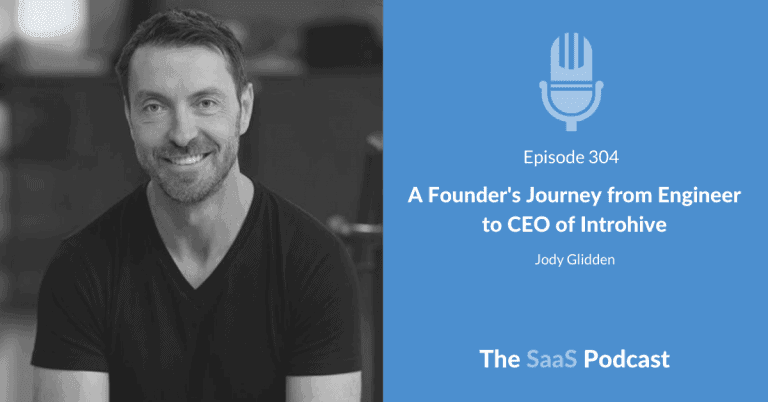
In this episode, I talk to Jody Glidden, the co founder and CEO of Introhive, an AI powered SaaS platform that helps companies improve sales by making sense of huge amounts of data and better understanding their relationship.
Graph.
Jody and his co founder Stuart started Introhive in 2011 and have grown it into a SaaS business doing tens of millions of dollars in revenue and around 400 employees.
They've also raised over $135 million in funding.
It all started when they realized how difficult it was for most organizations to keep their CRM system up to date.
Being an engineer, Jody figured that this was a data problem that they could probably solve within six months or so.
But it took them almost four years to solve that problem.
And during that time they struggled with customer churn because their data just wasn't good enough at the time.
They also tried a lot of inbound marketing and got almost nothing from that for a long time.
Eventually they decided to do more outbound and chose one vertical market to focus on.
That approach got them onto the right path, but even then it took them almost three years to close a deal with the first customer in that vertical.
In this interview, Jody and I talk about how they've gone from zero to a business that's currently on track to hit $100 million in arrangement in the next two or three years.
We deep dive into all the major challenges they faced, how they solve them, and extract some lessons that might be helpful for you if you are currently dealing with similar issues.
So I hope you enjoy it.
Jody, welcome to the show.
Jody Glidden (02:03.320)
Great.
Thank you.
Yeah, great to be here.
Omer (02:05.640)
Do you have a quote, something that inspires or motivates you that you can share with us?
Jody Glidden (02:09.000)
Yeah.
I don't know if this is something that I heard or, or something that I made up because I've been saying, saying it for so long, but I always said that, you know, if you want the results that only 1% of people can achieve, then you have to be willing to do what 99% of people won't do.
That's something that we constantly repeat around here.
Omer (02:26.530)
Yeah, that's awesome.
All right, so tell us about Intra Hive.
What does the product do?
Who is it for?
What's the main problem you're helping to solve?
Jody Glidden (02:34.290)
Yeah, well, it started as a system that could go through all of the communication systems that you have in an enterprise or in a business like email system, calendaring, phone and all that.
Figure out who everybody in your enterprise knew and who how well they knew them.
Since then, we've expanded into a whole lot of categories that continue to drive more sales for salespeople.
And now we're getting into everything really on what we call the three R's.
Anything that can drive revenue retention or relationships for the enterprise.
Omer (03:04.140)
Can you give us a sense of the size of the business, you know, in terms of customers revenue?
Jody Glidden (03:08.990)
Yeah, yeah, sure.
We're in the hundreds of customers right now.
We have some really large customers.
We have over a quarter million users.
We have many companies that are over 10,000 seats each.
We have between 350 and 400 employees.
Our revenue is in the tens of millions.
Hoping to cross a hundred million in the next two years or so.
Omer (03:30.110)
Awesome.
And in terms of funding overall, you've raised about what higher 125 million to date?
Jody Glidden (03:36.590)
Yeah, I think maybe around 135 to 140, something like that.
Omer (03:40.990)
Okay, cool.
You've been working on this business for almost 10 years and I want to go back to where it all started and see what we can learn from you and tell that story.
Before we do that, can you just give us a quick summary of your background?
Because this is not the first startup you've worked on.
I think three businesses that had successful exits.
That's right, yeah.
Just tell us a little bit about your background and some of those companies.
Jody Glidden (04:05.080)
Yeah, sure, yeah.
So I was a coder for fun when I was a little kid, like entered the science fair at grade three with a computer program.
Anyway, so I always found that stuff fun.
I would do it as a hobby and I also used to like to tinker around with businesses, everything from lemonade stands to.
I remember when I was a kid and we were watching all the karate movies and I made nunchucks when I went to school, somebody bought them.
I went and took orders and like started bringing like a ton of it.
I was making a hundred dollars a day for a while until the police came and told my mom that your son's selling weapons at school?
Grade five.
So I, I just loved business and I loved coding and everything.
I never really knew those two things would come together.
But then I was in, I just graduated and I got a call from a startup that was just getting going and I joined them and I learned so much and had a blast and decided I wanted to go do one myself.
So then I started a company called IC Global.
It was one of the world's first, if not the first, learning management system for enterprises.
So I learned a lot about that sector, but I also learned a lot about how enterprises work.
I got exposure to a lot of big companies because we ended up being resold by one of the largest elearning companies in the world.
So I just got to meet a lot of big brands and everything, then sold that company just before the dot com crash and started another one with a co founder who called Chalk Media.
That one was focused on, it was a solution for sales, like dispersed sales teams to help train the salespeople on sort of surprise products.
So you think like let's say when the new iPhone was going to launch and they needed to get the word out to all the Verizon reps and AT&T reps around and all the rest, but they didn't want anybody to find out anything until the day they could.
Actually it was sort of like a Snapchat where it would trickle the information out, like the video or whatever content out onto their device and then you could set it to 9am on launch day.
All of a sudden it gets released and they can get, they can learn what they need and then it disappears.
So we ended up growing that one really quickly over the course of a few years and then we sold that company in 2008.
And then during that time once we were acquired, I thought, I'm just going to log into the CRM.
I'll see all of the different people that know the largest enterprises because BlackBerry had sold to everybody and that's who we got bought by.
They had like 99% of the Fortune 500 or something.
I thought I'll just look in the CRM and I'll just go get introductions.
That's how I'm going to crush my number.
But when we looked at the, in the CRM you realize how little of people are actually using it.
And so I started asking around and I started realizing, oh my God, this is a huge problem.
Like nobody's using their CRM to its potential.
They've all, you have two kinds of people in the world.
You have the people who don't enter the data in the CRM and so that's a problem.
Or you have the people who do spend all their time entering data in the CRM and that's a problem because they've just wasted about 20% of their day.
So it just got me thinking.
And then when I left BlackBerry I got thinking you know, there's so many amazing problems in this space, like automating the data into the CRM, creating this real relationship graph of who knows who and how well they know them.
And a number of other ideas popped into my head around, like sales intelligence and how you could make people as smart as possible when they're speaking to a customer.
And that was really the genesis of this company.
At the same time, I started another company with a, with a co founder, didn't expect that they would both end up being successful.
We ended up having to sell one of them off because they both ended up taking off.
But yeah, this is the one.
This is my baby.
Omer (07:40.010)
Back in 2011, there were plenty of CRM products around.
And so you've spotted a problem that, as you just described, but probably other people had spotted that as well.
And my assumption would be, and many people would think, well, there somebody's already solving that, so how did you dig deep enough to figure out, no, that's not happening.
And this is something that I'm going to invest the next few years of my life in solving.
Jody Glidden (08:09.940)
Well, when it comes to the automating of data into the CRM problem, that was something that was primarily at the time being solved with products like yes, where, where somebody would have some outlook, you know, toolbar or something, or Gmail, and they would, every time they'd go to send an email, they'd say, yes, put this one in the CRM and then they'd go map it to the right account and so on and so on.
Oh, let me type in the title.
And it was still a lot of work.
You're doing it every interaction you do, every time you schedule a meeting and so on.
I thought, why couldn't we do all this on our own in the background for them, sort of algorithmically or with AI or whatever.
And then I realized, well, it's because most of the data sources out there are only 65% accurate at the time.
There was data.com and Inside View and a whole lot of others.
And so I thought one of the main things I have to do some experiments on is to see if we can crack the data quality problem because you can't automate data into the CRM.
That's wrong 35% of the time.
So I spent a lot of years actually on, on that problem.
And that I think was really the key differentiator because it ended up making it so that we could solve the that problem.
We also could get way more accurate than everybody else on building a real complete.
Who Knows who database because it doesn't do you any good to do a search for.
Does anybody know, you know, t cook@apple.com they want to know, okay, show me all the CEOs that we know in New Jersey.
So that's a data problem.
And if you don't have your, your data accurate, it doesn't really do you much good.
And then same thing with sales intelligence.
There's still a lot of sales intelligence products out there that look good in a demo, but when you act, they can't get good retention because when you actually look at the data, it's wrong so often.
Omer (09:55.510)
So were you building a data platform at the time?
Jody Glidden (09:58.070)
Well, that's what it.
Yeah.
What it turned out to be is we realized in order to pull off any of these solutions that I had been thinking about and that were all related to tapping into the CRM and tapping into all of the communication systems, there were a number of things that we thought we could do that could drive a lot of sales.
They all kind of hinged on this fact of can we get data on all these different phone calls and email and everything that are happening?
Can we find out first name, last name, company title, et cetera, to about 90% accuracy?
Because that's a really difficult problem.
So I thought, you know, three or four months we'll maybe crack this, maybe six.
Turned out to be three or four years before we could find, finally get it to really high quality and started getting our churn to the level it is right now.
Like, now we have one of the best retentions in SaaS software.
Really?
Omer (10:42.780)
What were you initially selling in, in those first three, four years?
Jody Glidden (10:46.300)
In the first few years, it was who knows who database, so you could install it at a large enterprise.
We had a company called Entericis as one of our first clients.
You could search for, like, let's say you want to get into a strategic account.
You could search for who do we know over at Apple?
And it would tell you everything that all the people that your employees knew.
We also then built a CRM connector so you could like look at the Apple account in your CRM and it would also show you all the real relationships that you have, not just the ones that people happen to enter in the CRM right in the context while you're searching.
And that was the first thing that we were selling.
Omer (11:19.280)
And it was on prem.
It wasn't a SaaS product at the time.
Jody Glidden (11:22.040)
No, it was.
Well, this is one of the other things that we did differently than everybody else is that we realized that would be a lot of data sensitivity in ingesting all this data and processing it and so on.
Prem would have been a solution.
It's just that it's a very, it's very cumbersome and difficult to update and, and all it comes with its own problems.
Omer (11:43.170)
Yep.
Jody Glidden (11:44.010)
So, but then again, SaaS is, had its problems so we decided to go with a different, basically what we call private encrypted cloud.
So with just basically a point and click, we could create an environment that was SaaS, but it was single tenant and encrypted at rest and in transit.
Omer (12:04.140)
Got it.
Jody Glidden (12:04.500)
So it was their environment.
They could hold the keys, but if we wanted to do software updates, we could.
Omer (12:09.100)
Right, and was that driven by.
When you set out, did you sort of design the thing like that or was it once you realized that there was a bunch of privacy concerns about people and their data?
Jody Glidden (12:19.740)
Well, what, what happened was we had a really large customer in Pricewater as Coopers with my previous product.
And so we had some, we'd built some really great relationships and built a really great reputation at that company.
And so I thought, hey, they'll be our first customer.
And then we realized, okay, well, if we're going to land a customer of that magnitude, they're like three or four hundred thousand employees and they're very professional.
Obviously we thought we're going to have to build it with the same kind of security that BlackBerry had, that kind of level of security and trust.
And so we spent a lot of time talking to them about it.
But then we also spent years crafting the security experience and we sold to a lot of other companies first and then we circled back to PwC and then landed them as a customer.
And we've had them for a lot of years now.
Omer (13:06.869)
They're still a customer.
Jody Glidden (13:08.150)
Yeah, they're one of our largest customers.
We have over a hundred thousand users at PwC in 90 some countries.
Omer (13:16.070)
So how are you selling the product?
And obviously your background and the relationships with that you had built presumably helped.
But like how were you selling this?
Did you hire a salesperson?
Were you trying to go and do the selling yourself?
Jody Glidden (13:28.980)
Yeah, well, I've made that mistake before at my previous startups and it, it started to become a pretty recognizable pattern.
You know, we, we would hire a sales rep and, and the sales rep would struggle and you think, okay, well you got the wrong salesperson.
But I think what we came to realize is, no, you don't.
What you need to do is you need to do the job of the Sales guy until sales are flowing in so fast that you can't do it anymore because you've got other jobs you're trying to do at the same time.
And so you know, the first sales that we started closing were really us, me and my co founder in every single meeting all the way through to close.
Eventually we hired a salesperson, we actually brought him into the meetings and they acted as a sales assistant.
Even though they were like a real came with a good pedigree but it was more to help make us more scalable and then do the follow ups.
And then step three was okay, now we can let them sell on their own.
But we kept the team very, the sales team very small because we, we wanted to make sure it was working and we can gather feedback and iterate on the sales process and so on.
And then we scaled the team up after that.
Omer (14:36.780)
We talked about your background and being an engineer to start with.
Were you doing a lot of selling in your previous businesses?
Did you just learn along the way you've never had officially a sales role?
Jody Glidden (14:46.940)
Right, right.
Yeah.
So what, what ended up happening is in, in previous companies I sort of, because I was CEO, I was involved in sales.
I would often join the meetings and I sort of acted somewhat as a sales engineer because I could help us pass security reviews and different things like that.
Right.
In a way that other people couldn't sometimes.
And also, also the nice thing about being in those meetings is you, you learn the requirements firsthand on what should be the next generation of the product.
So I had a lot of exposure to it, but I wasn't really running the sales cycles there.
There was though a time in the right after the dot com crash where I actually took a job as an entry level sales guy just to see what it felt like.
Omer (15:32.450)
Wow.
Jody Glidden (15:33.410)
Took a job and I like did my 80 calls a day and got hung up on a ton and like realized what it's like to actually build pipeline and do the, that other stuff.
So that was actually a pretty cool experience.
And I've read a lot of sales books and Zig Ziglar and you know, getting to veto and all those kinds of things.
So I did my best.
But yeah, my background from the beginning was engineering but what I was trying to do through the years is earn credibility so that I could speak to the engineering team and give them product requirements and they're not going to roll their eyes like oh God, this guy just doesn't know what he's asking us to do and at the same time do the Same thing with the sales team.
I feel like I've been in your shoes.
I understand what you're going through.
I understand how hard it is to get hung up on like this and how you need very clear positioning and great materials and all these things.
Omer (16:19.960)
All right, let's go back and talk about the early days and going out and selling.
Obviously, the, the PwC example is great and then the existing relationship.
But what were some of the harder parts of going out and, and doing founder selling in for that business?
Jody Glidden (16:34.490)
Well, the way we did it is we leveraged a lot of relationships and it happened that we had software that was good at uncovering relationships that you, that you forgot about.
So like, even when there's somebody that you hadn't contacted in several years and maybe they changed jobs and they used to work at Nextel and Nextel doesn't exist anymore and now they're at Verizon, it's like, oh, wow, cool.
I didn't know that.
I know a guy over there.
So that was, that helped.
But when you're getting started in the first few years, well, in this business anyway, I got an awful lot of no's.
That's, that's.
Or you'd get even worse.
You get people who want to help you because they're a friend or somebody from the past, but they can't pull it off because you're new and you have no brand and you have a new weak product that hasn't been battle tested yet.
So that kind of stuff is hard and you really just have to persevere through it.
And you realize it's a bit of a numbers game.
You'll.
You'll talk to a hundred clients before you land one, and you'll probably land three clients before you retain one.
Those might not be the exact numbers, but it's still a lot.
But you have to churn through a lot and you have to put in an enormous amount of effort.
Omer (17:36.750)
And how long were you and your co founder doing the selling until you felt like you were ready to hire a salesperson?
Jody Glidden (17:43.470)
Yeah, well, we made the mistake of hiring a salesperson too early.
That didn't work out when we restarted it in the way that I just described to you, that that was around year four or so for us.
Finally hired a salesperson who became successful because we had gotten sales to the point where it was going and it had a lot of volume going on, a lot of activity going on.
Omer (18:08.900)
What else were you doing to acquire customers?
Was it all outbound in those first few years or were you doing it?
Trying anything else?
Jody Glidden (18:15.700)
Well, one of the first things that we did was we hired a VP of marketing from Salesforce who was.
Had this amazing reputation and was, I'm sure, really good head of marketing and especially really good on demand gen.
So like content marketing and ad based marketing and all of that.
But what we ended up realizing is that the tactics that worked for him at his previous role didn't work for a tiny company that was just getting started.
And so we, yeah, we just really got nothing from the inbound for the longest time.
Almost nothing.
And now it's completely changed.
Right.
It used to be all outbound and no inbound.
And now it's about 50% or so outbound and about 50% or so inbound.
The inbound stuff flows pretty easily.
If we crank the budgets up, more comes in, but we don't want to overwhelm the salespeople.
So we sort of like more instrumentation now at this point.
Omer (19:13.660)
So why do you think that's working now but wasn't working back then because you'd already been in business for several years by then?
Jody Glidden (19:20.140)
Yeah, well, I think one thing that we learned is that you, if you have a certain amount of money to spend, which we didn't raise, obviously, we just raised a hundred million dollars recently, but we didn't raise a hundred million dollars in our first year.
And when you have a smaller budget to get the word out, you need to speak to a smaller audience in order for them to hear you loud enough.
And so one of the things that really made the difference is when we focused on a small vertical to start, and then you dominate that vertical and everybody in that vertical knows who you are and they're telling their friends, wow, we tried this.
This is really cool.
And the word just spreads word of mouth.
And then we moved on to the next and so on.
So it was, that was a thing that made a big difference.
The other thing is just like we're starting to have a brand now.
I think like quite often somebody will say that, like, oh yeah, we interactive.
Oh yeah, we love that.
I used it at my last job.
Or people are changing jobs.
When we have like over a quarter million users, those people are changing jobs every year or two and the word's getting around.
Omer (20:19.900)
I want to talk a little bit about the vertical thing because I think that's sounds like a smart approach rather than let's go and try and sell this to anybody that will talk to us.
But how did you figure out which vertical to focus on?
Jody Glidden (20:33.450)
Well, we thought that we Started thinking about the vertical of accounting firms like the Global Systems Integrators.
Because if you think of these ones like Grant Thornton, Deloitte, kvmg, Accenture, they're massive firms, right?
Like each one of those firms has like three or four hundred thousand employees.
So that's a real plus.
They also have a massive number or percentage of those people who are sellers.
So they have a really big problem.
They had unbelievable security and security concerns and we felt like that was a big advantage for us over others.
And we had really great relationships with several of them from past lives.
And so we thought this is a really great place.
If we can land, start landing accounting firms, then we can work our way up to the Global Systems Integrators, which are a large part also based on accounting firms or grew out of that.
And, and then we'll move on to other, you know, verticals from there.
Omer (21:32.170)
When you were going and talking to these types of massive businesses, tons of employees, stringent security requirements, what was that?
Like, how long was that sales process?
Like what, how many hoops did you have to jump through to try and close it?
Jody Glidden (21:46.730)
It probably got to stage four in the first six months and then.
And then took another two, three years to close.
Omer (21:55.300)
Wow.
Jody Glidden (21:56.180)
Yeah.
Yeah, it was, it seemed very promising at the beginning, but then took a long time to get all the way to the finish line, you know, for the first one.
But after that, now it's a normal course for us.
Omer (22:05.500)
And sort of how quickly do you go from first touch to closing these days?
Jody Glidden (22:10.660)
We sometimes we see 30 day closes now and it's.
That was just unheard of before.
But I think the big difference is we have a lot coming from inbound and a lot coming from partners.
And either of those are going to move a lot faster because they sort of come with, you know, trust already built in.
Omer (22:29.070)
Yeah.
So I think the, so the inbound stuff, like how does that work today?
So people are coming through like various different places to the site and then what happens?
They book a demo.
Jody Glidden (22:42.350)
Yeah.
Like they'll attend a webinar or they'll read one of our ebooks or things like that.
They'll read content pieces, thought pieces that we have out there on different topics to take an interest in what we say and our point of view on things.
And often we'll come in to book a demo.
As long as they're the right company for us, we'll do the demos.
And then I think it usually moves pretty quickly from there.
It's more of like then identifying who the key Stakeholders are.
Do they have the typical stuff?
Do they have the authority and budget and all those sorts of things?
We just work through the process with them, trying to make sure that we can design the rollout plan that would make the biggest impact for them.
Omer (23:24.040)
And you mentioned partners.
That's become like a big part of your business.
Yeah, like recently.
Jody Glidden (23:30.760)
Yeah, yeah.
Because what the CRM providers, they have a big risk to churn as well.
Right.
So if you have, let's say a $10 million a year CRM contract with some company, you don't want that to churn.
And one of the things that we've noticed in the data a long time ago is that when Intro Hive is installed, the CRM just doesn't churn because why would it.
All of their problems are solved.
The data gets in there, it's accurate, it stays up to date.
The insights come out automatically to the right people and they're seeing value from it.
There's no reason to switch CRMs at that point.
So we get an awful lot of like, referrals and things like that from, from the CRM providers that we've helped and also from the global systems integrators who have been fans of using our product themselves.
They seem the in depth and then they thought, hey, this would be a great thing for us to introduce to this customer so that we can.
Anything you can ever, anytime you can make an introduction and do the kind of doing the customer a favor.
They remember it.
Omer (24:32.900)
Yeah, yeah.
So when we were talking earlier, you, I think you basically said partners in terms of the amount of business they generate for years.
Like what, quadrupled over the last.
Jody Glidden (24:42.530)
Yeah, like it's been growing really fast, like exponential.
So just to give you an idea, even though we're just about doubling every year, the, the percentage of revenue last year from partners I think was around 7%.
And this year I think we're going to end the year with like 30% of our revenue being partner generated.
So it's just, it's really catching on.
Omer (25:04.980)
Is that something that you've been deliberately focused on?
Jody Glidden (25:08.580)
Yeah.
Omer (25:09.060)
Like how have you grown that part of the business?
Jody Glidden (25:12.260)
Yeah, well, it was something that we thought would happen early on when we were dealing with the global systems integrators as customers that we just turn on the taps and everything would start flowing.
But it doesn't work like that, turns out.
So what happened was it was a slow process once the word really gets around and you prove a lot of success at the beginning.
Global systems integrators and then they make a referral for you.
It usually starts as one.
And then you just do an amazing job with that customer and turn those people into fans.
They go back and talk to the partner and tell them what a great job you did and how thankful they are.
And then they're going to make more introductions and then those people tell their co workers and so on.
So it's a long process and then there's a whole lot of education to it.
We brought on a really great head of partners and built a whole team around them and started stuff of really great people.
Omer (26:03.200)
You talked about the kind of learning the lesson about hiring a salesperson too soon from your previous businesses and didn't make that.
Well, you still made that same mistake this time.
But what, what other lessons helped you or maybe did you make in some of those earlier businesses that this time round you were more deliberate about not doing or pursuing something in a different way?
Jody Glidden (26:28.000)
One thing is on the board side of things.
So I know in the past I was a little bit more flexible when it came to who's on my board.
And then this time around I've been much less so because it really makes a difference.
I know people say people have a lot of different opinions on board members and they say, make sure you have people on that can be helpful.
But I don't know how you exactly predict those sorts of things.
I'm a lot more careful now about who I led on the board, who I allow on.
You know, you screen for when you're bringing on investor, you can often ask.
You can look up the people that work there and say, hey, I'd really love if this person could be my representative on the board.
And also ask a lot of people around for references and make sure that this isn't somebody that's going to be a pain in your butt either.
Because it's not just about the help they provide, it's about not getting in your way because you are the expert at your business, not them.
And they're good at things.
You're good at things, but you're at that B or C round or whatever for a reason.
The worst thing you can do is have someone who is getting in the way and causing you to delay on things that you know, when your competitors are not delayed, that's the kiss of death.
Omer (27:37.890)
Yeah.
So just overall, you look back at the last 10 years like, I'm curious, like what's.
Like, I think people will look at this and say, yeah, Jody's had successful businesses in the past, built some experience, started this business and Know has grown to tens of millions of dollars in revenue.
Almost 400 people, you know, working there.
Sounds like.
Sounds great.
But what, what's been the.
The hardest part of, of building this business?
Jody Glidden (28:03.230)
Yeah, it sounds great.
It wasn't exactly all great, I think.
I'm not even kidding.
Probably about a third of the time I like, wake up in.
At.
At some ungodly hour and can't sleep.
Like 4 or 5 in the morning, I'll wake up and just can't go back to sleep because something that I was thinking about the night before is spinning around in my head and I can't stop trying to find my way to solve.
Solve it.
So, yeah, it's definitely very tiring, exhausting work, but.
And then also there's relationship stuff.
You, you bring people on and they grow to a certain point.
But the more successful your company gets, you need to make sure that you're bringing in experienced people around you, and you.
You don't want to disrespect anybody that you brought in.
So it's.
There's a whole lot of things that you didn't really expect.
And every year that the company gets bigger, it's a whole new set of problems that you didn't expect to happen.
And now we're at the size where it's like, people don't know.
People just don't know me often employees.
And so I'll call somebody up to solve a problem, and people are like, sort of taken aback.
Oh, my God.
Like, it's just really strange where I'm.
I was used to just, oh, I heard this.
We might be having a problem with, you know, this type of marketing.
I'm going to call that person who's in charge of pr.
Okay, let me call them.
I call them and they're like, whoa.
And then you get a call from their boss like, hey, next time can you include just really strange issues?
Right.
You just learn.
As the company gets bigger, you learn different stages.
It's.
It's cool, though.
Omer (29:34.510)
What was the largest company you ran in the past in terms of, like, number of employees?
Jody Glidden (29:39.000)
Yeah, the largest I ever got to before was around 100 employees before we.
We sold.
But this one has.
Man, it's just grown so fast, too.
But it's grown a lot bigger.
It's just surprising every day when I log into our HR system and you just see how it's grown.
It's just insane.
Yeah.
Omer (29:53.920)
And with the latest round of your Series C, you presumably have plans to grow even bigger.
Jody Glidden (30:00.440)
Yeah, yeah, we have we want to really continue to press on our organic growth and then at the same time now start doing some small acquisitions because we.
Well, first of all, we think that in a few years there's going to be a system that people will buy to put all of their data, which is their CRM and a system that people will buy to make sure that everybody's selling to their peak potential.
Just as there is a head of sales now and ahead of sales enablement, I think there will be those two systems and we want to be the second.
Omer (30:36.240)
You mentioned that you felt that in the next couple of years you could be 100 million plus business.
Is, is that the path you think that's going to get you there?
Jody Glidden (30:44.880)
Yeah.
Although I think even with the solutions that we have now, we could easily reach and surpass that number.
We have a unbelievably large total addressable market.
Just like everybody's a seller and we're especially great fit for B2B sellers which are, it's just a massive number.
And then the value that we create is so high.
We've seen.
There was one company that ran an experiment, they took some of their employees and put them on Inter Hive and they took some of their employees and they didn't.
And there was a 31% difference in the revenue the next year.
So think of what we're charging right now is we just continue to, to like we never did a pricing study or anything like that.
We just continue to add product and increasing the pricing as the years go on and stuff and we add more stuff.
But I think we probably were way undercharging for the value that we were creating.
Omer (31:34.810)
All right, let's wrap up and go into the lightning round.
Before we do that, I, I gotta ask you like you're based in Florida, is the company, are most of your employees based there as well?
Jody Glidden (31:42.170)
We're pretty dispersed.
We have three offices of 50 to 100 people or so in eastern Canada.
We have a bunch in, in Toronto, we have a bunch in London, we have half a dozen here in Miami and some in Chicago and then a bunch of home based people.
And Chennai, India as well.
We have 40 or so in Chennai.
Omer (32:00.110)
No wonder you're freaking people out when you're calling them like in a different country and it's like yeah, yeah.
Jody Glidden (32:07.390)
All right.
Omer (32:07.790)
All right, let's move on to the, the lightning round.
I've got seven quickfire questions for you, so just try to answer them as quickly as you can.
Jody Glidden (32:14.190)
Yep.
Omer (32:14.630)
Ready.
Okay.
What's the best piece of Business advice you've ever received.
Jody Glidden (32:18.510)
Read books.
Omer (32:19.470)
On that note, what book would you recommend to our audience and why?
Jody Glidden (32:22.780)
Atomic Habits is my favorite book of the year.
It really made a difference for me because so much of businesses follow through.
Omer (32:29.180)
What's one attribute or characteristic in your mind of a successful founder?
Jody Glidden (32:33.500)
Risk taking.
Omer (32:35.500)
What's your favorite personal productivity tool or habit?
Jody Glidden (32:38.660)
A product called things for iOS things three.
Yeah.
Omer (32:42.060)
Oh, I love that.
I just, I went all in and started using that a few months ago.
What's a new or crazy business idea you'd love to pursue if you had the extra time?
Jody Glidden (32:49.580)
I was at one point when I was doing my, my master's degree, I was thinking about creating a site sort of like what Facebook, I think originally intended a way for you to network with other people in your class because you're in a class of like hundreds or 200 people.
And I thought it'd be great if like, hey, I'm, I'm working on this homework problem.
I want to connect with other people.
So I think that's a.
Still a great idea I'd love to have pursued, but I think I'll be here for life.
Omer (33:17.160)
What's an interesting or fun fact about you that most people don't know?
Jody Glidden (33:20.840)
Yeah, I guess probably the fact that I started these like little crazy businesses when I was a kid.
Every time I go through the history of that kind of stuff, like started a pool hall when I was 17, for example, people are always like, what?
Tell me more.
Just really crazy ideas in most of them, I think.
Omer (33:39.200)
Like you, like we talked about this earlier, like I was, as a kid, just loved coding and just making stuff.
And when somebody said to like, it didn't hit me for years until someone kind of pointed, I was like, what?
You can make money from this?
People pay you to do this stuff?
Jody Glidden (33:52.360)
Totally.
That's exactly.
Yeah.
What happened was I was going to computer or I was in my last year of high school and a person from the university came in and talked to us about computer science degree.
And I was like, wow, never thought of that as a business.
Omer (34:06.280)
And finally, what's one of your most important passions outside of your work?
Jody Glidden (34:09.800)
Snowboarding.
I try to be up on the mountain at 20, 25 days every winter in Colorado or Utah.
Omer (34:16.920)
Cool.
All right, well, well, Jody, thank you so much for joining me and sharing the story of Intro Hive and some of the ups and downs along the way.
If people want to find out more about Intro Hive, they can go to intro hive.com and if folks want to get in touch with you.
What's the best way for them to do that?
Jody Glidden (34:35.210)
Um, they can reach me on Twitter at Jody Gliddon.
So it's O D y G L I D D E N. Awesome.
Omer (34:42.610)
We'll include a link to that in the show notes as well.
Thanks again.
Wish you best of success and would love to follow up at some point once you hit that big hundred million in ARR.
Be happy to.
Jody Glidden (34:53.210)
And it was a pleasure to meet you.
Omer (34:54.810)
Yeah, same here.
Jody Glidden (34:56.010)
Cheers.