Omer (00:09.280)
Welcome to another episode of the SaaS Podcast.
I'm your host, Omer Khan and this is the show where I interview proven founders and industry experts who share their stories, strategies and insights to help you build, launch and grow your SaaS business.
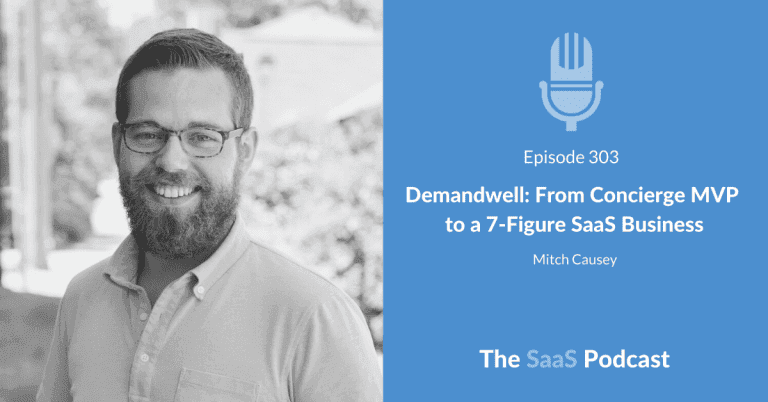
In this episode, I talked to Mitch Causey, the co founder and CEO of DemandWell, a SaaS company that provides software and coaching to help B2B SaaS marketers turn organic search into a repeatable source of revenue.
When Mitch launched DemandWell, it was just a one person SEO agency.
Mitch worked with one client at a time and his main tool was a spreadsheet which he'd create for each client and used to help grow their organic search traffic.
But he quickly realized that this business couldn't scale, and building a software product to replace his spreadsheets seemed like the next logical step to help him grow the business.
In about 18 months since launching the SaaS product, Mitch has been able to turn DemandWell into a seven figure business with a team of 16 people.
One big reason why he's been able to grow so quickly is because he spent the first 18 months before that providing a service and helping clients manually.
He effectively built an MVP without any software.
It's a concept known as a concierge mvp, and it's an approach that can work for a lot of different types of startups.
Many founders get stuck figuring out how to build an MVP or spend way too much time trying to build that product.
And the reality is your MVP doesn't have to be software, it can just as easily be a service.
So having a concierge MVP can help you quickly validate your idea, find customers, learn more about your target market, start generating some revenue quickly, and even Pre sell your SaaS product to some of those customers, which can help fund development.
And that's exactly what Mitch was able to do.
So it's an interesting interview and I hope you enjoy it.
Mitch, welcome to the show.
Mitch Causey (02:13.800)
Thanks, Omer, Glad to be here.
Omer (02:16.600)
Do you have a quote, something that inspires or motivates you that you can share with us?
Mitch Causey (02:21.240)
I do.
There's a lot of quotes in my mind, a lot of quotes that have inspired me over time.
But I've got one that it just keeps sticking in my head and I don't know, we'll see what folks think about this.
But I heard someone say when I approach my deathbed, I do not want to be on cruise control.
I want to be screeching around the corner.
Omer (02:46.020)
Okay, I haven't heard that one before.
Mitch Causey (02:47.700)
Yeah.
And what this person meant by that was that we are all given relatively a short amount of time on earth, alive and just expressing the idea of making every moment count.
And all the way to the end.
There's story after story of folk.
Their life plan is work till they're 65 and then sit in a la Z boy for the next however many years until they die.
And that just is not inspiring to me.
What is inspiring to me is to think that even up to the day that I die, I can actually have impact on other people and help other people grow for that entire time.
Omer (03:29.160)
Great.
Love it.
Okay, so tell us about Demandwell.
What does the product do, who is it for, and what's the main problem you're helping to solve?
Mitch Causey (03:37.320)
Yeah, absolutely.
DemandWell is an SEO coaching solution for B2B SaaS, merchant marketers.
Lots of buzzy words in there, but all actually hand picked because they're all important.
We're focused on SEO, we're focused on SaaS, marketing, and everything that we do with a coaching mindset to help others grow.
That's our mission as a company, that we help others grow.
And so that's how we approach everything.
The kind of key problem of, you know, how we help others grow really stems from a stat that we actually found from another or from a data dump tool in the space that's called ahrefs.
I'm sure a lot of folks listening have experienced, but they actually looked at over a billion pages on the Internet and they found that 91% of those pages get zero organic search traffic from Google.
Omer (04:28.510)
That's mind blowing.
Mitch Causey (04:30.510)
Yes.
910 million out of a billion pages get nothing.
And so we're flipping the script on that.
Take a look at, we looked at a bunch of demand pages that our customers have created, created using our platform and our process, and we found that 89% of those pages actually were getting traffic.
So 91% of most get none.
89% of content created using our method actually does get traffic.
And the way that we've done that and the way that we think about all this really comes down to one methodology, which is what we call pace.
PACE stands for plan, attract, convert and evaluate.
And those are all really basic words, but they're all really important.
And it's how we think about everything.
That's how we think about how we coach from a people perspective.
It's about how we create new features in our platform.
They all tie back to one of those things.
So the way we talk about it is that in order for organic search to be Successful.
And to break that 91% stat, you have to have all four of these components which are having a plan of how you're going to attract and convert attention, then actually going out and attracting that attention from organic search.
Once you have that, make sure that it is converting well and then evaluate how you attracted and converted, cycle that back into the next plan and do that over and over again.
So you know, the secret to success in SEO is not a flip of the switch or pay someone a certain amount.
It's about long term iteration, understanding, having a measurement in place, understand how you're doing and understanding where you could be going and then having a game plan how to get there, then actually doing it and doing that over and over and over again.
Omer (06:13.450)
Great.
So let's.
I want to start by talking about where you came up with the idea for this product.
But before we do that, tell us a little bit about your background.
And did this kind of whole world of SEO start for you?
Mitch Causey (06:30.360)
Yeah, yeah, absolutely.
SEO I feel like is in my DNA, but it actually didn't start until college.
So this is roughly 15 years ago.
I was sitting in class after class studying marketing, but still studying billboards and radio ads and stuff like that.
It was very outdated inside the classroom.
And so I started nights and weekends building websites and really just learning SEO.
So then I really enjoyed that and I ended up being able to actually get a few customers out of my dorm room doing SEO for them and just really enjoyed that even more than just doing it for my own websites.
And so from there when I graduated, I actually landed in an SEO specific agency.
Lucked out.
There was one in my hometown, Indianapolis that was actually had some really great traction.
Some of my customers there were like FedEx and Sears and Kmart and EA Sports and all sorts of folks that are, you know, really name brand.
And so I was able to learn so much there and at a different scale Then from there I actually went in house and was at a $400 million company here, also in Indianapolis.
They were an ADT reseller, so home Security Services.
And I had the was lucky enough to manage their team of SEO experts in that company.
And I had a really great time there as well.
But after about a year of that, I had a buddy of mine who was employee number two at a company called Lessonly.
And he called me up and said, hey, we need someone to run marketing.
Do you want to do it?
And I said yes.
So I joined as employee number three at lesnly and spent the next five years actually trying to get out of SEO.
Over that time, I was like, my entire background is around SEO.
I want to diversify what I do and how I do it.
And I did.
But over time came to realize the number one channel for us there at that company, and the number one channel that helped us scale and grow over the long run was organic search.
And so I started really thinking about codifying that and thinking of how could I help other SaaS companies actually do this as well.
So that is.
That was really the way that the idea came about.
Was thinking that there's a lot of other folks that could be learning from the things that I've learned, and was thinking, how can I help more folks?
And so it made sense for me to actually leave and start demand.
Well, early 2019.
Omer (09:08.910)
And when you started, you had no intention to build a software product, right?
Mitch Causey (09:12.910)
Correct.
Omer (09:13.390)
It was just going to be an agency.
Mitch Causey (09:14.910)
Yeah, exactly.
Omer (09:16.990)
And then at what point did you realize that you should be moving into a software business?
Mitch Causey (09:23.710)
Yeah.
So it was about 18 months of just being me and just being services.
Over that time, I built a bunch of spreadsheets that helped my customers be really efficient and grow faster and better than they could otherwise.
But that combination of humans plus spreadsheets really has limitations.
There's only so far you can go with that combination.
And I just kept hitting that wall with my customers where I could see the potential, but we were starting to stall out on some of the.
And so I said, you know what, I know that the way that we scale this wall is by adding software into the mix.
And so, yeah, went out and pitched.
A local venture firm here called High Alpha, was also behind Lessonly, so knew a lot of folks there and talked with them through that same problem, and they agreed.
And so we decided to partner together and restart demand well as a software company.
Omer (10:26.830)
Okay, great.
So I want to talk a little bit about that, the decision to build an SEO tool.
Mitch Causey (10:32.690)
Yeah.
Omer (10:33.330)
Before we do that, just give people a sense of the size of the business in terms of revenue, team size, number of customers.
Mitch Causey (10:41.890)
Yeah, for sure.
Last July, it was just about 150k in revenue and handful of customers.
Today, we are 16 people strong.
We are over a million in revenue, and we have, I think we're approaching 60 customers at the moment.
Omer (11:00.930)
So there's been like a lot of growth for you over the last 12 to 14 months.
Mitch Causey (11:06.490)
I'd say a lot of growth.
Omer (11:08.370)
And we're definitely going to dig into that.
But this isn't five or 10 years ago.
This was very recently.
Why did you believe the world needed another SEO tool.
There's no shortage of them out there.
Why did you believe that you needed to build something and more importantly, why you believed you could build a business around it?
Mitch Causey (11:30.510)
Yeah, yeah, it's a great question.
Sometimes I, I question my sanity there.
But no, in reality, there's no shortage of software companies in the SEO space.
There's also no shortage of agencies in the SEO space.
And if you are really primarily, if you're an in house marketer and you need help with SEO, those are your only two options.
You're gonna, you're gonna, you're gonna talk to some agencies, you're gonna talk to some software companies.
But at the end of the day, I believe that neither of those two can provide what someone needs in entirety.
And so the idea was, well, what if we took the best parts of both of those and combined them together?
And that is what we've done.
And we call it a people plus platform approach where every customer of ours is getting a human personal touch from a consultant that has 10 plus years experience doing SEO and has also been a director of marketing in a SaaS company.
We have three folks on the team that are like that, but then they're also going to get access to our platform, which has a number of features, but at a high level is essentially the place that our consultants and our customers go to interact and coach.
And the platform at the highest level helps you understand where you are, where you could be, helps you put together a game plan of how to bridge the gap, also helps you facilitate some of the production work that needs to occur during that.
And then once all that is done, it also has a reporting and insights feature as well to help you understand if there is an ROI or not.
And so if we take a look at those two components, agencies in the past can provide a really bespoke service, but they can't scale.
That's what I was experiencing before we added software.
On the other hand, you've got software companies that can scale almost infinitely because they're not providing any kind of bespoke nature to the experience.
And so it's by combining the idea of how do we create an experience that is specific to each customer but also scaled to a lot more customers than we could, than we could do otherwise.
So that's kind of the main reason that in the space there were only two options.
We've now provided a third option.
The other big kind of talking point there is I've used almost every platform out there in the space, in the SEO space.
And I have never been satisfied with the recommendations that they provide or the priority that they put on things or, or the idea that, you know, that essentially that they don't really listen to you.
There's not a way, it's not a two way communication, it's often just a one way communication.
And so what you end up doing is just ignoring everything that they tell you over time.
And after about a year of doing that, you're probably ready to move on.
And we have baked in what we, from a priority perspective, we've baked into our platform different things that, you know, not everyone pays attention to in the SEO space, but we found to be incredibly successful and we've created a different prioritization than what other folks had done in the past.
Got it.
Omer (14:41.650)
And so an agency will typically go and do the work for you with your model.
And I know you use the term coaching.
Is it more about providing support, guidance, expertise to your customers or does your team actually go and do some of the work for customers as well?
Mitch Causey (15:04.630)
So we, we do have some packages that actually allow us to create content for customers, so we do some of that.
But the genesis of the idea, and the primary intent of the idea of this software is to enable someone that is inside of a SaaS company, inside the marketing team, and give them the SEO experience that we all have without having to take the time along the way.
And sometimes the way that we talk about that dual approach of people on platform is that we want our customers to be, in an analogy, we want our customers to be the pro golfer, but we want our consultants to be the caddy and we want our platform to be the clubs.
And so we are providing the guidance and the tools, but it requires the pro golfer to actually use both of those to be successful.
Omer (15:56.860)
Nice analogy.
I like it.
Okay, let's talk a little bit about how you built the product.
So you're not a developer.
Mitch Causey (16:05.820)
Correct.
Omer (16:06.780)
So this is, was a new area for you to go and get a product built.
Mitch Causey (16:10.700)
Yeah.
Omer (16:11.660)
And you've also, you mentioned you've used every product, SEO kind of product out there.
Some are very good, some are not so good, but they've been working, most of them been working on those for years.
So probably when you look at that and do a comparison in terms of feature parity, there's probably at the outset a pretty big mountain to climb.
Mitch Causey (16:35.310)
Sure.
Omer (16:36.190)
So one, how did you figure out what type of product you were initially going to build?
And two, how did you get it built?
Mitch Causey (16:46.430)
Yeah, yeah, absolutely.
What was fun?
A fun Side effect of being services only for a while is those spreadsheets.
So each of those spreadsheets I made, I think I had a total of 11 standardized spreadsheets that each had a standard operating procedure of how to use it and how to scale.
I didn't have 11 when I started.
I had one and then two.
And over time, the customers I had as a services agency informed me about what their key problems were along the way.
And I would essentially create a spreadsheet for to solve each of those.
So it was this market product, market validation exercise, which was not the intent at all, but it turned out that way.
So when it came to actually create our software, we actually knew a lot of what our customer base already wanted and the problems that they were trying to solve.
It was primarily a matter of choosing which ones, you know, to solve for.
And I think one of the biggest lessons I've learned from my CTO and co founder, Sam Smith, he did not co found the original agency, but we said, you said I founded the agency, but we co founded the software company because that was.
That's absolutely the case.
Had to bring someone in who did know how to do this stuff.
And he's been in, he's been creating Martech for, you know, a decade.
And so what I've learned so much from him is this idea that you need to take whatever that grandiose idea is, break it down into what is truly critical at any given moment, and progress over time.
And while my patients didn't like that, it has proven to be just an absolutely, incredibly powerful way of thinking about things that really challenged me to think and to realize, like you mentioned, the feature parity across competitors.
The reality is we don't need a lot of the features that they offer in order to generate success.
A lot of things we were doing was just with.
And so we were able to really pare down what was creating success for our customers, focus there first, and then expand beyond that.
Omer (18:58.510)
And so where did those insights come from?
Was that just from the spreadsheets and kind of the experience of having run the agency for a while?
Mitch Causey (19:07.870)
Yeah, I think it was.
Is an evaluation of a handful of things, but one was just asking the questions of why are we doing that?
Why do we need to do that?
And doing that really annoying exercise of asking why like seven times for each thing.
And that was really revealing in the early days that a lot of things pointed to certain features that were more important than others.
And the other aspect of it is we just simply evaluated how much time each of these recurring tasks would.
Would require from either our consultants or from our customers.
And that allowed us to cross reference against the other analysis to understand if there's something that seems very important and is taking a ton of time.
What if we could reduce that time, you know, in half or by 10x?
If we could do that and achieve that important thing with such little time, that's probably a good idea.
So that's the initial approach, at least of how we took it.
Omer (20:09.790)
How long did it take Sam to get that first product built and in the hands of customers?
Mitch Causey (20:14.510)
Yeah, so we.
So he joined, I believe, early August, and we had our first MVP in customer hands by December 18 of 20.
Omer (20:27.550)
I like the specificity of that date.
That's nice.
Mitch Causey (20:30.830)
It was a very special day.
Omer (20:33.340)
Why was it so special?
Mitch Causey (20:34.140)
It was special because it was.
It was.
It was the first step of a dream come true.
When you can think of what something could be and you can think of.
You can see the growth in some of our customers that are just absolute rock stars and they're Vita's rock stars in their company.
You can see that if we could do that for thousands of marketers, that would just be amazing.
That would be a special mark left on the world.
And the way that we're going to do that is through software.
So just having that first experience, sharing that with customers and the resounding great feedback we heard from that.
Yeah, it was really the first step of a vision or a dream.
Omer (21:12.540)
I know that going from 0 to the first 150k in revenue you told me earlier was all through referrals.
Was that 150k before you built the product or was that as a result of building the product?
Mitch Causey (21:30.960)
Yeah, that was before.
So that was actually when I went through the investment pitch.
That was essentially the current revenue at that time.
Omer (21:40.080)
So you were roughly around that point when the product launched.
Let's talk about like the last year or so and what you've done to.
To grow this business from 150k to over a million ARR.
I know initially you were doing a lot of the selling, so maybe we can start there.
Mitch Causey (22:00.670)
Yeah, yeah, absolutely.
So there was definitely a founder selling phase for us, which I actually enjoyed for quite a bit.
There were varying levels of stress during that.
Definitely, definitely enjoyed that time.
But it, it really was still primarily referral for us.
It was whether that was a referral from my personal network, a referral from customers seeing great success, or referrals from our investors as well.
It still continued to be primarily referral driven.
And then the other interesting aspect of all that was we didn't have software for months of that time, but we were selling software.
And so that was something I had always heard of, of kind of startup companies doing, right, saying, hey, we're about to create this thing.
Do you want to pay for it now?
Even though you got to wait for a while.
And it was just, it was an overwhelmingly good feeling to hear that there were a number of folks that were willing to purchase a feature product without it actually even being in existence.
That gave me a ton of confidence during that founder phase.
Omer (23:01.670)
Okay, great, let's, let's talk a little bit about that.
Because the people who were pre selling, most of these people were warm leads, right?
Mitch Causey (23:07.990)
Yes.
Omer (23:09.190)
So there was at least some kind of connection or some kind of mutual existing relationship, which help you to have some more credibility as you, you talk to these people.
Mitch Causey (23:20.280)
Yeah.
Omer (23:20.760)
What was your pitch?
What did you tell these people that made them want to get out their credit card, literally or figuratively, and commit to paying you before the product was ready?
Mitch Causey (23:35.800)
Yeah, yeah, for sure.
And these were mostly referrals, but at this stage there were a few that I knew personally.
Most were folks that were new to me but referred in from someone.
So it was warm, but not, not as warm as the, some of the, I don't know, first 10 customers or whatever.
But I love the question of what were we selling?
And it's actually pretty similar to what we're selling today because while we think it's incredibly important that we're doing this people plus platform approach, a lot of customers don't care.
They just want a result.
They want to grow revenue from organic search in an exponential way in the fastest way possible.
And so that's really why we focus on selling both then and now.
We focus on that problem that we talked about earlier because it really resonates with folks.
A lot of people are creating content that is absolutely not performing how they wanted to.
And so we really focus in on that.
Just that proven results of increased SEO performance all the way through to.
We've got some great stats around roi and with selling towards you have a problem, we can fix that problem for you.
They didn't necessarily care back in the day that they had to wait for the platform because we were able to actually service their need with spreadsheets.
And they were totally, we were totally transparent about that, that we can do all the same things that we're going to be able to do, just going to be at a smaller scale because it's with Spreadsheets.
Yeah.
That's how we were able to work around that.
Omer (25:10.840)
Got it.
That's a really good point you made there.
It was like you weren't just selling vaporware and telling them we'll be back in six months with something.
You find a way to start helping them right away.
Mitch Causey (25:22.040)
Right.
Omer (25:22.760)
And sometimes I think we give spreadsheets less credit than sometimes they deserve.
Mitch Causey (25:29.390)
Yes.
Omer (25:30.430)
Okay, great.
And then I know beyond that you hired an sdr and just tell me a little bit about what you did there and how that helped you to grow the business faster.
Mitch Causey (25:40.830)
Yeah, absolutely.
Yeah.
We hired a outsourced freelance sdr and it allowed me to spend less time thinking about how are we going to get business and, and more time thinking about and refining how do we convert attention into revenue.
And I think that's the biggest way that it helped.
Could I have gone out or could I maybe have had a similar sale, tracking down the next referral and constantly networking and things like that?
Yeah, maybe it could have had the same amount, but would have taken a lot of time to attract that new attention.
Whereas having the SCR do it allowed me to shift my mind one step lower in the funnel to understand what's the scalable pitch that will resonate with everyone.
So that when we hire our account executives, which was the next phase, that I would be able to enable them to sell on something that we knew worked, rather than saying, hey, account execs, you need to figure this out.
Omer (26:41.820)
Okay, when you hired this first sdr, was this a full time position person?
And also like, how were you paying them?
Mitch Causey (26:48.780)
Were you.
Omer (26:49.220)
Was it commission based, a mixture?
Mitch Causey (26:51.140)
Yeah, it was definitely not a full time position and had a, had a monthly rate we had agreed to and a certain number of outreach activities that we had agreed to and kind of went from there.
Omer (27:03.580)
The role of this person was basically to help you find leads.
Mitch Causey (27:06.460)
Yes.
Omer (27:07.580)
Okay.
And, and then once you hired, like how long were you doing that until you also brought on an AE onto the team?
Mitch Causey (27:17.680)
Yeah.
So from the time we started doing that, it was really only probably a few months before we actually brought on our first two account executives.
And then as soon as they started, they really took a lot of self sourcing opportunities on their plate.
And that was a really key.
Had a really key impact for, for us on that next phase was them tapping their own personal networks and doing their own outbound outreach in order to drum up new business.
That was really effective for us.
Omer (27:50.450)
So you started off doing founder led sales, like doing it all yourself, and then slowly you Built out a small sales team as you figured stuff out rather than hiring salespeople to figure that stuff out.
Mitch Causey (28:05.010)
Right.
Omer (28:06.380)
Important distinction.
Yes, I know LinkedIn ads have also been working for you and most people will say, well LinkedIn ads are expensive, they don't convert well.
Partly they work for you because of the price point of your product.
Can you give us a range of typically where that sits?
Mitch Causey (28:26.220)
Yeah, so we have a few kind of standard packages on the low end is in the 20k mark, high end is a hundred k. That's the more enterprise kind of turnkey package.
But our most popular in most purchases just under 30k.
Omer (28:40.280)
So the average contract value here is large enough for you to be able to play in a place like LinkedIn.
Mitch Causey (28:47.960)
Exactly.
Omer (28:48.600)
Advertising where somebody selling a $50 a month product is really going to struggle to make LinkedIn ads work.
Why do you think you have had success with LinkedIn ads and can you just give us an overview of like what does that funnel look like?
Are you just running direct ads promoting demand well and getting people to go to a demo?
Are you starting off promoting content and retargeting people like what's like the basic setup that's worked for you there?
Mitch Causey (29:16.930)
Yeah, yeah.
We have a bit spread across all those things.
We've got some ads that are pretty low funnel, so sharing case study videos or just straight up asking for a demo, that kind of thing.
And then we also do have some higher funnel campaigns as well.
We actually have an SEO kind of education email course that is a six day experience that when folks fill that out, they get an email for six days and learn a bunch of stuff from.
So that's pretty high funnel.
But actually because we're baking in the recurring attention there, that's actually converted pretty well for us overall.
I think the biggest reason for success there is because it's one of the few places that we can really narrow down the targeting to the SaaS audience.
So because we're focused really exclusively on that audience, we are able to have an incredibly high percentage of MQLs compared to total leads, it's near 100%.
It's not quite there.
But we from LinkedIn in particular, it's almost exactly the right type of person at the right type of company every time we get someone from LinkedIn.
Omer (30:27.350)
So is there anything else that, that we haven't covered that's kind of a significant driver in helping you get to that first million?
Mitch Causey (30:34.590)
Yeah, I think the biggest thing is advisors.
We have had just tremendous success having advisors that we really respect and really appreciate.
And when we apply what they say, it actually works, whether that's our investors at High Alpha or independent advisors we have from various other SaaS, companies around that we've connected with.
I think the biggest thing is having perspective from someone who's been there, done that, to help you see around corners, make better decisions, all that stuff.
I think that is absolutely number one reason why we've been as successful as we have been and why we will continue to grow at a pretty substantial rate.
It's because we're listening a lot and asking a ton of questions all the time.
Omer (31:25.330)
So you've been running this business now for nearly three years.
What's been the hardest part of building this business so far?
Mitch Causey (31:35.170)
Yeah, I'm a relatively emotional person in general, good and bad.
But I think that, yeah, one of the most challenging parts is definitely the emotional side, having to be the one that is both setting goals as well as pushing to achieve those goals across the whole organization.
It's a lot.
It's.
It's definitely something that I am enjoying more and more, is the challenge of that and dealing with those emotions that occur.
But overall, yeah, that, that is.
That can be taxing at times.
And I think there's seasons where it's pretty rough and there's other seasons where it's really great and it's not dependent upon the success of the business or not.
Just, I think a lot of.
I think what I'm finding is the greatest correlation to my mental health is the level of context switching.
I think the less context switching you are required to do in a day typically allows your brain to process things better.
So that's one thing that I'm personally working on, is reducing the sheer quantity of things as much as I can to focus on what is truly most important.
How do you do that?
Omer (32:44.320)
Because I think you take on the role of founder and CEO and you have a lot of things to think about.
You have a lot of plates spinning at the same time.
And as you start to build a team that like 16 people now, that obviously help, but at the end of the day, the buck stops with you, and you're the guy who has to make sure that everything across the board is working.
And so what are some tactics that you use?
Like, I know some people use like day parting, and they'll talk about, okay, one day I'm going to just focus on whatever.
Right.
And maybe that relates to what you said about the context switching, but what have you done to find more sanity?
Mitch Causey (33:28.500)
Yeah, one, I'll say two Things, and they're.
They have one thing in common, which is just writing things down.
And I think whether you're doing that physically or on a computer, I think it's just for me and my personal mental health that is just so important for me to get things out of my head and on paper.
And so there's two ways that I really like to do that.
One is just in general, writing down truly the list of all the things that you've got on your mind.
And often even just doing that, I think can be incredibly helpful and help you understand that's the scope.
It's not smaller, but it's also not larger than that, which can be encouraging.
But within that framework, you can, you know, take things, move them up and down on the list until you've got your top two, three, four that you need to focus on, and then call those.
I know some people use like the big rocks analogy, but use those for your next week or whatever.
The other thing that's also writing down is similar but slightly different, is I do this very regimented every single Friday.
I have what I call my stress list.
And I literally write down a list of the things that are stressing me out.
Because, you know, some things can be on your mind, but not stressing you out, but.
But what are those things that you're just ruminating on that's just filling up your brain and that have a negative spin?
And again, just having those down on the list is really helpful to know that it's not larger, but it also just for me, I know that every week I'm going to experience and I'm going to, over time and I do this, be able to look back at what was stressing me out a couple weeks ago and see, oh, that wasn't on my list this week.
And it helps encourage me that, wow, if I focus on something, if I deem it a priority and I focus on it, I can actually have an impact on things.
It helps me feel less like a victim of a circumstance and more, whether it's an illusion or not, more in control of, you know, what's going on.
Omer (35:28.580)
Yeah, I think there's a just.
There's some magic in just writing stuff down.
And I wrote something the other day about morning pages and this idea of just journaling and just getting stuff out of your head.
And I think it's amazing sometimes even things that you are stressing you out just by writing them down, you don't fix anything, but you feel better once you've done that.
Yes, that's like, I'll take that.
Mitch Causey (35:50.490)
Absolutely.
Omer (35:51.530)
All right.
Okay, good.
Well, thank you for sharing that.
Let's wrap up.
Let's go into the lightning round.
Got seven quick fire questions for you.
What's the best piece of business advice you've ever received?
Mitch Causey (36:01.690)
I think it's actually another kind of quote.
I'm going to butcher this quote, but I think it's important is that success is dressed up in.
I think it, I think the quote is success is dressed up in overalls and looks like a lot of hard work or something like that.
Omer (36:17.420)
I was just trying to look up the quote so we can make it better.
It's.
Mitch Causey (36:20.180)
Oh, here we go.
Omer (36:20.860)
Opportunity is missed by most people because it's dressed in overalls and looks like work.
Mitch Causey (36:26.300)
Yes.
Always remember that perseverance, discipline, and just action is what's required.
Omer (36:33.500)
Great.
We nailed it.
What book would you recommend to our audience and why?
Mitch Causey (36:38.090)
I can't really narrow it down to one, but I would say just anything from Malcolm Gladwell.
That's probably a cheesy answer, but I am just always inspired by the way he thinks about things and because I love listening to things that are not about business because I think you learn so much that you can apply in unique ways to business.
Omer (36:57.690)
What's one attribute or characteristic in your mind of a successful founder?
Mitch Causey (37:01.770)
Perseverance.
Omer (37:02.890)
What's your favorite personal productivity tool or habit?
Mitch Causey (37:06.130)
I think what we've already talked about with writing things down, but I do actually every single week also create a quote, unquote big rocks list that's typically between, you know, four to ten at the absolute max, things that I'm going to get done that week.
Omer (37:21.290)
What's a new or crazy business idea you'd love to pursue if you had the extra time?
Mitch Causey (37:24.890)
So I don't know that this counts, but I'll share my, one of my dreams if, if I'm ever able to retire early.
I want to be an intern for 50 different dirty jobs, like over the course of a year.
So I'd love to, you know, work in like a sewage plant to, I don't know, poultry farm or, you know, wherever.
I think it'd just be really cool to get a first person perspective on a lot of that stuff.
Omer (37:50.570)
What a crazy idea.
I've just never has.
No one has ever said anything like that before.
Mitch Causey (37:58.610)
Early in my career of, you know, when I was like 15 and barely had a work permit, I was, I did a lot of dishwashing.
And still to this day, some of the best things that I learned about people about business, about life.
Happens in some of those just grimy, grimy jobs.
I don't know what it is about them, but.
But that.
I think that's part of the reason why I want to do it again.
Yeah.
Yeah.
Let's love it.
Omer (38:20.090)
All right.
What's an interesting or fun fact about you that most people don't know?
Mitch Causey (38:22.650)
One is, so my full name is Mitchell Fairbanks Causey, and I always get the number of greats wrong here.
But my great grandfather, I think I'm missing a great there.
But anyway, his name was Charles Warren Fairbanks and he was actually Teddy Roosevelt's vice president.
Omer (38:40.790)
Wow.
Mitch Causey (38:41.430)
Yeah.
So I'm named after him.
And so is Fairbanks, Alaska.
Omer (38:45.750)
That is a very interesting fact.
And finally, what's one of your most important passions outside of your work?
Mitch Causey (38:52.900)
Yeah, number one, definitely family.
I've got a wife, two boys, and another baby on the way, actually.
But outside of that, I love being on two wheels.
Whether that's road cycling, mountain biking, or dirt biking, I don't know what it is.
Two wheels, that's my passion.
Love it.
Omer (39:13.380)
All right, great.
Well, Mitch, thank you so much for joining me and sharing your story.
And congratulations on turning an agency business into a SaaS business.
I know many people running agencies want to do that and you provided hopefully some inspiration for people who are in maybe in that situation.
And also, it's great to talk about what you have done over the last year or so to hit seven figures and that might give some people listening some ideas on how they might be able to accelerate their growth.
Mitch Causey (39:43.880)
Yeah.
Omer (39:44.360)
If people want to find out more about demand, well, they can go to demand well.com and if folks want to get in touch with you, what's the best way for them to do that?
Mitch Causey (39:55.170)
Yeah, I'm absolutely happy to share my email.
It's just mitchemandwell.com awesome.
Omer (40:01.650)
Thank you so much.
I wish you and the team the best of success.
And thanks again for joining me today.
Mitch Causey (40:06.290)
Oh, my goodness.
Thank you, Omer.
It's wonderful talking with you.
Cheers.