Omer (00:09.280)
Welcome to another episode of the SaaS Podcast.
I'm your host, Omer Khan, and this is the show where I interview proven founders and industry experts who share their stories, strategies and insights to help you build, launch and grow your SaaS business.
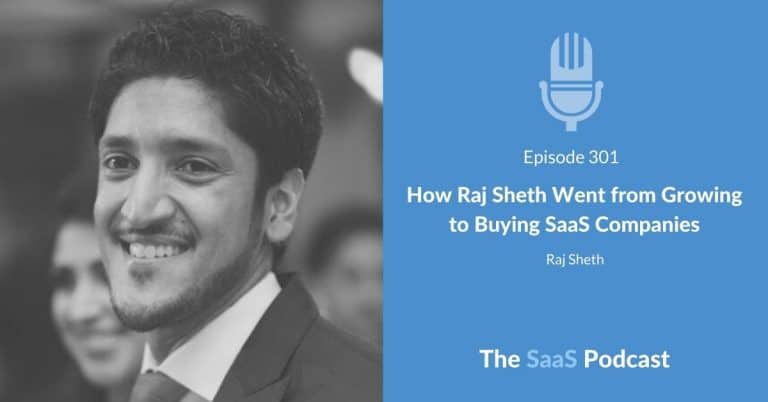
In this episode, I talk to Raj Sheth, the founder and CEO of Deca Lab, a SaaS factory that buys SaaS businesses that are doing between 1 and $3 million in ARR and helps them to grow faster and more efficiently.
In 2020, Raj acquired a SaaS data migration company called Fly Data.
He turned that business around and sold it just over a year later for a 3x return on his investment.
But it took a long time for Raj to have that type of success.
In 2006, he launched his first B2C software company, which failed.
A couple of years later, he launched another B2C software company which also failed.
In 2011, Raj Co founded Recruiter Box, a recruiting SaaS product which he and his co founders grew to over $4 million in ARR with around 3,000 customers.
They went on to sell that business to a private equity firm, but it took them seven years to get there, so it was by no means an overnight success story.
In this interview, we deep dive into how the co founders built Recruiter Box.
We talk about how they used SEO, paid media, directory listings, and all kinds of other things to grow the business and the lessons they learned along the way.
So I hope you enjoy it.
Raj, welcome to the show.
Raj Sheth (01:52.620)
Thank you.
Omer (01:53.100)
Omar, do you have a favorite quote?
Something that inspires or motivates you or just gets you out of bed that you can share with us?
Raj Sheth (02:00.540)
Not all those who wander are lost because I've done a lot of wandering in my time.
Omer (02:06.780)
Okay, well, hopefully we'll get into that as we talk about your story.
So tell us just a quick a little bit about Decalab.
What does the business do?
It's a little different to a traditional kind of a SaaS business.
So just give us an overview of what's going on there.
Raj Sheth (02:20.270)
The best way I can describe Decalab is it's a SaaS factory.
So what I mean by that is we are acquiring companies between 1 and $3 million in annual recurring revenue.
These are B2B software companies, SaaS products, and for multitude of reasons, either they have hit a bottleneck or the founders are looking to move on or they are pivoting or they are in their current strategy, they're dependent on too much capital.
Whatever be the reason Decalab is buying these companies, giving these founders a liquid Cash Exit and then we are getting better and better at trying to get these companies from 1 to 10.
So that's why I call it a factory floor because we want to probably own just five or 10 of these and as a collective get them to a hundred million in ARR efficiently without venture capital.
Omer (03:15.570)
So your story I think for this interview probably starts about 15 years ago when you started, you founded two B2C startups and both of them failed.
So maybe let's start with that.
Just tell us a little bit about what those, those two startups were.
Raj Sheth (03:35.620)
Yeah, absolutely.
I graduated undergrad in 03 and a lot of us, I was super excited about the Internet.
I done a couple of small student businesses websites while in college and then after I worked for three years 03 to 06 at EMC square, I was like, hey, there's only one way to pursue doing my own thing.
The only way I learn is by actually doing it.
So again like most people I didn't have any experience with B2B but I was super fascinated by filling up your stadium so to speak.
Right.
With, with a lot of people.
So the first B2C company was actually a Craigslist for India.
It was a classifieds portal which I started in 2006.
It, it basically it was exactly like Craigslist so people could, you know, buy and sell a lot of things that they were not using in a seconds market from their homes.
It did get to a few thousand users and transactions but I had no revenue model, I had no team that was actually building products and features.
I had, you know, just a freelancer as a programmer.
And it was hard lessons but in hindsight it would have helped to have a little more guidance, a little more support, maybe a co founder.
And that was a two, two and a half year journey.
So my savings ran out and I kind of just put that platform and a back burner and taking from the lessons of it I was like hey, let's, let's see if we can get a little more defined with the supply side and the demand side.
So the, the next B2C company was also a marketplace but this time I don't know if you heard of Blue Nile here in the US and there are a couple others globally.
But this time I had, I was intimately familiar with some folks and friends that were in the high end diamond manufacturing jewelry business.
There's a big hub in Israel, in India and Belgium, etc.
And a lot of these folks were wholesalers.
So my value prop to them was that hey, why don't we put part of your inventory on demand online and folks can directly, the end customer can directly buy that.
And there were a lot of hard hitting lessons there as well.
First of all, we had about seven manufacturers I would say but their finished inventory, which is the actual designs of the jewelry we probably had, you know, around 100 SKUs I guess is what they call it in the e commerce world.
So we had about a hundred products on there and what we realized is that it was really hard to get this supply side to commit on an ongoing basis because their core business was like wholesale and distribution manufacturing for them to commit to having a variety on here.
And of course it was super hard to even get the demand side to a come to the website but stay engaged with a static base.
And even though I didn't have a cost of inventory, I was unable to get that flywheel going as well.
And this was 2008, 2009 so wasn't the best time either.
But that till the end of 2010 is what I was where I was doing that.
And that's when like a lot of the supplier support was dwindling.
And plus I didn't have a lot of traffic on the website.
So yeah, those are my two disaster stories.
But they were fun.
Omer (06:55.740)
Were you based in India at the time?
Because I, I think your first job was in Boston, right?
Raj Sheth (06:59.900)
Exactly.
So after SE I was in Boston like for seven odd years but for these two, those five years I was in India.
Omer (07:07.580)
Yes, got it.
And then 2011 is when you co founded Recruiter Box which is a B2B SaaS product that you worked on for about seven years and then eventually that was acquired.
So tell me about how you came up with the idea for that product.
Raj Sheth (07:27.030)
Absolutely.
So this was the one that stuck actually before the idea.
What happened is the biggest hard hitting, hard hitting lessons from these two were that hey, I want to be quick to revenue, have something that was super tangible and did not rely on any flywheel.
Meaning if I get went to one customer, solve their problem with one product, they would pay.
That was our introduction to B2B SaaS.
And what was even more important is around that time I met my two co founders and they were, you know, engineers.
One was a backend engineer, one was a front end engineer and they had basically built a couple of products but not had until that point had much traction either.
And when the three of us met, we really hit it off because they wanted to do this global SaaS product.
They felt that they were building the product but didn't know how to get it out there.
Whereas I was lacking in building a tech product myself.
And so we teamed up and the how the way the idea came about was a little bit of an accident actually.
The primary thesis was that hey, when we were looking for jobs, there has to be a better way than just job titles to find a fit, right?
There has to be other things, other characteristics that we can search for.
But we were like hey, how would we go about that?
So when we talk to a few companies we realize that the first point of where a job originates at a company is, is potentially its careers page, its careers web page or at the time which we were not very familiar with the applicant tracking system.
And so we went about trying to solve that problem that what is the biggest pain for a lot of companies and startups and small and medium companies when they are hiring.
And back then the overwhelming feedback we got because we weren't talking to enterprises and that's an important point, we were talking to the mid market was that they were just using email and spreadsheets to manage that hiring process.
So we got focused and fixated on that problem and we said that hey, it's impossible to receive like 400, 500 resume attachments on email and sift through all of that and sounds like a nightmare.
So we created, at the time we didn't even know the term, but we created like the easiest to use training free applicant tracking software which anybody could just get self started with login and they didn't have to use email and spreadsheets anymore.
And funnily that turned out to be and ape any enterprise HR software because we didn't enter the problem that way.
So we got lucky with having that first principles approach and that stuck.
So we added, we started adding customers and revenue and before we knew it we were making this product better and selling it completely of course without a sales process online.
So we had a lot of customers discovering us through at that time, Google App Marketplace, Chrome, Web Store, SEO, et cetera.
And by making the product better and better we went From I think 100k in 2012 to 300k in 2013 to a million in 2014 to 2 million 2015.
So we kept tripling and doubling revenue and finally had that predictable revenue model.
And of course that company went on to over seven years to have 50 employees.
We had a distributed team even then.
So we had 16 folks.
And by the way now for most of that period I was then back in the US I was in San Francisco because we were also Exploring, should we apply to an incubator, should we raise funds, should we go up market?
We never ended up raising funds.
We just, you know, kept focusing on the product and the revenue.
And finally in six and a half, seven years in, we were of course, you know, looking at a couple of adjacent products as well because we felt that in the SMB space we didn't think we would break all the way to 50 or 100 million revenue.
So when private equity came knocking and we had also honestly poured everything back into the business all seven years, so it's not like we had taken any dividends and it was just the three of us, no investors.
When private equity came knocking, we decided to sell.
It was a clean, all cash exit and that's what we did.
Omer (11:50.770)
So how much revenue was the business doing when you sold it?
I guess it was in 2018.
Raj Sheth (11:55.650)
It was, yeah.
End of 2017, early 2018, it was between 4 and 5 million.
It was around.
It was closer to 4 million and change in ARR.
In err.
Yes.
Omer (12:06.570)
Yeah.
So tell me a little bit more about that.
Number one is you talked about this started from.
It was like an accidental find because you were really thinking about it from the perspective of finding a job, not building software to solve the problem for recruiters.
But once you had these ideas, how did you go about validating it?
Raj Sheth (12:25.120)
We talked to three or four companies and they were like, hey, there's no way I can go through all these resumes.
So we literally didn't even build out the whole product flow.
We didn't design the opening section and the candidate section.
We didn't design the onboarding.
All we did is we first built a shared inbox to sort candidates.
So there was only less than half the product.
How we validated it is we Talked to the five or 10 companies and we were sort of co building.
They were dogfooding the product as we built it and what was super exciting about us and since then, like we all know how hard this can be, but I think the first person was paying the first, first revenue three months after any code was.
So that's how we validated it.
When somebody, when the first person paid for it, we knew the other three or four would pay for it, five or six would pay for it and then we knew it was a valid.
Omer (13:23.310)
So you had this sort of initial group of customers who, who were dogfooding and beyond that you talked about a few different channels that you use to, to grow and acquire more customers.
Which one of those worked best for you?
And also I want to dig into what were some of the ones that didn't.
Right.
Because it's easy to talk about.
Yeah, you know, we did X and had this amazing success, but there's a lot of experimentation and trial and error that goes along with it.
Raj Sheth (13:49.310)
Absolutely, absolutely.
So actually, let's put this all on a timescale.
Sometimes you're not able to break through certain ARR levels.
You get stuck because a channel is just not.
Doesn't have enough juice in it.
So either it's 100k or 300k or half a million.
And sometimes it takes a long while to just break that first million and then you can even get stuck at 2, etc.
So 2011.
2011, June 2011.
June is when we started it.
And I'll talk through those channels of early revenue, but to be honest, it took almost two, almost a year and a half or two years.
So in 2013 is when we were ranking in the top two or three organic results for applicant tracking software, recruiting software, recruitment software.
Okay.
And.
And those had pretty healthy search volumes in, in, in the thousands, like close to 10,000, which was pretty decent.
So 2013 to 2016, SEO was a primary channel that brought in most of the gains.
But let's go back to the building blocks till then, because SEO was a lot of experimentation, a lot of site redesign, a lot of great content.
And then other things happened in the ethos as well, which is Google had this Panda update or something which penalized all of the other bigger sites because they had, you know, a lot of, you know, either bad content, black hat, whatever, so they fell away.
But because we had only built our not from an SEO lens, but just from a helpful lens, we were rewarded.
And there was no plan.
It's not that we really planned for that or we engineered that, but that was a great thing that happened.
But we were plugging away at everything we knew how to do for SEO for a year and a half before that.
But the first 25, 30 customers, I would say was a combination of three or four channels.
One is, and this is not the same anymore, by the way.
Now people might be thinking Goop, Google Suites, etc.
But if you remember back in 2011, there was Google Apps Marketplace.
I don't know if that's there anymore where you could, you didn't have to have any integration with Google, but you listed your product and it just literally linked out to your own website.
So we got a few customer, we got a trickle every month from Google Apps Marketplace.
We always Got signups from Google Apps Marketplace right from the time we put it up on there, which was the second or third month.
There was also Chrome Web Store, and this is again, not a Chrome plugin.
But back then there used to be like Chrome Web Store and we could list our business app there.
Both were free listings, by the way.
And then it.
We were just linking out to our website.
Then there was a long tail of.
There was something called Haro Help a reporter out, where every day I used to write.
I used to write to related things so that we would get, you know, a link or a mention or something contextual.
And if you.
I don't know if you saw my medium, but I put a whole list of press we got, which was still sparse.
But I remember in 2011 we were covered by MSNBC.
There was a news segment like we were on television and we didn't even request that, or obviously we didn't ask for that.
But they found it interesting on one of the Haro things and they picked it up.
And then we also got to do a guest author thing on the online version of the New York Times.
So every month.
And these were all the things that DIN scale, by the way, so they didn't add, you know, that much of the kitty.
But they kept giving us a burst of traffic all the way through.
And then we also had.
And this kind of connects back to the SEO, but we had a blog.
On recruiterbox.com, we had a blog which had a lot of interviews.
We were putting a lot of checklists.
So content was a big part of it as well.
So we poured a lot of our efforts on the marketing side, not necessarily on.
On anything on the sales side.
Till 2015, I would say four years in, we were like almost at 2 million when we started the sales stuff, because till then it was all those channels.
And once we had money, by the way, we also were doing capterra.com these were all paid listings.
We were doing getapp.com and we were doing Google AdWords.
We were doing Retargeting Adroll, that is.
So all of this was PPC paid advertising, which is.
I think that was after we had half a million in revenue.
Till then we were pouring in all the revenue into a bigger engineering team.
Omer (18:24.340)
Okay, so that's a great overview of those early days.
So I just want to get clear on a couple of things.
So you said the first 25, 30 customers came from those three or four channels that you mentioned, the Google Apps Marketplace you got listed in there.
But Are you saying you didn't actually have a Google Apps integration, but you were still able to list at the time?
Raj Sheth (18:49.950)
Yes, it was.
And again, some of.
Some of the listeners might remember this, or maybe they used it, but yeah, they had this thing called Google Apps Marketplace.
I don't think they have it anymore.
And that had nothing to do with the G Suite integration, because we didn't have one at the time.
I distinctly remember.
Omer (19:04.670)
And then you also got listed in the Chrome Web Store, although you weren't a Chrome extension.
Raj Sheth (19:11.340)
Yeah, by the way.
So we, we went and listed ourselves there, by the way, because they wanted app businesses.
Omer (19:18.380)
So it sounds like basically you were trying a bunch of different things, just getting the word out, getting the product listed wherever you could.
The harrow thing in terms of help a reporter out, that I haven't heard of a lot of SAS founders doing that.
But what we did you say you were like, trying to.
You were like, reaching out to journalists, like every day.
Raj Sheth (19:44.090)
Yeah.
So what happens is, I think that site is still around, actually.
But if you go to Help.
Yeah, if you go to helpreporter.com what happens is you put your own profile as somebody who can, you know, answer some questions.
Yeah, I'm a source.
I'm actually looking at the website right now, and you list yourself as a source, and then they have a daily newsletter and there are a bunch of things in there.
You have to list yourself as a source, but also put your profile and put some context in there.
Like, for example, my feed wouldn't have things on environmental law, for instance, because I don't know anything about that.
But I would put a few categories of things, hiring, recruiting, business marketing, small business growth, a lot of those things.
And then I would basically look at that list of, you know, 25 things a day.
And there were probably one to two that I could genuinely add some value and probably that response would be appreciated or included.
So, yeah, that's what I did.
Omer (20:42.890)
So let's talk about the paid acquisition.
So you, you tried a bunch of different things.
The content focus, and slowly the SEO was starting to kick in or, although, you know, obviously didn't happen that quickly, how much were you spending to.
What was your CAC in terms of paid acquisition?
And was that something that worked for you quickly or did it take some time to figure out?
And I asked that because I know some founders have had some great experiences where they're like, yeah, I put up some Facebook ads and I got a customer the first day.
And the majority of, yeah, I've tried Paid ads and nothing ever worked.
So where did you fall on the spectrum?
Raj Sheth (21:25.560)
I was more in the second bucket to be honest.
So I and so let's break it down.
So first I'll, I'll talk about the CAC and then we will do the breakdown of what was paid, what was organic.
So in if you look at starting 2013, we had a good flow of between 25,000 and 30,000 close to 30,000 visits to our site which we were very happy about because 0.3% or sorry 3% of off that traffic.
So a thousand were signing up to the free trial and then out of a thousand that were signing up to the free trial, a hundred were converting to paying customers every month.
Now keep in mind we had a relatively long tail small business audience and they were on average paying US$100 a month.
So we had a hundred people hundred dollars.
So we were adding 10,000 mrr, new mrr every month.
Now in a thousand signups were not always sales qualified leads as you would call them or even marketing qualified leads.
There was some strain there as well.
People would just sign up out of curiosity and things like that because we had made it really easy to sign up.
Now the 30,000 sign up, if you look at that, that waterfall or windfall was very, very SEO organic skewed.
Now we were obviously trying to get higher intent folks signed up with a paid advertising and throughout us experimenting with the paid advertising it was probably at the very start when we were only 100, 200, 300k ARR.
We were spending $3000 a month.
Month.
And the first lesson in PPC was because it was getting so expensive on Google AdWords and Capterra and we had these heavily funded competitors in the same words who had taken a seven $10 a click just to give you a sense and that's why everybody probably should have always kept buying Google stock.
7 $10 a click by the time we sold the company was $65 a click if you can believe it.
So, so when you ask me how was paid I very honestly remain confused till this day of it was like right, but, but I'll still give you the data analytics and you, you'll know why I'm saying that.
So the first lesson was that 3,000amonth was not a statistical enough number.
And that's the lesson we got and advice we got from a lot of people.
And that number needed to be more 7 to 10,000.
And when we started spending 7 to 10,000 at a slightly higher revenue level every month, 10,000 every month.
Then we started getting some that, hey, we seem to be paying 750 to a thousand.
We seem to be paying up to $1,000 to acquire a paying.
And then you would be like, okay, if they're paying you $100 a month and lifetime value is four and a half years, so that's fine, but you have to then get the true lifetime value because there were some that would also churn.
So we had to filter out all the leads from the paid ads and what is the aggregate lifetime value and you know, the thousand dollars.
Do we have better channels?
So sometimes what we did because we were not funded, we did a round robin.
We also.
Second lesson was.
First lesson was you need a statistical number like some people do on high bid words.
If you're only doing $500,000 a month, you won't get enough learning and data.
Second lesson, you can't do it for a month or two months and say, oh, it didn't work and stop.
So that was a second hard lesson that you have to do these.
I would say to a lot of people who are like on the fence there right now, I would say at least two quarters.
I know it's painful, but you will realize that you need six months of data.
Because sometimes what happens is even if you don't have attribution, you're like, no, this lead didn't come through Google AdWords.
What you turn off the ads and then the next two months funnily are lower and then you're like, hell, the only thing I changed is I turned off the ads, but it's not showing in my attribution.
So that was one more, one more lesson for us, right?
So you got to do it or a significant amount of time, make sure your attribution is teed up.
Right.
Which even for any of us to this date can be a little bit of a challenge with Google Analytics and HubSpot.
So yeah, sorry, I can go go on and on paid ad ads.
But at scale, believe it or not, we had gotten up to spending $30,000 a month on Google AdWords, retargeting LinkedIn, and we were up to $30,000 a month.
And sure, we were.
Still, the more you spend, sometimes the efficiency gets worse.
Depends on the challenge.
It's dynamic, right?
Depends on the channel and depends on what everybody else is bidding.
So I think that thousand also didn't remain thousand.
It started getting pushed up to 1500 2000.
Which is also why we were considering just going up market because the product had also improved a Lot.
And we also realized that hey, we really solved problems for people who are hiring all the time, not just for seasonal hiring folks.
So there were a lot of lessons, lot of punches, a lot of slaps out I would say.
But yeah, that's the PPC was integral part of the learning.
Omer (26:53.310)
So let's talk a little bit about upmarket.
So you just explained that you were getting a lot of churn or there was a churn problem with the SMBs that you were targeting at a hundred dollars a month and the product was getting better.
And there was certainly you guys saw an opportunity to go up market and as I understand you shifted it to more focus on 3k a year product.
Is that right?
Raj Sheth (27:22.310)
3k to 10k.
And believe it or not, there was, there were even customers that then only one or two paying us like 50k a month because we had like stuff done for them in a separate sort of server.
They had high volume, some other features for them, security.
But yes, 3K.
Omer (27:39.590)
Because help us understand like how did you make that transition?
Like you've got a business, it's, it's working well, you're acquiring customers, it's growing and it can be a scary move to then say we're going to go after something else.
Raj Sheth (27:55.440)
You know, funnily, Omar, the truth is we never made that transition.
Yes, we attempted the transition, but the transition was never made.
So I know since then the folks that have bought us made the transition completely.
They don't even have the $100, they don't have the sign up.
They only have demo only.
You have to talk to a sales team, right?
So forget that.
But when we were making that transition, our transition was to just fork.
We did two things to start with A, we started going outbound.
We started going outbound.
We got good, I got good at the mechanics of the outbound campaign.
But what I realized is that we had a positioning brand problem, right?
Like it's not just about going outbound and telling people about feature.
And we just realized that when one of our competitors raised a lot of money from a named VC and went to the talent point person at the several VC funds and said that hey, we do data driven recruiting.
And funnily the word data driven recruiting just seemed to make a lot of sense to a lot of people even though our feature set was the same.
So I, it's just like this was a marketing positioning problem.
That's the one thing we learned.
But let's put that on the side.
When we were in that transition, one of the things we started doing in the funnel is we said hey we're going to now fork people in the onboarding.
Like if you are a company, if this is the Persona signing up, if you're at this size company then you continue just using that product and all is well and you just don't want us in the way anyway.
And folks that were HR team that has an RFP or they are anyways going to look at the three or four products they anyway used to request a demo.
So it's not like they were going to suddenly be like oh I'm appreciating the self of onboarding.
I just want to get started with that.
They can't get started like that.
They're still trying to.
They're going to commit to one in three products and they need to basically have that beauty contest and they had the list and they need to check that list, et cetera.
So we started doing that transition, we started pushing the annual plan but we could not make still most of our revenue was coming from the self serve business and we didn't have very meaningful traction in in on the other side of the pond.
And of course we have 100 lessons from there and since then we've put them into play.
But to answer your question accurately, we didn't really make that transition.
Omer (30:23.880)
The so you sold the company in 2018 to a private equity firm and then in it was in 2020 that you made your first acquisition through Decalab which was a company called Fly Data.
What did the product do?
Who was it for?
Raj Sheth (30:45.370)
Basically when imagine an E commerce company, a fintech company, video gaming, any big site that has a lot of data, they have a lot of signups, a lot of transactional DBs.
So not to go super technical but even I can explain it layman's terms that what happens is when a company's database, their MySQL Postgres in hundreds of millions of rows you can't run analytical queries right on that database or even on a read replica.
Over the last 10, 15 years these things called data warehouses came about, right?
Amazon AWS has one called Redshift.
Google has one called BigQuery.
And I'm sure you you must have heard of Snowflake.
Like they recently went public and it's been like a very popular company and stock grown very quickly.
These things are called data warehouses.
In simple words what they do is you move all your data like your data from your transactional databases and your data from your salesforce or whatever, you move it to your data warehouse and the same query that would take you nine hours on a transactional database.
Now on this analytical database takes only nine seconds, right?
Because your data is stored differently.
And that's what a data warehouse does.
Fly data are the pipes the industry speak for it is elt, extract, load, transform.
So the fly data, think of it as a zapier for big data.
So like they are pipes that take all your data, all your signups that's coming in, et cetera, in real time, and replicate it and sync it to your data warehouse.
So if different parts of the business, when they're running real time analytical queries, oh, I'm spending a million dollars a day on advertising.
Is it working?
What happened in the last five minutes?
I'm a fintech app.
What happened with those transactions?
When analytics is super crucial, businesses use both, something like fly data to pipe the data, have it be part of the infrastructure and basically they're using these data warehouses.
So we sit on top of the data warehouses.
Hope, hope that.
Omer (32:56.020)
Yeah, that's very helpful.
So how, how did you find this one?
How did you find this company?
And how did you.
What was the decision process?
Raj Sheth (33:03.580)
I did a search, honestly on Crunchbase.
I did a few searches, but I did one search of companies that had raised money four years ago or early in San Francisco, but had a team size of 10 or less.
It was just my rough rudimentary way of searching for companies that had not done the venture scale.
If somebody had raised money four or five years ago, my guess would be typically they would have one or two more rounds after that and they would maybe have 60, 100, 200 people.
I got a list of companies and then I sent them an outbound campaign like a super friendly founder to found a note, being very honest that hey, I've had one exit, I have some capital and I'm looking to buy a company because this is the model that I'm thinking of pursuing and perfecting.
And funnily, I had so many replies from.
I had 22 Zoom calls scheduled within the first three days of that campaign going out and I spoke to 22 people.
A lot of the businesses, to be honest, I would not have been able to understand them or do justice to them.
But I love listening to the stories and we were troubleshooting where they go from here.
And some founders were just, they were just stuck that maybe they had raised around but not really got into product market fit, some had got into product market fit, but not to scale and they just had some flatline growth and some had problems with their VCs.
And so it was great education for me actually, because, yeah, I learned a lot doing hiring and doing growth stuff at RecruiterBox.
But this was amazing because I, and I, I instantly also, on a personal note, realized that I really enjoyed this.
I really enjoyed like learning all these stories, et cetera.
And then one of them was Fly Data and they had raised 9 million previously attempted 23 products.
The founder was a phenomenal great engineer.
He was like a 10x engineer, but somehow done the 23 products which had not worked.
And all that was left with this one core product which they had originally started with, called Fly Data.
And which I was explaining what they do and they.
What I.
What instantly struck me is the business had very low churn.
And so that was a big part of my decision because I was like, hey, SaaS revenue, if the churn is low, can be so resilient that you get, you have time to learn.
And then also it was a very large, it was well sub a million dollars in ARR and we were getting a fairly reasonable deal out of it because the investors are written it off anyway.
And the founder was looking to move on and do something very specific in virtual reality.
So it was a win because I was taking it off their hands.
And it was win for us because we instantly, since then, in the last year, we redid the website instantly, we redid the SEO, we got some SEO traction.
Then we realized the search volume is not that high though.
But that was great to get that in shape and get a trickle going.
And we rewrote large parts of the product, which I don't recommend or we don't want to do it again and again, but we had to because our product only integrated with Redshift.
But now we wanted to integrate with Snowflake and Bigquery and you know, get those connectors.
That's the natural next step for growth.
And we added a few customers and we started doing ads again and experimenting with that.
And again the ads have worked in a mixed way.
And yeah, it's been phenomenal because at the revenue it was the founder was taking, keeping a portion of it for a salary.
But as soon as he left, I was literally at a pretty decent EBITDA profit stage.
And I just used that whole profit to put my decalab team on it and engineering team on it and outbound SDR team on it.
And it's all being funded from the revenue.
Omer (36:49.830)
So yeah, so the business I think was doing about 500k in ARR when you bought it and had raised quite a lot of money but there wasn't much going on.
So you turn that from the acquisition, doing a turnaround and then you selling that business took you about 13 months.
And I know you said you got a 3x return on what you invested in that business.
Raj Sheth (37:13.610)
Yes.
Omer (37:14.410)
When you looked at Fly Data, what made you think you could fix something that these guys that had been working on for six, seven years hadn't been able to?
Raj Sheth (37:21.370)
No, honestly, I don't want to position it like that or take credit.
I had the honest answers.
I had no clue.
I had no clue.
I was just looking at two things.
Hey, I'm getting this at a great price, okay.
And if we screw everything up, it will sort of be a wash, it'll be a break even, it'll pay for itself.
So that was the honest notion.
And then we did know because we actually enjoy this stuff and funnily the intention was not to sell it or flip it 13 months ago.
Purely an accident.
And I'll explain all of that in a second.
So we just jumped in and we learned a ton about the space, did a partnership recently started talking to the Snowflake team and we've been talking to our customers and we like, like I said originally 1 to 10 then why would I sell it?
And two or three things became, you know, clear to us.
One, one, the rewrite took longer but we were so glad because I'm so these engineers are my original recruiter box engineers by the way.
And I was super, I'm like thrilled with they have been able to pull off because this infra product is a very different product and we had no experience in it to be very honest.
So we didn't think that we could and for that matter when we are talking to any founders now for buying the company, we don't believe we can do it better than them by the way.
We just stick to certain basic things that when we buy a company we are going to simply bring it to 50% EBITDA.
So we will keep 50% of the cost, which is mostly the current team.
So we'll bring it to 50% EBITDA and we'll use the other 50% of the revenue for the growth of the business.
And we, we look now we are smarter since the Fly Data deal too by the way Omar, because I wouldn't do, I would say that almost screwed up a couple of things on Fly Data because now I look for companies that at least have a 15, 20% net positive growth rate whereas Fly Data was on Declining growth rate at the time.
That's point one.
Point two.
I would love to pick things where we need to either do the heavy lifting on the growth funnel or the product on Fly Data.
We had to do both, but which was okay, which was great.
And then when this company, Fly Data is the only missing feature set in this company that has just bought us a couple of weeks ago, bought Fly Data, the product that is.
And when they came in, we're like, no, actually it doesn't make sense for my model.
And they were initially offering something that was.
That wouldn't make sense for all the, you know, work we put into it.
And we should, like, really see it through for five, seven, ten years.
That's how we are looking at it.
But to be honest, when they, when the price went to what they ultimately ended up with, we are like, wow, this proves out a model and we can now look at the bigger picture and go do three companies.
Go buy three companies, not just with this capital, but maybe even raise more money and buy these three, three companies.
Because we are going to have a tough time by ourselves.
See, they already have 500 customers into which they're going to sell this product into.
But getting a funnel going from scratch where now that we understand the space, we're going to have a very tough time unless we put 150 connectors over the next two or three years.
And that's going to be much more engineering heavy lifting.
And do we really want to expand the team, et cetera.
So Fly Data was a great incubator for our model and it's super fortunate that we ended up getting free extra money.
That's.
That's great.
But we also learned a lot and we also made a lot of mistakes.
And it's just a fortunate accident, I would say, that I managed to get that deal and connect some dots, and I knew these people as well from the past.
Omer (41:01.300)
Before the acquisition.
Was this something that.
Were you already thinking about acquiring other businesses or.
Raj Sheth (41:07.510)
Absolutely.
Omer (41:07.990)
Okay, so this was like Fly.
You acquire Fly Data, but then you were like, also thinking about doing other things.
It wasn't like the acquisition made you rethink, oh, we should go out and buy more.
Raj Sheth (41:18.470)
The original thought, if you see that original substack that I've written, was right around the time we had just bought Fly Data.
Fly data was June 2020.
I launched my second big campaign in December 2020.
And I, I already talked to, you know, 40, 40 to 50 companies since December 2020 till today, actually, which is amazing.
And we were doing, of Course, a lot of day to day work, heavy lifting on Fly Data.
The whole team is, you know, focused on Fly Data.
And then I'm taking, you know, some time out every quarter or so to go deeper into companies and perfect our thesis a little bit, get more of a bench commitment for people that are going to join the DECA lab layer to run these companies.
And absolutely we want to do.
Because the true value is in the aggregation.
I feel, I still feel that.
And that's why Fly Data was an anomaly.
But the point is not to flip these, not because we just want to keep doing them for 10 years, but I think the value is in the aggregation of revenue, aggregation of profit, taking profit from one company, putting it into the second, etc.
Omer (42:23.930)
Is this something that you find?
There are founders who are good at starting new things, there are founders who are good at scaling and growing large organizations.
And I guess what you're doing here is a bit in between, which is taking something that's been started, didn't really get off the ground, figuring out how to turn around and fix that and get it on a healthy path.
Is that something that you've learned and found that you feel the most comfortable in, or is this just because it's a great kind of a business model that you've come across?
Raj Sheth (42:58.440)
Yeah, no, that's a great question.
In the light, Preferred opted for the initiating something from scratch and creating something from scratch funnily, before we found Fly Data as well, of course, because our team's still there.
So we even banged out one product and we of course love doing that.
But during the Fly Data experience, to be honest, I realized that I actually really enjoy looking at something and seeing what can be different.
So absolutely we enjoy this.
I wouldn't go as far as to say right now that we are good at it or we are better at it.
I think that remains to be seen, to be super candid, but I actually do love seeing this.
And yes, I think it's more efficient as well, unless you have very high conviction that you are going to take something from scratch.
And I'll give you an example.
The Zoom founder created Zoom, but let's keep in mind that he had created, he had been in that same industry creating that Same products for 10, 20 years before Zoom, if I'm not mistaken.
And he had already sold a company in that exact space.
So he had that domain expertise.
And for us, unless we have super high conviction that, hey, we're going to exactly play in this space and we will hit product market fit And I also see, I also feel that this is a more predictable, more efficient business model to get 200 million in revenue where the products sure might be different, but the characteristics of the business are all the same.
They all need SEO, they all need great onboarding if they're self serve products.
They all need amazing support and success.
They all need certain kind of outbound sales.
So we enjoy that whole production line, so to speak of on that factory flow.
Omer (44:44.470)
Yeah, it's Certainly an interesting 99% of the founders I talk to are obviously building businesses and that is a very different kind of challenge.
But yeah, this has been really interesting to hear about your experience and your plans and the way you're thinking about this.
We should wrap up here.
So let's go into the lightning round.
I'm going to ask you seven quick fire questions.
So just try to answer them as quickly as you can.
Okay.
What's the best piece of business advice you've ever received?
Raj Sheth (45:11.650)
Solve a problem that you've had firsthand.
Omer (45:14.450)
What book would you recommend to our audience and why?
Raj Sheth (45:18.050)
The Everything Store, which is a book on Amazon.
And what was super striking to me is Jeff made so many mistakes but was still able to build an amazing company and that's because they just took a lot of action quickly and experimented fast.
So the Everything Store, what's one attribute
Omer (45:38.070)
or characteristic in your mind of a successful entrepreneur?
Raj Sheth (45:42.710)
Thought to action ratio.
No matter how intelligent you are, make sure you're taking more action than just thinking.
Omer (45:48.830)
And what's your favorite personal productivity tool or habit?
Raj Sheth (45:53.510)
Google Calendar.
I'm a calendar fiend and I love being on time and having everything on the calendar.
Omer (46:00.150)
What's a new or crazy business idea you'd love to pursue if you had the extra time?
Raj Sheth (46:05.160)
I would want to do a marketplace for people who are lonely in their 50s, 60s, 70s to send them a buddy for social.
Omer (46:14.520)
What's an interesting or fun fact about you that most people don't know?
Raj Sheth (46:18.920)
I tried to be a full time actor between the failed businesses.
Omer (46:24.360)
And finally, what's one of your most important passions outside of your work?
Raj Sheth (46:27.960)
I like writing.
Just writing down my thoughts, writing poetry and also, yeah, spending time with Raj.
Omer (46:33.960)
Thank you so much for joining me.
It's as I said, it's been really interesting to shift gears and talk a little bit about acquiring companies and how you're thinking about that and obviously you've got two, two great examples with Recruiter box and which you didn't acquire.
You found it and fly data.
So thank you for your time and for sharing some great insights and lessons with us.
If people want to get in touch with you, what's the best way for them to do that?
Raj Sheth (46:59.260)
Rajecalab IO that's the email.
R A J at Decalab D E C A L A B IO and
Omer (47:07.260)
if they want to learn more about Decalab, they can go.
Actually, decalab IO is your substack, isn't it?
Raj Sheth (47:13.740)
Currently it is, yeah.
The site is coming up.
We've just been spending all our time on fly data and getting that done.
Omer (47:19.980)
Awesome.
Thank you so much and wish you and the team the best of success and look forward to hearing about your next few acquisitions.
Raj Sheth (47:27.970)
Thank you, Omar.
Thank you.
Omer (47:29.290)
All the best.
Cheers.