Omer (00:10.000)
Welcome to another episode of the SaaS Podcast.
I'm your host, Omer Khan, and this is the show where I interview proven founders and industry experts who share their stories, strategies, and insights to help you build, launch, and grow your SaaS business.
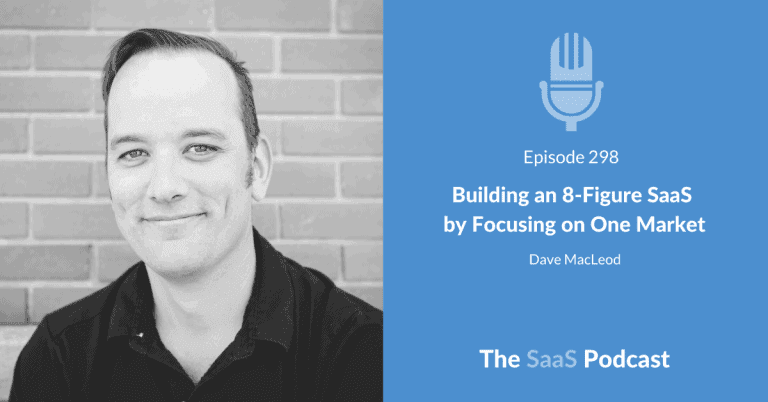
In this episode, I talk to Dave McLeod, the co founder and CEO of Thought Exchange, an enterprise tool that helps leaders quickly gain critical insights and make better decisions.
In just over 10 years, Dave and his co founder Jim have grown Thought exchange into a $20 million annual business with 200 employees and $45 million in funding.
But there was a time when no one was interested in buying their product.
They built the product first and then tried to find people who had a problem that they could solve.
It wasn't a smart way to go about building a business, so it was hardly surprising that they struggled to find customers.
They kept hearing the same feedback.
People told them, it's an interesting idea, but it's not a product we'd ever use in our organization.
But eventually, they did find a customer in an unlikely place.
It turned out that a school superintendent had the exact problem their product could solve.
And at that point, the founders made a very smart decision.
Although they didn't fully realize it at the time, they decided to go all in and focus on school districts.
For almost five years, they focused almost exclusively on that one market instead of going out and trying to sell their product to everyone.
Today, half their business comes from enterprise customers.
But their success was originally built by focusing on one target market and one customer for years.
Whether you're trying to find your first 10 customers or get to your first hundred million dollars in ARR, focus is just as critical.
And that's what we dig deeper into in this interview.
So I hope you enjoy it.
Dave, welcome to the show.
Dave MacLeod (02:07.190)
Hey, it's great to be here.
Omer (02:08.950)
So do you have a quote, Something that inspires or motivates you and can share with us?
Dave MacLeod (02:13.950)
The one that comes to mind right off the top is that good judgment comes from experience.
And experience, well, that generally comes from bad judgment.
That's my favorite.
There's versions, all sorts of different versions of the same quote, but it sort of talks about the fact that the crucible of good judgment is the fact that you screw up a lot.
Omer (02:33.950)
Love it.
So tell us about Thought Exchange.
What does the product do?
Who's it for, and what's the main problem that you're helping to solve?
Dave MacLeod (02:40.960)
Yeah, so Thought Exchange is a discussion management platform.
It's a way to have a conversation with a large group of people.
Large meaning 10 to 100,000 in a way that removes bias and surfaces important thoughts rather than just frequent thoughts.
So we are now a company that's used by a growing number of the Fortune 100, actually, and as well as lots of public organizations sort of across North America to have large conversations with their constituents.
Omer (03:11.880)
Okay, great.
So the company was founded in 2010.
Tell us a little bit about what you were doing before you founded Thought Exchange and how you came up with the idea for this business.
Dave MacLeod (03:23.560)
Yeah, so I went to four different colleges and got zero degrees, and I was an outdoor guide.
I was wannabe musician and a writer, and I took photography and math and political science.
And that really prepared me to be an entrepreneur and a consultant.
And so I was actually.
I'd founded my own businesses doing leadership training and consulting and developing workshops and courses and things like that.
And along the way, I had devised a way of hearing back from a group of people, totally analog, no technology involved, to, you know, hear from 100 people to help set an agenda for a meeting where you just get everyone to write down their idea on a recipe card and then you shuffle it around the room and everyone scores those recipe cards five or ten times, and then you figure out which.
Which of those ideas is most important to that group.
Sounds like a pretty simple thing, but people just loved it because it actually did a lot of things.
It removed people's names from the process.
They could share their ideas freely.
And there was a good process.
I tell you that story, because at the same time, there was another guy by the name of Jim Firstbrook who was a principal engineer, physicist, and a product manager at a company called Creo that had just been sold to Kodak, you know, a nice billion dollar exit sort of thing.
And he had just read the wisdom of crowds and was trying to crack software to be able to solve for.
How do you get a crowd to come up with an answer to a question?
And a common friend of ours named Lee White that both has an outdoor guiding background said, hey, you guys got to meet each other.
And famously, Lee came to me and said, hey, you really gotta meet Jim.
He's trying to basically do what you're doing in software.
He's trying to build collective intelligence software.
And I was kind of like, no, thank you, not interested, not really my thing.
And he then went to Jim, his friend as well, and said, hey, Dave is this guy who uses recipe cards and drives around to all sorts of places and puts on meetings with all sorts of people.
And Jim sort of famously was like, yeah, not Interested.
And so despite that, Lee was very persistent, and I managed to be persuaded to go to the very first alpha look from the first group of developers that brought the alpha of Thought Stream at the time out.
And I saw it and I was like, wow.
I mean, infinite recipe cards.
That's basically what occurred to me.
That's kind of a big idea.
And so Jim and I got in our first argument within three or four hours of meeting each other, and the rest is kind of hit history from that point.
Omer (05:53.970)
Love it.
So give us a sense of the size of the business in terms of revenue, employees, how much money you've raised so far.
Dave MacLeod (06:01.090)
Yeah, so we're sort of just just under a few hundred employees.
We're just.
Just this year we just passed 20 million in ARR.
And growing pretty strong.
Growing very strong, actually.
We've raised just over $40 million so far as an organization.
Those are some general things as of right now.
Omer (06:19.240)
Awesome.
Okay, so you and Jim get into an argument in the first few hours.
Sounds like a match made in heaven.
Dave MacLeod (06:25.600)
Exactly.
Omer (06:26.200)
How did you guys move forward on this idea?
Like when you mentioned Thought Stream, is that what kind of like the first version of this product, Is that where it all started?
Dave MacLeod (06:36.680)
Yeah, well, it was actually called Sophia, I think, at first.
And then Thought Stream was the first thing that came to market.
And yeah, it was sort of.
You know, I came from having built a career around doing this sort of work with paper.
I had an instinct for what it could do.
And the technical team was taking a different approach, which was like, what's possible given building software to solve for a problem?
And I will note that I just talked to a CEO who just exited their business for around a billion dollars, and they had a very specific corporate business problem that they solved and built software for.
And I like to say that I very famously, we didn't do that.
We actually did the classic mistake of we actually were like, wow, you can build software to have a conversation with 10,000 people.
That's great.
Let's really create that solution.
And then we'll go wandering around the world trying to find people who have a problem that we could solve, which is a terrible way to really go about building a company.
You got to think about it.
And so I really.
It's one of those things, you know, do what I say, don't do what I do.
Because it was a terribly dangerous and risky way to.
To create a whole category and define a software category based on a capability that people.
It wasn't really clear anybody actually wanted to do Such a thing, if that makes sense.
Omer (07:52.300)
Yeah.
Yeah.
So, I mean, that was one of the questions I was gonna ask you, was like, how did you go about, like, validating the idea?
It sounds like you didn't.
You had the.
Dave MacLeod (07:59.900)
Well, really.
I mean, we did that in a way where we took it out to all sorts of people.
We took it out to corporate leaders and business leaders and government leaders and school district leaders and the First Nations Health Authority.
And, like, we took it to everybody and sort of were like, hey, we built this capability.
What do you think?
And again, this is in the spirit of advice.
This is.
I don't advise this 2020 hindsight.
However, that's what we did.
And we went to Validate, and we actually heard some really interesting feedback.
This was 10 years ago.
And we were sort of like, hey, you can talk to people.
You can talk to a thousand people.
They all get to see the thoughts of one another and rate them, and then you get to figure out what matters to them when you can learn all sorts of fascinating things.
And we sort of.
We heard over and over again.
Well, frankly, there's two major problems.
One, we don't really want to hear from everybody.
I don't know why we would.
And two, this idea of everyone seeing each other's thoughts totally openly like, this is way too open and vulnerable for our organization.
Like, that will never fly.
Big problem.
So interesting idea, But A, I don't want it, and B, we'd never allow it.
So thank you for the time.
We heard a whole lot of that.
And we're like, but it works.
You know, don't you want to.
So we sort of.
I feel like we kind of created the Zune.
It was very early, great capability, but nobody really wanted it.
And yet we.
We kept fighting.
We kept fighting with, somebody must want this.
And we were very fortunate to find that disproportionately, a school superintendent of all Personas has a very specific problem where they have a very decentralized group of constituents.
And it ranges from staff members to.
To voters to parents, to community members, and then students themselves.
And they were like, wow, a tool where I can talk to thousands of people and help solve my problem of trying to fund my school district and hear from people and understand what I should put in elections and figure out how to reshape boundaries and things like that.
They were like, this is a perfect tool for that.
And so we're like, wow, really?
Okay, great.
We are educational leadership tool that helps superintendents make amazing decisions by involving thousands of their constituents.
So we were like, okay, great, let's do that.
That sounds like a buyer.
They're interested, we can create value there, they want us, they love us.
So let's become an education company.
Omer (10:19.490)
How long did it take you to get that first customer?
Dave MacLeod (10:22.690)
You know, it was actually sort of, we had our first five very random customers sort of within six months or so of bringing the product out.
And then the next six months after that we sort of were able to get paying customers start to see a pattern of five or six paying customers that had a similar ish business problem in the next sort of six months after that.
So not a gloriously ripping fast timeline that exploded users overnight, that's for sure.
More like a painful one on one conversation process to find people that really had a problem that we could help some solve.
Omer (11:02.020)
Do you remember how much you were charging for the product then?
Dave MacLeod (11:05.460)
Yeah, well, geez.
So we, in the spirit of talking to a bunch of founders, we have ranged from 39.99amonth to well over a million dollars over the course of the lifespan of thought exchange.
Meaning we were like, well maybe low end of the market where people just, we need a visa way of being able to run a very simple exchange that has none of the features, none of the analytics, none of the software and support and things like that.
And we tested that and we sort of had to, we worked through all sorts of different pricing and packaging and service and support modules to be able to figure out how can we actually solve the business problem that we're out to solve.
And then eventually landed where, you know, a school district might buy us for between $20,000 and $40,000, software and some services and a corporation might buy us from between 100,000 to a million dollars.
Omer (11:54.060)
And then how did it play out?
Once you've, you've got school district as a customer, you focus on that market.
What happened next?
Dave MacLeod (12:05.240)
Yeah, so thoughtexchange, you know, six or seven years ago, the website would literally hit you with a bus.
Like you would get there and it would be like there was a video of us and it would like hit you as you came to our site.
And then there'd be a picture of superintendents who loved us and we were helping solve problems, helping hear from their unheard majority, helping them understand things.
And we would, we had showcase all, you know, 25 of them would be on our front webpage and we were like, we are the solution for doing large scale constituent engagement for school districts.
And we just built that.
We actually, at first it was like, let's do 50%.
And then I was like, how about let's do 70?
And then Jim actually was like, you know what, let's do 90, 95%.
Until we actually can build out the product properly and get some scale inside our services and our technology and make it more mature.
We're creating a ton of value here.
Why would we do anything else?
It's a huge market.
Let's just stay put here until we get the product really baked.
And that was probably the smartest thing we ever did, is stop.
Stop trying to sell to the whole world and just really focusing on one Persona that we really knew would speak on our behalf, would go and tell all their friends that they definitely should buy thoughtexchange, et cetera.
So, yeah, there was a period of we went extremely wide, talking to anyone in the world, buying ads, taking sales, conversations with insurance companies, anybody that talked to us, to a world where if you weren't a school superintendent, we wouldn't talk to you, period.
And that was really instrumental for our early stage growth, sort of between 500,000 and 5 million in ARR.
Omer (13:44.500)
So from what I understand in the early days you mentioned you were buying ads and you were kind of doing outbound talking to anybody who would listen to you, and you weren't getting a lot of positive feedback at all, actually, from how you described it.
So what kept you guys going?
Dave MacLeod (14:08.200)
Yeah, that's a good question.
Because I actually think there's kind of two.
It's oversimplification, I'm sure, but I think there's kind of two things, two ways to really bring something out to market.
One is to just say, we have a capability, we want to build software, we want to solve a problem that we see out there.
We're going to solve that in any way, shape or form.
Where we actually had a different.
We actually had a vision which was, you know what?
People have the right to be heard and businesses are going to be better.
If you can hear from people and remove the identity and remove bias from hearing from people, we know this has value.
The market might not be ready for it.
But we stayed pretty resolute that the idea of scaling conversation and removing bias in any organization is going to be super valuable, whether it's recognized now or not.
We have to find a way to wait until, define our market and then let the market catch up.
And sure enough, five or six years later, after we built it out far enough, we went back to the corporate sector and people were like, wait a sec, you have a way to talk to a thousand People without bias sounds like exactly what we want.
Right in the values of our right from the top.
Our strategic plan is inclusion and hearing the voice of people and honoring what people think and say.
And what an amazing tool for such a thing.
And it was like, yeah, well, yes, it's the ipod.
You know, we happened to also have created the Zune a few years ago.
Let's forget about that.
And now it all, all of a sudden, the market aligned with our product.
But that's not without a five year gap of a hell of a lot of no, not interested, wrong time.
And so we were almost just stubborn with our vision of like, this thing has value, it just has value.
You can't dispute the fact that hearing from 2,000 people and knowing what matters to them has value.
So we just had to say, mission critical, eyes on the prize.
Our vision has to get to the other side, which I think is only right once in a while because I think oftentimes with products you should just listen to exactly what your customer says and solve their problem near term, not have a vision for what you think is possible, if that makes any sense.
Omer (16:04.910)
Yeah.
How much were you in terms of revenue were you generating in those first few years when you were focusing on school districts?
Dave MacLeod (16:12.580)
I mean, we were, we were doubling and tripling our revenue on small numbers.
So, you know, when, when your first year revenue is $10,000, that's not so hard.
But so we went from like tens to hundreds to several million over the course.
But it took us, you know, doubling or tripling in first years.
Tripling our revenue meant going from 100 to 300 and then over a million and then getting over 2 and 3 million within three or four years.
So it wasn't sort of rocket ship growth from an overall jump up to 500 million in ARR.
Point of view.
But it was very steady growth, good growth for a company that's doing better than doubling every year.
But it was just staying humble and knowing that doubling 500,000 to a million is a great thing to do or to 1.5 million.
I can't remember the exact specifics, but we were always within sort of doubling or tripling on those small numbers.
Omer (17:02.860)
And then in those first few years, you stayed focused on school districts as your target market.
Dave MacLeod (17:07.990)
A hundred percent.
I mean, if there's.
This is my.
That's why I gave you the quote.
Good judgment comes from experience.
And our bad judgment was that, you know, we, we missed at one point.
We're like, you know what, let's expand, let's really get out there and start selling to a whole bunch of people and let's buy all sorts of ads and get some marketing people and get salespeople and SDRs that'll just really knock this open.
And we missed our year end, you know, dramatically with this stance because we were so unfocused.
We didn't have a group of referenceable customers.
Our ability for them to actually understand similar people with similar problems, all the money we're spending on random marketing for all sorts of things, this was very ill advised.
But yet it's something that we certainly did and that we had this capability which was like, of course we can solve your problems.
We're thought exchange, which was sort of overly arrogant and not very wise and all of a sudden now we seem smart.
But that wasn't without a lot of licking our wounds and making a lot of bad choices along the way.
Omer (18:07.420)
What did you do in terms of funding?
Were you initially bootstrapping the business?
What point did you raise money?
Dave MacLeod (18:14.060)
So we, we raised money from some excellent angels.
So we had angel investment.
Actually the CEO is of Creo, Amos Michelson.
He was Jim's former CEO and he, he really invested in this group of people to say, okay, I'm not entirely sure what this product does, but I actually really believe in this group of people.
And so I'm going to give some money and have some faith that they're going to talk to enough people and they're going to figure out what it is that they're going to do.
And that is, you know, the truest form of angel investing.
I think it occurs like angel investing, when you're not totally sure on your vision, you're not totally sure on your market, yet you have people that'll back you with some millions of dollars to support your growth and development in the early days when you sort of have no right to be able to do such a thing.
So yeah, we had some really great angels that came along and supported us in that sort of tumultuous time of finding our first target market that allowed us to then get to a proper series A VC round, et cetera, some years later.
Omer (19:14.630)
Tell me a little bit about, like, how are you selling to the school districts?
What did that sort of sales and marketing process look like?
Dave MacLeod (19:22.550)
Right, so the.
Here's the good judgment.
At first we sort of read all the books and hired people and did all sorts of stuff to build, you know, pay ads and SEO and all sorts of things.
But then when we found our target market and found a problem that we were solving for them.
It became a lot more obvious about what we needed to do and that there are places where our customers gathered, there are publications that they read, there are specific events that they go to, there are trusted people that they see as leaders, there are associations.
And we started to put all of our marketing advertising dollars to working with those organizations and help them solve problems with our product as well and getting our product inside the whole realm of our, the people that we're trying to serve and with that focus.
So we arranged, we would still buy ads and things like that, but it was ads to come to roundtables to meet with other superintendents and talk about business problems.
And we started sponsoring associations related to our superintendents and we started going to events where they would be gathering.
All of this really specific focus on our Persona allowed us to all of a sudden have a really great conversion rate.
And our CAC started coming down dramatically and our speed of revenue started increasing and our ARR started jumping up properly.
But that all came with focus, not the opposite, not with actually sort of going wide and being very clever about.
We had great SEO, we had lots of people visiting our website and it just wasn't converting to deals that were allowing us to grow.
But we had a period that we were a very interesting company and we had all sorts of people interested in us.
But yeah, I think there's a real interesting lesson in there of like, find your.
Like how granular can you get?
I guess would be my.
A lot of people have asked me as far as a lesson learned, what I would do differently.
You know, we went down to 90% after a year of selling superintendents, we should have gone to 100% in the first day.
As soon as we figured out that we were creating the amount of value we were creating for that customer, we should have just quadruple down or all in on that customer so that we could.
Marketing became so much easier once we knew exactly the problem we were solving and who we were solving it for.
Omer (21:38.610)
So that's a pretty common thing with a lot of early stage founders where there's this reluctance to really niche down.
I've got a product, it can help everybody.
Or even if you pick a particular market or a Persona, often it's still really broad.
And so your messaging, your marketing, everything is still kind of really diluted.
And I think it can be really hard to, to, to kind of jump in with both feet and say this is where we're going to plant our flag, this is where we're going to focus what advice would you give somebody who's kind of going through that right now?
Because it sounds like your experience, maybe all the no's you got from all the other kind of prospects you talk to maybe helped you to get to that point, maybe in an easier way.
Because, okay, well, we've got one customer, they're paying.
There's definitely some value here.
Let's just focus on them.
But, yeah, there's often this real reluctance
Dave MacLeod (22:44.220)
to do that, I hear, and I felt it too.
And there's a lot of pressure from the investment community as well to say, well, what's your target market?
What's the total size of the opportunity here?
And there's this fear, which is, if I can't show that I can serve a global market with this, how can I actually attract investment dollars?
And so therefore, I think it'd be very wise to have one sale in 50 verticals to show just how amazing this product could be at the end of the day.
And that that's a deadly trap, I think, honestly, because, yeah, you need people to love your product and to go out and speak.
The whole net promoter thing is true.
And so what investors want is an amazing product, an amazing team, and the amazing ability to execute against a vision.
Not so much proof that you could technically sell to a hundred different verticals.
So, yeah, that temptation is real.
And so the advice I'd give is until you have customers that are willing to go on stage and take calls for you and be references and help you sign up other customers because they're just so in love with your product, you're not in the right vertical yet, you're not talking to the right customer, and you're not solving the right problem.
And as soon as you find that, like, this problem has been solved in a way that only you can solve, and there's nothing like this on earth that's solving that problem.
And you get that feedback 10 times, and it's like, okay, let's just stay here for a while and let's really build a company around this.
And until you get there, you know, find it and then double down on it versus, well, great, we did that once.
Now let's go see if we can do that 25 more times.
I think it's a dangerous way, a very expensive way.
And actually, I've talked to some amazing.
I've had the privilege of speaking to some amazing presidents and CEOs of organizations with hundreds of millions of dollars of revenue.
And one of the best advice I got from one particular president was, you Know, we got to where we're at now with nearly a billion dollars in annual revenue by doing 80% less.
So it's no less true for us now at our stage than it is for you and your stage to have focus.
Because our, our product can also do all sorts of things for all sorts of buyers across all sorts of verticals.
And so as a company that's just got over a billion dollars in revenue, annual revenue, we have the same advice.
Focus, focus, focus and focus.
Omer (25:07.150)
Yeah, yeah.
And did you get any pushback from maybe like investors in terms of focusing on school districts?
Dave MacLeod (25:15.670)
Yeah, because there's, you know, it's this market size thing and I think it's pretty agnostic as to which market you focus on.
If you focus only on left handed Frisbee players, then you know, the investors will be like, well, what is the total size of left handed Frisbee market?
And you're like, well actually, you know, it's, it's pretty big.
If we can crack this market, it's the rest of the planet.
But there is an overall near term pushback.
But what I found is that was especially true for shortsighted investors, which we don't have any in our company.
But we definitely got a lot of no's from people that were like, you know what this market, I don't effectively it came down to, I don't see how we're going to sort of flip this company in a few years based on this market and this trajectory.
Whereas the investors that did come in and double down were like, wow, I see how this could become a global phenomenon if we can really keep cracking things in the right order here and follow crossing the chasm.
And so yes, it scared off some investors to say, well, I don't know, the education market is 10,000 school districts that are sort of large and that's not the most sexy place to put capital right now.
The edtech world is.
Some investors love it and some investors really don't.
It takes a particular investor to understand we're now working with some of the Fortune 50 on seven figure deals and solving enormous problems.
And they're like, yep, that's what I saw in the early days.
But that was not true across all investors.
Absolutely.
There was a lot of fear that your target market's just too small.
And we would try very hard to say, well, it's about focus and scale and getting it right and building the team and then we're going to be able to go out and get to where we are now as a company.
But that was not obvious in many attempts to raise money that didn't result in term sheets.
Omer (27:02.240)
Yeah, I remember talking to the founder of GoGuardian, which is a content filtering solution for like K12 schools, and he said something similar where a number of investors, they were getting rejected because they were just told that K12 market just doesn't have money and you've got the wrong strategy here.
And then that company, when I last spoke, I think they were doing north of like 50 million arrangements.
So again, it goes back down to if you focus, then, you know, even if the market size may not be huge, it gives you a way to very clearly solve a problem for a very clear customer.
And your messaging becomes like super sharp.
Dave MacLeod (27:52.120)
Absolutely.
Yep.
And I mean, there is, there's a lot of, you know, I would say a lot of questions you need to keep asking yourself through that.
Are you developing product features, capabilities that are at least a little bit vertical agnostic, meaning would this have value across, or is this something that we're building only for a very specific user?
You do have to sort of think of those things as you're going through and you're building out the product so that you're not, you know, making the product that would never work for anyone else because you're only focused on one target market.
I think that's an interesting balance, but that's also pretty product specific.
And I also, I always like to point.
I mean, Qualtrics has made a lot of news in the recent times.
And I'm pretty sure if, when Ryan's dad was making software for universities and went, if he was to have taken that idea to investors and say, I have a, you know, a research tool that we're selling predominantly to universities.
I don't imagine many investors were like, well, that sounds like a behemoth company that's going to get bought by SAP and then IPO and be worth billions and billions and billions of dollars.
You know, the university market is far too small, so it's not always easy to spot an enormous, successful juggernaut kind of company.
And so also as a founder, it's probably good for you to spot it yourself and know what you have and know what you're building and be resolute about that so that investors can either be right along with you or they can realize later that they missed it.
Which is, I think that's an important attitude to have.
Omer (29:17.350)
Yeah.
So I want to talk about kind of the process you went through to make the shift and, and expand beyond school districts.
But before we do that.
Tell us about TechCrunch.
Dave MacLeod (29:32.190)
Which part?
The part we were talking about earlier.
Omer (29:35.070)
Yeah.
Dave MacLeod (29:35.870)
Yeah, well, I will.
Just before we started recording, I was saying that when I was sort of in the 1 to 5 million dollar mark, there was a point in my life that I actually, you know, every day I would open TechCrunch and read it in the morning, and there was some other funding announcement of some company that was doing better than.
And I found it, like, I just eventually I deleted it.
I was so pissed off every day at, like, all these other companies that seemed to be doing always better than me, more successful and finding better capital and better traction and the whole thing that eventually I was like, you know what?
Screw this.
Delete.
I can't read this anymore.
I just can't wake up every day feeling like I am somehow less than all these other amazing founders that are better than me.
So I was like, I got to focus on my business.
So I, like, stopped reading TechCrunch for.
For a while because I just did not want to hear about the success of other founders because I found it a bit disheartening when I was trying to build a great company and we weren't, you know, being successful in that moment, getting term sheets, et cetera, et cetera.
So, yeah, I don't know if that's the story you wanted me to tell, but.
Moment.
Omer (30:39.300)
No.
Yeah.
And I think, you know, I had somebody tell me once, like, you shouldn't compare your insides with other people's outsides.
And that's so true.
Dave MacLeod (30:47.300)
Right.
Omer (30:47.620)
In terms of you, everything looks perfect when you look out in the market and what other people are doing and you're like, oh, crap, I'm dealing with this and this doesn't work, and this is a struggle.
And yeah, I think it's good to sort of put those things into perspective.
Dave MacLeod (31:00.940)
Yeah.
And, you know, I think it's also on that note, it's eventually, then all of a sudden, then you go and you raise money and then you feel a bit more successful and you reinstall TechCrunch.
And then you're able to actually talk with many of those founders that had great outcomes and things like that.
And you're right.
Sometimes an outcome is like, well, yeah, you know, we exited because actually we stopped growing, or maybe we raised money because we ran out of money, or there's all sorts of reasons why.
And sometimes it's just massive success and they're crushing it.
And let's give.
Give kudos where kudos are deserved.
But, yeah, often you don't know the story.
And so that was definitely.
I resonate with what you just said because sometimes I realized that I was totally comparing myself with something that I just didn't understand that well.
Yeah, the goal of a company is not to raise capital.
Omer (31:41.250)
Right.
Dave MacLeod (31:41.650)
The goal is to create value.
Create value in the world and try to ask for some of that value back.
That's the goal of a great company.
Omer (31:49.230)
Totally.
All right, so let's talk about how you sort of expanded beyond school districts.
So things that things seem to be going nicely.
You're getting more and more customers, revenue is growing.
At what point did you decide that you were going to move into other areas and other markets?
Dave MacLeod (32:08.470)
Yeah, so, you know, I kind of see it as a bit of a trifecta of things that happened.
So one thing that happened is, you know, starting three or four years ago, we came back to the corporate sector and said, hey, we're thought Exchange and we have a very.
We actually have the world's most advanced platform for hearing back from thousands of people and just curious if this is now valuable.
Effectively said in different ways.
And the message had changed like I alluded to.
People were like, wow, this seems fascinating.
What do you do?
And oh, this is a very complete platform with complete capabilities.
And this sounds like tons of value and tons of interest.
And while that was good, there was also sort of a one by one showing process because people weren't going in and googling hybrid work solutions and anti bias technology and unconscious bias removal and new leadership paradigm.
This wasn't something that was really anybody was looking for three or four years ago, but when they saw it now it was like, this is a really interesting product to go talk to my sales team or to help with a new leader that just got onboarded to hear back from 100 or a thousand of the people that are working for them.
So there was like resonance all of a sudden, except we were still a bit of a disruption because we were like, hey, you can talk to a thousand salespeople instead of flying them all to Orlando.
And then they're like, wow, that sounds great.
Except we already sort of have, you know, tickets for Universal Studios.
So I'm not really sure if we want to cancel our Orlando trip just yet.
The reason I tell that story is because like now the market was ready and people were talking about it.
They're very accepting.
We got some great early adopter customers and lots of use and success stories and things like that.
But then what happened is that as that started to grow, then Covid happened.
And all of a sudden people were like, well, wow, we actually now thought Exchange wasn't a disruption.
That was saying, hey, we want to disrupt the way you're thinking and the way that you're doing work and the way you're talking to people.
All of a sudden work had been disrupted and thought Exchange was a solution.
So at one point in the early days of the pandemic, we were 1000% year over year from a user growth perspective on the platform, because people were like, we need to talk to these people and we have no sort of way to fly them together.
And all of our analog ways of gathering people are gone.
And then add on top of that, Black Lives Matter, anti racism, the whole push to actually drive towards removing bias, and people finally waking up to the value of diversity, equity and inclusion and saying, we're going to actually operationalize this and put some budget behind it.
And now all of a sudden we're out with these amazing customers, talking to sales organizations and being launched by CMOs and CEOs and all sorts of super exciting stuff.
And it seems like it's been obvious all along.
It's like a overnight success kind of thing.
And of course we're a great fit and lots of people are evaluating the tool, etc.
But that's actually.
It actually took sort of three different miracles of the corporate world.
Waking up to the importance of diversity mixed with hybrid work, being sort of forced on people mixed with people suddenly valuing the aspects of inclusion and realizing that this is going to be the thing that we need to focus on to compete in the marketplace, those three things happening together.
And it's like, wow, this tool really has value.
So I think every company needs at minimum, one miracle to happen.
And I don't like to characterize Covid as a miracle, God forbid, but I don't want that as a misrepresentation.
What I do want to say though, is that hybrid work is really important.
We've been distributed for 10 years and we don't actually believe people need to commute to work and fly all over the place in order to run a business.
And so I think one of the positive things coming out of COVID and all the terrible things that are associated with it is that people are actually able to have a better balanced hybrid work environment for their organizations.
And Thought Exchange helps with that.
Sorry, that was a super long answer to a short question, but sometimes I ramble.
Omer (36:06.210)
Yeah, no, no, that's good.
Good stuff in there.
You know, one of the things that I've seen people struggle with is when they've gone all in with one market like you did with the 25 superintendents on your website, talking about being the solution for superintendents and school districts.
And then you go out into a different market.
You kind of have this weird period where you might be talking to people and they go and look at your website and it's like, oh.
And so as you sort of expanded, how did you deal with that in terms of how you thought about expanding your marketing and your messaging to appeal to, you know, additional markets?
Dave MacLeod (36:51.230)
Yep, that's a really good question.
And I think the key there is to not underestimate the value of early adopters and people willing to take a risk and people who actually disproportionately like doing that as a key component to their Persona, like I and finding.
So we were very fortunate to be able to get a group of people from sort of the Global 2000 and up, many of them in the sort of Fortune 50 leaders inside these companies that were like, yeah, we believe in a new way of doing doing things and they didn't require a whole bunch.
In fact, it's actually better for them to not to be first, to not have to try this tool that obviously works so well in a different sector and to be the first one to try it in corporations resonated disproportionately with a group of people.
And so it was making sure in that case, the good experience from bad judgment is like, don't try to sell to laggards when you know you need early adopters.
If they're super risk averse, if they're super, they need to talk to five other customers in order to work with you.
And you don't have them.
You just have to say, okay, great, actually why don't we talk to you in a year.
I need someone who actually doesn't need that right now and just gets the value and can understand it and is willing to take a bit of a risk.
And so the answer was finding, you know, 15 or 20 of those customers so that they would be successful and then suddenly turning it on in our website and our marketing to say, hey, we're working with many of the greatest brands in the world.
But that wasn't without sort of hard fought conversations to find early adopters that were like, oh, I love it that I'm first.
It's fantastic.
I don't, I don't need the reference market.
In fact, if you did, I probably wouldn't buy you.
So I think that that might be the secret from that, again, we learned the hard way too, by talking to a lot of people and trying to find a way to give them five references when we didn't have them.
You know, we can't have.
You can talk to a superintendent.
Yeah, I don't know if that's gonna.
Well, we can, you know, we can try to get you in front of some people that were like very business savvy superintendents.
But what I didn't realize in that is like just the fact that they needed to talk to referenceable people in that should have just disqualified them.
Never mind.
Let me find someone who actually just wants to go ahead and do a pilot with us that doesn't need to have that total reference around them, which is just later in the adoption cycle.
Omer (39:02.610)
Yeah, yeah, I love that because I think what I basically heard was if you're making that shift into a different market before you have customers or referenceable customers, don't pretend you're already in that space.
Don't waste a bunch of time trying to redo your website, but go out and have those conversations.
Find people who want to be those early adopters who kind of understand the process that you're going through.
And that's probably going to get you better results than spending weeks figuring out how to improve your website.
Dave MacLeod (39:36.010)
That's right, yeah.
I mean, many of those people we met through different events or through different networks and things like that.
And I learned something very.
Which absolutely doesn't apply right now.
It's like, know your state stage.
But when you're in the fighting for early adopter stage, we'd talk to them afterwards and be like, you know, have you been to our website?
And they'd be like, yeah, I think so.
I don't know.
Yeah, pretty sure I did at some point along the way, but it was like, oh yeah, well then probably we shouldn't put a bunch of effort into the website because our early adopters haven't even read the damn thing.
And so let's not lie to ourselves and imagine that, you know, that sort of marketing is really important for that cohort of customers.
Whereas now, of course, it's absolutely instrumental and critical, etc.
For the early adopter stage.
They didn't care.
In fact, they would prefer not.
They were not website reading people.
They were just like, I got the capability.
We met them at an event or something like that.
Many of them were product qualified.
They'd seen our product in another venue.
Maybe they were a parent in a school district that's a corporate leader.
That said, hey, I could use you over here.
And we'd say, great, we chase that down.
Early adopter, self identified.
How can we help you solve a business problem and expand from that excitement?
Omer (40:45.540)
Yeah.
Love it.
Okay, we're going to have to wrap up, go into the lightning round.
Before we do that, just one quick question.
Roughly what percentage of your customer base is now superintendents?
Dave MacLeod (40:56.020)
So we're sort of getting up past on track to be 50, 50 sort of in the next three or four quarters.
So our corporate is catching up dramatically, but our education continues to grow pretty quick right now as well.
Omer (41:10.030)
Got it.
Great.
Yeah.
And that on its own, I think is really valuable.
It's just the lesson that just because you pick one market and you plant your flag there doesn't mean you're stuck there forever and you can expand out when the time is right and makes sense 100%.
Dave MacLeod (41:24.670)
Yeah.
I mean, and for us, our corporate business is sort of.
It's dramatically different growth numbers and that can happen once you have the right levers in place.
But yeah, I don't want to have a moment where they delete this podcast because that made it sound too easy.
Hell isn't.
Omer (41:42.490)
All right, let's get on to the lightning round.
So I've got seven quick fire questions for you.
Just try to answer them as quickly as you can.
Dave MacLeod (41:48.810)
All right?
Omer (41:49.250)
All right.
What's the best piece of business advice you've ever received?
Dave MacLeod (41:53.210)
Best piece of business advice is don't listen to business advice and ask people to tell you stories.
And also don't give advice, tell stories.
So someone's like, you know what, you should do this.
You should ask them, well, you know, why do you think that?
And what experience do you have that makes you think that?
And the story is way better than the advice.
Omer (42:12.400)
What book would you recommend to our audience and why?
Dave MacLeod (42:16.080)
My book.
I wrote a book, I have to say, my own book.
I wrote a book called Scaling Conversations that got published by Wiley.
So there's a fearless moment to plug my own book.
Omer (42:24.960)
Great.
We'll include a link in the show notes to that book.
What's one attribute or characteristic in your mind of a successful founder?
Dave MacLeod (42:33.770)
Some mixture of empathy and empathy and vision, like being able to.
That's not one.
But it's like, I think great founders are like, they deeply empathize with the problems that their customers are facing and they actually have to deeply want to solve them for their customers reasons, not for their own reasons.
But that has to blend with.
And why do I want to help them solve that problem, you better have an answer to that.
But I would say empathy plus envision.
Omer (42:59.620)
What's your favorite personal productivity tool or habit
Dave MacLeod (43:05.140)
productivity tool would be jumping in the lake as many times a day as possible.
And when not near a lake, go biking and when not near a biking place, go skiing for at least an hour.
Omer (43:14.340)
Love it.
What's a new or crazy business idea you'd love to pursue if you had the extra time?
Dave MacLeod (43:19.060)
Of course, very related to the discussion management space is I think that non alcoholic drinks could actually be super sexy and interesting.
They just are so boring right now and it could help solve a lot of problems.
And you know, if it became as exciting as like fancy pickles and mustards and when you're in a boat to have like a really awesome cleansing, whatever, non alcoholic something or other, you could solve a lot of interesting problems and save a lot of marriages.
Omer (43:42.980)
I like it.
What's an interesting little fun fact about you that most people don't know?
Dave MacLeod (43:47.980)
I'm a wannabe musician.
I just, I just recorded an album last week with my old friends and bandmates from, from years ago and I took pto and vacation time and actually decked out a place and recorded a rock and roll album because despite my CEO dome, I'm still a wannabe rock star.
Omer (44:06.390)
That is awesome.
And finally, what's one of your most important passions outside of your work?
Dave MacLeod (44:12.710)
You know what?
I would be remiss if I didn't say being a dad.
I have three kids, three boys, and I have an amazing wife and my mom.
So I'd say yeah, I think all of this has to be for something.
And so I'm hoping that I'm pulling through as a good dad with all this work.
Omer (44:30.700)
Awesome.
All right.
If people want to find out more about thought exchange, they can go to thoughtexchange.com the book is called Scaling Conversations.
We'll include a link in the show notes to that.
And if folks want to get in touch with you, what's the best way for them to do that?
LinkedIn.
Dave MacLeod (44:47.350)
Twitter.
Omer (44:48.630)
Great.
We'll include those links as well.
Dave MacLeod (44:51.670)
That'd be amazing.
Yeah.
Omer (44:52.710)
Awesome.
Dave, thank you so much.
It's been a pleasure.
Thank you for sharing your story and condensing down what's happened in the last 11 years or so.
Dave MacLeod (45:00.590)
Appreciate that.
Yeah, that was a valiant attempt on my behalf to try to condense something down.
I hope it provides some level of value.
We'll see.
Omer (45:07.430)
And you'll have to send me a link once you have your album published or whatever it is you're going to do.
And I will do that.
Great.
Well, thanks so much.
I wish you and the team the best of success.
Dave MacLeod (45:19.510)
Awesome.
Omer (45:20.030)
Cheers.