Omer (00:10.000)
Welcome to another episode of the SaaS Podcast.
I'm your host, Omer Khan and this is the show where I interview proven founders and industry experts who share their stories, strategies and insights to help you build, launch and grow your SaaS business.
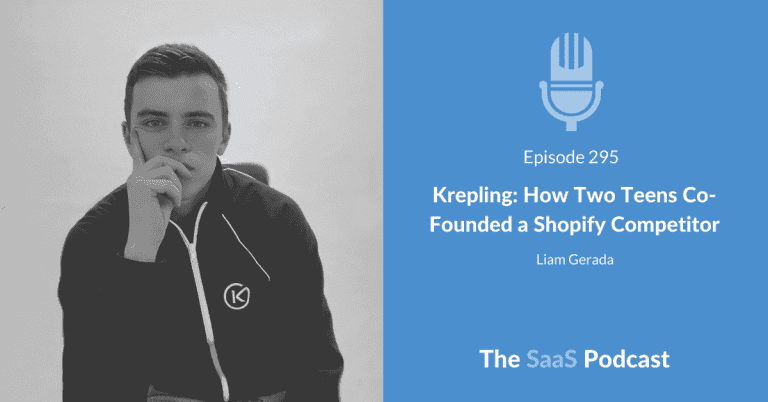
In this episode, I talked to Liam Girarda, the co founder and CEO of Krepling, an e commerce platform for online stores.
In 2018, two teenage brothers in Malta wanted to start an agency.
They'd recently sold their Shopify store and decided that they wanted to help others running similar businesses.
They spent a few months validating the idea, but realized people didn't need an agency, they needed a better platform.
So Liam and Travis set out to build a Shopify competitor.
Neither of them were developers, but Travis had taken some courses so knew just enough to start building something.
And after months of work, they shipped a product with a clunky backend and an ugly user interface.
But the product was free and they were still able to attract new users.
But as soon as they started charging pretty much every user they had churned, the brothers pushed on and tried anything they could think of to find customers.
For example, posting on sites like Quora and Reddit, sending cold emails.
Eventually, they were able to find a handful of customers.
Fast forward to today.
Liam is now 21 and Travis is 18.
The two brothers have made significant improvements to their product.
They now have over 500 customers and they've raised a pre seed round from Jason Calacanis launch accelerator.
They still have a long way to go and a lot more work to do, but I think they've accomplished a lot in the last couple of years.
They're both still pretty young, didn't have tons of experience, didn't know how to code, and live on a small island in the middle of the Mediterranean.
But that hasn't stopped them from building their SaaS business and finding customers.
So I hope you enjoy it.
Liam, welcome to the show.
Liam Gerada (02:24.600)
Hi.
Yeah, great to be here.
Omer (02:26.840)
So do you have a favorite quote?
Something that inspires or motivates you or just gets you out of bed you can share with us?
Liam Gerada (02:32.840)
Yeah, I wouldn't say I have a specific quote.
I would say my brother and I both are highly motivated in solving problems, particularly around what we love and enjoy, be it in E commerce or just in general.
And I think we really get excited about solving something and we're able to assemble a team of other people just as enthusiastic about solving that problem as we are.
And I would say that that in total, really heavily motivates us to pursue whatever we are pursuing.
So I think that's really the one thing that really gets us out of bed per se.
Every day we're solving a problem that we really are passionate about and other people have joined us on this journey to help us solve this problem.
And that's just what we do now and even outside of what we do.
Omer (03:17.060)
Awesome.
So tell us about Krappling.
What does the product do, who is it for and what's the main problem you're helping to solve?
Liam Gerada (03:25.610)
Yeah, essentially Kraepling in a nutshell brings together everything that's required to build an Internet business and scale to global markets with ease.
Krappling is a strict no code e commerce platform that aims to solve one simple problem and that is the decentralization that comes with building an online business.
Krappling enables and empowers entrepreneurs and businesses of all sizes.
No matter the technical background, no matter, no matter the scale of the business, size of the business.
If you're a first time entrepreneur just looking to test it out and build out your own e commerce website or test out selling online, Krampling has you covered.
Or even if you're a business doing $30,000 a month in sales and you're enterprise by terms of scale, we can also cover you in that aspect as well.
We enable businesses to sell in over 120 plus countries through a few clicks of a button.
We take the successful user base also very seriously.
And that's one of the most important metrics we analyze even above our own revenue.
And the problem is simple.
I mean we saw that when we started our own e commerce store.
We saw that the stitching together of disparate systems and paying for expensive third party apps was a really poorly designed system.
And e commerce platforms weren't really built towards the e commerce businesses of today.
That really affected the backend and core functions of our online business.
And when you have a decentralized backend, you automatically setting the odds of your business scaling and succeeding against you.
And that's essentially what we're solving with.
Krappling is a centralized platform that's no code friendly and is as simple and as easy as the Internet should be.
Omer (04:59.610)
So how is Krappling different to other products that support running e commerce businesses like the Shopify of this world?
Liam Gerada (05:10.490)
Yeah, absolutely.
I think we essentially we started off as Shopify merchants ourselves.
We built our first e commerce store on Shopify.
We, we tackle a few.
We were built on Magento BigCommerce and essentially if I took sum it up, Kreplin differentiates from some of the bigger names in e commerce in a number of different ways.
The biggest being the way we tackle core e commerce verticals in the no code space.
So Kraepling has positioned itself as one of the more favorable options for business owners looking for a centralized no code solution.
It does everything you need it to do and more whilst being able to provide core value proposition across all e commerce verticals.
So if a user were to build a business on Krappling, you're not having to stitch together a bunch of disparate apps, you're not having to pay for a bunch of poorly designed integrations.
It really is built for the e commerce business of today, not back in 2006 when essentially the only problem e commerce had was there was no e commerce, there was no way to sell online and these platforms made that possible.
Since then, times have evolved and e commerce has evolved and the way you integrate and scale your business evolved.
And Krappling is really building for the businesses of this generation.
And this time of e commerce, there hasn't been many companies tackling the full scope of building online business the same way krappelink has till date.
I think this is really pivotal to the success of any new disruptive effort in the space today is being able to tackle the full scope of problems integrations and that's really essentially how Krappling differentiates from the likes of Shopify, BigCommerce and etc.
Omer (06:49.610)
Okay, great.
And we'll get a little bit more into that because we're going to talk about some of the challenges you faced when you were running your own e commerce business.
But before we do that, give us a sense of the size of the business.
So you guys spent most of 2019 doing validation.
Officially launched October 2019.
So you've been in business for just under coming up to two years now.
What can you tell us in terms of customers, size of the business?
Where are you guys?
Liam Gerada (07:22.720)
Yeah, so essentially to date we're powering businesses all across the world.
We have businesses on all six different continents transacting and building on Kraepling.
We have around 500 plus customers at the moment.
Within our SaaS model, we are only currently realizing 25% of revenue potential in the sense that we haven't really built out towards the fintech space just yet.
That's something on our roadmap definitely for in development this year.
So we still Only on the SaaS side of E commerce, not towards the payment side.
But that being said, our business is finding Success very quickly.
They're producing actually a worldwide GMV over $1 billion plus, purely on Krappling.
So that's a huge reflection of the type of businesses we have that are transacting on Krappling and moving in our space.
Omer (08:10.640)
So, Liam, GMV is just like gross merchandise value.
Can you just explain to people who don't know about kind of E Commerce Y type stuff what that means?
Liam Gerada (08:20.100)
Yeah, sure.
So essentially, GMV is the way we calculate essentially how our businesses are transacting on the platform.
In layman's terms, it's just a term used to indicate the local sales and monetary value of merchandise sold through a particular platform or business.
And it's just the way we sort of calculate exactly the type of type of business that's going on the platform, the type of transactions we're seeing, and the health and status of the companies using Krappling.
So it's just a term we internally like to refer to, is how our businesses are succeeding.
It's not necessary to say that they're doing tremendously better than any other platform, but they are doing in our own ecosystem.
There's a large amount of E commerce companies finding success on Krappling, which, as I said earlier, is a huge reflection on us.
If our users are finding success, great.
Omer (09:10.190)
Yeah.
So over 500 paying customers and you guys have bootstrapped until quite recently, right?
Liam Gerada (09:19.930)
So, yes, essentially.
Omer (09:21.410)
So are you going through like raising a seed round at the moment?
Liam Gerada (09:24.210)
Correct.
We actually, yeah, we've been completely bootstrapped since launch, so we had a period of validation.
Then October we officially.
October 2019, we officially launched the beta product and have been through our MVP stage ever since.
We've just opened our seed round.
It's a very exciting time for the company and a great reflection of the momentum and further excitement around the E Commerce space.
We've just welcomed Jason Calacanis and his team at launch as our first seed investors to kind of kickstart the round.
I strongly believe that E Commerce is one of the most investable sectors right now outside of vaccine pharma and general medtech.
And our goal is to further our investments into our products and continuing to build off the success of our user base.
As I mentioned earlier, when you look at E commerce today, there's a lot of disconnected solutions.
Our goal is still to build a centralized foundation for our customers.
So we really want to be investing in our products and to be able to power the new generation digital businesses and business owners and enterprises.
So that's hence the move towards the seed round.
And we just feel that, yeah, I mean, if you're going to move the speed of E commerce, you've got to have the right tools to do that.
So that's essentially how we've sort of the momentum around our seed round.
Omer (10:39.610)
Great.
So yeah, I think there were a few things that sort of kind of interested me about this interview.
One that, you know, you guys have got some decent traction from bootstrapping.
You've got some good investment coming through now with your seed round.
But also you're running this business from Malta, which is about as far away as you could probably get from Silicon Valley.
And the company was founded by you and your brother.
It's Travis, right?
Liam Gerada (11:15.560)
Yeah, that's it.
Omer (11:17.560)
And how old are you guys?
Liam Gerada (11:18.760)
Yeah, I'm 21 years old.
Travis is 18 years old.
So we're kind of on the younger side of the Silicon Valley, stereotypical entrepreneur, whatever.
But I mean, it's a passion we've had for a long time.
So we like to consider ourselves at least slightly knowledgeable in the E commerce space in that sense.
And yeah, it's turned into from a passion to full time.
So we like to rather focus on that as opposed to just being typical young kids and disrupting a space.
Omer (11:54.410)
Yeah.
All right, so I think the story here starts when you were running your own e commerce business a few years ago.
So can you kind of set the scene for us and tell us a little bit about what you were doing then?
Liam Gerada (12:07.940)
Absolutely.
So essentially we got this idea.
We actually.
Well, I say myself originally I was a huge fan of sneakers and within that sort of, I was interested in purchasing sneakers and reselling sneakers.
What I discovered was essentially that there was this gap in the market for an E commerce consignment marketplace.
Short term, I would say short term business we could build.
And it wasn't really think much of it.
So essentially what we're trying to do is democratize the waste.
Sneakers were sold online.
What we planned on doing was creating a consignment marketplace where we would charge fair value to customers and not charge the resale price of sneakers.
And that was essentially that baseline idea, got us into the e commerce space, got us to build our first Shopify store and Magento store as well and get into the e commerce space in general.
And yeah, that started off as a passion for sneakers and we quickly discovered how exciting E commerce is.
Our store did quite well.
We managed to scale to most of Europe through organic word of mouth.
We were on the latest drops.
We were able to outsource a lot of the latest products and really just provide sneakers at a fair price.
And hence the name of the store was the king's fair comes after a king's fair price.
And that was essentially how the store was built and what the value proposition we were providing.
And as we scaled, we became accustomed to e commerce.
We came to discover what e commerce was like.
And we encountered some problems along the way.
We discovered essentially how difficult it is to integrate your store, how difficult that is to scale your store, and how the process can become quite tricky if you're not really in the coding space, especially as your business begins to grow and you begin to open different stores and you get to discover the possibilities of headless commerce and what have you.
So it was those challenges that got us to start thinking about what could a fundamental e commerce platform built with today's problems in mind look like.
We didn't think much of it until later on.
Our store actually got acquired.
We were able to sort of, luckily time was right and we were able to, through that acquisition, we were able to pivot towards helping other e commerce goers to help them solve problems in the space.
And what we did was we essentially looked at starting our own e commerce agency.
And what we looked at doing was helping other e commerce goers build out their stores, correct the mistakes we made from the mistakes we made, help them discover correct those mistakes and find success similar to the way we did.
And we knew that in e commerce there was a lot of stores not finding success for really silly reasons that we felt we could help.
And we started off to start off our agency, we thought it would be a good idea to get a feel for the market, validate what sort of segments to tackle.
And we went out, surveyed e commerce goers we knew e commerce platform companies we worked with.
And what we discovered was essentially that there was some major fragmentation between what e commerce platforms were providing and what e commerce goers were looking for.
And that came up with a great idea.
Why don't we actually be the ones to build the new products, built for the problems that our e commerce goers are facing today.
So it was from that very love for sneakers that we went into grappling.
Omer (15:28.240)
Got it.
So you didn't set out when you did that validation to build a SaaS product, you were trying to understand the market and how you could provide a service as an agency.
Liam Gerada (15:40.680)
Exactly.
Omer (15:41.160)
And then you sort of stumbled across this opportunity.
Liam Gerada (15:43.640)
Exactly.
We just, we were actually looking just to.
Even simpler than that, we were actually just Looking to when we prelaunched our agency site, what services could we offer?
I mean, we were just, my brother and myself, we couldn't exactly offer the full suite of SEO right down to website design.
You know, we wanted to sort of really niche out the kind of service we're offering.
We wanted to dim it down to around five problems that we could offer.
And when we did that survey, we actually discovered that, listen, a lot of e commerce goers have problems with integrations.
A lot of E commerce goers are having problems with scaling on these platforms and finding the right platform to fit their business.
Find the right integration to fit their business.
And we took a look at the survey and the kind of results we had.
We thought, wow, I mean, this is a problem we thought was a problem is bigger than it already is.
So there might actually be a potential fit here for taking on this market as a new E commerce platform.
We originally knew there was something there, but now we sort of had a clear as day that maybe we could be the ones to do it, even though we had no background in tech.
So that was just that initial validation.
Yeah.
Omer (16:47.680)
Okay, great.
So the validation period, which is about kind of 10 months in 2019, helped you to get to a point where you were able to launch an mvp.
Tell me a little bit about the experience of going through that.
Because, you know, you and I talked earlier and it wasn't as straightforward as it, it sort of sounds.
Right.
In terms of, oh yeah, we did, we did this, we sent this survey out.
Liam Gerada (17:12.849)
Yeah.
Omer (17:13.329)
And we found this opportunity straight away, which was like, build this product and, you know, we'll live happily ever after.
So tell us a little bit about the challenges you had along the way when you were trying to validate the potential opportunities in that market.
Liam Gerada (17:26.889)
Yeah, exactly.
I mean, I wish it were as simple as that.
I think we definitely had the mindset that it was going to be as simple as that and we were eager to get started.
Little did we know that obviously a survey doesn't exactly translate to a clear cut problem and a clear cut solution.
Humans are more complex, problems are more complex and thus we needed to be more complex in the way we thought of solutions.
So I hate to admit it, we didn't really think of that straight away.
We actually went out and we decided to start building this platform.
We took as little coding knowledge as we knew, really little.
We sort of looked at a few courses, took a bit of knowledge.
My brother was more in the coding space than I am.
He was more of a developer than I was so we kind of built out this product and we discovered that essentially this wasn't actually solving anything, it was more or less complicating a lot more things.
So we really need to take a step back and think, okay, so what exactly are these problems and how can we really solve these problems through a platform, not just as an agency?
I mean, initially we were asking these questions as an agency, not as a new platform.
So we really need to tackle this and look at it bigger picture.
And what we essentially did was we actually took a step back and we said, okay, so if E commerce goers are expressing these problems towards an agency type survey, are they expressing similar problems to a platform type survey?
And the answer was no.
There was a discrepancy, there was a difference between what agencies were providing and what platforms were providing and the problems they would express.
So we need to take a step back and look at the industry as a whole and see exactly what they what kind of solution would solve the major pain points in a way that sounds much more doable and is much more and still within the no code space.
So what we were able to sum that up to, from the users having difficulty finding the right platform, from users having a bunch of broken integrations, paying for extra add ons, having to figure out which type of platform catered towards the development space, which was an no code space.
What we discovered was the clear indication here is there's a lack of centralization, there's a lack of a platform that is no code friendly, is centralized, easy to use, and is essentially tackling the core verticals of E commerce the right way, not just built out from solving one problem and is now providing a marketplace.
There is a platform, there is a need for a platform that centralizes the E commerce experience and that is built towards what the problems in mind of the E commerce goes up today.
Whereas backend in 2006 and beyond, when the Shopify came in, there only really was one problem and that was we couldn't sell online.
We need a platform to do that now.
There's a vast array of platform.
So with that bearing in mind, we sort of took the validation to a different phase.
We initiated a beta product, we called it Beta V1.
It was a free product where we had the initial survey people or anyone who wanted to sign up could come on and test the product and we just watched, see which customers were willing to pay, see which customers just churned.
And we used that as stepping stone to validating the product further.
And what we discovered was when that Initial stages was the customers that we were solving for, a vast array of problems were sticking on.
The customers that felt the centralization was working for them, the integrations made sense, they stuck on.
Whereas the customers who were example, we provided tools that allowed them to sell subscriptions and digital products, that was kind of a niche problem we were solving.
So they kind of turned or went off to another platform.
So within that scope, we sort of built our beta products around those early days of testing and validation and that happened right up until October.
So almost a whole year of validation and we were able to customize ui, make the small tweaks as well on the side until eventually being satisfied with the product and launching an official beta paid MVP in October 2019.
Omer (21:20.890)
So what did this first version of the product actually do?
Liam Gerada (21:24.170)
It essentially just helped with integrations and it made the same.
You were able to sell different products a lot easier, so you were able to sell subscriptions, digital products.
It was kind of layered.
So the product more or less catered towards the type of plan you purchased.
Whereas if you purchased a plan just to sell digital products and subscriptions, you kind of report to a front end that solved that problem.
Whereas if you were looking for better integrations, you would purchase a different plan and you'd have the integrations working a lot better.
So there were actually plans and platforms catered towards different plans just to get a feel for what customers were feeling and what the initial first purchase looked like in terms of ui.
It was a disaster.
It wasn't the greatest.
We didn't really have much to build on and we kind of just essentially stitched together a backend that we thought made sense and initially just got to market to test our logo was also kind of built on an idea that it was a monkey initially which was built on the idea that E commerce should be as easy as for for monkey able to be able to do it.
So even the logo itself kind of spoke volume to what the first version of the product looked like.
And yeah, essentially I wouldn't exactly call it the most good looking product on the market, that's for sure.
Omer (22:37.480)
So when you say centralized, I'm not sure if I've understood this correctly.
It's like if you go to use a Shopify, there are probably thousands of third party apps that you can integrate with your E Commerce site, but often there's a bunch of to kind of get it working seamlessly.
It's not that straightforward and it might involve some coding and so on.
So with Krappling, are you kind of saying, when you talk about centralized, you're saying all of that functionality or the core functionality is built into the platform.
You don't need to go out and integrate these third party apps into Krepl.
Liam Gerada (23:18.060)
Essentially we don't claim to do it all, so we don't claim to provide an in house solution for all the problems.
We just claim to integrate more effectively.
So in the sense that Shopify would provide an app for almost every different type of function, simple functions would require an app and more streamlined functions would be in house, we essentially are providing integrations that are much easier.
There's no need for purchasing 500 apps to do one basic task and integrations are one click install.
So there's no need for complex disjointed back ends or disjointed integrations.
It's a much more streamlined integrational process.
A lot of folks have compared it to the likes of Zapier and what have you.
So we've just streamlined integration process.
We've essentially moved a lot of barriers.
So the platforms tend to be much more expensive when you go into the integrational side.
For example, there's likes of Kajabi who have provided vast variety of integrations and have sort of got an idea for what, what a fragmented experience looks like, but they're much more on the high end enterprise space.
So we've kind of also gone towards the less expensive route as well and being on top of that with a less disjointed backend and with the cherry on top being that it's completely no code friendly and no code is at the heart of everything.
So every integration is streamlined and it's easy to use.
Even those integrations we don't provide in house and we haven't yet provide an app for that just yet.
It's still much easier to integrate using code if you need to.
So it's just a far more streamlined, easy to navigate centralized experience.
So although centralized is a vague word, we like to use it because it really sums up what E commerce should be in 2021 and beyond.
Omer (25:05.710)
Yeah, okay, great.
So when you launched the mvp, initially I think you said it was free, and then how did you go about getting your first 10 customers?
How long did you keep the product running for free?
What point did you introduce a paid plan?
How did your users react to that?
Liam Gerada (25:26.280)
Yeah, essentially we actually brought in a paid plan pretty early on.
We started off in the first month or so as a free plan just to kind of see how that works.
We just felt that with a free plan, we really weren't getting enough data to validate the product just yet.
So we actually pivoted to a paid plan pretty quickly.
And as you can imagine, I think every user churned at that point.
I think we lost most of our users.
But we felt that that was a good step.
We felt that if, you know, if we're going to really going to be solving a big problem here and taking on a very competitive market, we've got to come in with a solid ground and we've got to come in with a real solution, a real product differentiation.
And that has to speak for itself.
That has to be in a position where customers are willing to pay for that early on.
If that's not happening, it's not.
That's our fault, not the customer's fault.
So we pivoted to a paid model early on and as a result we saw data coming a lot easier.
So we obviously shared the product within our ecosystem.
We shared it on forums, we shared it with other e commerce goers, we did a bit of cold selling every now and then and that brought up the first five or ten and so on customers and that allowed us to start validating, start moving through those phases and they obviously recommended other people.
What we discovered through that phase was a lot of e commerce goers.
It's quite common in the e commerce space for e commerce goers to share their experience on their site, how they build this business, if the business is succeeding, how they got it to succeed.
They document their experience, be it on other social channels, forums, what have you.
And that brought a lot of eyes on Krappling.
That brought a lot of people to Krappling.
So that worked well in our favor in terms of word of mouth.
Another route was our ability to partner with agencies.
A lot of agencies, particularly in e commerce were also expressing similar problems that we had addressed in the sense that they also felt the likes of Shopify, BigCommerce and co really weren't disruptive enough and built towards the later new versions of e commerce.
And that they could also benefit from building their clients websites on Krapping.
Bearing in mind that integration is a lot easier, it's much more no code friendly.
So the offboarding fee giving over the product phase was a lot easier and a lot more streamlined.
So that initially brought a lot of agencies to us.
We partnered with a lot of third party agencies and that brought a lot of customers to Krappling too.
A lot of agencies would build their sites on Krappling, build their customer sites on Krappling and a lot of clients would start off on Krappling and even find an agency.
So it worked both ways.
And that was essentially word of mouth and agencies that got us to where we are.
We spent very little on paid advertising, not because we didn't want to, because we simply couldn't early on with being bootstrapped.
And that's essentially got us to where we are today.
It's just word of mouth, organic and being upfront with the customer and just being able to help every step of the way.
So combination of all those three.
Omer (28:14.940)
Okay, great.
So I want to talk a little bit about.
You introduced a pricing plan about a month in to kind of launching that first version of the product.
Now, with many founders, there's.
I think there's two challenges that often come up when you think about pricing.
Number one is you look at where your product is right now compared to where you think it should be and you see this big gap in terms of the features that you believe need to be there to have a great product.
And that on its own kind of can hold people back from saying, okay, I don't think there's enough there to start charging for it.
The second challenge is that they look externally and they look at competitors like a Shopify and they say, I built this product like in the last few months.
Shopify has been doing this for years.
Why would anybody paid to use my product when they could use Shopify and it has all of this functionality?
So did you kind of have go through similar thoughts and what pushed you kind of forward to still introduce that price that paid plan so early on?
Liam Gerada (29:23.530)
Absolutely.
I think for sure we definitely had those thoughts.
I think we were essentially, we came to the conclusion, I think right from the beginning that there's no ways we can charge anywhere near what Shopify charging for a product that is just on the market for even not less than a couple months.
So we weren't looking to go towards that pricing point whatsoever.
We also fundamentally believed that E Commerce, my brother and I really believed early on, even when we started our own E commerce store, that it should be free.
I think starting an E Commerce store should be free.
It should be for everyone.
Given that the E Commerce customer, essentially us as well, when we started our store initially, we didn't have any capital to put into this.
We couldn't afford to pay $29 a month for a store that was making no revenue.
And that's how.
That's a big pain point for E Commerce goers that when they're paying for a price for a plan and they're not making sales, they tend to churn.
So we're a big believer in being free, but we also big believer in making a product, validating a product, validating the source product.
And we were eager to validate that product as early as possible.
So it was the tough choice whether to go in with a complete free product from the beginning and stick with what we believed in or going with a paid version.
And I think our tech at the time couldn't support a free trial.
So we really had to make a decision and we started with a free plan and we just felt that the initial customers we were getting weren't initially they were churning quite quickly, they weren't sure, they weren't actually taking time to look at the product, see if it's within their range, try out the product, help their business to find success and really spend time building their E commerce store and really trying all the features we built.
And, and essentially when we decided if we could try and move to a paid version we'll get a stronger sense of customers coming in that are more within the E commerce space and are more willing to try and build a store given that there's that pricing point.
So it really was decision that was mainly based on validation more than anything else.
I think our core belief is E Commerce being as free and as cheap as possible.
And to this date we actually have never put our prices up beyond Shopify's range or any of our competitors ranges fundamentally because we still believe there should be a party point and we charge $15 a month to $35 a month on purpose because we believe customers should start off in the $15 a month range or possibly free and move up and scale as their business scales the same way we had that problem.
So I agree, I think it's a tough choice to make and I think it really is product dependent.
I think we were in a space where pricing really has a lot to do with how and how the user will use the product and how they will sort of go about creating the business with the tools we're providing.
And we felt that with a free trial we weren't getting enough validation and we felt that that process wasn't streamlined enough.
So a tough choice to make but I think in the long term it certainly benefited our ability to cater towards better problems and validate markets more effectively.
Omer (32:22.870)
Great.
And kind of in terms of attracting customers you talked about it was kind of mostly word of mouth and tell me a little bit about that, like where were you going online to tell people about the product and how were you doing it in a way which wasn't coming across as, you know, douchey.
Right?
Liam Gerada (32:41.800)
Yeah, no, exactly.
And that's the one thing we didn't want to do.
I think that was tough.
I think what we did initially was being e commerce merchants ourselves.
We, we often were quite loudmouth about the problems we faced.
We would often join forums and complain about if Shopify were to rise certain fees on payment fees or that there was a certain conversion we didn't really like on app that didn't really work.
So we, in that in a negative way, we were very loudmouth about problems in e commerce and that allowed us to sort of talk to other e commerce goers with those problems.
And essentially when we initiated, we started building crapling, we went out to those people, those people we shared those problems with.
Listen, we're working on a solution to solve the problems we faced and we shared with you.
When I say forums, I simply mean places like Reddit, places like Quora.
Those are places where people have issues and openly discuss them.
And that's where we were.
That's where we were when we started off and that's where we went back to when we launched Krappling.
And we felt that we got a good array of customers just willing to try it out simply because we were also e commerce goers and we experienced those pain points.
That was initially how we started off.
From then on, we actually built out systems that allowed customers to increase their ability to share the product.
When we discovered that word of mouth is a powerful marketing tool, especially with e commerce in general, we created systems like our affiliate system, our partner system and we gave the incentive for customers to share the product and talk about about the product we actually create.
We had a lot of businesses and entrepreneurs who would build out a website on Krappling and actually have they'll build out an agency on Kraplink to be able to cater and build other clients websites and build web design websites and refer people to Kraplink.
So there was entire ecosystem businesses referring people to Kraplink, building Krappling businesses and providing Krapplink related services.
So that worked out pretty nicely and we were focused on scaling what worked.
Early on, word of mouth was a focus first five or 10 customers, let's make that the next 10 or 100 customers.
So we stuck within that mindset and we weren't rushing to get into paid ads or get into things we didn't know enough about.
And that worked in our favor in that sense at least.
Omer (35:01.110)
Yeah.
And I also think working with agencies is pretty smart because every one agency could result in multiple new customers.
So how did you connect with agencies?
How did you start to build those kind of partnerships?
Liam Gerada (35:17.290)
Yeah, I think the first thing we did was essentially connect with the clients first so see what type of problems the clients were reporting, what type of difficulties they were facing.
And we weren't necessarily going and pitching to agency.
Listen, we have this new platform, take all your customers, take your hundred customers you spent years building on Shopify and move them over to us.
That wasn't essentially the way we thought about doing it.
We essentially just just went up to agencies and said, listen, what are the top problems you were facing as an agency and what are the top problems your customers are facing as E commerce goes?
And what we found out was there was a similar type of feel.
The agencies were battling to provide certain systems and code and build certain websites that functioned the way the customer liked it, whereas the customer was saying, I'm having certain problems with my website doesn't look as well as it should and I'm struggling to find agency within my price range that provides that.
So what we're seeing there is a fragmentation.
The platforms aren't allowing the agencies to build better websites and the customers aren't being able to build a better website using no code.
So there's a disconnection there.
And we said, okay, well why don't you try our platform and build out your website and see how it looks, don't pay for anything and if it works, we'll do the migration for free.
And that initially got the first agency on board.
And as you said, once they've sort of seen how one problem can be solved, any other customer facing a website design problem, an SEO related problem, or a product selling related problem, gateway related problem, they're able to move to Kraplink too.
Because there's a solution here that brings both parties together.
And once you initiate that initial, you demonstrate that solution to an agency, they kind of see the reason to move over to Krappling.
And that provides a sound partnership that's completely transparent from the beginning, that's not based around price, not based around commissions.
It's purely based on solving problems.
And that sort of translates nicely when you've other agencies in their network.
So it was that simple as that.
And that got us to a large amount of customers, especially when we were initially launched looking to scale towards our fundraising.
So that definitely helped now you know,
Omer (37:21.330)
running an E commerce business is very different to building an E commerce platform.
And you know, between you and Travis, sounded like there was enough knowledge and skills there to be able to build an MVP and get going.
But I know you told me that you still kind of had a tough transition as a non technical founder in terms of building a product technology business.
Tell us briefly a little bit about what kind of challenges you faced and what you've learned from that experience that might be helpful for other founders who are also non technical.
Liam Gerada (38:01.380)
Yeah, essentially I think the biggest challenge was creating a team around bringing this product together.
I mean we were able to get people excited enough to join us and pursue this journey with us and who also passionate about the problem.
But when it came to the technical side of it, you need more than just a passion and ability to see a problem.
You've got to be able to build this thing and code this thing and that's something we knew nothing about.
My brother was more technical than I am, but I promise you I knew nothing.
A real big challenge was finding the right people to, to bring on this journey with us and make a part of krabling, make them one with us within this solution we're trying to bring up.
And I think in the early days trying to hire the right people and trying to find the right talent was very, very difficult.
I think we really struggled in terms of what type of qualifications we were looking for, what type of skills we were looking for and eventually it got to the point where we were just.
We really had to expand our knowledge within the tech space and really try things out for ourselves.
And my brother was lucky enough to, to he's more in the tech space than I am and he was able to sort of bring the skills he had and make those and bring those to the talent field and say, listen, can you solve this problem?
Can you build this out?
We use them as those tests essentially as opposed to just looking for so and so who's got a series of qualifications in a space that we know nothing about.
Let's give them a real problem to solve in a way we believe could be solved.
And that's essentially how we found how we found talent early on.
But it was a real challenge for us.
And I think being two founders who are non technical moving to a completely different model, I think the results of that challenge was definitely longer time to build the product.
There were validation problems, glitches like you can't believe.
And essentially I think, yeah, I mean it was a huge problem, but I Guess in a way our non technical ability as well allowed us to see things from a different perspective.
Maybe that helped too.
Omer (40:02.330)
So yeah, yeah, that's a good lesson there.
I think that on the one hand, if you are non technical and you're looking to hire a developer or developers, giving them a standalone piece of work, something that you can actually give them a problem and see how they solve it, can be a good way to figure out if you've got the right person.
And if you can do that with a couple of people, at least you have kind of like an apples for apples comparison in terms of, wow, this person was much better at kind of going through this, understanding the problem, coming up with the solution, communicating it versus this other person.
The challenge obviously being if you're bootstrapped, you don't have the luxury of just saying, let me run these human A B tests.
Right.
To figure out who the right person is.
So I think definitely, probably the skills that Travis has or kind of being able to lean on somebody at least who can provide some technical validation, I think is also an important part of that.
Liam Gerada (41:03.100)
Absolutely, absolutely.
Omer (41:04.540)
All right, great.
So look, we should wrap up, so let's get on to the lightning round.
I'm going to ask you seven quick fire questions.
Ready to go?
Liam Gerada (41:14.060)
Perfect.
Yeah, sure.
Omer (41:15.100)
Okay.
What's the best piece of business advice you've ever received?
Liam Gerada (41:18.780)
I would probably say to put the customer first at all times.
I think that's one advice we've been given a lot and I. I think it goes a long way.
Omer (41:28.240)
I agree.
What book would you recommend to our audience and why?
Liam Gerada (41:32.080)
I think probably Past Dangers and Strategies by Nick Bostrom.
I think it's a really interesting book.
It's not really in the business space, but it really shows how the world's changing and how innovation is great.
But to bear in mind the downside risk of AI taking over the world,
Omer (41:50.400)
what's one attribute or characteristic in your mind of a successful founder?
Liam Gerada (41:54.550)
I would say it's the ability to get excited about something early on, especially when a lot of people aren't excited.
And being able to excite other people about what it is you've discovered and being able to build a team around that I think is a real characteristic to have in anyone looking to solve a problem nowadays, for sure.
Omer (42:12.150)
What's your favorite personal productivity tool or habit?
Liam Gerada (42:15.350)
I don't really have a favorite productivity tool, but I think a good habit that I think everyone should have is being able to find the good in little things you do.
No one necessarily.
Everybody has to change the world, to do good.
But little things, I think, really go a long way.
And making doing good a habit can change a lot of small things for a lot of people.
Omer (42:33.390)
What's a new or crazy business idea you'd love to pursue if you had the extra time?
Liam Gerada (42:39.310)
I've always wanted to go into the ecotech or sustainability sector.
Definitely would like to pursue more of that if I had more time.
It's definitely one of the things I'm more or less passionate about and that I set aside time for, whether it be in a personal level, even internal projects within Krappling, I think.
Yeah, definitely one thing I'd love to pursue more.
Omer (42:57.870)
What's an interesting or fun fact about you that most people don't know?
Liam Gerada (43:02.750)
Well, I think maybe it's the fact that I really do enjoy design, actually.
Yeah, maybe not.
Let people know that.
Omer (43:13.150)
Well, I think the crippling site looks pretty.
Pretty darn good compared to how you were describing the first version of the product.
Good work there.
And finally, what's one of your most important passions outside of your work?
Liam Gerada (43:27.970)
I think I speak on behalf of my brother and I as well.
I think I say our passion really has always been solving problems and building things online.
I would say we're definitely one of the lucky ones that it's been able to be our work as well.
But, yeah, people have told us it's unhealthy, but an unhealthy habit.
But I mean.
And then I need to find a new hobby, but I mean, yeah, you can't really find a new hobby, can you?
Omer (43:49.220)
Love it.
Cool.
Liam, thank you for joining me today and sharing your story.
Congratulations on the traction you got in the first year and a half or so bootstrapping this business.
And now on raising your seed round, looking forward to seeing where you take this business over the next couple of years.
If people want to find out more about Krappling, they can go to Krappling.
That's K R E P L I N g dot com.
And if folks want to get in touch with you, what's the best way for them to do that?
Liam Gerada (44:21.190)
Yeah, any way possible.
Email Liam krapling.com LinkedIn, Twitter.
Twitter's good place.
Probably anywhere I'm not unreachable.
Omer (44:31.910)
All right, cool.
Well, thanks, man.
Thanks for joining me and I wish you, Travis and the rest of the team the best of success.
Liam Gerada (44:37.350)
Thanks a lot.
Really appreciate it.
Omer (44:39.270)
Cheers.