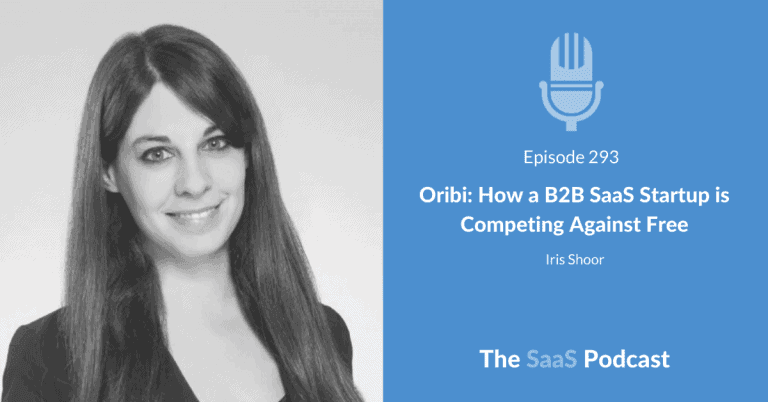
Iris Shoor, Oribi
From $79 to $500/Month: SaaS Pricing Against a Free Competitor
Like this episode?
Get real founder strategies for the AI era. Delivered weekly.
Free weekly newsletter · No spam
Episode Summary
Iris Shoor got her first customer 30 minutes after turning on Facebook ads - for less than $50. The product was clearly working. Then she killed it. She shut down a product with real users, real engagement, and real validation because investors told her Facebook would build it themselves.
In this episode, Iris reveals the SaaS pricing journey that took Oribi from free to $79 to $500 per month, why charging more actually improved retention, and how she grew the company to 60 employees and $28 million in funding by competing against free Google Analytics.
Iris Shoor is the founder and CEO of Oribi, an AI-based web analytics tool that gives you actionable insights to help you make better data-driven marketing decisions.
In 2016, Iris had an idea for a new SaaS product. She'd already built two successful startups and was ready for a new challenge. As a marketer, she knew how hard it was to make good data-driven decisions and so she decided to solve that problem.
She spent the next year talking to people and researching her idea. She had one big question: why is nobody doing something about this problem?
During that year she also hired a developer and started building an MVP. She used Facebook ads to get her first customer for less than $50. The product was clearly solving a pain point because it didn't take long to find more customers.
She had a great product, early customers, and was ready to raise money. But then Iris decided to kill the product.
She shut it down and started looking for a different product idea. The decision came after investors warned her that Facebook would improve its own analytics UI. Four years later, that UI still looks the same - and Iris still regrets killing a working product based on investor concerns.
Eventually, Iris built Oribi around a completely different technology - codeless data collection that eliminates the developer bottleneck in marketing analytics. Her SaaS pricing evolved from free (to avoid showing weak metrics to investors) to $79 per month, and then to $500 per month after discovering that higher-paying customers retained better and invested more in the product.
Today Oribi has 60 employees, several thousand customers, and $28 million in funding.
Key Insight
Oribi founder Iris Shoor raised SaaS pricing from $79 to $500 per month and saw retention improve - because customers with meaningful marketing budgets invested more in the product and extracted more value. She also learned the hard way that killing a working product based on investor concerns cost her years of growth that she would never recover.
Key Ideas
- Iris acquired her first customer in 30 minutes through Facebook ads for less than $50 total spend
- She killed the working Facebook analytics product after investors warned Facebook would build it - four years later, the Facebook ads UI remained unchanged
- Raising SaaS pricing from $79 to $500/month improved retention because serious customers with real marketing budgets engaged more deeply
- Oribi's core differentiation is codeless data collection that removes the developer bottleneck from marketing analytics
- Starting free before fundraising avoided showing weak early metrics, but Iris later learned that earlier pricing would have accelerated learning
Key Lessons
- 💰 Higher SaaS pricing improves retention, not just revenue: Oribi raised prices from $79 to $500/month and found that higher-paying customers engaged more deeply, extracted more value, and churned less - because they had real budgets to invest in the product.
- 📉 Never kill a working product based on investor concerns alone: Iris shut down a validated Facebook analytics tool because investors warned Facebook would build it. Four years later nothing changed, and she lost years of compounding growth.
- 🎯 Vertical packaging boosts conversion before vertical features: Oribi created separate landing pages and onboarding flows for e-commerce and agencies with vertical-specific terminology. Conversion rates jumped even before adding vertical-specific product features.
- 🧠 Create a wish list of experts, not a convenience list of contacts: Instead of asking friends and portfolio companies for feedback, Iris reaches out to specific experts on LinkedIn with precise questions - getting 80% reply rates by being relevant and specific.
- 🚀 Facebook ads work for B2B SaaS pricing validation: Iris acquired Oribi's first customer in 30 minutes through Facebook ads. B2B founders who dismiss Facebook as "B2C only" miss that decision-makers are people who use Facebook too.
- 🔄 Start with gated content to build lookalike audiences cheaply: Direct B2B signups through ads are expensive. Iris used $1-2 gated content signups to build a seed audience of thousands, then used that for lookalike targeting at higher-intent campaigns.
- 🛠️ Optimize SaaS pricing continuously, not once: Iris treats pricing as an ongoing experiment - testing packaging, upsells, and vertical segments - estimating that most founders leave 20-30% revenue on the table by focusing only on lead generation.
Chapters
00:00Introduction
02:30What inspires Iris: building things and solving challenges
03:24What Oribi does: no-code marketing analytics
05:06Target customers: mid-sized companies with marketing budgets
05:57Business size: 60 employees, thousands of customers, $28M raised
06:27Background: architecture to Autodesk acquisition to OverOps
09:08How the analytics idea came from marketing pain
11:50Building a wish list of dream advisors instead of using your network
14:05Reaching out to ex-Google Analytics PMs on LinkedIn
16:51The key question: if this is painful, why is nobody solving it?
18:44First product: Facebook analytics tool
20:00Bootstrapping the first version with one developer
20:21First customer in 30 minutes through $50 in Facebook ads
21:54Killing the product after negative investor feedback
23:37The regret: never kill a working product based on investor opinions
24:54Starting over: building codeless data collection from scratch
27:19Three years of development before beta launch
27:50Getting first customers through Facebook ads, not personal network
31:09Why Facebook ads work for B2B SaaS
32:48Building lookalike audiences with gated content at $1-2 per lead
34:24SaaS pricing evolution: free to $79 to $300 to $500/month
36:51Why starting free before a fundraise can be strategic
39:53Competing against free Google Analytics
42:38Hitting the gas: from $2K to $50K monthly ad spend
43:39Vertical packaging: e-commerce, agencies, SaaS
45:03Lightning round
Episode Q&A
Why did Iris Shoor kill Oribi's first product even though it had paying customers?
Investors warned that Facebook would improve its analytics UI, making Oribi's Facebook analytics tool obsolete. Iris agreed at the time but now considers it a major regret - four years later, the Facebook UI still hasn't changed.
How did Oribi raise SaaS pricing from $79 to $500 per month without losing customers?
Iris discovered that customers spending $500+ per month had real marketing budgets, engaged more deeply with the product, and retained far better. Lower-priced customers with small websites didn't invest enough effort to see value.
How did Oribi get its first customer through Facebook ads in 30 minutes?
Iris placed $50 in Facebook ads, and within 30 minutes someone clicked, signed up, used the product, and emailed saying "this is amazing, for the first time I understand my audiences."
Why does Iris Shoor recommend creating a wish list of people to talk to instead of using your network?
Most founders default to reaching people they already know, who may not represent the target customer. Iris creates a dream list of specific experts and reaches out on LinkedIn with precise questions - getting an 80% response rate.
How does Oribi compete against free Google Analytics with $500/month SaaS pricing?
Like CRMs competing against Excel, Oribi's codeless data collection saves thousands in developer costs. A company spending $10K/month on marketing that optimizes even 10% saves $1,000 monthly - justifying the price.
What is Oribi's core SaaS pricing philosophy around packaging and upsells?
Iris believes most founders obsess over lead generation while ignoring that pricing optimization can increase revenue 20-30%. Oribi continuously tests packaging, upsells, and vertical-specific landing pages rather than just changing the price.
How did Oribi use vertical packaging to increase conversion rates?
By creating separate landing pages and onboarding flows for e-commerce, marketing agencies, and SaaS companies with vertical-specific terminology, Oribi saw significant conversion rate improvements - even before adding vertical-specific features.
What did Iris Shoor learn about SaaS pricing from starting free before her fundraise?
Starting free avoided showing investors weak early metrics like 10K ARR. But the lesson is nuanced - earlier pricing would have generated faster learning about willingness to pay and which customer segments were serious.
How did Iris Shoor use gated content to build Facebook ad lookalike audiences for B2B SaaS?
Getting direct signups cost too much for small B2B volumes, so Iris created gated marketing analytics articles at $1-2 per lead. After collecting a few thousand email signups, she had enough seed data to build effective lookalike audiences.
Book Recommendations
Full Transcript
Omer (00:10.000)
Welcome to another episode of the SaaS Podcast.
I'm your host, Omer Khan and this is the show where I interview proven founders and industry experts who share their stories, strategies and insights to help you build, launch and grow your SaaS business.
In this episode, I talked to Iris Shure, the founder and CEO of Aribi, an AI based web analytics tool that gives you actionable insights to help you make better data driven marketing decisions.
In 2016, Iris had an idea for a new SaaS product.
She'd already built two successful startups and was ready for a new challenge.
As a marketer, she knew how hard it was to make good data driven decisions.
And and so she decided to solve that problem.
She spent the next year talking to people and researching her idea.
She had one big question.
If this is a pain, why is nobody doing something about it?
During that year, she also hired a developer and started building an MVP.
She used Facebook ads to get her first customer for less than $50.
In fact, you'll be shocked how quickly she got that first customer.
The product was clearly solving a pain point because it didn't take long to find more customers.
So now she had a good product, early customers, and was ready to raise money.
But then Iris decided to kill the product.
She shut it down and started looking for a different product idea.
In this interview, you learn exactly what led to her making such a drastic decision.
She talks about why the decision made sense at the time, but is something she still regrets today.
There's an interesting story behind that decision and a useful lesson for all founders.
Eventually, Iris did build another product.
This time her product was focused on web analytics.
And in the last four years, she's grown her company to 60 employees and several thousand customers.
And she's also raised $28 million in funding.
It's a great interview with some interesting insights.
As a serial entrepreneur, Iris already learned some tough lessons with her previous startup.
In this interview, you learn about some counterintuitive things she did this time around.
And those insights may actually help you to avoid making the mistakes too.
So I hope you enjoy it.
Iris, welcome to the show.
Iris Shoor (02:30.310)
Hi.
Omer (02:31.510)
So you're a serial entrepreneur.
This is your third startup that you're working on right now.
What gets you out of bed every day?
What inspires you to work on these businesses?
Iris Shoor (02:42.790)
What I like doing the best is building stuff.
It's interesting because I was always very artistic and they studied architecture.
And I have to say that the place that I feel most creative at in life is in my company.
It's mainly about Tackling your challenges, thinking about how to build things from scratch.
I'm not speaking just about the product, it's also about challenges with HR marketing crisis.
So I think that's what inspires me most to build new things, to build things that I don't have any reference to, and to solve challenges.
Great.
Omer (03:24.350)
So tell us about orb.
What does the product do, who is it for and what's the main problem you're helping to solve?
Iris Shoor (03:33.150)
So oriby is a marketing analytics tool.
The main problem that we're helping to solve is to help marketers to be data driven, to understand how to allocate the budget, to really understand if the different efforts that they're working on actually convert.
So I think that one of the toughest things to do today is to really understand if I'm writing content, does it actually bring more people to convert?
If I am making new videos, advertising, email marketing and what we're doing very differently than other tools and mainly Google Analytics, and we'll probably speak more about it later, is to have everything in a no code approach.
So we really want to take the developers out of the equation and to have the marketing teams to define all the data themselves, to ask all the questions.
I think that all of you probably know the issue of trying to collect new data and then marketers need to have a developer to add new events to the website.
Usually it's a bottleneck, they don't have enough time and the marketers can't do it by themselves.
And that's what we're trying to change with oribi.
How to collect data, how to collect the entire customer journey in a super easy way without code, without entering the website and to use it within oriby, but to also export it, to create audiences on Facebook, new fields on HubSpot and so on.
Omer (05:06.090)
You said marketers, but who's your ideal customer?
Is there a certain type of company or size of company or a vertical that you're focused on?
Iris Shoor (05:15.430)
So today we're working mainly with mid sized companies.
We work with E commerce, marketing agencies, SaaS, companies, finance, so a few different verticals, usually with a marketing spend of a few thousand dollars a month, up to a few millions.
Omer (05:34.550)
Got it.
Okay, so give us a sense of the size of the business and where you are right now.
So Orobi was founded in 2016, so you've been working on this business for over five years or about four or five years.
Tell us a little bit about like how big is the business today?
What's the size of the team and how many customers do you have?
Iris Shoor (05:57.510)
So Today we're over 60 employees.
We have a few thousand customers.
We raised $28 million to date.
Omer (06:07.870)
Okay, awesome.
Before we get into the story of how you came up with the idea for this business and got started, tell us a little bit about what you were doing before.
Because as I mentioned earlier, this is your third startup.
So just give us a quick recap of your first two startups so people have a little bit more context about your background.
Iris Shoor (06:27.310)
Yeah, definitely.
As I mentioned before, I studied architecture.
When I was just about to graduate, I decided that.
And that's not what I want to do in life.
I wasn't sure what I want to do.
It was a period that many of my friends started the company.
It seems like the easy path.
It wasn't one, but it was a very exciting one.
And I decided to start my company together with two founders.
We were pretty clueless and learned everything the hard way.
And we decided to start with something that came from the world that I came from of architecture and how to take 2D and 3D models into the web and mobile.
So these were the early days of mobile apps and there was a very interesting challenge over there.
And it took us a while, but when we managed to create and build the product, we were backed by Sequoia and the company was acquired by Autodesk.
Later on after the acquisition, we were in charge of all the mobile development of Autodesk and AutoCAD.
I've been with Autodesk for two years.
Then I co founded another company called Overops, a very different one.
I really love the world of CAD and 2D and 3D modeling, but it's really hard to build large companies over there.
And that's why I decided to move to a different space.
And the second company was a company solving production debugging for developers.
DevOps, a very technical one, a very interesting challenge.
I was there for the first four years and then left and started.
Really company is doing very well.
Raised over $70 million to date.
With both of my first companies, I led the product and marketing.
I was always intrigued by how challenging it is to be data driven for marketing.
I think that what, what I love best about marketing is that the sales, the cycles are very short and you get like almost immediate feedback every time you change something.
You create new content, you change your videos, ads and so on and you're able to see the results.
But it was very hard for me to answer more advanced questions.
So I can see like the CTR of a new Video.
But it was very, very challenging to understand how it really impacted sales.
Or if I change something on the homepage, I can see how many people are clicking a different button right now, but they really want to understand the entire funnel and the entire impact.
And that's what I decided to do with Oribi.
Omer (09:08.920)
Okay, so tell me a little bit more about how you came up with the idea.
So you're seeing this kind of pain and as a serial entrepreneur, you're probably, your brain's already ticking away at how you can go and solve this problem.
But tell me a little bit about like, what led you to actually kind of get to the point where you were like, yeah, this, there's enough here for me to want to commit the next, you know, X number of years on solving this problem.
Iris Shoor (09:36.420)
Yeah.
So the first question that I asked myself is, what is like my zone of genius?
What am I doing best?
Where do I shine as entrepreneur?
I say this is like a very important question for entrepreneurs in many cases that you think that there might be a very big challenge or a very big opportunity, but you're not the right person to solve it.
So the first question was, what do I do best?
And the answer was B2B, low touch, high scale.
I love product, I love marketing, I love B2B products.
And I felt that I can do a very good job at creating something that is low touch, self serve.
And then I started asking myself in which spaces there's still like a huge opportunity around it.
So in which spaces there are lots of great tools for the enterprise and also, but also not, not enough tools for the mid market or things that are self serve.
And I, I really, I found it very interesting, the space of analytics and marketing analytics because of this reason.
So this is like a combination of something that I felt by myself, I felt it as a user, but also an area that I felt that I can really be good at and I can create a simple product and to create a smart go to market.
And then I started investigating.
So before I started, the first year for Weebee was for me mostly about speaking with people, understanding what are the main barriers.
My main question was, okay, so how come nobody's doing it?
So it's obvious that all marketers want to be more data driven.
There is a pain the market is big enough.
I can say that the challenge is becoming more and more challenging because of all the different channels, attribution challenges and so on.
But the market still existed before.
So I really tried to answer the question of like, what is the Number one barrier and try to tackle it.
Omer (11:50.240)
Like when you said you spent the first year having those conversations, was this just through your own personal network?
Were you reaching out to strangers and other marketers?
Like, what was that process like?
Iris Shoor (12:05.680)
So one important shift that they made as entrepreneur was instead of trying to reach out to people that it's easier for me to reach out to, I always try to create to myself, like this dream list of people I want to speak with.
One of the common mistakes of entrepreneurs is that let's say that you have a challenging time with marketing and you're not sure what is the right go to market for you.
And then in most cases you'll think, okay, so I know this guy and this company is doing well, and my investor can help me to reach out to them.
So usually the way you think about how to reach out to people is who I can get to plus who is interesting.
And I found that it's pretty easy to get to people.
So I usually try creating to myself this wish list of all the people that I really feel that I want to speak with.
I can give you another example.
That is a more recent one.
About four months ago, I decided to change the pricing and to change the packages, and I wasn't sure about the right way to do it.
And they wanted to speak with companies that they have like zero contact to, and they just reached out to people on LinkedIn.
And I think when, when you have a good story, and I think today it's very hard to to succeed with cold emails if you're just like trying to reach out to customers and so on.
But when I write to someone who's in charge of pricing at a company that resembles the Rebbe but doesn't compete, and they write to them that this is where I'm at right now, and I would love to hear their feedback about this specific issue.
Then I think in 80% of the cases I got a reply and managed to set to set a call.
And I meet lots of young entrepreneurs that are meeting lots of people because they're trying to get to the right answer and so on.
And my advice is just create a list of five, 10 people you really want to speak with.
And in most cases you'll be able to reach most of the most of
Omer (14:05.080)
them, I think that's great.
And ultimately, I think for what you're saying, it boils down to making sure that when you're reaching out to these people, it's super relevant.
And, you know, if you're kind of going in and really Thinking hard about why you want to have a conversation with this person and explaining that to them, you're much more likely to get a response than, hey, let me just copy and paste a cold email to a thousand people and hope, you know, some of them reply.
Iris Shoor (14:34.020)
Yeah, I think most people really enjoy helping other people if they feel that they can help.
So I can share that.
Like when I get an email of someone saying, like, I need your help with marketing of a mobile app and I don't have any experience with it and I will usually say no, even if it's someone that they know, but I will help someone that they feel that is very related to my space and, and can help.
I can share more about like this topic that when I started Ruby, one of the common questions that I got from investors is how can you make sure that Google won't build something similar?
So I just reached out via LinkedIn or email to ex product managers of Google Analytics from Google and told them that's where I'm at right now, would love to hear your feedback.
And they were happy to share what they could and they managed to get to them and to get interesting answers.
Omer (15:30.910)
That's awesome.
And when you reach out to people like on LinkedIn with that example with ex product managers, the message you were sending, like, were you being that specific in terms of, you know, I'm doing this, this is a concern.
I want to get your feedback on whether this is going to be a problem for Mimi or not.
Because I think a lot of the times people kind of do the outreach and it's kind of pretty vague what they're asking for and it's just like, yeah, can I have a chat?
Iris Shoor (15:57.800)
Yeah, so I'm very specific.
I think that in many cases it will also help you to save time because in some cases they might say like, I'm not the right person or I can't really share anything about it.
And I feel that if they can help, it will.
Being very specific is going to help you to get more answers.
I think that once you say, like you mentioned something like, let's chat, I'm building a new startup and looking for feedback, as in people, you think that you probably reached out to dozens of different people and you don't really need their help.
Omer (16:32.640)
Great.
So you said about a year having these types of conversations, trying to understand what was going on.
And I think the question you mentioned a little earlier was, if there's a need here, why is nobody doing it?
So what did you learn at the end of that?
What were your takeaways.
Iris Shoor (16:51.150)
So first of all it was a year of conversations, but also building the product.
I'm usually very against of that.
Just like being into theory and just learning and there is like a limited, there is a limited data that you can pull from people.
I always try to start developing a small product and test it around and also learn more about the go to market.
And the main thing that we got to is that to build a good product you need to have the data layer set.
So let's say that you're building like a very nice product of understanding, of analyzing content marketing.
For example.
To have it right, you need to really understand what is each blog post, how do people interact with it, what do they do later, which other conversions are related to it.
And in most tools or in all tools you need developers to use code based events.
They don't have enough time.
And what happens is that you don't have the basic data layer.
And therefore even if you have this amazing system of insights and reports and so on, once you don't have the foundation of data, you can't do much.
And that's why we decided to really be to focus mainly and this is the core, core of the technology on how to collect customer data without being dependent on developers.
So think about it a bit like WordPress and Wix or WordPress and Shopify.
The main differentiation is that you can do it without developers having like different templates of designs and marketplace and so on.
It's amazing.
But that's not the main reason why people decide on their on choosing this alternative.
So that's what we're doing very differently.
Omer (18:44.320)
Got it.
You mentioned Google Analytics, but the first product you built was actually built around for Facebook, right?
Iris Shoor (18:54.560)
Yeah.
So I shared before the story that the initial space I decided that I want to deal with was analytics.
I felt that it's really hard to get answers.
But they also mentioned that I really love getting to the market and understanding it.
I also feel that it's very important to sense the field, to sense people, to understand how challenging it is to get to them, how are they seeing, what are they looking for.
And the initial tool that I decided to build was around Facebook Analytics.
The idea was always to build something bigger, but I saw a very interesting opportunity around Facebook Analytics.
I think that this is like the main platform for advertising today.
It was the same a few years ago.
And their analytics and ads UI is very, very basic, very hard to get insights from.
People lose lots of money because they don't really understand what's working and what doesn't.
And we just created a better analysis of how the ads behave.
Omer (20:00.240)
Okay.
And initially that was bootstrapped the business.
Right.
You hadn't raised any money at that point.
Iris Shoor (20:05.760)
Yeah.
Omer (20:06.320)
Okay.
So you've kind of built this product.
And from what I understand, you know, the feedback was very positive.
It sounded like you were onto something here.
But that kind of changed when you started talking to investors.
Like, what happened?
Iris Shoor (20:21.600)
Yeah, so that's something that in hindsight, I would change and I would probably act differently.
So actually, the product was amazing.
I remember, like, the first day we launched it, I put like, I placed like $50 on Facebook for a few ads, thought, okay, let's see if people are using it and if I can even like, acquire customers in $50 a day.
By the way, the reason that we were bootstrapped at first is, was because it was very important for me to really understand the market and to understand the space.
And I think that many entrepreneurs, many today, that there's lots of money, rush into taking money.
And it's important to understand, like, there's no way back.
Once you took money, you can't really tell your investors, okay, I don't realize this space, I want to change it completely.
Like, you can pivot, but it's not as easy when.
As when you're bootstrapping.
So I started telling that we had, like, a very limited budget.
I started like the Facebook ads, and probably like 30 minutes after I started Facebook ads, I got an email from a customer to the info to Ruby Dialogue.
It was the first user we saw.
Someone signed up, started using it, and it was an email saying, wow, this is amazing.
For the first time, I understand my audiences.
Omer (21:44.090)
Did you say you got somebody in 30 minutes?
Iris Shoor (21:46.410)
Yeah, I got somebody clicking the ad, using the ad and sending us an email that this is amazing.
Omer (21:54.180)
Wow.
Iris Shoor (21:55.140)
And yeah, and this was like, wow.
I think it's so hard to get to great feedback with something that is low touch and to get someone who doesn't know your brand seeing an ad on Facebook using the product and really managed to get value out of it.
That was amazing.
And we saw great engagement, great feedback, ability to bring customers inbound, low touch.
And I decided now it's time to raise money.
It was like two months after we launched it, and I got very negative reactions from investors.
So they were all telling me that Facebook are probably going to change their UI soon.
You're building a business based on Facebook, not having a good interface.
That's the entire business.
And I agree with them.
I think that they were right in some sense, but we had something really good that they think that could have been like the seed of a more mature product.
And I decided just to kill it because I felt like, okay, I'm just racing with Facebook.
And now, like, four years later, the Facebook UI looks exactly the same.
It hasn't changed.
They have more advertisers.
So in hindsight, I would leave this product, use it as the growth engine, as a revenue engine.
I think the main lesson is that I had something really good and I decided to kill it.
If I had something that didn't really work out, that had an issue, that's something else.
But we already had something really good.
Omer (23:37.750)
Yeah.
Was there a lesson there?
Because I think that it sounds like you did the smart, rational thing.
You're talking to people, you get feedback from investors.
It's a very valid concern.
Right.
If you're building this whole business and raising money on something that Facebook could change tomorrow, then that's a huge potential vulnerability.
But I think deep down, intuitively, something told you there was something here.
Iris Shoor (24:05.850)
Yeah.
And I think it was already working.
If it was like an idea direction, that something else.
But I feel that we had like this small gold mine, and it might have been.
I say that we should have had like a plan B all the time.
I've never thought of, like, Oribi's just Facebook analytics, but I feel that we had something really good and I dropped it just because of, like, investors concerns.
Omer (24:30.670)
So, okay, so you've been kind of building this thing for a year, having conversations.
You launch a couple of months later, things are looking great, and then the investor conversations sort of basically pulled the plug on the idea.
Some people might have given up there or moved on.
You didn't.
What did you do next?
Iris Shoor (24:54.760)
I decided to go after the bigger vision of a new method for marketing analytics.
That was actually like the initial plan.
But I felt at the beginning that I want to start with something that is easier to develop.
It was very important for me to also understand how.
How to reach users, how to work with marketers.
And that's why I decided to start with Facebook analytics.
But I decided to start from scratch and start developing the core technology of the codeless identification, of creating the customer behavior data without using code and the product based on it.
Omer (25:34.720)
How big was the size of the team then?
Is it you and who else?
Iris Shoor (25:38.640)
And one developer.
Omer (25:40.160)
One developer, yeah.
Okay.
Iris Shoor (25:43.040)
By the way, I have to say that there's something.
When I started Ruby, I was like, after two successful startup, I Could have raised money probably pretty easily.
But I think that there's something very healthy about starting with a very small team.
I think it takes time to understand the direction, to make some mistakes, to fill the market.
I don't think that it should be as tiny as two, but I think that there's something very healthy starting out, like five people, eight people.
Omer (26:13.980)
Yeah, I totally agree with that.
So how long did it take for you to kind of get that next kind of version of the product shipped?
Iris Shoor (26:26.940)
So it was kind of like the other way around from there.
Like the initial product was, okay, let's take a look everything we can from Facebook API and develop like this very basic UI and release something in two months.
And with the second round, it was mostly about, okay, let's build like a very, very different technology and let's base everything on a different aspect, on a different technology.
So from the get go, we knew like, it's meaningless to build yet another Google Analytics, even if the UI is going to be nicer or we're going to have some other features.
But it was really like, it was really about, like, different building, a completely different approach.
And it took a while, I think, like it took us like over a year to have the first beta.
It, it was very challenging together.
Omer (27:19.810)
So.
So by now you've been working on this idea for what, a couple of years?
Iris Shoor (27:24.930)
Yeah, about like three or four years.
Omer (27:27.650)
Oh, okay.
So tell me about when you, when you did eventually launch this, this kind of next version of the product.
How did you get your first 10 customers?
Where did they come from?
Was this again, more kind of just outreach?
Were you, were you running more ads and trying to find people that way?
Where did the first customers come from?
Iris Shoor (27:50.060)
So over here I also had a shift comparing to how I used to work with my previous companies.
I think that what most people do when you have like your first version is to start speaking with some companies, you know, friends, other portfolio companies of your investors.
And in most cases they don't represent your typical customer for both sides.
So it can't be that they're going to work with you much more and interact more.
And if they have a problem, instead of ditching the product, they're going to work with you and wait for explanations and also the other way around.
So sometimes they're nitpicking and in many cases, and that's like the main reason I decided not to reach out to people I know or that I get from my network, in many cases, they don't really need your product.
So you reach out to another startup company, they say, okay, let's try it out.
It's not something that they really need.
They're really looking as they're really, really actively looking for.
And what I try to do with the riby and this is like a concept I'm a big believer in, is to find people that really need my, my product.
So from day one I started with Facebook ads and that's what gave me the ability to really test the entire loop.
So it was what is the right messaging to hook people.
So that was also very interesting to understand if it's something that people are interested at.
How do I get people to understand the product?
This is critical because this is the entire difference between a low touch company and enterprise company.
Do I manage to get people to see a Facebook ad, to install the product and to see the value and then do I get them to pay?
So I think there's something much, much more interesting with getting inbound leads from the get go and you're able to get to more people.
Something, for example, that happened to me a lot with my previous company in which the first like 10, 20 customers were Israeli companies.
We knew we got to and in many cases we started working with them.
They found it interesting.
But there was always something that happened.
Someone just left the company, they have a bigger project and it was always in many cases it got stuck.
And when you really simulate getting to potential customers the way you will when you'll be bigger, you learn much more and much faster.
I would say that it's not like that you can do like a technical.
Like one thing that we've done at the beginning is asking favors from friends to just install Ruby on the website.
And we checked that everything worked correctly.
So on the technical side it's something else.
But to really understand the product market fit, I would try to simulate getting to people that are not on your network and to understand how they're working with the product.
Omer (31:09.120)
Now many people rule out Facebook because they're thinking, well, I'm selling a B2B product and for whatever reason people think Facebook, you know, is like a B to Z C kind of platform.
But we know that people, people work at companies, people, those people are on Facebook.
So tell me a little bit about like what did that sort of initial kind of funnel look like?
How did you figure out who to target or how to target people on Facebook?
And then what were you doing?
Were you just like running ads and trying to get people directly to sign up for a trial?
Were you doing some kind of Initial message and retargeting.
What was.
What was the approach that you were taking in those early days that you found was working for you?
Iris Shoor (31:55.100)
So lots of trial and error.
I feel that the beauty about marketing is that unlike product, you can try a lot of different things.
So I tried with like five different ads.
They were very basic, which was mainly about the messaging and some nice image.
I worked with freelancers on Upwork and Fiverr for the design.
I tried out different audiences.
I think that Facebook is probably the easiest place to start with because it's much easier to create audiences.
And unlike, for example, like LinkedIn, that is more B2B, where you need to understand much better what you're doing.
And in many cases the funnel is longer and more complicated.
So I think that Facebook is a very good sandbox, unlike search and unlike where it's less about the messaging and unlike YouTube, that you need to prepare videos that take longer.
Omer (32:48.440)
And how did you figure out who to target on Facebook?
Were you using just like, were you targeting people in particular, whatever you could get in terms of demographic information about them, where they might work, or were you trying to, you know, build your own custom audience?
Like, how did you do that?
Iris Shoor (33:09.810)
So there were two different approaches.
The first one was working with interests.
So just to target digital marketing, Google Analytics, other names of relevant companies, and so on.
It works to an extent.
And one of its main challenges is that lookalikes always works best.
But in order to get a good seed, you need to have like a few hundred people that signed up to your Service.
And with B2B, it takes a while.
So another thing that they've done was like gated content.
With articles about marketing analytics, you need to sign up, you need to leave your email, but it's much easier to get people to do it rather than sign up to a product or installing a product.
So I think it cost me like, let's say like a dollar or two to get someone to sign up for the gated content.
And then I was able to get to a few thousand people to create the initial seed for lookalikes.
So my approach is to try to think of, like, a cheaper way to create your first seed of lookalikes and then to start working with it.
Omer (34:24.130)
Okay, awesome.
Do you remember what you were charging for the product at that time?
Iris Shoor (34:27.650)
Well, we actually started for free.
It's very tricky because I think one of the main challenges of entrepreneurs, and I feel it all the time, and I guess that all entrepreneurs that are VC back also experience it a lot, is that you have like two customers.
The first one is like the real customers and the second one is investors.
And I think it's very, very tempting to start charging from the get go because you want to learn if people are paying and you want to earn money.
So you have a low conversion rate, you have low ARR.
And then you get to the next round and you say, okay, so I have like 10k ARR.
And it's much easier to say I'm pre revenue and not to get into all the metrics.
So the reason it was free was because there was before the next round I didn't want to show like low metrics.
And it's super tricky because you have two customers that churn and then you have like 10% churn and then investors start dealing with it.
So it was free at first.
After the round, we started with $79 a month.
And I think what really helped us to grow is that was at one point we decided we want to really increase the prices.
We increased it to $300 and then $500.
We saw that serious that they're actually using the product, really see how much it saves them with marketing.
Expensive.
They're serious about it and they're willing to pay much more and it works much more for them.
And people with very small websites that have a very limited budget and probably can't pay a few hundred dollars a month are usually not a very good fit for the product.
They don't invest in it much, they don't see enough value.
So for us, changing the pricing and that's by the way, something that we're doing on ongoing basis.
So right now we're not changing a lot the price itself, but we're playing a lot with packaging and upsells and so on.
I think, I think it's really critical for having a successful company because in most cases we're so obsessed with getting more leads and more traffic that we forget how easy in most cases it it is to optimize the revenue by 20, 30% by finding the right pricing packages.
Omer (36:51.260)
Yeah.
Now this I think is very interesting one because when I looked at Oribi, it was like, I think the plans today, certainly what I saw was they were starting at around $500 a month.
And so you're thinking about, okay, there's $6,000 a year for.
And there's a positioning challenge here, I think.
Right.
Because a lot of people will say, oh, it's an alternative to Google Analytics.
And so there's a big leap that someone has to make from paying nothing for Google Analytics and paying $6,000 plus a year for Aribi.
Now, a lot of founders would sort of think about a market like this and say, God, how do I compete when there's a free alternative?
It's going to be really hard for me to be able to charge anything.
If I do, maybe I should just be charging a little bit, but not going kind of super high.
But when you and I were talking earlier, you were saying that actually that was one of the things that you regretted that you actually, you know, you wish you hadn't started with.
With such low pricing.
Iris Shoor (37:57.110)
Yeah, yeah, definitely.
So first of all, I think that when we look at many successful products, you can say that there is some free alternative or a cheaper alternative.
You can even say like, why do I need STRM if I can manage all my customers within an Excel file?
Omer (38:13.550)
Right, good point.
Iris Shoor (38:14.430)
So there's always a reason why you need to pay more.
And I think with the ribi, with our customers, they definitely see the value.
So there are two ways in which you can justify the pricing.
So the first one is just they get better marketing analytics and they're able to optimize their budget much better.
So let's say, for example, that you're spending.
Let's even take a pretty modest marketing budget of like 10k a month.
If you're able to optimize it BY Even like 10%, you're saving $1,000.
And in most cases, people that use Google Analytics are unable to really understand what their channels are doing.
So if you're able to allocate the budget better, to understand which content to write, to understand which changes to make to your website, it's super significant.
And another aspect is just the cost of developers.
So what happens today?
And that's bringing me back to the example of like WordPress compared to Wix or to Shopify.
Most companies work with either like in house or external developers.
Every time they need to collect new data, they need to set a new report, and that usually costs them a few hundred dollars a month and they need to be relied on someone else.
So it's pretty easy to explain how they're going to see this money back at which cost they're saving today.
And I think like, in many cases, if you have a superior product, you can charge more.
Omer (39:53.290)
Yeah, that's a good point.
Okay, so you'd been working on this idea for a while.
You had the one developer with you, the Facebook product didn't work out as planned, and then you went back to the drawing board.
And built this.
This alternative.
What point did the.
Did you sort of feel the business started to take off?
At what point were you able to start hiring?
Or maybe another way is just like, you know, how long did it take for you to get to, you know, like the first million ARR?
Iris Shoor (40:23.520)
So until two years ago, we were a pretty small team of about like 10 people.
It took me a while to get to a point that I thought that I have product market fit.
It wasn't about pivoting the product, but it was more about polishing the product.
I'm a big believer in taking things from good to great or from medium to good to great all the time.
And that is something that we keep on doing with rebates.
It's more about taking the existing features and improving them and polishing them and changing the performance and the UI and the capabilities all the time.
And the thing like the initial feedback that we received from customers was that they really need this kind of product.
And they were very excited about the codeless collection and about the concept of a different approach for Google Analytics, but it wasn't there yet.
So we saw the engagement wasn't high enough and we kept on polishing it.
And by the way, as I mentioned before, I think today companies try to grow as fast as possible.
And with today's cloud, I really understand it, but they also feel that it's much easier to move faster and to get a product market fit when you're a smaller team.
And when all the changes are quicker, you have a smaller customer base that you need to address.
So it might took us longer, but I'm very happy that we took the time.
So until like two years ago, we were only 10 people.
We were at a very low ARR.
And then we really started hitting the gas.
So we saw that everything is working, people are reacting well, and they think that we moved from like a marketing spend of like $2000 a month to 50k a month building all the marketing in there and sales machines.
Until then we were mainly R and D and then we were able to grow pretty fast.
So it seemed that from like the 100k to 1 million in ARR, it took us like probably like less than 1 year, maybe like 8 or 10 months.
Omer (42:38.920)
And their marketing spend was most of that still.
Has that still been going on on paid acquisitions?
Are you still doing Facebook ads?
Iris Shoor (42:47.440)
Yeah, we're still doing mainly Facebook and YouTube ads.
Omer (42:51.440)
That's interesting.
All right, we should wrap up.
Before we do that, just one quick question.
I know one of the things that you've also decided to do is to go into you focus on verticals.
So you focus, as you mentioned, marketing agencies and e commerce businesses and so on.
Is that something you've done recently or was that a while back?
Because in many ways it's smart to be able to segment your audience and target them in different ways.
But it also feels like there's a lot of work that suddenly you kind of have multiples of work just by having these different verticals and funnels and so on.
So what was the main driver for that and is that something that's working today?
Iris Shoor (43:39.790)
So I think there are two levels of going vertical.
The first one is to really change the product.
I think it's amazing and it's something that we really plan to do.
Even like changing the terminology within the product for each vertical but also adding the specific features.
And another level that is easier is packaging the product in a different way.
And that's the main thing that we've done.
So we created different, we created different landing pages and onboarding flow for e commerce and marketing agencies, highlighting the features for them.
We created some features for them, but it's still pretty minor within the product.
But you see that once you tell people that, okay, now you have a tool for e commerce analytics and they see it from the onboarding and they see the right terminology, it makes magic.
And there's a huge difference in the conversion rate.
Once people feel that it's specific for them, they will put more resources to test out the product.
So I feel that that was a very wise decision and definitely a direction that we're going to explore more and more.
Probably create more packages around different verticals.
Omer (45:03.390)
Awesome.
All right, we are out of time so let's just wrap up.
I'm going to go on to the lightning round.
I'm going to ask you seven quick fire questions.
So just try to answer them as quickly as you can.
Iris Shoor (45:15.230)
Okay?
Omer (45:15.710)
Ready to go?
Iris Shoor (45:16.430)
Yes.
Omer (45:17.390)
All right.
What's the best piece of business advice you've received?
Iris Shoor (45:21.950)
Try to stay focused.
Don't work on too many projects, features in parallel.
So do one thing right.
Omer (45:29.350)
What book would you recommend to our audience and why?
Iris Shoor (45:33.350)
I have to admit it, like two or three years ago I decided to stop reading business books and to start reading fantasy books.
I really need this vacation from work and to visit different worlds when I have some time.
So right now I'm reading a book called the Book of Dust.
But maybe my recommendation is to take some time off from business books.
Omer (45:56.680)
Yeah, not bad advice.
What's One attribute or characteristic in your mind of a successful founder.
Iris Shoor (46:03.960)
Being very modest.
I think that the world is changing all the time, and you need to be very flexible.
So, yeah, being modest, understanding the changes, Learning everything from scratch all the time.
Omer (46:17.800)
What's your favorite personal productivity tool or habit?
Iris Shoor (46:22.690)
Actually, one very good habit that I adopted about, like, a year or two ago was to stop making to do lists.
So I was always very much about, like, what am I going to do every day?
And I felt that it added lots of stress to my life.
I always felt that I'm competing with the to do list.
So right now I have this, like, very long list.
And it's unstructured and it's not by day.
And there aren't very specific goals for the personal test that they have.
And I found it, like, something that really helped my productivity and creativity.
Omer (47:01.210)
So you just kind of look through there and see what kind of pops out and decide to work on that.
Yeah, I've done something similar to that.
I think there's something to that other than waking up and feeling stressed.
Because all the stuff that you didn't do yesterday is now carried over.
Iris Shoor (47:17.150)
Yeah.
I have 20 things that I need to complete today.
Yeah.
And I really, like, I felt that every day I come back home and I tell my husband that I didn't manage to complete my test today, and I have so much to do.
And then I just, like.
And then I decided to start to do less and to try to manage my time better.
And then I just decided that I want to do what I feel that the most productive at every day.
So my productivity advice is to be more loose about your productivity.
Omer (47:51.160)
Yeah, I love that.
What's a new or crazy business idea you'd love to pursue if you had the extra time?
Iris Shoor (47:57.080)
Wow.
I have plenty.
I think something that I.
Omer (48:01.000)
Or maybe you're already working on one.
Iris Shoor (48:03.240)
No.
But something that I find very interesting is everything around economics.
So, like, trying to build, like, different models.
Like, something that they find very interesting is the entire concept of, like, salaries.
If there is a different way to pay people to build different structures, I feel that, like, this entire space didn't change at all for, like, hundreds of years.
And so that's something that I find very interesting.
Omer (48:35.660)
What's an interesting or fun fact about you that most people don't know?
Iris Shoor (48:39.740)
I go to lots of workshops and everything around, like, being more spiritual.
I think that as I, like, mature more, I'm less about the facts of the words and I'm becoming, I believe, more about the spirit of the world and that there are lots of things that we can't explain.
Omer (49:03.730)
Cool.
And finally, what's one of your most important passions outside of your work?
Iris Shoor (49:08.930)
Well, I have to admit, between managing a startup and having young children, I have no personal life.
It used to be more around art.
I hope to get back there soon.
Omer (49:28.260)
Well, good luck with that.
Iris Shoor (49:29.340)
Thank you.
Omer (49:30.100)
All right, well, thank you so much for joining me.
If people want to find out more about Orobi, they can go to Orbi.
That's O R I B IO.
And if people want to get in touch with you, what's the best way for them to do that?
Iris Shoor (49:46.820)
Probably on their LinkedIn or Facebook.
Omer (49:49.550)
Okay.
We'll include links to your profiles there in the show notes.
Well, Iris, thank you so much for joining me and sharing your story.
I think it's always inspirational for a lot of people who listen to this show to hear about somebody who not that long ago was bootstrapping with one developer and now is in a very different place.
And so thank you for sharing your story and kind of your lessons along the way.
And hopefully it's going to be helpful or inspirational for people listening.
So appreciate you making the time to do this and I wish you and the team the best of success.
Iris Shoor (50:30.570)
Thank you.
Omer (50:31.530)
All the rest.
Cheers.
Iris Shoor (50:33.530)
Thanks.