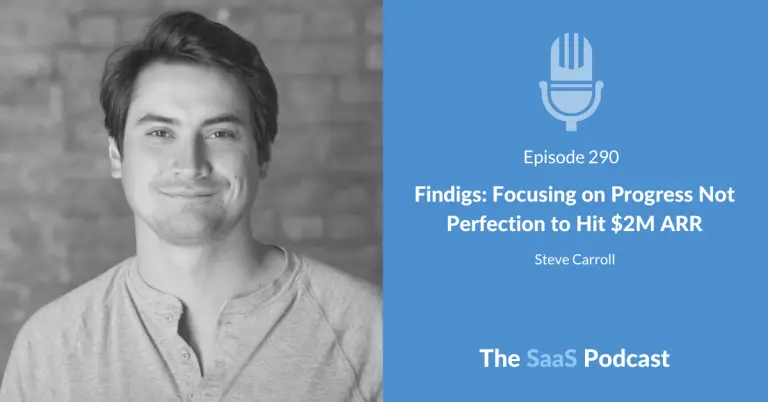
Steve Carroll, Findigs
How Findigs Pivoted to Vertical SaaS and Hit $2M ARR
Like this episode?
Get real founder strategies for the AI era. Delivered weekly.
Free weekly newsletter · No spam
Episode Summary
Steve Carroll sent his co-founder into New York bars to ask strangers how they paid their rent. Some women thought it was a pickup line - until they saw the Typeform survey. That scrappy approach got them 1,000 survey results and enough conviction to build a vertical SaaS product for the rental market.
In this episode, Steve reveals how Findigs pivoted from a consumer rent payments app to a B2B leasing platform after brand partners kept asking for access to renters at the point of move-in - and how that shift helped them reach $2M ARR with just 12 people.
Steve Carroll is the co-founder and CEO of Findigs, a property rent management software that improves the leasing experience for renters and landlords.
Like many people moving to a big city like New York, Steve had experienced firsthand how difficult it can be to rent a place.
He realized that the vast majority of renters were still paying their rent offline or mailing checks every month.
So he teamed up with his best friend Keith to launch an online payments solution for renters.
People told them they were wasting their time because banks were already solving the problem and could send checks for renters.
But Steve had found the experience clunky and almost got evicted when his bank stopped sending rent checks for several months.
They started their customer research by going to a local bar and asking people how they paid their rent. Some women thought this was a pickup line until they'd whip out their phones and show them a Typeform survey.
Just taking a scrappy approach like this quickly got them about 1,000 survey results, which gave them enough data to move ahead.
But the real breakthrough came when Steve started talking to brand partners. Every partner said the same thing - they wanted access to renters when they were moving, not after. That insight led Findigs to pivot from consumer rent payments to a B2B leasing platform that sits between renters and landlords.
Today, their business generates around $2M in annual recurring revenue with a team of 12 people, serving over 60,000 units across 65 customers in the United States. They built a vertical SaaS product in one of the most crowded proptech markets - and differentiated by creating an ML-powered underwriting engine that validates tenant data in a fraction of the time competitors need.
Key Insight
Findigs co-founder Steve Carroll pivoted from a free consumer rent payments app to a B2B vertical SaaS leasing platform after brand partners revealed that renters are most valuable at the point of move-in - not after. That pivot, combined with an ML-powered tenant screening engine, helped Findigs reach $2M ARR with 12 people and 60,000 units.
Key Ideas
- Over 80% of US renters were still paying rent offline via cash, check, or money order when Findigs launched
- Brand partners told Carroll they wanted access to renters at the point of moving - not after - triggering the pivot to leasing
- Findigs differentiated in a crowded market by building an ML-powered underwriting engine that validates tenant identity, income, and employment without manual review
- 97% of landlords encounter at least two fraud instances per year in their leasing process
- Sales cycle measured in weeks instead of months because Findigs integrates without requiring a rip-and-replace of existing software
Key Lessons
- 🎯 Validate with vertical SaaS customers, not just users: Carroll's bar surveys showed consumer demand, but the real business insight came from calling landlords already receiving Findigs payments - revealing the leasing pain point that became their core product.
- 📉 Onboarding mismatches kill vertical SaaS retention: Findigs signed diverse customer profiles before supporting their workflows, creating manual workarounds that end users resented - proving that decision-maker enthusiasm does not equal user adoption.
- 🔄 Listen to adjacent stakeholders for vertical SaaS pivot signals: Brand partners told Carroll renters are most valuable at move-in, not after. That feedback from outside the core user base triggered the pivot from payments to leasing.
- 🤝 Warm outbound beats cold outbound in vertical SaaS sales: Findigs' first B2B customers were landlords they already paid rent to, turning cold calls into warm conversations. Building an existing touchpoint before selling creates natural entry points.
- 🛠️ Avoid rip-and-replace to shorten vertical SaaS sales cycles: Findigs integrates alongside existing software instead of replacing it, reducing sales cycles from months to weeks - a critical advantage in a market with entrenched incumbents.
- 💰 Usage-based pricing can look like SaaS revenue: Findigs charges per rental application, but because leasing volumes are predictable, the revenue behaves like recurring SaaS revenue with high predictability.
Chapters
00:00Introduction
02:27Steve's background on Wall Street and restaurant tech
03:03What Findigs does and the problem it solves
04:03Business size: $2M ARR, 12 people, 60,000 units
05:30How the idea came from renting in New York City
07:25Starting with rent payments as the first product
08:57Getting started with funding from a Wall Street contact
10:02Bar surveys: collecting 1,000 results in New York
12:19How Keith met his girlfriend doing customer research
13:30Shipping the first product in five months
14:59Getting 400 payments in the first month with no marketing
16:03Why the service was free and 75% of users tipped
18:04The shocking stat: 80% of renters paying offline
18:44Pivoting to B2B after brand partner feedback
21:33Understanding the leasing pain point for landlords
25:00Six months of research before building the new product
27:25Early product mistakes: shipping before workflows were ready
29:06Getting attention in a crowded market
31:09Outbound sales: posing as renters to find leads
32:06Lessons from onboarding customers too early
37:01Differentiating with ML-powered underwriting
38:12Usage-based pricing model
39:15Sales cycle measured in weeks, not months
40:50Serving both landlords and renters going forward
42:20Lightning round
Episode Q&A
How did Findigs validate demand before building their vertical SaaS product?
Steve Carroll sent his co-founder to New York bars with a Typeform survey to ask people how they paid rent. They collected 1,000 results showing over 80% paid offline, confirming the opportunity.
Why did Findigs pivot from consumer rent payments to a B2B vertical SaaS leasing platform?
Brand partners kept telling Carroll that renters are most valuable at the point of moving, not after. That feedback led Findigs to call landlords they were already sending payments to and discover massive pain in tenant screening.
How did Steve Carroll get Findigs' first B2B customers after the pivot?
Carroll called the landlords Findigs was already sending rent payments to on behalf of tenants. Having an existing relationship made cold outreach warm - they could say "we've been paying rent for your tenants."
What makes Findigs different from other vertical SaaS tenant screening tools?
Findigs built an ML-powered underwriting engine with a human-in-the-loop that validates tenant data using external data sources, reducing the typical 3-day screening process and catching fraud that manual review misses.
What mistake did Findigs make when onboarding early vertical SaaS customers?
Carroll signed customers with different workflows before the product supported them, creating manual workarounds. End users - not the decision makers - had to deal with the friction, leading to pocket vetoes and churn risk.
How does Findigs charge for its vertical SaaS leasing platform?
Findigs uses usage-based pricing charged per rental application processed. Despite being transactional, the revenue looks like SaaS because leasing volumes are predictable within a few percentage points year over year.
Why did 75% of Findigs' early users voluntarily tip for a free rent payment service?
Carroll launched rent payments as a free service with an optional tip. The pain of mailing checks was so acute that 75% of users chose to leave a tip, validating willingness to pay before Findigs had a formal pricing model.
How did Findigs approach outbound sales in a crowded vertical SaaS market?
Findigs salespeople posed as prospective renters to find target landlords, researched their application processes to identify pain points, then used those specific friction points as the leading edge of cold email outreach.
What competitive advantage did Findigs build by not requiring a rip-and-replace?
Findigs integrates alongside existing software rather than replacing it, which shortens the sales cycle from months to weeks. Competitors typically want to replace the entire operation, creating a much larger implementation burden.
Book Recommendations
Full Transcript
Omer (00:10.000)
Welcome to another episode of the SaaS Podcast.
I'm your host, Omer Khan, and this is the show where I interview proven founders and industry experts who share their stories, strategies and insights to help you build, launch, and grow your SaaS business.
In this episode, I talk to Steve Carroll, the co founder and CEO of FineDigs, a property rent management software that improves the leasing experience for renters and landlords.
Like many people moving to a big city like New York, Steve had experienced firsthand how difficult it can be to rent a place.
He realized that the vast majority of renters were still paying their rent offline or mailing checks, and every month.
So he teamed up with his best friend Keith to launch an online payment solution for renters.
People told them that they were wasting their time because banks were already solving the problem and could send out checks for people.
But Steve had found the experience clunky and almost got evicted once when his bank accidentally stopped sending rent checks for several months without even notifying him.
The founders started their customer research by going to a local New York bar and asking people how they pay paid their rent.
Some women thought this was a pickup line until they'd whip out their phones and show them a Typeform survey.
By just taking a scrappy approach like this, they quickly got about a thousand survey results, which gave them enough data to move ahead.
Today, about three and a half years later, their business generates around $2 million in annual recurring revenue with a team of 12 people.
In this interview, you'll learn how the founders focus on progress, not perfection, with their customer interviews and why you should why they didn't let a bunch of flaws and bugs in their product stop them from getting it in front of their customers.
How they discovered a bigger opportunity and pivoted to fixing the leasing process, both for landlords and renters.
We also talk about some of the big mistakes they made in the early days, such as selling their product to customers that they clearly weren't ready or able to onboard, and how getting out of the building literally to do customer interviews led to Keith meeting his girlfriend.
So I hope you enjoy it.
Steve, welcome to the show.
Steve Carroll (02:27.200)
Omer, thank you so much for having me.
Omer (02:28.880)
Do you have a quote, something that inspires or motivates you that you can share with our audience?
Steve Carroll (02:33.120)
Yeah, absolutely.
I'm a big quotes guy, but I think the one that I'd like to share today is from Oscar Wilde, which is some people bring happiness wherever they go and others whenever they go.
To me, it just exemplifies the attitude that you need to bring to motivate people in a startup.
Omer (02:50.630)
I haven't heard that one before.
I like it.
Great.
So tell us about Finddigs.
What does the product do, who is it for and what's the main problem that you're helping to solve?
Steve Carroll (03:03.110)
Yeah, absolutely.
So I'll start with the main problem here.
Omer, which is renting in the United States, if you look at it as an entity, is more or less unfair.
People have very different access to rental housing.
And what we see in fine digs is that a big part of that comes down to how we actually evaluate who we want to rent units to make underwriting decisions, whether or not we're going to issue someone a lease and give them the keys to an apartment or rental home.
So in today's market, if you look at any operator, they have to make this decision.
They're not just going to give you the keys.
They have to figure out if you're going to be a good tenant, you're going to pay the rent.
And the way they do that today is very much not based on technology, not based on data.
So they're relying on a lot of self reported information.
They ask applicants a bunch of really important questions and then they ask them to provide documentation to prove those claims.
And what findings does is we create a data layer that exists between renters and landlords to make the leasing process 10x more efficient, fraud proof and transparent.
Omer (03:58.430)
Awesome.
Give us a sense of the size of the business.
Where are you in terms of revenue?
How big is the team?
Steve Carroll (04:03.710)
Yeah, absolutely.
So our core product launched over the summer, so we've seen amazing growth since then.
We're running at about $2 million in run rate revenue at this point.
The team is 12 and quickly expanding.
So it's an exciting time for the business.
Omer (04:17.630)
And how many landlords do you have using the product?
Steve Carroll (04:20.830)
Yeah, so at this point, you know, we're in over 60,000 units across the United States that's spread, you know, 65 unique customers.
And what's exciting to us is, you know, those numbers keep getting bigger every month.
Omer (04:31.770)
Great.
So I want to talk about how you came up with the idea for the business, this business.
But before we do that, tell us a little bit about your background.
What were you doing before you started this business?
Steve Carroll (04:42.570)
Yeah, absolutely.
So I got my start, my career started on Wall street actually.
I worked on the structured products trading desk, which you know, for your listeners that know anything about finance is where pretty much all cash flows that are real estate backed are going to trade.
So that could mortgage backed securities, that could be bonds backed on single family rental or whole loans, fix and flip loans.
So as on the sales side of that, I got to see a wide range of how products were underwritten and originated.
So been exposed to real estate at arm's length for some time now.
And then in 2017 I left to go be the co founder and chief operating officer of a business called Ceded, which is a restaurant technology company which does dynamic pricing for restaurants.
So some of your users may have heard of that, especially if they're in the New York area.
Omer (05:27.280)
Great.
So how did you come up with the idea for findings?
Steve Carroll (05:30.560)
Yeah, I mean, so you know, for me I think everyone who moves to New York has a bad experience doing so.
You've never heard someone who moves to New York and says, wow, that was a really smooth tech enabled process.
So on one hand, you know, I'm seeing this from the perspective of a 20 something year old in New York City and you just see all the shortcomings, right?
You see you're toyed around with brokers, then you find a place that you like and now you don't understand the rules of the game, you don't understand what you need and what's required of you.
What credit score is your dog, the right breed, anything related to am I going to actually get this apartment or home that I want?
You're doing all this in paper, you know, then from there you're going to sign a contract or a lease in paper, you're going to mail a rent checking paper.
It's just obvious to me and to a lot of other people that you know, the renting process in the United States isn't tech enabled.
So when I looked at that and juxtaposed from my experience on a trading floor where you have people who are originating bonds and securitized products based off of these cash flows, you can see that there's serious information asymmetry and you can see that the market really needs something to a clean up the experience and to b be a knowledge base and data center for both sides of the marketplace.
So to me the problem really stemmed from renting in New York City and just thinking, look, what part of this is a place that you could tackle and really make a better consumer experience.
If you look at all the technology that exists in this space, you can seldom point to one piece really anywhere along the renting lifecycle that is a good consumer experience.
So to me that was a landmark sign that to that it was time to try and tackle this business and we originally got our start in rent payments, actually.
And we got our start in rent payments because, you know, I was personally afflicted by this problem.
You know, as a renter in New York city, like over 80% of the country, I was mailing a rent check every month.
So, you know, my idea in the beginning was, you know, can we just make it a lot easier for consumers to pay rent?
Omer (07:25.380)
Interesting.
So that's a very different business to where you are today.
Steve Carroll (07:32.580)
Yeah, absolutely.
Omer (07:33.860)
How did you get started and why?
I mean.
Yeah, I mean, it sounds like there's a pain point there, but like, what was it about that that sort of made you feel like there was an interesting enough business opportunity to just help people find a better way than mailing those checks?
Steve Carroll (07:52.820)
Yeah, I mean, to me, you know, looking at how I interacted with my rental property and, you know, I was in high rise building in New York City.
This was not some townhouse that was being rented to me by a mom and pop landlord.
This was a professional management company.
And you looked at everything that I had to do as a renter.
And there's just so much of your life as an American renter that's a hassle.
I had roommates.
So we were managing our utilities and our Internet and all the furniture that we were buying for the apartment, all the subscriptions from streaming services to home services, et cetera, all of that we sort of had to figure out on our own.
So the idea that I had was like, I was like, look, if there was some platform that was universal where as a consumer I could interact with that and I could manage my rental out of it, the natural starting point for me was paying rent.
This is a place that obviously is ensuring that you're going to stay in that unit.
You need to pay the rent to not be evicted.
If this were a place where you could basically capture a captive audience, that would be really powerful as a consumer platform.
Omer (08:57.179)
How did you get started?
Steve Carroll (08:59.020)
So we got started by having one of the customers who actually covered on Wall street believe in our idea enough.
They believed in our vision, which at the time was very focused around rent payments, and they offered to post our first round of funding.
So pretty quickly we hired a small team.
My background is not engineering by trade, so we had to figure out how to hire the first set of software engineers to actually build a product.
And pretty quickly we shipped an MVP out in the app and play stores a few months after making that capital call and hiring the team.
Omer (09:28.930)
And so did you have a technical co founder who's setting the direction for these developers that you were hiring?
Steve Carroll (09:36.690)
Yeah.
So my co founder, Keith, has been my best friend for the last 10 years.
I met him on the first day of college and while he's not a traditionally or classically trained technical mind, he has taught himself a lot about product management and programming.
So I was fortunate to have him.
And originally we really didn't know how we were going to hire software engineers and how we're going to build a product roadmap.
But that's something that his background we were able to figure out together.
Omer (10:02.270)
And what kind of validation did you do to figure out whether this was a worthwhile problem?
Like, was it just the research and some of the data points that you described earlier?
Were you going out and talking to people or looking at what other products were out in the market?
What was that process you went through and how long did it take for you to get to a point where you were like, yeah, I kind of understand this problem well enough to be able to at least get started with building a product?
Steve Carroll (10:36.080)
It's actually really funny because this is a great story and it's actually how my co founder met his now girlfriend.
So you look at the market research and the landscape is very clear right within rent pending at the time we were doing this and this might have changed since then, over 85% of people were paying rent offline.
And tellingly, the commentary that we were getting is like, look, Steve, banks are actually trying to do a better job making this easier so your bank will send a check for you.
And I went through that experience with several different banks and did some user testing on my own and found that to be a really clunky experience too.
And actually I almost got evicted because of it.
Because when I set up TD Bank Bill Pay, they basically just didn't send the check and didn't tell me.
So for months I wasn't paying my rent unknowingly.
And you look at the numbers and only 7% of people are using their bank to pay their rent via the bill pay feature.
So the next step in this is we said, okay, look, the market landscape is clear.
People are not paying rent all online.
You know, we did some research as to as to why software adoption on the supply side, on the landlord side hadn't been higher.
But really we wanted to dig into the consumer side of things.
So we put together all sorts of surveys and at the end of the day I told my co founder and one of the guys who was working for us, I said, look, you know here's my credit card.
I want you to go to bars and I want you to get 20 survey results a day here on why people, how people pay rent and would they use something that made it easier.
So we actually took a really bootstrapped approach of going out in New York City and just talking to many people and approaching them and saying, hey, how do you pay rent?
Is it easy?
Is it enjoyable?
Et cetera.
And once we had collected about 1,000 results in that survey, the numbers held up as we imagined they would and said, look, we have something here that we can make a lot easier for consumers.
Omer (12:19.140)
Tell me about the story on how your co founder met the woman of his dreams.
Steve Carroll (12:29.060)
Yeah, it's actually really funny.
So on the first day, my co founder is.
He's not an introvert, but he's not someone that is just going to go strike up conversations.
So to me, this was a great exercise for him because it's as on the ground user testing as you can do.
And on the first day, I actually, I couldn't be there.
I couldn't be out the bar with them.
I had something else, another commitment.
So I said, guys, don't come back until you have 20 results.
So they go to this bar and the very first person that they approach, she thinks that he is just absolutely making this up as a pickup line.
But he pulls out his phone and there's a Typeform survey there and he makes her fill it out.
And it turns out not only does she pay rent with a check and hates to doing that, but also she was pretty into Keith.
Omer (13:12.140)
That's funny.
Yeah.
I gotta say, it's like I've never heard of anyone in doing kind of these customer development interviews by going into bars.
Steve Carroll (13:22.300)
Well, I knew it was a place, you know, we like bars.
So if we could make it someplace enjoyable and have a few beers along the way, then that turned out pretty well.
Omer (13:30.860)
All right, so you get the product built.
How long did it take for you to ship the first version of the product?
Steve Carroll (13:40.560)
We shipped the first version in a little bit under five months and just
Omer (13:46.200)
kind of describe what it was doing.
I mean, obviously there was some kind of interface where if you're a renter, you can go there and pay.
But what was going on behind the scenes?
Steve Carroll (13:54.800)
Yeah.
So, you know, really what we had to figure out is how do you securely connect someone's bank account?
You know, you need a payment mechanism and then how do you get money from them to their landlord?
So, you know, our interface is to this day, you can still Download the app on the play and app stores today, which is a really clean interface where you link a bank account, you do that through plaid and then findigs on the back end.
What's going on is we're figuring out what the optimal way to pay your landlord is.
So the whole beauty of this is we didn't have to on ramp your landlord in order to pay them.
We were just going to pay them via whatever means they accepted, whether that's sending a check for them, sending a wire, even more bootstrap things like paying a Venmo, et cetera.
We had to create that entire backend database and architecture to be flexible around how does your landlord accept rent payments and how are we going to get this do the KYC information?
No, we're not laundering money, no, we're not sending money to someone who shouldn't be, et cetera.
And at the end of the day the punchline had to be the consumer had to have a 30 second experience.
And then we said your rent payment is handled.
So all went on to the back end steering that out.
Omer (14:59.480)
Okay, so it takes about five months to build the product.
And then what happened?
How quickly did you get customers?
Steve Carroll (15:10.610)
Yeah, I mean, shockingly, people hate sending rent checks.
So you know, we started sending, you know, in the first month that we launched a product, you know, I think we sent like 400 rent checks and 400 payments out to landlords without doing really any marketing.
So it was incredible validation for us.
You know, we started running some basic Facebook ads from there and just growing our footprint organically.
You know, we wanted to be smart about growth.
Because at this point, you know, the piece that I'm missing that I'm not telling you about is, you know, we had this entire vision for a rewards marketplace built on the back end that we hadn't yet built out.
So we were being a little bit throttled about growth because we wanted to have the users and the proof point to that to approach the brands that we were ultimately going to use to fund the whole thing.
Omer (15:56.190)
Then how were you charging for that service?
Were you just taking a fee for each rent payment?
Steve Carroll (16:03.070)
No, actually part of our thesis here was that we could eventually monetize via other mechanisms.
We made it a free service for consumers.
And what was cool to see actually Omer is actually when we launched it, we had, we said, this is free.
You know, we're going to handle this for you for free.
But if we've made it easier to pay rent, feel free to leave us a tip.
And you know, Users can voluntarily elect to leave a tip.
And actually 75% of people were doing that.
Omer (16:30.170)
So you've got the product you've made.
Like, it would have been tempting to say, okay, let's try to build something on the back end that makes it easier for landlords to accept the payments.
And you didn't go down there, right?
You were just like, well, like, we'll just deliver the payment in whichever way they want.
And you're not charging people to use the service.
So I guess the only possible objection might be, do people trust the product and connecting up their bank account.
And it sounds like people were having enough pain that even that wasn't really an issue for you.
Steve Carroll (17:14.730)
Yeah, I mean, I think we did a good job in the early days there of really thinking about the UI and the UX around this.
You know, it's obviously something that we're very wary to do as consumers, but something that we've seen in a lot of places.
You know, you link your bank account to all sorts of things these days.
And I was frankly shocked at the willingness that we saw in the early rollout for people to link a bank account.
But, you know, I think we had enough out there, you know, on the, on the brand side of things, you know, the little content that we pushed, people got comfortable with it at a rig that was a lot faster than we had originally anticipated.
Omer (17:48.710)
I mean, this, I, I'm surprised.
This is like, we're in 2021.
You launched a product a year ago and you're saying that still, like, what was the number like over 80% of people are sending checks in the mail.
Steve Carroll (18:04.000)
Yeah, 80% were paying cash, check or money order to their landlord.
So the online adoption rates had been, you know, sub 15%, and that's inclusive of the, you know, 5 to 7% of people that were using their bank bill pay on a monthly basis to pay their rent.
So the numbers were quite staggering.
Omer (18:26.160)
That is shocking.
So at some point, point, you shifted to a B2B business and started focusing primarily on landlords.
Can you explain how that happened and why you decided to make that shift?
Steve Carroll (18:44.480)
Yeah, absolutely.
So my background prior to Findigs was working as chief operating officer of the restaurant app Seeded.
A lot of what makes seeded work, if you're unfamiliar, is the consumer partnerships.
So basically the way Seeded works is, you know, if you and I were going out to dinner in New York City tonight, you could book a reservation on seated, and you, as a person that made that reservation, are going to get a dynamic reward based on the time that we go to the restaurant.
So, you know, if you and I went to Da Umberto in New York City today at 6pm you might get 30% of whatever we spend the restaurant.
You give it back and you're going to get it back to one of Seated's brand partners.
So in credit to Lululemon or SoulCycle or ClassPass or Uber, and you know, having, having looked at those partnership, understanding how brands thought about their customer acquisition costs and retention economics, a big part of the original vision was to plug in those brands to this rent payments platform.
If you could control the rent payment, then you could give brands a monthly audience and use them and tie them to your rent payment.
So you could say really cool things like Omer, if you go to Flywheel this week, you can get $30 off of your next month's rent, or if you buy a Casper mattress, you can get 300 dol off your next month's rent.
So a big part of what we wanted to do was natively negotiate those partnerships and use the control of the rent payment to tie all these incentives for consumers.
So the way that we went about this was first, obviously we had to solve one side of the marketplace which was getting people to pay rent through us.
Then pretty quickly I turned my attention to building these partnerships and all of these partners, they kept saying the same thing to me, which is really interesting.
They said, steve, we love the idea of our brand being able to help people pay rent by consuming our good or service.
But what you have to understand is that when people are moving, that is when they're the most valuable customer to us.
So if you could give us access to consumers when they're moving, you know, we would have a lot more margin to play with and you'd basically make yourself an indispensable partner to us.
So we looked at this and said, okay, we already have this audience of people who are paying rent through us, and we obviously know who their landlords are.
So, you know, how do we get access to them when they're moving and how do we, how do we control more of this, you know, renting journey?
And the natural extension for, for us was, you know, to pick up the phones and to start calling all the landlords and the property managers that we were sending checks and to figure out what happens before people move in.
And that's really where we identified just this massive pain point around how rental applications and tenant screening happen in the United States.
And that's when we said, look, if we could get this right, payments and Everything else would come naturally, but this is clearly the highest friction, highest stakes piece of the renting journey and something that no one seems to be happy with their existing technology around.
Omer (21:33.660)
So just, just tell us a little bit more about what that process looks like or why it's so painful.
Steve Carroll (21:40.500)
Yeah, so I touched on this a bit earlier, but basically when you apply to a rental home in the United States, you are going to be applying into a black box.
For the most part, you don't understand the requirements.
What is the credit requirement?
Is your dog the right breed?
Has someone else applied before you?
What is the income requirement?
Am I going to need a guarantor?
All that stuff is fairly opaque.
And it's opaque because an operator trying to make a leasing decision, Right.
Most of the information is coming from the applicant who wants to rent your unit, who, you know, has a perverse incentive here.
You know, you're incentivized to overreport your income.
So they have these elaborate processes on the back end set up to validate the claims that people are making about their income and employment and assets and savings and identity.
So that the whole process, you know, for most landlords and property managers across the United States is going to take at least three days.
Three days from the time that you apply to a rental home to the time that they can actually, actually give you a yes or a no.
And we looked at that and said, you know, this space has not been nearly sophisticated enough about how they're thinking about injecting outside data and technology.
Omer (22:46.700)
Right.
But that's the pain from the renter's point of view.
But what about the landlord?
Why did they.
Steve Carroll (22:53.180)
Yeah.
Omer (22:53.820)
Or the pains that they had.
Steve Carroll (22:55.820)
The pains that they had.
They're myriad.
But they start with this understanding that their process is incredibly time consuming.
It takes three hours of manual work per application.
And furthermore, they understand just how beatable it is.
It's very easy in today's day and age if you're basing your underwriting decision on someone who's uploading a document.
Everybody knows what Photoshop is, so they have to do these extensive research processes to validate the information they're looking at is legitimate.
So the stat that's thrown around a lot is that 97% of landlords and operators encounter at least two instances of fraud in their leasing process in a one year period.
So, you know, fraud, especially in the coronavirus era, where we've moved much more digital, is all too common.
It's something that keeps these guys up at night.
And then there's A host of regulatory challenges and compliance challenges, because obviously this is an important decision for them that the government is just not going to let them make on their own.
So it really comes down from a time efficiency standpoint.
They're spending so much time reviewing rental applications with the hopes of catching fraud, which they're not confident in their ability to do.
And all the while, you look at the lawsuits that have happened in the last two years alone, we've seen more class actions around discrimination in tenant screening and automated decisions going wrong.
It's something that can wipe out an entire portfolio's return.
Omer (24:16.710)
Okay, so you initially started talking to landlords to figure out how you could get, I guess, more visibility on tenants before they move in, because to help fuel this reward kind of business that you were thinking about, this business model.
And then you started.
You started to understand that there was this pain point that landlords had that there was an opportunity to solve.
How long did it take for you to get to a point where you decided, okay, we need to kind of change plans, at least for now, and start focusing on building a different product?
Steve Carroll (25:00.110)
Yeah, I mean, this was months of research.
Omer looking at this, one thing that we knew was this is an incredibly crowded space.
You know, if you Google tenant screening, those.
Those ads are incredibly competitive.
So we really needed to understand exactly how it worked, not only from a process standpoint, you know, what are current clients doing today, but also from a regulatory standpoint, you know, are there tripwires that might be being crossed that people don't even know about?
This was six months of research and understanding.
You know, what do customers do today?
Where do we see the loopholes in that?
How can the process be augmented with technology and automation?
Before, we were actually comfortable to say, look, we can create a differentiated product here.
Omer (25:42.680)
And did you find that the landlords you were speaking to were already using some type of product?
Steve Carroll (25:49.960)
Almost universally, yes.
Omer (25:52.520)
And so there was.
There was the pains associated with the general process.
But it sounds like even though it was a very crowded market, there was still a bunch of issues with whatever incumbents there were in that space.
Steve Carroll (26:10.910)
Absolutely, absolutely.
And I don't want to speak ill of any existing companies or competitors, but you looked at these, and their satisfaction with them was extremely low.
And it was low because a lot of these guys place all of the onus on the operator.
The technology just moves information around.
It doesn't do anything to help you structure it, to help you augment your workflow, to help you task track or anything like that.
So they were incredibly Frustrated, you know, this process shouldn't take as long as it does.
And they understood that, which is really where we saw the opening.
Omer (26:43.770)
Okay, so you're building now another product.
And so how long did that take for you to come up with a solution for the landlords?
Steve Carroll (26:54.090)
Yeah, it took, you know, well, it depends on what you count as come up with a solution because we thought we had a solution separately times along the way.
And it turns out that as soon as we actually try to put it out into the wild, we realized that there were just glaring shortcomings in it.
So from the time that it took us to go from customer research to the time where we actually had something that we felt like was the first version or the MVP of what we could scale on top of, that's a five month period there.
Omer (27:25.190)
So give me an example of you said you put it out in the wild and you realize realized that you hadn't quite nailed it.
Can you give me one example of that?
Steve Carroll (27:33.860)
Yeah.
So when you're looking at this, a big part of what the objective is is to validate key pieces of information, right?
Your leasing decision is going to be based off of someone's identity, their income, how long they've been at their job, their previous landlord references, a whole host of inputs which are actually different for everybody.
So in the beginning, we didn't realize just how different everyone's leasing logic going to be.
So, you know, per the Fair Housing act and per the Fair Credit Reporting act, you know, as someone who's evaluating someone for rental property, you have to have a standardized way that you do that.
So usually you're going to see people who have a point ranking system.
So, you know, you're going to apply and you're going to get a score.
And you know, oftentimes the highest score will be the person that gets to be the tenant or wins that apartment.
So in the early days, we thought we'd set up this beautiful scoring system system and then we just kept realizing that like there's so many inputs we didn't, we didn't even have.
You know, we thought it would be enough to say, okay, we're going to weight the income requirement differently or we're going to weight your employment requirement differently.
But as it turns out, you know, landlords across the country, they have so many different inputs they're going to include.
So we had to go back and, you know, figure out how to make our back end flexible to accommodate basically any decision tree.
And in so doing, it's like people look at the product.
And they said, you know, this is obviously a lot cleaner UI and a lot cleaner UX than what we're used to.
But, you know, what about this one thing that we need to have as an input?
And our response is, hang on, we'll be back to you.
Omer (29:06.750)
Okay, so one of the things that I often see when founders are going out and trying to talk to prospective customers, especially in a market where there's already a bunch of different solutions, is that it can be hard to get people's attention or time for the them to talk to you.
So what was your experience with that?
Were you finding that it was pretty easy to get time with these landlords?
And, you know, like you mentioned earlier, these were sort of like the mom and pop type landlords.
You're talking about larger companies.
Like, how hard was it to get attention?
Steve Carroll (29:47.620)
Yeah, I mean, look, I think this is obviously one of the key challenges in any business, especially one that's creating a new product.
Right.
Is how do you even stand out from.
Separate the signal from the noise in the space?
So I think we had a few sort of hacky advantages.
One that when we were reaching out, the first people we reached out to are people that we've been paying on behalf of their tenants already.
So our original customer base came from people that we sent checks to or sent payments to.
So you could very easily pick up the phone and call them and say, hi, we've been paying rent.
We have some questions.
Oh, by the way, who can we talk to you?
So for the first few clients, we really were bootstrapped about the way that we got them that way way.
As we transition more into a traditional outbound sales approach, you know, we had to get really scrappy around our email marketing content or copy rather our touch points.
And then, you know, basically how do we incentivize customers to refer other customers?
But so far, that's been the primary way that we've grown is just being very effective about email copywriting, writing very short, punchy emails, getting to understand their process well before we reach out, and then obviously qualifying leads and getting the right.
Right person.
Omer (30:52.530)
Okay, so yeah, let's talk about that.
Because outbound sales has been the biggest driver of your growth.
What does that process look like?
Presumably you guys are building some kind of list doing what?
Cold email outreach?
Steve Carroll (31:09.330)
Yeah, exactly.
So looking at the landscape today, there's all sorts of ways these people have to make themselves easy to find.
Right.
Because they have units that they're trying to rent.
So we actually come at this.
Our sales Purchase to come at this from the perspective of someone who's trying to rent one of their units.
You know, that's who we ask our salespeople to put themselves in the shoes of and to go through to find target customers, you know, just by basically pretending to need to rent apartments, you know, and looking at it, what is the process going to be like for me as someone who wants to rent one of your units?
And then, you know, once we find them, which you can do in a whole host of different ways in today's day and age.
You know, there's listings aggregators, you can reverse into what software people are using, using.
And moreover, they're doing a ton of marketing.
Right.
So we find them that way.
They publish what the application process looks like today, and then we find a few key things based on what they tell you the application process is going to be like for the tenant that we key in on.
And we use those as our leading edge of the secure and cold email content.
Omer (32:06.280)
Got it.
Okay.
So one of the things you mentioned before we started recording was some of the experience you had in the early days with, with finding customers and getting them onboarded manually and some of the issues that sort of, that created.
Tell us a little bit about that because I think there's a useful lesson there for a lot of people.
Steve Carroll (32:29.570)
Yeah.
So Omer, the way that I look at sales in general, at startups, having done this in restaurants and now landlords and property managers, is in the early days, you are creating as little friction as you can.
Your salespeople are probably counting a verbal yes as a win.
And you know, anybody who is going to use your product is a win for you because you have nothing, you have no brand, you have no recognition.
If you can get people to use a product, that's key to iterating on it and making it smarter, better, faster, stronger, et cetera.
So in the beginning we were casting a really wide net.
You know, casting a wide net not only across types of operators, so whether they have single family homes, class A apartments, class B apartments, class C apartments, but also based on what they're processing, you know, we weren't really understanding because we didn't have a knowledge base how they were doing it in granular detail.
So when we would show them the product demo, which was the same for everybody in the early days, we were just kind of gunsling.
We were showing them like, look, this is what we can do.
We can make this process so much more efficient because we have all of this outside data and all this proprietary algorithmic, rules based approach that we're going to take to this.
And the clients are looking, they would say, wow, this is great.
But what they're not thinking about is what actually goes into implementing this.
So we got, you know, seven or eight clients who were just totally different customer profiles with totally different workflows.
And we looked at them and said, like, look, you know, our technology is clearly superior to what you're doing, but we don't support your workflow.
There's plenty of pieces of this that you're going to have to do manually if you want to switch over to findings.
Because we simply haven't built it yet.
And you know, the mistake that we made was they said, screw it, Steve.
Like, this is so great.
If you could do what you said you're going to do, then we'll do those things manually.
And as it turns out, you know, creating those manual friction points is something that you just can't do if you want to sustain them long term.
Because the people that are actually using the product are not the decision maker.
They're people who are downstream in the leasing staff, in the underwriting staff, and they're going to hate that you've created this manual work for them.
So I think a big mistake and a big learning for me would be even if people are really excited about using the product, you have to think about who the end users are going to be if it's not the decision maker, and what implications you're going to have there because they can just pocket veto and you want to create a seamless experience for them to get them to be a sticky customer for long term.
Omer (34:45.749)
So was that because you were just getting a real diverse set of customers and the product wasn't designed for that, or was it like just, you know, you had plans to kind of build that workflow in and the product was behind what the market needed.
Like which one was it?
Was it a combination of both?
Steve Carroll (35:08.949)
That a combination of both, to be honest with you.
I mean, like in the beginning, you know, we said, look, here are the pain points that we want to solve, we want to make these things easier.
And then you have all of these outside processes that people are going to undertake.
And it's very much tied to the difference in client profile.
Someone who has high end luxury apartments, they're going to have a separate workflow that they go through to make underwriting decisions than someone who has single family homes, maybe in a more rural area.
We were casting such a wide net, so talking to all these customer profiles and Just saying, look, we know we don't have a lot of these workflows built out.
You know, we know they're going to have to do these things which, you know, in many cases they're already doing offline.
But you know, they have the process at least formalized and documented.
So it's a combination.
I think the different types of customer profile sort of begets this different type of workflow which we didn't have because the product was definitely, you know, very nascent at the time.
And you know, that that created the headaches that we ran into.
Omer (36:07.370)
You know, one of the other challenges, you know, if you're going into market that's crowded, that has competitors that maybe have been around for years, is figuring out what's your differentiation and what was that for you?
There's obviously you talk to customers or prospective customers and you figure out these are the opportunities, but then also you're not going to be able to build the perfect solution and catch up with what, you know, the competitors may have been trying to do for years in a matter of a few months.
So you always have this gap in terms of, okay, the product is new, we're kind of an unknown quantity, we're trying to play catch up, we're trying to solve these problems.
How did you tackle that and how did you sort of figure out, okay, based on what we are capability today, this is the way we should differentiate ourselves?
Steve Carroll (37:01.810)
Yeah, no, I think it's a great question.
And obviously whenever you have incumbents who are in the space for decades, you know there's going to be elements of their business that you just can't compete with.
So where we really set out to compete was we are going to create a product that makes it a better experience for people to apply and makes it quicker for them to get into apartments.
But on your side of things, we are going to be the best in the business at taking an ML with a human in the loop approach and a rules based approach to validating all these really important things from identity to employment, et cetera, we're going to do that better than anybody else.
And we're going to do the that because we think we have the team in place to build the most sophisticated leasing engine and decision trees in the business.
And it's that sort of look like they believe that our data is more sophisticated.
And when they believe that, that's why they were willing to sort of take the gamble on creating these manual headache, because they thought that we were accessing a level of granular information and process that they couldn't get with their other software providers.
Omer (37:59.050)
And then how do you charge for the product?
I mean, we talked about the sort of the consumer, consumer piece of this and what your plans had been.
But did you take a different approach when you built this landlord solution?
Steve Carroll (38:12.130)
Yeah, I mean, we looked at this and we looked at what everyone's costs were today.
They're already paying for somebody to do this for them.
So it's a simple usage based cost.
Omer (38:22.210)
Okay, so what is it?
Is there a flat monthly fee?
Is it based on the number of properties?
Transactions.
What is it?
Steve Carroll (38:32.650)
Transactions?
Rental applications.
Omer (38:34.730)
Okay, got it.
And so how does that work in terms of like, that feels like that's a number that could fluctuate quite a bit.
Month to month.
Steve Carroll (38:43.290)
Yeah, you know, actually it looks a lot like SaaS revenue.
It looks a lot like recurring revenue because you know, these people manage large portfolios and their leasing volumes and their application volumes are actually quite predictable.
You know, over the course of the year, you know how many units are going to turn over for the most part within a few percentage points and you know how many applications you're going to get per vacant unit.
So, you know, we're still, I would say flexible, you know, nimble enough to have, have pricing flexibility on that because those volumes are so predictable.
Omer (39:15.350)
Got it.
Okay.
There was one other thing I wanted to ask you in, in terms of the, the, the sales process.
So you're doing the cold outreach.
Once you get people interested or respond, you're doing a demo and then what does the sales process look like?
How long does it typically take to close?
Steve Carroll (39:39.520)
Yeah, so I think we're very fortunate.
And where our engineering team spent a lot of time is making the lift on the operator or the end client fairly easy.
So you know, our sales cycle is, you know, in this space usually measured in monsage, is measured in weeks.
Omer (39:55.280)
And again, sort of just give me one example of why you're able to, to do that better than some of your competitors.
Steve Carroll (40:02.600)
Because we've built out this understanding with each client.
We've gotten smarter about how they're doing it today and we understand what it takes to peel off that side of the business for them.
So I think you look at this and most other competitors are going to want to replace a lot of your software.
This is going to be one small function of what they want to have you sign up for.
So to do that is a big rip and replace effort.
We've taken the approach of saying, how can we make it really easy to use Findigs for just this one function today, not disrupt anything and have our engineers have the framework to be able to implement this without having to go and rip and replace everything about your operation.
So it's sort of that nimble and sort of tactical approach that we've taken on peeling off this piece of it.
Omer (40:50.020)
When I looked at the Find Digs website up in the navigation you have for landlords and for tenants.
And so my initial impression was, oh, they built this for landlords and then now it looks like they're doing something to make it easier for tenants to pay their rent as well.
And then when we started talking, you were like, no, no, it was the other way around.
Which is interesting, but sort of going forward, I mean, you're serving both those customers today.
What's the plan?
What's the vision?
Is that something you're going to continue to do?
Are you eventually going to focus more and more on landlords?
Like, where are you going with this?
Steve Carroll (41:31.020)
Yeah, absolutely.
I mean, to me, I think it really comes down to the piece of the transaction that we own.
This has historically been a place where there's very little trust on either side.
So if we can get this right and we can be the trusted intermediary here, not only can we create a more efficient process for our landlord clients, but consumers also trust us to handle the rental application in a fair and standard standardized way.
So our vision is very much to balance both sides of this market and ultimately to make renting in general much easier.
You know, we think that, you know, by owning this part of the workflow, you know, there's, there's plenty that can be done to make it easier to apply to apartments, easier to move into apartments, easier to manage your rental.
So ultimately we see this as sort of an attack point of bringing great UI and great UX and great consumer experience to both sides of the marketplace.
Omer (42:20.310)
All right, great.
Well, on that note, I think we should wrap up and move on to the lightning round.
I'm going to ask you seven quick fire questions.
Just try to answer them as quickly as you can.
Ready to go?
Steve Carroll (42:31.610)
Sure.
Omer (42:32.090)
All right, what's the best piece of business advice you've ever received?
Steve Carroll (42:36.010)
Never treat your transactions like relationships and never treat your relationships like transactions.
Omer (42:42.810)
What book would you recommend to our
Steve Carroll (42:44.450)
audience and why the culture code?
Because microbehaviors matter a lot in media social startups.
Omer (42:50.180)
What's one attribute or characteristic in your mind of a successful founder?
Steve Carroll (42:54.340)
The ability to understand when they're wrong.
Very quickly.
Omer (42:57.620)
What's your favorite personal productivity tool or
Steve Carroll (43:00.420)
habit Wim HOF breathing exercises.
Omer (43:03.380)
Oh, yes.
I'm a big fan of WIM as well.
What's a new or crazy business idea you'd love to pursue if you had the extra time?
Steve Carroll (43:10.260)
Oh, man, there's too many of these.
Let's see.
I think that access to venture capital and fundraising dynamics need be to change and a startup is going to do that.
I think.
You know, cpace and Clean Energy Loans are a place that will see a lot of validation in the next 10 years.
I would love a washer that automatically put my clothes in the dryer, but I don't have much demand expertise there.
Omer (43:32.470)
Well, we have those.
You know, I grew up in England and most people just have a combo washer and dryer and they're actually terrible.
Like, you know, your clothes come out
Steve Carroll (43:42.030)
just like they have to.
It's a waste of time.
Omer (43:47.790)
What's an interesting or fun fact about you that most people don't know?
Steve Carroll (43:50.750)
I'm an avid bridge player.
Wow.
Omer (43:54.030)
And finally, what's one of your most important passions outside of your work?
Steve Carroll (43:57.630)
Animals.
Yeah.
Big on my rescue dog and helping foster here in New York.
Omer (44:03.950)
Awesome.
Well, if people want to find out more about fine digs, they can go to finddigs.com and if people want to get in touch with you, what's the best way for them to do that?
Steve Carroll (44:15.730)
They can hit me up on LinkedIn.
Omer (44:17.810)
Awesome.
We'll include a link in the show Notes to that.
Steve, thank you so much for joining me and getting us up to speed on your journey and the story.
And I love how all of this business started by hanging out in New York bars.
Steve Carroll (44:35.330)
Awesome story.
Thanks, Omer.
It's been a pleasure.
Omer (44:40.450)
Yeah.
I wish you guys all the best.
Take care.
Cheers.