Omer (00:10.000)
Welcome to another episode of the SaaS Podcast.
I'm your host Omer Khan and this is the show where I interview proven founders and industry experts who share their stories, strategies and insights to help you build, launch and grow your SaaS business.
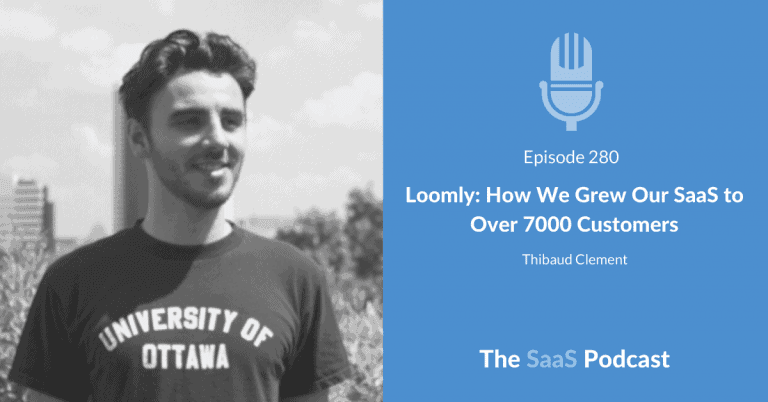
In this episode I talk to Thibaut Clement, the co founder and CEO of Loomly, a SaaS platform that helps marketing teams to streamline their social media communication and improve how they collaborate.
In 2015, Thibaut and his wife Noemi were running an advertising agency.
They were working with clients in France and the US but collaborating with them was time consuming and inefficient.
Nearly everything was done using spreadsheets.
Eventually one day Thibaut decided to build a software tool to make their lives easier.
He was a self taught Ruby on Rails developer, so he had enough knowledge to build something.
The first version of what later became Loomly took Thibaut a few months to build, but it didn't do much and was pretty basic.
All people could do was upload an image, click add some text and see a mock up of what the post would look like on social media.
But the tool helped them streamline how they collaborated with clients.
And their clients loved the tool even though it didn't do much.
So in 2016 they launched it as a product and two months later had their first paying customer.
Today, Loomly generates north of $5 million in annual recurring revenue and is used by over 7,000 marketing teams around the world.
In this interview we talk about how Thibaut and Noemi turned their little tool into a multiple 7 figure SaaS business.
Why they charged for the product from day one even though it had very limited functionality, how they differentiate their product and try to stand out in a very crowded market, and why launching a referral program turned out to be a bad idea and what they learned from that.
We also talk about how they use quick feedback loops to quickly and continuously improve their product and how that's helped them to grow the business.
So I hope you enjoy it.
Thibaut, welcome to the show.
Thibaud Clement (02:29.560)
Thanks for having me Omer.
It's a pleasure to be with you.
Omer (02:31.640)
Do you have a quote that you can share with us?
Something that inspires or motivates you or just gets you out of bed every day?
Thibaud Clement (02:37.640)
Yeah, yeah, as a matter of fact.
So like the way I usually like think about it is that you know, nothing beats perseverance.
But like the actual, like the true quote, the one, the original one is actually nothing in this world can take the place of persistence from Mr. Coolidge.
And you know, I think that, you know, having persistence or perseverance or however you want to call it is very, very important when you decide to start a business.
So that's something I try to remember every morning.
Omer (03:10.940)
Awesome.
So tell us about Loomly.
What does the product do, who is it for and what's the main problem that you're helping to solve?
Thibaud Clement (03:20.460)
Yeah, so Loomly is what we call a brand success platform.
And what it does is that it helps marketing teams streamline their collaboration to produce content and build their brand online.
And the main problem that we see these days, and I'm not even talking about the current context with the pandemic, is that, you know, how as a team, as a brand do you go from a blank page to a consistent story that you are going to tell on social media and on all your digital channels?
This is the problem that we are trying to solve.
And of course, you know, with the Pandemic, this is something that has skyrocketed for two reasons.
One, we have seen more and more smaller businesses who were not operating online and who had to shift online due to many of the challenges that we are all going through.
And so usually the first thing they do is they open up a website or an online store.
And so the second thing they do is trying to promote it.
And so this is where, you know, Loomly can help.
That's kind of the first thing.
And the second thing that we have noticed is that it's more on the larger organizations where, you know, we had all these great marketing teams and even better, all those great cross functional teams that were used to collaborating, seeing each other in the meeting room and then all of a sudden everyone is working from home and so they have to find a way to collaborate online.
So this is what Lonely does.
It helps you create your content, it helps you preview it.
And so before any piece of content goes online, you can see what it looks like, you can assign it to one person in your team, get their feedback and get their approval so that everything that goes out is typo free, it's on brand, it's compliant.
And so you have the peace of mind.
And that also helps you, like I was saying, build a consistent brand story over time.
Omer (05:13.870)
Awesome.
So let's just give folks a sense of the size of the business.
Like how much are you doing in revenue at the moment?
Thibaud Clement (05:21.310)
I don't know when this show is going to air, but we are very, very close to 5 million ARR.
And we're growing about 100% per year.
That's what we've been doing the past two years, and that's what we expect to do this year as well.
Omer (05:33.750)
And how many customers do you have?
Thibaud Clement (05:35.830)
We currently serve over 7,000 marketing teams around the world.
Omer (05:40.230)
And how big is the team?
Thibaud Clement (05:41.910)
We're just seven persons, so we are a very small team of highly efficient people.
That's how we like to think about ourselves.
Omer (05:49.589)
I was very surprised about that when I heard that number, because for the size of the business that you are now, I would have expected the team to be at least three, four times as big.
So I want to kind of dig into that because there's some lessons that we can talk about in terms of hiring, but also I think, just in terms of learning about how to operate a lean and mean machine.
Thibaud Clement (06:14.720)
Right, yeah, that's a good point.
I think just to set the context, something that we need to know is that we have been a distributed team, and we have been working remotely since day one, again even before the pandemic.
So, you know, that has kind of forced us to always work asynchronously, to limit meetings and these kind of things.
And so this is, you know, now this is in our DNA.
And it turns out that this actually is a huge source of productivity when, you know, everyone can work asynchronously.
You don't need to be in the same room or even in the same video call at the same time.
It's just, you know, much more productive.
So I believe this is one of the things that we've been doing differently for a long time.
And the other thing is we also like to spend a lot of time developing repeatable processes.
So when we do something, we like to think about how can we do it once?
And then once we know how to do it once, how do we scale it up from there?
An example of that is that we have no salesforce, so we do not have any sales representative.
We never go out and knock on the door and ask someone if they want to buy the product.
That's not how we've built our marketing.
And so as soon as you kind of remove the sales force, you are already kind of decreasing the correlation between your revenue and the size of your team.
That's one of the scalability aspects of what we do.
And I believe that the last thing probably that is related to operating a business this way is that we have never, and I hope that we will never, evaluated our success or measured our success based on headcounts.
We have always focused on the growth of the business, the satisfaction of the customers.
We've never used the size of the team as a vanity metric, so I believe this is also informing the decisions that we make.
Omer (08:14.620)
So you said seven people.
So there's you and Noemi, your co founder and wife.
And then what do the other five people do?
Are they support developers?
Thibaud Clement (08:25.260)
Yeah.
So the company is kind of split into one half.
So actually three engineers work on building the product, and then two other people, two other wonderful persons are actually working on support and customer success and helping customers with any kind of questions they may have.
Omer (08:42.510)
Awesome.
So the company was founded in 2016.
Thibaud Clement (08:47.230)
Yes.
Omer (08:48.110)
Let's talk about how you came up with the idea for this business.
Where did that start?
Thibaud Clement (08:54.830)
So I've been working with Noemi Myspoons for over nine years now, and Loomly is actually the fourth company that we are building together.
So prior to building Loomly, we were actually managing an advertising agency and we were operating both in France, where our largest client was l'.
Oreal.
We were managing five brands for them online and here in the US and we were mainly working with startups looking for growth and how to scale and how to acquire more users.
But there was one process that was common to all those customers, which was the collaboration that we were having with them.
Everything was going through Excel spreadsheets, what we call editorial calendars, where we were basically listing series of posts to go on social media and blogs and in the media and with the copy and the images, and we were asking for their approval and their feedback before we could actually execute on those pieces of content.
That was a nightmare.
As you may imagine.
Excel spreadsheets are great for numbers, for P and L, not so great for content and assets and collaboration.
So we looked up what we could do to streamline the process, and we could only find two types of solutions.
Generic project management software, on the one hand, which was great for collaboration, not great for publishing.
And on the other hand, we were finding social media schedulers that were great for publishing but not great for collaboration.
So we kind of took the matter in our own hands.
I'm not an engineer.
I just learned everything on my own.
And that was actually back in 2015.
And I built a prototype and we started using it with our clients.
Sorry.
We did not tell them it was our own product because we wanted some honest feedback.
And it turns out that they liked it very much.
I will always remember that one of our clients from the agency actually told us, after trying the product, he said, if we have to go back to Excel, you're fired.
So we are like, okay, maybe there is something here.
And then like you said, Early 2016, we opened up the platform in public beta, and from there it just got out of control, but in the right direction.
Omer (11:14.180)
So tell me about, just at a high level, like the tech stack, what did you use to build this sort of first version of the product and how long did it take you to put it together initially?
Thibaud Clement (11:24.750)
So I use Ruby on Rails.
My first Commit was on August 15, 2015, and I had a prototype up and running by December that we started using with our clients early January.
Omer (11:38.750)
So roughly, it was like how many?
Thibaud Clement (11:41.230)
A couple of months, I would say.
I would say four or five months.
And I was doing that on the side.
So by day I was working in the agency.
By night I was programming.
So busy weeks.
Omer (11:53.890)
Were you already like coding and just as a hobby or something?
Or did you actually.
Was that something new that you learned in terms of how to code with Ruby and learn about for Rails when you decide to build this tool?
Thibaud Clement (12:10.370)
I had been playing around with HTML and CSS and JavaScript for years, maybe five years, something like that.
And I had picked up Ruby on Rails in a different context, and I was kind of in a different.
Pretty amazed by this framework and how it helps you put together some MVPs in such an efficient way.
Always the elegance of the Ruby language.
So it was pretty impressive.
But to answer your question, it was kind of.
I learned on my own in a different context.
And so then I kind of used that knowledge to build the tool that I needed.
Omer (12:44.940)
And that first version of the product, what did it do?
Because not much.
Yeah, I'm sure there was like a thousand things you wanted it to do, but probably it just started with a very few, small number of things.
What was that very few things?
Thibaud Clement (13:03.860)
Nothing compared to today.
When I started, when I built this first version, it was probably one of the most basic crud applications you can think about.
What it was doing is it was allowing some users to upload text and images to the platform, and the platform would turn those into mockups of what the post would look like on social media.
So you would upload the copy of your post, an image, and then it would kind of generate a Facebook post for you, and it would show it to you, and then you would take the link of that post on the platform, not on Facebook, on the platform, and you would be able to send it to someone so that they could review it and they could leave comments on it to tell you what to change or what they liked and approve it.
And that was it.
That was the only thing the platform was doing because remember, like I mentioned, what we were trying to do was replace the spreadsheets.
And so we didn't have any, you know, asset management features like we have now.
We didn't have any publishing features like we have now, we didn't have any interactions management system where you can respond to comments and things like that.
And we of course didn't have any kind of analytics features like again we have now.
But you know, once we opened up this platform in beta to some social media marketing professionals, the feedback was essentially, I've been looking for that for 10 years, I've tried 10 products and no, I'm not doing that.
And so that's when we kind of realized that even though it was basic, even though it was much more simple than everything else on the market, which was connections with APIs and tons of things we didn't even know how to do, it was kind of addressing a pain point.
Omer (14:58.350)
Yeah, I think that's really interesting.
Many founders go into a market, they see existing products and sort of mentally set a very high bar on what they have to launch with and that kind of creates a lot of unnecessary pressure and stress.
And also you sort of force yourself when you think like that to have, you know, like one, two year sort of development roadmap before you can get something done.
There's almost this reluctance in terms of if my product doesn't do enough, people aren't going to take it seriously.
But I think this is a really good example that if you figure out that one thing, and it doesn't have to be, you know, some life changing thing that people haven't seen before, but it just takes a pain away and makes people's lives just that little bit easier.
That's such a beautiful place to start.
Thibaud Clement (16:00.950)
It's so funny that you say that because a couple of hours ago I just saw a tweet from one of our investors.
So like I mentioned to you, I'm French and so this investor is French as well, and he invests in a lot of startups and he was basically kind of saying that kind of the main, I would say, downside of French engineered products is that they have so many features because French engineers are so brilliant and they can basically build anything.
So the French engineered products have so many features that at the end of the day, you don't even know what they're doing.
And so it's exactly what you say.
And so in that case, the constraint having I Would say some, I would say basic engineering skills kind of drove us to focus on what we could achieve and actually solving the problem that we had.
Omer (16:56.650)
When you put this beta out there and started letting other people use it, did you charge for the product?
Did you let them use it for free?
What was the approach that you took to get this out there in front of people and sort of validate it?
Thibaud Clement (17:14.900)
We charged for the product, not much.
It was starting at $12 per month.
That was like four or five years ago.
And there was like two months free trial.
Our goal was to see one, if people were interested in using the product and two, if they were interested in paying for the product.
We figured that if we made it free, maybe we would be having an answer to the first question, but for sure not to the second question.
So from the start, we decided to make it a paying platform because it was kind of part of the customer development effort.
Omer (17:52.120)
How did you find those initial beta users, these people that you knew, or did you.
How did you get the word out?
Thibaud Clement (18:00.120)
Well, you know, we kind of come from that industry, right?
We come from the industry of digital marketing professionals, social media marketing professionals.
And so we were in all those groups and we had all those friends who all kind of knew, you know, mainly Noemi, because she's the one doing this networking part.
So she started sharing it with the communities that she was a part of.
And that's how we started getting a lot of feedback, because again, we know, and we knew these persons were exactly in the target audience.
Omer (18:33.710)
Okay, so you've got these beta users, you start to collect some feedback.
How long did it take you to get to the point where you felt like, this is a business, this is not just a side project.
Thibaud Clement (18:51.080)
So we got the, you know, we opened up in February 2016.
We got the first paying customers two months later because there was a two month free trial.
So it was actually, you know, it was kind of the, like the smallest amount of time we could hope to get a paying customer.
And then, you know, the feedback, although again, the product was very simple and not the sexiest platform you may have seen.
First feedback was very.
Kept coming, interest kept coming.
And then about that time, what is kind of interesting is that we had some entrepreneurs much more seasoned than we are, some entrepreneurs that we knew, and they were kind of asking what we were working on.
And so we mentioned it to them and so we showed it to them.
And then they were like, yeah, you should raise money and we can help.
And then we were like, okay.
So it seems like There is a lot of demand for the product.
It looks like we have people who are interested in helping us to put some resources behind the product.
So we kind of put two and two together, and that's when we decided, yes, let's do it.
Because if we have identified a pain point in an audience and now we have the resources to serve that audience and solve their pain point, then if you're an entrepreneur, you cannot say no to that.
Omer (20:08.830)
Did you keep the agency running?
Was.
Were you splitting your time between the two businesses?
Thibaud Clement (20:17.080)
I stopped working on the agency around September 2016.
So that was about a year after I wrote the first line of code.
That gives you an idea.
Noemi kind of kept managing many aspects of it.
I was kind of supporting her, but, you know, we kind of had split the responsibilities.
And then, you know, she kind of joined me full time the following year.
So that's kind of how it happened.
Omer (20:41.710)
So using your network and the people, you know, and getting people to try the product, it's not a lot of money.
$12 a month, a very generous trial of two months.
Thibaud Clement (20:55.550)
Yeah.
Omer (20:56.590)
But we also know that when you're targeting marketers, that market is.
Is filled.
Like, it's.
It's almost overwhelming when you look at, like, tools that marketers can use.
So how did you figure out what your niche was, how to stand out in that market and to sort of get attention, people's attention?
Was that a difficult thing to do, or just by leading with this one problem, you were finding that that was an easy way for people to get it and start, you know, have some interest and start using the product?
Thibaud Clement (21:35.730)
Well, I think there are a couple of, you know, things, you know, that kind of helped us and played in our favor.
The first thing is that, like you say, there are many, many, many tools targeting marketers, but the way we think about it and the way it turned out to be is that usually if there is competition, if there is supply, it's because there is a market, it's because there is demand.
And so in our specific case on the social media marketing segment, it turns out that there had been, and there still have many other players, most of them that have been here for a longer period of time than we have.
And they actually, they are much bigger than we are, between 100 and 1,000 times bigger than we are.
And so they are doing many things, and they may not be able to kind of respond with the same speed as we do to the customer requests.
And so the reason why and the way it has played in our favor is because those other players have kind of evangelized, they have helped the market get used to using tools.
So when we arrived on the market, we didn't have to convince people that they needed a tool.
They already knew they needed a tool.
And because satisfaction was not as high as it could be on the market, many people were looking for other solutions.
And on top of that, because the pain point that we had identified was, was not yet kind of satisfied and covered, it kind of helped us a lot.
Because all of a sudden we're not just like a small startup going after a market that is undefined and where you have to convince everyone to change the way they work.
No, we were on this huge market that is still to this day, depending on the studies that you look at between 35 and $50 billion a year growing 16 to 18% in compounded annual growth rates.
So it's huge, it's growing fast and it's major.
And so all of a sudden we are here and we have a solution that no one is kind of offering.
We are pouring our souls into making sure that people who try the product are happy and if they're not happy, how we can make them happier.
And so, you know, the last thing is we also try to design the product in a very user friendly way, not because we are great designers.
Another designer, I built the first UX and if you still look at how it looks, it's still the same layout, it's nicer, but the same layout.
And the reason why it was user friendly is because we were the first users of the product.
That triggered a lot of comments from users saying, yes, that's simple, that makes sense, that's how it should work.
And so when you combine that like a major and mature market that is growing fast, where there is some lack of satisfaction, you combine it with a lot of attention to support and customer service and you go after that market with a user friendly product.
Then all of a sudden what you have to do is just make sure that people say, start to hear about yourself.
And you know, that's where content and word of mouth is kind of coming into play.
Omer (25:17.090)
Yeah, I want to talk about content.
I know that's been one of the key ways that you've grown this business.
But before that I want to talk a little bit about just how you sort of think about prioritizing features, especially in those early days as well, because this is quite a common, I think, scenario where you solve a small problem, you get this product out in front of the market, people start using it, they love it, they, they get excited and then the feedback comes in with it.
Would be great if you could add these thousand features to make this, do this and, and, and basically turn it into some, you know, huge monster of a product.
So, which is great to get that feedback, but then how do you decide what to work on?
So what was your experience?
Did you also find that you were getting a lot of this kind of feedback?
And then how did you sort of decide what was the next thing you were going to build on this?
Thibaud Clement (26:10.940)
I think there are two parts to my answer.
I'll try to keep it short, but there are two parts.
The first part is when we started, I was on my desk.
On the other side of the desk was Noemi, my booze and my co founder.
I was building the product, pushing the commits.
She was trying it, giving me some feedback.
I would make modifications and we would do that all over and over again.
So the feedback loop was small and fast and it allows us, it allowed us, at least allowed me to make sure I was building something that she could use very quickly.
We realized there was a lot of power in this feedback loop and collaboration very early on.
One of the main things that we try to do is start thinking about how can we keep that feedback loop, how can we keep this flow of ideas between the users and the developers, how can we keep that and how can we scale that?
And I'm actually very, very proud of the fact that we have been able to do that, because today I'm no longer the one who is actually building the features.
Noemi is far from being the only person to use the product, but we have built processes.
We speak with over 200 customers every single day.
And so they give us feedback, they tell us, they say, hey, there is a bug here, or hey, it would be really nice if we could build this feature, or hey, I don't understand how to do that.
Can you maybe make the UX a bit better or the UI a bit better?
And so we take all of that, every single interaction with every single customer, we have some takeaways from those conversations and we have a roadmap and we just very, very simply, we basically increment counters with the number of requests for a given feature and then based on that, we are able to see what is the most frequently requested features or improvements.
And that's how we work on those.
That's the first part of my answer.
The second part of my answer actually complements it, is that when you have so many data points, when you are lucky to have so many people using your product and so many people actually being willing to tell you what they think.
Well, then what happens is kind of, you know, like when you look at an impressionist painting, you know, it's all those little touches of paint.
So when you look at them individually, you're like, I don't understand what it is.
But if you take a step back, you see the full picture, it's exactly the same thing with that.
Once you get 200 pieces of feedback per day, then you take a step back, you look at the roadmap, and you're like, okay, this is where we are going.
The big picture, the big vision, where you see your product going becomes crystal clear from there.
Once you have that big picture, then you can decide which items of the roadmap make more sense and contribute more to the actual big picture.
These two things really work hand in hand at the macro and micro level.
Omer (29:35.690)
Yeah, I think that's a great way to think about it.
In many ways, it's like you're not just taking feature requests, you're enabling your customers to basically co develop the vision of the product with you.
Thibaud Clement (29:49.320)
Absolutely, yes.
The vision, the features, everything.
And actually, if you go to our blog and you go to the Lumley News section where we introduce new features, you will see that in every single feature announcement at the bottom of the post, there is a big thank you note to all the users who actually contributed to this feature and told us that that was needed.
And so, yes, it's just, you know, it's just extremely necessary.
It's extremely helpful.
And you know, I actually like to say that I'm far from being a visionary.
I'm just someone who listens and just, I just try to deliver on what I'm being asked.
So it's purely execution.
Omer (30:31.250)
So let's talk about content and how you've used that to grow the business.
Maybe just start by telling us, like, how has your content marketing strategy contributed to the growth of the business?
How significant has that been?
Thibaud Clement (30:47.810)
Again, we come from a digital marketing and advertising background, so producing content driving growth online is something we had been doing for a couple of years, even before starting loomly.
And so content, what amazes me is how content is growing with the business even when the business is growing extremely fast.
We are growing about 100% per year.
That's a lot.
And so we see that content is growing along that pace even when we keep adding new channels to the mix.
If we do PR, if we do AdWords, if we do other Things.
What is amazing is how content keeps maintaining its share if not increasing in the mix while we are growing.
And so I think this is very impressive because when you are growing at that rate, it's very probable that your mix is going to evolve because maybe some channels are going to plateau and you're going to have to complement them with other channels.
That has not been the case with content, and I think it's very interesting.
Omer (32:04.070)
So when you say that content has been growing, are you talking about the amount of organic search traffic you're getting through content, the volume of content that you're creating, or both?
Thibaud Clement (32:16.070)
The volume of business that is driven by content?
Omer (32:19.510)
Got it.
And is that mostly coming through organic
Thibaud Clement (32:22.630)
search on the content side?
Yes.
Omer (32:25.990)
Yeah.
So if you're sort of building a content strategy and you want to reach marketers, you kind of have a few problems in the way, like, you know, like these companies like HubSpot who actually do a really good job and spend a lot of, you know, money and kind of resources and creating this content.
And no matter what you're looking for, marketing related, HubSpot will show up, you know, somewhere high up on the results page.
So that obviously is going to be a challenge in terms of how do you create content, which is competitive, which ranks well, which stands out and so on.
What did you do to sort of make that happen, to get attention and to make this content be as effective as possible for you?
Thibaud Clement (33:20.070)
Okay, yeah, the answer is probably going to be very boring.
So I'm sorry.
So the first thing is we just discussed the vision and understanding where you're going.
And so once you know that, you understand what are the main high level pain points of your audience?
For us, it's one, how to build a brand.
Two, how to collaborate as a marketing team.
That's basically what we do because that's what our customers need.
Once you know that, it's pretty easy to have a different take on all the marketing topics because we're not necessarily saying, hey, how to hack algorithms to earn followers.
That's not something we do.
We just never do that because we are all about helping our customers create quality content, building their brand, telling their story.
And so it allows us to have a very unique angle on the topic that people are searching.
And so this is very important because it kind of sends you to one like, you know, it kind of leads you.
Sorry.
To kind of the main things that SEO is about now, especially more in 2021 than before, which is intent, you know, it's people are like, it's very rare these days that people are looking for actual keywords.
You know, sometimes they do, but what they are looking for is answers to their questions.
And so once you have your vision, you know what people are struggling with and you know how to explain things through that perspective, then you know, you have chances of surfacing in search engines in a very different way.
So that's number one.
And it kind of helps us to not go head to head with HubSpot, for instance.
And the other thing is, again, because we have this vision, we understand the pain points, then we kind of think out of the box and we always try, try to think about not only just blog posts, but also resources that can help our users and our customers.
And so this is something that we refresh all the time.
Sometimes it's a quiz to evaluate their own practices in their company so that they have some cues about how to improve productivity as a team or build a brand.
Sometimes it's about creating resources like a dictionary or things like that.
And so again, once you have this big vision, everything kind of makes sense because you know what you're trying to achieve and you know which pain points you're trying to relieve.
Omer (35:57.320)
How frequently were you, were you creating content?
Was it like, you know, something once a week, every day?
Like what was that sort of frequency?
And then were you doing anything in terms of like, you know, trying to do link building or, you know, or was it just a matter of publishing it and just, you know, promoting it through social media channels and whatever.
So what was the general kind of approach you took there?
Thibaud Clement (36:26.490)
Yeah, we publish consistently so that, you know, our users and audience kind of knows what to expect.
We distribute it through our channels, social media, of course, our newsletter as well.
And then, you know, because, you know, loomly is growing and the brand is starting to stand out and we have those people, you know, who are, seem to be pretty happy about, you know, what we do then, you know, the brand kind of drives word of mouth and so that kind of, you know, makes other people talk about you, write articles about you and you know, then this is how you get the links.
We don't do like we've, at some point we have tried to do some outreach to build backlinks and it didn't work well for us.
I know some, some companies are extremely successful at that.
For instance, Canva is like, they are a machine, they are impressive, they're extremely successful and they do it very, very well.
It just didn't work for us.
Omer (37:26.530)
Yeah, I get about 10 emails like that.
Every day.
Thibaud Clement (37:30.690)
Yeah.
That's why we don't do it.
Omer (37:32.410)
Yeah.
After a while you just kind of just, you just numb out.
You don't pay attention to it.
Thibaud Clement (37:38.140)
I don't want you to hear about Loomly that way.
I don't want you to.
Because then down the road if you come to our website and you're like, oh yeah, there was a guy who kind of reached out to me in my inbox.
He did some call outreach.
Oh yeah, maybe I'll just go to another website.
That's not what I want.
Yeah.
Omer (37:56.860)
So content worked really well and it's continuing to work well.
And we talked about how building the product in the right way and being really deliberate and thoughtful about how you collect feedback from your customers and then use that to guide the development short term and long term development.
One of the things that you and I were talking about before we started recording was like referral programs.
And I hear this a lot with a lot of early stage founders who are very keen to start a referral program as soon as possible because they feel it's a great way to sort of, you know, get, get early traction.
But that didn't work for you, right?
So what, what happened with, what was your experience?
Thibaud Clement (38:45.050)
Yeah.
So you know, when, when you are in the SaaS SAS environment, there is always something that, that comes and, and I wouldn't say that haunts you, but something that, you know, you have to play by and it's the famous LTV over CAC ratio or.
Although I don't really agree with that and I explained in a very lengthy article on Medium why you have to look at this in a very particular light for it to make sense.
But anyway, you know that you basically have to keep your cost of acquisition to one third of how much a customer is going to generate for you in terms of revenue.
You know that.
So then you start looking at your different channels and you're like, oh yeah, I'm spending a lot of money on them.
I don't really know how, how much revenue they are generating.
And then someone is going to talk to you about a referral program.
Maybe it's a cool growth hacking blog article, maybe it's one of your investors, maybe it's a fellow CEO who is telling you, yeah, this is great.
You're like, oh yeah, that makes sense.
I'm going to pay my users who already know the product and I'm going to give them a cut of the revenue they generate so that I pay per action, per conversion, so that I don't waste my money.
And that's, that's great.
And like we say usually in advertising, half of the money is wasted, but we don't know which half.
So that's kind of the problem.
So, you know, so you're like, yeah, like the referral program is a great idea.
So we start, we implement it, we design it the best we can.
We have landing pages for each referral person.
And then it turned out, you know, after like a couple of years doing it, looking into, turned out that it was not incentivizing the right audience.
So basically we were having more and more people who were just doing it for the money.
And so when you do it for the money, then it actually doesn't work really well because it's just, we are one of those products that they promote maybe next to some other products that they're just doing that for the money.
And that's fine.
I respect that.
Absolutely.
But.
But for us, it was kind of driving some unqualified leads and it was not working.
But that's not even the most interesting part.
The most interesting part is that the truly ambassadors, the truly qualified users who were Loomly, users who were loving Loomly, they were doing it for free.
They sold the Ambassador program, the referral program, it was front and center on the dashboard.
They didn't care about it.
And so we kind of realized, okay, so we are paying people who drive bad traffic, not really paying, but they're still driving bad traffic.
So it kind of hurts the metrics.
And people who could drive good traffic, they don't want to do it.
So it just doesn't work for us.
And so we kind of discontinued it last year.
It was interesting.
It was just not a great fit for us.
Omer (41:50.040)
So is word of mouth still something that, that's, that's working.
So you, you have people, they become fans, they love the product and then they're just telling other people about it.
And, and that's another source of, of free referrals.
Thibaud Clement (42:05.490)
Yeah, that's, that's a good thing.
And it's still happening a lot.
And, and you know, another thing is we are a collaborative platform.
So by nature, when you sign up and you want to work with your team, you're going to invite your team.
And so what we see a lot is sometimes someone is going to start using Loomly for their job and then they have a side project, and so they will be able to use the same Loomly account for both.
Because in Loomly, you can segment content by project or brand.
Or whatever.
We have a system of calendars, each calendar being the equivalent of a spreadsheet, which I was mentioning earlier.
So you can be invited to, to use Loomly at work and then you have a podcast that you are developing or you have like an e commerce brand that you're building.
Well, you can still use Loomly and that's also this kind of cross contamination.
I would say probably not.
That's a poor choice of word these days.
But I would say this virality is kind of how we are also growing a lot.
Omer (43:11.490)
Okay, so you have an interesting story.
I think the last five years when we sort of look at that and say you sort of experienced this problem yourself with you and Noemi and sort of, you knew enough to be able to build a product.
And once you got it out in front of people, they were excited about it, even though it didn't do much at the time.
And the feedback that you got from the customers has helped you to shape this.
And making the bet in terms of the content marketing has really helped to sort of drive that growth.
Is there, you look over the last five years, is there anything you wish maybe you had done differently?
Maybe that could have avoided you some pain along the way?
Thibaud Clement (44:01.390)
Yeah, of course, I believe I still make so many mistakes every day.
So, you know, it's just kind of pick your poison.
But yeah, I think to this day, one thing that, you know, I, when I, in hindsight, when I, when I look back, one thing that we necessarily didn't do really well is that we tried.
We didn't try.
We actually did.
We kind of grew the team too fast in the early days.
Not necessarily like the early early days, but as soon as we got some traction and you know, we, we went from four persons to 10 in just a couple of months.
And for many companies, if you're a big company, maybe adding six persons to your team is not much, but when you're four and you had six person, it's a big change.
And so we really tried to think about it and understand what happened because now we are seven.
We are probably four times bigger than we were at that time in terms of revenue, but we are seven persons.
And so in hindsight, when we keep thinking about it, what we realize is that we had this very implicit culture, like you mentioned a couple of times.
This is a company that I co founded with my spoons, Noemi.
So we knew each other before starting a company.
And the first two engineers who joined us full time who were kind of the first team members they were friends of mine before we started working together.
And so the four of us, we were working very well together, but we had this kind of implicit culture where we were just operating in sync and we didn't even know why, and we were not even realizing that it was working that well.
So then we started hiring more people, and we had.
Our very first hire, was extremely successful because this person is still with us.
So we kind of.
I don't want to say that we let our guard down, but we kind of thought that it was standard.
And so then we kept hiring more team members.
And then that's when we realized that we had to make our expectations very clear.
We had to have some processes in place to explain what we were expecting and how things were working, because maybe people who were just joining us and people that we didn't know before and who didn't know us before could not guess what we wanted.
And where this becomes interesting is that it's good to have a cultural deck, and it's good to say, here are our values and here is how we work.
But if you don't understand, if you're not even aware of what the fundamentals of your culture are, then you're not going to be able to scale or you are going to change your culture, and maybe that's how you're going to hit a wall.
I don't know.
That's how we see it now inside.
Omer (47:05.840)
Is that one of the reasons that you're still a fairly small team?
Has there been some reluctance to start to grow again?
Thibaud Clement (47:11.920)
I don't think it's a reluctance because we actually have four positions open, so we are hiring.
We have a lot of work to do.
We have great projects.
It's just, you know, for a while, we just didn't see the need.
And so, like, I, you know, we don't see ourselves as.
We don't measure our success by our headcounts.
So we don't want to just hire to look bigger.
We want to hire when we need, you know, talent.
And these days, that's.
That's where we are.
So I would say it's just more pragmatic.
We don't.
We don't feel like we've been burned.
We just feel like we just need to think a bit more about it.
Omer (47:51.130)
All right, it's time to wrap up, so let's get onto the lightning round.
I'm going to ask you seven quick fire questions.
Just try to answer them as quickly as you can.
Thibaud Clement (48:00.730)
Sure.
Omer (48:02.010)
All right, are you ready?
Thibaud Clement (48:03.290)
Yes, sir.
Omer (48:04.490)
Okay.
What's the best piece of business advice you've ever received?
Thibaud Clement (48:07.770)
Listen to your customers.
Omer (48:09.850)
What book would you recommend to our audience and why?
Thibaud Clement (48:13.030)
How to win friends and influence people.
Because it's just teaching you empathy.
Omer (48:18.790)
What's one attribute or characteristic in your mind of a successful founder?
Thibaud Clement (48:23.350)
Persistence.
Omer (48:24.230)
Persistence.
What's your favorite personal productivity tool or habit?
Thibaud Clement (48:28.470)
The Gmail snooze button.
Omer (48:30.470)
I love that.
What's a new or crazy business idea you'd love to pursue if you had the extra time?
Thibaud Clement (48:35.990)
I would love to build something that helps people in general, and youngsters in particular to live, study, and work abroad.
I was born and raised in France.
I interned in Dubai.
I studied in Canada, and now I live in the US Those international experience have just shaped my life and who I am now.
And I think it's just.
It's literally mind blowing and it helps with starter runs, which is probably much needed these days.
Omer (49:06.480)
Yeah, I love that.
My family used to move around a lot.
My father was an international banker and I think I'd been to like 14 schools by the time I was 16.
So you get very used to change and meeting new people and adapting.
But I also sometimes feel jealous of the people who can still in touch with their childhood friends and everything, because it's like, oh, I don't have that.
Anyway, what's an interesting little fun fact about you that most people don't know?
Thibaud Clement (49:32.860)
Noemi and I traveled around the world for one year.
Omer (49:35.820)
Nice.
And finally, what's one of your most important passions outside of your work?
Thibaud Clement (49:40.060)
Cooking.
I'm French.
Omer (49:41.980)
You're French, of course.
What else?
Awesome.
All right, great.
So if people want to find out more about Loomly, they can go to loomly.com and if people want to get touch with you, what's the best way for them to do that?
Thibaud Clement (49:58.230)
They can shoot me an email.
It's Thibaut.
H I B A u d@lumi.com.
they can find me on Twitter, on LinkedIn.
I'm always happy to help in any way that I can.
Omer (50:07.270)
Awesome.
Thank you so much for joining me, Thibaut.
It's been a great conversation and I wish you and the team the best of success.
Thibaud Clement (50:13.190)
Thank you for having me.
Omer.
Best of luck with your show.
Omer (50:16.870)
Thank you.
Cheers.