Omer (00:10.000)
Welcome to another episode of the SaaS Podcast.
I'm your host, Omer Khan and this is the show where I interview proven founders and industry experts who share their stories, strategies and insights to help you build, launch and grow your SaaS business.
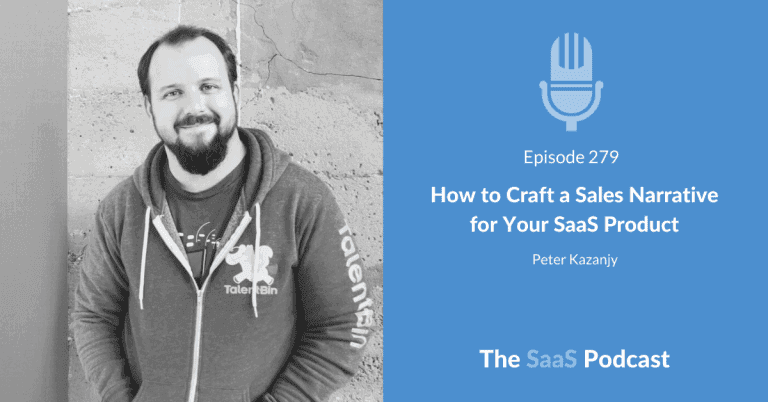
In this episode, I took to Pete Kazingy, the co founder of Atrium, a sales management tool that uses data and smart analytics to help sales leaders and managers improve team performance.
Pete is also the author of Founding the Early Stage Go To Market Sales Handbook for Early Stage Founders and other First Time Sellers.
In this episode, we talk about how to craft a sales narrative for your SaaS product.
Before you can scale your sales process, you need to ensure that there's consistency in your messaging throughout your organization.
You don't want your marketing and sales teams communicating different messaging to your prospects and customers.
And you certainly don't want sales reps pitching to a prospect when they don't understand how to deliver the right message in the right way.
A sales narrative is critical to helping everyone in your company to understand the product that you're selling and and how to tell its story to your prospects and customers.
Once you've crafted that narrative, you can eventually use it to create your sales decks, email templates, website copy, videos, advertising, and so on.
So your sales narrative is a critical foundation for your sales process.
But most companies don't understand how to tell a story about their product.
In this episode, we'll share a framework to help you develop the key elements of your sales story and put it all together into a cohesive narrative that helps you close more deals.
So I hope you enjoy it.
Pete, welcome to the show.
Guest (01:59.770)
Hello.
Hello.
Omer (02:01.850)
So for people who aren't familiar, can you just tell us a little bit about Atrium?
What does the product do?
Who is it for?
What's the main problem you guys are helping to solve?
Guest (02:12.350)
Yeah, so Atrium makes software that helps sales managers do what we like to call data driven rep management.
Essentially use use data and analytics to better manage their AES, their SDRs, their AMs and CSMs.
Using metrics, using continuously monitored analytics that is really super quick to set up out of the box.
It takes 90 seconds.
And then importantly kind of monitors those KPIs for those managers, they don't have to stare at walls of charts in order to figure out what the hell's going on.
The software just does it for them using, using math.
But it's something that's kind of the provenance of all of, all of my experience from leading sales organizations and kind of thinking about what the state of the art of sales Operational.
Excellently run sales organizations are great.
Omer (03:04.700)
So today we're going to talk about your book Founding Sales the Early stage Go to Market Handbook.
Startup sales for founders and others in first time sales roles.
So this is a conversation that's, that's relevant not just for somebody who's trying to sell, but people who are in the other parts of the organization.
Whether you're working on product design, marketing, there's a lot of relevant information in there.
So tell us a little bit about what does the book cover and why did you decide to write it?
Guest (03:37.460)
Yeah, so the book is really focused on kind of two stages but the way to kind of think about it is it's like the missing manual if you will for early Stage Go to market.
And really the reason why I wrote it was because at my last software company Talent Bin, when I started Taliban with my co founder Jason, I didn't have a background in sales.
I had previously been a product marketer and a product manager in enterprise, like large enterprise software organizations.
And so I didn't really know anything about early stage go to market.
And so when I was trying to figure that out at Talent Bin, I had kind of like looked for a book that might be available that would answer these questions because that's kind of how I approached them.
Like oh, I'll just read the book on it.
And I was kind of surprised that there wasn't really a book on it.
This is back in like 2011, 2012.
Most of the sales literature was more for people who are already sellers, people already sales managers.
There of course was Aaron Ross's predictable revenue and what have you, but there really wasn't any.
There was like no real estate sales for dummies if you will.
So we ended up kind of figuring it out over time with the help of a bunch of kind of like other founders who were more senior had kind of been through it themselves.
We were invested in my first round capital and so they really facilitate a lot of interaction amongst their portfolio.
But it ended up being like a lot harder than it really should have been.
And so after we sold the company to Monster in 2014, it seemed like there was an opportunity to kind of take down the learnings from the prior four or five years and just write it down such that people who were in a very similar situation, you know, would have a roadmap for themselves as opposed to like trying to have to make it up as they, as they go along or engage in a number of other unfortunate anti patterns that end up Kind of killing companies.
Omer (05:31.800)
Great.
And then can you just explain why the book is relevant not just for sales folks and you know, why other people or disciplines in an organization can also get value from this?
Yeah.
Guest (05:44.360)
So the way to think about it is the primary user of the book is a person who does not have early stage selling experience.
So who could that be?
It's called founding sales because the primary user for it is a founder.
But if you think about who founders were, kind of like founders come from, if you will, usually they're like former product managers, former engineers, former designers, what have you.
And so it's been actually really fascinating to see as we have a Shopify store up and we see people, a couple dozen books get bought a day and you see people like, we see the titles of people who are purchasing and it's very popular with engineers and product managers and founders and investors and what have you.
So that's kind of the primary audience because if you think about it, most of these folks like you don't.
Sales is largely learned through apprenticeship, if you will.
So the way that sales has historically been learned, as you graduate from college, you become, you know, a junior sdr.
You do that for a couple of years, you transition to being an SMB account executive, you get trained on the job, et cetera, et cetera, et cetera.
Right.
Whereas if you think about like where founders come from, it's like, you know, you start as a product manager or an engineer or consultant or you know, fill in the blank.
Right.
And you do that for, you know, 3, 4, 5, 6, 8, 10, whatever years.
And then if you go and start a company, it's now it's not like, oh well, I have to learn how to sell.
And so it's really, really focused for that audience.
Now that being said, I've actually been surprised by the reception from salespeople and sales leaders who are coming from non startup situations as well.
So people who maybe we're a seller at like a Salesforce or you know, a sales leader at like an Oracle or SuccessFactors or something like that.
Because obviously early stage go to market is a very different ball of wax than kind of just being part of the machine and one of those scaled sales organizations.
But it's really for the book is really for anybody who doesn't have that direct selling experience in the 0 to 1 or $2 million of arrangement time frame.
Omer (07:57.170)
Great.
So today we're going to talk about building a narrative or a story.
And this is kind of like the foundational product marketing stuff.
And when you're in the early stages and you're going out and selling a product, from what I've seen, a lot of founders, especially if they don't have experience with sales, they sort of tend to avoid it.
Guest (08:26.410)
Right.
Omer (08:26.970)
And so there's this tendency to maybe think about, this is going to be more of an inbound marketing model, and I'm going to have landing pages and I'm going to drive people there.
And you might be able to do that eventually.
But in the early days, that's really hard because you don't know what you don't know.
And it's really hard to put something on a web page which is going to convince somebody about that.
And I think that there is this process you need to go through.
You do need to go and talk to customers, do some prospecting, learn to pitch your product, hear what customers are saying, how they're responding.
But a lot of that, it doesn't work unless you've done the foundational stuff and built this narrative.
And as you sort of explain in the book, this is what, once you get this bit right, this is what really feeds into what type of slides you create in the pitch deck, or how you write your email template for outreach, or how you talk to customers.
So I thought this would be a good conversation for us to have and just to say, let's.
Let's kind of walk through and talk about what, what those sort of foundational pieces are in terms of building that narrative.
Guest (09:35.260)
Yep.
Omer (09:35.780)
And hopefully people can listen to this and kind of walk away with some actionable insights that they can hopefully apply for sure.
To get started and then go and read the book when you want to do.
Guest (09:47.890)
Yeah, there we go.
Omer (09:49.730)
That's the goal.
Guest (09:51.010)
Good goal.
Good goal.
Omer (09:52.850)
All right, so let's start from the top.
Tell us about, from your perspective.
Why is this important?
What does it really mean to build a narrative or a story?
Guest (10:01.650)
Yeah, So I think this is a little bit of kind of like my product marketing background, kind of like peeking out.
I mean, I think that when you're working on new disruptive technologies, like new innovative new disruptive, kind of like new new.
Right.
So like something's new and you're.
And you're trying to convince somebody to change that user and that who may be a single user or maybe a number of Personas within an organization.
Well, they need to be able to comprehend why they need to change.
Right.
Because that kind of is like at the crux, sales is about persuading somebody to change the way that they're Doing something to do it this way over here, using your technology as opposed to the current way that they're doing it.
And of course to then pay you money in exchange for the right to do that, because of course they're going to get all this wonderful value out of it, right?
And so in order for that person to get it and be like, yeah, you know what, Omer, like, you're right, I should do that.
They need to comprehend that.
They need to.
And that the way that humans comprehend these things is through, is through narratives and like understanding what's, you know, like, okay, cool.
Yeah, you're right.
I am the person that has that problem.
That is me.
And you're right, that is a very substantially costly problem.
And, and you know what?
You're right.
The current way that I'm, I'm doing it is unsatisfactory.
And, and so that's really the crux of all of that and why, you know, oftentimes what you see in early stage companies is they'll like, rather than having a reasoned argument that kind of presents that it's more kind of like they'll just do like a demo, like, here's the product over here, is this over here, is this over here, is this, here's this feature over here versus the connecting the reason why the product exists, the reason why those features exist, tying to the pain points that an individual has or an organization has and the reason why it is worth solving those problems and how those features do that.
As you noted, everything sits on top of that.
You got to nail that story first because then you can create slides off of that that echoes that story and you can create videos for your homepage that echo that and you can create demo scripts that echo that.
And it just kind of the entire thread kind of follows along from there, which is why it's really important to get that right from the get go.
Right?
Omer (12:34.210)
Okay.
So the first step is really to identify what the problem is.
And that might seem obvious.
It's like you think, well, yeah, the problem is the thing that my product solves, right.
But I think it's going deeper than that and really understanding from the customer's perspective what are their pain points.
And then also there's some level of validation that goes on here, right?
Because you're not going to figure out those problems right away.
And maybe there's a working hypothesis in terms of these are the two or three things that I think these target customers or market is struggling with that we can do a good job solving.
So anyway, how do we start with that?
Guest (13:19.140)
Yeah.
So the interesting thing, you totally nailed it and spoken like a true former product manager on your behalf.
Because I think this actually kind of starts even before you're formulating the narrative, because you can't just pull it out of your ear and be like, here's this problem, right?
Do you have it?
And this kind of goes all the way back to.
I'm sure people who listen to your show have probably heard of Eric Reese's the Lean Startup and Steve Blank's Four Steps to the Epiphany now called the Startup Owner's Manual.
But really what this comes back to is doing good customer research and customer development interviewing early on.
And so this is something that we did at Atrium.
We actually used Michael Sippy.
So there's a really great article and First Round review called get in the Van.
Written by Michael Sippy or Written by First Round Review with Michael Sippy.
It's based on a talk he gave at a First Round Capital CEO Summit.
It's really just a framework for rigorous customer interviews for the research phase.
And we actually did this at Atrium.
We did about 100.
In early 2016, we did about 100 customer interviews, just in a very structured way, saying, hey, how do you use data in your organization to manage staff?
And then a bunch of questions that kind of cascaded from that.
So how do you do this?
What's unsatisfactory about it?
How do you solve those unsatisfactory things?
What sucks about that?
What's good about, Is there an opportunity?
And so by doing this and having dozens and dozens and dozens of these conversations, what ends up happening is you start detecting patterns.
Like, in our case, it was like, oh, yeah, we aspire to do data driven management of our AES and our SDRs.
But, like, and it's really difficult to get the data into the CRM in a way that we can report on it.
And even if we do report on it, it just turns out the managers don't really look at it because it's like a bunch of walls.
Like, it's a wall of charts.
So then bad things happen because we miss that.
So in retrospect, we can look back after the fact and be like, oh, my goodness, this guy has been underperforming from a pipeline ownership standpoint for the trailing 60 days.
But I only figured that out after the fact because I saw that he had a bookings issue.
And so as we went through this and we saw these patterns, like, okay, who are the people that have these?
Oh, it's the sales managers have this problem and then, oh, but the sales operations people also, they're responsible for building reports and dashboards, but they don't really have time to do that.
They certainly don't have time to interpret the data.
And you just start hearing these patterns again and again and again and again and you start cataloging them.
Right.
And this is where you start getting this, you know, the, like, this is where the kernels of this stuff come from.
And then you probably heard what I said in the interview structure.
It's how do you do this right now?
Because you have a, like in our case, we had a hypothesis that this was done in an unsatisfactory way.
It revealed the fact that our hypothesis was correct.
It revealed the fact, it confirmed the fact that the existing ways of solving these problems were unsatisfactory.
And then we asked questions around like, okay, well what sucks about that?
How painful is that?
What are examples of failures that have happened?
So that's kind of the first thing is like you actually have to do the work in order to identify that.
Omer (16:32.130)
Yeah, a couple of points on that.
Like you said that these sort of like themes or patterns emerge.
And that's a really important point because it's not like you have these interviews and you're like, ah, we got the answer.
And this is the thing that if we just are going to go and talk to people and they're going to be like, yes, yes, yes, where do I sign?
But it's more like you sort of start to get, okay, here are sort of like five or six things that we keep hearing over and over again.
Maybe you know, there's going to be some of them that are important enough that people will want to pay for another solution.
Maybe there are others that they're telling us is a problem, but we need to dig into deeper because maybe they just don't care about solving that problem, particular problem, as much as the other ones.
And so this, the thing is still evolving and you're still trying to make sense of what's coming out of these conversations.
And then the other thing is, I think you have to be really careful not to talk about your product at that point.
Right.
When you're having these conversations and you're just trying to understand what problems they have.
Guest (17:40.760)
Yeah, I mean in this case, this was before.
This is pre product.
Right.
We were doing just research at this point because better to understand that there actually isn't a problem there and it's well solved.
And then you solve your, you save yourself from, you save yourself from spending a bunch of engineering resources building something to solve a problem that doesn't exist, for instance.
But yes, you certainly should not be talking about your product at that point because ideally, ideally you're doing this research before the product exists because it should inform the thing that you're going to end up building.
But yes, for sure, it's about hypotheses.
And then you start converging on understanding, okay, what is the problem that like, what is the problem that this organization has?
And the problem might have be like a little bit different or like the problem might be framed differently depending on the Persona internal to the organization.
So in our case, so like with Talent Bin, the problem that we were solving was technical recruiting is really hard.
We have these technical recruiters who are trying to engage with, with engineering candidates.
The problem is, is that those engineering candidates, at least this was back in 2011, had sparse LinkedIn profiles.
Like they're never applying to, they don't apply to jobs on, on job boards because it's like a very supply bound market.
If you want to go outbound to them, they're hard to identify on LinkedIn because they have sparse LinkedIn profiles.
And then even if you can identify them on LinkedIn, nobody reads their LinkedIn Inmails, especially like software engineers because they're not on LinkedIn all day long.
And so the way that organizations or recruiters would try to historically solve this is they would try to manually snip these people out on GitHub or Stack Overflow or Twitter or these other places and then try to manually find their email addresses in order to be able to engage with them.
And so it was just like a very laborious, time consuming process.
And of course the, and it was so it was really unsatisfactory.
And so that was like the problem.
And the recruiter had that problem.
And it was really like the technical recruiter had that problem is their day to day or the technical sourcer had that problem, their manager had that problem.
Like they didn't actually have that specific problem because they weren't the one who was doing that work, but they had a different problem, which is the VP of engineering is expecting them to deliver five engineers this quarter.
And if they're not going to hit their hiring goals, if they weren't able to scalably engage with these candidates.
And so that would be an example of a problem that we had detected after having talked to a bunch of these recruiters when we were doing our research.
Omer (20:14.620)
Great.
And then the second part of this is so we've sort of defined what is the problem.
The second part is like, which you made the point in the book is just as important is like who has the problem Initially when we're thinking about this, it's like we think of it like the company has this problem, but then you need to sort of figure out who specifically who's your, you know, your ideal customer profile or your target Persona.
And I think that becomes even harder as the bigger the organization gets.
Right, so how do we figure that out?
Guest (20:49.770)
Yeah, so oftentimes there's like multiple people who are responsible for solving a problem in kind of a different ways.
We kind of just talked about that a little bit with Talent Bin.
But really what it comes down to is like who's the person that's measured on this, whose success is measured on this result.
Right.
So let's use Atrium as an example.
Atrium kind of has like two primary human Personas and then one like secondary human Persona.
They care about what we do.
Their first primary Persona is a sales manager and SDR manager because they're responsible for hitting bookings goals and hitting pipeline creation goals in the, in the form of the SDRs.
And so they have the challenge of they're responsible for six AES or eight AES or six SDRs or eight SDRs or 10 SDRs or what have you.
And so monitoring those, those folks performance ends up being very challenging for them.
And then bad things happen when, when somebody doesn't hit their goals because something needed to happen 30 days ago, 60 days ago, 90 days ago, in order to course correct, like they needed to be managed in some sort of capacity.
And so that sales manager is the person who has that pain point because they're the ones who like, they're the ones who's like.
But it's going to be roasted if their SDRs don't produce enough opportunities or if their AES don't hit those goals.
So that's the first Persona.
But then there's a second Persona who's an internal vendor at that organization who's responsible for solving that problem.
So like the manager has the pain point of like, yeah, it's really important for me to know if an AE is tracking poorly, an SDR is tracking poorly.
So I can jump on that fire while it's still like a little fire versus like a raging fire.
But then there's a second Persona who is responsible for solving that for the sales manager or the SDR manager.
And that's the sales operations.
Usually the sales operations function.
And so they have the problem as well.
But it's a little bit in a cast, in a different way where they're responsible for providing all sorts of process and tooling and what have you to the sales organization.
And so the notion of performance instrumentation and analytics for the purposes of data driven management is part of their portfolio.
But oftentimes they are not able to achieve that.
Their ability to deliver and solve that internally is impinged by all the different priorities that they have, the challenges associated with the tool stack that they have, and so on and so forth.
So like the problem is still the same, which is like the root problem is still the same, which is we want to make sure that our AES are doing, you know, doing sufficient quantity and quality of selling activity.
The same with our SDRs, but the two person, there's a little bit of different Personas there and then of course then there's the like the leader, the sales leader who they don't have this like specific day to day pain point of understanding what's going on with their reps and how they're, how they're performing.
But ultimately like they own the big number, right?
Like they need to hit the overall bookings goal.
And so they know if they have four managers that leader can't manage those reps individually.
Right?
Like he or she can't have their finger on the pulse of you know, four times eight account executives.
But what that leader knows is that if, if he or she can help those managers do a better job of using data and analytics in order to manage their team well, then good results will happen for that leader.
So, so like the important thing is to kind of figure out what the value chain is in the organization.
And in our case we have what's, what's referred oftentimes to like a two legged sale.
So we have an internal stakeholder so like AE managers, SDR managers and sales leadership and then we have an internal vendor who is involved in this as well.
Like Optimizely or like Amplitude has the same sort of situation where like LaunchDarkly is a great example where they make feature flagging software.
Product management really likes that.
You know, it's something that product managers love because they can turn on off features and they can, it helps them with like more rapid delivery, et cetera, et cetera.
But then engineering is also involved in the decision making because it's the feature flags have to be embedded in production like production delivery, et cetera, et cetera.
In other organizations you don't necessarily have or sorry with other products sometimes you don't have a two legged, two legged sale.
In the case of Talent Bin, literally we're just selling to a recruiter and then potentially the recruiter's recruiter's boss.
So it kind of depends.
Omer (25:17.840)
Now the target customer or the person who has the problem isn't necessarily always the same person who's the decision maker.
Guest (25:29.600)
Yeah.
Omer (25:30.530)
And so you might be in a situation where you've identified somebody who is really struggling with the problem and they would love to have a solution, but maybe you know, based on the, the price point of your product, they're not the right person to make that decision, that buying decision, it's somebody else.
But that somebody else may not be experiencing that problem or the pain from that problem as much.
Guest (25:56.050)
Yeah.
Omer (25:56.490)
So one like how important is it to figure both the sort of the user and the decision maker early on in the process and any thoughts on how to sort of think about targeting a decision maker who maybe is a further away from actually experiencing the day to day pains here?
Guest (26:19.100)
Yeah, and so I think that that's just sometimes what you have is you have messages on a per Persona basis.
Right.
Or narratives on a per Persona basis.
You kind of heard me talking about that a little bit in the Atrium example where there's a couple of ways you can kind of skin that cat one, one thing that you can potentially do is structure your product in such a way that it can be transacted at a lower price point.
Right.
This is one of the powerful things about SaaS delivery and kind of self serve or even like you know, easy in companies like New Relic or Datadog or what have you started a low enough price point where the person who's like the, who actually has the problem can say yeah, you know what, this is only like 299amonth.
I can put it on a credit card and I can, I can try this out.
So that's one way to solve this.
Another way to solve this is that if you need to curry budgetary resources in order to, in order to transact then you just need to have a message for that.
You know, that, that secondary audience, right.
They like the, the primary audience is convinced, they're excited about it, they've seen value, they want to make this happen.
And so we need to have the arguments in place for that secondary audience.
So in the case of Atrium, that's like sales leadership for example, where it's like.
Yeah, and we run into this sometimes where somebody who maybe it's sales leadership or maybe it's even like leadership Leadership, like the CEO or what have you.
It was a small organization and they might say something like, wait a minute, don't we have like tableau for this?
Or what have you?
And so for somebody who's not close to the day to day, you need to be able to have a message to say like, yeah, here's the reason why this is important for the stakeholder who is excited about this, and here are the negative consequences associated with the fact that if this isn't solved and here's the reason why the existing solutions are unsatisfactory but presented to them in a way that because they're more distant from it, they can at least comprehend it.
They can comprehend it in a way that makes sense for them and allows the release of those budgetary resources for the person, your primary stakeholder.
Essentially, the ability to sell internally, if you will, is important there.
Yeah.
Omer (28:35.870)
And that leads us onto the next point, which is understanding the costs associated with the problem.
And ultimately, I think this is about understanding what sort of value they're getting or not getting today.
What's the impact to the organization.
So tell us a little bit about that.
Like how do we sort of unpack this and try to figure out the costs associated with that problem?
Guest (29:06.150)
Yeah, so I think there's kind of two ways of doing that.
There's like hard ROI and then there's kind of like more soft roi.
And really the reason why organizations invest in technology is in order to make their businesses more efficient and either reduce costs or make more money.
And so what you want to do is connect your solution to exactly that in some sort of way and quantify that.
And so that could be in the case of atrium.
Right.
There's kind of statistics around these things.
You could say, hey, look, you know, this number, this proportion of new hires ultimately end up not having success and like have failed ramps because they were insufficiently instrumented in order to intervene.
Right.
And that's, you know, that that creates this, this opportunity cost of a rep not hitting their number, not ramping up.
You know, there's like time cost arguments that can be made.
Hey, this person who is the internal resource, who, the person is this internal resource who's responsible for resolving this problem, cost this amount of money.
And this automates this amount of money on a hourly basis.
And this is how the automation of this part of their job removes this amount of labor cost here.
And hence, this is the money that you're going to be ending up saving because that person can redirect their labor to something else.
Or alternatively, you don't have to hire like as you're growing, you don't have to hire another one of those resources as quickly because the same resource that you have, that same single resource that you have is now twice as efficient or what have you.
So just to whatever extent you can kind of crystallize that and connect it to, connected to value is important.
And then there can be like, like the harder the roi the better, right?
So like more, more revenue, reduced cost.
Then there's of course like, you know, softer ROI things like, let's use LaunchDarkly as an example because we were talking about them earlier from a hard ROI standpoint, like the ability to have feature flags that, that keep you from releasing a bug onto production or allow you to roll back really quickly by just turning a feature on or off or what have you versus having to do like a rollback or what have you.
That could be extraordinarily important if you're an E commerce provider, right?
Because whatever, the amount of downtime is money for you.
So that's like a very, very clear hard ROI where you say like this is the amount of downtime that organizations typically have based on their, you know, based on their size from, from bugs that get out on production or, or what have you.
Or this is the amount of, if you're going to build this feature flagging internally, this is the amount of engineering costs that it would take for you to do that and then, you know, and then do care and feeding of that over time.
Then there's the soft roi.
This allows you to be more agile, allows you to ship things faster.
Kind of hard, hard to quantify those sort of things.
But those oftentimes can be really great emotional arguments to folks where they can understand, like use HREM as an example.
A lot of sales, sales managers don't get into sales management necessarily to be spending all their time doing statistics.
They like to do it because they like to coach people.
They want to improve reps, they want to make people more effective.
And so the idea to them of being able to like be an amazing manager and really help people be the best that they can be is something that's very appealing to them.
That's maybe not as persuasive to the CFO as, yeah, look, this is going to raise your win rate by, because the managers are managing their reps better and the reps are managing their pipelines better.
As a result, your win rate is going to go up five points from 15 to 20 and that's going to represent this much more bookings.
The CFO loves that argument.
The manager might like the more the argument of, hey, you don't have to be a pain in the ass to sales ops anymore and like constantly asking them for reports and you'll be an amazing, you know, you'll be able to be an amazing data driven manager, but you want to have like a handful of these, these various proof points, both kind of like the left brain ones and the right brain ones.
Omer (33:28.170)
Yeah.
And I think to understand that you really need to, I think it leads on to the next point is you, you really need to understand like how, how are they solving the problem today and where is that current solution falling short?
So as you dig into that, you're going to be able to understand, okay, what is the cost associated with how they're trying to solve this today?
Or if they're not even bothering to try and solve it, do they really care that much about this problem and maybe this isn't the right thing to be focusing on with your product.
Guest (34:04.160)
Yeah.
So how they currently solve it usually kind of buckets into a couple of different, like a couple different buckets.
Like one, they're not solving it right now, two, they're solving it via like a process, an internal process, three, they're solving it via like a service provider or four, they already have an existing product that's in place.
And so ideally, when you did your customer research, you understood like you figured out that this actually is a broad problem.
And in organizations that don't have a solution in place, it's not because they don't have the problem, it's because they haven't gotten around to solving it or they didn't perceive the problem necessarily.
To use atrium as an example.
And this kind of goes to the crux of discovery questions.
When you're selling, you could imagine saying, hey, how do you currently track precursor KPIs like leading indicators for your reps who are ramping?
And the, the customer might respond to that.
Oh, we don't, oh, how do you track ramp success?
Well, we look at when they close their first deal or when they, when they hit full productivity on bookings.
Ah, got it.
Well, what about like, how do you know that you're tracking.
They're tracking towards that success.
Are you just going to wait until month six?
Oh, right.
And so that would be an example of a situation where the person did have the problem and they're not solving it right now, but they maybe just weren't aware of it.
You might have a situation where they don't have a solution in place because they don't have that problem necessarily.
But then probably ideally you are targeting those prospects, which I kind of talk about in the prospecting chapter of founding sales.
Kind of like, you know, how can you target the folks that are going to be most resonant?
So, you know, so that's like a no solution situation where you want to understand like, what, what is the opportunity cost of not solving this?
Usually when something's being solved by an existing process internally, maybe to use the Atrium example again, you might have a situation where someone's like, oh, let's talk about ramping again.
Oh, you said earlier that you have eight AES that just started.
How are you tracking their ramp to success?
Oh, well, I have a junior sales operations person and what he does is once a month he goes and pulls all this data and puts it into a bunch of Google sheets and then he goes and he reviews it with all those, all those managers.
Oh, okay, cool.
So like how long do you think that takes?
It probably takes him about like two days to do that all in.
And then the meetings with the managers are another two days.
So let's say like it's a week all in.
Okay.
Wow.
So that kind of sounds like a lot of time and, and, and pain in the butt.
What, like if he wasn't doing that, if that was automated, what would, what would you be having him do?
Oh my gosh.
Well, you know, instead of me having to do deal desk or me having to do commissions, I would have him do that.
Okay, got it.
Right.
So like that would be an example of how you would understand how an existing solution by a process might be solved.
And then there's kind of other examples as well.
Omer (37:10.070)
And you sort of also mentioned like, if they're already using a product to solve the solution or solve the problem.
Sorry.
But I think you also said something about like, it's also important to understand that that product might not actually be a competitor to you.
There may still be an opportunity.
Can you explain that a little bit more?
Guest (37:37.100)
Yeah, for sure.
I mean, yeah, the notion of competitor is kind of tough because things are like, things overlap, if you will.
Right.
And so use like Atrium as a, as an example there.
Atrium.
You know, oftentimes organizations try to solve the problem of data driven rep management via, you know, maybe by salesforce reporting or business intelligence or what have you.
These are like, not actually direct competitors with us.
And so what they are is they're just like alternative solutions that are inferior in some sort of regard.
And so what the important thing there is to very crisply delineate the difference between how your solution goes about this versus how their solution goes about this and kind of the daylight between them.
So maybe in this example using, again using Atrium, you might say, hey, so how do you, how do you do, you know, data driven team management and rep management right now for your sales managers and the response that might be like, well, we have a bunch of Salesforce dashboards.
Cool.
Well, how's that?
How does that go?
Well, not so great.
Nobody ever looks at them.
And then we have some managers who want to have ask incremental questions, but they're not actually very good at Salesforce reporting.
So what ends up happening is they ask me, they asked my sales operations person for help on that.
He's really busy, so he can't help with that and just bad things happen.
Oh, okay, got it.
Right.
So that would be an example of like an inferior, an inferior solution using existing technology that isn't necessarily like a specific heads up competitor.
Omer (39:18.540)
Awesome.
Okay, great.
So we've sort of covered the importance of doing customer interviews, how that helps you to really start to understand the different themes or get more clarity around exactly which problem matters most to your target customers that your product can solve.
Zeroing in on your target customers within the organization and understanding who that person is or who the different roles are and whether somebody is user of a product or a decision maker and how we sort of navigate that and then really trying to understand how they're solving the problem today.
Both to build a deeper insight of the opportunity for us, but also to figure out, okay, what does this actually mean in terms of cost and potential?
Could be time, money, et cetera, that we can demonstrate some better, clearer ROI with, with our product.
So I know there's a lot more to unpack there and we've just talked a little bit about sort of, you know, small section of the book, but now that we have this information and we sort of started out saying, look, this is really about building this narrative or a story that you can use in your sales materials.
Maybe we could just sort of, sort of wrap this up by giving people an example of, okay, if you had all of this information, how would you then think about structuring a cold outreach email in a way that sort of leverages all this work that you've done?
Guest (41:07.130)
Yeah, well, the one last thing that we didn't then touch on just really quickly, of course, like we teed everything up and then the last thing is like, hey, how does this new solution work and why is it, why is it better?
And we won't get into that, but like, and it's just essentially in contrast to everything else that you, that we had already talked about before.
And so that's the entire arc of it's like, hey, here's these problems, here's why it's unset.
Like, here's this problem, here's who has it, here's what's unsatisfactory about and the magnitude of that problem.
And then, by the way, here's this magical new thing that solves this in a unique way that is like, newly enabled and is way better because of reason A, reason B and reason C. And so when you, when you have that entire arc, that can then be delivered a variety of ways.
It could be delivered in a cold email, for instance, where that might be something along the lines of, like, let's say we, we went and identified a set of a couple hundred technical recruiters.
Let's say this is back, like early 20, 2011 or 2012, and we wanted to go do cold outreach to a bunch of technical recruiters.
It might be something along the lines of, hey, I saw that you're a technical recruiter at so and so.
I imagine that it's really difficult to get engineering attention because it's such a hot market and, you know, they have a tendency to hide their LinkedIn profiles.
I don't know if you're solving that by manually digging into GitHub, like trying to go through GitHub profiles or stack Overflow and then hunt down email addresses, but I imagine it's like a really big pain in the rear and hard for you and also probably hard for your leadership, who has the VP of Engineering breathing down everybody's neck.
Well, the cool thing is that here at Talent Bin, we do this magical thing where we've actually crawled the entirety of GitHub and Stack Overflow and a couple dozen other sites in order to create profiles of these searchable profiles of these engineers.
So you can search for engineers that match, that have the skills that you're looking for.
And then we've actually already detected all their email addresses.
We've also called that as well and appended to those profiles.
And the result is that you can send, you can find the people you're looking for, you can engage them directly by email in an automated fashion, and it saves 95% of the time that would.
It would require in order to do this manually.
And so the result associated with that is way more interviews on your calendar.
And hitting your hiring goals faster, Would you be available for 15 minute touch base?
Maybe next week?
Here's my calendar link.
So you have the entire arc right there.
That was probably a little verbose.
You probably want to cut it down and put bullets in it, etc.
But.
But the whole point there is like, that was the entirety of the arc and the thrust of the argument in like one fell swoop.
Omer (44:09.770)
Yeah.
I mean, we can kind of go back and forth in Wordsmith and kind of make the email shorter and all that stuff.
But what I liked about the way you went through that was you described the pains that they're most likely having based on the customer interviews that you've already done.
You describe it in a way which really resonates with them.
And you also are demonstrating that you understand the problem.
You're not just some random person saying, hey, you want a demo?
Want to buy my product?
But it's like, no, no, I really understand what the pain here is.
Guest (44:46.220)
Yeah.
Omer (44:46.540)
And then the way you just described the solution was it demonstrates some expertise that we have something that could solve these pains that you're experiencing.
And then I think the way you.
And then you sort of closed it with really like, and this is the outcome, this is how your life is going to be better from this.
And that I think is.
Is much more effective than probably 99% of the cold emails that I get.
Guest (45:14.700)
Yeah.
Omer (45:15.099)
Or any.
Most of us.
Guest (45:17.020)
Right, Exactly.
And, but of course, all of this kind of cascades, as you delineated at the beginning of this conversation, all of this cascades from a.
Like having gotten that narrative set up for success from the get go.
And of course, where that got set up for success from the get go is by doing thoughtful and rigorous customer research that then actually, yeah.
Put you on the right track.
Omer (45:39.790)
All right, cool.
Pete, thank you so much for coming back and joining me today.
Really great conversation.
I think, as I said, we've just unpacked just a tiny bit of what you cover in the book.
So if people want to check out the book for themselves, they can go to foundingsales.com yep.
And as you told me, the book is actually available for free online.
Yep.
If you want to buy a hard copy, you can do that as well.
Also, if people want to check out Atrium, they go to atriumhq.com and if people want to get in touch with you, what's the best way for them to do that?
Guest (46:21.520)
Folks can just find me on LinkedIn or Twitter.
I'm pretty easy to find.
I'm the only Peter Kazanji on there.
Omer (46:28.080)
We'll include the links to those profiles just in case there's another Peter out there.
All right, great.
Well, thank you so much.
Really appreciate the time.
And congratulations on getting that book out of your head.
I know it's a painful process to go through for many writers.
I don't know what it was like for you, but I think what we've just covered here, I think is a great example of it's filled with really a ton of useful information.
And I do think that it does fill a gap where in terms of early stage and people who aren't necessarily experts in sales.
So thank you, and I wish you and the team at Atrium all the best of success.
Guest (47:17.470)
Thanks so much for having me.
It was really fun.
Omer (47:20.030)
Cheers.