Omer (00:10.000)
Welcome to another episode of the SaaS Podcast.
I'm your host Omer Khan and this is the show where I interview proven founders and industry experts who share their stories, strategies and insights to help you build, launch and grow your SaaS business.
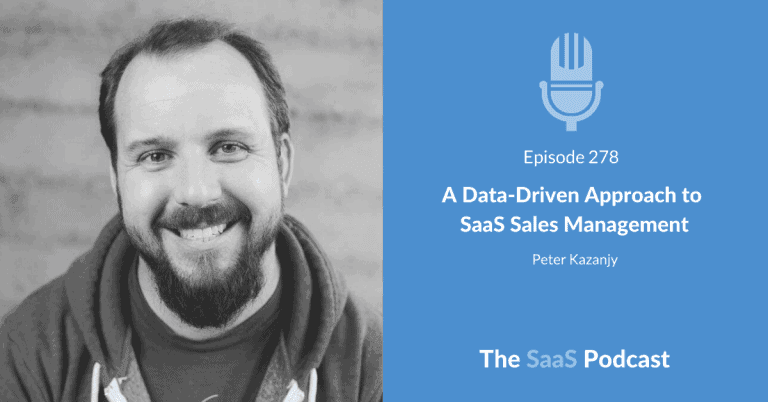
In this episode I took to Pete Kazanji, the co founder of Atrium, a sales management tool that uses data and smart analytics to help sales leaders and managers improve team performance.
He's also the author of Founding Sales, a book on startup sales for founders and other first time sellers.
And he's the founder of Modern Sales Pros, the world's largest sales operations leadership, an enablement community with over 15,000 members.
In 2009, Pete Co founded Talentbin, a talent search engine and recruiting CRM, which Monster Worldwide acquired five years later.
After the acquisition, Pete led new product sales for over 600 sales reps at Monster.
Although Pete is known as a sales thought leader, author and speaker, he doesn't come from a sales background.
He started in product marketing, became a founder, then his startup's first sales rep, and accidentally became an early stage sales leader.
In this episode we chat about how Pete learned to sell and how he's applied his product marketing and data driven mindset to managing sales teams.
He explains why dashboards don't help sales managers and what they need instead of to improve sales team performance.
So I hope you enjoy it.
Pete, welcome to the show.
Pete Kazanjy (01:54.470)
Great to be here.
Omer (01:55.830)
Do you have a quote, something that inspires or motivates you or just gets you out of bed that you can share with us?
Pete Kazanjy (02:02.470)
When I saw that, I was like, damn, a quote.
Maybe the title of a book would count here.
One of my favorite books is by Bill Walsh and the title of the book was the coach of the 49ers Stanford football team.
And the title of the book is the Score Takes Care of Itself.
And it's a terse encapsulation of this idea that when you have big goals, big monolithic goals that are made up of lots of precursors, the problem is you can't think about achieving that goal.
You can't think about winning a game, literally.
What you have to do is you have to break things down and just think about what are the precursors and what are the things that I can actually control.
Do them excellently, right, do them repeatedly and with high excellence, and if you do that, the score will take care of itself.
And so that actually kind of informs a lot about how I think about company building, sales management, sales performance management, but also just kind of like life in general.
Like Focus on the precursors.
If you do things right, the score will take care of itself.
Yeah, yeah.
Omer (03:03.580)
It's not just sales.
Pete Kazanjy (03:04.300)
Right.
Omer (03:05.100)
It's whether you're running the entire company or your life and setting goals.
And it's beautiful because it is encapsulated in five words.
Pete Kazanjy (03:14.600)
I know, right?
It's a good book too, but the title kind of gets you most of the thesis.
Omer (03:21.480)
It's like, I wish I could come up with stuff like that.
When you look back and you're like, oh, I could have done that.
All right, so for people who aren't familiar, tell us about Atrium.
What does the product do?
Who is it for, and what's the main problem you're helping to solve?
Pete Kazanjy (03:36.740)
Yeah.
So Atrium makes software that helps sales managers, sales leaders and sales operations folks do what we like to refer to as data driven team management.
Essentially bring data and analytics into the tactical day to day management of SDRs, AES, AM, CSMS.
And essentially what the software does is it instruments the kind of the meat and potatoes, the core KPIs, that are important for SDRs, AES, AM, CSMs, IT instruments those KPIs, and importantly monitors them as well.
Kind of the way that we all would do if we were trying to stare at a bunch of graphs, but it turns out that humans are really bad at staring at a bunch of graphs and we don't like to do it.
Computers are really good at that.
And so as a result, if you can have computers paying attention to these metrics for you and giving you the answers, managers can spend more of their time coaching and managing and fixing problems as opposed to trying to search them out.
Omer (04:32.800)
Great.
Before we get into how you came up with the idea or how you and your founders came up with the idea, let's talk a little bit about your background.
Pete Kazanjy (04:42.710)
Sure.
Omer (04:43.270)
I think that's, that's kind of relevant and important here.
Yeah.
So give us a kind of a quick overview of that.
Pete Kazanjy (04:49.590)
Yeah, for sure.
So my background is actually a little, little funny.
Right.
Because, you know, I'm well known in the software industry in the SaaS community as a, as a sales, you know, sales thought leaders, author, speaker, et cetera.
But I actually don't have a background in sales historically.
I started my career in product marketing and product management at a company called VMware way back in the day.
And so when I, when I started my last software company, Talent Bin, really had this kind of recognition that.
So Talent Bin was a recruiting software company that was a pivot out of a prior company.
And so we pivoted from a B2C idea to a B2B idea, which essentially was just like LinkedIn Recruiter for the entire Internet talent search and kind of like lightweight talent marketing automation.
And so what we realized is somebody had to sell it or else the company would go out of business.
And given the fact that the company was like six people at the time, it's like my co founder who's led our product efforts and probably like five engineers is like, all right, cool.
Well like you're the only one who like, your job is to sell this.
And so what I did was I was our first sales rep, our first sales manager, and then eventually a sales leader.
And so through that process really kind of came to derive my philosophy on modern sales management, which then when the company was acquired by Monster worldwide in, in 2014, I kind of brought to Monster, where I went from running a 20 person sales organization to Talent.
Then I was responsible for new product sales at a thousand person sales organization and Monster.
And so for folks who are probably familiar with Monster or maybe not familiar with Monster because it eventually got acquired by, by Ronstadt as kind of a legacy, kind of declining prior, kind of like hegemon.
Monster was, you know, a very old school sales organization that really struggled with data driven sales management.
And I kind of struggled with their struggles associated with data driven sales manager because I was coming from my experience at Talent where I was like, I got this whole place tricked out.
I got like, everything's instrumented.
I know what everyone's like.
Nothing surprises us.
This is just a factory that we have completely, you know, completely tricked out and instrumented.
And what I kind of came to realize was that the way that we were running the organization at Talent was kind of like in the future, if you will.
And that it was very challenging for most organizations to use data to manage the day to day.
And that seemed like there was a market opportunity making that way easier.
Omer (07:17.510)
What was the main reason why you took on sales to start with?
I mean, I know somebody needed to go out and sell, but why you?
And how did you go about learning?
Because this was like something pretty new to you, right?
Pete Kazanjy (07:34.710)
Yeah, for sure.
So probably a really big contributor to that was we were a portfolio company of the investors, First Round Capital, which I'm sure you and probably your audience is very familiar with.
And so First Round Capital, they have an internal kind of like stack overflow, if you will, like a community question and answer community.
And so when we first started trying to figure out how we were going to take this talent then thing to market.
We had done our customer development, we had done interviews with recruiters and so on and so forth in order to figure out what the pain points were and then kind of form some hypotheses around fitting technology in order to solve those.
And then so we're at this kind of juncture, it's like, okay, well now we need to start selling this thing and like, you know, asking for money for it in exchange for the value that it delivers.
And so when I, when I started doing that research and there were a couple of things.
One was, you know, ask folks like, well, what's the right way of going about this?
And some.
So some other kind of more senior founders in the first round capital portfolio were very helpful there.
So like Angus Davis at the time, he's now a general partner at Foundation Capital.
He was running Upserve, or I think it was called Swipely back in the time.
Sean Black, who was one of the heads of sales at Trulia, way back in the day, he was running a company called Crunched.
And their recommendation was that it was important to kind of sell initially yourself.
The other thing too was that we had a board member, a gentleman named Paul Lee.
He's an investor.
He was an investor at Light Bank.
He now runs a fund called Builders BC I think is the name of it in Chicago.
He's a great guy.
And we were having this board meeting where we were talking about like hiring a head of sales.
And this is a little bit after I had like come my initial reps and Paul kind of, and we were talking about where we're going to potentially hire a sales leader from.
We only had two AES at the time.
And Paul kind of like took a step back and he's like, why don't you just keep doing this?
Because you're doing a good job at it.
And it seems like a high risk proposition to hand off like change horses in the middle of the river.
And we're like, okay, fair point, fair point.
Let's consider that.
And so that's kind of where that came from.
So I think, in short, the notion of a founder having to do this themselves to start kind of like was pointed in the direction of some of the existing founders who had previously done it.
Unfortunately there wasn't a lot of documentation on it.
And this is why I ended up writing the book that I wrote on.
And then similarly, after kind of initially doing that, selling the notion of at least proving it out more before you then hand it off to a professional, a Professional manager was something that we kind of converged on in board discussions.
Omer (10:10.750)
So let's talk about Atrium.
You launched the business in 2016.
Where did the idea come from?
Pete Kazanjy (10:20.190)
In short, it came from our experience at Monster.
So I had my sales organization at Taliban was very heavily instrumented.
We had eight account executives.
We knew what our win rates were, we knew how many customer facing meetings our reps should be having, weekly, monthly, how many net new demos, what the average selling price was like.
We had it all instrumented.
It was essentially a factory.
And we did that because I had gotten pretty good at Salesforce reporting and then putting those dashboards and meeting invite reminders and essentially just operationalizing everything.
And then when we got to Monster, you know, we really struggled from scaling up the sales of Talent Bin.
And it was, it was super surprising to us because we're like, well, we know what our win rates are on qualified opportunities.
We know that our AES run these opportunities well, we know like we'd run like 5,000 opportunities prior to the acquisition.
So like what's changed?
What's changed?
And so in order to answer that question, we want Mina to get into the data to kind of figure out what was going on and quickly what we, what I realized was that there just wasn't a sufficient quantity of selling activity that was, that was going on.
We were selling it the way they were previously been selling it with this notion of an acquirer who brings to bear a bunch of existing customers to sell them to you wasn't transpiring largely because like the demos weren't happening.
And so the reason why I knew this is because I was still running my own shadow CRM.
I was still running our own instance of Salesforce.
I had my own Google sheets, we had these overlay request form.
So like the Monster sales reps would come and submit a request for an overlay assistance, whatever.
And so literally we just like, okay, there's not enough, there's not enough activity happening.
And so when I brought this to the leadership, I was like, look, you know, we, we just have a deficit of new opportunities here.
Like the win rates are still fine, the ASPs are still, the average selling prices are still fine.
There was a lot of defensiveness on the part of the sales leadership.
Like, what are you talking about?
You know, it's happening, it's happening, it's happening like the selling is happening.
But then when we went and looked in the CRM, like the Monster CRM, you couldn't see anything.
There was no data.
It's like, okay, well, there's no meetings being recorded in here.
There's no opportunities being.
Oh well, yeah, they're just not getting logged in there, et cetera, et cetera.
So eventually what we did was we broke into the Exchange server, where we got access to the Exchange server in order to pull all the meeting data, and then ended up kind of massaging it in Excel and so on and so forth.
And what we ended up finding out was that there was just across the entire sales organization, there was probably about like 60% that the level of selling activity happening that was actually that they thought was happening.
Wow.
It's kind of like a big deal, right?
Like, yeah, yeah.
And so we kind of had this like aha moment.
We're like, man, you know, this is a pretty large organization right here with like a lot of sales reps. And you know, if imagine you, you have a boat that's being rowed, right?
And say you have like 10 people who are rowing the boat.
If it turns out that like all 10 people are rowing at 50% speed, like for effort, that that's going to kind of be a problem.
And so what we realized, like, okay, well, maybe there's an opportunity here.
And so what we ended up doing was after we left Monster, we did a bunch of customer development interviews in order to figure out how organizations go about this.
It's just, it was the same story again and again.
It's like, oh yeah, you know, we have to figure out the metrics that we want to track and then we have to get the data into some sort of data warehouse, into the CRM.
Then we have to build a bunch of reports and dashboards.
And then the problem is like, nobody looks at them because it's such a pain in the ass.
And like, you know, people are just spending their time like, you know, working on deals or trying to help their reps. And so what ends up happening is like people spend all this time and energy creating visualizations that nobody actually ends up consuming.
Even if people do try to look at them, it's just kind of like a, a spray of spaghetti across the screen.
They're trying to figure out signal from all that noise.
And so we had this hypothesis that if you could build software, they could just essentially do statistical analysis and anomaly detection on these things in order to say, hey, watch out.
This rep right here, he's got half as many customer facing meetings as the other reps who are like him this month.
That seems problematic.
Like, it's not ML, it's not like AI or whatever.
It's just statistics, but it's the sort of statistics that an individual manager doesn't do because they're so busy doing it.
Or like, hey, you know what, look, this SDR right here, his, his opportunity creation is declining over time as compared to his prior performance.
What's going on there?
Right?
And then the converse too.
Hey, you know, this, this rep right here has a dramatically higher average selling price than everybody else on the team.
Even though she works, you know, she's in the same segment as them, she works the same ops.
What's the secret to her success?
Like, maybe we should investigate there because then if we could generalize that to everybody else, if we get everybody else's average selling price 25% up, well, guess what?
Everyone's happy.
So that was the initial kind of thesis.
And then we kind of spent second half of 2016 and 2017 building in an alpha and then really started taking it to market in 2018 and validating that the, that the product was, was solving these problems.
Omer (15:29.250)
So what products does Atrium integrate with now?
You're not still hacking some exchange server or anything, right?
Pete Kazanjy (15:38.930)
No, no, no, no, no.
Yeah.
No, precisely.
Yeah.
I mean, this is why, unfortunately, for good or for bad.
And it was, it's funny because I was just reading something about like doordash just went public and you're reading the initial experiments that they did around like they just put up a landing page and like people would order like with like four PDFs of, of menus.
People would order from them and then they would like go off to the restaurant and like order it for them and like deliver it.
Unfortunately, we didn't have something that could be like man behind the curtain so easily.
Largely because in order to have good data driven management success, like you got to know what metrics are important to track.
It turns out that like the same metrics that apply to this, the AES over in this organization apply to the EAs.
In this organization.
It's bookings, wins, win rate, ASP deal, cycle, opportunities, pipeline, new opportunities, new pipeline, customer facing.
There's a, there's not a hundred, but there's like a couple dozen that end up mattering.
So it's not dissimilar to athletics in that regard.
Like, turns out there's a set of KPIs that you can use to describe a basketball player or a baseball player.
Right?
Like, you know, and maybe the metrics for a point guard are going to be different than the metrics for a center, but they're all like, these are, knowable so that's the first thing.
The second thing is that you got to be able to capture the data in order to calculate those metrics.
And so by virtue of, as we discuss in the monster example, by virtue of the fact that capturing that data oftentimes can be challenging.
So you just end up with like, no data.
And you're like, well, there's no data.
So like, let's just throw our hands up in the air.
The good news is that there's APIs nowadays.
So we integrate with Salesforce for opportunity data.
There's APIs there for calendar and Calendar and email data.
The good news is Gmail has and Google Calendar have APIs.
The same is true with Office 365.
And so the way that atrium works, it takes about 90 seconds to set up.
Someone just shows up, they sign in with their CRM.
Right now, Salesforce is the only CRM that we, we support.
They sign in with that, you know, they sign in with Google Calendar.
And what we're able to do within a couple of minutes is just like pull all that data, calculate all these metrics, and essentially give them a metrics, the sort of metrics harness that normally would take like the sales operations person a couple of weeks to put together, but in our case, we're able to populate it in a matter of minutes because we already know the KPIs that matter.
The data is being pulled directly from the sources.
And then from an ongoing standpoint, the software, because computers love to do math.
Humans hate math.
Computers love to do math.
The software just continuously monitors those KPIs on behalf of the.
On behalf of managers and leaders and sales operations folks, and essentially just presents to folks like, hey, there's an issue over here you should investigate.
Hey, this rep is killing it.
And here's specifically here, specifically why.
Omer (18:21.550)
So when you first built the product, who was your target customer?
Who were you selling to or who did you want to sell the product to?
Pete Kazanjy (18:29.150)
Yeah, so I think we had to.
We had to figure that out initially and figure out what job exactly we were.
We were doing.
And what we eventually converged on is the organizations that we are really, really great for is organizations that they have a repeatable sales motion, right?
Like, they're not trying to figure out what their sales motion is, but instead they know what they have a repeatable sales motion.
They have a handful.
They have, you know, reps that are repeatedly selling.
And now what they need to do is they need to instrument to make sure that those reps are selling successfully.
And Then as they bring new reps on, they need to make sure that those folks are ramping in a band and being successful.
And so what those organizations, we, we have these, this internal nomenclature of Tier 1, Tier 2, Tier 3 and Tier 4.
Tier 1 organizations are those who don't have any sales operations in place.
Usually what that means is that there's less than 10 account executives.
Usually those organizations, they're not necessarily an amazing fit for Atrium because oftentimes they actually don't have a repeatable sales motion.
When an organization actually gets to the point where they're starting to add a sales operations person, it's usually like tier two.
That's when they're like, okay, look, it's time for us to start system.
Like we know what the repeatable sales motion looks like.
We have an idea of how many first meetings our rep should be having a week or month.
We know how many opportunities they should be managing.
We know we have a sense of what the win rates are.
Maybe you haven't calculated them specifically in those situations.
That's where Atrium is extremely helpful because they're like, you know what, we could go and build all this stuff or we could just flip on a switch and have it done for us.
And that way we can spend our time managing instead of, instead of building this stuff.
And then the next tier of organization called Tier 3 is where there's like a handful of sales operations people.
And so in those organizations that's usually like, you know, 25 to like 100, 150 sales reps. Usually in those organizations there is some dashboarding in place or maybe some bi.
But the problem is that the non technical user, so sales managers, SDR managers, they struggle to consume dashboarding and reporting largely just because they're not like, like math is not part of their life necessarily.
And it's, it's not because like you know, they're bad people or whatever.
It's just that like, you know, day to day, you're, you're firefighting with SDRs or with AES or what have you.
And so who's got time to go look at a dashboard populated with like 30 tiles of different reports and what have you.
And so what we, in those organizations, Atrium ends up being very helpful because it's essentially like software that brings data into the specific management cadence.
Their weekly meetings, their one on ones, their pipeline reviews, etc.
Whereas if you think about like Tableau or Looker or Salesforce reporting or what have you, those are more kind of like horizontal reporting and analytics solutions.
That have kind of been like shoehorned into data driven management.
And so the people who are like they're great for data analysts and maybe they're great for like if you have enough sales operations people to actually consume that information and then hand the insights to managers that can be, that can be good.
But most organizations don't have that.
Which is why the next stage of organization tier four is we kind of shy away from.
Because usually those are larger organizations that maybe have a pretty robust tableau infrastructure, looker infrastructure in place.
And then unfortunately what they've done is they've run into the fact that then they spend all this time and money building this stuff and then the managers don't consume it and they're like, oh well gosh, why are the managers not consuming these dashboards?
Well, for the reasons why we discussed earlier.
All right, well let's hire a bunch of like 24 year old finance grads and we'll give one of those guys or gals to four or eight managers as a shared resource and they'll do the interpretation for them.
We just do that with software of course, but trying to engage with an organization who's already built out, who's already solved it with humans if you will, is usually a little bit more of a slog.
So we're right in those tier two, tier three area.
Omer (22:32.790)
Got it.
Okay, so you have the product ready, you effectively become the first sales rep, sales team, everything in the company.
What were some of the struggles with trying to sell the product in the early days and what did you learn from that?
How did you change the way that you were selling?
Pete Kazanjy (22:56.080)
Yeah, in terms of struggles, I think there was an earlier pre scaling lesson and kind of challenges and there are post scaling challenges.
I think the first thing that we realized was that that kind of the crux, the job to be done, if you will, of, of atrium was really in the interpretation.
Like yes, it's a nice value proposition to say like hey yeah, just turn this on.
Takes 90 seconds, you'll have all these KPIs that are pre baked for you.
Like those are really great value propositions for those tier one and tier two organizations that maybe don't have any reporting or dashboarding in place for their rep performance analysis.
But that's kind of like a one time value proposition.
I think what we came to realize is the real struggle was with the sales managers and the SDR managers who are in, you know, they're in the trenches day to day and making it really easy for them to be able to bring data to an analytics, to manage your team.
And so what that means is making it simple, interpreting it, not saying, like, because this is essentially the struggle that we call it marriage counseling.
When we get into these larger organizations, it's like sales operations is like, oh, my God, we made all these dashboards.
Why don't you guys just consume it?
And the sales managers are like, oh, but like a wall of charts.
This isn't helpful to me.
Like, who's got time for that?
What am I supposed to do?
Like, go through here with a fine tooth comb, like, what's going on?
And so you get this kind of, like, frustration.
And so what we realized is that really the crux of it was that what you needed was something that was specifically for managers.
You know, an SDR manager who used to be an SDR three years ago, or an AE manager who used to be an AE like, three years ago, who just needs something that a tells them what's wrong.
Hey, Bob, Frankie is kicking ass.
Here's why.
Go give him a high five.
Susie looks like she's struggling.
The reason why we think Suzy is struggling is because her new opportunity.
I was on a call with a fairly large sales organization this morning talking to the CRO.
It's like Atrium is noting that this rep who you think is your top performer.
She is the top performer right now.
From a booking standpoint.
In the last three months, she has had no new opportunities coming into her pipe.
Everybody else on that team averages five new opportunities a month.
She has had no new opportunities coming into her pipe in the last three months.
Everything might be fine.
However, that seems like something that is worthy of investigation.
And the problem, of course, like, we hear that and we're like, well, we could just go look and find that.
It's like, no.
The problem is that in order to go look and find the problem, you actually have to look at all 40 potential problems and validate like, that's okay, that's okay, that's okay, that's okay, that's okay, that's okay.
Uh, oh, here's the problem.
And then do that for every single rep. And of course, as humans, we just don't have the time to do that.
And so that was like, the key insight was that it's for the manager, it's for the non technical user.
Yes, Tableau and looker are great for the technical users.
They're great for, like the data jockeys, et cetera, et cetera.
It is not what we like.
We don't need a drag racer just to Go to the grocery store.
We just need to go to the goddamn grocery store.
I just need a minivan, right?
And I wanted to have good mileage and I wanted to have comfy seats.
That was the first.
That's like more of a product insight, but it also, it showed up in our go to market because we had this really amazing, this thing that people could manipulate the hell out of and it was super easy to set up and people could dive deep in the data and managers were just like, this is like, who's got time for that?
And so that's when we realized, like, it has to deliver insights to them so they can be like, oh man, I need to, I need to intervene with Susie because she's going to be hosed in 90 days.
That was the first thing, the second biggest struggle that we had.
And that was like a 2017, 2018 lesson.
Omer (26:42.560)
So that one was the main thing there was like, don't just give me the data.
Just.
Just tell me what to do.
Pete Kazanjy (26:50.450)
Yeah, tell me what to do.
I mean, essentially it was just like a product management insight, right?
Like we thought we were servicing, you know, the nerds, sales operations land.
But when it turned out the people who were really unserviced and where the real kind of like market opportunity and pain was was the unserviced, like the sales manager, right?
The.
Every sales operations person there's going to be, you know, three to six sales managers and they're the ones who like, who are not being serviced.
That was the first thing.
The second big error that we had.
It's actually kind of funny because it runs counter to a lot of the writing and the speaking that I do is that I was doing founder led selling in 2018.
I had acquired maybe a dozen customers or so.
And then beginning of 2019, I hired a new rep.
It was great.
Got him to success.
He was closing deals in March and April of 2019.
And then I got a little greedy.
And what I did was, instead of what I should have done was hire another two reps, right?
And prove that actually we did have repeatability of this sales motion.
Because that's actually the crux of.
With the sales motion, what you're trying to do is like, first you try to prove that you can repeatedly sell it as a founder, then you're trying to prove that other people who are not you can repeatedly sell it.
And then once you've done that, prove that again.
They're like, okay, can we do this, like four or five reps?
All right, maybe now is the time to get a manager in here to take this off of the founder's plate.
I tried to, like, jump up two steps at once on the staircase, if you will, and Tripton slammed my face.
And so what happened was I ended up hiring a sales manager concurrently with two reps in April, May of 2019.
And so essentially what had happened there is, you know, I was trying to hand off the team to a new manager who himself, you know, was not intimate with the sales motion.
But then the problem was is that the sales motion itself was not super refined.
Like, it was repeatable as repeated by me and also by the first rep.
But it wasn't like, super, super packaged.
It wasn't super, super.
Like, we essentially skipped that step.
That second cohort of reps would have been the.
Like, the first rep is the alpha test.
The second cohort of reps is the beta test.
Right.
And so in the beta test, you take off more of the bugs and the rough edges and so on and so forth.
And.
And so what ended up happening was I hired that sales manager.
We really kind of struggled.
The existing rep kind of flatlined a little bit from a sales standpoint.
The two new reps didn't ramp as quickly to our credit atrium indicated to us that there were problems.
Oh, hey, these reps used to have.
Yeah, I know.
It's super meta.
These reps who used to have way higher win rates, and it's deteriorating.
And so the good news is that, you know, I kind of re.
Intervened three months in and was like, okay, cool.
I've been too distant on this and, like, got back in the weeds again.
And what was good about that is that then come, you know, September, October, November, December, the new reps, the first rep got back into band.
The.
The new reps got into band as well.
They ramped back up.
And so we were really humming come January and February.
And then a pandemic happened.
But, like, that was really.
The big head fake was essentially abstract, like, abstracting too early, if you will.
Which is funny, because this is one of the things that I warn about in my book, founding sales, on the book I wrote on sales for founders, and also in a lot of the speaking that I did.
But I think that we made a calculated risk.
We took a bet and ended up not working out.
But the good news was, is that because we knew it was a bet, we had our eyes on it.
We only lost three or four months versus, you know, if we had been like, all right, cool.
Like, this is the way to going about it and potentially like, you know, wasted 6 months, 9 months, 12 months.
So which it could have been better, but at least we only lost like, you know, three, four, five months.
Omer (30:38.560)
So I'm sure that that's not an uncommon situation that a lot of companies get into.
So if somebody is, is struggling with that right now, where maybe they have hired a couple of salespeople and are struggling to make that transition or are still doing founder led sales and want to move over, what are some insights, some advice you could give them to sort of think about how to get there?
And I know that, you know, we can't go into a lot of detail and I'm asking you to basically give a lot of information very, very concisely and we will cover this in more detail when we, when we do the next interview and we talk about the founding sales in the book, but just in terms of giving some people some food for thought, what would you say?
Pete Kazanjy (31:27.740)
Yeah, so we talk about this in the book.
And then also there's a presentation that I give a lot called Founder led selling and Startup Sales Maturity Stages.
And I think that the key insight there is that there are steps, right?
There are steps in a process and at each step there are things that you should be focused on and things that you should not be focused on.
And if you focus on things that are appropriate for a later step too early, you know, prematurely, kind of like I did, abstracting into a manager, you're potentially in for trouble.
So in your example there, if you have somebody who's successfully founder selling and they're struggling to transition that or like to prove that somebody else who's not them can repeatedly sell this.
Well, the important things there is like your job at that point is actually not selling anymore.
Your job is actually proving that abstraction.
For the engineers who are listening, it's like, oh, well, it runs on my machine.
It's like, well, too bad.
You got to figure out why it's not running on somebody else's machine.
Or when you go to push the product, why does it break there?
That's literally your job there, is proving that abstraction.
And it's tough because you obviously want to continue to acquire customers as an individual and you might take a revenue hit there, but the only way that you're going to get to scale is to prove that you can abstract that out.
Because the way that you scale up a sales organization is abstracting that out to many sales reps.
So the first step there is proving that that can run on something that's not your local, if you will and then in the second example, you know, handing it off to somebody else, it's again, just kind of very much focusing on that.
If there's a, if there's a struggle in handing that off to another leader, the question then is like, okay, well, is it sufficiently packaged, right?
Or does it just live in your brain?
Does it live in your brain and lives in the reps, the brains of the two reps?
Okay, well, then that's probably going to be pretty challenging for a manager to come in and understand the sales process, unless you're going to have him run a bunch of opportunities himself.
And maybe that takes three months or six months.
So have you packaged the sales motion?
Are the slides all there?
Are the processes there?
Like, do you have a.
Essentially like a prd or do you have a Google document?
Or like the different stages?
Do you have a lucid chart of like, what the decision tree in your sales process is?
Oh, if you, you don't.
Okay, well, that would probably maybe indicate why somebody would.
Would be struggling in ingesting this and then using your recipe, if you will, to then bake more of these cakes.
So those are like two things that kind of pop to mind there.
But really the important thing is, like, what stage are you at?
And like, what are the things that we needed to do at this stage in order for us to get to that, to set us up for success for the next stage?
Omer (34:11.500)
Do you find that that's an easy thing for many founders to be able to do?
Because I'm sort of just thinking this through that.
On the one hand, a lot of founders may not necessarily be comfortable with sales in the first place, and it's something that they have to, to learn, just like you did.
But then there's.
Even if you are really good at sales, there's a.
You need a different mindset to be able to actually package it up and systemize what you're doing.
And do you see that is a struggle for most people, or is it just more about once they can see how to do it, it becomes easier?
Or is it really about mindset as well?
Pete Kazanjy (34:57.600)
My thesis on this is because you can imagine two situations.
You could say, look, the initial go to market comes after initial customer, you know, customer research, customer development, initial, like lightweight customer, like customer development, MVP development.
So you kind of have two, two opportunities that you could either say, hey, the business founder is going to go and sell this because you should be extraordinarily intimate with the problem space and why you made the product decisions that you did.
Like this feature exists.
These, this set of features right here exists because of these pain points right here that we heard from all of these, you know, from all these interviews that we did.
So you're super, super, super intimate with the problem space and why the product fits, fix those problems.
But maybe you're not good at sales, right?
Like, that's the trade off there.
Or what you could do is you could hire a salesperson who does have selling experience but is not intimate with the problem space and is not intimate with how the product fits those problems.
And so early on, for those first, like the claim I advance is that for those first 10, 20, 30 customers that it is easier and higher, it is a higher probability of success for that person who is super intimate with the problem space.
And the reason why the product was developed the way that it was to learn to grow some sales muscles than it is to try to abstract that expertise into somebody, into somebody else.
That, like, that's the initial thing.
And then also, if you think about it from a product development standpoint, early on, like, the product's not going to totally fit the market and hit the mark.
And so having somebody, if the, the seller has some product acumen, you're going to say, oh, yeah, you know what?
Like, this is, this is bouncing off of these people in a bat, like in a bad way, because it's missing xyz.
Kind of like the thing I was telling you earlier about our key insight.
We're like, man, this is really not about, like, you know, being a better, you know, geek data tool for sales operations to nerd out on.
As much as we'd like to do that, this is really about the managers.
And so every time we, like, get this in front of managers, they're just like, yeah, there's too much here.
Can this just tell me the answer, right?
Like, that's a product that's.
And so like that feedback loop essentially of like incremental feature collection and like user data collection or user story collection is something that is going to be better done by the founder.
And I think that's the initial claim.
Then the next thing would be, okay, well then is it like super hard in order to learn how to do just MVP selling?
And the response to that is like, no, it's not.
It's not rocket science, right?
I mean, like, selling is not easy by any stretch of the imagination, right?
Like, you know, you have to get used to rejection.
You have to get used to having the same conversation five times a day.
It's like, you know, you have to get used to the notion that you're only going to win.
I mean, if you're winning 15% or 20% of your opportunities, like, that's pretty okay.
And that means like 80% of the time people are going to be saying no or just like ghosting you.
That's just new.
That's a new skill and a new mindset.
But it's totally learnable.
It's totally learnable.
And that's kind of the crux of like my book is that this is something that you can learn now.
You shouldn't then full time it be like, all right, cool.
Like now I'm a seller and I'm going to be a sales leader for forever, because that's actually going to be a gate on your growth of the organization.
But at least, like having minimum sufficiency selling capacity really is a superpower for founders for the reason why we discussed earlier.
Omer (38:16.320)
So tell us a little bit about the book.
Anyone who has ever tried to write a book or thought about seriously thought about writing a book knows that it's not an easy job.
It takes a lot of lot of work.
So why did you decide to do that and who is the book really intended for?
Who did you have in mind when
Pete Kazanjy (38:44.830)
you wrote this book?
Really the audience of the book is Pete in 2011, right?
So anybody who's like a founder or a product manager, like future founder, product manager, engineer, designer, consultant.
So essentially the people who turn into founders and start companies who don't have experience with sales, it's largely for them.
And the reason why I wrote it was because I'm a pretty bookish guy.
When I try to attack a problem, usually what I like to do is to see what the do, like a literature review and understand what the state of the market is or what the state of the art is.
And so when I did that in 2011 with Taliban, what I found was that there was a lot of really great information on like scaled selling.
So like challenger sale and spin selling and of course Aaron Ross's predictable revenue, what have you.
But really what most of those are about is, you know, taking the audience.
For those folks is usually existing sellers or existing sales management and say, hey, here's a better way of selling or here's a better way of sales management.
And there really wasn't kind of like a early stage sales and early stage sales Management for Dummies or early stage sales management, Early Stage Sales, the Missing Manual.
And I was kind of surprised by that because I was like, gosh, that's weird.
That this book doesn't exist.
But then as I thought more about it, it kind of made sense because we're in this era of growing startups like the explosion of B2B SaaS companies.
And so only previously you didn't really have a lot of 30 year olds or late 20s somethings or what have you saying.
All right, cool, I'm starting a company, I need to learn how to sell.
And so it made sense that we're at that moment.
And so I was like, all right, well, company had been acquired, I was kind of in the right place at the right time.
And I said to myself, well, I'm probably in a good position to write this, so I should just do that.
Omer (40:36.160)
And so the book is.
I think people go to foundingsales.com to check out the book and it's.
It's sold through Holloway.
Pete Kazanjy (40:45.960)
Right?
Omer (40:46.400)
Is that how it works?
Pete Kazanjy (40:48.080)
So the entire book is available online, so you can just go to foundingsales.com that's actually, I'm a big fan of like using hypertext for content like this because you can search it and send links around to people, et cetera.
So the book is available@foundingsales.com if you want to read it in a browser.
We also have.
You can buy the hard copy as well, just links off to a Shopify store there as well.
And then yeah, if you want to buy a Kindle copy or a PDF, Holloway has that as well.
But yeah, I mean it's a great resource.
Since we got the physical books live in September.
It's actually kind of funny because the digital book had been around for a while, but people, people love themselves some paperbacks.
So the.
We've seen some really great feedback.
I hadn't really thought about the fact that product managers and engineers would be so into it, but I have some kind of clever stuff set up.
When we get a new order, it hits clear bit to enrich the email address and kind of see what their title is and their company and so on and so forth.
And I thought it was primarily going to be founders, but I'm seeing like a ton of like product managers and engineers and designers buying the book, which in retrospect makes a lot of sense.
Like oh yeah, these are people who are going to start their own company, so makes sense or they're having to sell internally, etc.
So I'm really happy with the reception we've seen so far.
Omer (42:04.270)
Yeah.
And I think, I mean what I loved about when I came across the book was that it is how I would think about modern sales.
I don't know, I don't know how I would define that, but to me, coming from a product and a technical background, there's something about it that, that clicks.
And, you know, I think maybe that's why you're also seeing, you know, more product managers and people like that sort of connecting with.
Pete Kazanjy (42:33.090)
Sure, yeah, for sure.
I mean, it's like the docs, right?
Like, you know, it's like, you know, rtfm.
Go read the docs.
Rtfm sound like, all right, cool.
Well, like here's, here's the manual.
Let's, let's, let's read it.
Omer (42:46.090)
Yeah, good.
We're going to go into that and do a deep dive, but for now, let's wrap up and I'm going to go into the lightning round.
So I've got seven quick fire questions for you.
Are you ready to go?
Pete Kazanjy (43:01.050)
Let's do it.
All right.
Omer (43:03.290)
What's the best piece of business advice
Pete Kazanjy (43:05.010)
you've ever received as relates to startups?
I think the Steve Blank, Eric Reiss insight of, you know, startups are not small, big companies, but instead they are focused on detecting a problem in the market and fitting a solution to that.
And like, without that, you don't become a big company.
I think that's, that's one of the most impactful things, most impactful insights when I think about early stage companies.
Omer (43:33.690)
What book would you recommend to our audience and why?
Pete Kazanjy (43:36.890)
Well, aside from founding sales, one of my favorite books, so I already talked about Bill Walsh's the Score Takes Care of Itself.
Another book I really like is called the Goal.
It's an operations research and kind of like Toyota lean manufacturing book that was written in the late 80s, early 90s and it's written as a novel, but it's really about just like process optimization and essentially it encapsulates the revolution that happened in manufacturing, Lee Manufacturing, which then eventually made its way into in startups in the form of Lean Startup.
It's really entertaining because it's written as a novel.
Omer (44:12.090)
What's one attribute or characteristic in your mind of a successful founder?
Pete Kazanjy (44:16.490)
I'm sure this is the thing that everybody says, but I think grit is the most important thing because it just turns out that things take way, way, way longer than you think and you just have to get really good at all.
Right, well, here's another unpleasant thing that I have to go and do, whether it's like selling or data cleaning or what have you.
So I guess I'm just going to get to it.
Omer (44:37.620)
Yeah.
And even More great if you're the guy who's doing the selling and hearing.
No.
Every day as well, right?
Pete Kazanjy (44:44.020)
Yeah, for sure.
Omer (44:45.140)
What's one of your favorite personal productivity tools or habits?
Pete Kazanjy (44:48.659)
I'm a big fan of just really great calendar management.
I know that calendar is not like a whizzy productivity tool, but one of the things that I tell my sales reps all the time is that calendar is destiny.
So if you don't make space on the calendar to like do tasks, for instance, or if you don't, you know, if you have your sales, sales meetings and you're back to back on them, but you don't have, you don't block sufficient time after a sales meeting to execute your follow up and your, you know, your action items and you don't block sufficient time ahead of a sales meeting in order to prepare, in order to really execute the hell out of that sales meeting, you're going to have problems.
So just getting really good at calendar management and is I think know, productivity superpower.
Omer (45:28.440)
What's a new or crazy business idea you'd love to pursue if you had the extra time?
Pete Kazanjy (45:34.520)
As if I have extra time.
You know, one of the things that my co founder and I were toying around with like way back in the day after we started.
So after this conference we went to with Taliban to HR tech.
The HR tech conference.
We had this huge backlog of email when it was in Las Vegas and we needed a place to go work on email and we wanted to watch football at the same time.
So we went to Buffalo Wild Wings.
It was the first time we'd ever gone to Buffalo Wild Wings.
Like this place is amazing.
Oh my God.
Right?
I mean maybe a little like, maybe a little chintzy, like you know, maybe a little like day class day or what have you, you know, and, but, but like so great, you know, strong WI fi, good power access.
And then of course like lots of football and lots of.
We were like, man, what would this look like as like what would the upmarket version of this be?
What would like the Tesla version of this be as opposed to the Prius?
So who knows, maybe after Atrium goes public, I'll go back and I'll work on an upmarket version of Buffalo Wild Wings.
Omer (46:38.310)
There you go.
What's an interesting little fun fact about you that most people don't know?
Pete Kazanjy (46:42.870)
I think the thing that people probably don't know is that I don't have a background in sales and you know, before, before eight years ago or nine years ago when I started doing it through Talpin, because most people come to sales through they graduate from college, they become an sdr, then become an ae, they become a sales manager, sales leader, et cetera, et cetera.
And so this notion of somebody who was a product marketer, product manager, who now is a sales operations leadership expert and thought leader is kind of like, huh, interesting.
Omer (47:14.800)
What's one of your most important passions outside of your work?
Pete Kazanjy (47:17.600)
I would say, especially with the pandemic, I think I have a three year old son and it's just been really amazing to be able to spend more time with him as a result of working from home.
And so I think that that's on our Monday morning sales team means we always talk about what are the great things that you were able to do this weekend to recharge.
And I'm kind of like a broken record because I just talk about going to the park or which park we went to or, or, or what have you.
So I would, I would say that.
Omer (47:47.180)
Awesome.
Pete, thank you for joining me and sharing the story of Atrium and some of the, the lessons you've learned along the way as you've gone through this transformation into the world of sales.
Yeah.
If people want to find out more about Atrium, they can go to atriumhq.com and if they want to check out the book, go to foundingsales.com if folks want to get in touch with you, what's the best way for them to do that?
Pete Kazanjy (48:14.720)
They just find me on LinkedIn, find me on Twitter.
I'm the only Pete Kizangi in the world, as far as I can tell.
Omer (48:23.040)
Okay, we'll include links to those in the show notes just in case there's another Pete Kasangi out there.
Pete Kazanjy (48:28.720)
Yeah.
Omer (48:29.160)
All right, cool.
Thank you.
It's been a pleasure.
And we'll be chatting soon and doing a deep dive into the book.
Pete Kazanjy (48:36.220)
Wonderful.
Omer (48:36.860)
Awesome.
Take care.
All the best.