Omer (00:10.000)
Welcome to another episode of the SaaS Podcast.
I'm your host Omer Khan and this is the show where I interview proven founders and industry experts who share their stories, strategies and insights to help you build, launch and grow your SaaS business.
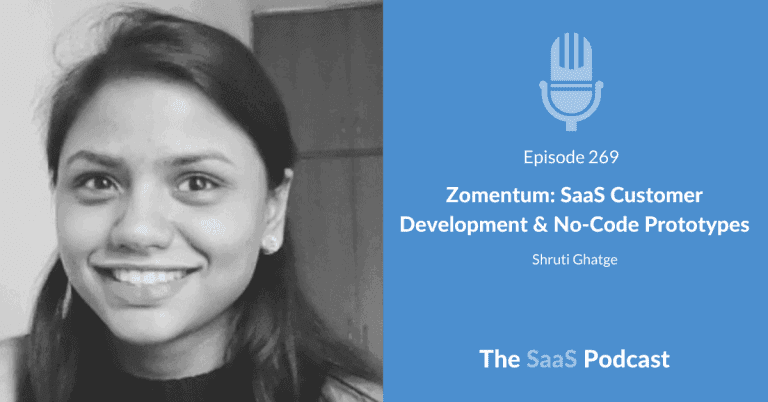
In this episode I took to Shruti Ghatgate, co founder and CEO of Zementum, an all in one sales product built for it managed service providers, or MSPs.
Shruti used to work as an investment analyst at a private equity firm.
She noticed that a lot of companies were building great products but struggled with marketing and sales.
She and her co founder Rahil identified this being an even bigger issue and opportunity with IT Managed service providers, but neither of them had any experience with that market.
So they spent six months doing customer development and resisted writing even a single line of code.
And then they spent another four months building the product.
When the product was ready, they sent out two and a half thousand cold emails to prospects and they got a zero response rate.
Not even one person replied to their email.
Both founders were discouraged and started second guessing themselves.
Maybe the problem didn't exist and they had spent the last year building a solution that no one wanted.
Their product also lacked a lot of features and was unstable and Shruti often felt embarrassed showing people the product and would worry that things were going to break during demos.
But they just kept going and trying different approaches.
Eventually they found a marketing channel that was working and started attracting some customers.
Today their business does multiple six figures in annual recurring revenue and they've just raised $4 million in funding.
There are some good lessons in this interview about doing customer development, why you shouldn't build a product too soon, how you can create a prototype without coding skills, and the importance of trusting your gut.
I hope you enjoy it.
Shruti, welcome to the show.
Shruti Ghatge (02:19.310)
Thanks so much Omer for having me.
Omer (02:21.230)
So do you have a favorite quote, something that inspires or motivates you or just gets you out of bed every day that you can share with us?
Shruti Ghatge (02:27.550)
I've read a lot of quotes, but the one that stuck is luck favors the prepared.
So then it asks you to be prepared every single morning because you never know when the luck will strike.
Omer (02:39.700)
Are you a very organized person?
Shruti Ghatge (02:42.260)
I would like to believe I am.
Omer (02:45.060)
So for people who aren't familiar with Zementum, can you just give us a quick overview of the product and the business?
So what does the product do, who is it for, and what's the main problem that you're helping to solve?
Shruti Ghatge (03:00.100)
Sure.
So let me give like a Take two steps back and talk about the market really before saying what we are solving.
So if you look at any company which is in business today, however small or big, right, they're dependent on technology in ways that was almost unprecedented a few years ago.
For example, if you looked at the 2000s, business owners expected hardware to be functioning and if something went down, they'd call an IT technician to fix the problem.
And as time changed and thanks to cloud and cloud adoption becoming more prevalent, the needs of the business owner sort of also evolved beyond hardware to say, security, backup, employee productivity, internal communication, marketing, customer management and many, many such other things.
Which also means that now they rely on so many different products that really drive their business.
But unfortunately, if you look at the small and mid sized business universe, for those guys to do implement all of these products to ensure all of that is working smoothly, to have in house dedicated IT teams is wildly expensive.
So they rely on an outsourced IT provider who can sort of do all of these things for them.
So the IT partner really establishes these deep relationships.
They ensure that all the solutions required by the SMB are kind of catered to.
They select the right products, they ensure they're integrated well, they train the employees and take care of security compliance and ensure everything's running smoothly on an ongoing basis.
This partner, 10, 20 years ago was selling, let's say five hardware boxes.
Today he sells hardware and 5,000 other SaaS products together so that it works for the small business.
This is really the change in landscape that's happened and that's all thanks to cloud.
But the poor partner here is really, really struggling and really they kind of process a $200 billion worth of services that's being solved by largely no purpose built modern tools for this kind of market transition.
And that's really what Zementum is solving.
We are giving kind of a go to market platform for the modern IT channel.
Omer (05:27.850)
So give me an example of an IT channel partner, maybe an existing customer today.
You know, who is that, what are they selling and who are they selling to?
Shruti Ghatge (05:37.210)
Let's take the example of any small business, right?
Let's.
A typical example would be a restaurant, for example, the restaurant will have like a POS system.
They have a CRM, they have emails for all of their employees, they do marketing in the restaurant itself.
They have a music system, they have WI fi, all of these things the restaurant owner needs to take care of.
But the owner in most cases would be like a chef who's interested in cooking great food and providing great service.
But all the ancillary technology is outsourced to a local IT partner.
Now these guys are small, so you will not have any branded companies here or named brands.
They would typically be like less than 50 membered organizations providing these kind of IT sales and solutions to small businesses, say in a 50 to 100 mile radius.
Omer (06:29.380)
Got it.
Okay, so before we get into the sort of how you came up with the idea for this business and got started, let's talk a little bit about your background because this was your first or this is your first startup and you're not a developer.
And also this from, certainly from what I understand of your experience, this was, this was not an industry that you had actually worked in.
And so often I have conversations with new founders who are getting into a market that they know very little about.
And there are often a lot of challenges that come with that because the understanding often is kind of pretty superficial.
They don't have a deep enough understanding or they understand the nuances enough to really be able to make good decisions.
And so I know both you and your co founder Rahel sort of didn't come from that, that industry.
So tell me a little bit about your background and then I think that will lead us into like how you guys got here or at least sort of came up with the idea, of course.
Shruti Ghatge (07:37.170)
So I spent over four years in the venture capital industry.
My latest job before starting this was at Accel.
I was part of the investment team working primarily in the B2B SaaS segment and investing majorly in cross border companies, companies that built in India but sold globally, taking advantage of the cost arbitrage.
So that's what I'd been doing at Accel.
But the interesting part of this job is you speak to lots of startups on a daily basis, plus you have lots of portfolio companies that you also work with.
So the idea really came from my time at Accel.
What we saw largely was say consumers have app stores or say marketplaces like Amazon, where they go and buy what they want.
The nature of business is super transactional in those cases.
The other end of the spectrum are enterprises which have high budgets.
There's a considered buying cycle and they almost get like a white glove service because the deal size is really large.
Somewhere in the middle of all of these are SMEs.
They are almost like customers in the kind of ticket sizes of the purchases they make.
But they are becoming more and more like enterprises in the way they want to be served.
This is really the problem we were trying to figure as to how do you create this kind of a rail system to reach SMBs in a very cost effective manner that made sense for the SMBs and also for the cloud products that we're selling to SMBs.
And that's really the thesis with which we started off to say, how do you develop distribution Systems to reach SMBs?
Omer (09:18.820)
So in your role at Excel, I'm sure you came across a lot of different ideas and potential opportunities.
What was it about this particular idea that inspired you to basically say, okay, this is a problem I'm going to go out and solve?
Shruti Ghatge (09:38.420)
So essentially this seemed like very, very large problem.
It is almost fundamental to any company to solve distribution because we know the best product never really wins.
It's the one that gets in front of most number of customers.
So every company is trying to solve a distribution problem, but if somebody came in the middle and said, hey, I solved the distribution problem, you worry about building great products and then we can figure out how to reach the right customer, that seemed like a very interesting and challenging problem to go after.
I knew that the answers would not be easy, but that's what kept us going and wanted made us want to find the right solution.
Omer (10:21.640)
And how did you go about validating the idea?
Did you start talking to IT channel partners?
Were you already getting a lot of these insights from just your role and how much of an understanding of the market and the landscape did you have when you started out?
Shruti Ghatge (10:40.360)
I'd say twofold here.
Of course, being part of Accel and having access to the Accel portfolio company network really helped so you could see from within how these companies are solving their distribution problem.
But we also went on Reddit and Facebook and tried to find out what IT partners were discussing.
We joined lots of Facebook groups.
There is a subreddit that's dedicated to these guys.
So we'd spend hours and hours trying to figure out what's the problem they're talking about.
We had to figure a low friction entry point into this market by building some solution for them, but also had to validate it if that was necessarily really large pain points so that for them to pounce on the solution that they saw.
So we did reach outs on LinkedIn, Reddit mostly and Facebook.
Some of them welcomed us to their office and some offices we just showed up at.
So yeah, one on one interviews and these guys were really nice.
Like what we realized through the process was the pain point was really high.
So they would sit down with us, help us understand the problem.
In fact they helped us articulate our solution better and the pitch just got better with time to add to all of this.
We didn't write a single line of code for first eight months of the company.
We're just building mocks on envision showing presentations and made it look like it was a real functional product.
And then they would see like, hey, this doesn't work.
This should have been this way.
Then we make that change and show it to the next customer.
So that's how the product feedback got better.
And we had feedback from more than 50, 60 potential customers before we started writing that single line of code that I spoke about.
Omer (12:25.530)
So I think it's interesting that you said that the pain point was high and they seemed pretty responsive to talk to you guys.
And I think there's a good lesson there because a lot of the times you'll find people who are in a similar situation trying to go out and talk to potential customers and those customers don't seem as excited or it's harder to get their attention and it could just be busy.
But I think there's definitely, once you go through that experience and you hit a problem or a market where you're getting people leaning in, where they're excited, they want to talk to you, that on its own is a really valuable kind of part of the validation versus, you know, you're talking about these problems and people are telling you they have them, yet they never seem to have any time or interest in really sort of sitting down and talking to you about, about it.
So I think that that's kind of like, was just one thing that sort of, I, I wanted to call out.
The other thing was you mentioned finding a sort of a low friction entry point into this market.
Because I'm sure when you start talking to these guys, they'll tell you about hundreds of problems and you know, you could potentially have a feature list, you know, which could keep you busy for the next 10 years.
But what was that low friction point that you eventually found to get into this market?
And how did you identify that?
Shruti Ghatge (13:47.530)
I think this is the bit where not being from the industry helps because then you ask them to only talk about the problems and then we, being completely outside of the industry, can come up with sort of creative solutions that does not have the baggage of how existing tools work, function, how these guys want to solve the problem.
Right.
We also very clearly stayed away from asking them, how would you like the solution to be?
Just like, talk to us about your problem.
But at the end of this, right after doing so many in person interviews and just showing up at Events that were related to this industry.
It boiled down to the fact that because now these guys were selling so many different products to so many customers and managing all of the sale, the cross sell and upsell that happens later.
There was no modern purpose built solution that helped these guys transition to these cloud selling model.
So really sales was the theme that we took away and finding a creative way of solving the sales problem of an IT channel partner.
Omer (14:58.820)
And were there not any products or solutions already out there to help them with this kind of thing?
Because when I read about Zementum I thought, I mean it sounds like such an obvious idea to sort of connect the channel as opposed to just talking about within a company.
And obviously, you know, in hindsight, as they say, everybody's a genius because connect the dots.
But at the time, were there other products out there, like when you looked sort of competitively?
Shruti Ghatge (15:32.460)
So the answer is yes, but they all did solve like parts of the problem.
These guys have a really complex sales process.
So either they use like four or five different tools to get the job done, or the tools that are existing in the market are super legacy that way.
Like they were built for the one time hardware selling.
So they didn't really evolve into this new model of service delivery that these IT partners were evolving into.
So the competition was kind of sparse in the sense that it came from either legacy clunky tools or just pointed solutions which didn't solve the entire problem.
So we said that, hey, we will make a modern solution that stitches all of these different tools together and gives you one platform to do your sales.
Because at the end of the day, sales is one process and it should be done on one tool.
Omer (16:23.810)
Now at the point when you were doing these interviews and talking to these prospective customers, had you guys quit your jobs or were you sort of doing this on the side while you were trying to figure out if the opportunity was worth something, you know, it was worth diving into.
Shruti Ghatge (16:42.450)
We both quit our jobs.
So this is roughly July of 2018 when we started doing this and that's when we quit our jobs.
We had a high level theme that we were chasing.
What I spoke about earlier, like the distribution landscape, but we knew that if we wanted to do it wholeheartedly, we had to quit our jobs, spend time at customer locations, just observe them through the day and that wouldn't happen without doing it full time.
Omer (17:06.830)
And were you guys initially self funded?
Were you bootstrapping this business early on?
Shruti Ghatge (17:11.750)
Yes, like the first six, eight, seven months.
But Axel participated very early.
They were an early partner and they supported us through the journey.
Omer (17:21.560)
That's a good connection to have good place to start.
Okay, so let's sort of go through and say you've done this sort of customer development process.
You sort of have figured out, okay, this is the sales piece that we want to kind of go and tackle.
We haven't written any code yet.
How did you go about building the product?
Is Ryhil developer?
Did you have to hire somebody and how long did it take you to build that product?
Shruti Ghatge (17:49.780)
So Rahul's a developer by profession, right?
He used to work at Twitter and then at Rubrik, one of their early engineers.
So Rahul comes from a development background.
He, along with one of our other early team members kind of built out the product.
And I think for us to launch the ARI beta it took four months.
But that four month was just heads down building because we spent the early eight, nine months just doing the mocks and getting what was required to be built.
So I think that kind of made the engineering job slightly easy.
Omer (18:25.430)
Okay.
And I want to kind of dig a little bit into what that first version of the product was like because I think there's always useful lessons in there in terms of, you know, ideally what we want to build and the reality of what you probably end up with.
And a lot of the times that's okay.
Before we do that, I want to talk about the Envision piece.
And sometimes I often sense there's a reluctance from.
For many early stage founders, they sort of feel like if I'm going to go and talk to customers, I need to have a product built, I need to have at least an mvp.
And when they sort of define an mvp, it's like code, a working product because surely, you know, these people have to be able to see this, this thing.
And you were like basically just doing mock ups and, and you know, as you mentioned using InVision, what was your experience from that and what sort of advice would you give to somebody in that situation, like why that is a better approach or can be a better approach than sort of jumping in and writing code.
And did you sort of have any pushback from customers?
Because they were like, well, you know, this is just Envision.
Shruti Ghatge (19:37.000)
Funny, the customers never knew it was an Envision mock.
I would just navigate around, I'd show them like, hey, if because we'd built like a full fledged mock, every button was sort of functional and because I was driving it, I knew where to make those clicks and make it like a full product experience.
So really like thanks to companies like Envision that exist, that made our job super simple.
And, like, shitty ideas get discarded in like 30 minutes by the customer, or maybe even three minutes for that matter.
Right.
So if you wasted three months building that MVP for it to be discarded in three minutes, it would be quite sad.
Omer (20:13.330)
I'd say that's a great point.
Shruti Ghatge (20:15.810)
But, like, this is what we do even today, like, when we are launching new features or new modules.
It's all envisioned till it is approved by, like, a advisory panel of customers, and that's when we start developing it.
Omer (20:29.170)
Okay, so let's talk about.
So you've got the product built, and you said that was about another four months or so.
How did you find your first customer?
Shruti Ghatge (20:40.450)
So first customers were actually the ones who helped us build the product.
So they were the beta customers as well.
But in the meanwhile, we started doing events, like some large, some small events in the U.S. speaking on stage, having booths, like, the product was ready, only we knew that we are still building it while we are speaking at these conferences.
So we used to get customers to sign up for an early access of the product, and then we started reaching out to them when kind of the beta testing was done and we were ready to put that product in front of a larger group of customers.
Omer (21:18.900)
So, you know, there's a saying that, you know, if you're not embarrassed by your first product, you probably took too long to ship it.
So I'm curious, what was it about the first version of your product that now you look back and were embarrassed about?
Shruti Ghatge (21:33.140)
Very embarrassed.
I used to do the early demos, like the first, at least 50 customers.
I've personally done demos, and I used to be scared to click every button, to be very honest.
Don't know what will break when.
And you're always trying to punch up and position yourself like you know what you're doing.
This product is stable, large company, you can trust us with this product.
And those.
It was just.
Yeah, I used to do a demo for 30 minutes, and I don't want to recall that.
Omer (22:05.920)
Okay, well, I won't put you through much too much of that pain.
So your first customer was in Southeast Asia, and that sort of led you down a path of finding more of those types of customers in that area.
And then at some point over the next few months, you realized that that wasn't such a good idea.
Can you tell us a little bit about that and what happened and sort of what you learned from that?
Shruti Ghatge (22:31.420)
So we started somewhere in August, and I think within the first five, 10 days, we took this bold step of Taking up a booth at a conference in Singapore.
It was Cloud Expo 2018, large conference, all large companies there.
Somebody luckily had dropped out last minute and I happened to inquire and they said hey, this is the booth.
We'll give it to you at a very discounted price.
Do you want to come and pick it up?
It's in the middle of the conference hall so it'll just look odd if it's empty.
We were like okay fine, we'll do it.
This.
At that point we were not even sure of what is the problem, right?
Or problem we are solving or what the product does.
But we created banners like it was a full blown company and two kids sort of in the middle of this.
IBMs and AWS of the world have a booth and are talking about what the product does.
It was a two day conference and if you met us at 9am on day one, then 6pm on day two, you would have thought these are completely different companies.
Because the pitch was just evolving, talking to every customer and if somebody reacted we'd improve it.
If somebody just walked away, we were like okay, this pitch is not working.
But it was at that very conference we got our first customer.
He was like hey, this seems like I need to solve this problem.
You can custom implement it for me.
I'm okay to wait for three to six months for this to get implemented.
We will share all our processes with you.
And he thought we were a legit company just because we could afford that booth there, right?
So he trusted us instantly.
And that burned their hands with some other vendor before us.
They were like we've anyways lost money if you guys can solve it.
And we didn't ask for any upfront money commitment so they were totally fine.
But then we went down the rabbit hole of figuring out what they needed, built some version of the product for them.
We had to demonstrate, give them some demos.
But almost like two, three months later, while development was going on for these guys, we realized that it was really not a repeatable process.
Like we found one customer, but I don't know if we could find 10 others even at that point.
Also us.
At the same time we were exploring and that market seemed much more open.
They were willing to try out new products.
The pain point seemed more legit there.
They valued efficiencies and productivities and increase in sales through software.
Looking back, I'd just say that maybe we should have started with the US market.
It would have saved us a good three, four months, which is really a long time in a Startup journey.
Omer (25:08.960)
Yeah.
And what do you think you could have done differently?
Or if somebody's in that position to make that call?
Because on the one hand, yeah, I mean, you got a customer.
And so if there's one customer in that market, then sounds like there should be more and seems like a good place as any to start.
So what do you think?
Were maybe some of the signs that this was not the best market for you to start with?
Shruti Ghatge (25:36.360)
They were not just our first customer.
I think they said that this is at least a $50,000 contract.
So at that point, you're like, we have to do this.
But I think what is important is to establish that the pain point you're solving for exists across a larger base of customers.
There's a repeatable way of getting these customers customers, and there is one kind of solution that works across most of their problems, and that's something we didn't find.
Every IT partner we spoke to in the Southeast Asia region had different kinds of problems.
They were all over the place.
So abstracting out that kind of theme, that and a product that would work across all of them just didn't seem like it.
Omer (26:20.820)
Okay, so you, at some point you decided, okay, we're gonna.
We need to focus on the US Market.
How did you find customers?
Or maybe I should say, how did you try to find customers?
Shruti Ghatge (26:32.420)
This is where the whole Reddit and Facebook journey began, really.
And this is when we learned also that let's not build, let's figure out, this is the pain point.
This is the product.
That's where Envision came in.
And in general, in us, people were far more receptive, talked about almost the same kind of problems.
I remember there were days when I was in New York and then somebody in LA was ready to meet us.
And I've taken the red eye to say that, hey, I'll be there tomorrow.
Yeah.
I think the three weeks that Rahul and I did extensive market research, we've not slept at the same hotel room for more than two nights.
That's how much we've traveled in the US during those few weeks.
Omer (27:12.800)
Wow.
You also did a lot of sort of mass outreach with email, cold email.
How did that go?
Shruti Ghatge (27:21.280)
In hindsight, I just feel very foolish for doing it.
But we scraped out email of partners from some website, and Rahul spent like a good three, four days writing the code to scrape that.
And then I took those three, four days to draft that email, make it compelling, put a survey in there.
I think we sent out the email to around 2500 partners and zero responses.
Like zero responses.
Omer (27:53.040)
Wow.
Shruti Ghatge (27:53.480)
And this was very, very early in the journey.
So at that point you just feel like giving up, right?
Like, hey, 2500 of them have not responded.
Maybe this problem does not exist, maybe this does not require to be solved.
So.
But waking up the next day and trying different ways of getting to talk to customers.
But if looking back, one thing I could fix is just not do anything.
One too many do everything one to one.
At least in the early days.
Because the passion of the founder counts, the excitement you have to talk to potential customers and the interest you have in listening to their problems actually comes across, I think, very evidently.
And that's what makes them talk to you.
Omer (28:37.950)
So what was the lesson from the cold email?
Because you're right, I mean, sending out two and a half thousand emails and getting a zero response rate could be a very strong signal that you're wasting your time on a product that nobody or a problem that nobody cares about.
And we, we all know how much crappy cold email gets sent out because we all receive it.
Which means that even if you spend time, as you sort of described, in trying to come up with something which is kind of relevant, sort of, you know, sort of a higher quality sort of outreach, it still gets lost in the noise.
So what was the lesson for you there?
Like why do you think that didn't work?
Because the problem exists.
Right.
And you've proven that.
So why, why do you think you weren't getting a response?
Shruti Ghatge (29:26.580)
Think about it.
If I got an email like that, I wouldn't respond either.
So yeah, I think when, when you're just starting out, you have the energy to try everything.
Yeah.
Than being smart about it.
Omer (29:41.780)
I love that.
Actually, next time you send a cold email out or you're about to ask yourself, would you reply?
And if you wouldn't probably need some work or a different approach.
Okay.
And so the people that you were having these one to one sort of outreach or conversations with, rather than trying to do it on scale through, you know, these mass outreaches, were most of those people coming through sort of the Facebook Reddit groups?
Is that where a lot of most of these conversations sort of initially started?
Shruti Ghatge (30:11.600)
Yes, because in Facebook you kind of have an identity and you're a real person they're talking to and they can validate if you're legit or not Reddit somehow.
Our group of customers are very active, so they respond.
So it's very easy to create a post and ask for opinion and people will respond on the thread and then you can reach out to the ones that have responded because they found something interesting about that post to talk about their problem.
So that's how it happened.
And now that I've met all of them in flash, I know that they're real people on Reddit.
Omer (30:42.420)
Yeah.
Okay, so you're going around and trying to kind of break into the US Market.
Were you able to, like, so far, you know, a lot of that focus had been on.
On sort of being in Southeast Asia.
Did you sort of find you had to change the product in any way or change your marketing approach, or was that a fairly smooth sort of transition from, you know, one.
One sort of market to another?
Shruti Ghatge (31:12.860)
Smooth would not be perhaps the right way to describe it here because the first three, four months getting the customer writing that code, we discarded all of that and started from scratch in the US So it was kind of like our second startup that way.
So we didn't want to repeat the mistakes we did earlier.
So no writing of code.
Let's nail down what the product is on envision first, then don't do mass reach outs like talk to people.
But at the end of that process, I think we had feedback from over 450 potential customers before we launched the product.
I think we just became more structured about our approach and smarter, I think, or I'd like to believe so, so us was more smooth sailing that way.
Omer (32:00.450)
And were you getting sort of like new objections from customers when you were trying to sell the product in the US or do you sort of feel like sort of going back and saying, okay, we're going to sort of take a step back and it might feel like a bit of a step backwards, but we really need to go out and spend time again talking to people.
Do you think that that actually helped you to start getting sales quicker because you did that even though it sort of feels counterintuitive?
Shruti Ghatge (32:34.050)
Yeah, I mean, the sad part about that process is it's very hard to quantify progress when you're doing market research.
When you're writing code, it's very easy to measure Progress.
You've written 10 lines today, 20 lines tomorrow.
So you know you're making some headway in market research.
That sort of is not the way you could do 10 customer interviews and maybe you're back to square one.
But it does help once you launch.
Like, it helps build that momentum and get customers signing on early.
Like today, half of the customers who see our product actually sign up for it.
So I would just give that credit of that conversion rate today just to our market Research.
Omer (33:15.830)
So what's the size of the team right now?
How many people do you have?
Shruti Ghatge (33:19.430)
We are around 30 today across India and US.
Omer (33:23.750)
Okay, and in terms of revenue, I think we won't go into specifics but you're doing sort of multiple six figures in ARR and you guys have raised just over $4 million as well.
Let's talk about sort of how you've got to that point in terms of revenue that you sort of obviously taking the one to one approach using Facebook, Reddit groups, that was sort of a good way to sort of get out there and start talking to people.
But then when you started sort of thinking about how to, to sort of scale this business and sort of drive more sales, what does the sales process look like today?
Are you still doing a lot of one to one outreach?
Is it kind of more about now, inbound, like what's going on?
Shruti Ghatge (34:18.660)
So we'd invested in events like I think since around 12 months we've been doing events and these are industry events, they are smaller size but that's where partners come really to discover new products and then they go and look for those products online.
So that's how the typical discovery in our industry works.
So that's what we've been doing and that's how we generate our lead flow even today.
And kind of thanks to Covid, this has become a level playing field now.
So it's increased the number of audience we can get in front of because all events are now virtual, people can come in at any point.
So that's really how we generate most of our leads today.
It's not so much one on one, but it's one on one.
When customers talk to each other, there's a lot of word of mouth that started to happen.
So even though our focused go to market is still US driven, we have customers in uk, parts of Europe, Australia, New Zealand, South Africa, Middle East.
So everything other than us is really inbound for us.
Omer (35:27.090)
So do you think the virtual events are actually a good thing for you?
Is it making it easier for you to reach customers than sort of physical in person events?
Shruti Ghatge (35:36.530)
I definitely think so.
I think virtual events are good for startups in general because larger companies can buy the whole Platinum diamond sponsorship, have big booths and stage presence which companies like us perhaps cannot afford to do.
But when it's virtual you are all the same.
So it's made it kind of a level playing field for you to get in front of those customers and also opening up barriers which are not really geography driven anymore.
Omer (36:07.790)
Yeah, I think it's just been such a crazy year and there's so many things that, you know, when we sort of looked at what was happening with events as an example, you're not the first person to have said that.
That actually the virtual thing is actually working kind of better for us.
And obviously it's a lot more cost effective.
Shruti Ghatge (36:27.520)
Yeah, yeah.
And organizers transitioned really fast.
Right.
Like I think the last two, three weeks of marches when they were figuring what's to happen.
But April events were back.
They had figured the logistics of running those events online.
So it was great for us.
Lead flow did not get affected.
Omer (36:47.120)
So what are some lessons you've learned from just like virtual events?
Like, I mean, obviously it's a very different format, but is there any sort of things that you sort of bits of wisdom that you can share about how to make the most of participating in a virtual event?
Shruti Ghatge (36:59.580)
I think for us, really, part of the sales team is in India and part is in the US So my India team has gotten to attend these virtual events and talk to customers sort of one on one, which otherwise they would have never had a chance of doing.
So it has helped my team upskill really fast.
So that is one of my biggest takeaways.
So if there are companies like us which are doing things cross border, then it's a great time to leverage and help everyone in the team kind of get in front of customers.
Omer (37:29.980)
Awesome.
Okay, so I think we should wrap up on the conversation.
One question for you before we sort of get onto the lightning round is as you sort of look back at this journey over the last couple of years, maybe a bit more.
What piece of advice do you wish you could kind of go back and give yourself when you were starting out?
Shruti Ghatge (37:51.030)
When you're confident of something, just do it.
Like in my case, we were, we knew that it was US market.
We should have just done it then.
Like sometimes you have the fear of failure.
I think that, hey, if I go to do what I know and if that does not happen, what next?
Maybe just get rid of that fear and face them head on.
Omer (38:10.230)
Yeah, that's good advice.
Okay, let's get on to the lightning round.
I'm going to ask you seven quick fire questions and just answer them as quickly as you can.
Are you ready to go?
Shruti Ghatge (38:20.460)
I'll try.
Omer (38:21.140)
Okay.
Shruti Ghatge (38:21.580)
Yes.
Omer (38:22.100)
What's the best piece of business advice you've ever received?
Shruti Ghatge (38:25.380)
Focus on a narrow problem and get it right first.
Opportunities and markets will open up.
Omer (38:32.900)
What book would you recommend to our audience and why?
Shruti Ghatge (38:35.940)
The one I read recently is Blitzscaling by Reid Hoffman and I was really inspired by it.
I'd say it explains how Silicon Valley companies are disrupted in nature and how they've created sort of disproportionate value.
So really enjoyed that book.
Omer (38:53.080)
What's one attribute or characteristic in your mind of a successful founder?
Shruti Ghatge (38:58.120)
Context switching.
Omer (38:59.720)
What's your favorite personal productivity tool or habit?
Shruti Ghatge (39:03.560)
I work out very regularly and that sort of keeps me calm and keeps my energy levels high throughout the day.
Omer (39:11.000)
What's a new or crazy business idea you'd love to pursue if you had the extra time?
Shruti Ghatge (39:15.320)
At the moment?
I'd just say adjacencies in my in and around my business, which would be kind of catalyze the ecosystem is that's all going on in my head.
Omer (39:24.560)
What's an interesting or fun fact about you that most people don't know?
Shruti Ghatge (39:27.920)
So my friends say I'm not a very fun person to hang out with, so that should answer your question.
Omer (39:34.560)
Well, they're still your friends, right?
And finally, what's one of your most important passions outside of your work?
Shruti Ghatge (39:42.000)
This is kind of repetitive, but I think working out, just working out.
Omer (39:47.330)
Awesome.
Shruti.
Thank you.
It's been a pleasure talking to you and kind of hearing the story of Zementum.
If people want to find out more about the product, they can go to zometum.com and if folks want to get in touch with you, what's the best way for them to do that?
Shruti Ghatge (40:05.570)
LinkedIn would be probably the best way.
Omer (40:07.890)
Okay, great.
We'll include a link in the show notes to your LinkedIn profile.
Great.
Well, thank you so much.
Appreciate you making the time to chat with me and I wish you and the team all the best.
Shruti Ghatge (40:18.910)
Thank you.
This was a fun chat.
Omer (40:20.670)
Yeah.
Thank you.
Cheers.