Omer (00:10.000)
Welcome to another episode of the SaaS Podcast.
I'm your host Omer Khan and this is the show where I interview proven founders and industry experts who share their stories, strategies and insights to help you build, launch and grow your SaaS business.
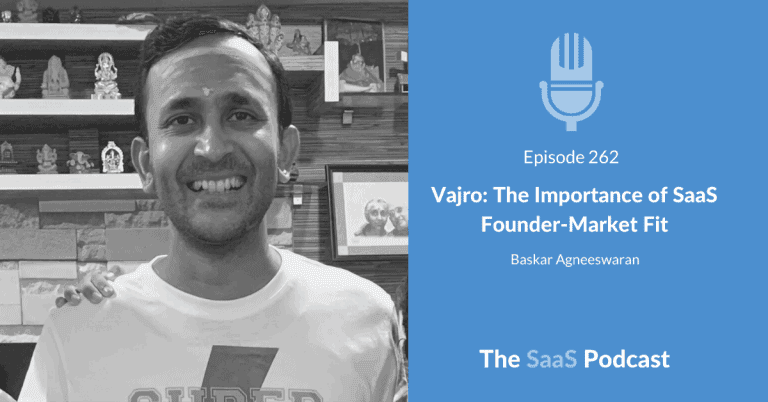
In this episode I talked to Bhaskar Agneswaran, the co founder of Vajro, a cloud based mobile commerce platform that creates instant mobile shopping apps for e commerce stores.
You probably hear about product market fit all the time and why that's so important to building a successful SaaS company.
But what about founder market fit?
In 2015, Bhasker and two of his friends set out to build a price comparison app.
They wanted to get into the e commerce space and believed they could help consumers find better deals.
But two years later, their startup failed.
They'd underestimated how much work was required to maintain the huge amount of data they needed to power their app, and as a bootstrap business, they just didn't have enough money to keep going.
But even though they failed, their experience helped them learn about e commerce and more importantly, about themselves.
They knew that price comparison app was a great idea, but it just wasn't a great idea for them.
They realized that their strength was in mobile app development and that they were more likely to be successful if they focused on that.
Soon after, they came up with the idea of a SaaS product that helped shopify stores to quickly and easily create a mobile shopping app.
And it didn't take too long for them to start to get traction.
Then the pandemic hit and initially it looked like their business was going to be in trouble.
But instead of panicking, they started taking a closer look at what was going on and they saw that mobile usage was increasing and it felt like there was actually an opportunity for them.
So they decided to double down and actually hire more people during the pandemic and in the last few months they've actually tripled revenue and are doing six figures in MRR and still growing.
It's a great story about the importance of founder market fit.
You may have a great idea, but it might not be the right idea for you.
So figuring out your founder market fit is just as important, if not more important than product market fit, especially in the early days of your SaaS business.
I hope you enjoy the interview.
Bhaskar, welcome to the show.
Baskar Agneeswaran (02:37.520)
Hey Omar, it's a pleasure talking to you.
Omer (02:39.920)
Do you have a quote?
Something that inspires you or motivates you or just gets you out of bed every day?
Baskar Agneeswaran (02:44.320)
Oh yeah, I'm really obsessed about Vajro and I feel every entrepreneur should be obsessed about his startup.
That in my opinion is possibly the key to success obsession.
Yes.
Omer (02:59.280)
So tell us about Vajra.
What does the product do, who is it for and what's the main problem you're helping to solve?
Baskar Agneeswaran (03:06.960)
Vajra is basically a mobile app development platform.
We are currently aligned to E Commerce and more specifically aligned to Shopify.
What that means is E commerce stores who have their backbone with Shopify, if they actually want to convert their website into a mobile app, they could basically do that using Vajro and they don't need to write a single line of code.
So we are a no code mobile app development platform and the E commerce stores could basically get up and running in about a few hours.
That's all that it actually takes to be live with their apps through Vatsdo.
Omer (03:51.520)
So the app, is this a native app?
This is like there are some apps and it's just basically an app showing the browser page or there's a sort of a native implementation.
Baskar Agneeswaran (04:02.080)
That's right.
So this is a fully native app.
Native for Android and native for iOS.
It's fully native and it's not a PWA.
We don't really take the web pages and then put it into an app.
That's really not what we do.
We are a full fledged mobile app with over 200 features and over 50 integrations.
Omer (04:24.180)
Got it.
Vajro basically was founded around June 2018, just over two years ago.
But I think the story starts probably two and a half years before that when you built a prior product which didn't work out and then eventually led you to starting Vajra and the product that you have today.
So why don't we start with that product?
Tell me what that previous product was called and how you came up with the idea for that.
Baskar Agneeswaran (05:02.350)
Sure.
I think that's where we need to start because behind every success there is a failure and the failures are actually the stepping stones for success.
Our journey actually started with PriceApp.
PrizeApp was basically price comparison app primarily for the US market.
What we actually tried to do was we connected the backend with the major e commerce platforms like Walmart, Ecommerce, ebay, Amazon and so on.
And we were basically pulling in data from those websites and we were basically trying to provide the latest and the lowest price for products.
So that was our objective.
So for example, if you searched for an iPhone, we would quickly go back to these sites and get the lowest price for iPhones from all of these sites.
So that was PriceApp's intention, but it was a failure because it actually required a lot of heavy lifting at the back end.
And we had actually outsourced the backend work because our core strength was actually mobile app development.
We realized through the journey that the mobile app was only a kind of a rendition engine.
So the actual heavy lifting was done at the back end, which we had very little control on.
It failed.
And that's when we introspected and we thought through what was our strength and what we really wanted to do.
And we realized that our strength was actually mobile app development.
And that was the starting point for Vajro.
The one biggest learning that we had when we did PrizeApp was that we actually learned a lot about E commerce.
We did not know the size of the market before we did PrizeApp.
We did not know the potential that E commerce held for us.
So PriceApp was kind of stepping stone for learning all of these.
And when it failed, we realized our course trends and aligned ourselves accordingly.
And the day that we actually launched Vajro in Shopify, that was basically in June 2018.
That was really the turning point for us.
Got it.
Omer (07:15.539)
I want to talk a little bit more about Price App because I think there's some interesting lessons here.
First of all, when you said we were working on this, how many of you were there?
Did you have co founder, co founders?
Baskar Agneeswaran (07:27.190)
Oh, yeah.
So I actually have two co founders in Vajro.
So Niven Santosh is my tech co founder, if you can call that so.
He's a technology genius behind Vajra's platform right now.
Omer (07:42.230)
So.
Baskar Agneeswaran (07:42.590)
And he was the person who also created the app for Price App.
Omer (07:47.030)
So why did you.
So you say you have two co founders?
Baskar Agneeswaran (07:49.830)
Yeah, the founder is Raghu.
Raghu is basically a sales and marketing expert with more than two decades of experience in selling software internationally across geographies.
Omer (08:03.220)
Okay, and so it was the three of you that started Price Zap together as well?
Baskar Agneeswaran (08:07.780)
That's right.
Omer (08:09.220)
Why E Commerce?
Like, how did you guys decide that was the space that you were going to tackle?
Baskar Agneeswaran (08:15.380)
Okay, so we were.
To be honest, we were actually very naive when we actually did Price App.
So we knew that price comparison could hold significant potential, but did not really size up the overall e commerce market.
But through our journey in Price app, we actually discovered the size of the E commerce market and the kind of play that we could possibly have in that market and so on.
Omer (08:38.970)
Okay, this was sort of like a B2C play, right?
The product was designed for consumers.
Baskar Agneeswaran (08:46.650)
Yes, that's right.
That's right.
And that was the other part.
So you hit the nail on the head.
B2C is possibly not ideal with a bootstrapped company.
So you possibly need to have a big war chest if you want to do B2C.
So that was definitely another learning that we had.
And when we did Vajro, it was B2B and we could still pull it off bootstrap.
So until like December 2019, we were bootstrapped and only then we actually raised our first round of funding.
Omer (09:20.560)
And how much time did you spend on Price App?
Because you were working on this for a couple of years, right?
Baskar Agneeswaran (09:28.320)
Yeah, nearly a couple of years.
So from conception to building the backend and then building the actual mobile app, it did take a significant amount of time.
And after we built it, we kind of spent a few months in trying to make it successful.
We realized that, number one, the product was not up to the mark.
We kind of needed to admit that to ourselves because sometimes you just need to step back and look at things objectively.
You need to call a spade a spade.
So if your product was not good enough, you should be able to admit that and move on or at least try to bring that up to speed.
At that point of time, we realized that to bring it up to speed was going to be a herculean task and we could possibly not pull it off being bootstrapped.
Omer (10:13.310)
Okay, so you've kind of gone through this process that a lot of entrepreneurs and founders go through, which is you come across an idea, everyone gets excited about it, you go out and sort of build a product and then the honeymoon is over and the reality of
Baskar Agneeswaran (10:29.950)
the business starts, you come crashing down to earth.
Omer (10:33.390)
Yeah.
And at the point that you guys decided that this idea didn't have legs or certainly, you know, it, you didn't have all the the resources to be able to, to really see this idea through.
Did you already know that what you were going to be doing with Vajra or was this sort of a thing that you sort of shut down and then sometime later you sort of came to together again with this idea?
At what point did the Vajra idea emerge?
Baskar Agneeswaran (11:04.630)
Yeah, so the Vajra ID actually emerged kind of a year before we actually launched in Shopify.
So what we were actually doing was soon as we launched and you know, a couple of months down the line after launch of Price App, we kind of realized that the reality of Price app's failure and, you know, we started thinking about, as I said, our course trends and, you know, what we really wanted to do and so on.
And we really decided that we would actually go ahead and build a mobile app platform, because that's our core strength.
So we actually went ahead and created the platform.
And incidentally, Shopify was not the first platform that we actually launched Vajro with.
It was actually a platform called Cart Rocket.
So they are based out of India.
So it's a kind of a small platform, maybe a few hundred clients, as compared to kind of 1.5 million stores who are currently using Shopify.
But that, again, kind of gave us market validation.
It instilled the confidence in us that we could actually make the whole thing work.
It was successful with Cart Rocket, and then we went ahead and launched Vajro on Shopify a few months later.
Omer (12:24.680)
What kind of validation did you do with this idea?
How did you sort of hedge your bets and make sure that what you were doing here was going to be more successful the second time around?
Baskar Agneeswaran (12:34.440)
Oh, yeah.
We were kind of, I would say, cautiously confident that Vajra would be successful, primarily because we were playing to our strength, which was basically mobile app development.
And the second thing that worked in our favor was two things actually, that worked in our favor.
One is.
Is basically the fact that this was actually B2B and not B2C.
And the second thing was as soon as we started ideating, we reached out to Cart Rocket and the deal immediately worked out.
So the way it actually panned out was that we actually signed up with cartrocket first and then actually built the platform.
So that way, what happened was we actually had a platform in our bag before we actually got started.
Omer (13:24.060)
How did you do that deal without a product?
Baskar Agneeswaran (13:28.060)
Okay, yeah.
What cartrocket was basically looking for was actually a mobile app developer.
What we actually did was that we just told Cart Rocket that, okay, mobile app development is what you want.
You could refer your clients to us, and we could basically build mobile apps for your E commerce stores.
So that was basically the deal.
And it was only later that we actually went back to them and told them that, hey, you know what, we've actually built a platform, so it's actually kind of easy for us to build mobile apps for your clients and we could actually do it on a much larger scale.
Omer (14:07.380)
Got it.
Okay.
So that was sort of like the way for you to sort of test the water and to validate the idea.
And then how did the Shopify opportunity emerge?
Why did you decide that Shopify was the ecosystem that you were going to invest your energy into?
Baskar Agneeswaran (14:33.289)
Oh, yeah, that's a very good Question.
Because the day we launched the platform with Cart Rocket, we started doing research and we kind of zeroed in on a few platforms.
But we picked Shopify primarily because of the maturity of the ecosystem.
We realized that what Shopify was doing was basically something like what Apple itself had done in the early 2000s when they actually opened up the Apple ecosystem and said, hey, you know what, any developer could actually come on our platform and actually develop apps on the iOS platform.
So that was basically what Shopify had done too.
They had a core E commerce platform, but they realized that they could not possibly build each and every feature that the platform required.
So they had actually created an ecosystem where third party developers could basically come and they could basically build anything on Shopify that would help customers sell more or less, you know, that that could help customers in any which way that it could help an E commerce store.
So the maturity of the ecosystem was the prime driving factor for us to zero in on Shopify.
Omer (15:51.270)
So this is two and a half years from the time that you, you launch Price Zap to getting into Shopify and you guys were bootstrapping this business up until that point.
So how are you paying the bills?
Like how are you funding the business?
How are you paying your own bills?
Was this a part time thing for you guys?
Baskar Agneeswaran (16:14.830)
Oh, no.
So it was part time for me and Raghu until we kind of launched in Shopify.
But Niven was full time into this and we also had a handful of employees.
I'm thinking now possibly, I think we had three employees or four employees at that point of time.
So I was actually running a couple of more businesses and that was basically funding this initiative.
Omer (16:39.810)
Okay, got it.
Okay, that makes a lot of sense.
Baskar Agneeswaran (16:42.450)
Yeah, yeah.
And the day we launched in Shopify, you know, it's kind of.
I've been more than full time into this right now.
Omer (16:51.810)
So tell me about.
So you've got the.
What does launching in Shopify actually mean?
Because I'm not that familiar with Shopify's platform.
And for a lot of people listening, what does that actually mean?
What work or time is involved to get your app in front of Shopify's customers?
Baskar Agneeswaran (17:14.879)
Sure, yeah.
What that actually means is a listing on the Shopify ecosystem.
You actually have apps.shopify.com that's the kind of the marketplace where E commerce stores can basically find thousands of plugins that they could potentially use for their store.
Getting ourselves listed in that ecosystem, that's basically what it is.
We basically built our platform and we actually went through the vetting process with Shopify for, I think, six months, really, before Shopify could approve it.
They have a very stringent process of making sure that the app is really functioning the way that it should.
And there is a good customer experience when they go through the setup and so on.
So they have a lot of parameters, and it's a very intense process.
So it took us quite a few months, but when we finally got there, it was really awesome.
Omer (18:20.980)
Okay, so tell me about the day you launched.
Baskar Agneeswaran (18:24.660)
Oh, yeah.
So it was quite exciting.
And I remember the conversation that I had with Niven and Raghu that day when we actually got listed.
One of the key decisions that we made on that day was that we could actually price the product really low because we wanted to acquire customers.
So if you actually visit the Shopify ecosystem, you'll realize that each plugin or each app is actually rated by customers.
So the more rating you had, the more e commerce stores actually come and install your app.
We initially wanted to drive a lot of installs, so we kind of started our plan at $25 a month.
That was the starting point, and that really helped in acquiring a lot of customers in the initial stages.
I remember that conversation the day we actually launched.
It turned out to be a pretty good launch for us.
Immediately after the launch, we started getting a lot of customers, all organic installs.
That was pretty exciting for us because that was the first time that we had actually built something and you just needed to wait, and clients could basically come and install, and they could basically start paying and so on.
So it was like a little bit of magic happening there.
Omer (19:51.070)
Okay, great.
So you've got.
You're in the app Store and you're sort of figuring out how to improve your ranking in there, make the product more searchable, and drive up reviews to incentivize more people to feel confident enough to try your product.
Were there other things that you were doing outside of the App Store to reach Shopify customers?
Baskar Agneeswaran (20:18.120)
Oh, yeah.
We actually started doing a lot of stuff.
We started building affiliates or partnerships.
So we basically started researching Facebook groups where people are actually looking out for solutions to increase sales or solutions for increasing conversions or solutions for increasing customer retention and so on.
We discovered a few groups, and we got ourselves entrenched in that group, and we started doing a lot of digital marketing consistently.
So over a period of time, we realized that it pays to patiently do your digital marketing and wait for the magic to happen.
You really need to build your brand in those groups and so on.
And then people start to know the brand vajro we did some pretty smart stuff.
So we would typically ask our customers who come from that group, they would have a moment of realization when they actually like our app and their customers provide positive feedback about the app and so on.
At that point of time, we would actually ask them to talk about us in those groups.
That really helped us gather momentum.
That was the initial part of the first 12 to 15 months.
We were predominantly doing a lot of partnerships, affiliations, and making our presence felt in various forums and building the brand.
And that is really what was driving the app installs and revenues.
Omer (21:53.530)
Okay, got it.
So there's a clear difference with Vajra and once you launch that in the Shopify marketplace, which is very different to the experience you had with Price app.
And so looking back, I mean, you know, you often hear founders say, you know, once you've found the right problem solution fit or the right product market fit, you know, things are different, things start to fall in place in a different way than when you're trying to force an idea into a market that nobody really wants.
Or there's a bunch of different reasons why you can't find that traction.
So how different was that experience for you?
And what, if anything, do you think you could have done differently with the Price app experience to learn that lesson faster?
Baskar Agneeswaran (22:45.630)
Okay, that's a tough one.
So.
Because I'm not sure if it would have been possible for us to actually learn that stuff faster because, you know, I feel sometimes it just comes with experience.
You got to fail, you know, in order to introspect and understand and, you know, use it as a stepping stone for success later.
So I'm not sure if that learning can be crashed because it's a process that you need to go through.
But thinking back, I think there are a couple of things that I want to talk about here that would possibly accelerate the learning.
So when you actually ideate about a product, I think one of the key things that you need to think about is what's the delta that you're actually delivering to your customer?
What was his previous state and what is the state that he would be in after he uses your product?
Because if that delta is 2x times better than what the customer is experiencing currently, you definitely have a business case.
That's definitely something that you need to think about.
For example, if you talk about Bachelor, there is a clear delta in the fact that 80% of the online sessions for E commerce stores now happen from mobile devices.
So it's actually a no brainer for E commerce stores to have a mobile app.
So it would result in significant increase in conversions, significant increase in customer retention, and therefore significant increase in revenues.
There's a clear delta in people using Vajro.
So that's one thing.
The second thing is you really need to know what you can do and what you cannot do.
That's a key learning.
If our core strength was actually mobile app development, then that is what we should have stuck on to rather than trying to be opportunistic in what we are doing.
You possibly need to marry the delta part to your inherent strengths and weaknesses and really figure out what you want to do.
Omer (24:55.270)
Yeah, I think that's a really good insight and really smart thing that you.
That you just said there that it.
It's really important to understand your own strengths.
And I think a lot of the time when people are.
Or founders is trying to get their idea off the ground, there's almost this misconception that I have to find the right idea for the market.
And then.
Yes, you do, but it also has to be the right idea for you.
And the lesson there is that sometimes it might be a great idea, it's just not a great idea for you.
And so we look at like price zap and say, okay, well, that doesn't mean a price comparison tool is a bad idea.
Now I look at companies like Honey, right, which is a very similar product in terms of being able to do price comparison.
And you know, that company has like, you know, 6, 700 employees.
They've raised 20, 30 million dollars.
So the idea wasn't a bad one, but it was about understanding what's.
Is it right for us?
Do we have the core skill set to be able to execute on this idea?
Do we have, you know, the.
All the things we need, like the kind of the funding and the investment for the B2C marketplace?
And then obviously the answers to that were no.
And then you found the thing that was a much better fit for you as a group of founders.
So I think that's just a good thing to say.
It's not just about good idea or bad idea.
It's also about is the idea good for you or not?
Baskar Agneeswaran (26:35.000)
Absolutely.
Absolutely Right, Omer.
Yeah, you definitely need to think about whether it's good for you because you need to have the skill sets to actually pull it off when it comes to execution.
So, yeah, as you rightly said, the idea may be great, but you still need to execute.
Omer (26:51.040)
So let's talk about.
So the business, you know, June 2018, you're into the marketplace.
2019, you know, you're continuing to grow and acquire more customers.
We talked about some of the things that you've been doing to find customers both in the ecosystem and sort of around things like Facebook groups and so on.
Baskar Agneeswaran (27:14.970)
There's just one more thing that I would like to add there Omer.
It was not only about the partnerships and affiliates and the kind of marketing that we were driving.
The one thing that I would like to add there is we also had a very keen ear on the ground listening to customers and we realized that one of the key things that customers needed was actually live video selling capabilities from within the app.
And we were actually the first mobile app platform in the world to actually launch a live video feature from within the app where our E commerce store owners could actually go live, sell products, do try ons and those kind of stuff and buyers could actually go ahead and at the click of a button they could actually add the product to their cart and two click checkout.
Basically in effect what I'm trying to say is it was not only about the marketing, it was also about enhancing the product all the time.
Omer (28:17.350)
Yeah, yeah, that's, that's a, that's a very good point.
And then Obviously this year 2020, the pandemic hit and a lot of businesses have, have obviously suffered or, or, or gone out of business.
But there's also a lot of businesses that have been doing well during this time and Vajra is one of those examples.
And I know a lot of companies are sort of reluctant to talk about how well they're doing through the pandemic because it kind of feels a little weird.
But I think we also have to accept that, look, the way things are changing is that I was having a conversation with some of my SaaS Club plus members yesterday on a call where we were talking about, look, it's not like the money has just gone away.
All the money that's out there is just moving and shifting into different places.
And it's really important to understand what's happening, how people and companies behavior is changing, what they're spending more money on or where that money is shifting to.
And I think, you know, Vajra is a really good example of that.
So let's talk a little bit about that.
Like what did you see when sort of the sort of the pandemic hit?
Did you see any slowdown in the business?
And then at what point did you realize that this was actually an opportunity for you guys?
Baskar Agneeswaran (29:47.820)
Sure.
Yeah, that's going to be a very interesting story by itself.
So we've actually More than doubled our revenue since the pandemic started.
So we've been growing at a frenetic pace in the past four, five months.
And we've actually tripled our revenues since Jan this year.
Omer (30:05.770)
Now, I know you don't talk about numbers specifically, but you're okay with us telling listeners that Vajero is doing six figures in monthly recurring revenue?
Right, right, right.
Baskar Agneeswaran (30:17.770)
I'm fine with that.
Yeah.
So we actually tripled our revenue since Jan.
There's an interesting story behind it.
Sometime around Jan and towards the end of Feb, things were really slowing down and the pandemic was starting to take a grip of the entire world.
That's when we put on our thinking hats.
We actually did a lot of data analysis.
We went to stores who were actually using Budget, we looked up their stats and we did those groundwork.
And.
And we also tried to anticipate customer behavior.
And I actually stuck my neck out and I said, you know what?
The next couple of weeks, people are going to kind of stock up Essentials.
But over the next month or next couple of months, what's going to happen is people are.
It's going to move beyond Essentials.
People are actually going to start buying things differently.
A lot more people are going to start to buy online, and those kind of stuff is really going to happen.
And we actually anticipated that.
And what we did was.
I know it might sound counterintuitive, but we actually went ahead and doubled our team size during that time.
And we also put in place a lot of serious sales and marketing efforts.
And as we anticipated, by the first week of April, things really started to pick up.
So it was not about Essentials anymore.
I had actually written a blog about it.
Beyond a certain point, a lot of people were going to start working from home and they're going to have significantly more money because they were not going to travel anymore to their workplace and so on, and they're going to have a lot more screen time and all that was going to translate to more E Commerce purchases beyond Essentials.
So we actually wrote about it and we went ahead and planned for it and we created our marketing campaigns around it.
Of course, the advantage that we had was we were in the E Commerce space.
That kind of really helped.
For example, if we were possibly in real estate, we would have possibly fallen flat.
So it did help that we were actually in an industry that was kind of poised for tremendous growth.
But we did take the risk and doubled our team size and invested heavily in sales and marketing.
And the result is now for there to see, because we've been able to double our revenues since then.
Omer (32:47.950)
So what gave you the confidence to double the size of your team at a time when everybody else was.
Well, not everybody else, but most people were going into this mode of fear and kind of thinking about cutting costs or managing or freezing things.
Baskar Agneeswaran (33:08.770)
Yeah.
So actually, three things that led us to believe strongly in that and take a calculated risk.
The first, as I said, was the anticipated consumer behavior.
The second was actually the data analysis.
We actually went back and saw stores, and we realized that a lot of stores actually started doing really well during March and April.
Their sales were going up.
So we realized that there was really something there for us to think about.
So the analysis was the second part.
And the third part was again, another critical piece of stack.
When we did that analysis, it was not only the revenues that were going up, but the mobile sessions were also increasing significantly.
What was previously like 50% web sessions and 50% sessions from mobile devices, there was a decisive shift there.
We started seeing something like 70 to 80% of sessions coming from mobile devices.
So that's primarily because people having a lot more time with them and not traveling to offices and so on, and therefore having a lot of time with them and browsing a lot more from their mobile devices.
These stats, basically the stats combined with anticipated human behavior, that's what led us to take the calculated risk and say, let's double up and let's try to pull this off and kind of etch what it happened.
Omer (34:34.030)
Yeah, that's smart.
It reminds me, you know, there was.
There was a paper that I read From Bain Company, the consulting firm, and this was from.
This is probably from about nine, 10 years ago, maybe around the.
The last sort of, you know, the Great Recession that we had in the US 10 years ago.
So, and they had done some research, and they'd looked at a number of previous recessions and try to identify who are the companies that came out doing well after a recession.
And they sort of said, think of a recession as if you're in a racetrack, a recession.
Think of it as almost like a very sharp curve that you have to take on the racetrack.
And what happens is that a lot of these, in a recession, everyone sort of is slowing down, is not spending, is thinking about cutting costs.
And they said that the companies that did well after each of the recessions that they looked at were the ones who looked at that opportunity to actually invest, to actually think about how they were going to prepare for when the recession ended.
And that allowed them to use that sharp curve as the point that they could overtake the competition and they show the example.
Baskar Agneeswaran (35:58.640)
Example.
Omer (35:59.120)
I'd love to kind of, I should find where that paper is.
I don't have a handy right now, but I thought that was a really, really good insight.
Sort of a very data driven way of looking at what has happened in the past and a good lesson for a lot of companies.
Although it's not always an easy thing to do or a decision like that to make when you're in the middle of all that chaos, right?
Baskar Agneeswaran (36:26.320)
Oh yeah, it's definitely not easy.
So in fact, when we did our reading, a lot of, I would not say peers, but a lot of people in the e commerce industry, we're still talking about essentials poised for growth, whereas we were thinking ahead and said the essentials poised for growth will hold good for the first month, but what happens from the second month on?
So, so we were going beyond the headlines that were given to us and that was also one of the key for us to make that calculated guess and say that this is what is going to happen.
It's kind of very intuitive, but sometimes you got to believe that.
And we also had the stats backing to say that there was actually a lot more sessions and a lot more purchases from mobile apps now.
Omer (37:18.280)
Yeah, I mean it sounds like it was.
You used as much data that you could get hold of to make that decision.
But it was also, it was also an intuitive decision that's turned out to be a good one now that we're sort of starting to look back at what's been happening.
Baskar Agneeswaran (37:35.480)
Right.
Omer (37:36.680)
All right, we should wrap up.
We should move on to the lightning round.
So I'm going to ask you seven quick fire questions.
I just try to answer them as quickly as you can.
Baskar Agneeswaran (37:45.730)
Sure.
Ready?
Omer (37:47.250)
Okay.
What's the best piece of business advice you've ever received?
Baskar Agneeswaran (37:51.490)
Yeah, I think the best piece of business advice that I've seen is, and that's basically from an Indian founder, Vijay Shekhar Sharma.
He actually expounded the concept of Delta 4 that I was talking about earlier.
So I think that's possibly the best piece of business advice that I heard.
Omer (38:11.850)
What book would you recommend to our audience and why?
Baskar Agneeswaran (38:14.170)
I would possibly recommend Spear by Michael Crichton.
So the reason is it's all about self discovery.
So I think that's really key for entrepreneurs.
So I think Spear by Michael Crichton would be my take.
Omer (38:32.330)
I don't think we've ever had a Michael Crichton book recommended.
Baskar Agneeswaran (38:36.090)
Oh yeah, Yeah.
I don't read management stuff.
So yeah, I learned from the practical world and fiction writing like Michael Crichton.
Omer (38:45.660)
What's one attribute or characteristic in your mind of a successful founder?
Baskar Agneeswaran (38:50.380)
I would possibly say two.
One is obsession that I talked about in the beginning.
The second is perseverance.
I think those two are possibly foremost in my opinion.
Omer (39:02.380)
What's your favorite personal productivity tool or habit?
Baskar Agneeswaran (39:06.200)
Personal productivity tool.
I'm actually old school, so I actually have a notepad and pen with me all the time, taking down notes and taking it off and I actually complete the stuff that needs to be completed.
So that's possibly my favorite productivity tool.
Omer (39:25.400)
What's a new or crazy business idea you'd love to pursue if you had the extra time?
Baskar Agneeswaran (39:31.160)
Oh yeah, that's a good one.
So I think I would possibly do something like the Chennai Incubator.
So I want to incubate SaaS companies and if they have a good idea, I want to provide all the other ingredients to basically make it successful.
That's my favorite idea.
Omer (39:50.380)
What's an interesting or fun fact about you that most people don't know?
Baskar Agneeswaran (39:54.460)
Interesting fun fact about me.
I'm really as old school as it can get, and yet I'm at the forefront of technology, running a successful SaaS
Omer (40:08.380)
company because of the stuff.
Like the paper and pen stuff.
Baskar Agneeswaran (40:12.510)
Yeah, paper and pen.
Deeply religious and, you know, I do a lot of meditation and, you know, those kind of stuff.
So I'm really a contrast in that sense.
Omer (40:25.150)
And finally, what's one of your most important passions outside of your work?
Baskar Agneeswaran (40:28.510)
Outside of work, My passion, I would say two things.
First, I like to spend a lot of time with family.
My wife, my kids and my parents.
So I like to spend time with family.
The second thing is I love sports.
I love playing table tennis and a little bit of karam.
Yeah, karam.
Omer (40:49.540)
If you don't know what karam is, get up.
Baskar Agneeswaran (40:51.380)
Yeah.
Yeah.
That's a very Indian game, isn't it?
Omer (40:56.900)
Great.
Bhaskar, thank you so much for joining me today, sharing the story of Fajaro and how you guys, you know, launch that.
They found that opportunity and have grown the business and the lessons that you've learned along the way.
If people want to check out Vajro, they can go to Vajro.
That's V A J R O dot com.
And if people want to get in touch with you, what's the best way for them to do that?
Baskar Agneeswaran (41:26.630)
They could possibly email me.
Bhasker V A s k a rajror.com awesome.
Omer (41:34.590)
Oscar, thank you so much.
I wish you all the best, and thank you for taking the time to talk.
Baskar Agneeswaran (41:40.830)
Yeah.
Thank you so much, Omer, for giving me the opportunity.
So it was an absolute pleasure talking to you.
Omer (41:47.390)
Cheers.
Baskar Agneeswaran (41:47.950)
Cheers.