Omer (00:09.920)
Welcome to another episode of the SaaS Podcast.
I'm your host Omer Khan and this is the show where I interview proven founders and industry experts who share their stories, strategies and insights to help you build, launch and grow your SaaS business.
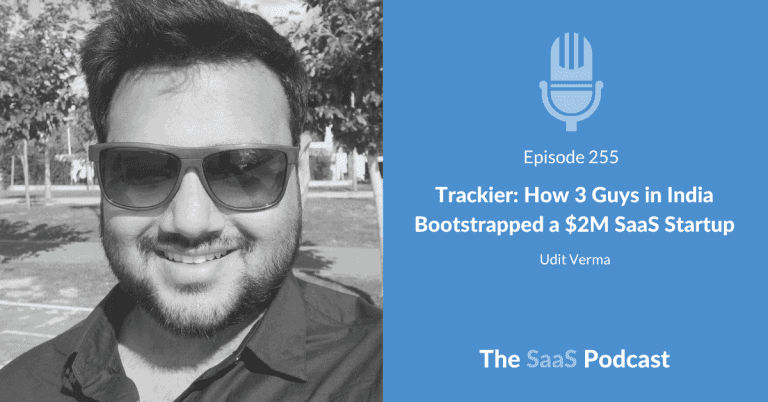
In this episode, I talk to Udit Verma, co founder and Chief Marketing Officer of Trakier, a SaaS performance marketing and affiliate marketing platform.
This is a story about three guys in India who were about to graduate from university.
They'd started a web development company and were building websites for clients as a side project.
And they started talking about what they were going to do next and decided that instead of getting jobs, they were going to build their own software, product and company.
So after they graduated, they started their new company.
But their first product idea didn't go anywhere.
But as they talked to potential customers, they got an idea for a different product.
They spent the next nine months building that product and and landed a handful of customers.
But they didn't have a strategy or plan for growth.
They didn't know how to find and acquire customers and tried a few things like testing $150 on Google AdWords and getting zero leads.
Eventually they decided to focus on inbound marketing.
And they did something really simple.
They wrote help docs which explained how to use a particular feature.
And then they republished those same help docs as blog posts.
And they started reaching out to other websites and getting them to also publish their content.
Each blog post had a simple call to action at the end.
Sign up and try our product.
That simple idea and approach helped them to go from zero to $2 million in annual recurring revenue in about four years.
And on top of that, their business is 100% bootstrapped.
In this interview, we dig into exactly what they did and how they've been able to bootstrap a multimillion dollar SaaS company.
So I hope you enjoy it.
Udit, welcome to the show.
Udit Verma (02:28.310)
Thanks, Umar.
Thanks for having me.
Omer (02:30.710)
So do you have a favorite quote?
Something that inspires or motivates you or gets you out of bed every day?
Udit Verma (02:35.590)
Yeah, one quote which I liked and motivates me to try new things is do one thing every day that scares you.
Omer (02:42.990)
Do you know who said that?
Udit Verma (02:43.950)
I don't know.
Omer (02:44.470)
I don't know where that came from.
I've heard that before.
Udit Verma (02:46.430)
Yeah, I just read somewhere, I don't know like where, like who's the author?
I'm sorry, I apologize for that.
Omer (02:52.230)
No, that's okay.
Udit Verma (02:52.950)
I don't know the author.
Omer (02:54.990)
Yeah, that's totally fine.
Yeah.
Do one thing every day that scares you.
I like that.
Okay, so for people who aren't familiar, can you tell us about Trackier, like what does the product do, who is it for and what's the main problem that you're helping to solve?
Udit Verma (03:10.450)
All right.
Trekker is a daughter company of cloudstro Technology.
We are on the mission to make cloudstaff the one of the best ad tech company in the world.
So currently we are having two ad tech products in Cloud Stuff.
One is Striker and another one is Offers Optimize.
So I will tell you a little bit about both of the product.
Omer (03:31.490)
Okay, so hold on.
So, so Cloud Stuff is kind of like the parent company.
Udit Verma (03:36.530)
Yeah.
Omer (03:37.010)
And then within that you've got Trackier, which is the main product we're going to talk about today.
And then what was the name of the second one?
Udit Verma (03:44.690)
It's offers optimize.com.
Omer (03:47.130)
offers optimize.com.
okay, great.
Udit Verma (03:49.810)
So Tracker is an advanced performance marketing software for some companies and it's an advanced affiliate marketing software for some company from some other companies.
So we are helping advertisers, ad agencies, ad networks, affiliate networks and some web gaming companies to track their analytics for their performance based campaign.
Ad agencies, ad networks, advertisers create their own marketplace with the help of Tracker and they can automate their operation via two way API.
We have two ways build the endpoint for every action in the API so that it will make very seamless work working for the affiliate networks.
So we are we also providing customized solution on their demands and we have made our tech that much flexible that instead of building in house platform, you can have more scalable, more features enabled platform and have competitive advantages.
So I'll tell you a bit about Offers Optimize.
So Offers Optimize is a offers link checking tool which is helping like affiliates to automate the link testing of the campaigns.
Omer (05:04.120)
Okay, great.
So I think most people understand like you know what an affiliate platform does.
I wasn't clear about what a performance marketing platform is.
So maybe if we talk about one of your types of customers, whether it's a ad agency or a publisher, can you just kind of explain like how would they be using a performance marketing platform?
Udit Verma (05:27.810)
So yeah, so for the direct advertisers it's a performance marketing software and for the affiliate networks it's a affiliate marketing software.
So right now like the ad agencies who are working directly with the advertisers, they give the reporting of performance, they give performance based reporting to their advertisers while affiliate networks are running Some rebroking campaigns.
So they are using it as an affiliate marketing software.
So I hope like it's a bit clear for you.
Omer (06:00.580)
Yeah, I'm still not clear about what a performance marketing platform is.
Like give me an example of how that gets used.
Udit Verma (06:07.460)
So yeah, so suppose I'm X agency, I have Coca Cola as my advertisers.
So Coca Cola is saying that I have, I have launched one new drink and I want to like for pur sale of the bottle, I will just, I will pay you one cent.
So for agencies who is working for like direct, for the direct campaigns, they are giving their advertisers the performance report.
Omer (06:35.290)
Got it?
Yeah.
Okay.
So an ad agency for an ad agency, this is basically what they use to show their clients how campaigns performed.
Udit Verma (06:47.320)
Yeah.
So it's totally depend on the kind of like lead generation campaigns so how you take it as a product.
So like it's a very thin difference between performance marketing and affiliate marketing.
I feel.
Omer (07:00.840)
Okay, we need to get into that.
We're going to talk about that because I want to know how you can basically have the product positioned for two different types of customers as two different types of solutions and how do you do your marketing to work in a way that kind of, you know, attracts these people and converts them.
But before we get into that, let's kind of set the scene for the business so people can just kind of get a, get a sense.
So the business was founded or Trackeat was founded in 20002016 with your co founders Faizan and Hemant.
And in the last four years you have bootstrapped the business and you guys have gone from 0 to 200k in MRR.
And apart from spending a little bit on an AdWords test, you guys have pretty much spent 0 on marketing.
Udit Verma (08:01.810)
Yeah, so yeah, so we have spent 0 on like on marketing for like in our first year of operation.
Omer (08:09.410)
Okay, so before we get into the details of how you guys have built and grown this business, let's kind of go back and talk about like where the story starts.
So where did the idea for Trakia come from?
Udit Verma (08:25.170)
So it's a story of three passionate college grads started their journey in fourth semester of their college.
So me, Faidan and Hemant belongs to the same college.
So we started with a web service company where we bid for the project and build the project for different companies.
So while building the project for like different company, we found our Ikigai.
So we love building product.
We feel sad like when some other guy hold the ownership of that product.
So we decided to, to build a product and made a company from it.
So it was our last semester of engineering.
So we, while coming back from a trip, we decided to go with a B2B product.
So we have decided we have to go with product side.
We have to build a B2B product, not B2C.
Because of our capabilities of promoting and building a B2B product.
Omer (09:18.720)
So let me just ask you one thing you mentioned.
We found our ikigai for people who aren't familiar.
Can you just kind of explain what that, that means?
Udit Verma (09:26.980)
It's a, it's a, it's a eureka moment.
Like when you, when you feel comfortable with something, when you feel passionate about something.
So it's a, it's an ikigai for you?
Omer (09:35.100)
Yeah.
I mean for people who don't know this, I think it's a Japanese term and it's just, yeah, it's kind of like finding this overlap between like what you're good at and what you're passionate about and where you can add value, I think.
And so you guys decided, okay, you know, we want to focus on the product piece and we want to build a B2B business.
And this was something that you were planning to do like, okay, you know, we're kind of going to be graduating and then once we're, we've done with college, this is the thing we want to work on full time.
Udit Verma (10:05.050)
Yeah.
So like while, so we have a like strong alumni connect.
So while talking to like one of our like alumni, so he showed one product of Exponential Interactive.
So Exponential is having, he is like launched one product, VDX video driven experience.
So we found it like it was one of the good way to monetize your video.
So while looking to that product, we thought that, we thought to build a native Recommendation engine for SaaS.
So it was not a like final product, it was just an initial product.
So we started with building native recommendation engine and we named it as VNative.
In VNative, we were blending the advertisement into content.
So so that the user who are using, who are coming to the website got confused whether it's a content or advertisement.
Omer (10:56.180)
Okay, so did you kind of go out and talk to potential customers or was this just basically like this seems like a good idea.
Let's, let's build it because it sounds like a cool product.
Udit Verma (11:09.140)
Yeah.
So we, so being a product guy, so we attracted to the product and we thought to build that and so we were like good at technology, so we just built that product and then after that, so we we use our alumni connect again.
So we asked our alumni to arrange a meeting with one of like with late Anurag Gupta who was the CEO of FPG Media, one of the India's biggest media agency.
So after talking to him we found that this product should be sold to publisher and publisher like to pay less for this for this particular product.
So while having the demos for vnative we met one guy.
So we pitched our product to that guy.
So instead of using native recommendation engine, so he asked us to build an affiliate network for his click based affiliate network.
So we built that.
So it was our first step towards our main product Trackeer.
Omer (12:09.940)
Okay, got it.
So I got another question for you here.
You kind of use your alumni connections to, to get in front of this guy.
You said it was one of the largest media agencies.
Udit Verma (12:23.720)
Yeah, Media agent, Digital agency of India.
Omer (12:27.320)
Yeah.
And so basically the feedback from him was look, the product that you're trying to build, you're not going to make, you're not going to be able to charge a lot for it.
And then through chance you got this other feedback from somebody else saying build this affiliate platform for me and that's something I could use.
But weren't there already other products out there that did kind of affiliate management?
Like why did you need to go and build another product?
Udit Verma (12:54.690)
So yeah, so in, in India the affiliate thing was like booming.
So there was no affiliate tracking platform we can see in like in back 2016.
So it was India's first affiliate tracking platform.
And like while so there.
So if you talk about the global market, so the platform who were in the market was having some UI issues, some, some kind of issues while in UI or like ux.
So there was like issues in using, using the analytics for like by, by using their product.
So we thought that we can make a UI friendly and user friendly, UI friendly and scalable platform than the others.
Omer (13:37.810)
Okay, so you've got feedback from one guy.
Was that enough for you then to say okay we're going to go and change the product.
Did you try to get any commitment?
Did you try to pre sell the product to him?
Udit Verma (13:49.650)
No.
Then we were keep on asking people to use vnative.
So while asking one user in Russia for Vnative he told us to build a conversion conversion tracking platform.
So then we improvise tracker from click based tracking to conversion based tracking.
Then after we never look back, we keep on implementing things and complete and completed the whole product and launched it in like 2016 September.
Omer (14:21.050)
And did you ever start charging for V native.
Did you make any money from that?
Udit Verma (14:25.930)
No, we didn't made any money from like vnetive.
Omer (14:29.960)
Okay.
So the product was out there and you were trying to find customers and get people to use it and you didn't get any sales there, but you started getting feedback from people who looked at that and they started telling you, actually, here's some other problems that we have right now that, that you could help solve.
Udit Verma (14:48.720)
Yeah.
Omer (14:49.080)
Is that kind of how it went?
Udit Verma (14:50.040)
We made our focus on ad tech.
So we like, we made something clear in our mind that we will do something in ad tech.
So right now.
So V Native wasn't working, but Tracker was working.
So we were getting traction with Trek, like for Tricare, but not for vnative.
So we thought that let's focus on one product.
Let's devote the time for one product.
So we carry forward with Tracker.
Omer (15:12.240)
Got it.
And then so you launched Trackier, that was in 2016?
Udit Verma (15:19.040)
Yeah, so it was September 2016.
Omer (15:21.440)
Okay.
And how did you find your first customer?
Udit Verma (15:24.620)
So yeah, so I already told you that there was like, while we were building the product, so we were having a client and you know, like we got our break even in like within, within three, three months of track here.
So we got like three clients for track here for like in our like initial days.
And that guy who were like, who asked us for building click based tracking, so he was also paying during that time because the platform that we made is like kind of scalable for him and he was making lots of money.
Omer (15:58.350)
Right, but how long did it take you to build Trackier?
Udit Verma (16:03.070)
We started development from like January 2016, then we completed it, the whole module till like September 2016.
It took us like nine months.
Omer (16:12.990)
Okay.
Did you generate any revenue between January 2016 and September 2016?
Udit Verma (16:20.630)
Yeah.
So people who are like using Trekker were paying us like for.
So we have, we build the click based module.
Like initially we build the click based module and they were paying for that because their businesses are like click based tracking.
Omer (16:40.150)
Okay.
Udit Verma (16:40.950)
This is what they were, they were needing like so we have implemented conversion based tracking afterwards.
So the tracker is built on the customer feedback.
So we got the feedback from the customer, we implement that features and then we made it for the client.
Omer (16:56.980)
Got it.
And then so when the product launched in September 2016, how many customers did you have?
Udit Verma (17:03.140)
We have around 10 customers at that time.
Omer (17:05.940)
And how much revenue were you generating?
Udit Verma (17:08.260)
I'm not sure about that, but some of them was on free model because we were new for the conversion tracking.
Like I don't I don't know what the, like, exact revenue at that time.
Omer (17:18.960)
Yeah, just ballpark, like, just a rough estimate.
Udit Verma (17:22.240)
It was around, like, 60 to 70K.
INR.
Omer (17:26.720)
Okay.
Udit Verma (17:28.319)
If I talk about, like, it's around, like, $1,200.
Omer (17:32.400)
Okay, so just over a thousand dollars.
Mrr.
Udit Verma (17:35.680)
Yeah.
Just $1,000 Mrr.
Yeah.
Omer (17:37.880)
Okay, great.
Okay, so you've got a handful of customers.
You've sort of used the feedback that you got from them, and you're generating some revenue.
It's not a lot, but it's still revenue.
So where did you go from there?
How did you start finding more customers?
Udit Verma (17:56.070)
So everything was, like, new for us, but, like, our basics and intentions was clear and strong.
So we followed two strategies that worked very well for us.
One is content marketing, and another one is, like, another one, like, from where we got clients is words of mouth.
Omer (18:15.350)
Content marketing and word of mouth have been the two biggest drivers for your business.
And from what I understand, the only time you've spent money for marketing was when you did a Google AdWords test and you spent about $10,000.
Udit Verma (18:37.500)
No, 10,000 INR.
Omer (18:40.860)
Okay.
Udit Verma (18:41.500)
Yeah.
So you can say it's around $150.
Omer (18:45.588)
$150.
Okay.
Udit Verma (18:48.100)
Yeah.
Omer (18:49.820)
What results did you get from spending that money?
Udit Verma (18:52.140)
Yeah, so it was terrible.
So results was terrible.
So we got, like, five leads, and four of them was junk, and one lead was kind in, like, initial stage.
So it was so.
And that guy, as I remember that, that guy didn't beat us.
Omer (19:11.430)
Okay, so you basically, you ran this test.
You know, $150 isn't a huge amount of money for a Google AdWords campaign, but if you're college grads and you're already generating $1,000 in revenue, it's a big chunk of your revenue even to do that.
Udit Verma (19:29.350)
Yeah, it was a lot for us because we have to manage.
The seats are, like, for the team, and we have to manage.
And then several costs, like, was also there.
Omer (19:40.790)
Okay.
So, I mean, content marketing, I want to dig into that.
I want to kind of figure out exactly what you did there, because it sounds like that's been a big part of your growth.
But as you know, content marketing, the downside of it is that it takes time.
It takes time to get it out there and to educate leads and whatever it takes to get them into the funnel.
So did you start with content, or did you start with sort of word of mouth and using referrals or working through your network?
Like, how did you kind of get to that next step from that 10 customers to the hundred customers.
Udit Verma (20:18.220)
Yeah, words of mouth was working side by side.
So we were giving our clients like the best possible service.
So we are getting the client from the reference as well.
But what we focus in marketing is inbound marketing, not specifically on content.
I'm a big fan of inbound marketing.
So what I did is I tried to make content.
So it was a content marketing.
I tried to make a knowledgeable content and put it on on website and the content would be on the features.
So how to use that feature to build the ROI and how to use that feature to generate more revenue.
So I keep on like building this kind of content and even like I did some co marketing thing as well where like I asked the some websites to like post an ad and I'll just give you some kind of like usage of Tricare.
So this is, this is kind of barter system that I did in our initial period.
Omer (21:20.890)
Okay, and were you promoting the content anywhere else?
Like you know, social media or was it kind of just basically looking for these types of kind of co marketing
Udit Verma (21:32.370)
opportunities with other sites for the co marketing thing?
I just like, I always believe in, in like offering something knowledgeable.
If you are giving something knowledgeable to your user then they will definitely read your stuff.
So what I did did is I just asked the website to post a content of tracker into their websites and just ask the users to just get involved.
Omer (21:58.420)
So how clear were you about your, your customer at that point?
I mean you know the product so you can pick a feature and you can write a about that product.
But who did you know like when you talked about like ROI and benefits like that, like did you have a specific customer in mind at that point or was it sort of fairly broad and trying to appeal to anybody who might need that kind of product?
Udit Verma (22:25.720)
It was clear that I have to focus on affiliate networks and ad agencies.
So I build the content on the basis of like I just studied that what an affiliate network, like what an ad agency is like.
So I build that content that revolves around the problem solving statement of ad agencies and affiliate networks.
Got it.
Omer (22:47.890)
Okay.
How much content were you creating?
Was this like, you know, a handful kind of talking about the main features.
Were you trying to go for volume and write, you know, a bunch of content every week?
Like what was the approach here?
Udit Verma (23:05.350)
Yeah, so what I did is I build the support article in that way that it becomes a content for me.
So it, it was kind of like two things that I involved like include in one thing.
So this is how I edit the Content marketing.
And I just having some like one button like at the bottom that you have to, you can, you can use it for free 30 days.
So I just gave that and got the leads.
Omer (23:32.160)
Wait, they weren't even blogs.
You were kind of like just writing like help docs and using them as content as well.
Udit Verma (23:38.160)
Yeah, so in that way I just draft the content in that way that it sounds like a help doc and it was making sense for some marketing guy as well.
So it totally depend on boosting the roi.
So the content was.
So you can use this feature to boost your roi.
Omer (24:00.290)
Okay, and then so how did this work?
Like when you, when you went out there and you started to do this sort of co marketing and get, get this website to promote the content, what happened?
Udit Verma (24:10.530)
Yeah, so I approaches forums.
Yeah, so there were like warrior forums.
There were like lots of forums that I approached.
So it was good for me.
Like so it was giving, giving me the results.
Omer (24:22.430)
And so were you sort of focused on finding customers in India or were you kind of going out and looking for customers in other markets like you had tried?
You know, you'd said you were trying to do with the web services business when you were at college.
Udit Verma (24:40.350)
Yeah, my like my mindset was to make this a global product.
So I built the content for the global market and Indian market both.
I didn't like, I didn't have that focus on Indian market.
I just focused on like outside Indian market because India is my home ground, I can meet anyone anytime but like for outside India.
So I have to think out of the box.
Omer (25:03.210)
Yeah.
And so what kind of.
You were just finding like what affiliate related forums?
Udit Verma (25:09.370)
Yeah, yeah, so it was like affiliate related forum.
So there was some forums who were like just associated with some ad agencies, some ad affiliate networks.
So yeah, so I just approach them, I pick up the niche and just stick to that niche.
Omer (25:26.550)
Okay, and what were you doing in the forum?
Like you know, I presume, you know you weren't just going in there and spamming and telling people about your product, but there was a bit more of a plan to this.
Right.
Udit Verma (25:36.630)
So I never spammed any anyone until it, it was like email marketing and just a follow ups thing.
So yeah, so for forums I never, I never have this kind of behavior.
I never spammed people.
I just like give them the knowledgeable content.
If, if you are like okay with that like you can, you can just sign up.
Otherwise like I have like I have something more beneficial for you because I have seen there's a capability in the product I believe in the product.
So like, in that way I don't want to like do spamming because people get irritated and I don't want to ruin the relationship.
Omer (26:13.660)
Yeah, yeah, no, totally.
And I didn't, I didn't assume you were going to do that.
Like, what I'm trying to figure out is when you went to the forum, were you just sharing links to the content that you'd created and saying, oh, I created this content which can kind of help you get, you know, this result or ROI with this feature.
Or were you sort of spending time and looking for conversations where people were asking related questions and then using that as an opportunity to reply to them and tell them about the product or explain about your feature?
Or was it a combination of both of those things?
Udit Verma (26:51.090)
Yeah, it was a combination of both things.
So I was just keep on posting the blogs.
I just offer them some deals.
Like I have, hey, I have 30 days free trial, you can use it for free for 30 days with.
I have some API integrations that, that might help you in boosting the roi.
So being a tech founder, I have like many things to offer with a problem solving mindset.
I just post my content and engage the audience.
Omer (27:19.560)
Okay.
And then so how did the forums work?
How successful were they?
What kind of results did you get?
Udit Verma (27:24.760)
It was like, okay, so yeah, I like, I didn't say that forum didn't generated the lead for me, but it was generating, it was working for me because I got like, if I get like one or two clients from one forum, then it's okay because we were like, we were in early stage and like two clients with like, with one forum is okay for me.
Which is paying like $2,000.
Omer (27:48.960)
Right?
Yeah.
And that's a, that's a good distinction to make because like the kind of companies that you're going after, I mean you guys have built almost a 2.5 million ARR business with what, about 350 customers?
Udit Verma (28:07.700)
Yeah, including small enterprise and big enterprise.
Omer (28:10.980)
Right.
So the average contract value for each customer is pretty high.
So even getting one customer through a forum, especially in the early days is a good boost to revenue for you.
Udit Verma (28:28.340)
Yeah, so what I feel is like, so when somebody starts the company.
So it was like it was on the initial like initial plan.
When they start building their team, building their like connections, then they definitely upgrade your platform, like upgrade the plan.
So this is how like we help people in their initial stage and then they start growing.
So that's how we build this kind of revenue right now.
Omer (28:54.600)
Okay, so the Word of mouth is kind of happening in parallel as you get customers using the product, you're doing everything you can to give them a great experience.
And some of those are kind of turning into referrals.
Were you asking customers for referrals or was that, was that just something they were doing themselves?
Udit Verma (29:14.680)
So while meeting some clients like face to face.
So yeah, later on we also did some exhibition in like global events.
We also went and started attending the events like all around the world.
So we start meeting our clients.
So they were like, so we find that there is a hundred percent of customer satisfaction and they were that much happy.
They just introduced us to their partners.
And so this is how the thing will work.
Thing is working.
So we sometimes ask, asked our client for the referrals, but majorly there's a time they refer us automatically.
We don't have to ask them.
Omer (29:57.530)
Got it.
And then for the inbound marketing, the content you created, we talked about sort of distribution and you said one way I was distributing that was sort of like co marketing and finding relevant websites that could basically promote this content and do some kind of, some sort of barter and you know, not pay for this.
And then the forums were another way that you were getting the word out with the content.
Was there anything else that you were doing to, to distribute that content?
Udit Verma (30:30.120)
So I was also like side by side doing SEO.
So we have some SEO tools.
So we are also focused on doing SEO and we improve our ranking on Google for like, for particular like keyword.
So we research that which keyword is working well in the market.
So whenever we feel that this keyword is working well, then we build a content around that keyword.
Omer (30:54.260)
Okay, how are you learning this stuff?
Because you hadn't learned any of this stuff in college, right?
Udit Verma (30:59.060)
Yeah.
So we are also like not from the tech background.
Nobody like from my team is from tech background.
So I'm, I'm personally passed off from production and industrial engineering.
So I learned I'm a big fan of Wingify, so how Parash Chopra created the content and I'm big fan of HubSpot.
So how HubSpot like follow the ideology of inbound marketing.
So yeah, I just read the content of HubSpot and I followed strategy.
Omer (31:33.000)
That's interesting.
And so you were just learning and teaching yourself as you sort of went.
Udit Verma (31:36.600)
Yeah, so I learned by myself.
That's cool.
Omer (31:39.640)
Yeah, I mean and I think like Papyrus, you know, for people who don't know, you know, founder of Winkify and visual website optimizers, which people, you know may have heard of and in, you know, in many ways I guess, you know he was sort of a pioneer right for, for many, you know, entrepreneurs and SaaS founders in India because I guess he launched back in probably 2010 and you know, I don't know where they are but when I he was on my show he was on episode 16.
So we probably talked about five years ago and at that point they were doing over 8 million arrow.
So assume in the last five years, you know I haven't checked in but I'm assuming it's a lot more than that now.
Udit Verma (32:28.220)
So yeah, so Parash Chopra is like from my college.
So yeah, definitely.
So it's a, it's again the alumni connect.
So we always wanted to connect with the alumni.
Omer (32:39.740)
Yeah.
And I think you from sounds of it, you guys were pretty smart about taking advantage of those alumni connections to, to get introductions and kind of have the I guess the conversations and the feedback to help you get or stay on the right track with this business.
So you launched the business in September 2016 and where were you in terms of revenue after year one, around sort of late 2017?
How was the business doing?
How much were you generating in revenue?
How many customers did you have roughly
Udit Verma (33:21.890)
as far as revenue is concerned?
Like I'm not sure about that but I was close to around 50 clients.
Omer (33:29.490)
And typically how much were you charging those customers at that time?
Udit Verma (33:32.530)
So it varies.
So it was like it's also having this like story.
So our commercial is also.
We drastically changed our commercials from clicks to conversion based in the favor of making the platform more pocket friendly for our users.
So initially we were charging on click based on per click.
Then we found that there is a more efficient way of charging people and make that platform pocket friendly for them.
So we start charging them on conversion based.
And when we came out with that conversion based pricing, the people love that pricing and because instead of paying for 10,000 clicks, they love to pay for one conversions, one conversion and install.
So the pricing was same.
So it was like still the same.
So for 10,000 conversion we were charging some clients like 299 and there were some clients who were paying us more than $1000 for like 100k conversions.
Like more than 100k conversions.
So it varies from the size of client.
Omer (34:45.330)
Got it.
Okay.
So like if I look at the pricing today, you sort of start at $299 a month and there's sort of some various add ons that people can do like an anti fraud at $100 a month or a link checker at $49 a month.
But that's kind of like the starting point.
Your middle sort of tier plan is 499amonth with the same add ons and then you kind of have a custom tier there.
Udit Verma (35:10.720)
I found that people love the add ons so if I'm adding value to their vision or like to their goals.
So they would love to pay us like any amount because these add ons are helping them grow.
Omer (35:24.480)
Yeah, yeah.
Okay.
So I mean I'm trying to get a sense of like where you were with revenue, like what the growth trajectory was.
So kind of end of year one, where do you think you guys were?
I mean from what you've described to me in terms of pricing and the number of customers, I'm guessing maybe 20, 30K MRR.
Around that ballpark.
Udit Verma (35:47.390)
I think, I think it was like around 60 KMR, maybe 50.
So it was like ARR 50 to 60k ARR.
Omer (35:56.350)
Oh okay.
Udit Verma (35:57.790)
Yeah, so it was, it was like that.
Omer (36:00.240)
Okay, so it was about 5k monthly recurring revenue.
Udit Verma (36:04.120)
Yeah, it's around like 5k in year one.
Omer (36:07.400)
Got it.
Okay, so what happened?
What changed?
Like so you go into starting 2018 and you're you know, give or take five, around 5K MRR.
And then in the last two years you've gone from that to 200K MRR.
Udit Verma (36:31.400)
Yeah.
Omer (36:32.280)
What has driven that growth?
How did you do that?
Udit Verma (36:35.560)
So it was the time to go global.
So initially like people weren't like believing us that this, this can be the like platform, this platform can be that, that much scalable.
When people start using tracker that they then it was like words of mouth that worked well for us.
So people thought that there's a like, there's a platform tracker who is like, who's 100% scalable.
Like you can send any amount of like traffic.
So currently like we have tracked around like 80,000 RPS.
So like for Google like it was like around 86,000 RPM.
So Google track like 86,000 RPS but right now we have that much of scalability that we can handle 80,000 RPS traffic.
So people start referring us to their client who were facing problem with the current platform.
So then we got many of the enterprise client in 2018 and while we were attending some international event, we also got some traction from there as well.
So 2018 was miracle for us.
So the going global was a key for this kind of mrr.
Omer (37:49.610)
Okay, but you were already, you know, when we talked about this when you started out, you were from the start trying to be global and find customers outside of India.
So what was different about 2018 when you said we going global?
Udit Verma (38:07.770)
So in 2016 like I started writing the blogs.
So at one point it can make it convincing for the product.
So you have to use the product and this feature will solve your problem.
But if you are like, if you meet someone like in person and help, like show them the demo and like it generates the trust because their whole business is on track here.
So their MRR ARR would be on track here.
That's why like generating trust would be the main factor for us as well.
So being a tracking platform and being a place where they can create the marketplace, it's a bread and butter for them.
Omer (38:52.990)
Okay, so how did you go out and kind of go global?
What did you start doing differently?
How did you track those customers initially?
Udit Verma (39:03.200)
So we started setting up the meetings with the client.
So we start approaching them on LinkedIn.
So we know who all are coming from the events app.
So we know the name, we know the company.
Then we start approaching them via LinkedIn.
Then we fix meeting for face to face meeting in the event and then we showed them the product and in some of the events we also exhibited.
So exhibition makes, also like, also makes my impressions on like on person that this, when, this, when this company is like exhibiting then it might be like trustable.
Omer (39:44.620)
Give me an example of an event that you attended.
Udit Verma (39:47.420)
My first year was the GM GMIC one like which held like in Beijing, China.
So I got like one client from that, from there and like so when I score one client so my ROI of that event is justified.
So I got one client from Jimmy.
I just pick up one random, random person to talk.
Then I told him that I'm building this product and I'm helping this kind of market.
So that guy was also from the affiliate network side.
So he told me his problem, the challenges he was facing.
So I solved his problem.
Then when I came back to India, I just had a tech meeting and discuss about the problem that he was facing and implement all those features, all those problem solving features in track here.
And from there I just bagged one first client from the international event.
Omer (40:48.100)
Okay, and 2018 you said you started going to events, so how many, how many events did you do?
And the LinkedIn piece of that was that you were just finding people who were going to be attending the event and using LinkedIn as a way to schedule meetings.
Udit Verma (41:05.250)
Yeah, so I use LinkedIn to schedule meeting and even like I searched them on Facebook, I searched them on like Skype.
So wherever, like I found them, like, I just asked them like to set up the meeting, but I never spam them.
Omer (41:19.660)
Okay.
And then at the events, it was the opportunity you got face to face time with them and you would just give people a demo.
Udit Verma (41:27.020)
Yeah, so I got to know them like very well by meeting them face to face and like in, in some cafeteria.
I just showed them the demo.
Omer (41:37.180)
How many events did you do in 2018?
Udit Verma (41:39.820)
In 2018 I did three events.
One was in Lake China and another one was D. Mexico in Germany.
And the third one was the, the European summit in Prague.
Omer (41:49.580)
Okay, so you were in Prague, you're in Germany and in China.
And of those three events, do you know how many customers you were able to to win?
Udit Verma (42:02.780)
Yeah, so I think from three of the events, like, I think I got like 2030 prospects, not customer, like which later on become the customer afterwards after the period of seven to eight month.
Omer (42:16.070)
So by the end of 2018, where were you in terms of revenue?
Udit Verma (42:19.910)
So we were like around 70 to 80 ARR.
Omer (42:24.390)
Okay, 70 to 80k.
ARR.
In 2018?
Udit Verma (42:28.150)
Yeah.
Omer (42:28.590)
Okay, so let's talk about 2019.
What happened here?
Because now I'm kind of like we're looking for that hockey stick growth here.
Right.
Because you guys have been in business for three years now and you're doing about, you know, 6 or 7k in monthly recurring revenue.
What happened in 2019?
Udit Verma (42:48.610)
How did you grow in 2019?
We like, our growth was 2x.
Like I would say 2.5x.
We got the trust of customers.
Our inbound marketing was start working and like, these are the way that we generated huge amount of like leads.
So I think in 2019, words of mouth worked very well for us.
Omer (43:14.380)
Okay, so you said like 2x or 2.5x growth.
What did that mean?
Like you were kind of basically doubling MRR every month.
Udit Verma (43:23.580)
Yeah, like first of all, our sales strategy is like on solution based sales, we never did the product selling.
We also did like solution selling.
Okay.
Omer (43:33.980)
For people who don't know what that means, just explain what the difference is.
Udit Verma (43:37.020)
So in product selling you just like keep on building relation and then you then after building relation, then you sell the product to the, to the client.
And in solution selling, you ask the client about their, about their problem and then you solve the problems by a solution.
Omer (43:55.660)
Yeah, I guess some people also describe it like consultative based selling or something like that.
Udit Verma (44:00.860)
Yes, yes, exactly.
It's kind of consultive based.
Omer (44:05.920)
Yeah.
Okay, and so how did that work?
Udit Verma (44:11.280)
Yeah, it worked well because we were solving the problem because during, during those days, people were facing issues with the current platform.
So they start shifting, they start migrating from that platform to tracker.
That brings us the revenue because.
And even like some, some of the platforms were charging on, like on clicks while we were charging on conversions.
For some, some of the companies it was like more of pocket friendly platform and more scalable platform than others.
Omer (44:44.920)
So revenue wise, where did you guys get to by the end of 2019?
Udit Verma (44:49.880)
I think it was 140k, like MRR.
Omer (44:55.460)
Wow, that's a lot of growth in, in a very short space of time.
Udit Verma (45:00.020)
Yes.
It was like, it was miracle for us.
Omer (45:02.980)
And how much of the growth was coming from new customers versus customers kind of upgrading and making more use of the platform.
Udit Verma (45:12.820)
Yeah.
So right now, like, I think so I have to calculate that for, for that particular year.
I haven't like calculated that.
Omer (45:22.910)
Okay.
Udit Verma (45:23.150)
Yeah.
Omer (45:23.350)
But just generally, like, do you feel like most of the growth came from new customers in that year or most of it came from existing customers spending more?
Udit Verma (45:33.070)
It definitely came from like new customers because the number of customers was like way too high like in 2019 for us because people were shifting.
I told you that people were shifting from their current platform to track here.
Omer (45:47.550)
So one thing that I think is pretty remarkable here is that, I mean, you know, you guys started out from zero and for the first three years of the business, it was very slow growth.
And then suddenly 2019, all the work that you've been doing for the last three or four years started to pay off and you started to see growth.
And it sounds like 2020 has continued to be a strong year for you.
And despite all the pandemic stuff, you guys haven't really been impacted by that.
Right.
Udit Verma (46:25.470)
So it's a, like, it's a big ocean for us.
So we can get client like from anywhere.
Omer (46:30.830)
Now one thing I want to talk about, and I touched on this at the beginning, is, you know, one thing that everyone so I talk to will say is, you know, it's super important to be clear about what your product is like positioning your product and making it clear who you serve, how you solve their problems.
And that's one of the reasons I always ask that at the beginning of every interview in terms of, you know, who's your customer, what problem are you helping to solve?
And what I think is interesting about track year is it kind of basically sounds like there are two different products there.
Udit Verma (47:09.440)
Yeah.
So it can, it can be used as a, like for, for managing your partners too.
So it's Kind of analytics for them.
So instead of like having different, different dashboard, you can automate all the operations, all the analytics operation in tricare.
Omer (47:26.400)
But does that make it difficult for your prospects to understand what your product does or does it make it more difficult for you to market the product in a way that helps them understand kind of your positioning and what you do?
Udit Verma (47:49.379)
So it totally depends on the content.
So for affiliate marketing, so performance marketing is similar.
So they understood that what is performance marketing and what is like affiliate marketing for some people like affiliate and performance marketing is same, but it's kind of a thin difference between performance and affiliate.
To attract affiliate marketing networks, we create some content for affiliate marketing networks.
To attract performance marketing network, we create content for performance marketing networks.
And we, right now we have distinguished the help doc.
Initially that was a period that, where we were like mixing the content with the help doc, but right now we have differentiated the help doc and the content.
Omer (48:42.130)
Yeah, I mean, I think it's a challenging thing because for most SaaS products it's hard enough explaining to the customers what one product does, but once you have a product which is like yours in terms of serving two different types of customers and two different types of problems, it can potentially be kind of confusing.
And I think, for example, when I go to the Track year homepage, it's interesting.
You've got this kind of, what do they call them, the slideshow kind of thing where it says it's performance marketing platform, it's affiliate platform.
And you know, even initially, like when I was kind of preparing for this interview, I was like, it took me a while to kind of get to a point where I could understand or describe what the product did.
Has that ever been an issue when you talk to customers?
Udit Verma (49:40.700)
Yes.
Well, like in our initial time when we were like initiators, so we had that kind of issues.
But, but right now, currently, so we have the content ready and then it's not an issue right now.
Omer (49:56.260)
And that's because the type of content you're creating, you're starting with a very clear idea of who that customer is that you're writing this for.
And then is the actual content still focused around like usage of the features or are you now creating, you know, different types of content?
Udit Verma (50:17.390)
Yeah, so right now like it's mixture.
So we have mixed the content.
So we are still the, still our, like our strategy is to create a knowledge, knowledgeable content so that, and we don't want to create a content which doesn't seems helpful for the, for the users.
Like our main Goal and our main strategy is to create this knowledgeable contents.
Either it's like industrial report or like or it's like feature based block.
Omer (50:47.960)
Okay, we should wrap up.
So I'm gonna go into the lightning round.
I'm gonna ask you seven quick five questions.
Just try to answer them as quickly as you can.
Are you ready to go?
Udit Verma (50:56.199)
Yeah, yeah, yeah, sure.
Omer (50:57.560)
What's the best piece of business advice you've ever received?
Udit Verma (51:00.360)
Yeah, the advice which I got is to settle on one product and make it a successful then think of something else.
So here the dedication was the key.
Omer (51:11.980)
What book would you recommend to our audience and why?
Udit Verma (51:14.860)
Yeah, the Challenger Sales by Matthew Dickson and Brent Adamson.
Omer (51:22.780)
What's a book called Challenger Sales?
Udit Verma (51:25.980)
Yeah, it was Challenger Sales.
Like the points that I was talking of like product selling and solution selling wasn't there.
Omer (51:36.530)
What's one attribute or characteristic in your mind of a successful founder?
Udit Verma (51:40.930)
Discipline.
So you name any of the successful founder like you will find that they are very disciplined guy and they are very focused.
Omer (51:51.090)
What's your favorite personal productivity tool or habit?
Udit Verma (51:55.250)
So I meditate.
That's my like one of the productivity tool and like if I talk about some apps I love Todoist and blinkist and Todoist like help me in some task management and Blinkist like provide me 10 to 15 minutes summary of any book which I want to read.
Omer (52:17.260)
Yeah.
Yeah.
I'm a big fan of Todoist as well.
Udit Verma (52:19.500)
Yeah.
Omer (52:20.540)
What's a new or crazy business idea you'd love to pursue if you had the extra time?
Udit Verma (52:24.220)
I would love to merge ad tech with mark tech.
The product I would like to work would be like attribution technology for the gaming and then involving that attack with the marketing technology.
Omer (52:37.060)
What's an interesting or fun fact about you that most people don't know?
Udit Verma (52:40.340)
So yeah so I bunked 70% of my college to attend the office and startup events during that time.
Omer (52:49.140)
You did What?
Udit Verma (52:50.260)
I bunked 70% of my college.
College time you bunked.
Omer (52:55.050)
You didn't attend?
Udit Verma (52:56.530)
Yes, I, I didn't attend the college like so it was like I think my, my attendance percentage was like 30.
30%.
Omer (53:05.242)
30%.
My God.
And finally what's one of your most important passions outside of your work?
Udit Verma (53:10.930)
Yeah, like I would like, I like to travel.
Like traveling is my passion and like knowing the culture of the place and see them live whenever I like visit any place.
I used to read about the place before going to any place.
Omer (53:24.980)
Yeah.
Udit Verma (53:25.380)
So wherever I visit any place I will feel the vibes and emotions associated to that particular place.
Omer (53:30.820)
That's awesome.
Okay, great.
Thank you for joining me today.
It's been great to go through your story and talk about this kind of incredible journey you guys have had.
Congratulations on the success and getting to 2 million ARR and doing that with a bootstrapped business that is totally awesome.
If people want to find out more about trackier, they can go to Trackier.
That's track I E R.com and we'll include a link in the show notes to that.
And if people want to get in touch with you, what's the best way for them to do that?
Udit Verma (54:04.400)
Yeah, they can reach me like through email.
It's Udit Vrma at the Rate Tracker.
It's Udit Verma.
Udit.vermadtrack here.com okay, so that's u d
Omer (54:17.350)
I t.verma v e r m a trackier.com.
Udit Verma (54:21.950)
yep.
Omer (54:22.390)
Awesome.
Ulit.
Thank you so much.
I wish you all the best and thanks for taking the time to talk to me.
And I know it's like past midnight there right now, isn't it?
Udit Verma (54:30.390)
Yeah, it's around like it's one o'.
Clock.
Omer (54:33.830)
I appreciate you doing this at this time.
Thank you.
And I should say I did offer to do this a little earlier.
And you actually preferred to do this time?
Udit Verma (54:44.970)
Yeah, I feel vital during this period.
Omer (54:50.010)
Great.
Thanks so much.
I wish you all the best.
Cheers.
Udit Verma (54:53.050)
Thanks for having me.
Thank you.