Omer (00:09.920)
Welcome to another episode of the SaaS Podcast.
I'm your host, Omer Khan and this is the show where I interview proven founders and industry experts who share their stories, strategies and insights to help you build, launch and grow your SaaS business.
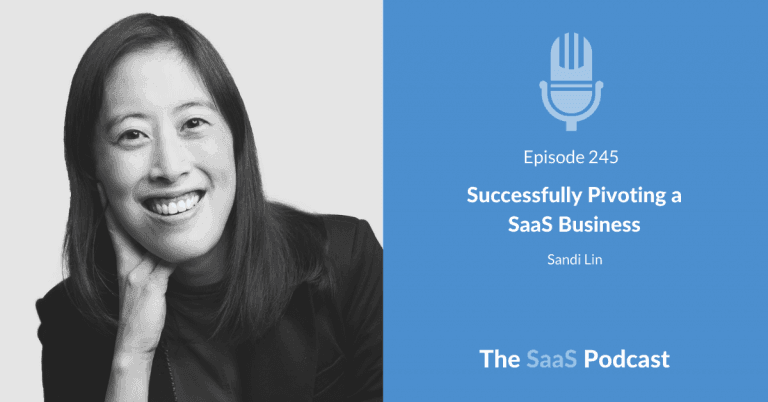
In this episode, I talk to Sandy Lynn, the co founder and CEO of Skilljar, a customer training platform that helps enterprises improve product adoption and customer retention.
Sandy left a job at Amazon in 2013 to work on her startup.
She had enough savings to give her a one year Runway.
Her idea was to build a yelp for online learning.
But within a few months she realized there wasn't a need for a product like that.
So she and her co founder decided to pivot and build an online learning platform for course creators.
Their Runway was quickly getting shorter, so they had to be ruthless about prioritizing the features and building a minimum viable product that did the job.
Even though it wasn't particularly easy to use, they were able to attract customers who paid them $49 a month, but they still hadn't found product market fit.
According to Sandy, they had enough customers to be ramen profitable and pay themselves a minimum wage.
And then something interesting happened.
They started getting approached by larger companies who wanted a product to help them create training content for their customers.
Eventually, the founders realized that these were exactly the customers they needed to focus on.
So they pivoted again to an online learning platform for these larger companies.
In this interview, you'll hear Sandy's story in more detail.
We'll also talk about how she had a really hard time raising a seed round because no one wanted to talk to her.
We also discussed the multiple times she failed at hiring and building a sales team, and how she finally realized that as a founder, she was the best person to lead sales in the early days, even though she didn't believe that she could sell.
Today, Skilljar has raised over $20 million in funding, has a team of around 100 people, and is closing in on almost $10 million in annual recurring revenue.
It's a great story.
I. I think you'll really enjoy it.
Sandy, welcome to the show.
Guest (02:44.320)
Thanks.
Excited to be here.
Omer (02:46.480)
So, do you have an inspiring or motivational quote to help us get started here?
Guest (02:53.200)
I do.
My favorite quote is from Vincent Van Gogh and it is what would life be if we had no courage to attempt anything?
And this was actually written on a card that my officemate gave me the day I was leaving Amazon to start my company.
So it's a beautiful beginning of the startup journey and I love it because it Reminds me that there's no guarantees in life or startups, but let's find meaning in the journey and the attempt and be brave and have courage to attempt things.
Omer (03:29.500)
I love that.
I've done close to 250 interviews and I've never heard that one before.
So that's great.
Awesome.
So let's talk about Skill Jar for people who aren't familiar.
Can you just kind of give us the overview?
What does the product do, who is it for and what's the big problem that you're helping to solve?
Guest (03:52.130)
Yeah.
Skilljar, we are a customer education platform and we help companies deliver online training and certifications to their end users.
And some of you might be familiar with learning platforms from either an academic context or an employee and HR context.
What makes Skilljar and our product different is that we are designed for the external customer and partner context.
So our champions are customer education teams and they typically report into a professional services, client solutions, customer success function.
We're about 100 people based in Seattle, Washington.
We're approaching about 300 customers and we primarily serve mid sized software companies like Zora, Tableau, Slack, Asana and you know, prior to working with Skilljar, these companies have really struggled with bridging the gap between sales and support.
You know, as much as we'd like to think so, not every product is self service for every single user, especially in the enterprise.
And yet companies are still struggling with, you know, approaches other than just hiring more customer success managers or support reps to essentially deliver one on one training.
Omer (05:21.120)
So Skill Jar would be used by somebody like Asana to help train and educate their customers.
Guest (05:28.560)
Correct.
So Asana, for example, they actually it's open to the public, so anyone can go to Asana Academy, which is believe is@academy.asana.com and take courses about project management and how to use Asana product more successfully.
And that's actually delivered through Skill Jar under the covers.
Omer (05:48.790)
Got it.
So how did you come up with the idea for this business?
Guest (05:52.470)
Well, it's a bit of a long story, but I hear this is a longer podcast.
But I was pretty aware in starting a company that my first idea would almost certainly be wrong.
And so I did go into the process with a lot of humility and even so I was humbled even further.
I actually call the first two years of Skilljar my two failed startups.
I wish I could have been sitting around at Amazon dreaming up of this vision and executing exactly towards it, but that's not what actually happened.
So initially I think especially in 2013 13.
When I started this company, a lot of the advice around Lean Startup, it was to solve a problem that you have for yourself.
And at the time I was taking a lot of online classes myself to brush up on my own programming skills.
I have an engineering background and I was having a lot of difficulty finding the appropriate quality and skill level of content.
So came up with the idea of a Yelp for online learning.
Built a prototype, and that type of product is actually pretty easy to build.
You know, got traffic and did what I thought was quote, unquote, customer discovery and even generated a tiny bit of affiliate revenue from conversions.
But I soon realized that, you know, doing an SEO driven business was not for me.
And in this market, in the online learning market, there's just not enough value being generated on the other side, as opposed to businesses like mortgages or senior living facilities.
And fortunately in Seattle there's a lot of demand gen entrepreneurs.
And I quickly realized that that was not the business, at least that I wanted to do.
And at that point I thought it would be a hard reset.
I would have to go out of online learning into something else entirely.
But I decided to at least do some interviewing of the instructors on that Yelp platform to see if I could salvage something.
And I not have any hypothesis nor idea, just purely open ended discovery, digging for pain.
And, you know, there were a couple things that emerged and I actually did a resurvey of, you know, about the 50 interviews I did to see, you know, whether there was a clear pattern.
And what I did learn was that many of these instructors that had been part of our kind of Yelp concept, they also needed a learning platform to deliver their training without having to sell it to lynda.com or Udemy.
And so I thought, well, how can I prove this in say, 30 to 60 days?
That's a ton of product.
And my co founder and I decided we would just manually do everything on the back end.
And we had to believe the market had enough pain that people would just jump through all kinds of hoops to use the product.
And I'm happy to talk about that more if it's of interest.
Omer (09:00.930)
But yeah, no, totally.
I would say a few questions like, so when you left Amazon, Was that in 2013?
Guest (09:08.370)
Yes.
Omer (09:09.250)
And so this was this product, this kind of Yelp for online learning, was that also called skilljar or was it called something else?
Guest (09:17.410)
It was called Everpath.
Omer (09:20.120)
Okay.
And then, so for how long did you work on that idea before you decided that you needed to, I guess, pivot?
And also did you and your co founder raise money at that time or were you sort of self funding, sort of bootstrapping the business at that time?
Guest (09:39.080)
Yes, we were self funding and my co founder actually hadn't joined at that point.
So I probably spent about three months building that first product.
In some ways it was actually really good because it was a way to exercise my very rusty programming skills and get back into that game.
And actually in deciding to shut that down at that point, my co founder was able to come on, but we had no idea.
So we really went through that new customer discovery process together.
We hadn't raised any money at this point.
Omer (10:16.920)
Okay, cool.
And then did you say, like, how long did you work on that business before you pivoted?
Guest (10:20.920)
About three months.
And in hindsight, I should probably never have started, but I didn't know what I didn't know in those days.
Omer (10:27.880)
Okay, and then when you went out and you said, I thought I had done the customer discovery stuff, but it sounds like maybe you felt you hadn't.
Then when you went out and you started talking to these instructors, did you do anything differently this time?
Guest (10:47.390)
Yes.
So I would say the first time I suffered from, you know, it's called like the free ice cream problem or the social network for pet owners problem, where the idea is if you ask someone, hey, do you want free ice cream?
Everybody's going to say yes.
And so.
Or if you ask pet owners, hey, would you be interested in joining a social network where you can meet other pet owners?
Like every.
Usually everybody's says yes, but it doesn't mean that they would actually do it or that there's enough pain in their lives or even the third step, which is, you know, a pivot I haven't even got to yet, but monetization.
So in the beginning it's like, can I just build a product that people actually use and adopt?
And so, you know, the second round, because, you know, I had given myself actually a year to go without a salary and I'm something like six months in at this point.
So the second round, you know, we honestly did not have an idea.
And it was like we were starting over from scratch.
All we had was this essentially database that I'd built of people teaching classes online.
So almost out of a last ditch attempt, we're like, hey, let's just do a call down and see what pain people have.
And we literally had no idea going into that process.
And so after roughly 50 conversations, there were three pain points that emerged.
And I still remember what they were like.
One of Them was video editing.
Video editing is very difficult.
People would say for, you know, one hour video, it probably takes me 40 hours of editing.
You probably have some sympathy being in the podcasting space.
Another one was, you know, marketing.
Of course, everybody wants to figure out how to get more customers to their door in an efficient way.
And then the third was this, hey, you know, I have a mailing list of 40,000 people already and I'm releasing this book and I really want to do this video course, but I don't have a way to actually distribute that and kind of own the intellectual property as well as the revenue from this.
And so there were three.
Those three pain points emerged after all these interviews.
And so the survey that, you know, I talked about was Jason, my co founder and I were like, well, at the time, actually after the interviews, it still wasn't clear.
We probably heard a third, a third, a third from a pain point perspective.
So we decided let's actually survey everyone we talked to again and design that survey to fail in a sense.
And I can't remember exactly what was on that survey, but it was rank order.
Which of these problems is most significant from you and how much would you be willing to pay theoretically for a product that does X, Y and Z?
And I thought, this is going to be like, I'm going to end up with a third, a third, a third again.
And you know, I'm kind of in not the best mental state at this point because I've just.
You develop an emotional attachment to the ideas that you're working on.
And it'd been hard to shelve that first product.
And also like I was feeling desperate to get some kind of idea, so I was like, oh, it wasn't clear.
Any of these is actually a huge opportunity with enough pain and we're just going to get a third, a third or third.
But actually it was extremely clear that people were most interested in this learning platform concept and that they were willing to pay for it.
So that's where that gave us the.
And I was honestly shocked.
And that's what gave us the confidence to start building our MVP there.
Omer (14:24.120)
So you first reached out to these people and did kind of like what, like a phone interview and then you use the survey as a follow up to try and sort of, I guess, validate or clarify where to go.
Is that kind of what you did?
Guest (14:40.430)
That's correct.
That's correct, Yeah.
Omer (14:42.190)
I think that's really interesting.
And there's an art to putting together surveys, which I always find out the hard way.
Part of what we do here is I have a private membership and community called SaaS Club Plus.
And so it's made up of early stage SaaS founders and once they're in the membership, you know, they get access to content, you know, community forum and we do like live events, you know, like webinar type stuff.
And one, I totally get the video editing piece because creating like a ten minute video lesson.
Oh my God, it's like the amount of time it takes to do that, to create it, to record it, to edit it, to public.
It's like it really is like, did I really spend that much time to create a piece of content which is 10 minutes.
And then the other thing I've also personally experienced is like doing surveys where I go out to the community and I say, okay, what do you like?
And the whole idea being like, can I learn from what people find the most valuable and double down and do better there?
And I had the exact same experience where these sort of three sections are on content community and sort of live events.
It came back like a third.
A third, A third.
And it was like, okay, well what do you do here?
Right?
It's like so basically it's not telling me anything.
Guest (16:05.700)
Yeah.
Omer (16:06.420)
So I'm kind of curious like when you said like designed to fail, even though if you can't remember the specifics, like how were you trying to get it to fail and sort of like what's the lesson that you know, someone like me or anybody listening who's thinking about surveys could learn from that.
Guest (16:21.220)
Yeah.
So going into that survey, I will say that I had a strong bias towards hoping that the learning platform for win because I did not see you can identify a problem, but it doesn't mean that there's going to be a solution.
And even if there is, that it's something that is a founder solution fit, founder market fit.
And also it wasn't clear that there was a clear signal that the learning platform would win.
And so randomized questions, randomized answers, stack rank and even people who in the interviews had told us didn't even mention that this was a problem.
We're ranking this as their top problem.
So that's the part where I guess it was designed to fail in that we had no real indication that the learning platform would win.
And then we set up the survey in a randomized way and there were enough people responding to it that didn't even mention it in the interview that I was shocked were making this as their number one problem that they were willing to pay for.
A solution for.
So even more than the video editing or the, you know, the marketing problem.
So, yeah, I think it's easy to design a survey to tell you what you want to hear.
Omer (17:40.110)
That's interesting.
And I would add to that and say, I think it's, it's also easy to go and do customer interviews and ask questions.
That helps you validate your idea.
If you want it to be validated.
Yes, it's a lot harder to, you know, I think someone once said to me, like, don't kind of validate your idea.
See if you can, you know, invalidate it or actually talk them out of the idea that you want to go and build.
And if you can't do that, then it means you're onto something really worthwhile.
Guest (18:08.640)
Yes.
And then even that, I would say, like our customer just that customer discovery just gave us enough confidence to continue investing in the idea.
But it's a good question to ask at each milestone, whatever that is, on the product market fit side or on the monetization side, because nothing is real until your target customer either uses or pays for your product, depending on the business model.
And my first job was in transportation planning.
And so this is a very understood concept in transportation because, for example, when you're trying to figure out where to put a new subway station, you'll typically go and stand in that area and ask people walking by, like, you know, if there were subway station here, would you use it?
And that kind of thing.
And there's actually statistical models that correct for what people will say versus what they do.
It's called stated versus revealed preference.
And so even in this survey, you know, I always knew that people are saying this.
It doesn't mean people will do it, but it was enough to say, let's go try building something minimal that will prove that people will use it.
And then after people will use it, the question is, will they pay for it if that's part of the business model?
And then after that happens, you have to figure out, well, is it scalable or will enough people use it and pay for it.
And so there's many versions of that.
I think always throughout a company, we're still in some ways doing mini versions of that with various customer segments.
Omer (19:37.920)
Yeah, yeah, I bet.
So you'd given yourself a one year Runway after Amazon and it sounded like, I think you said by the time you were done with these interviews and survey, you had about what, six months left?
Guest (19:52.720)
Oh, I think by the time we were done with these surveys, I had about four months left.
Omer (19:58.800)
Nice Nothing like a little bit of added pressure here.
Okay, and so what did the second iteration or the second version of your startup look like?
Guest (20:09.510)
Yeah, so this was like Jason and I were like, wow, that's a lot of product to build a learning platform.
So what is the absolute minimum we can do to prove whether it will work in 30 to 60 days?
Because we had a belief that if we're going to work on something that's going to become huge, that the market must have enough pain that people will jump through all kinds of hoops to use it.
And so on the sort of learning platform side, we decided, okay, to prove this, all we need to show is that if this, say, video, let's use the book author video course example, if this video course exists, that the author will be able to launch it to their audience and people will buy it and consume the content.
And it doesn't matter that the author actually sent us those files on the thumb drive or that we're cutting them checks every two weeks to pay them the money.
Like all kinds of hoops, there's no administrative tools to manage the course or the content.
You can only have one course, not two courses.
You can only have videos, not PDFs or quizzes or any of that stuff.
So we really stripped that down.
And because of that, we were able to launch a proof of concept with a handful of those early survey respondents.
That's the other advantage of a survey.
You get to understand who your alpha group is going to be and they were able to launch something within 60 days.
So that was the second product concept that I was working on.
And for the next year we continue to get more signals from the market, more people signing up.
Slowly we began building self service tools, we began building content management, and more and more instructors were signing up and launching courses with Skilljar.
So that next year was very organic in terms of how we continued building on the product.
Omer (22:02.880)
Yeah, so I was going to say one like, it sounds like you guys were very ruthless about what you weren't going to build in the product, that in the next 30, 60 days we need to prove this concept.
And there's a whole bunch of stuff that we know we should have because that's how we're going to make our product easy to use.
But we're not going to put that in there.
And as you said, people are going to have to jump through a whole bunch of hoops to use it.
And in many ways that's a great way of again, validating whether there is a real need for this in terms of are people willing to go through some level of pain to solve this problem that they have?
But I'm also curious, and it's kind of a hypothetical question, but I also wonder if this was the product that you were building from day one when you left Amazon and you still had a year's Runway, would you have maybe spent more time trying to build in more features and make it easier to use?
Like, was the time constraint a big factor in forcing you guys to really kind of think much harder about what absolutely needed to go in the product?
Guest (23:24.760)
I think time constraints are critical when you're first starting a company.
And my background's in product management, so you might.
So parts of me see all the holes and I want to lay out a three year roadmap and make this amazing thing.
But the other part of the product management hat is exactly what you said, absolutely ruthless prioritization.
And the reality is most like good products will die in darkness.
It's easier to build a product than to market and distribute it.
And finding the, and tapping into the market demand is usually the key for any startup like consumer businesses.
You know what I hear is a lot of people the key to scaling consumer businesses is apparently Facebook ads.
And this is not my domain expertise.
So please, if you're listening, don't just assume what I'm saying is true.
But I hear a lot of people actually just test all their consumer business ideas just on Facebook testing.
And there's an example actually later from Skilljar when we pivoted to the enterprise or to sales driven motions.
We heard a lot about the need for a Salesforce integration, but we didn't really know exactly what that meant or how many people use it.
So I just put up a landing page on our website that said skill Jar for Salesforce and you know, made an educated guess at, you know, three or four bullet points to describe what it might meant and said for more information, you know, sign up here.
And then people started signing up and so then I called them and understood more.
So there's, there's various ways to test things without actually building it.
Building things is the most costly because it takes time and usually it's not necessary to prove whether an idea will work or not.
Omer (25:14.750)
Okay, so you've sort of come up with the next idea and you sort of built that and I guess got some level of validation because you continue to run with that idea into sort of year two of the business.
Were you generating enough revenue to keep going or was sort of raising money at that point?
Something that you started to do.
Guest (25:40.520)
We were what I would call ramen profitable.
I think that comes from Y Combinator.
So, you know, we're like three or four people.
I think we're paying ourselves minimum wage or contractor wage or something.
So we were generating a little bit of revenue, but not enough to say, you know, scale the business or spend any money on marketing or hire sales reps. And that's when we went to.
Well, so we had raised our angel round during that first pivot and that's a whole nother story.
We probably didn't deserve it based on our traction at the time.
And so partly because we were.
This actually ties into kind of the second pivot of 2015.
So kind of towards the end of that second year we just started, we knew that our initial target customer, which was that kind of solo instructor and book author, that there was product pain there and that we were sort of break even to profitable as a small business.
But at the same time, we started getting a lot of inbound interest from much larger companies, like even Fortune 500 companies that wanted to use the platform to educate their external customers and partners.
I mean, same product, video based training, often with a commerce component, very brandable scalable technology.
And we started winning Fortune 500 deals.
And we're a tiny company, angel funded and so we're like we should start doing more of that and not this $49 a month thing.
And so partly knowing we were shifting into a sales driven model, which is really that second pivot of going up market, was when I went out to raise the seed round, knowing that we'd have to invest in a sales team.
Omer (27:36.020)
Okay, so I want to talk about the seed round because I know there were some challenges there.
Yeah.
But before we get into that, I'm curious as you started getting these larger companies reaching out to you, I mean, you weren't the only, you know, online learning platform around at the time.
So when you talk to these companies, was there something you were hearing from them, that why they were coming to you versus trying some other product or maybe working with a company that was kind of more established or had a bigger team, what was it that was attracting them to you when you talked to some of these customers?
Guest (28:17.530)
So at the time, 2015, and I would say it's still the case today that from a learning platform perspective, and when you're talking about like a white label for corporate purposes, the best option other than skilljar is typically like an HR learning platform.
And on a feature basis, there's a ton of limitations.
Like one of them just being.
Does this person have to be in your HR system?
Sometimes.
And so those first say like 10, you know, big customers we've had, they all were in severe technical pain.
They had done things like launched a $50 million free training initiative and their system had died like the first day.
And they were looking for a learning platform that was designed for an external audience and that was built with strong technical foundations and, and suitable for a enterprise business model.
And the fact that we were video based and that we had commerce built in, because a lot of companies do charge for customer education and training in some way were also sometimes necessary.
So there are a lot of learning platforms out there, but not really for companies or that are geared towards external audiences.
And so I think we just had enough of the right words on our website and our blog that these companies found us.
Omer (29:50.070)
And you weren't like, in terms of your positioning or messaging on your website, you weren't kind of deliberately targeting those companies at that point, right?
Guest (30:02.950)
No, our website, I was the web mistress.
It was not good.
Omer (30:08.870)
Okay, so let's talk about so next.
Okay, you see this opportunity and okay, so this is like the second pivot moving from, as you said, focusing on sort of instructors who you're paying like 49 bucks a month to these larger companies and then you decided you were going to go and raise a seed round.
So like how did that go?
Guest (30:32.230)
Gosh, that was probably, oh, there's so many hard times in the first three years of a startup or let's face it, anytime in a startup, but that was probably one of the hardest.
So at this point we're still paying ourselves minimum wage, building our own furniture, but we're starting to sign Fortune 500 companies and there's an increasing number of interesting companies just finding us and talking to us.
I decided at the time was right that we needed to raise a little bit of money so that we could hire some what I thought were real salespeople at the time and take the business to the next level, invest in more enterprise, enterprise ready features like APIs and single sign on and that kind of thing.
And so being in Seattle, Seattle is a tough.
There's not a lot of early stage capital here and I had an amazing angel investor community and did all the right things.
Made a list of target seed funds, largely in the Bay Area, some in Seattle, probably five in Seattle and the 50 in the Bay Area and got warm introductions and it was just so hard to even get meetings.
And this is, yeah, 2015.
So seed investing is Hot.
And it was like being like, even with the most, the warmest introduction and just people not even wanting to take a meeting with me over and over was just really, really hard because I know at this point that we are, we are onto something.
The deals we were winning and the deals, the interest we were getting from the market and our ability to meet that demand without, like I said, I was not the world's best salesperson at this point.
But when you start signing six figure deals per year, you know, you know you're onto something and inbound demand as well.
But then to, you know, go out to the seed investor market and not get meetings or if I did get meetings, I would ask questions like, why is this different from YouTube?
Or like questions that were totally like not understanding what you were doing.
That was really, really hard.
And you know, our first employees and my co founder just happened to be people with families, with children.
And I knew that they were taking, you know, huge salary cuts versus what they could be earning at Amazon to be working on this.
And so, you know, I did feel a lot of pressure because we had something to lose.
You know, we had amazing customers that had taken huge risks within their own companies to bet on Skilljar.
I had a team that was making 10% of their market salary probably and some angel investors.
But I think they had come into it knowing the risk and then most importantly the opportunity to make a big impact on the world.
And then here I am needing to raise money and not even able to get meetings with people that I have very warm connections to.
So that was a real struggle for, you know, 90 days, 180 days.
And this is all in the lens of also still continuing to like do all the business functions for this company because, you know, it was only engineers and myself and so payroll responding to sales, people signing up for demos, customer onboarding ourselves, you know, customer support.
I was doing all of that at the same time as trying to raise money.
So it was a lot.
Omer (34:03.040)
And were you able to eventually raise a seed round?
Guest (34:06.240)
Yes.
So we raised a 2.6 million seed round from a local investor here in Seattle, Trilogy Equity Partners.
They're amazing.
And it probably they were actually not on my radar initially because I was under the mistaken impression that they only invested in mobile solutions.
But it actually all worked out for the best, which usually is what happens with startups.
Omer (34:33.200)
Awesome.
And then so you've got this money and I think she said sort of part of the plan was they're going to use this and you're going to Start hiring salespeople, and they're going to go out and start selling to all these companies, and then everything is going to be great.
Guest (34:47.680)
That's exactly what I thought.
Omer (34:50.080)
Yeah.
And it didn't quite work out like that.
So tell me a little about what was your experience with trying to build a sales team?
Guest (35:00.580)
I have failed so many times at building a sales team.
So as context, my background is in engineering and product management.
I like working in code, not people all the time.
And I had this fear, I mean, I still do to some extent, this fear of sales.
And so I thought that hiring a sales rep and I did not understand all the different flavors of sales out there.
But if I hire salespeople, I teach them the product, they would be able to sell it, and everything would be magic.
And that is not the case, I think for any founder.
You're just going to have to sell all of your first deals for at least in SaaS, like a million dollars of ARR.
Nobody can do it except for the founders.
And then after that, we'll still have to be heavily involved in sales, probably to at least 5 million of ARR because it's just impossible to replicate the knowledge of the customer and the market and what the product does and does not do and matching that to the customer's problem.
Omer (36:07.700)
Yeah.
And then no one is going to be as passionate or as a big advocate for the product as you as the founder.
Guest (36:15.630)
Yes.
Omer (36:15.950)
And I think that's.
That's kind of can be sort of the challenging piece as well.
So how many sales people did you initially hire?
And I think also you spent some time trying to kind of get sales leadership in place as well, right?
Guest (36:28.590)
Yeah, I mean, you know, we went from one to three or a handful at various times.
And I think the tricky thing about hiring salespeople early is that a salesperson generally needs to know what they're selling and how to sell it.
And unless you're extraordinarily lucky, most sale.
And maybe this is a startup fit issue.
But it's very hard to put a sales rep into a position where they have to, like, figure out a lot of the messaging and the target ICP and the what the deck looks like and learn the product and learn the use cases, and then you stack that also against not having a brand or having the resources of a larger company.
And that is very, very hard.
And so I kept hiring reps and sales management or leaders thinking that they would be able to figure it out better than I could.
And I gave them lots of room to do so because the other interesting thing about sales reps is they like to have a lot of ownership over what they're doing.
And so I was like, okay, okay, you got it.
Let me just tell you about the product when you need me.
And that just did not work at all.
Omer (37:36.770)
And like, where did it end up?
Like, do you have a sales team today and how big is it?
Guest (37:44.460)
Yeah, so we're in a great place.
I actually love working with a sales team now.
So I'm going to fast forward a few years.
A few sort of failed building go to market attempts.
So our amazing sales leader Ray Carroll joined in October last year.
So October 2019 and prior to that I'd actually run the sales team directly for about, you know, I guess maybe four to six months before that.
So we have nine account executives and a similar number of sales development representatives which is the top of the funnel when it comes to selling.
And I actually, I was so afraid and intimidated by it.
And the sales team thinks this is hilarious and I actually really loved it.
And you know, skill jars at a totally different scale now.
You know, we're upper seven digits of ARR again.
You know, we have blue chip customers and a lot more resources in the company.
So I get that it's like a totally different experience when we were like 200k of ARR and had no idea what was going on.
But yeah, our team is really humming now.
We just put together two sort of record quarters back to back and are really on fire for the upcoming year.
Omer (39:00.150)
And I think from what I'm hearing as well is you realized that you're probably better at selling than you thought you were.
Guest (39:11.890)
I am so much better at selling than I thought I was.
I had the impression mistakenly at least at Skilljar, that sales is a bit of the.
I don't know, nobody says that they're so excited to talk to a sales rep because they think they're going to get, you know, the slick sort of used car salesman, pull something over your eyes type of stuff.
Right.
And.
But what I love about our sales team and what true sort of consultative selling is is understand what the customer's problem is and see if there's a match for the product that we're offering.
And of course, as a product oriented founder and with amazing customers, I fully believe that we are the best solution for customer education in the world.
And with that type of confidence, it's almost moral imperative.
I'm sort of groaning as I think that for, you know, if that we truly solve the customer's problem to be able to have that conversation.
And if we're not the best solution, I don't have any problem saying we're not the best solution.
And maybe here are some other things you should look at.
So I view it as problem solving and I love that.
I love problem solving.
Omer (40:25.000)
Yeah, I think that's, that's a great way to look at it.
And I talk to a lot of early stage founders who are in a similar place and they sort of feel like either they don't think they can sell the product or that they are going to enjoy doing that.
And a lot of the times it's because we have this kind of preconception or the wrong kind of preconception of like what we think sales is.
And when you sort of frame it in your mind as exactly how you described it, which is, I just want to learn more about what problems my prospective customers have and if I can help solve them, great, I'll try to do that.
And if not, then, you know, we just say kind of goodbye.
It's not like I have to go there and, and force them to use the product or something like that.
I think that's a really powerful shift in the way you sort of think about sales, that you don't even think about it as sales anymore.
As you said, it's like I'm just, I just want to help people solve problems.
Guest (41:25.760)
Yeah.
Omer (41:27.200)
So you've been on this journey for over seven years and so this is the third sort of iteration of the business and now things are really starting to click.
You've got, you know, a team of about 100 people.
You said, you know, in terms of ARR, you're kind of, you know, I guess, closing in on like 10 million ARR type thing.
And you've also raised 20 million now in funding.
So that's a worlds apart from, you know, where, where you were when, you know, you were sort of built the sort of the yelp of kind of online learning.
If you could go back and give yourself any Advice back in 2013, what would you tell yourself?
Guest (42:19.540)
Oh, gosh, I would tell myself that it will get better and you can do this.
It took me a long time to believe in myself.
I think in this process.
The first few months and years were so hard and especially, you know, I've gone to elite schools, I've had, you know, prestigious jobs.
And to be like, the emotional journey of going, of starting a company is so hard.
So I would tell myself, you know, first it gets better and also you can do this and you know, trust your ability to problem solve and figure it out as best you can.
Omer (43:08.390)
I think that's great advice for your previous self and for other people listening.
And I think in many ways, you know, there's a lot about the, you know, the sort of the execution part in terms of the idea and how you go out there and talking to customers and you know, how you kind of build the business.
But in many ways just as important is that mental, I don't know what you call it, situation or whatever.
Right.
It's just having not just the grit and the determination to keep going and to deal with all of the challenges you're going to face along the way, but also learning to believe in yourself.
Guest (43:53.200)
Yes, we are our own worst enemies and we are the only thing limiting what each of us can do.
I think the mental game is so important.
Omer (44:04.980)
All right, I think we should wrap up and move on to the lightning round.
So I'm going to ask you seven quick fire questions.
Are you ready?
Guest (44:14.420)
Yes.
Omer (44:15.300)
Okay, great.
What's the best piece of business advice you've ever received?
Guest (44:19.860)
Treat others with respect and integrity because you never know who or how might be helpful to you down the road.
Omer (44:28.650)
What book would you recommend to our audience and why?
Guest (44:31.530)
I love Shoe Dog by Phil Knight, the founder of Nike.
It is a raw and humble story and will raise the spirits of any entrepreneur.
Omer (44:41.370)
What's one attribute or characteristic in your mind of a successful founder?
Guest (44:46.730)
Grit.
You've got to be able to run through walls constantly and it's going to hurt and you're going to come back for more.
Omer (44:55.000)
What's your favorite personal productivity tool or habit?
Guest (44:57.880)
Definitely sleep.
I really organize my life to sleep at least eight hours every night.
It is one of the most healthy things that you can do for yourself.
And I definitely recommend a book called why We Sleep by Matthew Walker to learn more.
Omer (45:13.880)
What's a new or crazy business idea you'd love to pursue if you had the extra time?
Guest (45:18.360)
Really interested in healthcare tech?
I'd love to solve the problem of prescription drug delivery.
There's still way too much pain in that process, as well as the application of AI to medical imaging and radiography.
Omer (45:33.190)
What's an interesting or fun fact about you that most people don't know?
Guest (45:36.870)
I really like phone games.
I'm a level 40 Pokemon Go player and I'm still grinding it out in Wizards Unite.
I think I'm level 43 right now.
Omer (45:47.910)
And finally, what's one of your most important passions outside of your work?
Guest (45:51.390)
Spending time with my three lovely nieces.
Omer (45:54.750)
Awesome.
So if people want to find more about Skilljar, they can go to skilljar.com and if folks want to get in touch with you, what's the best way for them to do that?
Guest (46:08.030)
Email.
It's sandyskilljar.com and I spell my name with an I.
So it's S A N d I@skilljar.com awesome.
Omer (46:16.950)
Sandy, thank you for joining me.
Thank you for sharing your story.
This was one of those conversations that I think I would have been happy to keep going for another hour.
I just kind of feel like there's so much we could talk about, and I really appreciate your openness and transparency, and I think your story is going to resonate and inspire a lot of people out there.
So thank you for taking the time and congratulations on kind of having survived through that roller coaster ride over the last seven years.
I'm sure you know there's still plenty of challenges ahead, but that's that on its own is a huge accomplishment.
Guest (46:56.480)
Thank you.
It's been really fun.
Omer (46:57.920)
Awesome.
I wish you all the best.
Cheers.
Guest (47:00.640)
Bye.