Omer (00:10.000)
Welcome to another episode of the SaaS Podcast.
I'm your host Omer Khan and this is the show where I interview proven founders and industry experts who share their stories, strategies and insights to help you build, launch and grow your SaaS business.
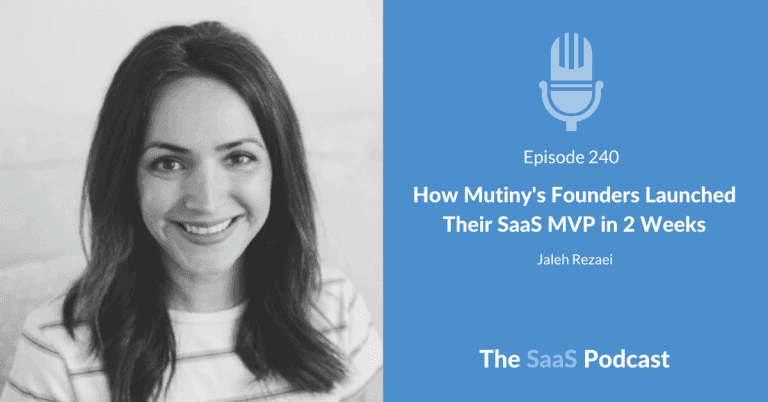
In this episode I took to Jali Razai, the co founder and CEO of Mutiny, a SaaS product that helps B2B companies personalize their website for each visitor in order to close more sales As a product marketer at VMware, Jolly got to work with a lot of salespeople and soon realized one thing that made the difference between great salespeople and average ones.
The best salespeople knew how to adapt and personalize the conversation for each customer and so they were more successful at closing deals, which typically at VMware, were worth over $100,000.
In 2011, she joined Gusto when they only had around 10 employees.
With an average deal size of just $500, Jolly had to quickly become really good at online customer acquisition.
She wondered if she could create a more personalized experience for people who visited their website, but quickly realized how hard that was with the tools available to her at the time.
So when she eventually had the chance to solve that problem, she jumped at it.
Jalet and her co founder were accepted into YC and built their MVP in just two weeks.
It was a simple API and a pitch deck.
They didn't even have a demo to show people at the time.
Now it's hard getting prospective customers to use your product even if you don't charge for it.
They have to learn how to use the product, which requires a time commitment.
And since you're just starting out, they don't even know if your product will actually help them or not.
So the founders decided to get really hands on with their early adopters.
They worked as an extension to their teams to create content, help them launch and measure the results.
It definitely wasn't scalable, but turned out to be a great way to learn about their customers and find product market fit.
To date, the founders have raised over $3 million.
There are some really good lessons in this interview.
For example, you may have a big idea, but you don't have to take months or years to launch an mvp.
Think big, think, but start small.
Jale, welcome to the show.
Jaleh Rezaei (02:37.660)
Thank you for having me.
Omer (02:39.660)
So let's break the ice.
I like to ask my guests what quote they have that inspires or motivates them or gets them out of bed.
Like, do you have one to share with us?
Jaleh Rezaei (02:48.380)
You know, I immigrated to the US from Iran when I was in 8th grade.
And when we moved here, we didn't really know the language.
You know, our family didn't have that much money.
And a lot of kind of basic things that you take for granted were just really different about the environment.
So in Iran, you grow up playing music, and, you know, here girls played sports.
And so when we had first moved, I realized that I felt really small and afraid because I just wasn't very familiar with the terrain.
And at some point, I came across this Eleanor Roosevelt quote.
It goes something like this.
You gain strength, courage, and confidence by every experience in which you stop and look fear in the face.
And I decided that that was a motto that I wanted to take on and that I was going to face everything that I was afraid of.
And the big thing for me early on was I really liked physics and math, and I wanted to study mechanical engineering.
And Berkeley was close to where we lived, and I was just obsessed with going to Berkeley.
It was this big, scary goal for me, and I ended up really facing that and ended up getting in on a full scholarship there.
And I think over time, by having that mentality, that fear got replaced with confidence.
And I started to develop this muscle that just sort of devoured every time I faced an unknown or a scary problem.
And so, you know, now whenever I'm in a situation where I don't know what I'm doing, which is very often, I remind myself that, you know, while I don't know how to address this particular situation, I do know how to do things that I don't know how to do.
And that brings me a lot of peace, confidence, and it's something that has been extremely helpful as I've built my career and especially as I've built Mutiny.
Omer (04:47.910)
That's a great story.
And I kind of wonder if you went back to that girl in eighth grade and said, hey, you're going to be the CEO of a tech company and pitching to VCs and raising millions of dollars and doing all of this stuff, Would that have seemed like something achievable?
I don't know.
Jaleh Rezaei (05:05.590)
Yeah, I think I grew up with a lot of ambition.
My mom and dad, they're both chemical engineers.
And one of the things that my dad did when I was young is he would always solve these riddles with me.
And he would always remind me, like, hey, this riddle book is for kids that are five years older than you, but I really think that you will be able to do it.
And he would work with me, ask me questions, push me on things until I would be able to solve the riddles.
And then he would remind me like, wow, that was for someone that was much older than you.
Great job.
And so I think I grew up with this sense of if I work really hard, I can achieve things that seem like they're out of scope at the moment.
Omer (05:57.660)
Yeah, I love that.
And you know, as a parent, I wish, you know, we were able to do that with more kids to help them to grow up and sort of have that sort of belief.
So.
But anyway, I guess we should talk about SaaS as well, right?
Jaleh Rezaei (06:13.100)
Yes, definitely.
Omer (06:14.680)
So tell us about Mutiny.
So what does the product do?
Who's it for?
And what's the big problem that you're helping to solve?
Jaleh Rezaei (06:22.280)
So we help B2B companies personalize their website for each of their visitors or their target accounts in order to close a lot more sales.
So, for example, a website that's personalized with Mutiny will show enterprise companies a different call to action.
Maybe request a demo versus a startup will see the option to start a trial, and the logos will adapt to that visitor's industry.
And to give you a little bit more context on kind of the bigger problem, personalization is one of the most proven and important strategies within B2B.
Because in B2B, you're selling the same product to different people.
And based on who is buying the product, the way that it's messaged and sold is extremely different.
And B2B companies have been personalizing that process from, you know, forever ago, using sales reps to kind of understand the customer and adapt.
And now the interesting that's happened in the past few years with SaaS and with the growth of a lot of online platforms, is that the majority of those customer interactions, about two thirds of them, have shifted online.
And everything that's online is completely generic and often doesn't really resonate.
Often it doesn't even make sense when a customer or a prospective buyer sees it.
And the result that we see is that companies have extremely low conversion rates, sometimes as low as 1%, sometimes even lower than that, for instance, on their website.
And so the problem that we are solving here is helping B2B companies be able to bring that same level of personalization and resonance to their digital buyer experiences.
We're starting with the web, which is a really critical channel, and then building a platform that helps people personalize the entire experience, regardless of the channel.
Omer (08:26.060)
So I think most people get, you know, personalization with Netflix, you know, you, you, you kind of log in.
They know what you've been doing what you've been watching or Amazon.
Right.
Those kinds of situations are kind of.
The personalization is kind of pretty straightforward, but it's not straightforward but to understand.
But with the case of Mutiny, you're talking about people coming to a website, a homepage, they're not logged in.
So just kind of at a high level, can you just explain to us like how it works, like how you're able to help companies personalize the website?
Jaleh Rezaei (09:01.060)
For each visitor, we integrate with a variety of different data sources in order to understand what company that visitor is coming in from.
So, for example, IP data helps us identify the company and characteristics of that company, such as the number of employees that they have or the industry that they're coming in from.
We integrate with Salesforce, which allows us to understand what stage of the funnel is this particular visitor in.
We can integrate with advertising data so we can see what are the search terms that this particular visitor has come in from and therefore what type of problem might they be looking to solve when they have arrived at this website.
We look at things like location, etc.
We integrate with first party data platforms such as Segment, which allows us to get access to information that a user that has previously signed up has given inside of a signup form, for example.
And all of these data sources are assembled into a user profile within Mutiny, and we then allow our customers to use that data to create a segment.
So they might say, I want startups to see something different than enterprises when they come to my website, or I want financial services to see something different than healthcare companies.
And then we give them a visual editor that allows them to change any part of their website.
And we have analytics built in so we can show them exactly what is the impact of a personalized experience.
Because we show folks both the personalized and the non personalized experience.
And that was kind of the very first V1 of mutiny.
This idea that we can let anybody, any marketer, without any engineering effort, be able to completely change their website experience for different buyers.
The thing that I'm really passionate about is this idea of helping people with not just the science of personalization, but also the art of personalization, which is things like, well, which segments should I be prioritizing?
Which groups on my site require the most attention?
How should I be personalizing the experience for them?
What are the best tactics?
That's something that we built into the later release, as we actually released this at TechCrunch Disrupt last year, which is this idea of automatic recommendations.
So we're constantly Evaluating the customer's website and surfacing concrete recommendations based on the performance of their website, as well as based on aggregate trends that we're seeing in personalization across B2B customers.
Omer (11:51.240)
So how did you come up the idea for this business?
Jaleh Rezaei (11:55.160)
Well, one day I was in a conference room and it just hit me.
The idea came from years of, I guess, B2B marketing experience.
So my first big chapter was at VMware.
I was in product marketing, marketing organization.
We worked really, really closely with the sales team.
And the thing that I learned there in working with our best sales reps was that the really great sales reps knew how to adapt the conversation to the customer.
And we ultimately studied this, and we figured out how to help the broader sales organization be able to apply personalization.
So we developed many different versions of our pitch deck based on, for example, like industry that the customer was in.
And we started talking about solutions and pain points and really mapping that to the customer.
And this worked incredibly well for us.
And when I then came to Gusto.
So I joined Gusto when It was about 10 employees, and I left around 500 employees to start Mutiny.
But when I joined Gusto to lead all marketing, I felt that applying this tactic of personalization was really important for us within our funnel because we were serving small businesses, you know, across the United States and restaurants and lawyers and startup founders.
They were all great fits for our product.
But what they were looking for from us was really different.
And that's when I realized how hard it was to apply personalization to, to an online experience using the technologies that were available, you know, and for us, I think the big pain point there was that Gusto's average deal size was around $500.
So very different than, you know, VMware's that was over $100,000.
So we couldn't really even leverage sales within our buying experience.
A lot of things had to be done online, and there wasn't really an easy way to understand our customers and in real time change for them.
And so we started to piece a lot of things together with landing pages.
So we showed, for example, at some point we had like 50 different unbounce pages that would show the customer the right incubator offer based on which incubator they were coming in from.
And it was really hard to assemble all of that and to measure the impact of it.
And we started to develop a growth engineering team and built our own personalization features for different parts of the funnel.
And after doing that for a while, at some point it started to hit me that here we were, and these different personalization features that we had built, regardless of which channels they were applied to, and regardless of what the specifics of it was, we would see lifts of 30%, 50%, 100%.
And I didn't have a scalable way to apply that to my entire customer acquisition funnel.
But whenever we did, it would have this huge lift.
And then in contrast to that, you know, I would look at our channel mix, and one of our biggest channels was AdWords.
And, you know, we had multiple people working on it.
We were paying millions of dollars to acquire customers, and it was generating about 10% of our customers.
And I think, you know, once I got this sense for what is, what does personalization look like in a digital file funnel and how to build it, and what's the impact?
And I could compare that to what else I had available to me as a marketer for growing my business, that's when the aha moment happened for me.
And I realized, like, wow, this is something that every B2B company is going to need.
While Gusto is sort of at the leading edge because our deal sizes are so small and we're forced to be really good at online acquisition, every other company is probably feeling the same trend of wanting to create more engaging experiences with their customers and having conversion rates that are dropping over time, cost of acquisitions that are rising over time.
And so I started to talk to different CMOs and different heads of growth to get a better sense for was this an anomaly or did they feel similarly?
And after those conversations is when I got really, really excited that at some point I just couldn't stop thinking about the business and just felt like I had to go and build this and that I had a good sense for how this could be done.
Omer (16:45.870)
Okay, so how did you get started?
Like, when I look at this product, I can see, like, there's a lot that, you know, you've already built, and I'm sure you have a vision to do a lot of more to kind of really grow this product.
But what I think a lot of people struggle with at the start is like, okay, yeah, I probably now I need to do an mvp, but what does that really look like?
Especially when I'm kind of trying to go out and serve enterprise customers and there's certain expectations and, you know, there's certain problems that I need to be able to solve really well.
So how did you approach that and kind of get.
Get out of the gate with the right product?
Jaleh Rezaei (17:29.979)
We got started by doing a little bit of upfront work to figure out which channel we wanted to apply personalization to first.
And we kind of looked at okay impact for the customer in terms of their bottom line, which we measure as revenue or leads for marketers.
We looked at what would allow us to build a product more easily and still be able to deliver a lot of value to the customer.
And then we also looked at where we saw a hole in the market and where we thought customers could adopt our product much more quickly.
And on the impact front, we had done a lot of testing with personalization in different channels, and it really works across the board.
So that didn't necessarily whittle down a lot of the options for us, but the combination of where can we build the best product, and there is a big gap in the market, and we think there'll be a lot of interest for us, ended up percolating around the web.
So the web is a really great place because you can get a lot of different data sources.
And in B2B, a lot of companies, there's not really a clear owner for the web, but it's a really strategic channel because all of the visitors and customers eventually are going to go through the website.
And the way that we approached building Mutiny meant that we could add a simple line of JavaScript to the website, and it wouldn't require our customers to displace anything, such as their content management system or analytics platform or whatever else that they were using.
So it was kind of this perfect intersection.
It was a very starting point, very easy to get started, but it would also yield a really great product for us.
Omer (19:28.190)
All right, so just having a JavaScript snippet in there is great.
That kind of makes it easy for anybody to be able to add that to their site.
What did that first version of the product do?
Jaleh Rezaei (19:38.110)
Well, the very first version of the product, which we released in two weeks, was basically an API and a slide deck in my face.
So, you know, I went, I would do a demo, and I was very focused on what can that particular customer do on their website and what were the types of things that we could help them achieve.
And then they would say, can we see a demo?
And I would say, no, you can't really see a demo unless you like looking at a black screen and a console.
And so I think the lesson there is we got to market really, really quickly.
So we started Mutiny about a year and a half ago.
So this is June, and we started basically Day of Y Combinator is when we started, like, really building the product in earnest.
And we released our MVP two and a half weeks later.
So I think it was the third week of YC where we released that and we sold our first customer about one to two weeks after that.
Omer (20:40.770)
So how did you find that first customer?
And like, two and a half weeks is a really short space of time to sell a product to an enterprise.
So who was that customer?
And did you have an enterprise customer in mind when you started out?
Jaleh Rezaei (20:58.530)
We started with companies that either we knew from our network or other companies that had gone through YC before that we thought could be an interesting fit.
So we built a very short list of folks and reached out to them for product feedback.
That's how we found our very first customer.
I think a lot of our early testing was about figuring out where are we going to be the best fit, is it seed stage companies, is it mid market, or is it enterprise?
But in that very first few months, it honestly was just valuable to have somebody use the product so that we could see how were they using it, what were the workflows, and we could leverage that knowledge as we were building this user interface.
So one of the things that we did at Mutiny that I think was extremely valuable that a lot of founders ask me about this is we were very, very hands on.
So rather than building product for, you know, 6, 9, 12 months and then releasing it and seeing if people liked it, we built the very bare bones and then we approached the customer and said, okay, here's, here's the problem we solved.
Do you have this problem?
And if they agree that yes, I have this problem, I'm serving a lot of different audiences and my conversion rate is not good and I want to give them more tailored experiences, then we would help them and say, okay, well we have a platform and we're going to be really hands on and walk you through this whole journey, help you create the content, help you launch the experiences, help you measure it.
And one, we kind of needed to do that because the product wasn't fully built out to let the customer do all of those things.
So they needed a lot of hands on help from us.
But the reason we purposely chose that strategy was that I knew personalization was really hard for people and it was an idea that a lot of folks had talked about.
But for some reason most people don't end up personalizing their site.
So clearly there is a lot of obstacles and in the way, and learning those obstacles firsthand by being essentially an extension of their growth or personalization team would be just really, really valuable to our product development.
Omer (23:20.510)
Process.
Jaleh Rezaei (23:21.550)
So to give you an example, we realized very early on the interdependence between analytics and making decisions around personalization.
And so, so for a lot of our customers, we thought, okay, great, so choose, just tell us which industry you want to personalize for and we'll get that launched.
But what we realized was that they actually had a lot of questions about, well, where do I start?
And they would need to pull a lot of data and understand what are their larger segments, look at conversion rates and make some comparisons.
And that process was all done in Google sheets and it would take several weeks.
And so from that we learned exactly what that initial interdependence is around being able to make a choice for personalization segments.
And we productize that.
So very early on we built into the product UI all of the analytics around the different segments.
And that was something that it probably would have been years before we really understood that had we not been so hands on and just watching what our customers were doing manually and then thinking about, okay, how can we automate this for them and make their lives easier?
And there's probably like dozens of lessons like that that allowed us to build a better product, but also not waste a bunch of time building the wrong UI for them when they actually needed help with something else.
Omer (24:51.780)
Yeah, I think what you just said there was gold.
I've talked to many founders who kind of starting out and they'll say, you know, I kind of got this MVP and I kind of got people to agree to use the product.
And then when I followed up with them a month later, it was like they hadn't done anything or, yeah, I didn't have the time or whatever.
Right.
And there was three things that you said, I think, which are really sort of powerful sort of takeaways here.
Number one is as obvious as it sounds.
Are you clear about the problem you're solving?
And when you're talking to potential customers, are you checking to see that they actually have that problem right before you're trying to kind of impose the product onto them and say that you should absolutely be using this?
The second thing was, if you're not getting engagement with these customers using the product, then it's also about, well, is this because, you know, the product is hard to use, it's kind of early stage, it's kind of not polished, and is that just difficult for them?
They can't get their heads around that.
And then thirdly, do they really know how they can use the product to actually get the results and solve the problem?
And I think you kind of addressed all of those by basically saying, you know, we'll kind of be an extended part of your team and we'll help you get this thing up and running, we'll help you kind of figure out a plan.
And it was almost like a, you know, we're going to kind of do provide a, kind of a consulting service along with the product and it's totally not a scalable thing to do, but this is the best way we're going to learn.
Jaleh Rezaei (26:26.320)
Yeah, absolutely.
You know, we have an internal rule that anything that blocks our customer from having a really successful personalization program is ultimately our responsibility and we need to figure out how to help them solve that problem.
And so our team operates with this extreme empathy for where the customer is at and what they need from us.
And we've never created space to kind of walk away and say, oh, the customer.
I can't believe they don't know how to do this because that's a product feature immediately.
Why don't they know how to do this?
How can we make it more clear in the user interface?
Is there something that, that we can be doing in terms of content that can help them solve that problem?
Omer (27:17.000)
So a big part of what you've done to grow this business has been around using account based marketing to find and grow customers beyond, you know, reaching out to people within your network.
Can you kind of walk us through that in terms of, you know, how, how did you go about, what was your approach to ABM and maybe some of the lessons you learned along the way?
Jaleh Rezaei (27:39.360)
Yeah, absolutely.
So ABM has been extremely effective for us.
Our ACV is such that we can do account based marketing.
And account based marketing is really fun because you know who the customer is and therefore you can be a lot more personalized in the, in the outreach.
So the way we approached ABM was we created a list of companies that we felt were a good fit for us.
I think in the very early days we weren't quite.
There was some variance in that.
So we tried to expand the list a little bit.
If we thought someone was maybe too small, we still included them.
And if we thought someone was maybe too big, we still included them.
And we didn't put any restrictions around industry or business model because we wanted to see where we were getting a lot of traction.
And then we started to reach out to these customers using our own ABM product.
So we have the ability to create one on one personalized pages by plugging into either a CSV or Salesforce.
And so Everybody that was within our ABM program, we would create a one on one personalized page that would basically introduce Mutiny to them.
So we would reach out to customers and use Mutiny to introduce them to Mutiny, which is a little meta.
But it worked pretty well for us.
We started by just doing email and learned a lot about how to not get stuck in spam filters and things like that.
You know, apparently you can't just like dump 5,000 contacts and and email them all in one day.
And so there was some optimization around making each channel work and figuring out how to increase our response rate.
And then we layered in LinkedIn, which worked really, really well for us.
So today we have about an 8% demo rate, so from people who receive information from us within our ABM program to them, you know, booking a call with us.
And it varies a little bit depending on the exact campaign, but roughly that's where we end up.
Omer (30:00.310)
That's 8% from cold email or 8% from once they've already engaged with you.
Jaleh Rezaei (30:05.510)
From cold.
From completely cold.
Yeah.
And half of that comes from LinkedIn.
Omer (30:10.710)
Interesting.
Jaleh Rezaei (30:11.750)
Yeah.
And so LinkedIn was a really valuable channel for us because email alone was a lot less effective.
So doing LinkedIn alone and doing email alone, you know, each of them would generate just a couple of percentage points.
But when we would put them together and we could reference the outreach from one channel and the other channel, then we saw that synergistic effect.
And the thing that we're now adding in is an advertising layer.
And so, you know, we do retargeting, but we're now building out a much more sophisticated education and ad layer that starts before our outreach even starts, and then continues through the sales process to continue to get that customer information, case studies, ROI materials as their journey with us matures.
Omer (31:07.030)
Okay, so if I understood this correctly, you're starting to run ads before you email them or reach them on LinkedIn as a way to basically warm them up a little.
And then you're using a combination of email and LinkedIn to do the outreach.
And then there's some follow up with retargeting as well.
So there's kind of like multiple touch points that these people are getting.
Jaleh Rezaei (31:30.880)
Yeah, absolutely.
And I think that's something that works really well for abm.
For a company like Gusto, it can actually be really expensive to turn on so many channels for the same customer.
And so a lot of our strategy at Gusto was almost the opposite, was we would try to get in front of the customer with a rapid set of messages.
And in a short sequence to see if we had spotted somebody who was interested at this point in time and if they weren't, it wasn't cost effective to continue to nurture them and to pay for each one of those touch points.
Whereas with abm, the idea is that you've been really thoughtful about how you have curated your contact list, Right.
You're picking companies for whom you solve a real problem.
You've done some research, you've put together the list really thoughtfully and your deal length or sales cycle is long enough where you do need to be in front of that customer for kind of consistently for some period of time so that you can catch the right sales cycle and so that you can kind of start to build that relationship.
And because your deal sizes are higher, you can afford to spend more time and effort on every single one of them in order to give them this higher touch experience.
Even digitally prior to them engaging with you, you on the sales side.
Omer (33:01.340)
And you had these, you know, this list of companies.
How did you figure out like who in the company you were going to do the outreach with?
And, and presumably there were like multiple people in every organization that you would target.
Jaleh Rezaei (33:14.940)
Yeah.
So multiple people within a company.
The titles that buy Mutiny has always been pretty straightforward.
We, it's the cmo, it's the head of, you know, account based marketing, and it's typically either the head of acquisition or someone on the acquisition team.
So those are the folks that tend to be involved within our deal process.
So we just took a look at that and created, you know, search terms that map to the titles that we were already seeing within our sales process.
And we add two contacts per account.
But I actually think increasing that even more would be even more helpful, especially once you add advertising, because you do want to get in front of more people within the marketing organization.
And ABM platforms do a really good job.
So like clearvet X, you know, there's, there's terminus, there's demand based, there's a lot of different advertising platforms that let you get in front of a particular account and the marketing department or whatever department you want within that account so you can be super targeted in your outreach.
Omer (34:21.660)
And once you send these people to a personalized page, like let's say a CMO of a company, what do they actually see on that page?
Jaleh Rezaei (34:30.540)
So for using our one on one personalized page, they'll actually see a fully custom page for them.
So it would say, hi Joanne, meet Mutiny.
As the head of abm, these are the problems that we think you're facing, you know, you have 23 sales reps and you are looking for ways to scale your own ABM program.
You advertise on, you know, LinkedIn, Facebook and Google.
And you know, you're probably looking for ways to increase your conversion rate and things like that.
So we lay out a very custom problem statement that incorporates the data about that customer and then we explain how our product can solve those problems for them.
And this is all laid out within our ABM landing page that gets personalized per account.
Omer (35:21.420)
Got it.
Okay.
Makes sense.
Let's talk briefly about pricing.
How are you pricing the product today?
Jaleh Rezaei (35:27.260)
We price just standard SaaS pricing.
So we price the product on a monthly basis and our pricing starts at $2,200 per month and it just kind of goes up based on the number of visitors that a customer has.
We're always experimenting with like introducing packages for smaller companies and things like that.
But this is our current like ACV is within that 30k to 60, 70k range.
Omer (35:57.350)
How much did your first customer pay you?
Jaleh Rezaei (35:59.910)
$100.
Per month?
Yeah, you know, I think in the early days it's really just about like getting somebody to use the product.
So we had our standard pricing.
I think our first price was $1,000 per month.
And you know, if we could find somebody who had the need, who was super eager but just wasn't able to afford it in those first few months we were really flexible and I do highly recommend that because the waiting for another month without getting someone touching and using your product is extremely expensive in those early months of starting a company.
Omer (36:42.040)
Yeah, and when you're starting out, it's better somebody pays something for your product.
It doesn't have to be the perfect price.
Jaleh Rezaei (36:48.040)
Totally.
And now that we have a lot of companies using us, we have some really great logos like Brax, Segment carta, trip actions, etc.
Now we have have a reputation where we can, you know, we can justify and we actually don't really do any discounting and we kind of have like a price point and we simplify that decision process for the customer, but certainly not something we could do and they want at Y Combinator.
Omer (37:16.850)
Yeah, totally.
Okay, I think we should wrap up and get onto the lightning round.
So I'm going to ask you seven quick fire questions.
Just try to answer them as quickly as you can.
Are you ready?
Jaleh Rezaei (37:27.980)
Great.
Omer (37:28.540)
Okay.
What's the best piece of business advice you've ever received?
Jaleh Rezaei (37:31.820)
You know Bogomo Balkanski that I used to work with at VMware, he's now a partner at Sequoia.
He taught me not to ask questions if I wasn't going to like the answer.
And what that means for me is like if you have conviction that something is right and you know that asking for permission will lead to a no, then asking means kind of a hard stop and you have no path forward.
So you might as well find some other scrappy way of making progress before you ask that question.
Omer (38:00.920)
I like that.
What book would you recommend to our audience, and why?
Jaleh Rezaei (38:04.200)
Thinking Fast and Slow.
I think especially as you know, I've grown as a leader and have managed larger and larger teams.
Understanding how people make decisions, how ourselves make decisions in different situations, is really valuable.
And I think Thinking Fast and Slow is probably one of the best books within this category.
Omer (38:27.210)
What's one attribute or characteristic in your mind of a successful founder?
Jaleh Rezaei (38:30.890)
The wisdom to know when to give up on something and when to push harder and to basically do the former with extreme speed and the latter with a lot of creativity.
Omer (38:42.490)
What's your favorite personal productivity tool or habit?
Jaleh Rezaei (38:45.530)
I don't have a lot of hacks like that, but I would say one thing that works really well for me is doing things in serial versus in parallel.
Omer (38:55.010)
What's a new or crazy business idea you'd love to pursue if you had the extra time?
Jaleh Rezaei (38:59.170)
I don't know.
It would probably be something at the intersection of neuroscience and psychology, which is what I like to spend a lot of time on in my.
Any free time that I have.
Omer (39:11.010)
What's an interesting or fun fact about you that most people don't know?
Jaleh Rezaei (39:14.290)
I am obsessed with film and comedy, and I've been making these really silly, bad, short films since I was really young, since I was like five or six with my.
With my cousins.
And then that's kind of continued a little bit.
It's something that I do with my friends and something that I hope to bring into.
Into the Mutiny brand in the future.
But hopefully we'll make good ones and not just bad, homemade ones.
Omer (39:39.040)
Well, if it sounds like you could always become a YouTuber, I guess
Jaleh Rezaei (39:45.120)
we'll see.
Yeah.
Or Instagram celebrity, right?
Omer (39:50.020)
And finally, what's one of your most important passions outside of your work, Friends and family?
Jaleh Rezaei (39:55.060)
I think people are really important to me, and for me, I strongly believe that work should be your second priority.
I think when it's your first priority, you end up becoming kind of one dimensional with not a lot left to give and inspire.
And that's something that I learned about myself as I've tackled different chapters of my career.
So something that I really recommend to others as well.
Omer (40:22.390)
Great.
Excellent answers.
So if people want to find out more about Mutiny, they can go to mutinyhq.com and if people want to get in touch with you, what's the best way for them to do that?
Jaleh Rezaei (40:34.950)
LinkedIn.
Omer (40:36.310)
Okay.
We'll include a link in the show notes to your profile.
Jaleh Rezaei (40:41.450)
Awesome.
Omer (40:41.810)
All right, Jolly, thank you for joining me.
It's been a pleasure.
I wish you and your team all the best of success.
And, yeah, thanks for making the time.
Jaleh Rezaei (40:51.370)
Thank you so much for having me.
I had a lot of fun.
Omer (40:53.850)
Yeah, me too.
Cheers.