Omer (00:10.000)
Welcome to another episode of the SaaS Podcast.
I'm your host Omer Khan and this is the show where I interview proven founders and industry experts who share their stories, strategies and insights to help you build, launch and grow your SaaS business.
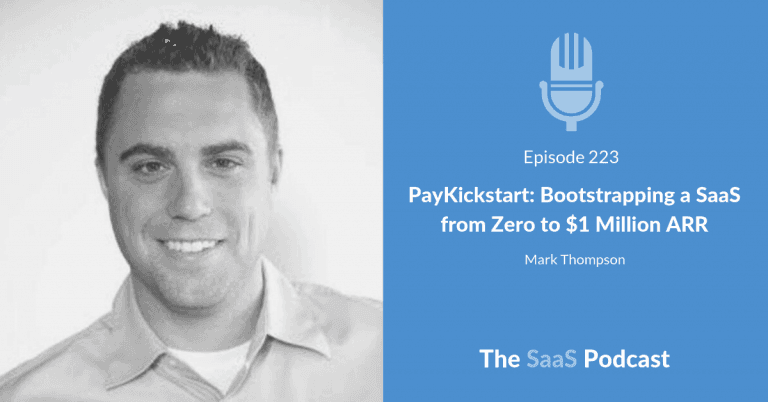
In this episode, I talk to Mark Thompson, the co founder of PayKickStart, a shopping cart and affiliate management platform for online businesses.
Mark got started as an entrepreneur in 2009 by selling online training and coaching products.
A couple of years later, he started getting into building and selling software products.
And over the next few years, he built about a dozen different software products, most of which failed, but a couple of them did well and generated some decent revenue for him.
But one thing that he noticed when selling these products was how there wasn't really a good shopping cart solution.
He always felt that he was leaving money on the table.
He and his co founder Matt tried different shopping cart products, but none of them met their expectations and gave them the flexibility to sell products the way they wanted.
So eventually they decided to build their own shopping cart solution.
And once they started using their internal shopping cart, their revenue started to skyrocket.
Before they knew it, they had colleagues and partners asking them how they could get the same checkout experience for their products.
That was the aha moment when Pay Kickstart was born.
Today, the company is about to exceed a million dollars in annual recurring revenue and is continuing to grow at a pretty fast rate.
But the founders also had their fair share of challenges along the way.
For example, they wanted to build a product that had a lot of functionality and flexibility, but that resulted in a big customer churn problem for them because after signing up, many customers were overwhelmed and confused about how to use the product.
So they also had to figure out how to find the right balance between flexibility and a simple to use product.
And they also had to figure out how to have a better onboarding process.
So in this episode we talk about how they've grown the business so quickly, the importance of being focused, and how they went about solving their customer churn problem.
Hope you enjoy it.
Mark, welcome to the show.
Mark Thompson (02:26.599)
Thank you so much for having me.
Great to be on.
Omer (02:29.079)
So do you have a favorite quote?
Something that inspires or motivates you and just helps us kind of get inside your head a bit.
Or if not, just tell us in your own words, like what gets you out of bed every day?
Mark Thompson (02:39.030)
Yeah, absolutely.
I'm a big fan of Warren Buffett.
I've loved everything, just everything that he represents.
And so I do have a quote.
It takes 20 years to build a reputation and five minutes to ruin it.
If you think about it, you'll do things differently.
So I love that quote.
I'm all about just trying to be as transparent and authentic as possible.
And I feel like if you do that with your customers and your audience, then that's really going to go a long way and really just do whatever it takes to, to make the situation right.
Of course you can't make every single customer happy, but do what you can to make it right.
And so that's really something that I've taken over the last decade of being an online entrepreneur is that my reputation is everything and I want to do whatever it takes to be right.
Omer (03:23.230)
Yeah, Love it.
Actually, it's funny because I was just watching a video of Warren Buffett, I think a couple of days ago.
You've probably seen it.
It's this clip that he was on with Charlie Rose and Bill Gates and it was talking about the value of time.
And Bill was like, well, you know, when I was CEO of Microsoft, I was like, every last minute was scheduled, I knew exactly what I was doing and I'm making the most of that.
And then Warren shows Charlie his diary, which is basically a little paper based pocket diary.
And he opens it up and he's like, oh, next week you have one meeting and the week after you have nothing.
And, and he just, it was so profound when he just says, you know, I can buy anything in the world, but I can't buy time.
Mark Thompson (04:04.380)
Yep, yep.
Omer (04:05.300)
And it's just the guy says things and you're just like, oh man.
Mark Thompson (04:07.900)
Yeah.
And I think it's something you learn later in life.
You know, it's not.
When you're first starting out, you feel like you need to be doing everything yourself and you can't outsource everything.
Warren's just been a great, a great person at delegating and time management.
Omer (04:20.860)
Yeah.
Okay, so let's kind of set the scene.
We're going to get into a lot more detail, but for people who aren't familiar, can you tell us like about PayKickStart?
What does the product do, who's it for, and what problem are you trying to solve for them?
Mark Thompson (04:35.890)
Yeah, so, so Pay Kickstart.
It's a, it's a SaaS application.
What we're trying to do is reinvent the modern day shopping cart and affiliate management solution.
So we work with a lot of online entrepreneurs, online businesses, specifically digital products.
So we work with software companies, we work with information marketers.
Maybe you're Selling a training program, or maybe you're a coach and you're selling services.
That's really our sweet spot.
We're starting to do a little bit more with physical products, but we're not a shopify, we're not a magento, so we really know who our target audience is.
And really anyone who's selling a recurring subscription for a digital product, that's who we're targeting.
Omer (05:15.340)
Got it.
Okay, so before we get into, like, how you guys came up with the idea, tell me a little bit about what you were doing before you launched Pay Kickstarter.
Mark Thompson (05:26.680)
Yeah, so I'll try to give you the Reader's Digest version of it.
So I've been an online entrepreneur for about eight years now.
Before I went off on my own, I actually worked for a few different marketing agencies in the North Carolina area where I live today.
And so I was really just trying to build the foundation for learning how to sell things online, how to generate leads, how to get exposure online.
And that really laid the groundwork for what I do today.
I spent probably five years or so in the trenches helping other local online businesses with everything from search engine optimization to pay per click to email marketing to social media.
And so it was a great learning experience just on the job, in the trenches every single day, trying to figure out what works, what doesn't work, working alongside other online marketers just teaching me everything that I possibly could.
So I was really a sponge for about five years.
And then to make a long story short, I kind of had one foot out the door.
I knew that I always wanted to be an entrepreneur.
I didn't know exactly what it was going to be, but I always had one foot out the door.
And I think my boss at the time kind of knew that.
And that was the last job I ever had.
I got fired from that job.
And when I left, it kind of.
It was a blessing in disguise.
I actually started my own online agency and I was working with other local businesses, but that really opened up time to learn about this whole other side of things, which was how to create a product online and be able to sell it.
I always sold my services.
And so for the past eight years, that's really what I've been doing.
I haven't looked back.
And it's been something that has really helped me to scale.
You know, I couldn't scale the services side of things very well.
And so I always love the concept of being able to create a training program or a piece of software and sell it once or sell it a Thousand times and you know, I could scale it up much easier and being able to sell it 24, 7.
So I really loved that concept, that model and that's really what stuck with me till today.
Omer (07:27.100)
Now Pay Kickstart.
You launched in 2016 and the business is bootstrapped and you've gone from zero to about a million dollars ARR, which I guess about 85, 85k monthly recurring revenue in about 3 years with the bootstrap business, which is awesome.
But this wasn't your first software business, right?
Mark Thompson (07:49.420)
No, I mean there was a lot of stepping stones that led to Pay Kickstart.
So as I mentioned, for probably the last seven or eight, I've been creating lots of different products.
And so I'm not, I'm not a developer, I'm not a designer, I'm somewhat technical.
You know, I can get around WordPress and do things like that, but I can't code.
And so when I first started off I was doing a lot of information marketing.
I was doing, you know, video training programs, teaching people the things that I had learned in the agency world.
And so I started with that and then I learned about more about software and actually hired a software company.
I had an idea, but I didn't know how to execute on it.
So I hired them and, and I paid like 30 or $40,000 to have this piece of software created.
And at the time that was a lot of money for me.
I didn't have that kind of money and so that was a big risk on my part.
And so I created this product and I had this product, but I didn't really know exactly how to go about selling it.
I knew about SEO and pay per click, but I didn't really have a ton of money to spend on paid ads.
And so I kind of learned along the way that you have to find other people that complement what you do.
And so one thing I did find early on, which was another bless disguise was I found a mentor to help me along the way.
And he introduced me to this whole concept of affiliate marketing and finding other people that have an email list of like minded buyers and subscribers and saying, hey, you know, you only pay them if they refer a sale to you.
And I was like, this is great, you know, I mean, so one thing that my mentor was able to do was introduce me to a whole bunch of affiliate partners and they were able to help expose that new piece of software that I created and help make a lot of sales from it.
And I was like, man, I was just, I was hooked after that.
And so I kept on creating new products and programs and started to build my network of affiliate partners.
And that's one of the ways that I started to build my email list of customers was just through other affiliates promoting my products and earning commissions.
Omer (09:50.360)
So how many software businesses did you actually try building before you launched PayKickStart?
Mark Thompson (09:54.680)
I've probably created about 12 different products, different pieces of software, which is a lot.
I don't recommend anybody doing it.
So one thing that I like to think that I'm fairly good at is building systems and being very efficient with my time.
And so I was really good at taking an idea.
And as anyone who's an entrepreneur listening, we all have so many ideas, right?
And it's the ones, you know, we always want to act on all of them, right?
We're always like, oh, this is such a great idea.
I got to go and implement this, right?
And so one thing I've learned, at least fast forwarding to today, is that it's important to try to focus.
And I learned that the hard way.
But back eight years ago, I was just like, oh my God, I have all these great ideas now.
I know how to create software.
I have a team of designers and developers and support staff that can handle all of the heavy lifting.
And so I started just to create tons and tons of software.
And some did really well, right?
And it was kind of that 80, 20 rule.
About 80% of the products just didn't do well.
So it was that 20% that did well.
And those were the ones that I started to create new iterations of and add new features to it and find new marketing opportunities.
And a lot of those products are still with me today.
I've continued to support every single product, but the ones that have kind of risen to the top and have gotten a lot of exposure and people have really enjoyed them, those are the ones that I've continued to expand on and add more features to.
Omer (11:22.480)
So you're not working on PayKickStart full time?
Mark Thompson (11:25.200)
Well, today, yeah.
So we spend about 95% of our time on Pay Kickstart.
So we've shifted a lot of our focus and a lot of our resources towards the evolution of PayKickStart.
That's our long term vision.
That's really what we're working towards.
We do have another side of the company.
So I actually started a company called Digital Kickstart, which is really just a sister company and that really houses all of our other applications and software.
And so we do have some developers and support staff.
And a lot of that business runs on autopilot.
I have someone that manages it.
And so, you know, that's handled for the majority.
You know, unless there's a big decision that needs to be made.
You know, I spend the majority of the time on PayKickStart now.
Omer (12:07.180)
Okay, so over these, you know, four or five years, you built about a dozen different software products.
You had ideas, you were testing them out.
A lot of those products are still around today, but none of them really took off the way that PayKickStart did.
Mark Thompson (12:23.260)
Yeah, well, I think that was one of the mistakes that I made was that I never actually sat down and focused on one of those ideas.
And some of those ideas did really well.
I mean, you know, a couple of the products, we've generated millions of dollars in sales.
And, you know, I had that entrepreneurial bug in me that, where I had that add where I always wanted to create the next best thing.
And I never actually sat down and said, hey, you know, this product is doing really well in the market.
It's serving our customers, and they love it.
Why don't we just continue to expand on it?
And that was something that I learned probably three or four years ago.
And that's one of the reasons that I said, hey, you know, focus on Pick Kickstart.
We know that it has a wide audience, so many people can use it.
We've gotten great feedback from the beta launch that we did.
Let's continue to expand on it and really stay focused.
And that's where we are today.
Omer (13:14.440)
But if you already had a product that had generated a couple of million dollars, what was that product, by the way?
Mark Thompson (13:18.840)
The one was Easy vsl.
So that is a desktop application that helps you to create video sales letters.
So what it does is it takes your video sales script and, and it creates a presentation, and then you can upload your voiceover and then you can sync the slides with the voiceover and then export an MP4 format, a ready to go video sales letter, and then.
Omer (13:41.240)
So why not just kind of double down and focus on that business?
Why start another business?
Mark Thompson (13:46.040)
Yeah, it's a great question.
And that's again, I think one of the mistakes that I made early on was not focusing specifically on that business because it did so well.
One other thing that we noticed was the landscape has shifted a lot.
The.
The development landscape.
So back, you know, God, seven years ago or eight years ago, when we first started to develop Easy vsl, it was.
It's an Adobe AIR application.
So it's a desktop app.
Whereas nowadays everything is mainly SaaS focused.
And so in order to kind of, we'd have to build it from the ground up if we wanted to change it to a SaaS model.
And so, you know, it's always done really well and it's always been a great revenue generator for us.
But one thing that we really noticed when we were selling each of these products was that there was not a really good way to sell our products like a really good shopping cart that kept up with the times.
Right.
There's all these things, like we realized over about a two year span that we lost almost half a million dollars in revenue because we didn't have a built in dunning sequence.
Right.
So about 30% of all transactions, they fail, whether it's from, you know, a credit card expires or there's dozens of reasons why.
And we kind of took a step back and we're like, oh my God, we're losing all this revenue.
And so, you know, we started using different shopping carts and none of them really met our expectations of what we needed.
And so that was one of the reasons that we actually created our own internal shopping cart.
And so once we built that shopping cart, our revenue just started to skyrocket.
We started, we built in a dunning sequence.
We used things like one click upsells and order bumps.
And we found that there was so much that we could do in our existing business to generate more revenue.
And that's what became our passion over the recent four or five years.
There are so many vendors out there that are using these archaic ways of selling online.
And that's one of the reasons that we decided, hey, pay Kickstart is what we want to do moving forward.
It just became our passion project.
Omer (15:44.220)
Okay, so there are two sides to pay Kickstart.
One is the shopping cart and then the other is the affiliate platform.
Mark Thompson (15:53.920)
Yep.
Omer (15:54.720)
For people who aren't familiar with the concept of a shopping cart, I think most people get what a shopping cart is.
But you know, a lot of people listening to this going to be, you know, like yourselves, going to be SaaS founders and they're going to be like, well, you know, I can integrate my SaaS product with Stripe and I'm good.
Why do I need shopping cart software?
How does that help me?
Mark Thompson (16:17.600)
Yeah, so it's a great question.
So what Payck Star allows you to do is just to easily accept payment and manage subscriptions.
So there's a lot of things that you don't think about Whether you're a SaaS founder or you're just selling a subscription service or a video training course, whatever it may be.
There's so much that goes along with selling that product, like behind the scenes.
So obviously one thing you need to do is work with a payment gateway to actually do the processing.
So we integrate with Stripe and PayPal and Braintree and Authorize.net, which handles all of the processing.
But outside of the processing you still need to manage the subscription.
There could be things like coupon code management, right.
If you want to create a discount code or things like one click Upsells where once the payments information is collected from a customer, they can click one time and add an upsell or a cross sell or an add on.
There's things like usage billing and seat billing and affiliate management.
Right?
You want to manage affiliate partners and pay out commission for anyone that they refer.
So there's all these different things that you know, just a payment gateway out of the box doesn't allow you to do.
And so we've added all this functionality to make it super easy where you don't need to be technical, you don't need to have a developer and custom program all this functionality.
Omer (17:35.610)
So in many ways you guys are like when you say shopping cart, it's kind of like a, similar to a subscription management billing platform like a Charge B or Charge if I or recurley like would you compare yourself to those types of products as well?
Mark Thompson (17:53.010)
Yeah, so I think we're a hybrid, you know, I mean we are similar to chargebee, chargify or Curly in the sense that, you know, we can handle the subscription management.
We have a powerful API for Those, you know, SaaS, customers that want to have a totally custom checkout experience or be able to manage the billing.
But then we're also, you know, the affiliate side as well.
So we can manage.
You can, you know, offer commissions for a lead for a sale and then, and again we've added just so much other out of the box functionality.
And I'll give you one example.
So say that you want your customers to be able to manage their subscription without having to contact your support team and say, hey, I was wondering, can you cancel my subscription or can you upgrade my plan or hey, I don't get paid till the 1st, can you go and push out my next bill date till the 1st of the month?
All of these things.
So what we did was we created a customer billing portal where any vendor, anyone selling a product can embed this little widget onto in their membership area, inside of their SaaS product and it handles all that functionality for you, so you don't have to worry about all the overhead of doing all that custom logic and custom development.
Omer (19:01.350)
Got it.
Okay, so let's talk about growth and how you built this business.
So you kind of touched briefly on how you and your co founder is Matt, right?
Mark Thompson (19:13.280)
Yeah, his name is Matt Callum.
Omer (19:15.200)
So how you guys came up with the idea for this product, which is really kind of scratching your own itch and solving a problem that you guys had.
How did you go from zero to a million ARR in three years?
What was the biggest driver of that growth in that period?
Mark Thompson (19:34.800)
Yeah, it's a great question.
And so I kind of.
I think it kind of goes back to our story.
Right.
And so as I mentioned, we had worked with a whole bunch of affiliate partners.
Everything that we've ever done has been bootstrapped.
We didn't have millions of dollars in funding, so we didn't have money to just play with and see what worked.
So the thing that had the least amount of risk was working with affiliate partners, at least in the beginning, and having them promote our products and giving them a commission for the sale.
And so we did that for years.
And so we were able to build a list of about 100,000 customers that have purchased various products from us.
And so that was one of the best ways that we were able to kind of get pay Kickstart on the radar is just tell our internal email list of customers and subscribers about the product.
So that's what initially kind of kick started it.
And we did kind of a beta launch.
We didn't want to rush into it too much, especially because we're a shopping cart.
We're dealing with people's money.
So we needed to make sure that the foundation of our product worked well.
And so that's how we got started.
And so we did some webinars, we did just direct response to emails to a landing page.
We did kind of like a grandfathered pricing, early adopter pricing promotion.
So we did a couple of promotions like that.
We also worked with some other affiliate partners that we've worked with in the past to promote and obviously earn a commission as well.
So that's what we started with early on.
Omer (20:59.520)
Okay, so even though you launched the business in 2016, there was effectively a lot of groundwork going on before that in terms of building that email list.
And that sounds like that list of roughly 100,000 subscribers was the biggest driver of helping you kind of accelerate growth pretty quickly.
Mark Thompson (21:26.950)
Yeah, I mean, it's A different story, right?
I mean, compared to, I'm sure a lot of the other SaaS founders that you've talked to.
Most SaaS founders have, you know, millions of dollars in funding where they can throw a lot of paid media at your product and build exposure that way.
We didn't have that starting out, so we had to kind of be frugal with our money and, you know, reward our affiliate partners and that's just kind of how we came to be.
So, I mean, we're proud of the fact that we're a startup company and that, you know, we're just very efficient with our time and how we expose the product to our market.
Omer (21:59.800)
Do you have SaaS companies using pay Kickstarter for affiliate management?
Mark Thompson (22:05.310)
Yes.
Yeah, we do.
I would say probably about 30% of our vendor base are SaaS companies mixed in with, you know, information marketers, people like in the health space, finance space.
And then we also have some authors and coaches as well.
Omer (22:21.710)
Okay, so I was talking to some members of our community yesterday about affiliate marketing and people had a number of questions and sort of perspectives on how to sort of set up an affiliate program and how much you should pay out and for how long you should continue to pay.
Is it a lifetime thing, is it a one off, etc.
So maybe let's kind of start by learning from your example.
Like, how did you guys structure that affiliate offer when you started out?
Mark Thompson (22:52.760)
Yeah, another good question.
So one of the things that we did was we offered a, an offer on a webinar.
It was like a high ticket.
So it was, it was basically $1,000.
And that got you one year access to our highest plan, which is our premium plan.
And so one incentive that we offered affiliates was, you know, we'll give you 50% commission.
And then after that first year it rolls into our normal monthly plans.
And then after that first year they're going to earn 30% commissions recurring.
That's how we structured things initially, especially because we were a new SaaS platform.
People didn't know us, they didn't, you know, so we had to give away a little bit more.
Now I wouldn't recommend, you know, an intercom or someone who's been, you know, been around the block to just offer 50%.
And you see most SaaS companies, they offer between 20 and 30%, which in my opinion is around.
That's the normal commission for, you know, a SaaS company that's been around and is established.
Omer (23:48.720)
Okay, so you were asking the affiliates to promote an offer for a one year Plan, you know, the top tier plan for about a thousand dollars.
And you were saying if you sell that, then we'll give you a one time payment of $500 and then year two it'll switch to whatever the monthly payment is.
So let's just see like you're, your top plan is like 149amonth right now.
And so then you were like, okay, we're going to give you 30% of that 149 as long as that person continues to be a customer.
Is that right?
Mark Thompson (24:34.420)
Yep, that's correct.
Omer (24:35.260)
Got it.
So number one, like why did you sort of decide to package this up as sort of a thousand dollar offer rather than just saying here are our plans and if you start selling the $149 a month plan or whatever it was at the time, we'll start paying you 30%.
Mark Thompson (24:56.680)
Yeah, there's a few different reasons.
One was just kind of, we know our subscribers really well and unfortunately a lot of the products that they buy are, they're used to buying products at a one time price.
We knew that to make pay kickstart a long term business, there's no way that we're just gonna be able to sell it at a one time price and be able to continuously support it and add new features to it.
We knew this was more of a long term play.
One thing that we did see was, I'm sure you guys are familiar with, with Russell Brunson from Click Funnels.
We know Russell, he's been an affiliate of ours and vice versa.
And so one thing that we saw him do with the growth of clickfunnels was he did something very similar where he wrapped clickfunnels into a 997 offer for the first year.
And so we've noticed that it did really, really well for him.
And so we thought that we could do something similar.
Very similar.
And that's what we did.
Omer (25:46.580)
Okay.
Okay.
Yeah, yeah.
I think Russell has done something really impressive with clickfunnels and I would love to get him on the show at some point to talk about that.
And then also like the other question was like, why did you offer a lifetime affiliate payout?
And again, I'm not an affiliate marketing expert but you know, I'll often hear people saying, well hey, you know, you want to try and limit this to whatever period, but not perpetuity.
So what was the reason behind that?
And for people who are thinking about an affiliate program for their SaaS product, would you recommend they structured in a similar way?
Mark Thompson (26:26.040)
Yeah, I mean we thought it was a better selling point.
Right?
I mean, if.
Omer (26:30.680)
Oh totally, yeah, right.
Mark Thompson (26:31.920)
I mean, obviously if you're, if you're an affiliate and you're like, okay, well I'm only going to get paid for the initial sale and that's it, then there's a good chance that they're not going to promote it.
And so we wanted adoption, really.
And if we don't have anybody promoting it and we're not driving traffic to the offer, then we're a bootstrap company.
So we needed sales, we needed proof of concept, and so we were willing to give up a lot.
And we felt that the program was very generous and we think it is.
And so one thing that we have done, or at least we're in the process of doing, we're redoing our affiliate program.
Because now that the brand is more established, the product is more established, we feel that we can offer a lower percentage and still get affiliates to promote our product.
Because a lot of our affiliates are our vendors, they use our product to sell their own products.
But when you're first starting out, we felt that we needed to make it appealing for affiliates to promote us.
And that's what we did.
And so we tried to sweeten the pot and make it as appealing as we could.
Omer (27:29.210)
Yeah, I guess one way to think about it is getting 70% of $149 a month is much better than getting 100% of nothing.
Right?
Mark Thompson (27:40.980)
That's exactly right.
That's exactly right.
Omer (27:43.860)
Okay, so let's say we've got somebody listening to this who's saying, okay, well, I'm a founder of a SaaS business and I've been thinking about an affiliate program for a while and pay Kickstart looks pretty good.
It's going to take away a lot of the, the complexity for me in terms of being able to bring on affiliates, track what's going on, handle payouts, all that sort of stuff.
But I don't really know where to start.
Like how do I start recruiting affiliates?
What advice would you give them?
Mark Thompson (28:17.000)
So there's a few things.
The first one is we do have a built in marketplace.
So you can list your product in the marketplace and we have about 25 or 30,000 affiliate partners that are exposed to that marketplace.
So they can go in there and they can search by category or what type of offers they like to promote or what their list likes and they can see your product and then they can request to promote and then you as the vendor can either approve or deny them.
So that's one way.
It's just kind of organically we're trying to introduce vendors to affiliates and vice versa.
The other thing to do would be just to be proactive.
Right?
Just obviously just network with people, talk to people in Facebook groups.
I assume you guys are probably on dozens of email lists.
If you're on email lists from other affiliates or other companies, start to partner with them, figure out ways that you can partner with them.
Whether it's a cross promotion or just a one off promotion with them.
Maybe it's like a, we do time sensitive offers all the time.
We'll do like a three day promotion with one of our affiliate partners.
So a lot of it's just opening your ears and listening and seeing who the bigger players are in the market.
And if you're working with vendors, affiliates are just kind of a byproduct of being a product creator.
Right.
If you're a product creator and you are selling that product and you probably have hundreds or thousands of customers, you could and it makes sense, why not work with them and do some sort of cross promotion.
So we did that with a company called Segmate.
They're a Facebook messenger app.
And so we, we actually built an integration with their messenger service so that you could enable segment onto the checkout pages.
So when someone's going to buy your product they can click on the little messenger checkbox and then it can, you know, they can follow up with people through Facebook Messenger.
So those types of promotions work really well.
Omer (30:06.520)
Okay.
Because I'm trying to sort of break this down and think about, okay, if I was looking for affiliates there's kind of like different categories that I can kind of think about and I kinda be interested to know like your thoughts on this.
Like sort of there's one bucket is like probably is my customers or people that I have on my list who use the product, like the product, maybe there's some opportunity there to recruit them as affiliates.
The second one I think might be like industry influencers or companies that are natural partnerships that there's some, you know, win win scenario by them promoting the product or even vice versa.
And then I think there's like this bucket of people who are like, you know, affiliates, like they do nothing but the business of being an affiliate.
And you know, within that, you know, you probably have like super affiliates or people who are like, you know, who have the biggest following and are able to deliver the biggest results on these sort of affiliate programs.
Is that kind of a good way to think about it and are all of those kind of categories of affiliates worthwhile pursuing.
How do you think about that?
Mark Thompson (31:12.800)
You're exactly right.
There are different buckets of affiliates.
A lot of our top affiliates are also vendors.
They're also selling something, a piece of software or information, whatever it may be.
And then there's integration partners.
So the example I just gave you with Segmate, that's an integration partner.
So that could be just more of a long term play.
You know, Segmate is, you know, they'll put us on their integrations page, they'll see that, oh, Pic Start integrates with Segmate.
And so people will find us naturally through that.
There's also like another bucket of marketing agencies, like agencies that are working with clients and they're the ones saying, hey, oh, you gotta use Pay Kickstart, it'll be great to, you know, sell your products.
And so that's another bucket of affiliate partners.
So the type of affiliate partner that we worked with, at least out of the gate, was the people that have already, you know, just an email list and they're working, you know, with, they have customers from products that they've sold.
And so it was kind of an easy win win situation.
We had a list of customers from Digital Kickstart, our sister company.
And so we were able to say, hey, well you know, I think our customers would like your product and vice versa.
And so we could do kind of a cross promotion.
So I don't think there's a right or a wrong way of which type of affiliates you're going after.
Just depends on your business.
It depends on the industry and it also just depends on the relationship that you've built over the years.
Omer (32:33.180)
So having the email list, you know, the 100,000 subscribers running the affiliate program and your experience in already doing that, those things have definitely helped you guys to make a strong start, grow the business pretty quickly.
You also mentioned webinars as kind of one way that you've been saying the product.
But they didn't.
From what I said, they didn't work necessarily as well as you'd hoped, right?
Mark Thompson (33:01.990)
Yeah, they didn't.
We were a little surprised.
You know, we noticed that Russell from ClickFunnels and a few other SaaS companies that were just getting started, they were doing really well.
They're having a lot of success with it.
And we felt that we crafted our offer in a really, you know, a good way very similar to what they were doing.
So we tried to copy that model and for whatever reason, it just never converted that well.
We felt you Know, we had.
We're giving them a year worth of pay kickstart.
We're giving them all sorts of other bonuses, other pieces of software and training programs to give them everything that we felt they need to be successful with the product.
And, you know, to this day, we're still kind of a little, little.
It's a little fuzzy as to why it didn't work.
Maybe just because the product wasn't, you know, it had just launched.
So people were a little leery, especially with a shopping cart, a brand new cart, they're a little leery of saying, hey, well, I trust you with, with my money, essentially.
So I think that was part of it.
The other part was, you know, I think might have been trying to copy to a T a little bit too much from something like what Russell was doing.
So even our webinar sequence was almost identical.
Like, okay, he has a slide about this, let's do a slide about that, right?
So we tried to copy it to a T. And we felt that it wasn't addressing, you know, the challenges and the problems that our audience was having versus what Russell's audience was having.
So, you know, so there was a bunch of different things, some nuances between our webinar and some of the other webinars that were being a little bit more successful.
But one thing that we have noticed over time is since the product has evolved and matured, the webinars that we have been doing have done a lot better.
So I think the fact that there's been a lot more word of mouth, people are talking about it.
They're able to see that we have lots of reviews on places like Capterra and G2.
They can go and see all that stuff.
And that helps with social proof and seeing, okay, other people are using this product, I feel More comfortable using PayKickStart.
Omer (34:56.800)
Got it.
That makes sense.
And when we were talking earlier, you told me that Churn has been a big issue for you and continues to be a challenge.
Tell me a little bit more about that.
Mark Thompson (35:10.240)
Yeah, sure.
So selling a shopping cart and affiliate management solution, it's complex, right?
I mean, you know, just switching to a different shopping cart, that's not an easy thing to overcome.
So one thing that we realized was one hurdle we had to overcome was like, hey, I love your shopping cart.
I want to use it, but I have all of these other existing subscriptions in another shopping cart that I'm using.
Like, how can I start using your cart and make it a smooth transition?
So that was one problem that we faced early on.
And so one thing that we did add later on, probably about a year and a half after we had launched, was the ability to import subscriptions from, say, Stripe or Braintree or whatever payment gateway they're using into PayKickStart.
It's a seamless transition.
Their customers won't know any different.
And the subscription is now inside of PayKickStart and they can use all the features and functionality that we have to offer.
So that was one hurdle that we really had to overcome early on.
And again, the other thing was with social proof as well, just people are like, well, hey, I know you're brand new.
Are you guys going to be around in six months from, from now?
Right.
And I think people are seeing that, you know, we're here for the long haul.
We've been around for, for three years now and we just continue to have an aggressive roadmap with new features and functionality.
So I think people are starting to see and people are more confident with using our solution.
So there was definitely some challenges along the way that we had to overcome, especially early on.
Omer (36:33.100)
So those types of, they're not necessarily churn though, right?
I mean, I describe them as like onboarding or sales types issues and they're completely valid that you need to deal with.
But in terms of once you've got a customer on board, how do you keep them and what have the challenges been for you?
Mark Thompson (36:49.270)
Yeah, so, you know, when we created PayKickStart, we wanted it to be flexible but simple to use.
And so that's always been a challenge for us.
So there's so many different scenarios for how people can use our product.
One thing we never had, at least early on, was an in app onboarding experience.
Really like holding their hand, walking them through, okay, this is what you need to do first.
You need to first create your campaign.
Once you've created a campaign, you create a product.
Once you create your product, you create your funnel.
And so actually it's something we're working on right now and we're getting ready to launch it in the next few weeks.
Is that hand holding, showing them, okay, hey, once you do this, do that.
And we feel that once they get to that first value and they start selling their product, then that's when they're going to have that aha moment and they're going to want to stay.
Whereas, you know, when we were first early on, we got so caught up in, you know, people saying, hey, well it'd be really cool if it could do this.
It'd Be really cool if it could do that.
And so we got caught up in adding more and more features.
The product started to get bloated and it started to be a little convoluted as to what do I do next.
And so luckily, you know, over the last six months, we've again taken that step back and we started to analyze what are our customers doing, you know, like, what do they like about it, what don't they like about it, where are they getting hung up?
And so we've really been focused on how do we get them to first value as quickly as possible.
And so just to address your question about Churn, that was one of our issues with Churn is that people were signing up, they would try it out for a few months and it was just, there was a lot there.
It couldn't do so much.
It's very powerful, but it was kind of hard to figure out what to do next.
And so we feel that with the new in app onboarding experience, as well as with some emails that trigger based on where they're at in the onboarding process or maybe where they're getting hung up, we'll be able to walk them through that entire path and get them the first value.
Omer (38:39.490)
Got it.
Is that something you built in house, the onboarding piece, or were you using a third party product to help you do that?
Mark Thompson (38:47.570)
So, yeah, we looked at both.
We decided to just build something in house.
We tried to keep it as simplistic as possible, and it may be something we migrate to a third party down the road, but we custom developed it in house, you know, and there's basically three steps that we want them to do.
And then we added some reporting as well.
And then obviously, like I said, there's some emails that trigger based on if they've only gotten through one of the steps or two or the whole cycle.
Omer (39:13.470)
And what's the goal?
Where do you need to get them to what's that first value point that you'll feel like, okay, once they get there, they're going to stick around for
Mark Thompson (39:21.710)
a while once they sell their first product.
So once they have their first checkout page live and they make their first sale.
Omer (39:28.850)
Got it.
And how big is the team that's working on this product?
Mark Thompson (39:32.210)
It's about 15.
So there's about eight developers and then there's designer support staff, QA guys.
Omer (39:39.890)
Cool.
All right, so we've talked about the webinars, we talked about the Churn.
Is there anything else that you look back at over the last three years and sort of if you could go back in time, like, what advice would you give yourself and something that you do differently.
Mark Thompson (39:57.480)
Yeah, I mean, God, there's a thousand things that I would have done differently, I think.
Yeah.
The first part was kind of what I just mentioned about getting feature happy.
And we were.
We got so caught up in just trying to implement all of the feature requests that we were getting from customers that we lost sight of what the core functionality of the product was.
And just to make it as easy as possible to use.
So we needed to understand early on that we could.
Couldn't accommodate every single feature request, that it would happen over time.
And so we didn't really have a good system for that.
And so I think that was one mistake that we made early on.
And so that was one thing.
And so the other thing was obviously churn.
Right.
We kept worrying about driving more traffic to the offer and to the website, but if they're not going to convert.
Right.
If our free trial to paid conversion ratio is low, and even when they do get to paid, if the churn rate is 20, 30%, it doesn't make sense to continuously drive more and more traffic to the offer until you fix the churn problem.
And so that was something that we learned the hard way and we needed to flip it in reverse.
Omer (41:04.480)
Yeah.
What is your trial to pay conversion rate right now?
Mark Thompson (41:09.440)
Right now it's about 40%.
We need to get that up.
Yeah.
So I don't know exactly what the average is.
I think it's probably closer to 60%.
So again, there's some things that we're working on over the next couple months to continuously increase that.
Omer (41:24.020)
Cool.
Okay, great.
So we should wrap up here.
So I'm going to move on to the lightning round and ask you seven quick fire questions.
Mark Thompson (41:32.900)
All right.
Omer (41:33.460)
Just try to answer them as quickly as you can.
Mark Thompson (41:35.380)
Sure.
Omer (41:35.860)
Okay.
What's the best piece of business advice you've ever received?
Mark Thompson (41:40.020)
Don't reinvent the wheel.
Just make it better.
So, and also I'm going to add, along with surrounding yourself around talented people who complement your skillset, what book would
Omer (41:50.350)
you recommend to our audience and why?
Mark Thompson (41:52.510)
Zero to One by Pure Thiel.
It provides the blueprint for kind of a new outlook on how to build a business in today's landscape and really how to provide value to your customers.
Omer (42:02.590)
What's one attribute or characteristic in your mind of a successful entrepreneur?
Mark Thompson (42:06.910)
Perseverance.
I'm going to add time management and passion.
Omer (42:11.900)
And on that note, what's your favorite personal productivity tool or habit?
Mark Thompson (42:16.060)
Well, I always like to plan the night before for the next day.
So I use Google Calendar and I have a little notepad and I just mentally prepare for what I need to get done the next day.
Omer (42:25.660)
What's a new or crazy business idea you'd love to pursue if you had the extra time?
Mark Thompson (42:29.980)
That's a good question.
So funny enough, I would love to be like a music producer.
I love music, but I never really learned how to, you know, produce music.
But that would be, you know, I have a passion in music, but if I had the free time to do it, I'd love to do that.
Omer (42:42.430)
Are you a singer?
You play an instrument?
You.
Mark Thompson (42:45.630)
Not at all.
Not at all.
I'd love to just like, like.
So I, you know, growing up in, you know, the, I mean I'm 35, so like hip hop was.
And I don't look like a hip hop guy, but I used to love just, I love like beats and that kind of stuff.
So I love to do that.
Omer (43:02.190)
Love it.
What's an interesting or fun fact about you that most people don't know?
Mark Thompson (43:07.410)
I played baseball my whole life.
So I got a scholarship to play at a Division 1 college and then I tore my elbow, I had surgery and I was never really the same after I had surgery.
And so another blessing in disguise was that I realized that I loved baseball, but I didn't like doing it as a job.
And in college it's basically a job.
And so I'm kind of happy that I actually did tear my elbow and I moved on to other things.
Omer (43:32.970)
And finally, what's one of your most important passions outside of your work?
Mark Thompson (43:36.410)
Yeah, I mean, it might be a little cliche, but really it's family.
I have a wife and a seven year old daughter.
And so really I just, I like hanging out with neighbors, building long lasting friends, specifically outside of work.
You know, I mean, obviously I have friends at work, but sometimes I like to kind of separate from work and be able just to hang with friends.
And I love to travel to new places.
I don't get to travel as much as I used to, but I do get to travel every once in a while.
Omer (44:01.830)
I don't think that's cliche at all.
I'm with you, man.
That's a good way to prioritize life.
Mark Thompson (44:07.830)
Yeah.
Omer (44:08.550)
All right, so thanks for joining me.
And if people want to find out more about Pay Kickstart or sign up for a trial, they can go to paykickstart.com and if people want to get in touch with you, what's the best way for them to do that.
Mark Thompson (44:24.630)
Yeah, they can reach me on Facebook.
Just put in Mark Thompson.
You'll find me.
Or I also have a link to.
We have what we call the revenue accelerators.
So I just wanted to provide you guys with this link.
It's just paykickstart.com SASClub and a lot of what we talked about today is kind of summarized in that PDF where you can find out, like, how we're generating more revenue with less traffic.
So you can go to paykickstart.com sasclub and download that as well.
Omer (44:54.420)
Okay, cool.
We'll include links to both in the show notes.
Mark Thompson (44:59.220)
Awesome.
Omer (44:59.740)
Great.
Thanks for joining me, Mark.
It's been a pleasure.
And I wish you guys all the best.
Mark Thompson (45:03.380)
Thanks for having me.
Appreciate it.
Omer (45:04.900)
Cheers.