Omer (00:10.080)
Welcome to another episode of the SaaS Podcast.
I'm your host, Omer Khan and this is the show where I interview proven founders and industry experts who share their stories, strategies and insights to help you build, launch, and grow your SaaS business.
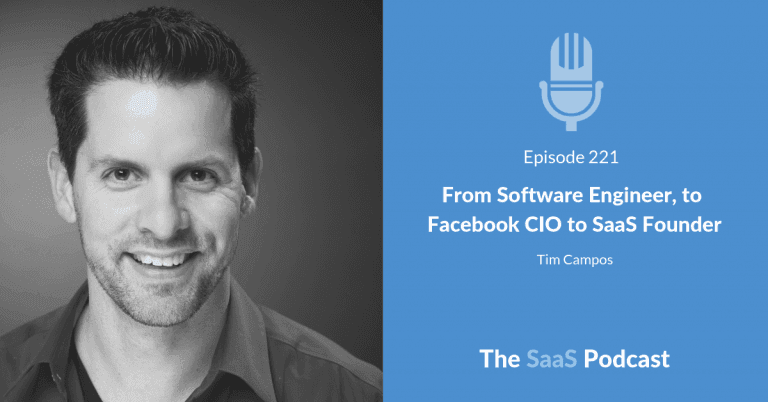
In this episode, I talked to Timothy Campus, the co founder and CEO of Woven, an intelligent calendar to manage your schedule and get the most out of your meetings.
Tim started his career as a software Engineer.
In almost two decades, he climbed the ranks from Engineer to CIO or Chief Information Officer.
And in 2010, Tim was hired as the CIO of Facebook.
He'd only been on the job for two weeks when he was summoned to Mark Zuckerberg's office.
Tim was excited that his CEO was so motivated to get into the details of it that just two weeks in, he was taking time to meet with Tim.
But when Tim arrived, there was no sign of Zuck.
Instead, he was met by a group of executive assistants who wanted to complain about the company's internal calendar app.
They told him that he had to get it fixed in the next week or he was done.
And from that moment, Tim set out to work on designing creative tools that would help Facebook employees easily find optimal times and places to meet.
And Tim's experience managing productivity for the entire Facebook workforce helped him realize that traditional calendars are broken.
And in 2016, he he left Facebook to co found Woven, an intelligent calendar that helps busy professionals maximize their most valuable asset, their time.
In this interview, we talk about Tim's experience at Facebook, why he feels the world needs another calendar app, how he tested different marketing channels to acquire users, and why we should trust Woven with our data.
I hope you enjoy it.
Tim, welcome to the show.
Timothy Campos (02:09.970)
Thank you for having me.
I'm excited to be here.
Omer (02:13.090)
So I always like to ask my guests what gets them out of bed every day, what inspires or motivates them.
Do you have a favorite quote that you can share with us?
Timothy Campos (02:19.970)
Yeah, I was thinking about this.
One of my favorite quotes is plans are useless, but planning is everything.
I think it's Eisenhower quote and what I like about it is it very much reflects, I think, the world today where you have to be able to think on your feet, but your ability to do that comes from preparation.
So just winging it is not the.
The key to success, but expecting that things are going to go exactly as you hope that they would.
It never works out that way.
So that's one of my favorites.
Omer (02:48.440)
Yeah, love it.
So for people who aren't familiar, can you tell us about Woven?
What does the product do?
Who are you targeting and what problems are you trying to help them solve for them?
Timothy Campos (03:00.040)
Yeah.
So Woven is a smart calendar and it is built today for busy people who don't have admins.
But our ultimate vision for Woven is that this is really built for everybody.
And, you know, it's a long history on what motivated us to create this, which I'm happy to get into.
But to cut a long story short, we believe that the time is the most valuable asset that all of us have.
It is the one thing that we are.
We're all given 24 hours in a day.
It doesn't matter how well off or successful you are, everybody has the same amount of time.
So the decisions that we make on how we will spend that time are the most important, most valuable decisions that we can make in our lives.
And we think that there is a significant opportunity to help people make better decisions on that by making time more of an information asset that they can use.
Much like many other systems have made customer information a data asset or people information an asset for companies.
Omer (04:03.080)
So, at the most simplistic level, Woven helps people to schedule meetings, but there's a lot of products out there already that, that do that.
So what is different about Woven and why did you feel like there was a need to build this product?
Timothy Campos (04:22.280)
Yeah, so you're right.
Today our user journeys focus on scheduling.
And.
And that's because scheduling is the biggest pain point that people have with their calendars, but it is by far not the only one.
So one of the very important tenants for us is that we built Woven to address a broad set of user journeys, not just scheduling.
But let's start with what's different about it.
Most companies that have tried to do anything on the calendar have approached it from changing the user interface.
You look at products like Sunrise or X AI, these are fantastic products, but all they really do is they change the UI of the calendar, but they don't really change what the calendar, the data is, the back end of the calendar or how the calendar operates.
And Woven has taken a very different approach.
We built this product from the back end forward, so we still have ui and UI is very important.
But calendars, one of the reasons that they're so awkward to work with is it they're built off of email and they behave like email.
So if I send you an email, once I send that email out, it's done.
If I need to make a change to it, like I mistyped something, I have to send you another email.
If I send you A calendar invite.
And I forgot to include the location.
I have to send you another calendar invite.
And this makes it very difficult to use the calendar invite as a basis for collaboration.
In fact, it's impossible to do that.
And so we don't collaborate on our calendar invites.
Instead, we collaborate in other systems like text messaging or email or other things.
And we.
We don't collaborate on sophisticated things.
What we do is we just collaborate on the time when can we meet or where can we meet, all the other things that go into how we spend time together, like briefing notes or a candidate's resume for an interview, or the pitch deck.
If you're pitching to a VC or the agenda for a staff meeting, all that tends to get handled outside of the meeting.
And that not only creates a lot of additional work, but.
But it removes the collaboration with that content from the occurrence of the event itself.
In other words, if the staff meeting doesn't occur, you don't need the agenda, doesn't matter.
It's a useless document at that point.
If the interview is canceled, then you don't need the candidate's resume anymore.
If the interview is pulled forward, there may be some important context as to why that is relevant for how you're going to approach the candidate.
So.
So the time of when things occur is much more important than we're able to make use of in today's day and age.
And this is ultimately what we're trying to address, starting with scheduling.
And so what we have built is a product that makes scheduling much easier and faster because it's collaborative.
We allow both sides to collaborate on scheduling an event, not just the organizer, but that capability will grow from there to other things in the future.
Omer (07:18.110)
Got it.
So a lot of the scheduling tools out there kind of will integrate with a calendar, like Google Calendar or whatever, and it's kind of used as a way to schedule those meetings and then get that information into your calendar and then you can do whatever you want with it.
There's what it sounds like what you're doing here is you're saying, well, actually woven can become your calendar and it can sync with all those other things.
But probably the way you're building this is that people are going to spend more time in woven doing all these things.
And scheduling is kind of the first part of that.
Timothy Campos (08:02.260)
That's exactly right.
One of the first things that we do that calendar systems is we recognize that people have their time spread across multiple systems.
When I was at Facebook, my work life was in exchange.
That's the calendar technology that Facebook used.
My personal life was in GCal.
Those things don't talk to each other in any productive way.
So if I had a doctor's appointment that I put on my personal calendar, nobody knew about it at Facebook, so I'd have to duplicate that information.
The moven is able to look across accounts so that we can fuse together all of the different calendars that represent your time into one single representation of your life, which makes simple things easy, like, are you free or busy at a particular time?
But it also makes much more advanced things possible, like, how did I spend my time?
Because we can now look across the entire universe of your time.
Omer (09:01.850)
So tell me how you came up with the idea.
Timothy Campos (09:04.730)
This started at Facebook, and it actually started in my second week at Facebook.
I was hired at Facebook as the CIO of the company in 2010.
And my job during my entire tenure at Facebook was the productivity of the workforce.
And I remember two weeks in, I got a call from Anika Goodman, who is the ea, to Mark Zuckerberg, and she said, we have something really important that we need to talk to you about first thing in the morning tomorrow, can you please show up at Zuck's desk at 8am?
And I was really excited because I was excited to be at Facebook.
I was excited to have had the opportunity to interview with Zuck and get to know him, and I was excited that he was so motivated to get into the details of it that just two weeks in, he was taking time to meet with me.
And when I showed up at his desk, I should have realized that he doesn't come into the office before 10 in the morning.
At least he didn't back then.
I was ambushed by all the executive assistants, who gave me a long diatribe about how the calendar was screwing up their lives and if I didn't fix it in the next week, that I was done.
So this created enormous panic.
I just got here and this thing is broken.
What do I do?
And I'd worked with calendaring systems, particularly Exchange, a lot in the past, but Facebook was somewhat unique because of all the Apple devices that it had in 2010.
That was not a very common configuration.
Anyways, to cut a long story short, to solve this, I had to really get into the details of how calendars are built.
And I was horrified.
As an engineer by training and a data person, I care a lot and study a lot.
The data architectures of things and the way that the calendar is built, as I said earlier, being built on top of email just horrified me.
Of course, we were going to have the kind of problems that we were having at Facebook because of this architecture.
But what made it even worse and also then created the opportunity for a product like Woven to be created, is that you couldn't do a lot of interesting things with calendar data because it was so hard to interface with.
A few years after this problem that we had with Zuck and the EAs, when we moved into our Menlo park campus, we wanted to do something simple.
We built all these touch screens at Facebook that would call them wayfinders.
They would tell you where people sit and where the conference rooms are.
And we wanted to include a feature in these touchscreens that would show you whether the conference rooms were free or busy.
Common problem would be, I'm walking around the office, oh, I need to have a quick one on one with somebody.
Where are the free conference rooms?
So by going to this wayfinder, you could see that they'd show up in green.
The information on whether the conference room was free or busy was in the calendar, but there was no easy way to talk to it.
And so we had to build a graph layer that allowed us to connect Microsoft Exchange into Facebook's internal graph so that we could build this tool.
And as we perfected that and made that work, there were turned out there were a ton of different use cases for that exact same technology.
We ended up using this for recruiting.
Facebook does a lot of interviews, particularly for software engineering.
And it's a lot of people, candidates and conference rooms to coordinate.
I mean, literally it's over 100,000, or at least it was over 100,000 interviews a year when I left.
It's probably actually much more than that.
That's too much for a human to handle.
And so we built some automation that would take candidate availability and then it would look at pools of people that can do interviews and pools of conference rooms that are dedicated for interviewing.
And it would for it people, this will make sense.
It basically did an MRP operation which would align all those resources together and come up with a plan for how to get a candidate interview.
And that's what the schedulers would move forward with to schedule.
Saved just thousands and thousands of hours of scheduling time.
We did something similar for our sales organization so that when they would meet with advertisers, that they would have all the information at their fingertips that was relevant prior to the meeting.
That information was constantly changing.
So this information would have to be tied to when the event occurred.
And again, this was very effective for the sales organizations.
And all this Got my co founder and I really interested in the idea that, you know, time is a really valuable asset and people don't have access to it.
Based on how we manage time today, there's a big opportunity to create something different out there.
And that is what gave birth to open.
Great.
Omer (13:33.330)
So I want to talk about, like, how you went through that process, but I'm curious, like these executive assistants told you you had like a week to fix it and you were done, or you were done and you weren't done because you were there for six years.
Timothy Campos (13:48.230)
Yeah, almost seven.
Omer (13:49.910)
So what did you do to fix that problem?
Put the fire out.
Timothy Campos (13:54.390)
Like I said, it required getting into the details of how Exchange was built to understand why we were having problems and without getting too technical.
The fundamental issue was that the way that executive assistants would interface with the calendar through Microsoft Outlook on a desktop often created problems with their principals, who would use the calendar through an iPhone connecting over ActiveSync, which would then interface with how other people in the company might be responding to those calendar invites through Microsoft Outlook on a Macintosh that uses Exchange Web Services.
You have three different protocols, three different platforms that all behave very differently.
And what we had to do is create a set of rules for the admins on what things that they could do and what things that they shouldn't do to avoid problems.
Stupid things like don't create a recurring event that doesn't have an end time.
And you know that the executives were not allowed to accept the invites on their phones.
They had to basically keep their hands off of that stuff.
Omer (14:59.980)
Yeah, I remember back in those days that any kind of syncing with Exchange and iPhone or Mac was.
Timothy Campos (15:07.940)
It's horrible.
Omer (15:08.460)
It's not.
Yeah, it's got a lot better since then.
Timothy Campos (15:11.780)
It has improved dramatically.
Microsoft rebuilt their APIs, particularly when they went to Office 365.
It's still bad.
As part of this journey, which even though we fixed many of the issues in 2010, the calendar dogged me throughout my career at Facebook.
I spent a lot of time with the executives at Microsoft and even the engineering teams to understand why they built the product the way that they did and when they were going to fix it to make it more like a database.
And I realized through this that Microsoft was never going to fix that because Microsoft's roots were in a world where the power was in the desktop.
Microsoft Windows on your PC, and when we go to mobile, we're going to take Windows, we're going to put it on the phone.
Exchange was very much there to support the client, but not to really be a server.
And even in today's day and age, with Office 365 and cloud computing, a lot of the architectural choices that Microsoft made are still there.
So again, that created more motivation to go build something different.
Because if Microsoft isn't going to get it right, then why not me?
Why not our team?
And Google is a different beast.
They have a different set of problems, and they have not repeated some of the mistakes that Microsoft has.
But you still have other problems with the calendar.
Omer (16:30.550)
Now, that story you just shared in terms of getting called to go and see Zuck, you know, the next day, and that kind of issue that we're telling you about, that was it back in 2010.
And so that's when the idea was born that there was something there.
But it took you another six years to get to a point where you left Facebook and started working on Woven.
So what happened in between those six years?
Like, was it just kind of an idea but you didn't do anything about?
Or you just kind of kept thinking deeper about it, but really didn't think of it as business until 2016?
Like, how did you get to a point where 2016 was like, okay, I'm going to go and do that now?
Timothy Campos (17:13.820)
Well, there was a lot of other things that we did.
My core thesis as the CIO of Facebook was that we were going to engineer productivity into the workforce, that we weren't going to just buy it.
So it took a while to fully exhaust all the opportunities there.
And we built a lot.
First we had to build an engineering team.
And I wanted to do that in a way that was very Facebooky.
So our engineers were Facebook engineers.
So we had to create a motivation for a Facebook engineer to want to come work on internal tools.
And then we had to go create some interesting products and we had to have a lot of successes with those.
We did a ton of things, from building our own CRM to a bunch of our own recruiting systems, to really advanced technology for how Facebook handles physical security, how we support advertisers, particularly large scale advertisers.
Some of the data products that we built became products that we sold to customers.
Things like Audience Insights.
I was quite busy doing all this stuff.
To me, Facebook was a giant startup incubator for enterprise software.
I could go and with my team, we could ideate new ideas to make people more productive.
We could build tools that did that.
We would test them with the internal audience that we had.
The things that worked, we would put a lot more investment in to be productized.
And that was a lot of fun.
And so the calendar was always a part of that.
We built a calendar tool, we built a meeting tool, we did a bunch of interesting things with calendar analytics.
And in 2016, I started to think that I was having too much fun doing this just for Facebook, that I'd really like to try doing this for the rest of the world.
And then we started looking at my co founder and I, who worked for me at the time, started looking at what are all the things that we built and what are some of the things that are most applicable to the rest of the world.
And the calendar was the thing that we were most interested in there.
Omer (19:12.360)
So 2016, you incorporated the company and it was just the two of you at that point?
Timothy Campos (19:19.960)
Yep, just me and my co founder.
Omer (19:23.080)
And was the business at that point self funded?
Did you try to raise money?
What happened in that first year?
Timothy Campos (19:29.560)
Yeah, so we knew this was calendars are hard to build.
We knew that going into this, I think we underestimated how hard, but we knew that we were going to need an investment, material investment to make a go at this.
So we chose to raise money.
And I had been talking to a lot of venture firms even before leaving Facebook about this idea.
And in fact, a lot of my conversations started with, I had this idea and I want you to talk me out of it because I'm not sure that this is going to be easy to do.
And so I want you to tell me, I want you to start with the premise I shouldn't do this.
And only if at the end of this conversation, we both are excited about it, should we, should we keep going?
And, you know, after having a few of those where I actually got a lot of investors pretty excited about it, I came to the conclusion that there was an opportunity here.
And so that was our first focus, is get investment for the company and get the right investment base.
And it took a little bit of time.
We got our first term sheet very quickly.
But to complete the close and to have the right level of investment, we took a couple more months, closed that in April of 2017, and then began building the team.
And as we got engineers on board, we could then start building the product.
Omer (20:49.740)
How much did you raise in 2017 for the first round?
Timothy Campos (20:54.940)
The first round, we raised three and a half million from Amplify Battery and then a small syndicate of others.
Amplify Partners and battery ventures were 85% of that investment.
Omer (21:09.260)
And what did you use most of the money for?
To hire engineers.
Timothy Campos (21:12.540)
100% for R& D for product.
So, you know, we put everything into let's build the right product up front.
And we figured everything else will stem from that.
Our general thing was, you know, marketing and brand and all that other kind of stuff is relevant.
But if you don't have the right product, it doesn't matter.
So let's put all our eggs into the product basket.
We also believe that if the product was good enough, then those things would sort of work themselves out.
So we didn't even pick a name for the company for another year and a half.
We had a stealth name that nobody could spell, made it really easy to stay stealth.
And we didn't put any time and energy into brand development or marketing or anything like that.
We just focused on building the product.
Omer (21:58.560)
Okay.
And then the product launched in 2018, and then it was like, okay, we need to get the word out.
Timothy Campos (22:06.320)
Yeah.
Omer (22:06.800)
So I want to.
I want to spend some time talking about what you've done to drive that growth and user adoption and to talk about some of the things that have worked and haven't worked.
So why don't we kind of start by talking about some of the things that you tried that didn't work?
Timothy Campos (22:27.080)
Yeah.
So while we were in product development phase, I was talking to some other entrepreneurs, and I was given this idea that one of the easiest ways to test features was actually not to build them, but just to advertise them to go out and build a landing page for them and see if you get a lot of people to sign up for them.
And this was a crazy idea for me because it was somewhat counter to that idea that we build the product and the product will take care of itself.
But I was finding in the end of 2017 that the product development cycle, particularly for a product that hasn't yet been released, there's still a lot of plumbing and infrastructure and foundational work to do that we weren't learning fast enough.
And so this gave us a really quick way to learn and to make it work.
We would do like Facebook and Google advertisements to drive traffic to these landing pages.
And then we would measure success based on the click through rates of the ads and the conversion rates on the landing pages as measured by people giving us email addresses.
And this was actually super valuable.
And it worked really, really well.
It works especially well on Facebook, surprisingly, but it works well across all platforms.
And we thought that because that worked so well, that when it came to doing product growth, getting users into the product, that we could just use the exact same technique.
And that turned out to be a bad assumption, a false assumption.
Not only was it not the best way to do, definitely wasn't the most efficient way to do it, and it didn't get us in many respects the best users.
So when we launched the product initially we didn't have to do any paid acquisition because we had a fantastic PR agency and marketing team that put together the initial let's introduce Woven to the universe.
And they did such a good job that we got a massive number of users and lots and lots of interest in a very short period of time.
Some of our users did product hunt stuff for us, so we didn't have to do a lot of work in order to get people aware of the product.
But what we didn't do is build the organic growth engine to then keep the momentum going after that initial launch, thinking erroneously that the paid strategy would be the right way to handle that because we would get more control that we could control exactly how much we wanted to acquire users.
And anyways, long story short, that turned out to be a bad.
A bad assumption.
And it took a few months to figure that out, but then pivot back to let's focus more on these organic paths as opposed to the paid paths.
Omer (25:07.870)
So if I understood that the PR launch, when you guys launched the product, got you a lot of media coverage and that helped to get a lot of interest in people signing up for the product.
And presumably there's an interesting story there, former Facebook chief information officer, former Facebook engineer launching this, going to do something with calendars.
So presumably that was kind of a big part of the story there in terms of generating the buzz.
So you get through that and you've got some initial signups and interest there.
Then you start looking at paid acquisition and you tried to use that as a way to test ideas, and that was working.
But you weren't able to do a good enough job to acquire users through those paid acquisition channels.
Timothy Campos (26:06.690)
Yeah, I wouldn't say it had anything to do with the quality of the job that we did.
I think it had everything to do with the quality of the channel.
Omer (26:15.970)
Okay, so let's talk about that.
So initially you looked at paid advertising on a bunch of different platforms from, you know, Google AdWords to LinkedIn.
And eventually you settled on Facebook advertising and it wasn't because you worked at Facebook.
Tell me a little bit about, like, how you went through that process and why you decided you were going to use Facebook as the main channel for.
For testing this.
These.
Timothy Campos (26:44.650)
Well, it was easy because the numbers spoke for themselves, you know, what was the cost of the ads in terms of the cost per click, cost per conversion?
What were the conversion rates, how quickly could we scale and how effectively could we target?
And all of these things favored Facebook.
LinkedIn doesn't have a lot of targeting options, for example, and Apple has even less.
Google has a lot of targeting options, but it takes a long time for Google's algorithms to learn.
So if I'm a large brand like Coca Cola and things aren't changing that much, like Google, I'm sure, is a fantastic product.
But if I'm a startup and I'm, you know, going after needles in the haystack of the web universe, Google just did not perform as efficiently as Facebook did.
But there's a very different objective when you're trying to get feedback from people on what would work for them or what resonates with them, and when you're trying to build a deep relationship with them.
And a calendar product is a very deep relationship.
The first thing you're going to come in when you sign up for Woven Woven is going to ask you for some very intimate things.
It's going to ask you for access to all of your calendar data.
And at present, it also asks you for permission to be able to read your email.
And that's an intimate relationship.
And when people don't know you as well, that's a tall order to ask for all of that stuff.
Moreover, you know, when a calendar product.
One of the natural benefits of calendaring is that it's inherently viral.
Calendar users don't sit there and use their calendars by themselves.
Generally, they meet with other people.
So every time they meet with somebody else is an opportunity for them to introduce your product to them.
But if you're constantly acquiring a set of users that are not necessarily connected to each other because you're going through these paid strategies, it creates a user base which is diverse.
Yes, that's good.
But when you're trying to build momentum, that diversity actually doesn't really help you.
I like to compare this to building a fire, right?
You know, if.
If I am trying to create a fire and I'm in the middle of the forest and, you know, it's cold outside, I don't want to take all my kindling and spread it across the campground and light each piece on fire.
I want to consolidate it together in the smallest concentrated point, and I want to generate heat that I can then grow from.
I can put more logs on the fire when I have enough heat in that one place.
And the paid strategies that we were pursuing were naturally diversifying the breadth of our fire, which is not what we needed in the early days.
Omer (29:20.340)
But interestingly, you said that running Facebook ads turned out to be a really good way to test ideas, but it didn't turn out to be a great way to acquire users.
So why was that?
Timothy Campos (29:33.780)
Going back to the fire analogy, it was a great way of testing where is the kindling, where are the things that I could then burn and to learn from that.
And in that case, you want as broad a perspective as possible.
But when I'm trying to create heat, that breadth is not valuable.
And you're much better off spending your time getting a tighter connection with your users and, in fact, getting your users to get you other users.
And if I were to go back and do it again, I would have focused all the focus that we're doing now on those things.
I would have focused up front, and I would have held off on paid acquisition as a scaling strategy until much, much later and only used the paid acquisition strategy as a way of testing ideas.
Omer (30:17.130)
So give me an example of how you used Facebook ads to test an idea.
Timothy Campos (30:21.610)
So one of the things that we were very interested in early on was what's going to be that hook to get users into a new calendar product.
And we had a lot of different thoughts.
Maybe it's making text messaging coordinating over text messaging easier.
Maybe it's having a map so that travel planning is easier.
And these are concepts that were fairly easy to articulate in visuals or in short videos or in, you know, very brief advertisements.
And we could put those out across thousands or hundreds of thousands of people.
And then we could measure resonance on it.
And like I said, resonance was measured by, do they click on the ad?
If they don't click on the ad, it's not interesting to them.
But we also wanted to put them through an escalating stage of commitment to us without having a product that they would actually sign up for.
And that escalating stage turns out, like asking people for information is a great demonstration of commitment.
Can I have your email address so I can contact you later?
Would you mind filling out this survey to tell me a little bit more about yourself and what you're interested in?
Would you like to do a brief video call to be interviewed for this?
And the better the idea of the product feature, the higher resonance you're going to have on those things.
And that was very insightful and valuable for us.
Omer (31:41.320)
Okay, so when you were testing these ideas, you were able to figure out what kind of resonated you were getting email addresses and things like that.
But when you tried to go kind of all the way and say, okay, sign up for this product and start using it, that's where you found there was more friction.
Timothy Campos (32:02.040)
Not only more friction, but the wrong kind of wrong way to build the user base.
So we have a diversity of users that use woven, but the best users are busy.
The best users meet with at least some other woven users.
And the best users are also generally professionals.
And while you can target some of that stuff on Facebook and Google and other things, a lot of it you can't target.
It's very hard.
There's no advertising cluster for busyness.
It just doesn't exist.
You have to do proxies for other things.
People who like productivity pages might be more busy than people who don't like those things.
But if we're talking to users who use our product influencers, people who blog about productivity and write articles about productivity and make recommendations on products for productivity, they're much more interesting to build out that user base.
In addition, when those users start spending time with each other and we can give them, hey, here's a way to demonstrate the value of woven to another user in a quick like 5 minute setting or 30 second setting, then they start bringing other users into the product.
And when those users come in, there's already somebody for them to meet with where the, the features of the product that are even better when you're doing it with another woven user start to shine.
So that's why I said earlier that if I were to do this again, I would have focused a lot more on that up front, as opposed to prioritizing for diversity and breadth, which might make sense for a company like Facebook when it's putting a new product out into market, but it doesn't make sense for a startup that has a new brand, that has a new concept or a new idea where you, you need that groundswell first.
Omer (34:02.370)
Okay, so paid acquisition channels, Facebook ads, Google, LinkedIn, et cetera didn't really work for user acquisition.
PR gave you an initial boost.
There was some inherent virality with the product, which helped you to acquire more users.
What else did you do to acquire users?
What else are you still doing?
Timothy Campos (34:27.179)
So now the things that we're really focused on that are working for us are threefold.
First off, fishing where the fish are is what we like to say.
Or because we're going after busy professionals, we're very interested in the places that they go and they get their information.
Places like your podcasts, other Podcasts, there are some mailing lists that are out there, and these.
Originally I sort of thought these were kind of vehicles that were not going to be as effective because maybe the audiences aren't big enough or it's email, and who reads email anymore?
But they turn out to be highly effective.
When people take the time to listen to a podcast like this, they're very interested in your content.
And if they're coming back and listening to your content over and over and over again, this is the space that they're constantly looking for new ideas and new tools.
So this is the ideal place to go and talk about Woven.
It's a much more efficient place where we're going to sidestep the people who are not ready to look at new products, who are not ready to think about managing their calendars in a very different way.
So that's the first thing that we found.
The second thing is that the influencers are critically important in this.
The people who have a following.
And as we get them to talk more about the value that they get out of the product, that creates a snowball effect where it just builds on itself.
Then finally, the more that we can do in the product itself to encourage users to get other users, the better.
Some of the stuff we've already done, we built an integration with Imessage, which is super awesome, to demo in 30 seconds or less.
Why Woven is different.
Why it's way better than Calendly or X Ara or anything else that's out there for scheduling.
And once I teach you how to do it, you can show it to your friends and they can show it to their friends, so on and so forth.
So the more we do stuff like that, the more we create the vehicles for our users to get other users.
And this is something that we have a long list of new functionality that we're pushing out in the product, some of which is still coming out, some of which will come out maybe by the time this podcast is released.
That is just really not only valuable for users, but it's exciting for getting the idea of what went across.
Omer (36:47.380)
Now, for somebody who's listening to this and thinking, yeah, it sounds like an interesting product, but I'm not sure.
There's been a whole bunch of issues with Facebook and privacy, and now we've got a bunch of Facebook guys who are building this product.
What's going to happen with my data?
What would you say to them?
How would you put their minds at rest?
Timothy Campos (37:10.660)
Well, first, I qualified.
I am a Facebook guy, but I'm a Facebook Enterprise guy.
My job at Facebook was to deal with the enterprise problems of the company, not with the consumer strategies.
And my background is that.
And it's important because we believe firmly that the way to deal with all these data issues is to make sure that the data ownership rules align to the business strategy of the company.
In our case, the data needs to be owned by the customer and the customer is the user and there's nobody else in there.
So we're not asking people to come into Woven and put their data inside of us and have us give value to them with that data, but then we're going to take that data and sell it to somebody else.
We're never going to do that.
That's not our business.
You are ultimately going to be the customer.
And as we build our business around this product, the payer.
And that means that if you don't want your data with us, you have full right to take it at any time.
You just delete your account and no harm, no foul.
We make commitments on how we're going to delete that data.
How quickly we do will never be Woven's business to take data and sell it to somebody else.
And so because of that, I think that we take the incentives out of the environment for us to do something that users are uncomfortable with.
But then you have the other side of things.
Like Nobody worries about salesforce.com taking one of their customers data and putting it out on the Internet.
And at this stage, people trust that.
Salesforce.com is probably a much safer place to put data than maybe an internal CRM running on infrastructure that's not necessarily well managed because it's a relatively small IT department compared to the security organization@salesforce.com same thing is true for a company like Woven.
And we've been able to architect the system to not only make sure the data is protected, but the use cases are protected.
If I go and I have a calendar event with a company that I'm looking to buy, anything that is inside of that calendar event is basically out on the public Internet as soon as I send a calendar at night out.
But within Woven, we can put controls around what data is shared and how it's shared and with whom it is shared to further protect the privacy of that particular event, which is not something that you can do even with Office365 and Google.
We think that we actually create a lot of opportunities for both individuals and in the long term corporations to think about their time in a, in a safer, more secure way.
And we will never do the things that have gotten Facebook in big trouble.
Omer (39:41.420)
Now, if I'm using Google Calendar and I decide I want to start trying Woven number one, you sync with Google Calendar.
And at that point, you know, I'm probably going to spend most of my time in Woven, rather than Google Calendar, doing whatever I need to do to manage my calendar.
If at some point I decide that I don't want to use Woven, and you said, you know, you can kind of delete your account, et cetera, but does the sinking kind of continue?
Like, could I just like, shut off my Woven account and go back to Google Calendar and, and just continue like business is normal?
Timothy Campos (40:15.790)
Yeah, I mean, all the calendar data and there's really only four fields that calendars keep track of.
They keep track of the, the time of the event, the title of the event, the description of the event, and the participants of the event.
All of that stuff is synchronized with Google.
And so any calendar event you create inside of Woven, that information is also going to live within Google.
So if you were to turn off your Woven account, all your data is still inside of Google.
However, all of the things that make Woven powerful are smart.
Templates are the availability sharing capabilities that we have, the custom fields that you can add to a calendar event for notes and collaboration.
Unfortunately, there's no place to put that stuff.
So if you were to delete your account, it's just like delete your account on Notion or Evernote.
Omer (41:02.270)
That data is going okay, so right now the product is free while it's in the beta.
You guys are going for scale and trying to build a massive user base here.
What's the plan for monetizing and when is that going to happen?
Timothy Campos (41:21.070)
Woven will be a paid product, but it will always have a free variant, a free version of it.
We want to have a version of the product that people can can try and use and get value from as a way of understanding the capabilities of the product.
And we haven't exactly finalized whether that paywall will come about after time or based on functionality.
I have a gut feeling it's probably going to be more on the latter, but that's where the paywall will begin.
But Woven also provides a lot of value for teams and organizations.
So you can imagine your company signing up for Woven and buying Woven on behalf of its users.
And we think in the long term that that will be the larger business, that the individual business will be interesting, but the business that will have a lot of scale to it will be more enterprise focused and these two things will be complementary.
For each other.
You'll be able to use woven in your personal life, and there'll be aspects.
Imagine if I work at a company like Facebook and I create personal calendar events on my Facebook calendar, and then I move off of.
I leave Facebook, I lose all those calendar events.
In a woven universe, you don't have that problem at all, because your personal life and your professional life are properly isolated from each other.
So you could have a woven account that has access to both.
And as soon as you no longer work for one company, you start working for another.
The personal aspects of your woven account will still transfer over.
And that's valuable for the individual.
That's valuable for the corporation.
So that's how we expect the business to evolve, both in terms of utilization and in terms of who's paying and in terms of when we'll do that.
I don't think you'll see that in 2019.
More likely in early 2020 is when we'll begin our paywalls.
Omer (43:03.230)
Got it.
Okay, I think we should wrap up here.
So we're going to move on to the lightning round, and I'm going to ask you seven quick fire questions.
So just try to answer them as quickly as you can.
Timothy Campos (43:14.490)
Sounds good.
Omer (43:14.930)
Ready?
Timothy Campos (43:15.250)
Yep.
Omer (43:15.610)
Okay.
What's the best piece of business advice you've ever received?
Timothy Campos (43:18.810)
Invest in yourself.
Omer (43:20.410)
What book would you recommend to our audience and why?
Timothy Campos (43:22.970)
Oh, I'm going to go a little bit off topic here, but the Righteous Mind.
Why Good People Disagree on Politics and Religion.
Interesting.
Omer (43:32.810)
I haven't heard.
Timothy Campos (43:33.290)
That's a fantastic book.
It is A secret to world Peace.
Omer (43:37.450)
What's one attribute or characteristic in your mind of a successful entrepreneur?
Timothy Campos (43:42.380)
Tenacity.
Omer (43:44.940)
What's your favorite personal productivity tool or habit?
Timothy Campos (43:48.260)
Well, of course it's woven.
And I do time blocking, of course.
Omer (43:54.460)
What's a new or crazy business idea you'd love to pursue if you had the extra time?
Timothy Campos (43:57.820)
I'm doing it.
I mean, you gotta be crazy to start a calendar company.
And so that's it.
There are others, but this is the best one.
Omer (44:05.900)
What's an interesting or fun fact about you that most people don't know?
Timothy Campos (44:11.050)
I married my high school sweetheart.
It's now 30 years we've been together.
Omer (44:15.850)
Wow.
Congratulations.
Timothy Campos (44:17.010)
Thank you.
Omer (44:18.250)
And finally, what's one of your most important passions outside of your work?
Timothy Campos (44:22.250)
An organization called Europe.
Y-E-A-R-U p.org, which takes young adults ages 18 to 24 who didn't make it to college for whatever reason and helps them get a second chance on life.
Omer (44:35.290)
Very cool.
Definitely include a link to that in the show notes.
Timothy Campos (44:39.140)
Fantastic organization.
Yeah.
Omer (44:41.500)
Awesome.
Great.
Tim, it's been a pleasure.
Thanks for joining me.
Thanks for sharing your story, both the Facebook days and how you're building the woven business.
If people want to check out Woven and try it out, you can sign up for it today.
It is at woven.com that's W-O-V-E-N.com and if people want to get in touch with you, what's the best way for them to do that?
Timothy Campos (45:05.490)
I'm easy to find on Twitter, on t.campos or timwoven.com awesome.
Omer (45:12.290)
Thanks again.
I wish you all the best.
Timothy Campos (45:14.450)
All right.
Omer (45:15.250)
Cheers.