Omer (00:16.000)
Welcome to another episode of the SaaS Podcast.
I'm your host, Omer Khan, and this is the show where I interview proven founders and industry experts who share their stories, strategies, and insights to help you build, launch, and grow your SaaS business.
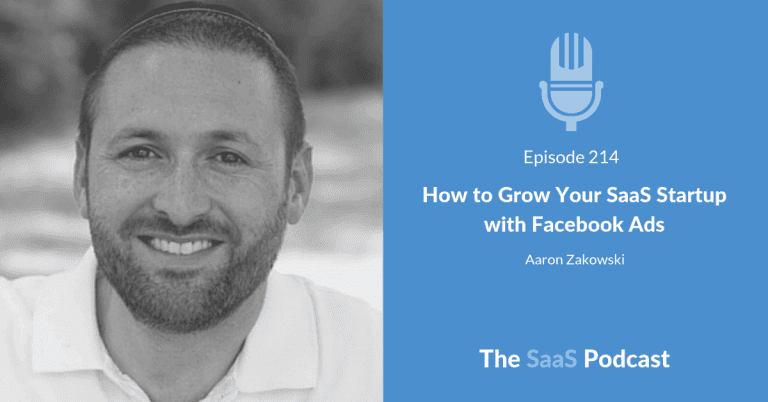
In this episode, I talk to Aaron Zukowski.
He's the founder of Zamo Digital, a marketing agency that specializes in using Facebook ads to help SaaS companies grow and scale their businesses.
His clients include companies such as InVision, DigitalOcean and Treehouse.
So have you struggled to make Facebook ads work for your SaaS business?
Maybe you read every blog post you could about Facebook ads.
You identified your target audience and put together great copy and images for your ads.
And then when everything looked good, you put the campaign live and Facebook quickly started eating up your advertising budget.
But your investment didn't turn into many leads or sales.
Well, if that's happened to you, then you're not alone.
A lot of SaaS companies struggle to make Facebook ads work.
And many B2B companies dismiss Facebook ads because Facebook is a B2C platform.
Right.
But with the right knowledge, mindset and approach, you can use Facebook ads to generate leads and sales for your SaaS business.
And in this episode, you're going to learn about the SaaS scaling framework for Facebook ads.
After spending millions of dollars and generating nearly a million signups and leads for their SaaS clients, Xamo Digital developed this framework to help them consistently deliver the results that their clients were looking for.
We're going to talk about how to test, optimize and scale your Facebook ads.
We'll look at how to identify your target audience, how to clarify your message, how to optimize and automate your ad campaigns, and how to scale your SaaS business faster with Facebook ads.
So I hope you enjoy it.
Aaron, welcome to the show.
Aaron Zakowski (02:16.150)
Hey, Omer, how are you doing?
Happy to be here.
Omer (02:18.320)
Great.
Nice.
Good to have you.
Why don't we start by you just telling the audience about Xamo Digital marketing?
What do you do?
What kind of companies do you help?
Aaron Zakowski (02:28.800)
Yeah.
Omer (02:29.160)
Great.
Aaron Zakowski (02:29.400)
So I run a company called Xamo Digital, and essentially we are a Facebook ads agency focused on helping SaaS companies to grow.
So what that means is essentially, you know, we're working with primarily performance focused user acquisition campaigns for B2B SaaS companies.
Mainly our main focus over here.
Omer (02:46.420)
And you're based in la, but you work with companies around the country or around the world?
Aaron Zakowski (02:50.980)
Yeah, really around the world.
I mean, we are based in Los Angeles, but, you know, we're a fully remote team.
And our clients are all over the place.
Omer (02:57.380)
So how did you get into Facebook advertising?
Aaron Zakowski (03:02.020)
Yeah, it's a great question.
So, I mean, short story, short version of it is essentially, I used to be a cpa.
I was an auditor at Deloitte and Financial Services for a long time.
Kind of went from there, became a CFO of an e commerce company, discovered Internet.
This was back around 2006, got excited about it, was doing a bunch of jack of all trades, Internet marketing stuff.
And early, early years, I think around 2009, got into Facebook ads, had some really good success with it.
It's a totally different platform then than it is now, but kind of from those early successes, kind of got pegged as Facebook ads guy.
And it's kind of just kind of grown and blossomed from that point.
And in terms of getting into SaaS specifically for Facebook ads, you know, back around, maybe four or five years ago, I got a call out of nowhere from a guy named Clark Valberg, who found me on LinkedIn and turned out to be the CEO and founder of InVision, you know, one of the big unicorn SaaS companies of our day.
Right now Clark hired me to run ads for InVision.
I did that for a couple of years.
We, you know, we had tremendous growth over there when they were really in their biggest growth stage.
And from that primary client, you know, that just kind of got me a lot of doors opened into working with some other great SaaS companies.
Companies like DigitalOcean, Treehouse, a bunch of other, you know, middle growth stage companies as well.
And it's just kind of grown from there.
Omer (04:14.300)
Awesome.
So let's kind of talk about, like, why a SaaS company or founder should think about Facebook ads.
And quite often the most common objections I hear are either, number one, I've tried Facebook ads, spent a bunch of money on it and didn't get anywhere, or got a really poor return on my investment.
Or secondly, they'll say, you know, I'm a SaaS B2B business, and either Facebook I don't think makes sense for me, or I've got no idea how I would Target kind of B2B customers on Facebook.
So we're going to kind of jump into a lot of that and exactly what people should be doing.
But what would you say to people who kind of come up with either of those two objections?
Aaron Zakowski (05:07.440)
Right.
So in terms of, you know, the, I guess the B2B objective, I mean, to be honest, you know, people are people and pretty much everybody's hanging out on Facebook, it might be that it's not meant to be a B2B platform, but, you know, if the people you're targeting are thinking about business as they are and you put something helpful in front of them, even when they're not kind of in business mode, you know, they will pay attention to it.
All of us are thinking about our jobs and our businesses all the time.
And if we're, you know, mindlessly scrolling through Facebook and something grabs our attention that's related to work, I'm sure we're all.
We could look at our own personal behaviors and we can see that we will click on those things.
Could be we don't want to convert right away, but we'll click on it.
And if it's interesting, you know, we'll.
We'll email it to ourselves for later.
You know, we'll save it for later.
But somehow when we get into work mode, like, we'll remember that thing.
And actually just a little bit of data that we've seen that supports that is in terms of the Facebook ads that we run for Most of our B2B SaaS clients, even though most of them tend to be desktop apps that don't really work too well on mobile, in many cases, we find that mobile ads work really, really well, which implies that people are scrolling on the mobile when they're not necessarily in work mode, and yet they're somehow getting over to their desktop to make the conversion.
And most of the conversion events are actually taking place on desktop.
Omer (06:18.080)
That's really interesting.
I had a conversation with somebody the other day who was kind of in that situation saying, I want to run these Facebook ads.
And from what I've already seen, the majority of my traffic is coming on mobile, but my app isn't optimized for mobile, so I should go and basically get that fixed before I run these Facebook ads.
And you're saying you have data which just says, actually that's not necessarily an obstacle to getting leads through Facebook right now.
Aaron Zakowski (06:48.410)
Correct.
We've had that same concern from clients we've started with where they'll tell us, listen, we understand that mobile has a lot more volume and it's a cheaper cpm, cheaper impressions on the ads, but we're a desktop app.
We don't work on mobile.
I've kind of convinced people to say, well, let us just test it out a little bit and see how it goes.
And generally, we can get the conversion cost way down with a much higher volume.
It's much more scalable.
Partially the reasons for that is that Facebook has so much more volume of mobile impressions and ad space to sell that it's cheaper over there.
And I think, you know, partially, you know, and a lot of businesses don't think they're going to work on mobile so well, so therefore they don't buy into it.
But the fact is, you know, the CPM cost is way cheaper over there and you know, we've got the data to prove across, you know, millions of dollars in ad spend at this point that the mobile traffic will convert cross device onto desktop.
In many cases, the data just proves it.
And I recommend that anybody that's concerned about that just test it and see how it works for them.
Omer (07:42.340)
And for people who say I've tried Facebook and I didn't get the ROI or it wasn't working for me, what are some of the most common mistakes that you see people making with Facebook ads?
Aaron Zakowski (07:57.060)
Yeah, so there's a lot of them.
I think Facebook definitely can work for most B2B SaaS companies.
I think some of the challenges are, you know, a, it's an ever changing platform and the algorithms are always being updated and it's really hard to stay on top of, you know, all that is developments and knowing what works best because, you know, what worked for us six months or a year ago isn't necessarily working so well today.
So, so we have the advantage of we're running, you know, multiple clients with similar business models and we get a sense for what's working right now.
And so we could apply those learnings from one client to another client and kind of helps us to stay ahead of the curve.
You know, when someone's trying to run that in house, it's a little bit harder because there's just so many distractions and other advertising platforms they might be running on.
So definitely that the changing platform is one of them.
There's a lot of, I think, challenges in pricing that people might have.
So sometimes, you know, if you're a lower priced SaaS platform, you know, it's kind of going on on a volume play and you need to get a lower price cost per acquisition.
Generally most of the clients we're working with are, are trying to get a free trial sign up or a freemium signup, although some of them are doing demos and other things versus it's a little bit different I think when you're working with, you know, enterprise type sales model and we could talk about that as well.
But most of the clients we work with are trying to get that free trial or equivalent sign up.
And what we're doing is trying to just get as many qualified leads signing up that trial offer as possible.
And so if someone comes to me and says, hey, we need, you know, sign up to five, $10, you know, that makes me a little bit nervous.
If that's the economics that's going to make it work for your company, you know, that's going to be challenging in many cases.
But if you come and you say, hey, 25 to 50 or sometimes, you know, much more than that as our target cost per acquisition, there's then, you know, that's often very achievable.
The other thing that a lot of people hear and come to us with a misconception is they think they need to do a nurture campaign first.
So they'll target their cold audiences with content or an ebook or some kind of lead magnet like that, and then want to retarget to actually get the conversion.
Retargeting the people that visited their website already or converted on the content.
In some industries that makes a lot of sense.
I think when you're dealing with a higher priced enterprise type of product that might have an LTV of a customer of, you know, tens of thousands of dollars, you know, that can make sense.
I think most of the time when you're looking for a lower price cost for acquisition of, let's say under $100, the economics get hard.
When you, when you expect to have two clicks, a first click on content and a second click on retargeting, that already is, you know, the double click and the drop off from the initial audience down to the secondary targeting audience is going to keep you with a small audience and a higher cost per acquisition.
So what we do is we usually do flip that around and we'll do our cold traffic going straight to our offer.
You know, usually it's to a homepage.
And that's one thing we love about SaaS is that the homepages are so well optimized for one primary offer that the homepage usually works as a very effective landing page.
And then if someone didn't convert the first time on that offer, then we're going to retarget them, you know, partially just to come back for that offer again, but then partially we'll start to nurture them again with content and webinars and other things like that.
Omer (10:40.940)
That's interesting, really interesting.
Okay, so you created a great PDF document which I'm looking at right now.
It's called the SaaS Scaling Framework for Facebook Ads.
And in there you basically describe a framework that you use to help make Facebook ads work for SaaS companies.
And so we're going to go through this and sort of there are three main pillars to the framework.
Test, optimize, and scale.
And we're going to dig into each one of these and talk about what's involved, some do's and don'ts.
And then at the end of the show, we're going to tell people where they can go to get a copy of this PDF themselves as well.
Aaron Zakowski (11:20.940)
Sounds great.
Omer (11:21.900)
So let's start by like, how did you come up with this framework?
Aaron Zakowski (11:26.060)
Yes.
So within the agency, you know, one of the most important things that I've learned is it's all about process.
You know, if every one of my account managers is kind of doing their own thing and every client is kind of, you know, we come with it a little bit differently, then things don't work as well for the client or as well for us as an agency.
So we built our internal processes in terms of the way that we approach every client campaign that we start to run from the early stages, when we're launching and testing, through optimization and improving, all the way to scaling and trying to get that thing as big and profitable as it can be.
So we created this framework, this process internal.
And then at a certain point we realized through some conversations that this was something that would be helpful to other people as well.
And to be honest, also establishes us kind of as the experts in industry.
So we decided to put this out here to help the industry and kind of explain to people the best way to have success with Facebook ads for SaaS.
Omer (12:13.210)
Great.
Well, let's jump into it and let's see how much we can learn from you in the next half an hour or so.
Let's talk about the first pillar.
So that is test.
And within that you talk about three things.
Number one, identifying your audiences, clarifying your messaging, and iterating on your images.
So walk me through that.
Yeah.
Aaron Zakowski (12:36.730)
So essentially, within the testing phase, the first few weeks or month of any campaign is going to be all about testing.
Although it's important to also point out that the testing phase should never stop.
The nature of Facebook ads is that you are putting your ads in front of people and so your ads are going to burn out.
So if you think about it, you know, as compared to, let's say, Google AdWords search, so in Google, you know, your ads might last a really long time because people only see them when they search for it, and so they're not going to see it multiple times.
On Facebook though, you know, we're trying to identify who is our target audience, the people that we're trying to sell to, and we're trying to put this in front of them.
So what happens is, as you start to push your budget, frequency goes up.
People see your ads, they stop being as effective.
So you always need to be testing new ads to make sure you always have new winners, or else things are going to die out pretty quickly.
So in terms of these three areas of audiences, messaging, and images, these are kind of the three most important pieces that you kind of got to get nailed down at the beginning.
So the way that we approach testing generally is trying to be as scientific and data focused as possible.
So what I mean by that is, whichever of these three elements we're testing, we make sure that all of the other variables are held static at the time.
So, for example, if we're testing images, we're going to have several ads that are all targeting the same audience with the same copy.
And the only variable that changes in that situation is the image.
We'll follow the same process when we're testing messages.
Obviously, same audience, same image, but all the different ads have different messaging.
What that does is, helps us to be confident that any differences within the performance of those ads is attributed to the variable that we're testing at the time.
So at the beginning of a new campaign, you know, we'll run that process for images for messaging or ad copy and then the audiences that, that we think we should be targeting, you know, usually from our experience, we have a pretty good sense of what we think is going to work.
So that gives us a leg up of testing things that, you know, we already have a pretty strong hypothesis.
But after that testing stage, you know, we've identified what are our best performing audiences, what are best performing messaging and what are best performing images.
Now we come, we combined all those winners, and that should usually put us in a situation where we now have a campaign that can actually start to work and perform properly, because we, we know what the winners are for all those three variables.
Omer (14:43.340)
So when you talk about identifying audiences, it sounds like you go through and you sort of test everything.
So you sort of come up with audiences based on interests and behaviors, and you're looking at retargeting audiences, lookalikes.
You're doing all of these things to try and figure out which targeting, I guess, is going to be most effective and most profitable.
Aaron Zakowski (15:07.740)
Correct.
And ultimately what we want to identify is where are the people hanging out that are, you know, or how can we identify them best to target who are most likely to convert for our offer without being too narrow either, because we want to make sure we've got something that can scale a little bit.
So an audience of, you know, 10, 50, 100,000 people is usually going to be too small.
Obviously depends on the reality of your market and how broad that market actually is.
Obviously we don't want to be going large just for large sake, but better to cast a wider net and let the algorithm optimize and find the right people.
Because as your ads run longer and as the pixel learns who are the people that are converting, the algorithm will optimize for you in order to help find the right people that are converting your offer.
Omer (15:46.720)
Got it.
Tell me a little bit about clarifying the messaging.
Like, you know, there's sort of different components to this in terms of, you know, the, the headline, the sort of the text you put there.
Is it really about kind of putting the offer right there in terms of here's the product, sign up for it.
Is it more about talking about the problem or the benefits?
And I know there's probably no click out answer because if it was that easy, everyone would be kind of succeeding with Facebook ads.
But exactly, like, just generally, what are some best practices you go through to sort of clarify the message for the ads?
Aaron Zakowski (16:26.690)
Sure.
So usually when we're starting off, the first thing we'll do is we'll create just a Google Doc, which is our brainstorming document.
And we'll have our team just kind of, we'll analyze the company's website and literature and their social presence and just kind of look at everything they're saying about themselves.
And then we'll take that information and we'll create this brainstorming doc.
We'll just throw every piece of content that seems like it might work into this document and just, you know, then we'll start weeding from there, we'll optimize from there and change things.
But we come up with ultimately different styles.
So we want to test some copy that's, you know, a straight up, you know, sign up for a free trial now or that kind of just direct call to action copy.
We'll want some things maybe that I kind of call like, you know, a content style ad where the ad looks more like native content.
So the headline might look like a listicle blog style headline.
Right.
So rather than a straight call to action or a benefit statement, it's, you know, five tips for better, you know, whatever your problem solves for them.
And I'll actually use that content still and send them Straight to a landing page or a homepage.
You know, even though it's.
It kind of implies it or gives the impression you're going to be going to content, but rather we'll just send them to a homepage anyways because the homepage will still ultimately solve the problem that we hinted at.
And those curiosity style things tend to do better because it looks like content people tend to give it click on it more.
So higher click is going to usually be a lower cost per click and often can lead to pretty strong conversions as well.
We find that bullet pointing in the text or the copy above the image tends to work well.
We bullet point some of the features and benefits tends to work really pretty well.
And sometimes longer copy, sometimes it's shorter copy.
We really try to test a bunch of different styles.
So as you said, there's no one size fits all answer over there.
Omer (18:06.830)
Yeah.
And then the next part of the sort of the test pillar is around iterating on images and you've kind of already touched on this.
I see a lot of ads that kind of just use like really like kind of crappy stock images.
Aaron Zakowski (18:19.700)
Yeah.
Omer (18:20.100)
Do those work?
Aaron Zakowski (18:21.220)
Crappy stock images will not work.
However, what I'll say is there's different approaches.
So photos of people tend to work really well.
Especially you know, happy, smiling, you know, semi attractive people.
You know, we're always going to stop and look at that because it just feels more organic.
Omer (18:37.460)
So there's also a lot of illustrations that we see as well, specifically with products, right?
Aaron Zakowski (18:42.660)
Yeah.
So we see in SaaS you see a lot of a picture of a laptop or a desktop screen with a screenshot of the product in there with a little text next to it.
It works sometimes.
Sometimes it does, sometimes it doesn't.
So as I put forward ideas, I just want your audience to realize these are ideas to test.
Sometimes one style works better for one client and something else works better for another client.
But we definitely test illustrated, you know, graphic design type of things.
We definitely like just photos of people usually with no text or no editing of them whatsoever.
So that brings you back to the question you asked about stock photography.
If our client can provide us with good photos of their employees or people wearing, you know, their T shirts or in their right environment that then fantastic.
And we'll use that.
It usually works really, really well.
If not, that's when we go to stock photography.
We've got our resources that we go to and some of it's just your typical pixels and unsplash and those types of really popular sites.
But we're super selective about the stock and product photography that we go through.
So we might go through a thousand photos and pick four that we're going to actually use in the end, and then we'll make sure we run those by the clients and get those approved.
But we want to make sure that the photos we use look authentic.
We don't want your typical generic looking stock photography.
I would be pretty upset if anybody on my team ever tried to use anything like that.
But there's a lot of good photography out there that's coming out every day that looks authentic and makes you stop scrolling.
Because ultimately the way that I think about these variables and elements of a Facebook ad is you've got your image and the job of the image is to get somebody who's kind of like thumbing through their newsfeed to get them to stop scrolling, just stop scrolling, pay attention.
That's going to get them.
Then once they've stopped to pay attention, they're going to read the copy.
The copy's got to take their interest and kind of get their curiosity going to what's on the other side of this ad.
Right.
And basically has the role of generating the click and then once they've clicked, they land on the landing page.
And ultimately it's the landing page's job to convert the user over there.
So photos are really just about getting people to stop and pay attention.
Omer (20:40.670)
And what about video?
We're seeing more and more video ads.
Is that, do you think that's going to be the future and that the vast majority of ads are going to be video and that's what people should be doing, or are we still going to continue to see, you know, just straightforward image ads, continue to play an important role and, and convert?
Aaron Zakowski (20:59.300)
Well, I think we're always going to see both.
And the reason for that to a large extent is people want variety.
You know, if you saw videos only on Facebook, that would kind of get boring.
If you saw images only, that would also get boring.
So we need a variety of those things going on.
Certainly images are easier to produce than a video.
So that definitely gives them an advantage over there in terms of, you know, our processes for iterating and testing as many new creatives as possible.
If I had to test a new video.
As frequently as we test images, our team is tasked with in our Asana projects that we have, you know, our, our team has to test 5 to 10 new images or creatives every week for every client.
If we had to do that for image, for video we would not be able to do that so, so quickly.
But video certainly can work.
So it's, you know, like anything else, it's hit and miss.
Sometimes it works, sometimes it doesn't.
It's also about having the right video that's going to work well for, you know, communicating your value proposition and grabbing attention for your custom audience.
And when we say B2B SaaS, there's a very large range of the type of people that we're trying to sell to.
You know, it might be graphic designers, it might be accountants, it might be project managers.
And each one of those people will have a different type of mentality that will, they'll relate to different type of content in different ways.
Omer (22:08.430)
Yeah.
Yeah.
Okay, let's wrap up on the testing pillar.
And so just to kind of recap this, there's a sort of a three step sort of testing process that you go through with each new client in terms of like, you know, how many audiences you test and message variations and images.
Can you just kind of give us a quick summary of that?
And it might just help people sort of think about, hey, you know, if you sort of test with one audience and one or two ads and you're not getting results, well, don't be surprised, right?
Aaron Zakowski (22:37.140)
So usually when we're starting off, we'll run a test campaign and it could be an ad set, it could be in a campaign, kind of however you like to structure things.
But we'll want to run an isolated test for audiences.
So we'll test, you know, five to 10 different audiences, you know, combination of interest, lookalikes, retargeting, et cetera.
Retargeting will usually be off at its own thing because we know that's going to work.
And then within each of those tests, we'll make sure we're using the exact same ad creative again.
So holding static, whatever variables we're not testing at the time.
And so based on that, we're using the same ad.
We'll know which audiences are performing best based on the data.
Then we'll do the same thing as we said before, we'll pick one audience, which we hypothesized to be the best audience if we haven't tested yet.
And then we will have one audience per test, a whole bunch of different versions of messaging, and all with one image.
And if we were at the beginning, we'll have to kind of just guess what's our best image.
But that's okay because we'll just be able to look at the bump in the left from the messaging of which one's working best.
And then we'll have a different test that will run simultaneously or one after the other for images where, again, we'll use the same audience, same copy, and then test five to 10 different images to identify what are the winners.
And that's how we start off with every campaign and then take all of our winners and put them together once things start to burn out.
We usually find, though, that rotating out the image is enough to refresh ads.
That's an important point, because once you identify good copy, that copy can usually last for quite a long time and quite a few different creative iterations by just changing the image as long as the copy was good the first time it converted.
Omer (23:59.850)
Got it.
Great.
So the next part of the framework, the pillar, is optimize, and just kind of explain, like, what this involves at a high level before we sort of dig into the details and at what point is somebody ready to move from the test phase to the optimized phase?
Aaron Zakowski (24:16.130)
Right.
So optimizing is pretty much where we start moving to once we've had some successful tests.
And to be honest, you know, there's a lot of overlap between the testing and optimizing stage.
Neither one of them really ever ends.
When we spoke about the testing before, we were kind of alluding to the early stages of testing to figure out what's working.
But testing should never end and becomes integrated as part of your optimization.
The optimizing stage is really about what we want to have happen when we've got things that are working and we're ready to kind of take it to the next level.
So, for example, right now we spoke about testing.
We really wanted to segment out all the different variables when it comes time to optimize the way that Facebook has really been working in the last year, and where they're moving going forward is where we want to consolidate rather than segment.
So consolidating as much as possible, all of our winning audiences should go into one campaign in one ad set.
All of our winning ads should be put together in one ad set and bring things together as much as possible and then doing whatever we can to bring success to our lower number of campaigns and a lower number of ads.
So it might have been, you know, a year or two ago, we had process where we would have, you know, dozens and dozens of ad sets live at any given time.
You know, today we'd like to limit that to 5 to 10 AD sets at any given time by bringing things together.
So the elements that we usually have within Optimizing are consolidation, getting together some type of automation in the campaign.
Omer (25:36.180)
So let's talk about that then.
So the first step of the optimize pillar is to install automation.
You sort of.
From my understanding, there are like four sort of rules that you apply here when you're thinking about that automation.
So tell us about that.
Aaron Zakowski (25:52.270)
Yeah, so we've got four automation rules that we like to apply for most of our campaigns that we're running.
And essentially what these are doing is trying to take out a little bit the human element of decision making.
So, as we said before, as much as we can rely on a process and take out our gut feelings, that's usually a good thing.
So there's obviously a balance between our emotional, our gut, once we have experience, and the automation.
But essentially, we're setting up rules within Facebook's native automation tools, one that's going to increase budgets for winning ad sets.
So essentially, we've got something working.
We want to increase that budget by 20 to 30% every 24 to 48 hours.
And we'll just create a rule that says, you know, if we're hitting our target goal of whatever our CPA goal is, then bump the budget, you know, every 24, 48 hours.
That'd be the first rule that we would run.
If something has a CPA that's a little bit too high than what we're targeting, then we want to decrease the budget automatically every day.
So if, let's say we've got a $30 cost per acquisition target and we're getting 32, $33, it's, you know, just a little bit too high.
Kind of want to turn down that budget a little bit.
So we might decrease that budget by 10, 20%, you know, every day or two if it's a little bit high.
If we've got an ad set that's way too expensive, well, then we just want to pause it.
And so it's, you know, we create a rule that says if the CPA is above, let's say, you know, let's say 10, 20, 30% higher than our target, we'll then pause that ad set automatically.
Whether it's the ad set, the ad or the campaign at whatever level, you're actually setting up your rules.
And then we've got another one, which we call reviving lazy winners.
Essentially, what that means is you might have a campaign that it ran for a couple of days and our cost per acquisition was a little bit too high, so we paused it and we turned it off.
Well, if we remember that Facebook uses an attribution window of 28 days on a click and one day of a view.
Sometimes people will click on an ad today and they'll convert in another seven days, 14 days, you know, whatever it might be.
And we might have already turned off that campaign or ad set or ad.
And yet the conversions might come later on.
And once those later conversions kind of get factored in, we might look back and say, hey, this actually was working.
It just took a little bit longer for the sales cycle or the conversion cycle to happen for these people to convert.
And if we'd been a bit more patient, this would have actually been a profitable campaign.
So in those situation, we want to activate based on the cpa, but over a longer window of time, not necessarily looking at it, just at the last couple of days.
Omer (28:10.160)
Yeah.
So it kind of really emphasizes the importance of really understanding your data to help you make good decisions.
And as you sort of started off saying that, you know, you're very sort of data driven sort of decision making process in terms of how you operate.
One interesting thing was that I kind of realized that you export Facebook data into Excel and you use that as a way to kind of analyze the data and look for trends.
And actually that was kind of one of the questions I was going to ask you was like, sometimes it's not always that easy to figure out what's going on in that ads manager in Facebook.
Aaron Zakowski (28:46.950)
I'm happy you brought up the point about data.
So one of the earlier pillars that we probably should have spoken about at the beginning is just the idea of kind of knowing what your metrics are and what your data should be.
So for example, we need to have a clear target cost per acquisition on the free trial.
And, and a lot of people we speak with don't necessarily know what that should be yet.
You know, the more mature growth stage companies usually have a better idea.
But it's important to know where your target is by.
And we usually work backwards from, you know, what's our average or expected long term value of a customer and then what's our expected upgrade rate from a free trial to a paid customer.
And then using that math and figuring, you know, what are our profit margins and how quickly do we want to recoup our investment, you know, what should our target cost per acquisition be?
So that's an important piece of the data that everyone should always know from the time they're getting started with an acquisition campaign.
Now, going to your question about Excel.
Omer (29:32.260)
Yeah.
Aaron Zakowski (29:32.620)
You know, it's sometimes very hard to get too nuanced with an ad manager.
So ad manager will give you a lot of different ways to slice and dice your data.
You know, you can look it by age, gender, placement, country, you know, a whole bunch of other things as well.
And that's helpful.
And we make it a point.
Every month we do a data deep dive for every one of our clients where we just kind of go through there and say, you know, are there any opportunities here, any trends that we're seeing that could help us to make better decisions within our optimization?
And part of that, though, is exporting the data as granular as we can and in different ways out of Facebook and then importing it into Excel.
And from there, we'll run a lot of pivot tables, and it allows us just the ability to slice and dice the data in different ways.
So, for example, one way that we might look at that is on the ad level.
We might have the exact same ad running in some different campaigns, different audiences.
So the same ad creative might be running in a retargeting campaign.
It might be running to a lookalike, and it might be running to an interest, and it's performing a little bit better in one, a little bit worse than another.
But they're all kind of generally working.
And we've got a whole bunch of different ads that have that same situation.
So how do you know which one is really your top performing ad, and how do you figure out the trends from that?
So for that reason, we kind of make sure that we if the ads are exactly the same, we make sure that for every audience that we're running them, we use the same name.
So essentially what that then later allows us to do is to run a pivot table in Excel later, where we sort everything by ad name, and then it'll consolidate all the data for that particular ad creative across all the different ad sets or campaigns that have been running it.
So we'll take all data from this particular ad, from the lookalike, from the interest, from the targeting, et cetera, and we can see how is it using, working in aggregate in terms of the data.
We can compare all of our ads that way.
And that's something that's a lot harder to do if you're just working natively within Facebook.
Omer (31:18.170)
Yeah.
And then sort of the last sort of step in the optimize process was about consolidating the ad sets.
And you sort of go through this process where you consolidate your ads, the winning ads, into what you call, like these super ad sets.
What does that mean?
And why is it important to do that?
Aaron Zakowski (31:35.050)
Yeah, so we touched on this earlier about the fact that Facebook is working better with more consolidation these days.
So the algorithm is super powerful.
Facebook's algorithm and their ability to kind of figure out what works and move your budgets around is quite remarkable.
What we often get into is as, I guess, more beginner marketers at Facebook.
We look in there and we see all these ways to segment our data and all these different interest groups and all these different things that we could do.
And as savvy marketers, we want to start thinking about all the different ways that we can segment.
And initially, that sounds like a good idea.
But the way that Facebook works better is that if you can bring everything together into one campaign or even one ad set as much as possible, and let the algorithm determine where should the impressions be delivered, then that's almost always going to outperform.
Because if I say I've got to have a whole bunch of different ad sets, each one targeting a slightly different demographic, so one of them is doing Facebook, and one of them is doing Instagram, and one of my ad sets is doing desktop, and one is doing mobile, and one is male and one is female, et cetera, et cetera, then I'm forcing Facebook to say where the budget should be allocated in each one of those things.
Now, to some extent now we're moving to a world where Facebook, in a couple months, is going to start making us use a campaign budget optimization CBO where budgets are set at the campaign level, which would allow, at the ad set level, at least, those things to be the budget to be allocated amongst those different ad sets.
But the more that we force Facebook to deliver ad impressions in the ways that we want, the more that we're taking control away from the algorithm, which in many ways just knows better than us.
So once we've established in our testing, these are the audiences that work, these are the age ranges that work, these are the locations, you know, the ads, et cetera, et cetera.
We want to put all those things together and let the algorithm determine where should those impressions of any given ad be delivered on any given day.
Omer (33:22.880)
Got it.
Great.
Okay.
So we did testing for at least a couple of weeks to figure out what works, what doesn't work.
Then we went through this optimization phase, which is really about digging into the data and deciding where you're going to focus.
So spending less on ads that aren't performing well, maybe turning some ads off, maybe narrowing down your target audience and the ads consolidating them once You've done that.
I guess we're ready to move to the next step, which is the scaling part.
Aaron Zakowski (33:52.330)
Right.
Omer (33:53.050)
And with scaling, you sort of talk about three things.
Number one is like, you know, increasing the budget.
Number two, it's about expanding the audience.
And number three is about adding platforms.
So again, let's start by maybe just saying, like, when is somebody ready to move from the optimization to the scaling phase?
Aaron Zakowski (34:11.960)
Sure.
So similar to what I said about the testing and optimizing, kind of always meshing together, you know, optimizing and scaling kind of go hand in hand as well.
So the scaling phase is basically once you have something that's working, and by working, you know, performance based, you know, user acquisition environment, you know, we mean, do we have campaigns or ads that are achieving our target cost per acquisition or lower?
Because if something's working and it's profitable, then we want more of that.
And that's what scaling is all about.
So if we have something working, you know, the first step is we're going to want to increase budgets.
Now, we spoke about this a little bit earlier.
You know, the easiest way to scale is just, you know, let's increase our budgets.
Now, I warn people, don't increase too quickly.
Our experience and also the information we've kind of gotten from Facebook reps is, you know, you're pretty Safe at about 20 to 30% increase in budget per generally at the ad set level at least, without kind of messing up the learning stage.
Because remember, the algorithm had to learn and the learning takes place at that set level.
If we move our budget too quickly, we could break that and kind of potentially cause all kinds of havoc for everything that we've achieved.
So increase budgets relatively slowly.
20%, 30% is usually pretty safe.
The other way that people scale a little bit, that isn't mentioned as much here is sometimes duplicating those winning ad sets.
And if you've got one that's running well at $100 a day or $500 a day, whatever it is, and you want to scale faster than you can by just increasing the budget, well, then maybe you could duplicate the whole ad set.
People get concerned in that situation about audience overlap and you're competing with yourself in the auction unless you do a really high budget, we've just found that that isn't really too big of an issue.
So that's the first thing is increasing budgets.
The next step we said, is expanding audiences.
So let's say we're using a 1% lookalike, which is often one of Our best performing audiences is usually going to be a 1% lookalike based on our conversion pixels.
So we're telling Facebook to find more people that are as demographically similar as possible to the people who have already converted off of our offer based on the pixel.
That's working really well and we're happy with it and we're scaling and we just kind of feel like we've hit a limit.
Well, then we can consider going from 1% to a 2% lookalike.
And what that means percentage is that a 1% lookalike is telling Facebook to go and find the 1% of Facebook users in the target country, let's say in the United States, who are most similar to my base audience in the US that's usually going to come out to about 2 million, to, you know, 2.2 million people.
If you do a 2% lookalike, it's going to go to the 2% of people most similar, which gives you, you know, 4 million plus and it goes up to up to a 10% lookalike, which is a little bit over 20 million people.
So if the 1% lookalike is working well for you, so expand up to a 2% lookalike, if 2% is working for you, you know, expand up a little bit like that.
I recommend people don't just jump to the bigger audiences because always go for your lowest hanging fruit and your best opportunities first prove that those things work and then kind of, you know, move up from there.
In addition to using bigger lookalikes, you can go from Facebook to Instagram.
You know, you can add in more countries if that's relevant to your offer.
More placements.
Placements.
Generally you want to determine, you know, by placing the right, right hand column, Instagram, Facebook stories, Instagram stories.
All the different places where Facebook run their ads.
You know, that should happen in the testing phase as well.
But if you haven't been running those, those are opportunities to get more impressions.
Basically you're trying to reach, you know, more impressions is the way that you scale and spend more money and hopefully generate a lot more revenue.
Omer (37:21.270)
And then you actually recommend adding platforms like actually going beyond Facebook ads to things like AdWords and Twitter and whatever.
And on the one hand, yeah, I mean, that sounds logical.
Although maybe I would ask, like, if you're scaling on Facebook, why not just double down and keep focusing on that instead of thinking about other platforms?
And then the second part of that is, aren't I going to have to start from scratch with every platform now?
Yes, like in terms of figuring out what works and what doesn't work well, to some extent.
Aaron Zakowski (37:52.240)
So addressing the first question, there is usually a ceiling on Facebook to how much volume you're going to get, and that could be determined on a company by company basis of how large is your audience.
If you've got a smaller potential audience, there's only going to be a limit to how many people you could reach.
And not everybody's on Facebook.
And there's also benefit to having your company be seen more around the web.
So if I'm only seen on Facebook, well, then there's opportunities for me to really be more present in somebody's mind, share and awareness by being present on AdWords, on Twitter, on YouTube.
The more they see my company, the more we're staying top of mind and ultimately going to convince people to want to do business with us.
So that's one part of it.
And in terms of more learning, there's certainly more learning by going to more platforms.
But if you've proven that that paid acquisition works, then it's very likely it could work on other platforms as well.
So I'm certainly a big proponent of Facebook, and I think Facebook is a huge opportunity.
But, you know, let's say we compare it with it with the other, you know, guerrilla company of AdWords.
You know, they work very differently, especially if you think about, you know, AdWords search.
So Facebook is for finding those prospects who aren't necessarily looking for you yet.
They haven't done a search for your type of product yet.
AdWords works really well for the people who have intent and are searching.
And in addition to that, they've also got their display network.
So there are opportunities there.
And there's efficiencies that come from, you know, having success with one platform and then trying to transfer that over to another platform.
So, you know, if you've got creative, you've got messaging that you figured that worked on Facebook, there's a pretty good chance that that might work on Twitter or LinkedIn or display ads as well.
So there's opportunities there.
So usually with us, you know, we're a Facebook and Instagram first agency, but once we've kind of gotten success with some of our clients, you know, using that, that's when we'll kind of increase our engagement with some of our clients and start taking on some other platforms for them and moving to AdWords or Twitter or some of the other channels as well.
Omer (39:38.970)
Got it.
That's great.
Okay, so to wrap up, I also know you talked about like, hey, you know kind of the importance of a growth mindset to really succeeding with Facebook ads.
So just kind of quickly kind of explain to me, like, what that means and why that's important.
Aaron Zakowski (39:54.170)
Yeah.
So essentially, I mean, a growth mindset is, you know, just kind of the always be testing mentality.
So always thinking about, you know, what can we do to grow, what can we do to iterate and always be testing new ads, always thinking about new audiences, always think new platforms.
And that creativity and tinkering is always what's going to help a company grow.
And, you know, the more testing we do, the more success we're going to have.
The more ad creatives we test, the more winners we're going to find, the more we could scale them farther and not have to worry about our ads burning out and, you know, frequency getting too high and CPA starting to climb too high.
So the more we focus on growth and testing, the more success we're going to see.
Omer (40:26.240)
Great.
That's awesome.
So that kind of wraps up the framework in terms of SaaS scaling for Facebook ads.
So you walked us through sort of the three pillars in terms of test, optimize, and scale.
Thank you for sharing that.
I think there was a lot of really interesting stuff that you shared.
For example, like, hey, you know, we kind of the way you approach retargeting and content and kind of flipping that on his head and driving people to content.
That was quite interesting in terms of, you know, if you're doing what everybody else is doing, then, you know, I think it kind of becomes harder and harder to get results.
And sometimes I think it's a combination of testing as well as kind of, you know, being a little creative and thinking differently about how you're going to go and get results here.
So I love hearing stuff like that.
Okay, so number one, let's talk about, like, if people want to get a copy of the PDF document, where can they get that from?
Aaron Zakowski (41:21.840)
Yeah, definitely.
So, you know, anyone can go and download a copy of the SaaS scaling framework for Facebook ads that we put together.
Just go to zammodigital.com sasclub so it's z-a m m o digital.com sasclub and you'll be able to download a copy of yourself.
Omer (41:37.920)
Okay, great.
And I'll include a link in the show notes to that as well.
And if people want to find out more about Xamo Digital, they can go to xamodigital.com Yep.
And if people want to get in touch with you, what's the best way for them to do that.
Aaron Zakowski (41:54.420)
Yeah.
So, I mean, the best way is just kind of go over the website.
You know, there's some, you know, big buttons to get proposal.
You could definitely, you know, click one of those.
And that's just basically just kind of sends me in an email with a little bit of your information.
Those things go directly to me.
Put in the notes.
Just, you know, you heard me on the on the podcast, and you'd love to chat, and I'll definitely get back to you, and it's probably the easiest way to get in touch with me.
Omer (42:12.340)
Awesome.
Aaron, thank you for joining me.
Thank you for sharing so much here, and I wish you all the best.
Aaron Zakowski (42:19.060)
Yeah, my pleasure.
Was a lot of fun.
Thank you.
Omer (42:20.980)
Cheers.