Omer (00:14.720)
Welcome to another episode of the SaaS Podcast.
I'm your host, Omer Khan and this is the show where I interview proven founders and industry experts who share their stories, strategies and insights to help you build, launch and grow your SaaS business.
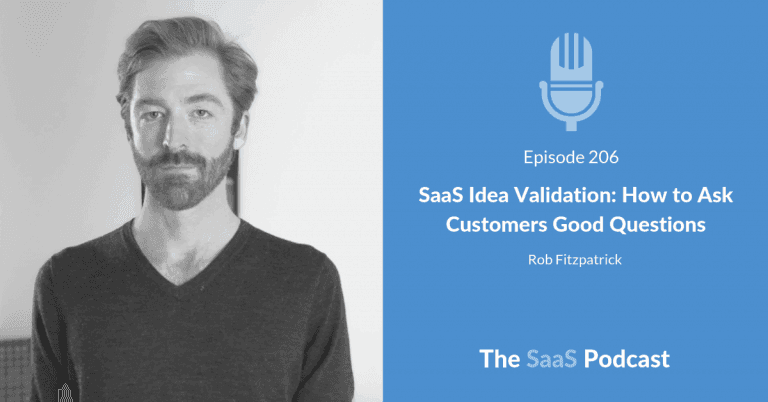
In this episode I talked to Rob Fitzpatrick, a tech entrepreneur and author.
Rob ran various tech startups for about 10 years, has raised funding in the US and UK, and is a YC alum.
He's the author of the Mum Test, how to talk to customers and learn if your business is a good idea when everyone is lying to you.
And he's also the author of the workshop Survival Guide, how to design and teach workshops that work every time.
One of the biggest challenges you face as a SaaS founder is validating your idea.
It might be an idea for a new company or something that you want to change in your existing business.
You're excited about the idea, but how do you know if your prospective customers will love it too?
And more importantly, how do you know if people will pay you money?
Most founders know that that they've got to talk to customers to validate their idea.
But it's easy to screw up customer interviews and hard to do them right.
So in this episode I talked to Rob about his book the Mom Test, and we go through a step by step process to improve how you run customer interviews.
We talk about how to ask good questions, how to avoid collecting bad data, and how to know when people are lying to you or telling you when what they think you want to hear.
By the end of this episode, you'll know how customer conversations can go wrong and how you can do a better job at learning if you really have a good idea or not.
So I hope you enjoy it.
Rob, welcome to the show.
Rob Fitzpatrick (02:01.250)
Thank you for having me.
I'm excited to be here.
Omer (02:03.410)
So what gets you out of bed every day?
What motivates you?
Do you have a favorite quote or just in your own words, like what drives you?
Rob Fitzpatrick (02:09.410)
I like making stuff.
So at the moment it's making books, doing some writing, or sometimes there's a big adventure, a big project.
Like recently I fixed up an old sailboat and that was pretty exciting for four grueling months, whatever the big project is at the time.
Omer (02:23.740)
So you have an interesting story, you've worked on a number of startups, you've written books, but right now you're living the life, right?
Can you just tell the listeners what you're doing right now?
Rob Fitzpatrick (02:33.740)
Yeah, I swung through the scalable startup stuff.
I did my 10 or 12 years of getting beat up, running various different companies.
And then maybe two years ago, I thought, man, it's time to relax for a bit.
Let's take one of these mini retirements that everyone talks about.
So I thought it would be maybe six months.
And it's been three years so far.
And I'm just floating off the cash flow from old projects that I did before.
Moved out to Barcelona, spent a year or two in my little boat.
Omer (02:59.080)
Yeah.
Rob Fitzpatrick (02:59.360)
And at the moment, I hang out with my dog in cafes and I write stuff.
It's great.
Omer (03:03.280)
It's awesome.
I'm jealous.
And I was telling you before we started recording that I was.
I was a little disappointed when I watched one of your YouTube videos.
And the story is basically that I was watching Spider Man Homecoming yesterday for the second or third time and love that movie.
And then I watched a YouTube video, an interview with Tom Holland, and he had an English accent.
And I was like, what?
You know, it's like, you know, he has this really convincing New York, Brooklyn accent or something.
And.
And then the same thing happened with you, right?
Because I knew you had been living in England for many years, and so I'd been reading the Mum Test multiple times, and I always imagined Rob talking to me in this English accent.
And then I watched a YouTube video.
And you didn't have an English accent.
Rob Fitzpatrick (03:48.360)
Yeah, fairly American, I'm afraid.
Grew up near Miami and then did the Silicon Valley thing.
The British accent never sunk in, I'm afraid.
Omer (03:58.680)
So tell us a little bit about some of the startups and sort of projects you've worked on.
Rob Fitzpatrick (04:03.900)
Yeah, my first startup, we had a great time.
We went through Y Combinator back in 2007 alongside Dropbox and Songkick and Discuss and a whole bunch of great companies.
We were kind of the black sheep and no one talked about us.
And we had.
It was a common story, Right.
We had funding from great investors, some of the best in the world.
We had some good customers like mtv, Sony, the BBC.
We were trying to figure out social advertising before Facebook or Twitter did, because the platforms existed, but they didn't have their advertising products yet.
So it was very exciting and very big.
And in the end, we moved too slow and we got crushed.
But I had such a great time.
And the whole reason I got into that was because I knew very early that I did not want to subject myself to the bureaucracy of corporate America.
You know, I'd learned that from the movies.
And I was like, okay, so my entire career planning thing when I was in university was, what can I Do that's not bureaucratic.
And in my naive mind, I thought the answer was academia.
So I started a PhD and I was like, this is going to be great academia.
Pure battleground of the minds, zero bureaucracy.
And about six months in, I realized I had somewhat misunderstood the inner workings of that industry.
And at about the same time, I heard about startups, and I was like, oh, this is so cool.
Because I'd learned to program because I wanted to make video games, but of course, that's a terrible industry.
And academia was now out, as I'd learned.
And so startups just seemed like the least bad option.
And once I got into it, I loved it.
And I can't imagine doing something different.
Omer (05:29.820)
I love that.
The least bad option.
Rob Fitzpatrick (05:33.340)
Yeah, well, it's still work, right?
Work sucks.
It would be better if you weren't doing work, but if you have to do work, you may as well be startups.
Omer (05:40.700)
And the mom test, how did you come to write that book?
Rob Fitzpatrick (05:44.620)
So the mom test, if anyone doesn't know, the idea is people say, don't ask your mom for feedback about your business idea because she loves you and she thinks everything you do is great.
And so people say, well, go ask other people who aren't biased.
But my argument, and this came from the hard experiences of my first company, is that everyone is biased, at least a little bit.
And whenever you ask for feedback about your idea, your business, you're exposing your ego, which invites a lot of compliments.
And it also invites a lot of opinions, which, frankly, aren't that useful either.
And so my solution was not like, don't ask your mom.
My solution was, well, take responsibility for asking questions that are so good that even your own biased mother couldn't lie to you.
So it's called the mom test because it's about making those questions.
Omer (06:23.610)
And again, why did you write that book?
How did it come about?
Rob Fitzpatrick (06:27.220)
Well, there's.
There's two answers to that question.
The where the idea came from and how I actually wrote it.
The idea was honestly, just because I was getting my butt kicked by trying to have these customer conversations.
And I didn't want to.
You know, I'm a techie.
I wanted to be programming.
But Paul Graham had said I needed to talk to my customers and my next set of investors, they said the same thing.
And I was like, all right, I got to do this stuff.
And so I bought a business suit and I was so miserable, like, all day.
And eventually the customer learning switches into sales, and I was doing these really awkward suboptimal sales meetings and I was reading so many books about how to try to do it better because I knew it wasn't quite working, something was going wrong.
And like, the books just didn't click for me.
They were all written for these people who already knew all the unspoken rules of the meeting.
And it wasn't until the very end of that company, because we ran it for about four years, that first one.
And I was like, okay, something's starting to shape up.
And one of my advisors, a guy named Peter Reed, really just wonderful guy and super talented businessman and investor who I told him I was going to be going in for a meeting with Sony Pictures and he goes, oh, in la?
I said, yeah.
And he's like, I'm in LA soon.
Why don't you set up the meeting for the same dates that I'm in LA and we can go into the meeting together, you know, because he was starting to get suspicious.
He's like, he's giving me all these great leads and I'm not getting enough sales out of them.
And he's like, you know, there's something happening in the meeting that we need to understand better.
And after watching me talk for about one minute, he just interrupted me and he took over the meeting.
And I was so grateful because seeing that difference between what I.
That was when I really realized what I was doing wrong and what he was doing right.
And afterwards he was like, ah, I, I know exactly how to explain to you what's meant to be happening.
And he like, was able to translate all of the sales ideas into a.
A language I understood having, having seen me come at it from a.
A techie, which I'm sure many technical founders do.
And it, it like gradually as I tried to explain this lesson to other people, I'm like, this is really important.
And like, it works now I can do this thing that I couldn't do just one day.
I just like this metaphor dropped into my head and I tried it and I was like, oh, that was like a much easier way to explain it.
And so I kept using the metaphor and I liked it.
And then I ended up, I met this guy, his Twitter handle, Startup Rob, he's also a Rob in the London startup scene.
Very talented entrepreneur.
And we were just getting drunk and having a good time.
It was the first time we'd met and it's like closing time at the pub.
And he goes, oh, what are you doing for New Year's?
You should come to Austria with me and my wife's family.
And.
And I was like, yeah, that's going to be amazing.
And it's like this guy I don't know and his wife who I've never met and their whole family who I don't know.
And like, rationally that should have been deleted the next day, but we're like, well, should we?
And I was like, all right.
And so I went.
It was so hilariously awkward.
They were very generous and kind hosts, but they put me in this like cabin on the property, which I was happy with because, you know, it was a weird environment.
And I was just sitting there and I'm like, all right, well this is weird.
And I've got like 18 hours a day and there's no Internet and there's nothing for me to do and all had was an empty notebook.
And I just wrote the whole first draft of the book, like during that five day vacation because I was just like, ah, what do I do?
Omer (09:32.290)
So it was kind of like the situation.
Well, funny things happen in pubs after work in London.
That's.
Rob Fitzpatrick (09:39.010)
Yeah.
But especially as closing time approaches and you just accelerate your drinking because you know you have to finish your drinking by closing time.
So you're like, two more, two more.
Omer (09:49.010)
And when people say, that's when you realize the next day when people say, you must come and look me up, they don't actually mean come and look me up.
Rob Fitzpatrick (09:56.690)
But we were both American so you know, we felt like we could violate that British unspoken rule.
Omer (10:02.370)
Love it.
Okay, so let's talk about that because, you know, if people really want to understand this, well, they should get a copy of the mum, test the book and we can kind of point people to that at the end of the interview.
But I want to try to use this time to pick your brain a little bit and sort of take away some of the key insights in terms of, you know, how to talk to customers.
Some of the things you learn, some of the things you put into the book that can help people who are listening today and maybe struggling with the same thing that, you know, they're having these conversations.
Neither they don't feel like they're going well or they aren't going well because maybe people are just telling them all the wrong things.
And yeah, sure, I love your product, it's great.
You know, I'll buy, totally buy it.
So let's sort of dig into that.
And the first thing we want to talk about is like, you know, customer conversations going wrong.
You talk about that in the book and sort of various other places, like tell us about some of the things that you've seen happening.
Rob Fitzpatrick (10:57.110)
So by far the most common way these things go wrong.
Okay, so the goal of customer conversations is to get what I call good data.
Good data is, like, stuff that's completely reliable.
It's bulletproof.
You'd bet your life on it.
There's no way you're being lied to, which is kind of like facts about your customer's life and worldview.
It's like, what they're already doing and why.
It's understanding them as a person.
Or it's like cash in hand commitments, something you can trust.
And then on the other side, you got bad data, which is most commonly compliments and opinions.
But it can also be hypotheticals, like, oh, yeah, I would definitely use that.
Like, these fluffy, empty promises about the future.
Because it turns out people are super bad at predicting their future behavior.
Like, how many times have you made and then broken a New Year's resolution?
Just like a sacred promise to yourself?
And it blew my mind the first time a customer was like, if you build this, I will definitely buy it.
You know, we talked to numbers, we talked prices, we had everything agreed.
And then I built it.
And they're like, oh, I actually don't need it.
I was like, what just happened?
You know, I was so mad at them.
But I realized it wasn't their fault.
It was my fault for kind of exposing my ego.
It's like, hey, I'm working on this great idea.
Here it is.
Let me tell you about it.
The entrepreneur superpower is that other people want to help you.
But the dark downside of that superpower is that it really biases the feedback you're getting because you're exposing your ego.
You get all these compliments and opinions.
And the biggest place this comes from is if you begin your feedback conversation by pitching your product or your business.
Basically, as soon as you've pitched, you're unable to learn about your customer.
You can still learn about your product, you know, especially with stuff like usability tests and all of that.
But, like, if I'm trying to learn, like, does this customer think this problem is important?
For example, are they going to spend money on it?
Or is this $100 problem or a hundred thousand dollar problem?
If I begin that meeting with a pitch, I am never going to learn that information.
Instead, I need to begin the meeting by asking about the customer and the customer's lives, what they're already doing and why.
It's like, if I'm trying to solve the email problem, I don't go, hey, I've got A great email solution.
Let me tell you about it.
I should start that by being like, man, email sucks.
And the other person's like, yeah, I'm dying.
And it's like, really?
Tell me about that.
Like, what are you doing?
When's the last time it went horrifically wrong?
How did you recover from it?
Can I see your inbox right now?
Can we walk through it?
Can you talk me through a normal day?
Can you talk me through yesterday?
Can you talk me through a terrible day?
As you get into these specific concrete behaviors in the past, there's no chance for them to hurt your feelings because they're not giving their opinion about your idea.
They're just telling you the facts of their own life.
And that's where you get this crystal clear learning.
But then, of course, the downside is you have to figure out what to do with that.
Which I think of as like buying someone a birthday present.
You want to understand your customers like your best friend.
And when it's your best friend's birthday, they do not tell you what to buy them.
They don't say, hey, I really want the new Pokemon game.
Can you get it for me?
It's just, you understand their life, and so you're able to surprise them with something that they didn't necessarily ask for, but which, you know, accomplishes their goals and solves their problems and all of that.
And you might be wrong, and that's why you include a gift receipt.
And that's why sometimes you need to go through product iterations.
But it's like, at least you're making these product iterations grounded in a good understanding of who it's for.
Omer (13:58.270)
Yeah.
So I think you're right.
Because a lot of the times it seems like pitching the product seems like an obvious place to start these meetings until you've been through either the pain of it not working or someone like yourself sort of helps people see why that's the wrong thing to do.
But in the book, you talk about a number of questions like things like, do you think this is a good idea?
Or how much would you pay for this?
And those typically are not going to give you good data.
Right.
Which is what you.
Rob Fitzpatrick (14:32.040)
Exactly.
Any question which is hypothetical, would you pay for it?
Would you ever use something that did this?
Can you ever see yourself wanting to.
Whatever.
All of those future hypotheticals are a huge waste of time.
You either need to look at people's existing behavior.
Don't ask them, would you ever use something that did this?
Ask them, what are you already doing about it?
I can come to you and I can be like, hey, I've got a product.
It makes you live 10 years longer.
It makes you sexier, skinnier, you're going to get laid more.
It's incredibly, it only costs $60 a month and like it takes about an hour a week for you to use.
And you're like, oh wow, yeah, I would definitely do that.
And then I'm like, all right, it's called the gym.
And you're like, oh no, I don't want, I don't want that.
You can get really confused if you're only talking about products.
Whereas if I'm like, hey, you're a person, like what do you do to stay healthy?
And you're like, oh nothing.
I'm like, why not?
And you're like, I honestly just don't care about my health at all.
I'm like, okay, that person's probably not a customer for health product.
But you might give me other indications that you are really desperate for something.
And it's like the truth is in people's behavior, not in their opinions about the future.
So yeah, all of those are bad questions.
And then all the common ones about your product, hey, I've got a great idea.
What do you think?
Be honest.
All that stuff, you're just inviting these compliments.
And you kind of need to mentally divide your conversations into two stages.
You can do it during the same meeting, but it's like two stages and the first is all about the customer and you don't even mention your product.
You're just trying to understand about their life.
Once you're pretty sure you're talking to someone and you understand their problems, their goals, their decision making process, then you can shift into a more product centric conversation.
You'd usually ask permission because often you'll get these conversations by asking for a favor.
You'll say, hey, I'm really struggling to understand how the budgets in this industry work.
You have so much experience.
Would you mind taking a coffee with me to spend 15 minutes to explain it?
It would help so much.
Like I don't have anything to sell you.
And if you've set up a meeting like that, people love saying yes and helping you out in a clear, specific non time wasty way.
But then it's hard to be like, haha, got you buy my stuff.
And so you ask permission to make a transition.
You go like, I'm working on something in this space, like no worries if not.
But if you're interested and if you've got 10 extra minutes I'd love to tell you about it and hear what you think.
And if they give you permission, then you can switch into a product meeting.
And at the end of those people always end product meetings by giving you, they go, oh, this is so cool.
I've never seen anything like it.
It's beautifully designed, let me know when it launches.
And that feels really good.
Which leads into the second big mistake people make because what that is, grammatically that is a compliment plus a stalling tactic.
Oh, your product's so beautiful.
Let me know when it launches.
It's like, oh, this is so innovative.
Can you send me some more info?
This is the easiest and most polite way for them to end the meeting without having to make any sort of decision and without having to reject you.
And so if you finish the meeting at this point you've really screwed up because you've accepted this non answer and you don't know, is that person a customer?
Are they not?
Was everything they said an empty compliment?
Are they actually super keen?
And so what you have to do is just ask them for something that they'll only give you if they're serious.
In businesses this is often an introduction, an intro to their boss, an intro to their lawyers, an intro to their tech team.
That kind of reputational risk.
With consumers it's more common that they'll give you like a pre order or deposit, although it's admittedly harder with consumers.
Sometimes there you just need to build a prototype and try to get them to use it.
But you're like, you're asking for this currency, you're not being pushy but you're giving them the opportunity to say yes or no.
And that cuts through all of those product related bad data and bad signals.
Omer (17:58.550)
Yeah.
So my takeaways from what you had in the book was in terms of like good questions.
Mainly they should be open ended questions because you're trying to get the prospect to talk as much as possible.
Rob Fitzpatrick (18:10.470)
Well, sometimes you can get someone to talk without an open question.
So I tend to think of it, it's like it's about their life.
I'm trying to get them talking about themselves.
And if you need to do that with a sharp question, that's fine because once you get into the right area, people will keep going.
So someone's like, let's say you're building a tool for people to manage their emails or whatever and you're like, oh, how's email?
And they're like, it's great.
I'm always at inbox zero and it's like, yeah, but it must go wrong sometimes, right?
And they're like, yeah, like, if I'm on vacation and the hotel doesn't have good Internet, it can get a mess.
You're like, oh, well, like, tell me about that.
Talk me through everything.
That's like a very focused question.
It's not like, how do you feel about email?
You're like, getting to a specific point, but then you're like, it's sharp and it's about their life and they can go on and on and on about that for ages, which is really valuable insight.
You're wanting to try to see how they think about this stuff.
So for me, it's less open, closed.
But yeah, in principle, I agree with you.
You want them talking, you don't want yourself talking.
Omer (19:08.480)
Right.
And then the other thing is, you should be focusing on their past or their present as opposed to talking sort of hypothetically about what they would do in the future, because that doesn't really help us.
Rob Fitzpatrick (19:21.400)
Exactly.
The future is always a lie.
And sometimes it's hard because you want to know about the future, especially if you're inventing a new category.
I was hanging out with some teams doing really cool stuff with 3D printing, and they're kind of like, they're saying, like, well, we can't ask people how they already do 3D printing because we're trying to create a new behavior and define a new category.
And I admit that's fair, that's true.
But my response there is not, like, ask them about the future because they're.
They're still lying.
My response is like, well, you're just not going to be able to learn as much from conversations.
So you're going to need to put a prototype in people's hands much earlier.
You're going to be in for the long haul because you're like watching behavior change and society change and tech change.
And it's like, that's a longer, harder type of business to build.
So it's like, not every type of idea and type of business can get very strong upfront validation.
You know, sometimes you need to build the thing.
Like, if you're making a video game, you can't run customer interviews and be like, do you like having fun?
Omer (20:16.780)
Right.
Rob Fitzpatrick (20:17.180)
It just doesn't work.
So there's no one magic tool.
You like, use conversations where they make sense and then you use the other learning tools where they're better suited.
Omer (20:25.820)
Yeah, yeah.
Now breaking it up.
And I like to sort of think about that as well in terms of, you know, one is just about the customer and the sort of the problem.
And then the second meeting is sort of more the product or the solution.
Rob Fitzpatrick (20:41.580)
Yeah.
Or just the second stage of the same meeting.
Like it's.
Sometimes you don't need a full meeting's worth of time to do each stage and also sometimes people.
Omer (20:49.220)
Right.
Rob Fitzpatrick (20:49.700)
Anyway, there's a bunch of reasons, but yeah, but definitely stages of the conversation.
Omer (20:53.340)
Yeah, But I would say, like, I think a lot of people who are not comfortable with sales, once they understand the first meeting and so the problem piece, become fairly comfortable with that because they sort of realize I don't need to go and sell anything.
I just need to go in and ask good questions that help me understand how they do currently do things and just get as much detail as I can in terms of, you know, the process that they go through.
But then once they have to switch to that next stage, whether it's a separate meeting or a second half of a meeting, I think that becomes a little bit difficult because okay, great, I get to demo my product and I always wanted to do that.
And I finally get a chance to talk about my solution.
But how do I actually figure out if they're going to buy and do I try to go for the close right there?
Because what are good questions to be asking at that point?
Rob Fitzpatrick (21:47.070)
So part of this, I struggled a lot with the mindset about sales.
I had this deep held belief that sales is sleazy.
But in most cases people are buying your stuff because your stuff is good and makes their life legitimately better.
And if that's the case, then you kind of don't need to feel bad if you're selling a shitty product that is trying to trick people and steal their money.
Like, then I understand why you feel bad about sales and like, you should maybe even reconsider what you're building.
But if you're building something you believe in and it's trying to like help customers you care about, and if you're talking to people and as you're talking to them, you're like, wow, they really feel this pain.
Wow, this would make their life so much better.
It would almost be cruel of you to not offer to give it to them.
Right.
Like if I'm on fire and you're secretly holding a bucket of water, it would be rude of you not to tell me about the water and like, you know, give me a chance to buy it from you because I want that.
I'm on fire, you know, I need what you've got.
And I found that made me A lot more comfortable is like, oh, wow, I'm not, like, stealing from them.
It's like, I've discovered this burning problem that no one else is helping them with, or I can help them with it better than anyone else.
And like, yeah, of course I'm going to do that.
And you have to test their interest at various points throughout the conversation, you know, by asking them to give you something.
And at first, maybe they're giving you an introduction or they're even just giving you more of their time with a clear next meeting, which has a clear goal.
Don't just take, like, let's just chat meetings forever, because that'll waste all your time.
But if the meeting has a clear goal, then even that is a bit of a commitment.
It's just like, okay, I'm going to ask for an hour of your time, then two hours of your team's time, then an introduction to your boss man.
What can I ask for next?
You know, to keep figuring out if you're serious.
Like, oh, how about a deposit or a pre order?
And I was kind of in that mindset the first time.
Someone wrote me a check for, like, 20 grand.
And I was like, okay, great.
They gave me 20 grand.
That means they're pretty serious.
And then I was like, whoa, I just sold my product.
You know, I just this.
I just made my first sales revenue.
And I wasn't even thinking of it as sales revenue.
I was just thinking of it as data that proved that they weren't bullshitting me, that they were actually excited.
And you can do that for small consumer products as well in some cases.
Not all.
Kickstarter helps a lot if you can fit that.
But I was talking to a guy and he had these 3D printed prototypes.
They worked, but, like, very crude.
Looking for this.
This tech he was building.
It was a simple product and he showed it to me, and I was like, ah, that's so cool.
Like, how much will you sell the prototype to me for?
Like, will you sell me this prototype?
And he laughed and said, why are you laughing?
Like, was it that insulting of an offer?
And he goes, no, no, no.
It's just I've sold like 12 of these things already.
I was like, oh, what?
Like a cool indicator, right?
You're just demoing your product and people are like, I have to have this now.
Even in its crude and roug state.
And it reminds me of in my first company, we were building before we switched into pure advertising.
We were doing, like, playful advertising.
And one of our ways was by building animation Software so kids could make their own animated cartoons.
And there's a bunch of ways you can include brand presence and advertising and stuff in that in a fun way for kids.
Which sounds really evil now that I say it.
I didn't enjoy that first company.
It was an exciting business on paper, but advertising is not an industry I am passionate about.
Anyway, so we.
We built this tech.
And we showed Paul Graham during one of our, like, weekly meetings during yc, and he goes, oh, you know, he looks at the website domain.
He's like, oh, the website's live.
And we're like, yeah, yeah, it's live.
You know?
And he's like, and it works.
We just made a cartoon.
I'm like, yeah, of course it works.
And he's like, oh, so you've launched?
And we said, no, no, no, we have not launched.
And he goes, but people can use it, right?
We're like, yeah, but we're nowhere near ready.
And he goes.
He goes, oh, you guys got a launch?
We're like, no, no, no.
And he's, okay, whatever.
And we leave.
And a couple hours later, he calls us and he's like, you guys are your computers.
And I'm paraphrasing, this is like 12 years ago, but.
And we're like, yeah.
And he's like, why?
What happened?
He's like, I just launched you.
You're on TechCrunch.
We're like, Ah.
And, you know, I was so mad.
I was like, how could you do this to me?
You've ruined my company.
And then, like, we started getting all these emails from people being like, hey, can we put our band in this?
Can we put our product in this?
Like, can the characters wear our clothes?
I was like, oh, wow.
And we got these scathing bug reports also.
We got both.
We got really passionate people and people getting angry at us and telling us how to make it better.
And, like, from there, the product did start getting better.
And I was like, oh, yeah, it's like, it's good to get people using it.
And, yeah, you don't have to do it quite that publicly and dramatically.
I'm not saying to throw it straight on TechCrunch, that was a bit much, maybe, but it's like you can do it way before you think you can.
Like, if you fail on the Internet, the worst that happens is people don't see it.
So it's like, no one knows about your failures on the Internet unless you're already famous.
So you can just kind of keep trying until people do notice it.
Omer (26:22.960)
Right?
Right.
And I think going back to that thing about kind of getting over sales and not thinking of it as being sleazy, one of the things I've seen really good salespeople do, which I think is basically what you're talking about here, is you spend time understanding the prospects problems really well first, before you even talk about your product.
And then when you do talk about your product, you're showing them how it's, well, if it doesn't solve their problems, don't give them the demo or don't talk about it.
But if it does, then you're going to sit down with them and you can say, look, here's how this can help you solve all the pains you've just told me about.
And so it's not like you have to sell in the sense of persuade people or force them or anything.
You're just showing them how you're solving the problem.
And if you've done a good job with that, then I think the last part in terms of actually closing becomes a lot easier.
Rob Fitzpatrick (27:17.230)
Yeah, you do still need to ask for money, which is scary.
So what I like to do is when I'm planning my meetings, so at the start of each week, I plan three big things I'm trying to learn about, like big high level learning goals.
Like, I need to learn what their budgets are for this.
And if a budget even exists, that might be one of them.
I'd have three of those.
And then I also have like, if a meeting goes really well, what am I going to ask for at the end of it?
And I had that written down on a piece of paper.
And it's like in every meeting I take, it's like a checkbox.
It's like, did I ask for the thing?
And just having that there and having thought through it in advance, because if I leave myself to improvise, I'll always take the easy way out and I won't, I won't ask the hard question.
So that bit of planning really helped me.
And also it lets you choose something that's appropriate.
Like if you're just starting out in your idea stage, it would be a little bit cheeky to ask someone to give you a big pile of money.
So like, what you ask for should be appropriate to how far along you are and you know, how mature the offering is and all of that.
And also be okay with being suboptimal.
So for example, I was talking to like a real hustler of a salesperson the other night and he was saying, like I said, yeah, if People don't want it.
I leave them alone because I'm more interested in understanding their existing, like, how much they care.
And if they don't care, I don't want to chase them because I want to find a customer or a product that they really do care.
You know, I want to find that fit.
I don't want to force it onto, like, a lukewarm audience.
Whereas he was used to kind of optimizing sales processes in much more mature organizations, he's like, no.
You keep chasing them until they explicitly tell you no.
And that I'm, like, less comfortable with, at least in the early stages.
But I'm okay with leaving money on the table because the money isn't the goal for early stage sales.
The goal is the learning.
It's learning if you've got the right customer and the right features and the right marketing language and all of that.
If people don't care, you don't need to force them.
You're just like, oh, cool, no, we're screwing something up.
And it's great if you can figure out specifically why they don't care.
You won't always be able to, but it's like, you're not trying to push them into buying something they don't care about.
You're just trying to understand the nature of their not caring.
And once that sunk into my head as well, I'm like, oh, I don't need to trick people.
I just need to understand them.
And it's like, we already know how to understand people.
We understand our friends.
We spend the time to get to know our friends.
And that the tone you want to take when talking to customers is the same.
It's like, oh, this seems like a big problem.
Tell me how you think about it.
Talk me through that.
And it's like, it's a very human conversation, you know, it's not like an.
On a scale of 1 to 5, how important is this?
It's like, it's natural you're trying to.
You wouldn't talk to a friend.
You.
On a scale of 1 to 5, how upset are you about your recent breakup?
It's like, that's not how we gain human understanding.
Omer (29:45.570)
You know, right now you also talk about, like, how to deal with tough conversations when maybe you're talking to someone who seems bored or is being hostile or offensive.
Like, what are some tips that you can share if people find themselves in those situations?
Rob Fitzpatrick (30:06.340)
This also comes down to stage.
So later stage, there's a bunch of tactical ways to deal with the objections and blah Blah, blah.
But if you're an early stage entrepreneur, then like, great news, them being mean has given you the answer.
They don't care that much.
And so you can just never talk to them again.
Or like put them on a list and loop back to them.
In six months, I had one of the worst meetings I ever had.
It was just set, it was completely the wrong meeting, but a really important person had made the introduction.
So I was sitting down with this person and within like five minutes we realized the meeting just never should have happened.
Right?
Like a super senior executive of One of the UK's biggest creative agencies, like, you know, tens of thousands of employees, this huge deal, and I'm like wasting an hour of her time in this meeting.
And after five minutes I was like, I could just see the way the rest of the meeting was going.
And I was like, it's not my job to convince her, right?
And I was like, I'm so sorry that like this happened.
It was totally my bad.
I didn't describe what was happening when I asked for the intro, let me just leave now and you can get an extra hour on your lunch break.
And she was like, blown away.
She was like, what?
No one's ever left, like voluntarily left a sales meeting early.
And I was like, yeah, I'm really sorry.
And we shook hands and I left.
And a week or two after that, she started making incredible intros that were relevant for me because she was just so grateful that I had, like, respected her time and just gone on my way and let her get on with her work.
So if you treat people with respect, like, even if you've really screwed something up, it's like, you know, it's not a big deal.
And also people's lives are going on.
Like, I know your startup is the end of the world for you, but for someone else, if they just spend an extra hour in the morning traffic because like of highway construction, that is a bigger deal to them than your startup.
So just because of the stress of their morning, they might end up being really mean or rude to you.
So also like, you know, people's lives are big and complicated.
Maybe their kid is sick and in hospital and it's like someone's rude to you or they cancel the meeting at the last moment, just let it roll off you like it doesn't matter because it's not them judging you.
It's just like they've got a lot of shit going on in their lives and you're fitting into that in some small way.
Omer (32:09.560)
Yeah, that's awesome.
And I think also there's this idea of like respecting your time and people's time that if you just feel that you have a clear sense that this is not going in the right direction, then it's not a bad thing to cut it short.
It reminds me of sort of a slightly different situation, but I remember the, God, this was probably about 15 plus years ago in London that I was working at big company and was interviewing somebody.
So this guy came in, sat down, you know, did the thing to kind of get him feeling comfortable and everything.
And then I sort of asked him a question, it was sort of, it was a technical question.
And he was like, ah, you know, I'm not really sure, he was kind of struggling with it.
And I was like, okay, you know, benefit of the doubt, no problem.
Let me ask you something else.
And so I kind of asked a slightly different question and he couldn't answer that.
And I was like, you know, I was like, maybe the guy's just nervous, right?
So maybe I just need to just kind of, you know, take it easy and I'll kind of ask him more gentler questions.
So I asked him a third question and he couldn't answer and then he was just like, he just got up and he was just like, well, I obviously haven't got the job.
Not going to waste any time, I'm leaving.
There was like 10 minutes and he was out.
And I really appreciated it.
Rob Fitzpatrick (33:23.470)
Yeah, poor guy.
I'm sure he found a great opportunity somewhere though.
It sounds like a stand up dude.
Omer (33:30.910)
So let's talk about like sharing the learning.
So you've done all of this stuff, you've gathered a lot of data.
What are some good takeaways in terms of sharing that what you've just learned with your team or your co founder or whatever.
Rob Fitzpatrick (33:45.140)
So you want to take some kind of notes because otherwise when the data is rattling around in your head, your brain contorts it and it introduces new biases.
So try to take down notes if you can.
A few exact quotes with a smiley face or a frowny face next to them will go a long way toward letting you remember and rebuild the conversation.
I personally don't like typing in meetings because I find find it like puts up this physical wall between you and the other person.
So I like to sacrifice some note taking speed in exchange for keeping it casual and more human.
And I also don't record, some people do, but I found I never listened to the recordings and I'm like, well if I'm not going to listen to Them, I don't really need to have them, so.
And also, my team's not going to listen to them because they're busy.
So we tried doing recordings for a while and then sending them off to a virtual assistant to be transcribed.
And then we had these massive text documents of all of our customer conversations.
But again, no one took the time to read them.
So we're like, all right, well, that's not very helpful either.
And what we eventually settled on.
Oh, gosh.
There was an in between stage where we would interrupt each other.
So this was from a later team, which took customer development a lot more seriously.
But there were still four founders, and we were all talking to customers.
So we had a lot of data coming in, and it was a mix of learning and sales.
We had some existing products that we were selling, and we had new products we were building.
And so we were like, okay, we need to share this stuff.
So we would come home from an important meeting.
We'd get everyone.
We'd be like, hey, this is what I learned.
But it was so disruptive.
It was so interrupting.
And so we set up a weekly call, and it was like our customer update call.
And basically we'd just go around and each of us would kind of rebuild.
So not say, the conclusion of the meeting.
Not like, I had three meetings.
They went well.
Rather, we'd be like, I talked to this person, they said this, and I asked this, and they said this, and we'd actually kind of give the summarized play by play.
And we would do that for all the important conversations of the week.
The conversation only took about an hour.
And it meant that then, like, the raw data from our customers was now in the whole founding team's head, and we could all kind of now make strategic decisions from being on the same page.
And after that, we just threw away our customer notes.
Basically, they were in a file somewhere, but we almost never referenced them.
It's like, it helped us make the next set of decisions.
Omer (35:47.890)
That's great.
So that's the mom test, the book.
And I would highly recommend, if you haven't checked it out, go and get a copy.
And people can go to momtestbook.com or I think they can just grab a copy on Amazon, right?
Rob Fitzpatrick (36:01.290)
Yep.
Absolutely.
Yeah.
The momtestbook.com links to everything.
The audiobook is releasing any day.
Finally, five years later.
Omer (36:09.890)
Is that you?
Did you narrate that?
Rob Fitzpatrick (36:11.850)
Yeah.
So if you want four more hours of my sonorous voice, the audiobook is for you.
Omer (36:16.770)
All right, let's get into the lightning round.
I'm going to ask you seven quick fire questions.
Are you ready?
Rob Fitzpatrick (36:22.250)
Yeah.
Lay it on me.
Okay.
Omer (36:24.010)
What's the best piece of business advice that you've ever received?
Rob Fitzpatrick (36:27.610)
Co founders are a lifelong asset and you can't treat co founders like a mail order bride.
You can't be like, I want to start a business, so I need a blank co founder.
Let me go to this event and find one or meet one, whatever.
It's like a relationship you build over your life, like getting married or something.
So you should date lots of potential co founders.
When you see someone really smart, go out of your way to get to know them.
Someone gives an incredible talk at a local meetup group, or you see someone at your university who always makes incredible projects, it's like, go find that person.
Find an excuse to do a weekend project with them.
Weekend projects are the startup version of dating.
It's like how you figure out who you're going to marry, who you're going to give equity to.
So do that, go out of your way for it, and then keep them for your life because they'll normally be busy.
Maintain those relationships.
But when you want to start your next business, as long as one person in your network of potential co founders is interested, then you know, that's enough.
Omer (37:22.400)
Yeah, that's great advice.
And I actually find that myself as well is that, you know, I've interviewed over 200 people on this podcast and there are certain some people that I don't know if I'll ever work with, but they're just people that there's something about them.
Right.
In terms of whether you click with them or when you have a conversation with them, you tend to come up with better ideas.
And it's always good to make the effort to stay connected with people like that.
Even if you never end up doing anything with them.
Rob Fitzpatrick (37:52.370)
Yeah, exactly.
And it's my main reason for doing side projects, actually.
It's like less that I want to do the side project, I really don't need more distractions.
And it's more just like I want something small to get some experience working with a particular person.
So we figure out how it works.
It's like, let's just go on a date, let's see if we like it, then we can put it in our pocket for later and decide if we ever want to pick it up.
Seriously?
Omer (38:11.650)
Yeah.
What book would you recommend to our audience and why?
Rob Fitzpatrick (38:15.820)
I was trying to think of what would be interesting ones that you guys might not have read.
So from the business side, the E Myth Revisited is incredible and it's written for cafe owners and small business owners, but it's about these traps of doing everything yourself as the founder.
And it's about a structured way to start building the processes and then hiring the people to do stuff so that your business runs as a bunch of processes.
Now that isn't as critical in tech businesses because your tech kind of acts like the process, but it's still fascinating to understand and it really changed my understanding of management and culture and how I wanted to build my companies.
And then on a personal side, I would recommend how to Get Rich by Felix Dennis and the title is very tongue in cheek.
It's a billionaire British magazine and newspaper tycoon who miraculously survived decades of incredible drug abuse.
He said in one 10 year period he spent £10 million on nothing but drugs, alcohol and prostitutes.
Or Maybe it was £100 million in 10 years.
It was some just incredible sum.
And it's such an interesting book because it gives you the mindset and this inside view into this unabashedly greedy and materialistic hedonist.
But it's also written very much as in this real character reveal and he's aware of the trade offs he made and he's like, he's aware that he gave up having kids so that he could pursue money and all this stuff.
And it's intermixed with this really bizarre, almost like surreal business poetry.
It's such a fascinating book to read and like a glimpse into the extreme money mindset.
I really loved reading it, it was great.
Omer (39:53.410)
I have both books and I'd highly recommend them too as well.
Yeah, great recommendations.
What's one attribute or characteristic in your mind of a successful entrepreneur?
Rob Fitzpatrick (40:01.810)
So this is possibly a bit controversial and I may be stepping on myself by suggesting it, but I think it's really useful to get comfortable making and spending money because money has a large like.
So one of the advantages I think of rich kids getting started in startups, the connections are nice, sure, like they already know people who are important and powerful.
But I think another huge benefit of being a rich kid is that you're comfortable with large sums of money.
Like saying the word the price tag is $55,000 does not give them pause.
They're like, of course it's $55,000.
You're lucky it's not $500,000.
And just like that, emotional comfort.
We're getting to the point where it's not like, oh my gosh, I've raised investment.
That's an incredible.
Well, it is a moral burden.
But if you can reach the point where it's like, that feels rational, and you can make that decision rationally instead of emotionally.
And especially the decision to shut down a company after you've taken investment or after you've sunk money into it, it helps so much.
With sales.
There's also all these little.
In early stage companies, like a friend of mine, she's spending something like, not very much.
She's doing a great job, but she's spending like £3,000amonth to kind of keep her, like, bare bones team running and the software getting developed.
They got their first one or two trial customers, and she's like, doing everything herself because she's very conscientious of her Runway.
But she had the opportunity to spend like a thousand pounds and basically save two months.
And she was hesitant because she's like, oh, it's a thousand pounds.
I don't know if I can do that.
I should just.
Just do it myself.
It's cheaper.
And I was like, it is not cheaper because you're already burning 3,000amonth just staying alive.
Right?
So spending that thousand is actually saving you 5,000.
That's a profit.
That's a profitable way.
And the emotional reaction to money was preventing her from seeing the obvious correct answer.
I don't know how you do it.
For me, freelancing helped a lot because I was like, oh, I can really quickly make money through freelancing.
This is great.
So I didn't bother making lots of money, but I knew in my heart that I would never be broke again, because if I was broke, I would just go and freelance.
And it was like, ah.
And that's where I turned the corner and I started being able to be rational instead of emotional with that stuff.
Omer (42:15.590)
Yeah, that's a really good insight.
Rob Fitzpatrick (42:17.189)
Also, going out of business the first time helped as well.
Gets you over some of your ego.
Omer (42:24.870)
What's your favorite personal productivity tool or habit?
Rob Fitzpatrick (42:28.640)
Personally, if you're a creative, if you're programming, writing, anything like that, I wake up, I do my creative work first.
I like to work up until lunchtime, basically.
And I don't check.
Actually, I say this.
It's a bit hypocritical because for the last week, I've been a huge mess on this.
But when I'm in, like, a good span of creativity, it's like no email, no text messages, no WhatsApp, no phone notifications.
It's just like, wake up, do my creative work for three solid hours.
Then, okay, it's lunchtime.
Turn on the communication, check what's up.
Do meetings.
Never schedule meetings for the morning.
It's just like, get that creative work done first.
And then on a team side, what we did is every time anyone on our team ever needed to interrupt someone else on the team, we treated that as a failure that we needed to do root cause analysis on.
So if I have to tap you on the shoulder and go like, hey, what did that client want?
Or like, hey, where's the documentation for this?
Whatever that interruption, we're going to root cause it and we're going to build the process and the documentation or the tool chain or the redundancy so that I never need to interrupt you.
Because we were a remote team and we were just getting torn apart by interrupting each other constantly.
And it's like, okay, this is a crisis and we're not going to be able to grow the business if we keep having to do this.
And it's been great.
That was like two businesses ago.
And it's something I've kept doing and it's made such a difference.
Omer (43:42.520)
Yeah, that's a really good discipline to have.
What's a new or crazy business idea you'd love to pursue if you had the extra time?
Rob Fitzpatrick (43:48.680)
I don't know if I could do this, but I would love to have a crack at reinventing high school education in person, in the classroom, and finding a way to make it higher quality education and also more scalable.
For me, it's not about replacing the teacher, it's about empowering the teacher so that they can do a better job with more students.
Because teachers now do a great job.
If they have 20 students, they struggle.
If they've got 30 and it falls apart if they've got 40, 50, and beyond that.
And I think with the right tools, like a bit of curriculum, I have no idea what it would be.
And it's almost presumptuous to suggest a solution, but I would love to wrestle with that.
I've kind of tabled it until I have kids, but I could see myself like when I have kids and I'm like engaged already with their schools and stuff, wanting to take a crack at that one.
And who knows, there's obviously a massive business there if you could figure out meaningful improvements.
Omer (44:38.980)
Yeah, yeah.
What's an interesting or fun fact about you that most people don't know?
Rob Fitzpatrick (44:43.100)
I got a little sailboat.
I love sailing.
The sailboat is currently in the middle of France, up the top of a mountain.
What?
Which is not where a sailboat is meant to be.
But I thought I could quickly get it from England to Spain by taking down the mast and driving it through the French canals.
But I had not realized how slow boats are and how many locks there are on the canal.
I'm on this stretch of canal at the moment called the Nivernay.
It's 200 kilometers long with 170 locks.
So you go, like 1.2 kilometers, then you stop for 30 minutes climbing ladders, throwing ropes, cranking lock gates.
It's just brutal.
I did it for, like, a month solid last year, and I only got halfway, so I'm about to have to go back and finish the journey.
But I'll be so excited once I get through to the Med.
Omer (45:25.720)
So wait, you're in Barcelona, you go to France, you travel on your boat a little bit at a time, and then you come back?
Rob Fitzpatrick (45:33.160)
Yeah, well, I did have.
I did half of it last summer, and I'll finish the journey this summer.
My average speed across land was like, 2 kilometers per hour.
Once you figure all the stops.
I was getting overtaken by old people having their afternoon stroll.
It was so painful.
Omer (45:49.350)
Finally, what is one of your most important passions outside of your work?
Rob Fitzpatrick (45:55.190)
Writing.
I mean, part of the reason I took this mini retirement, and hopefully it goes on indefinitely, is I was like, well, what would I be doing if I was retired, if I was rich, if one of my companies had exited for massive sums, they were profitable, they would give me a couple years or whatever, but they weren't.
Never work again.
Money.
And it's like, what would I do if I did have that?
And I'm not the San Francisco sort to just keep going bigger and bigger and bigger.
I was like, what would I do with my free time?
And at first I thought that the answer was hedonism.
So I was like, all right, well, that's not expensive.
I can drink and do drugs and sit around all day.
That's easy.
So I tried that for a year, and I was like, not all it's cracked up to be.
And then I was like, okay, well, what else would I be doing?
And I was like, well, I'd be writing, I'd be making stuff, you know, I'd be working on fun little projects with my friends.
Like, I made a board game, and we kickstarted it, like, with a buddy of mine.
It's like, I'd be doing stuff like that.
So I can't actually remember your original question now.
What was it?
I'm so off on my, like, life realization journey Rant your passions outside of your work oh, yeah, yeah.
So I came to this.
I, like, filtered through, like.
And my passions weren't what I thought they were, and it ended up being sailing, which I already talked about, and writing.
And so every day now I'm like, okay, what's like a little business I can build around writing?
So I started another book about designing and running workshops because I really like education as well, and it's so great.
It should be out pretty soon, actually.
It's called the Workshop Survival Guide.
So if you're in that space, you ever need to run, run workshops, you can give that one a Google.
But yeah, it's like, it's great.
That's the work I wanted to do.
So probably writing is my passion in sailing.
Awesome.
You know, normal life stuff.
Got a dog?
Dogs are pretty fun.
Omer (47:28.420)
You're all set.
Awesome.
Thanks for joining me, Rob.
It's been a pleasure talking to you and, you know, thanks for sharing some of the insights and all of the great stuff that you've shared in the mom test.
As I said, people can go to Amazon or momtestbook.com and if they want to get in touch with you.
I guess going to robfitz.com is the best way.
Rob Fitzpatrick (47:49.270)
Yeah, I'm robfitz.com or.
I mean, gosh, my phone number's on the website.
I'm not suggesting you call me, but I'm just saying I'm fairly easy to track down via Google.
Omer (47:58.470)
Awesome.
Thank you.
It's been a pleasure, and I wish you all the best.
And good luck getting that.
That boat home.
Rob Fitzpatrick (48:05.520)
Yeah, hopefully down the mountain is easier than up.
I'm sure it won't be.
I'm sure it's exactly the same, but we'll give it a try.
And good luck to all the listeners.
I wish you guys well with your businesses and, yeah, if there's anything I can help with, shoot me a note.
Omer (48:18.000)
Awesome.
Rob Fitzpatrick (48:18.560)
Thank you.
Omer (48:19.040)
Cheers.
Rob Fitzpatrick (48:20.080)
Thanks for having me.
Bye.