Omer (00:11.600)
Welcome to another episode of the SaaS Podcast.
I'm your host, Omer Khan and this is the show where I interview proven founders and industry experts who share their stories, strategies and insights to help you build, launch and grow your SaaS business.
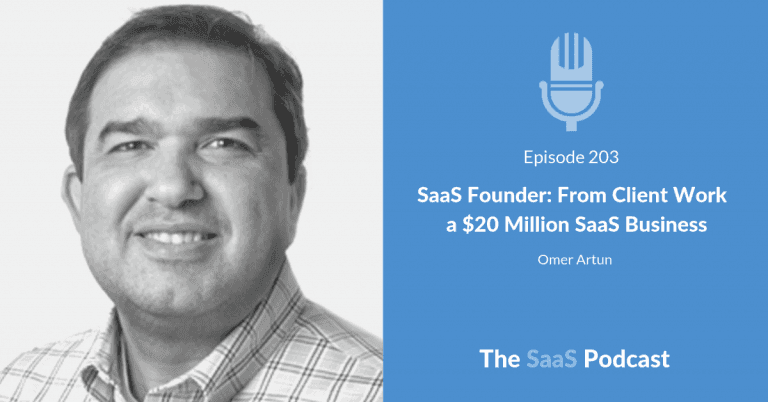
In this episode, I talked to Omer Artun, the founder and CEO of Agile1, a predictive marketing platform for business to consumer brands.
Agile1 allows marketers to understand and predict customer behavior to deliver automated personalized experiences across all customer touch points, online and offline.
Now, what do you do if you spot a market opportunity for a SaaS product but you don't have the money or resources to build that product?
Well, that's the situation that Omer found himself in.
He was working as a consultant and seeing the same recurring issues with his clients.
He knew that a machine learning based SaaS product could help these clients use customer data to improve their business strategy and deliver a better customer experience.
But he didn't know where to start or how to build that product.
So he took a different path.
He launched his own consulting practice and started solving these problems for clients one at a time.
After a few years, he was able to build a productized service and started charging a subscription for that service.
It took him seven years to finally turn his idea into a real SaaS product, which he shipped in 2012.
And he bootstrapped that SaaS product from the proceeds of the services business that he'd been running.
So it was a long journey.
But today he's raised over $50 million.
His company is doing almost 20 million in annual recurring revenue and he employs 115 people.
So if you've ever felt like you're being held back because you have an idea, because but you don't have the money or skills to build your SaaS product, then this episode is for you.
Or if you're just starting out with your product, or maybe you're currently running a services business and dream about transitioning into a full time SaaS business, then you might just get some insights to help you get closer to that goal.
It's a great story and I hope you enjoyed the interview.
Omer, welcome to the show.
Omer Artun (02:47.740)
Thank you, Omer.
Omer (02:48.780)
That is really weird.
I have never interviewed anyone with the same name.
And you know, we were just talking about this earlier that I've.
I don't think I've even met anybody with the same name.
So this is going to be fun.
So I'm glad to have you here.
You know, I always like to ask my guests what gets them out of bed, what drives or motivates them.
So what is it for you?
Like what inspires you or motivates you to work on your business?
Omer Artun (03:13.590)
So for me from an early age, the thing that really drives me is learning new things.
So if I'm stagnating, if I'm doing the same thing over and over again, that really demotivates me.
And the other thing that really gets me out of bed is building things and it's both physically and mentally creating something is really important for me.
Omer (03:38.070)
For people who aren't familiar with Agile 1, can you give us a quick overview of what the company does, what problem are you trying to solve and for who?
Omer Artun (03:51.790)
At a very high level, we're trying to solve how business to consumer brands can deal with their customers.
And to understand that, I want to go back 50 years when you went into your butcher shop, the butcher knew your name and what cuts of meat you liked and so forth and you got personal service.
We went from that to becoming for economical reasons because it's much more efficient, to becoming much more channel and product centric.
So then we started buying our meat in a Styrofoam package in a supermarket, then we started ordering it on E commerce and so forth.
So all of that stuff is, was optimizing the distribution and the product and not the customer.
So we've lost that personal touch.
So the problem and with technology and with the advancements in digital media, we are now able to recreate that personal touch at scale for businesses.
And that's the problem we're trying to solve.
We're trying to help businesses to refocus on their customers and become much more customer centric as they used to be.
Omer (05:17.450)
Now, I noticed that one of your customers on your website was Tumi.
So I'm assuming that that means that if I walk into a Tumi store, the person that I'm interacting with in the retail store is going to have a lot of the insights about me as a customer and what I've done before and preferences and things like that.
And is that kind of a way to think about it?
Omer Artun (05:44.460)
That's absolutely correct.
So customers today, the problem arises from the customers today interact with brands in many, many different channels.
So you might sign up for an email program, you might give your SMS phone number for an SMS program, you might call the call center for something, you might go to Tumi to get a baggage repair, you might buy three things, you might have moved from one address to the other.
So now there's eight different versions of you in different places and they're not connected.
So the task to become customer centric is first, you need to recognize that these eight profiles that are in different systems are actually the same customer.
The second step of that, and basically just tying it all together, the second step is just because we're trying to mimic what humans did 50 years ago, that's the kind of gist of what we're trying to do that comes with intelligence.
So you need to not just have the data on people like what you bought and how many products you returned and all that, but also how frequently do I buy, what price point do I buy does?
You know, discounting drives my behavior and so forth.
So what you do to get to that, you need to ask questions to the data.
And this is how humans do to learn about, to become intelligent.
So to become intelligent about your customers, you need to ask questions like this, what's the value of this customer?
Is the value increasing or decreasing and so forth.
And then based on that, you need to take some action on it.
You can't just use this as a, as a reporting or analytical exercise, but you need to change the way you treat the customers and interact with them and market to them and so forth.
And that comes in the kind of deactivation phase.
So those are the three things that we focus on doing with our product.
And again, the underpinning strategy of having a business with million customers act as if they're a corner butcher shop, you know, from 50 years ago.
Omer (07:52.570)
I think that's a great analogy.
So I wanted, you know, you started this business back in 2005, and there's a lot to cover here.
But before we, before we talk about how you came up with the idea for this business, I want to talk a little bit about you.
Like, what is your background?
You know, where did you grow up and when did your sort of entrepreneurial journey start?
Omer Artun (08:22.370)
Sure.
I was born and raised in Turkey, where I got my undergraduate degree.
And then I came to United States to do my PhD.
I have received a PhD in physics and computational neuroscience, which is kind of the machine learning area.
And I'll talk a little bit about, like, why I'm fascinated with that.
But my entrepreneurial spirit started when I was early in elementary school.
Since my early ages, I always knew that I wanted to build stuff and do things and learn new things.
So with the help of my uncle,
Omer (09:05.980)
who
Omer Artun (09:09.230)
taught me how to make paper bags from, you know, glue to.
There was, you know, bunch of fruit trees in our school backyard, which nobody was picking.
So I used to pick fruit, made paper bags and sold it on the street, you know, when I was in fifth grade.
And then from then on I've always had, you know, ideas here and there and always, you know, wanted to do new things.
Omer (09:36.260)
And didn't you start doing that as a kid because you wanted to buy a gift for your mother?
Omer Artun (09:41.540)
That's correct, yes.
There was a. I've talked about this in another video, but yes, it was a Mother Day's Mother's Day gift that I wanted to buy for my mom and I've saved all the money that I made from that.
It was a touching moment for my mom.
God rest.
Omer (09:57.940)
Love it.
That's an awesome story.
So let's talk about Agile 1.
And how did you come up with the idea for this business?
Omer Artun (10:09.530)
Yeah, I received my PhD in machine learning.
This is 1999.
And at that time I didn't want to go into academia.
I knew that I wanted to be more in the business world.
What really struck me is that in the business world people just didn't use analytics to its fullest extent of what was being used in academia.
So I thought that this machine learning, which is again, I can talk a little bit about that and it's a hot topic these days.
But machine learning really approaches the problems in a different way.
It tries to solve, not mundane problems, mundane computational problems like tax calculations and all that, but it tries to solve more complex problems that are easy for humans but harder for machines.
And I thought that there would be a lot of applications of that.
So I wanted to first understand how businesses work and so forth.
So I went to McKinsey Company to be a consultant there.
And there we use a lot of fact based problem solving approach and so forth to solve real life business problems.
And one of the problems that I encountered was, was one of the customers, the clients that we had had a salesforce sales team that was over 10,000 people.
They had 16 different product lines, they had over 50,000 kind of customers that are basically everybody on everybody's list and so forth.
But what they didn't, what they couldn't figure out is like, okay, some reps know some accounts better and some products better.
So how do you assign a sales rep to a product to an account?
And there was an optimization problem that everybody was trying to use like Excel spreadsheets to solve.
And I basically said, okay guys, you know, step aside, let me use some, you know, machine learning to kind of show you how this thing is done.
So I built an algorithm.
You know, I wasn't using Excel, I was using much more advanced modeling algorithms.
And it basically blew people away in terms of the accuracy and the insights they got out of it and so forth.
And at that point I had the idea of, okay, this whole analytics approach, the advanced analytics approach is going to make a real big difference in business over time.
So that gave me the idea that was my first spark.
And then from then on I said, where does this machine learning have the biggest impact?
And I thought that machine learning kind of tries to mimic human intelligence.
So I said, wherever humans are making decisions with business, that's where it's going to make a big difference.
And I think that's kind of business to consumer marketing.
So I went and ran marketing for a couple big multibillion dollar corporations, last one being at Best Buy.
And the stuff that I've done there, people started recruiting me to come do it for them.
At that point I said, okay, rather than go to a big company and become the data guy, I said, why don't I turn this into a business?
Because everybody's trying to solve this problem of I have all this data, I don't know how to make sense of it, I don't know how to take action on it, and so forth.
That was the idea behind starting the company, of turning customer data on its head to become, to drive business strategy.
Omer (13:47.060)
Now you've raised, what is it, $51 million to date.
Yes, but between 2005, when you started Agile 1, and 2011, so that's about six years you were bootstrapping the business.
Omer Artun (14:04.200)
Yes, that's correct.
So when I, when I wanted to start the business, you know, first of all I was in, you know, Connecticut, I was not in Silicon Valley.
So I didn't even know this whole VC landscape and raising money and all this kind of glamour of tech world.
So I, you know, as being an east coast person, I basically said, look, you know, when you start a business, you have to be profitable.
So, so I found a partner who have built and sold businesses before who was a great kind of mentor to me as well.
And he put in like, I don't know, $250,000 into the business to get us started, to basically pay for the first few months of my salary and office expenses and so forth.
And basically I became profitable on month 10 selling projects and services to companies with the purpose that the money that I would make from services, the margin that I would make, I would invest in building a product and the services that I would provide, I would be very disciplined around it so that those are more repeatable.
Things that would contribute to the product that I wanted to build at the end.
And that's kind of how it happened.
So the first five years was going from zero to about 35 people profitably.
And at the end of that I was getting into deals that I just couldn't handle myself.
And with the infrastructure I had, I had no cfo, I had no head of sales or anything like that.
It was just me and bunch of like super smart young people.
So I said, okay, this thing is going to become a real software company and this thing is going to take off.
So I said I better kind of move the company to Silicon Valley, raise proper funding, invest to build this product.
Not from gradual drip, drip, drip technology, but really have a sales team, really have a product team and so forth, and build it as a more product company rather than a services company building a product from its margin.
I think those are really, really different things.
Omer (16:34.210)
Yeah.
How long were you running it as a services business before you were able to ship your product?
Omer Artun (16:41.890)
So up until probably like 2011, we were running it more as a service company.
Although since 2009 to 2011, our contracts were written in a way that it was kind of like a SaaS contract.
So it was a subscription that gave them license to the software that we built and so forth.
But the software was, it was kind of like it was custom configured for every client and so forth.
It was not a real product product in the sense of a single SaaS platform, single like multi tenant instance and all that.
We didn't have any of that.
And at that time there was not a lot of technology to do that anyway.
So when in 2011 when we got funding, we basically said, okay, let's pull back and build a product in a more kind of proper SaaS way and probably shipped the product first.
Product probably like, you know, late 2012.
Omer (17:47.070)
Got it.
Okay, so.
So if I understood this, 2005 to 2011 was mostly running it as a services business, but in 2009 you effectively, you know, as you said, you sold it as a SaaS product and from a customer's perspective, it was starting to look like they were buying a SaaS product.
Omer Artun (18:11.930)
That's right.
Omer (18:12.530)
But on the back end of it, there was still a bunch of manual or custom work that you were doing.
Omer Artun (18:19.090)
Yes.
From an implementation perspective.
Yes.
When you came up with the new code and so forth, it was hard to upgrade people because they were not on the same database version and so forth.
We were not using a single database.
We were implementing a separate database for every Customer.
So from a customer perspective, it looked like they were logging into a product.
They didn't have to buy servers and software and so forth.
So from their perspective, it was a SaaS software, but from our perspective, it was not a SaaS.
Real SaaS business in the sense that it's multi tenant, like real SaaS.
There are a lot of companies today that I know of.
I'm not going to name any of them.
They say they're a SaaS company, but if you look under the hood, it's basically hosted software.
So we were hosted software in the beginning and then, you know, only in the last five years or so.
We are truly, truly SaaS, like multi tenant, single code base, every two week deployments, all of that stuff.
Omer (19:20.630)
So I'm curious, at what point when you started the business did you decide that you wanted to build a product?
Because it sounded like when you initially launched, it was like you had the vision that you wanted to build this into a product.
But from 2005 to 2011, that's like six years.
Why do you think that happened?
Omer Artun (19:44.570)
I mean, I've always had that vision from day one, but it took me much longer to get there.
Because when you are bootstrapping with services, you are at the mercy of the next dollar you're gonna get from the next customer you sell to.
And you don't have funding.
And it, you know, and cash is king.
You have to pay the bills and so forth.
So, you know, the customer kind of dictates the journey a little bit more than what, what you want to do strategically.
Like If I had $10 million in the bank at that time, like, I would have made different decisions.
Like I would have said no to certain things because the customer wants a feature.
Like they want to have a survey feature, let's say.
Okay.
And I would say, like, no, we don't do surveys because that's not in our kind of strategic interest.
I don't have other customers that are going to use it.
But if that customer is paying you money and there's margin in that deal, you would do it.
And then it would tie up development resources and so forth.
It would, you know, but you would have to do it because it would pay the bills, it would pay for something else that you needed.
But it's hard to keep focus with money coming from services.
Omer (20:59.340)
Yeah, no, it totally makes sense.
And I think there are a lot of founders or entrepreneurs who are running a services business, have an aspiration to move into a product business, but it's never that, you know, and even when they get to a point where they feel like they've got a market and they've got customers and they're providing a service, in many ways, you would think, well, great, you've identified a need, you understand customers, you understand a problem, and you've been doing that for some years and now it's going to be fairly easy for you to translate that into a product business.
But I think as you've described, it's not because you're very much at the mercy and the whim of what your customers want you to build.
Omer Artun (21:47.810)
And the other thing is, there's also a muscle memory of, you know, it took me from 2011 till 2013, but probably it took me like two years to understand, really understand the word product.
What is it?
What does the word product mean?
It took me a long time to understand because if you're coming from the services angle, you are client service oriented.
You think in a certain way you want to service the customer, solve the problem and so forth.
And you do not have the muscle memory to say no as a product company.
More often than not, you have to say no to 90% of the ideas that either come to your head or people come to you with, yeah, so,
Omer (22:36.330)
so clarify that a little bit more for, for, you know, for our listeners who maybe are in that, that service mindset.
What is different for you in terms of now when you think about a product business?
Omer Artun (22:47.170)
So when I think about a product business, you know, as an entrepreneur, you know, you are very always optimistic, you're always creative and, and chasing ideas and so forth.
And that is at odds with, you know, somebody who's a very strategic manager that basically sets out a road and it doesn't, they don't deviate from that road.
And again, I think the real answer is somewhere in between because, you know, you might, you know, if you have a very straight and narrow course that you, you set out and you don't deviate from that, you might miss the market or you might make mistakes because you need to be adjusting a little bit.
But the way a lot of entrepreneurs, or even I think which was some of the mistakes I made is, you know, when you hear, when you hear different ideas, you basically say, well, we can do this or we can do that.
You know, let's do that a little bit.
Test the market.
Let's do that a little bit.
Test the market.
I think again, like, there's no, there's no one right answer.
Like, being completely, like idea driven is chaos, but being kind of too narrow Focused on a path is also failure.
So I think you need to understand, you need to be able to go on as straight path as possible with some twists and turns that are dictated strategically.
But if you make a twist and turn like every five minutes, then you will go into chaos.
If you keep 100% straight line that you will fail.
I think the right answer is somewhere in between, which basically is the comment that I made earlier is 90% of the ideas that come to your head you should say no to.
Omer (24:29.220)
Yeah, I think that's a really good point because you can be so narrowly focused on what you want to go and build that you actually miss the opportunity or the other extreme.
You can be so open to what your customers are telling you that you go in all different directions.
So there is this thing about, yeah, you need to have this vision and you need to kind of work towards that.
But I think there are plenty of stories out there and I'm sure you know of many as well where, you know, founders were headed in one direction, but they actually got their breakthrough when they listened to what a customer was telling them.
Omer Artun (25:05.750)
No, of course you have to listen to the customers.
Like, there's no, there's no two ways about.
Like, again, like, you can't just think that you know better than the market.
Like, you can't just set out that straight course and not deviate from it.
But what I'm saying is like, if you have a product roadmap and do not change your next three month roadmap ever.
Like, if you want to change your roadmap, finish what you're doing in three months.
Or maybe it's two months, maybe it's six months, whatever the right break point is.
But you should not get the next idea and try to pull in your CTO or your head of engineering and say, oh, can we do this?
Can we explore that?
Like, don't do that on a weekly basis or a monthly basis.
Like, you need to have whatever the short term roadmap is that should not be changed.
Whatever twists and turns you make should be affecting more longer term roadmap or midterm low roadmap, if you know what I mean.
Omer (26:04.890)
Yeah, yeah, that totally makes sense.
Okay.
And so you know, to.
You talked about starting out the services business.
You're very focused on this getting to profitability as soon as possible, which is sometimes a novel concept for some businesses.
How are you getting the word out?
How are you finding customers or I guess clients in those days?
Omer Artun (26:31.250)
So in those days I would use my network number one and number two, I found problems that I knew was quantifiable that I could solve that people would pay money for.
So, you know, in those days, I mean, in those days and still today, people have a problem with like they invest a lot of money in marketing, but they don't know what works and what doesn't work and they don't know how to optimize it.
So I would go to these companies and say, look, you know, I'm going to optimize.
Like you basically give offers to everyone right now, you know, discounting offers.
I will basically figure out like which customers you should give what offers to, which will help you lower the total discounting you make and increase the value of customers.
Right.
It's very much in line with what, you know, our company's vision is.
And it will basically did an immediate value of like, you know, I've reduced their marketing spend by 20, 30%, I've reduced their discounting by 20, 30% and that immediately opened up millions of dollars that, you know, I could get like a few hundred K out of that.
Omer (27:37.640)
Got it.
And then when you were working with these companies, like you were doing all of this manually, you would gather data and then sort of go away.
Omer Artun (27:46.040)
And yes, I would basically have a server, would, you know, get there, get their data and you know, go to onsite and do certain stuff.
So I did that, I did that in the beginning and then I hired one person, second person, third person.
And then we started building some of the library of certain analyses that we did.
So as soon as we put the data in the right format, those analyses would kick out or models and so forth.
And that basically gave us, that basically gave us the, the opportunity to say, you know, not only I will do this thing once for you, but you know, you know, this project is 200k, but if you paid me like 5000amonth, you know, I will keep repeating this, you know, and you send me the data, I'll repeat this and send it back to you.
That was kind of the start of the so called subscription, which is like 2007, 2008 timeframe.
And then the next step of that was, well, you know, I'm not going to do it based on your servers, on your data, but you know, why don't you just feed me the data, I'll have the software like loaded on our system and you can access it from our office.
So I literally, literally had a closet with servers in it that, you know, basically served web pages of intelligence and so forth.
This is 2008, 2009 time frame.
And then we started basically saying like, look, it's not 200k, you know, to do this project, it's 80k to do this project and it's 80k per year ongoing.
Right.
Like it's.
So basically that was the start of the SaaS thing in 2008, 2009 timeframe.
Omer (29:37.210)
I think it's really interesting the way that you made that transition in terms of services business then looking for recurring revenue from the services, then sort of building this sort of front end.
So it's almost like this, you know what I guess they call it Concierge MVP.
That from a customer perspective it looks like a SaaS product.
And then eventually actually building all the back end technology that's been a six, seven year journey to make that transition.
Omer Artun (30:16.010)
Yep.
And we had to build the software twice.
That was also very painful.
Omer (30:19.490)
But yeah, you had to build it
Omer Artun (30:21.330)
twice because it was both a personal issue in terms of like, you know, I think the, there are a couple things there.
So we had this.
The specs for the software we wanted to build was pretty well defined, like what the customers wanted at that time, like in 2011.
But then I hired the professional development team and so forth.
And I had great junior technology people that built this initial thing until 2011.
And it worked really well for us until that time.
Feature Rich was very nimble to do new things and so forth, but it was just not scalable.
Right.
So now you're going from being very nimble and customer driven to becoming much more product focused, something that's scalable and upgradable and all those and managed as a real product with documentation and all that.
So going to that, I hired the professional kind of development team and there were personal issues there.
I didn't choose the right people because I'm not a software developer personally myself.
I'm more of an algorithmic math guy.
So then the initial product they built was because we're dealing with large data, we were using some of the new database technologies, these kind of big data technologies at the time was just brand new.
And I would say like 50% of the technologies were crap and the other 50% was way too early or way too buggy to work.
So we kind of.
Struggled with that for a couple of years.
And then in 2014 we basically said, okay, we gotta throw all this away and we gotta build a new platform.
So then we started building that and we came up with our product like at the end of 2015, beginning 2016.
So for the last three and a half, four years we're on this, you know, kind of newer platform that really works well.
Omer (32:32.220)
What were some of the issues you were facing with that first product?
Like how was it impacting your day to day business or the lives of your customers?
Omer Artun (32:42.700)
This is a common problem with some developers.
Like, you know, I've always see every developer wants to do certain things the way they want to do it.
So anything that somebody else did is never good because it's not invented here.
And they also want to use always like the newest technology and so forth, which sometimes lead to using immature technologies and you can't find enough people to hire and use those technologies and so forth.
But I think the right leaders kind of solves that problem.
And the problems that we ran into with the previous platform was, you know, the machine learning core was using one version of Java.
The other like some UI framework was using some other version of Java.
And don't quote me on these things because I'm not really proficient in these things.
But those things didn't work on the same server because they were using two different Java versions and blah blah, blah, and they had to like do bunch of like jump through a bunch of hoops to fix that problem.
Right.
Like so those type of things like you know, you need to use not the latest technology but you know, kind of the easiest path possible that has the highest, you need to build a product not because it's the coolest technology, but something that is, can be maintained easily.
Omer (34:06.540)
Yeah, no, I totally understand.
And I think, you know, there's one thing from taking a new, new piece of technology and building a, a side project as a way to, to learn the technology and to get experience with it.
And there's another thing, turning that into a, a production, you know, system or product that is going to be used to run and scale a business.
Right.
And it sounds like the former was used to do the latter here.
Right.
And then when you built it the second time, had you raised enough money and do you hire like your own team or were you still outsourcing?
Omer Artun (34:53.739)
You know, we hired the second team or we hired, I mean the same team.
Like we just got new leadership and new architects and so forth and that worked out well.
You know, but again it took again I think every founder or every company is strong on certain things.
Like we were very focused on kind of this machine learning intelligence and creating value for the customer.
And I think the whole software piece of took two tries to fix it, two tries to get there.
Omer (35:29.120)
Yeah.
And so today, uh, how big Is the company like how many?
What's the size of your team?
Omer Artun (35:37.160)
So we're about, you know, 115 people and our revenue is getting close to 20 million.
Omer (35:44.760)
20 million.
ARR.
So when you look back at this journey that you've taken, I guess for the last 14 years, what are some of the things that you wish you had done differently?
Or what are some of the, the, the mistakes that you made that you, you feel were some of the most valuable lessons you learned?
Omer Artun (36:06.650)
I would say the number one, there's two things I would, I would do differently.
One is again, it took me a while to understand what a product is.
So before you have, like if you're bootstrapping and then, then you take money, I think I wish what I have done is when I've taken the first money, not put any kind of revenue or growth pressure on myself and basically retrieved and built the right product that would scale fast.
I think building the product while you're trying to grow, putting the revenue pressure and the product pressure is not the right thing to do.
Because at the end what you create is you sign up.
We've signed up a lot of customers on a product that wasn't the right product, wasn't scaling.
So those customers that need to be migrated and so forth, and that's painful, right?
Like you lose some of those customers, you migrate some of them and so forth, but you're basically not ready.
So, so figuring out having the right product is the right thing and having the right product also means that the customers are also ready to buy.
So the market also you need to look at the signals of when you want to scale.
That comes to the next part.
Like once you have the product, is this product ready to get marketed?
At what stage are you, are few people trying it and getting value?
Is there a mass market out there?
Do you need to build the product in a way that can be an entry level product that can land and expand and all that?
So you need to understand all of that before you step on the gas of sales.
Because if you step on the gas of sales, if the car is not rolling downhill, pushing uphill takes a lot of money and a lot of effort, which, which is hard to do, which some people do.
And it starts rolling downhill at some point.
But I would also try to be always pushing the car on flats rather than pushing it uphill.
Omer (38:25.590)
What do you mean by that?
Omer Artun (38:26.950)
What I mean by that is we were early in the market.
We are in this market is now called the customer data platform and we are the Creators of this market.
And I'm not proud of it because I was eight years early into the market trying to explain people you're evangelizing and so forth.
So if you have, in that phase of growth, if people want to do like, if people ask you around, like what's the roi or can we do a pilot or you know, can you explain to us what you do?
And we're gonna have like five meetings and whiteboard sessions and so forth.
Those are signals.
Or do you have an ROI calculator?
Like if somebody's asking for an ROI calculator, it just means that whatever you're selling is not, you know, is not mainstream yet.
So for that, you know, I would do much more kind of word of mouth, reference, selling and so forth and not build a sales engine that, you know, that can ramp.
Because once you build a sales engine, those people, you know, they want that constant leads coming in.
There needs to be a conversion rate, there needs to be a mission, like don't build that machine until you go through that.
You end the phase of whatever you're doing where people are not asking for ROI calculators or proof points or free trials and so forth.
Omer (39:55.350)
Yeah, I mean that's a great insight, but I think it's really tough to do because as you said earlier, when you've got the revenue pressure, whether that's self inflicted or it's external, it's very hard not to be in a rush to put your foot on the pedal and accelerate.
Omer Artun (40:14.070)
That's right.
I mean, once you get money from the VCs, that's it.
People drool over getting money from the VCs and I have some of the best VCs in the world that support me and they're very supportive.
But at the end of the day, they are giving you money for you to grow.
Like if you, you know, they're not giving you money to build product.
Right.
Like, I mean, of course some of that money is going to go to product, but they're not, they're not going to get an exit for their money.
When you build the greatest product in the world, they're going to get an exit when you build that product and when you have revenue against that product.
Right, right.
So once you get the money, the clock starts ticking.
That pressure, you can keep that pressure off for a little bit.
If you are upfront about it saying, I'm going to take the next six months or a year to build this product.
But that was the mistake I've done, I should have done that.
Rather than stepping on the gas because I already had real customers and few million dollars in revenue and so forth, I thought that I could just build the product, you know, in flight.
But that was really hard.
Really, really hard.
Omer (41:24.120)
So are you saying you wish you had waited longer to raise money?
Omer Artun (41:28.840)
No.
I think so.
Yeah.
So there are two things, right?
One is after I raised money, I would have, I should have waited to.
I should have like given enough time to build the product a little bit better than what we did.
Like, rather than building it in flight, we should have pulled the, pulled the boat onshore and built it and then sailed again.
The second thing is, I think from a timing perspective, our vision was correct overall across the board, but we were way early in the market.
Like, this whole customer data platform thing is now being talked about by Gartner over the last two years and they're going to do Magic Quadrant this year and so forth.
But we were talking and evangelizing this six years ago.
So it was, you know, we were like, we were probably like three, four years early into the market.
Which is, which basically translates into, you know, we have built the market.
Like, you know, we can claim that we were one of the, or the original kind of people in this category, but you know, you don't get credit for it.
Right.
But you are, you know, using, you are burning money to educate the market and create that market.
And it's expensive.
Omer (42:42.850)
Okay, so it's time to wrap up.
We're going to go into the lightning round.
I'm going to ask you seven quick fire questions.
Are you ready?
Omer Artun (42:53.250)
Sure.
Omer (42:54.450)
Okay.
What's the best piece of business advice you've ever received?
Omer Artun (42:58.930)
Cash Pays the bills.
Omer (43:01.570)
What book would you recommend to our audience and why?
Omer Artun (43:06.310)
There's a book called Nudge.
It explains how people make decisions, how human kind of heuristics of intelligence works.
It really was enlightening for me to understand how people think and work.
Omer (43:22.230)
That's Nudge.
Improving decisions about health, wealth and happiness.
Is that the one?
Omer Artun (43:28.030)
Yeah.
Omer (43:28.430)
Okay, cool.
What's one attribute or characteristic in your mind of a successful entrepreneur?
Omer Artun (43:35.340)
Great.
Omer (43:36.460)
What's your favorite personal productivity tool or
Omer Artun (43:39.260)
habit as a very creative person?
For me, it's surrounding myself with people that are very well organized.
Omer (43:47.340)
What's a new or crazy business idea you'd love to pursue if you had the extra time?
Omer Artun (43:51.660)
Opening a restaurant.
Omer (43:53.260)
Really?
That's interesting.
What type of restaurant?
Omer Artun (43:57.740)
I cook kind of Turkish food and I actually do pop up restaurants every two months.
Omer (44:04.270)
Wow.
Omer Artun (44:05.390)
Yeah.
Which is in high demand.
So I would turn that into a restaurant.
Omer (44:10.190)
Wow.
I got to time my trip to San Francisco when you're doing that.
And if you know of any good Turkish restaurants in Seattle, I'd love to find one.
What's an interesting or fun fact about you that most people don't know?
Omer Artun (44:27.230)
So I'm also a semi professional potter.
When I was doing my PhD at Brown, I was a visiting artist at Rhode Island School of Design doing pottery.
I've been doing pottery for over 30 years and have a full studio at home.
Wow.
Omer (44:44.050)
You know, I've often said that I should ask these questions at the beginning because it just opens up like you just, you just see a different person.
Right.
In terms of when you ask these questions.
And finally, what's one of your most important passions outside of your work?
Omer Artun (45:04.060)
I would say it's pottery and cooking.
Omer (45:07.820)
Awesome.
Omar, thank you.
It's been a pleasure.
I've really enjoyed this conversation and thank you for sharing your story.
I know it's never easy to tell the story when you've been working on something for almost 15 years and someone's asking you about the early days and the things that you did.
So thank you for helping us, you know, go through that process and, and hear your story and sort of how you got started and how you built this business and, and also, you know, for sharing your, your insights and, and lessons and mistakes that you made along the way because that's really, you know, helpful.
And one of the things that I really try to do on this show is to share that with our listeners and, and to give people who are, you know, at the earliest stage of their journey know some more motivation and inspiration to keep going.
So, so thanking, thank you for, you know, helping me to achieve that.
Omer Artun (46:02.390)
You're welcome.
Omer (46:03.350)
Now if people want to find out about Agile 1, they can go to agile1.com that's a G I L O N E dot com.
I'll include a link in the show notes as well.
And if people want to get in touch with you, what's the best way for them to do that?
Omer Artun (46:20.150)
They can use my email address.
It's Omer.
Artunjul1.com O M E R A R
Omer (46:27.450)
T U N julwan.comagile1.com and just to be clear, it's Omer with a omer just like mine.
So don't write it with an Omar because neither of us will receive those emails nor we will respond.
Thank you my friend.
It's been a pleasure.
I wish you all the best.
Omer Artun (46:48.410)
Thank you.
Bye bye.
Omer (46:50.450)
Cheers.