Omer (00:11.440)
Welcome to another episode of the SaaS Podcast.
I'm your host Omer Khan and this is the show where I interview proven founders and industry experts who share their stories, strategies and insights to help you build, launch and grow your SaaS business.
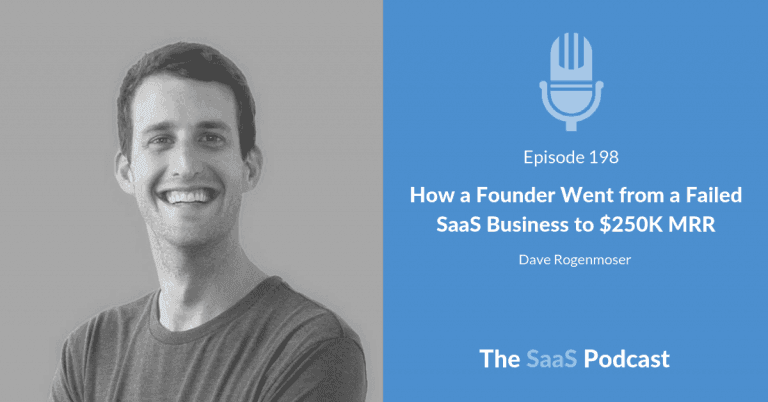
In this episode, I talk to Dave Rogenmoser, the co founder and CEO of Proof, a SaaS product that helps build social proof and increase conversion rates by displaying recent customer activity on your website.
Dave started as an entrepreneur about five years ago.
He paid a developer on Upwork $10,000 to build a software product, but he didn't know how to get customers and so the business quickly failed.
He started learning as much as he could about marketing and as he developed those skills, he was able to help local businesses get more customers.
So he started an agency, but quickly realized how much he hated the agency life.
Next, he and his co founders launched an information publishing business and sold courses and coaching.
But deep down, he still longed to have a software business with recurring revenue.
One weekend, Dave and his co founders built a widget for their website to help them sell more courses.
The widget showed you names of people who had just purchased the course.
It was social Proof and it quickly doubled their sales.
Dave started testing this widget on his friends websites and they all reported positive results and improved conversion rates too.
And that's how Proof was born.
In this episode we talk about how Dave and his co founders turn that widget, which they built in a weekend, into a SaaS business doing $250,000 in monthly recurring revenue.
We talk about how they've grown, how they've dealt with competitors and some of the biggest mistakes they've made along the way and what they've learned from them.
I hope you enjoy it.
Dave, welcome to the show.
Dave Rogenmoser (02:14.830)
Awesome, Omer.
Pumped to be here, man.
Omer (02:17.230)
So what gets you out of bed?
What drives you to work on your business every day?
Dave Rogenmoser (02:21.550)
Well, I was thinking about this recently.
It's kind of this quote I've been meditating on related to what are we trying to do here at Proof is I heard it from David Cancel at Drift.
I think somebody else said it before him.
It's whoever gets closest to the customer wins.
And I think that's this counterintuitive thing.
It's easy to kind of say we're customer obsessed or we're building for the customer or whatever, but on a day to day basis it's actually really, really hard to do.
And so I think recently, you know, what's been driving me is trying to crack that nut and figure out, how do we get close to the customer?
How do we truly build something that delights customers, solves their problems?
And how do we become the Most customer obsessed SaaS company in the world?
And that's a big challenge for us.
I think it's been a big shift in our company.
And so recently that's what's been driving me.
Omer (03:06.890)
So you said you've been meditating on it.
So do you meditate or that was just a, an expression.
Dave Rogenmoser (03:12.050)
Mostly that was an expression.
I do do some meditation, but mostly that's just been a quote I've just been chewing on and just thinking, you know, one, is that true?
Two, where have I seen that before?
And then three, you know, what does that look like for us?
And so, yeah, just a question I've been chewing on over and over.
Omer (03:27.090)
So for people who aren't familiar, tell us, like, what, what is proof?
You know, who your target customers and what problem do they have that you're trying to solve?
Dave Rogenmoser (03:34.690)
Yeah, so we started about a year and a half ago and Proof helps businesses increase their website conversion through personalized site social proof.
And so any business that's selling something out there right now, you know, we originally kind of got, came up with the idea because we were looking at, you know, booking.com or Airbnb and we'd see these, you know, notifications slide out and say two people booked this hotel room in the last day, you know, book, now there's two left.
Or, you know, 47 people are watching this right now.
And I thought that's pretty cool.
So we ended up creating that solution, you know, for ourselves.
And that's what we offer now is that companies can hook up to Proof.
And you know, if you're selling a product, you know, we could say how many people bought that product recently?
Or we could see how many people showed up on your site.
And then the last 24 hours, we're kind of taking what's happening on the site by your visitors, by your customers, we display it to your other visitors.
And what we found is that when we do that, people get probably 10 to 15% on average conversion lift across all of our different customers, which is a really, really exciting thing for them.
And so, you know, at the end of the day, what we offer is a conversion lift in a way that's, that's good for the business, but also good for the customer.
Omer (04:37.090)
Yeah, I've seen proof everywhere.
You know, going onto a sales page and so, and so just bought this product and you know, there's definitely some, some Great virality built into that product.
One question I had was, like, if somebody is, maybe they're not selling a product every day or regularly.
Like, for example, you know, I have a membership site called SAS Club Plus.
But most of the time it's a kind of a closed enrollment, and, you know, enrollment opens up at certain times of the year.
Would proof work in a scenario like that or would it not make sense if, like, there was nobody buying anything in the last two months because we weren't selling anything?
Dave Rogenmoser (05:23.720)
Yeah, yeah.
So probably wouldn't work well in that situation.
Kind of what we tell customers is, you know, what is the perception that people would expect of your business when they come to the site?
You know, maybe some people make 10 sales a day, and if you're a little shop, you know, customers see that and they think, wow, this.
This is bigger than I thought.
I thought maybe they're only doing one or two a day.
You know, if.
If Nike puts it on their site and they're showing that they had, you know, 10 purchases a day, people would be a little bit confused and a little bit worried that Nike was going out of business.
And so you kind of just decide, you know, it's like, what do people expect?
You know, what's their perception of your business right now?
And can showing and revealing, you know, what's actually happening on the site increase, you know, trust, transparency, and ultimately help people take more action and have a better kind of buying process?
Omer (06:06.740)
Okay.
So I want to kind of set the context of the business in terms of, like, size.
So in terms of revenue, where are you guys right now?
Dave Rogenmoser (06:12.740)
We're at about 250,000 mrr right now.
Omer (06:16.180)
And you have a team of what, 17 people?
Dave Rogenmoser (06:20.420)
Yep, 17 located in Austin.
We've got, you know, almost everybody here.
We have 15 people here in Austin and then two remote.
Omer (06:27.570)
I've got to come down to Austin.
Like, I'm hearing.
Keep hearing about it, and, you know, I got some friends who moved down there as well.
Sounds like it's the happening place.
Dave Rogenmoser (06:36.290)
It's pretty sweet.
It's November 29th right now, and it's 74 degrees outside, so I'm enjoying it.
It's pretty sweet.
Yeah.
Omer (06:46.930)
And you guys are YC alum?
Dave Rogenmoser (06:50.930)
Yep.
Yeah, I did one seed earlier this year.
Omer (06:54.220)
How much have you raised so far on this business?
Dave Rogenmoser (06:56.300)
Yeah, so we were kind of fully bootstrapped up until the point where we got into YC and then we took a little YC investment, and then we raised around $2 million at the end of YC as a seed round.
Omer (07:08.060)
Great.
So I want to talk about how you came up with the idea and sort of tell the story to where you've got to today.
But you have an interesting background.
So before we kind of get into proof, I'd like to talk about.
About what you were doing before proof and sort of what led you to build this business.
So what were you doing?
Dave Rogenmoser (07:30.390)
So I've really kind of been working for about four or five years now on the same problem for customers, but in about three different iterations of how to solve that.
And so I started as entrepreneur about five years ago, tried to start this little software business, you know, that failed.
I didn't make any money.
I spent about 10 grand getting this thing developed.
And I'm not a developer.
So I got this thing developed on upwork and.
And I knew I need to figure out how to do marketing because I didn't know how to get any customers.
I said, it's dead product out there in the world.
And so I just started like obsessively studying marketing and then started reaching out to local businesses, helping them do Facebook ads, do SEO, build their website, essentially help them build a site, drive traffic to it with a high enough conversion rate that they could make sales and be profitable.
So my kind of.
My first iteration of trying to solve this conversion rate problem was this agency where I would just do it all for them.
Got up to about, you know, 25 clients I was managing.
Kind of hated the agency life.
Cause now I just had, you know, 25 people that were mad at me all the time because I didn't know how to scale, I didn't know how to systemize.
I was just like, trying to, like, juggle all this at the same time by myself.
But it was a great learning opportunity to see, okay, this is a real problem.
Businesses are willing to pay a lot of money to help have this problem solved.
And I'm actually pretty good at this.
I can go out there and do this.
And so that's kind of iteration number one.
And I was actually working with my two co founders that are still with me at ProofNow on that same problem.
So I kind of got to the end of the agency and we were just, you know, so worn out.
We said, okay, we want to get rid of almost all of our clients.
You know, keep a few that we like.
And then we want to go launch into an information publishing company.
And we wanted to create courses and do some coaching and just teach people, one, how to launch and build a consulting business.
But then two, how do you do Facebook ads?
How do you build marketing funnels?
How do you do all these different things that we were doing that we were really learning about?
So we launched into that, which was us instead of kind of doing conversion rate optimization and doing online marketing for people, we were then teaching them, and they'd say, hey, can you optimize our website, our landing page for us?
I said, no, but you can buy this course that teaches you how to do that.
And that was a really cool experience for us because we learned that we could productize a service into a product and sell that.
But then also we learned how to really scale a business.
And at the agency, I could handle a max number of clients, but with the information product business, you know, we could sell, you know, unlimited copies of these video series and, you know, coaching a little bit less.
But we really learned in that experience how to scale, how to run a lot of paid traffic and run it at high volume, how to build high Converting marketing funnels and.
And just learn so much more about that while still helping people solve that same problem.
It was kind of around that time as well.
I still kind of lumped this into, like, phase two.
We, you know, we were building out or building out this consulting business.
We were trying to figure out how do we actually invoice our customers?
And one weekend, our co founder, one of our co founders, JP Built this little app that would hook up to Stripe, allow me to email a link to a customer, they could open up a little invoice into their credit card information, pay it, and be done super easy.
We called it Paynels.
And so essentially, we kind of built this thing for ourselves, but never intended on, like, selling it or anything like that.
So by the time we started launching this course business people would land clients, and they'd say, well, Dave, I just got a client to say yes.
How do I actually bill them?
And I said, oh, I don't know.
We use pay funnels.
You know, if you give me a week, we can probably figure out how to, you know, give you a login for it, and you could use pay funnels yourself.
And so without really giving, like, too much effort to pay funnels, it grew to about 500 people that were paying $29 a month for it.
And which is really exciting for us because it was this kind of recurring, relatively passive source of income that was just kind of piggybacking off of our main business, which was the courses.
And so that was kind of our first dipping our toes successfully into SaaS.
And we ended up Being able to sell that business off.
And it was kind of at that, around that time, we were getting a little bit tired of running courses and selling courses.
Um, we'd kind of successfully built this little software product and sold it off.
And we thought, you know, I think we could do this again, but way, way bigger and way, way better if we put all of our focus into this.
And that was around the time that Proof came about.
And, you know, Proof was kind of iteration number three of, hey, how do we solve this conversion rate problem for these customers?
And it was instead of doing it with a product, you know, a course or training, it was doing it with software.
So we said, well, we'll just hook up this software and it's actually going to do the conversion rate optimization and give you a lift for you automatically.
So you can see a pretty good progression between those three different stages.
And we've really been thinking about this problem really deeply for five years, Building up our skills, building up our knowledge, even building up a customer base to the point where when we launched Proof, everyone that had bought our courses and were on our email list and everything, I mean, they were already looking for solutions to this.
And so we had a really nice base to kind of go launch with, with strength into, which worked out really well for us.
And so that's kind of the background.
I really do think of all those as very, very tied together.
We really would not have been able to do Proof without the other two.
And I think it was important that we did them in that order.
Omer (12:42.700)
Yeah, I think it's always interesting because whenever we look ahead, it's really hard to figure out sometimes what to do, how to get something done.
You kind of think that it's a very linear journey and it's not, but when you look back and sort of connect the dots, you're like, oh, yeah, of course, I had to go through that before I could get to this point.
Why did you sell pay funnels?
Dave Rogenmoser (13:10.340)
We didn't really know how we were going to grow it or what even it really was going to be.
And so it was just, again, it was kind of built on accident.
And we ended up just talking with someone about selling this thing off so we could focus on a new product and, you know, got a good offer for it.
And I think we just kind of wanted to also see, like, before we started Proof, we wanted to, like, see the completion, like, the whole life cycle of a SaaS product.
And, like, what does it look like to actually package this thing up and sell it and what Is a buyer actually looking for and all of that.
And so I think for us, we just didn't really have a vision for where it was going to go.
And we knew we were going to put so much work into something that we wanted to have a clear direction of vision for what we were doing there.
Omer (13:49.510)
Did you already have a plan for proof at that point when you started to look for a buyer?
Dave Rogenmoser (13:54.470)
It was like right around that same time.
And so I think, yeah, we had started thinking about proof.
I think we ended up actually closing on pay.
I think we started trying to sell pay funnels about a month before we had the idea of proof.
But then we'd already, like, launched proof by the time pay funnels actually sold.
I think it was about a five month process of us kind of getting that thing sold off.
So.
So it's all kind of happening around the same time.
Omer (14:20.430)
So tell me more about how the idea for proof came about.
Dave Rogenmoser (14:23.550)
Yeah, so, you know, we were selling courses.
Facebook ad costs were rising.
It seemed like courses and kind of teaching information was becoming a little bit more of a commodity.
We were making, you know, less and less margin.
That compounded with the fact that I would look over at some of our competitors that were selling similar courses, and they were just lying about how many people were taking their product or what results.
And I kind of knew the backstory, but, you know, they were telling these people on these webinars these crazy things, and I was like, that's.
That's total crap.
Like, I know that's not true, and yet it was working.
You know, it's like they were selling something that was a little bit too good to be true, but it was working, you know, online, and they were making more money and their funnels are more profitable and more successful.
And so I'm sitting there thinking, like, what am I going to do?
Like, I'm not willing to do that.
I'm not willing, you know, one, because I didn't think it was the right thing to do.
But also I just thought, that's not going to be good for our business in the long run.
And we're trying to build a business that we can be building in 20 years.
And so if I just burn all my customers right now, there's not going to be a business there.
And so I was looking at that and thinking, there's got to be a way to make more money for us, but also be more transparent and tell our customers more.
And that was, again, kind of the time that we had seen on these other sites, these tools that Airbnb was using.
And I found out later that they just built them themselves where they were showing me like actually what was happening.
And as a consumer, it was really good for me because I can make a better buying decision.
I knew more about what was actually going on.
But then as a business, I was thinking, this probably works for them.
And so we built it one weekend, put it on.
We were selling a course called the Entrepreneur Alliance.
It was, you know, $30 a month, $1, you know, seven day trial, and about 19% of people who hit that order form would actually sign up for the trial.
And, and we've put proof on there, which we didn't call it proof.
We just this little widget thing and it just said, you know, Dave from wherever the IP address was located just bought the Entrepreneur Alliance.
And we put it on there, you know, waited, you know, a couple days to see what would happen, which, you know, looking back now, it probably wasn't a perfectly valid test, and came back and saw that it was converting at 42% instead of 19%, that the variant was at 42%.
And yeah, like, this is, this is amazing.
We really didn't know if it would work.
We hadn't invested much into it.
We're like, this is amazing.
I think at first we thought this is gonna help us sell so many more courses.
Like, this is gonna be our competitive advantage against the people who are lying out there.
But then, you know, I kind of started testing on some of my friends sites, people running webinars and you know, doing, selling other courses and stuff like that.
And across the board, all of them reported back, this is really awesome.
The split test with proof on it is crushing it.
How can I buy this thing and put it on other parts of my site and all that?
And that was kind of when we thought, okay, maybe this isn't just a tool for our own business.
Like, maybe this is.
And that was kind of the light bulb moment for us.
But we really wanted to see does this thing actually work first?
Because if it didn't really work, we had no interest in actually trying to scale this thing and sell this thing.
Omer (17:23.400)
I love talking about products that were built over a weekend.
I mean, you've been through that, right?
When you talked about building the first product.
And I'm sure it wasn't a weekend when you spent ten grand to build a software product.
And I've been there too.
But you know, it's, there's something just beautiful about taking a tiny, tiny product, getting it out there and seeing if the market, it resonates with the market.
Dave Rogenmoser (17:46.870)
Yeah.
And it's so much easier when you're solving your own pain because, like, we were our customers.
Like, we knew we wanted it.
You know, I mean, fortunately, we had an engineer, you know, as a co founder who could actually build that.
A lot of people aren't, you know, that fortunate to have that.
I think it's the way to go.
I mean, I think when you're thinking about an mvp, I mean, it's just gotta be quick and raw and dirty, and you've got to get it out into the market to test it and see, like, does this thing work?
Does this thing, you know, have any staying power?
I think that's just a huge mistake.
I mean, if you're building an mvp, you know, if you're listening, you're, you know, working on something right now, like, if you can't get something out in under a month, then it's too big.
That's kind of the, the rule of thumb we have for any new product.
It's like if it's, if it's more than a month, it's in scope, you know, it's way too big.
We gotta cut that thing down and just get it out there.
Omer (18:30.130)
So you're getting good feedback from friends and sites that you've tried this on.
It's helping them get results as well.
And you sort of realize this potentially is the business we should be focused on.
What was the next step for you guys?
Where did you go next?
Dave Rogenmoser (18:46.580)
Yeah, so at the time, you know, we had the entrepreneur alliance that was, you know, making this, you know, monthly recurring income for us, which was nice.
And then we said, well, we still don't really want to build out the whole product until we know, you know, that more people want it.
And so what we did was we held this webinar, invited our whole list to it.
I don't know, we had maybe 80,000 people on an email list or something.
And we sent us a bunch of emails and said, hey, come, we've got this new product.
We want to show you guys it's going to change how people do marketing.
And pitched on this webinar proof and it didn't exist yet.
We had some case studies of just people we tried it with pitch this thing.
And I'd done webinars before and we kind of get to the end and I'm like, you know, we're going to give this to you.
You know, it's $1,000 for the first year.
But the problem is it's not actually ready yet, and it won't be done for another month or two.
And everybody was like, so deflated in the webinar because they were like, you know, really, really wanting to try this thing now.
But even without the product being done, just me casting the vision for it, we had about 40 people, I think it was 39 people signed up for a year, paid money up front, like right on that webinar, and gave us about 40 grand in revenue for a product that didn't exist.
That allowed us to kind of invest that, you know, into the product.
And so not only was it nice, like upfront cash flow, but it validated the idea.
And it was like, well, worst case scenario is we're going to make 40 grand out of this thing.
You know, that's worth going and kind of building this thing out.
So I think that's a really important thing for a lot of people.
You know, they just spend so much time before they go out there and try to sell something where we kind of flipped it and we said, let's sell it to even see if it needs to be built.
And so, yes, that was kind of a really cool, I think, early lesson for us.
Omer (20:25.380)
Okay.
And so I want to talk about growth strategies that you've used to get to where you are today, which I think you mentioned it was around 3,000 customers.
Dave Rogenmoser (20:37.220)
Yep.
Omer (20:38.100)
Now the one, the obvious thing is the kind of inherent virality of the product.
Right.
So you see this thing popping up on different sites, and at the bottom you'll see, you know, verified by proof.
That on its own is a.
Is a great way to get the word out about the product.
But what were the growth strategies that really have helped you guys?
Dave Rogenmoser (21:04.270)
Yeah.
So I think it is important, you know, for companies to think through, like, is there some aspect of virality that you can build into the product?
And yeah, proof is, you know, very obvious.
It pops up on sites.
But I think with, with most companies, you know, there's something that you can do to.
To build in these viral loops.
I think a lot of people think about SaaS companies, you know, just like a funnel, you know, just from the top of funnel, you know, people on your visitors on your website all the way to the time the person buys.
And I think that it ends at purchase.
I think that's the wrong way to think about.
It's kind of the old way to think about it, you know, now you got to think about it in loops.
And once somebody buys, how can that cohort of new users actually create another cohort of users.
And so I think you've really got to stop and think, how can we build this thing into the product?
And don't just think, oh, I don't have a proof type product.
It's not going to work for me.
But we had that and we were really excited about that.
We thought that's going to be a competitive advantage.
And so first thing we did was we made A list of 50 people in the marketing industry that we felt like influenced most of the market.
And we just went hard after those 50 people and said, we want to get all of these 50 using the product.
And after a couple months, we probably had 40 of them using it on their sites.
And that was just a really great thing because all of a sudden everyone's saying, I'm seeing proof everywhere in reality is, you know, we didn't actually have that many customers.
We just had the right customers.
So everybody started signing up for it and they'd seen it and it was just validated.
And I just think we attacked the market the right way there.
So that's kind of the first thing is get the people, get the right customers early on, the people that will influence everybody else.
And that worked really, really well for us.
Omer (22:40.360)
How did you figure out who those influencers were?
Dave Rogenmoser (22:42.940)
Well, we'd been in the space for, you know, years.
And so I just, you know, I just knew inherently, we kind of just sat down and said, hey, who do we all watch?
Who do we all look up to?
You know, who's.
And this is all kind of an information marketing space.
And so we're just like, you know, who are the people we've bought courses from?
And so, you know, in that space, it was pretty easy to kind of make a list of those people.
And we kind of knew again, because we'd been in the market for so long.
Omer (23:04.380)
And did you charge these people to use the product or you just kind of gave it away?
Dave Rogenmoser (23:09.620)
I think some we charged, I think, you know, really we just kind of, I think we tried to charge and, you know, a lot of them or, you know, most of them, you know, paid, but I think if we got any pushback, it was like, hey, can we just put this on your site as a test and just see how it goes?
Because we knew that really what we wanted was, was the authority.
I didn't actually care that much about the revenue for many of those people, but yeah, I think, I think most of them paid.
Omer (23:31.940)
Yeah, because even if you got nothing from these, these influencers, they were going to be a great Distribution channel for you.
They were basically advertising on their website.
Dave Rogenmoser (23:42.670)
Exactly.
Yeah.
And I think we had them pay mostly because I thought they would value it more if they were paying.
You know, if they're just not paying, you know, they're probably not going to log in and set it up.
It's just this little thing.
But if I can get them to pay, you know, they're just me so much more invested in it, and so I just.
I wanted them to pay, you know, mostly for that reason.
Omer (24:03.600)
Okay, so you've got the influencers, and you had pretty good success if you were able to get, you said around like 40 out of those 50 people that you had on a list using proof.
And you're right.
Dave Rogenmoser (24:17.080)
Yeah.
Omer (24:17.440)
It doesn't mean proof is everywhere, but certainly getting on those types of sites makes it feel like proof is everywhere.
Dave Rogenmoser (24:26.400)
Yeah, yeah.
To that industry, proof was everywhere, and people saw it, you know, every time they'd go buy a course or look at a video, you know, whatever.
And so there was just so many impressions we were getting on one specific audience, which really, you know, made proof.
You know, we kind of had a monopoly, you know, in this new space that we had carved out.
Omer (24:45.609)
How does proof work?
Is it just like people add like a pixel on their page and you guys kind of hook up with that?
Dave Rogenmoser (24:51.850)
Yeah, yeah, essentially.
Yeah.
It's pretty easy.
Install.
You hook up the pixel, you know, you put the pixel on the head of your page.
People are familiar with that.
And you decide kind of, where are you capturing emails?
Like, where are you capturing different customer events from?
How do you want to format that information?
What kind of notifications do you want to show, and then what pages do you want to display that on?
So, yeah, it's a pretty simple process to hook up.
Omer (25:12.290)
The other thing that has worked for you is Facebook advertising, right?
Dave Rogenmoser (25:16.610)
Yeah, yeah.
Which has always just kind of been this natural strategy for us.
I think as I've talked with more and more SaaS businesses, people just aren't doing this and aren't using this.
And, you know, people kind of look back at me and say, you know, we haven't been able to get, you know, Facebook ads to work.
But for us, I mean, that's just.
That's just how we thought about growth.
It was like, if you're not growing with Facebook ads, you know, then what's the.
What's even the point?
And we've kind of used it, you know, from the beginning.
And for us, you know, so we think about.
We always want to spend about one third of our lifetime value, you know, for our customer acquisition cost, which I think is kind of a good industry standard, you know, one third, one fourth, you know, maybe a little bit worse than that when you're starting out.
But we wanted to be able to, yes, spend a third of what we make.
So we've always kind of kept that metric.
And, you know, kind of how our funnels work is, you know, when we were running info products and selling courses and whatnot, it was like, you know, we'd always laugh at the people that like drove Facebook ads to the homepage.
And we're like, you know, you need to send them to a lead magnet, capture their email, give them some sort of PDF and send them down this funnel, all these steps and steps and steps until they buy.
And we tried that with SaaS and it worked some.
But what we ended up finding after talking to a couple different people that were running paid traffic for other SaaS companies was that if we just optimized our homepage, we could drive most traffic straight to the homepage.
And the free trial is the lead magnet.
That's not a huge upfront ask.
It's not like I'm selling them some thousand dollar product, something like that.
And so, so the lead magnet is kind of built in inherently into the SaaS model for most companies.
And so for the most part, you know, we, we spend a lot of money, you know, driving traffic to our homepage.
We do some, you know, retargeting some warming people up.
You know, when we launch a new blog post, we'll kind of retarget our whole list, you know, with that.
So we definitely do some of that.
But, but really the moneymaker is driving people to the homepage from there.
Omer (27:11.970)
Okay, so you talked about how much you're paying on Facebook.
So let's just say, you know, a customer is worth what, about 800 bucks a year?
And let's just for argument's sake, say, you know, they're around for a year using the product.
So if that was the case, you'd probably be spending a couple of hundred bucks to on Facebook to acquire each customer.
Dave Rogenmoser (27:36.650)
Yep.
Yeah, we would say, you know, in that case, okay, $266 as our max.
We don't want to spend any more than that to get somebody to actually pay.
And then we kind of work backwards from there.
And we've got a 14 day trial where people actually have to pay at the end of that.
And so we kind of work backwards from there based on our trial conversion rate.
I think right now our Trial conversion rate, the way we're calculating it is about 23%, something like that.
So we kind of work back and say, okay, we need to get people to sign up for a trial and start the 14 days for about 55 or $60 in order for all this math to work.
And if we can't do that, we need to kind of scale back the ads and figure out, you know, what's gonna work.
I think I looked this morning.
We report on this every day.
I looked this morning.
I think yesterday we got all of our trials for, on average, $24.
So we're well under the amount that we need right now.
Omer (28:30.740)
Nice.
Is there anything special that you do with Facebook?
I mean, is it just like, are you running ads and just clicking?
You know, people just click through to the homepage, or is there something else going on behind there?
Dave Rogenmoser (28:43.740)
Yeah, we've got, you know, some really great guys, really great marketing team here that.
That runs all that.
I wish I could actually say.
I just don't actually know all the.
The secret sauce of what they're doing on Facebook right now.
You know, we do a variety of warming people up with videos.
You know, we're really big on video ads, and so most people will see some sort of video kind of initially after they see a video, you know, they'll see probably a ad that just drives them to the homepage with some copy on that.
We also run our ads for a really long time.
I think we have ads that, you know, we have ads that have, you know, thousands of comments on there, and some good, some bad.
You know, we don't really care.
We just like that, you know, it looks like it's been really, really popular, and we'll let those things run for.
For a year, and they still work.
And so I think, you know, obviously we're big into social proof.
It's what we sell.
But we love social proof in all different areas.
And one, I think one of the keys is to let your ads run long enough that you get likes and comments and shares, because it starts to build up a lot of social proof on your ad.
And when people see that, when people see an ad come through on their Facebook feed that has 400 shares, 2.2 thousand, you know, likes, you know, it's like all those numbers, they kind of stop and say, okay, what is this?
This is different than the other ad that had zero likes, zero engagement, nothing.
I'm going to keep scrolling on that.
So that's one thing we do that we just try to build up social Proof, you know, in everything that we're.
Omer (30:02.530)
Yeah, I was just looking at your homepage and I don't know, I can't put my finger on it, but it's not the typical page you'd see for a SaaS product.
There's just something about it just feels more like a landing page.
Dave Rogenmoser (30:19.730)
Interesting.
Omer (30:21.330)
I don't know what that.
Maybe it's that picture on the left that doesn't scroll.
Kind of just kind of keeps you there.
Dave Rogenmoser (30:28.210)
But.
Omer (30:29.570)
And then when you get there, obviously there's like, you know, hey, start that 14 day free trial is the most prominent call to action on that page.
Interesting.
Dave Rogenmoser (30:39.330)
Yeah, yeah, we definitely are thinking through like, what's the one thing that we want them to do on this page?
And it start a 14 day free trial.
And so yeah, I just think inherently like every, everybody that like started the company together, like we were all marketers and like all direct response marketers, that's kind of in our DNA.
So we probably can't help but, you know, when we create a homepage to think, okay, this is a landing page, like everything is a landing page.
Like, what is the one action we want people to do when they hit this page?
And let's just drive everything about that page into that action.
Omer (31:10.130)
I want to talk about some of the lessons that you've learned along the way or maybe the, some of the mistakes that you've made.
I know one of them was kind of around who you were targeting when you started out and kind of say, like, it's kind of how it lit a lack of focus.
Can you tell us a little bit about that?
Like who, who were your target customers when you started out with.
With Proof?
Dave Rogenmoser (31:32.500)
Yeah.
So starting out, we were just building this thing for us and we were selling courses and coaching and that was who most of my friends were.
That's who most people I knew.
Those are the conferences I went to.
And so I was like, this is, this is who we're building for.
You know, proof is social proof for infopreneurs.
That's probably what we called them.
And, and that made it really clear.
You know, it's like we knew the exact funnels that they were using.
We knew the exact software they were using.
We, we knew what price points they were selling, what they were selling.
So it became really, really easy to build the product, to do our marketing, to just like run straightforward because, you know, to create a list of 50 people that we knew influenced the whole industry.
And it just was this like such a focusing way to start that we were able to make, you know, huge amounts of tractions in such a short amount of time.
And so we launched that way.
And what quickly happened was, you know, the product started blowing up.
You know, we had more people signing up, you know, than we knew what to do with.
And with that came a lot of other types of customers.
People that were lawyers, people that were in E commerce, you know, stores, people that are running on Shopify, people that were consultants and services, business and agencies, and all these different people came in.
And I think a mistake that we made that we've kind of realized and re corrected recently is we just started building the product for anybody.
And it was kind of like anybody who sells any product online and like, has some money that they want to give us, you know, that's who our customer is.
And so I looked back and our messaging started getting watered down, our strategy started getting watered down.
We didn't know and we talk about who the customer was and we would just kind of say, well, it's anybody that's using our product.
And so we couldn't build these great deep features for people because we didn't really know who we were building for.
That was definitely hard.
I mean, you know, that was kind of a product of, you know, well, we just kind of started growing really fast, which is, you know, a good problem to have.
But looking back, we really should have stayed laser focused and instead of trying to go wide and serve everybody and think, you know, we're going to take over the world, we should have kept going deep and just trying to solve, you know, for our power users instead of kind of trying to solve for the average customer.
And so that was, you know, one of the bigger mistakes that, you know, looking back over the last few months, we've kind of said, okay, that was a mistake, let's go back and kind of fix that.
Omer (33:50.250)
Yeah, I mean, that's a tough thing to do because especially when you're starting out right, you don't.
When you're not really sure who your target customer is, you don't want to exclude anyone at the beginning.
And then I guess once you get to a point where people are coming and paying you money, it's even harder because you don't want to say, no, I don't want your money.
Dave Rogenmoser (34:09.130)
Totally.
It's a really hard thing.
And I think people worry and we worry.
You know, it's like, am I, am I limiting myself?
Am I, am I cutting off, you know, parts of the market?
Yeah, here's this person that is willing to pay money and, you know, how am I going to turn them down?
This is what I've been trying to do the whole time, is build a product that people want to pay for.
And I think there is a time for going wide and capturing, you know, new markets and new industries.
But I think, you know, for us, you know, we just didn't, we didn't execute really well on that and I think we just kind of got bloated and kind of got a little, a little soft there.
Omer (34:40.250)
Tell me also about the product, because when we were talking before we started recording, you were telling me how you started out and you had developed the product super lean, but you kind of ended up facing some issues around that not too long after you launched.
So what happened there?
Dave Rogenmoser (35:01.220)
Yeah, so I think when we started out, we just built this super scrappy product, not built to scale.
We didn't even know if anybody besides us was going to use it.
And so we really just weren't thinking about what happens if 3,000 people start using this in the next eight months.
You know, we just didn't have any good billing practices set up in how we built the product.
You know, we, we didn't have any way for multiple people to log in.
We, we didn't build our, our JavaScript snippet to, to load fast and to be able to be built on and iterate on.
And so, you know, fast forward about seven months and, and the product development kind of ground to a halt because every time we try to do something, you know, we'd, we'd break more things, you know, than we then we fixed.
You know, every time we would add a new feature, it would just be like, you know, this thing is not built to take new features.
It's just built to do this, this one little thing here.
And so we kind of, yeah, hit that earlier, you know, plus we've got all these customers.
We're trying to figure out how do we scale and how do we keep server costs down and how do we kind of do all those different things that we really weren't ready for at all.
And so, you know, we kind of stopped.
And also we didn't have many developers, you know, on staff.
We had, you know, mostly marketers, which is not the right way to build a SaaS company.
We needed more developers.
I think we were really late to the game as far as building or as far as getting more engineers to work with us and actually build up the product.
And so we kind of had to stop and almost for, I don't know, two or three Months generally just kind of work on back end things that customers couldn't see for the hopes of back when this is going to make everything so much faster once we get going again and we're going to be able to add features so much faster.
But I think we kind of took our eye off the ball and I think that's a deadly place for SaaS companies to be, is to be working on things that your customer can't see, customer can't feel, customer can't experience.
And I think we should have kept more resources on customer facing activity and then kind of staggered, you know, kind of the technical debt cleanup over a period of time instead of kind of like making the shift to just go deep on fixing that.
And so I think the result of that, customers were probably thinking we weren't developing as fast, this product isn't going to keep getting better.
Copycats entered the market around that time and they were kind of just coming in and cloning our product and making it look the same and calling it the same name or similar.
And so it's just like a lot of kind of things happened around then where I think we lost some ground and lost some of the momentum that we had.
And I think just looking back, if you have momentum, do whatever you can to keep that.
Like, don't, don't let that momentum up at all.
Because like, once you lose momentum, it's really hard to get it back.
Omer (37:41.680)
Now, I've seen a couple of different sort of scenarios.
One is where founders are kind of feel like they need to keep improving the product and get new features out there, but when you kind of scratch below the surface, you kind of realize, well, actually the kind of the main use case that they were trying to solve for, they're doing a pretty decent job.
And there aren't people sort of screaming at your door to fix stuff or add new features.
It's just the founder feels like, no, no, these are all the things we need to add.
The other situation you often see is where your customers are banging on your door every day.
It's like, hey, why isn't this working?
Or, you know, I really need this because it's going to make my life so much easier.
When are you going to ship that?
So which one was it for you?
Was this driven by you guys feeling like there was still a big gap in the product and you needed to innovate, or was it customers were asking for stuff and you weren't able to deliver on that?
Dave Rogenmoser (38:36.340)
Yeah, I think, you know, we probably had a year's worth of customer requests that we needed to get out the door, and we just couldn't get to them.
And so for us, it was like, man, there's all this demand, all these questions, all these integrations, all these, you know, issues, and we just can't get to these things fast enough.
And it's a really frustrating thing.
And almost every SaaS founder I've ever talked to feels the same way.
So it was good to actually hear that from other people.
But yeah, we just had so many things that we wanted to build and do.
We just didn't have the engineering manpower or skill to kind of pull it off at the time.
Omer (39:11.970)
And how much time did you spend thinking about competitors?
Because that's always a difficult place to be kind of thinking about how much time do you spend on focusing on your product and serving your customers versus what is happening in the market and what competitors are doing.
But I think it's even worse when those are copycat competitors and they're just people who are just plainly coming to your site and figuring out how to just completely clone what you're doing.
So how much time did you guys spend thinking about competitors?
Dave Rogenmoser (39:47.890)
We don't spend that much time thinking about competitors, to be honest.
I mean, we're aware of them and people certainly will tell us stuff and tell us what they're seeing in the market we ask.
But we really try to stay very customer centric.
Our number one core value is to be customer obsessed.
And so rather than think about all the things out there that we can't control, we think about, hey, who are we building for?
As long as one person wants proof or in business, and these are the people that we want to be building for.
And the markets are huge.
I mean, there's probably room for a hundred proofs out there.
And we feel like we've already kind of carved out and solidified this social proof marketing category and dominate.
And every new clone that comes out is basically a clone of us, not some of the other competitors.
We try not to spend that much time.
We don't spend a whole lot of time thinking about the competitors.
And I think it's just interesting.
Like, these companies come and go.
Like, we are thinking about how do we build a company that our grandkids can work at someday.
And so I just don't think anybody has the same time horizon that we think about.
And we're willing to invest the bulk of our lives into building great products for our customers.
And so I think when you kind of move the time horizon out, that Far no one's going to be around doing this in that long.
Certainly not a company that calls itself Blank Proof or whatever.
Whatever word that they use to kind of copy us.
And so I just think, you know, if you don't have, you know, the, the conviction or the, the innovation to come up with a little bit different product than us, you know, it's like you're really probably not going to be somebody that's, that's competing with me in, in 10 years or five years or even.
What we found is, you know, most of these companies aren't even around in like three months.
So we haven't really spent all that much time thinking about them, though.
I think at first it was, it was definitely frustrating.
Omer (41:31.120)
Yeah.
Right.
And, and I think the biggest takeaway there as well is that just because you can build the product doesn't necessarily mean you can build a business.
And that's probably why, you know, maybe people look at proof and say, yeah, I could do that, or, you know, we could build something like that.
But that's just half the story.
There's a lot of work that goes into actually building that business and marketing and acquiring customers.
Dave Rogenmoser (41:55.920)
Yep.
No, totally agree, totally agree.
Yeah, I mean, this again, there's just so much room and, you know, for most companies, like, you're just not gonna build a big enough business that, like, the market is gonna be so crowded that you can't compete.
And so it's just, you know, most people are just thinking, hey, how do I build a good SaaS business?
Not necessarily the next Google.
I don't think companies usually die from competitors.
I think companies usually die just because they couldn't get their stuff together internally and build a good enough product, you know, for their customers quick enough.
Omer (42:28.950)
Yeah.
Without kind of making it sound depressing, there's probably a lot more ways you can screw yourself up before competitors do anything to you.
Dave Rogenmoser (42:39.350)
Yeah.
And I'm a pretty competitive guy.
My wife says I'm the most competitive person she knows.
So I love the battle, I love the fight, but this isn't a zero sum game.
It's not like if I win, my competitors have to lose, or if my competitors win, I have to lose.
The reality is, even though I don't like it for competition is like multiple people are going to win and that's a good thing.
And we just need to make sure that we're the best that we can be and we're delivering value every day to our customers.
Omer (43:04.920)
And on that, I think it's time to wrap up.
So let's get on to the lightning round.
I'll ask you seven questions and just try to answer them as quickly as you can.
Dave Rogenmoser (43:15.400)
Love it, man.
I'm ready.
Omer (43:17.000)
Okay.
What's the best piece of business advice you've ever received?
Dave Rogenmoser (43:21.300)
I ain't that quote I've been thinking about recently.
Whoever gets closest to the customers wins.
Omer (43:25.940)
What book would you recommend to our audience and why?
Dave Rogenmoser (43:29.300)
I've been loving the Zappos biography.
I forget the name of it, but it's all around.
I think it's called Delivering Happiness is Amazing.
Omer (43:38.580)
Yeah.
Yeah.
I saw Tony Hsieh on a flight back to Seattle a while back now.
Dave Rogenmoser (43:46.370)
Very cool.
Omer (43:47.250)
And he was sitting in the middle seat in coach.
Dave Rogenmoser (43:51.010)
I was like, I love that.
I love hearing that.
Omer (43:55.410)
What's one attribute or characteristic in your mind of a successful entrepreneur?
Dave Rogenmoser (43:59.970)
I think being able to recognize sunk cost.
I think a lot of people start working on things and I am willing, if I am 95% done with a project and I decide it's not the most valuable, you know, thing I can be doing, like, I will cut a project right before the finish line and I will cut companies right before the finish line.
And I see a lot of most successful people doing that out there.
And so I think just being able to like, recognize the sunk cost and be able to just kind of optimize for like whatever needs to be done today, you know, do that.
Omer (44:29.430)
What's your favorite personal productivity tool or habit?
Dave Rogenmoser (44:33.590)
I'm not a big habit guy.
That's one thing I'm.
I'm trying to work on as being, you know, more disciplined, more productive, you know, better habits.
I. I've just historically not been very good.
There's this one app I've been recently called Forest that kind of shuts off your phone for however long you want it to.
It's been really cool for productivity and it's helped me, like, stay off my phone, particularly at night when I'm back home with my family.
Omer (44:55.410)
I'm not sure if this is a good question for you since you just told me that you want to think about building a long term enduring business, but what's the new or crazy business idea you'd love to pursue if you had the extra time?
Dave Rogenmoser (45:06.050)
Yeah, I was kind of thinking about this and honestly, I don't have one.
I'm all in on proof.
You know, we've kind of put all of our eggs in this basket and we are all in and in it for the long ha.
So, you know, I'm just so excited about what's down the road for proof.
Omer (45:19.470)
That's a fair answer.
What's an interesting or fun fact about you that most people don't know?
Dave Rogenmoser (45:24.670)
I've got a tattoo on the inside of my lip.
My bottom lip.
Omer (45:29.150)
No way.
Dave Rogenmoser (45:29.870)
Which is a weird place to have a tattoo.
Omer (45:31.710)
Why?
Dave Rogenmoser (45:33.470)
I don't know.
There's no reason why.
I just got it back in college and it says emaw e M a W, which stands for every man a wildcat, which is the.
The mascot of the college I went to.
So it was just some dumb college thing.
Omer (45:47.230)
I can't even imagine how painful that was.
Dave Rogenmoser (45:49.630)
It did hurt.
It did hurt.
Omer (45:51.870)
And finally, what's one of your most important passions outside of your work?
Dave Rogenmoser (45:56.270)
I think my family.
I got a new son, Benjamin, who's about a year old, and wife.
And.
Yeah, thank you.
And so, you know, I come home, I'm thinking, you know, turn off my phone, turn off work, you know, be all in on my family.
And I'm just passionate about learning how to be a dad and be a husband.
Omer (46:11.080)
Love it.
Great.
Now, if people want to find out more about proof, they can go to useproof.com and if people want to get in touch with you, what's the best way for them to do that?
Dave Rogenmoser (46:22.760)
Yeah, you can hit me up daveuseproof.com and yeah, we'd love to hear from anybody who's listening to this.
Omer (46:29.880)
Love it.
Dave, thanks for joining me.
Thanks for sharing the story of proof and both in terms of how you built the business and the lessons you've learned and also how you kind of the journey you took to starting this business.
It's a great story and I certainly learned a lot, and I think you shared some great insights, and I'm sure people listening to this will walk away with some inspiration and ideas that they can do with their own businesses.
So thanks for taking the time to join me and I wish you and your co founders all the best.
Dave Rogenmoser (47:00.260)
Awesome.
Thanks so much.
Omer.
It's a pleasure.
Omer (47:02.660)
Cheers.
My friend.