Omer Khan [00:00:00]:
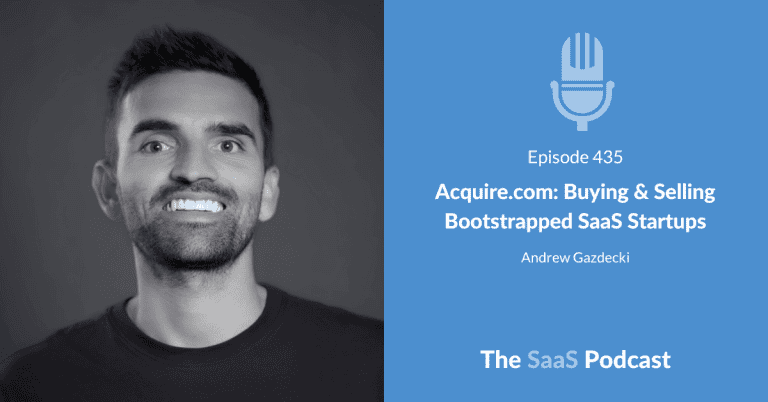
Welcome to another episode of the SaaS podcast. I'm your host, Omer Khan and this is a show where I interview proven founders and industry experts who share their stories, strategies and insights to help you build, launch and grow your SaaS business. In this episode, I talked to Andrew Gazdecki, the founder and CEO of Acquire.com the largest marketplace for buying and selling SaaS startups. Before starting Acquire.com, Andrew bootstrapped and sold his own SaaS company.
Omer Khan [00:00:37]:
The challenges and confusion he faced during that exit process inspired him to create a better way for founders to sell their businesses. Today, Acquire.com has helped over 2000 startups get acquired with total deal volume exceeding $500 million. They primarily focus on helping bootstrapped SaaS founders connect with financial buyers like private equity firms, family offices, and individual entrepreneurs. In this episode, you'll learn how to make your SaaS business more attractive to potential buyers and what key metrics they care most about.
Omer Khan [00:01:07]:
Why most founders dramatically overvalue their businesses and how to set realistic expectations that attract serious buyers. What critical mistakes to avoid when selling your startup and how to create a competitive bidding environment that maximizes your sale price. How to evaluate potential acquisition targets if you're looking to buy rather than build a SaaS business and why having clean financials and organized documentation from day one can significantly impact your eventual exit.
Omer Khan [00:01:36]:
So whether you're thinking about selling your SaaS business this year or planning to acquire one, this interview with Andrew will give you some practical insights into navigating the acquisition process successfully. So I hope you enjoy it. Andrew, welcome to the show.
Andrew Gazdecki [00:01:51]:
Thanks so much for having me.
Omer Khan [00:01:52]:
My pleasure. Do you have a favorite quote? Something that inspires or motivates you that you can share with us?
Andrew Gazdecki [00:01:58]:
Yeah, off the top of my head there's a quote by, I believe, Jim Rohn. It's if you want to make a living, get a formal education. If you want to make a fortune. Something about self taught education. I'm mixing up the words but I love that quote.
Omer Khan [00:02:16]:
I'll dig that up and we'll put that into the show notes or something. I think I know the one you're talking about, but it's like self education,
Andrew Gazdecki [00:02:22]:
make a fortune, formal education, make a living. Something like that.
Omer Khan [00:02:26]:
Cool. So tell us about Acquire.com. what does the business do, who's it for, and what's the main problem you're hoping to solve?
Andrew Gazdecki [00:02:34]:
Yeah, definitely. Acquire.com, we're the largest marketplace to buy and sell SaaS startups. The problem we're Solving is acquisitions are really confusing, really difficult, really slow. And so we're hoping to make that process just more transparent, helping more startup founders get acquired and going after that problem. Because I previously had a SaaS company that I built, I bootstrapped the company to about 10 million annual revenue and then when I went to go sell it, it was a huge headache. I spent years trying to find the buyer.
Andrew Gazdecki [00:03:06]:
I didn't know what the legal terms were, I didn't know what due diligence was. Got through that luckily. But when I sold the business, I remember a bunch of my, you know, founder friends texted me, they're like, how'd you sell the business? How'd you find the buyer? All the things I just mentioned. So I thought, oh wow. I, this is interesting. No one knows about exits. Maybe there's an opportunity here because there's all these books on, you know, marketing and fundraising and sales, et cetera.
Andrew Gazdecki [00:03:32]:
But there's like one book on, you know, the exit, which is what I think is the most important part of the founder journey. So that's what we do, we help startups exit. And we're specifically for mainly bootstrap SaaS startups.
Omer Khan [00:03:45]:
Cool. Why did you decide to focus on bootstrap startups?
Andrew Gazdecki [00:03:48]:
Those are really good acquisition targets. That's what a lot of buyers are looking to acquire. That's what I previously built, so I had some expertise in that area. But different from, let's say a venture backed company. When you're venture backed, typically the sales process is going to be different. You're going to typically need to sell to a strategic buyer to get the really high multiples. It doesn't always work out. And so the buyers that we mainly work with on Acquire.com are financial buyers.
Andrew Gazdecki [00:04:17]:
So think private equity shops, high net worth, family offices, individuals, and they are always looking to acquire bootstrap startups.
Omer Khan [00:04:28]:
And for somebody who's thinking about maybe buying or selling a startup, apart from the bootstrapped piece of this, what would you say is different about Acquire.com compared to maybe some of the other services they might be looking at?
Andrew Gazdecki [00:04:43]:
I think we take a much more data driven approach when it comes to acquisitions. So when we outline who potential buyers could be for a startup, we're able to access the a much larger number than a traditional advisory firm or investment bank. And if you're able to get more interest from more buyers, that leads to more offers and then eventually a higher sale price at the end of the day, which is the most important aspect, but then also just things like Sourcing or creating offers. What do they mean?
Andrew Gazdecki [00:05:15]:
Being able to quickly review those, Being able to showcase your business through connecting live metrics so we're able to reach out to more buyers faster. And then when we do connect with those buyers, present your business in a way that's going to be better than say, you know, the manual outdated approach.
Omer Khan [00:05:34]:
And then just in terms of some numbers, I think on your website I read like over 2000 startups have been sold through Acquire.com and the deal volume is like over 500 million now.
Andrew Gazdecki [00:05:49]:
Yeah, so we've helped over. You're right. 2000 startups sell and then over half a billion in closed transactions.
Omer Khan [00:05:57]:
Cool. Impressive numbers. So what I wanted to do today with you and I, we've. We've got you here and you know, I talked to founders, as I mentioned to you earlier, in talking to a founder who recently acquired a business through acquired.com and really, for me, this was like a great opportunity to just think about those people who are either thinking about potentially selling their Bootstrap SaaS startup this year or looking to buy something. Like, let's pick your brain.
Omer Khan [00:06:28]:
Let's figure out what they can learn, what are some of the mistakes and pitfalls people make, and walk away with maybe some additional advice from you that maybe they might not get from just reading stuff online.
Andrew Gazdecki [00:06:41]:
Sounds good.
Omer Khan [00:06:44]:
Let's start with talking about selling a startup. So what would you say is the first thing that a founder should do if they are thinking about maybe selling their startup this year?
Andrew Gazdecki [00:06:59]:
Definitely the first thing would be probably to get their house in order. So what that means is, do you have your processes documented? Do you have SOPs in place? Do you have a clean P and L that buyers could go over? And then asking yourself, why are you looking to sell? Getting really honest about that, but right at the top, just getting organized, you know, really trying to think in a buyer's shoes. If someone's gonna, you know, step into your business and take over your role, are they able to do that really easily?
Andrew Gazdecki [00:07:30]:
Is there a lot of things that they're gonna have to figure out on their own? What are the main risks on your business? Are you able to mitigate those? But if you go through that and just start thinking, you know, how can I document everything? How can I start preparing materials that a buyer could benefit from that'll naturally just make your business operate more efficiently, in my experience. But it starts there just being able to, you know, have everything to a place where the business is sellable.
Andrew Gazdecki [00:07:57]:
Because a lot of times, most Startups are not sellable, meaning you know, it's a piece of software. Everything's in the founder's head. You know, you can't really assess the, like you don't know how to value the company because there's no clean financials. So when you don't have those things, it's really, really hard to sell your business unless it's growing like gangbusters and you have 10 buyers trying to, you know, make you offers right there. So most startups aren't in that bucket. So just getting organized is typically the first thing I recommend is is there
Omer Khan [00:08:29]:
a certain type of bootstrap SaaS, maybe a vertical or a type of product that is more in demand, you know, that, that people will be more like, you know, more successful with selling that type of product versus, you know.
Andrew Gazdecki [00:08:50]:
Yeah, good question. To answer your question directly, no, not necessarily. I think there are some industries where, if it's really niche or really complicated, like extremely complicated, that can sometimes be harder to sell because the profile of the buyer is going to be very specific. One example there would be, it's, if it's a crazy, you know, data related company. We've had examples like this. The buyer is so specific that you know, a normal financial buyer won't be able to wrap their head around how to operate the business without you.
Andrew Gazdecki [00:09:23]:
Those can be harder to find buyers for. But generally if the business can be operated it's by, you know, you can learn the ins and outs within a few months. It's profitable. Those businesses tend to almost always get offers. So I, to answer your question, I think looking at it reverse, the businesses that we struggle to help get acquired are the ones that are, you know, typically losing a ton of money. You know, again, really niche and interesting industry where it's extremely reliant on the founder or the founders. Those are tough.
Omer Khan [00:10:00]:
You know, we were talking about you on, on social media and Twitter and LinkedIn and you've got a huge following. You're always sharing content, publishing daily and, and often you talk about, you know, some of the, the mistakes that, that you know, you'll see founders make. So when it comes to selling, are there, you know, two or three mistakes that you, you regularly see that, that, that founders make and you know, can, you can, you can offer any advice on how to, how to avoid making those?
Andrew Gazdecki [00:10:34]:
Yeah, definitely. I'd say the first one is actually valuation. I see founders overvaluing their business almost actually every single day, most multiple times a day. And that's natural. Everyone thinks, you know, take your Revenue, multiply it by 10, and that's what your business is worth. And it may be to a very specific strategic buyer who's going to pay a very high multiple. But when you take your business to market and you're actively trying to sell your business, it's a whole different process. So right at the top, being more in line with reality on valuation is
Omer Khan [00:11:07]:
going to be huge.
Andrew Gazdecki [00:11:08]:
Because if you're overpriced, buyers are never going to take the chance to learn anything additional about your business. They're immediately going to, you know, not be interested, move past it, and go right to other startups that are priced more in line with their expectations. So that's one. And you know, to get around that, you can look at some of the data that we put out or other, you know, firms put out and just be aware of, you know, what your business is worth and don't have, you know, crazy price expectations.
Andrew Gazdecki [00:11:37]:
I'd say the second one and this kind of ties with what I just said. But having just high expectations on even who the buyer is or what the deal structure is going to be like can definitely hurt founders that are looking to sell. More specifically, I see a lot of founders not wanting anything to do with earnouts or any sort of delayed payments or creative deal structures. They want it all cash at closing, so no stock or anything like that.
Andrew Gazdecki [00:12:05]:
And that can sometimes dissuade a lot of interested buyers because what they're hoping to do is de risk the acquisition. So on closing day, they're not paying for the whole purchase price and they're able to incentivize the founders to stay with the business or transition it over. And for some buyers, that's a complete deal breaker. So kind of to sum it all up, it just comes down to know having the correct expectations with acquisitions.
Andrew Gazdecki [00:12:31]:
And if I had to give another one, I'd go back to a point I made earlier, which is, is your business sellable at all? Is it profitable? Is it close to break even? Is it just burning a ton of ton of cash? And you know, whoever buys it is going to immediately start losing money. Because you got to remember when you're selling your startup, whoever is looking to acquire it, you know, they're thinking, how do I make my money back? How do I make a return on my investment?
Andrew Gazdecki [00:12:56]:
So no one is going to want to buy a company that's losing money unless they feel that they have a way to change that or take the products out to their existing customers. And those situations are definitely rare, but it reduces the amount of buyers that could acquire your startup. So those are a few, but I see a ton more as well.
Omer Khan [00:13:17]:
So basically I think it's set realistic expectations, be open to different types of creative deals and don't have an ultra super niche product that you know, that will open up more opportunities, more potential buyers who, who may start, you know, to be, you know, be interested. So if someone decides, okay, I want to use Acquire.com, just explain like the process that they would go through to get set up and sort of listed and you know, what, what advice could you offer for them to stand out to get noticed by potential buyers.
Andrew Gazdecki [00:14:03]:
So the first thing we have you do is typically create a draft listing. So that gives my team just basic information about your startup. So trailing 12 months revenue, so how much revenue made in the last 12 months? What is the profitability? Do you have a P and L? What industry is it in date, was it founded? How big is your team? Just very basic questions like that.
Andrew Gazdecki [00:14:25]:
So we can wrap our head around your business, we can give you some sense of a ballpark valuation and then from there we'll set up a call with you. So at Acquire we have a full team of hands on advisors with M and A experience where we'll walk you through everything from the day you create this listing all the way to the final exit.
Andrew Gazdecki [00:14:44]:
And that's where we'll go over, you know, our roles and responsibility in the sale process, what you can expect, things like initially meeting buyers, how to handle those conversations, typical questions they're going to ask you because every buyer is going to want to talk to you as the founder at some point. So it is sales. So we'll help you with that sale process and then we finish the listing, we get you ready to go live on our marketplace. So we'll schedule a date once you go live.
Andrew Gazdecki [00:15:10]:
And there's other things, you know, some of the details are we'll create, you know, a presentation for you, we'll recast your financials, which basically means cleaning up, you know, your P and L so it looks very clear to a potential buyer. Then you go live in our marketplace. We'll market your startup to our, you know, very large database of potential buyers. We have over half a million registered buyers on Acquire. So we'll map them out based on your specific startup. As an example there, let's say It's a profitable SaaS company in the Martech space.
Andrew Gazdecki [00:15:41]:
We'll pull down the data that we have on buyers that have specifically said that they're looking to buy startups. Of that type and will only advertise your startup to those specific buyers. What that does is it increases the likelihood that buyers are going to sign an NDA with you would be interested in learning more. And then from there, you create this process and this momentum where a lot of buyers are interested in your startup. And from there you'll start to ideally receive formal offers. So a letter of intent, you eventually sign one of those.
Andrew Gazdecki [00:16:10]:
I'm probably getting into like a lot of the nitty gritty here, but if we do our job correctly, you'll get multiple offers. You can negotiate against each other with those, meaning maybe one offer has a higher price, but not so good terms. You can negotiate better terms and the highest price because multiple buyers mean that you have the leverage. And so we'll help you select the winning buyer. You move into due diligence, we help with that as well. It's a huge headache, but we'll get you through that part too.
Andrew Gazdecki [00:16:41]:
And then you'll move into escrow and closing. And then at that point, you've successfully sold your startup.
Omer Khan [00:16:47]:
So you described, like, how your team helps founders kind of clean thing up, clean things up and sort of present their business better. Is there anything a founder needs to do in terms of how they get attention, or is that something that your team helps with in terms of how it's listed, how it's promoted, all that stuff?
Andrew Gazdecki [00:17:15]:
Yeah, we take care of all that. I think the best thing a founder could do if they're live on the marketplace is just. Just respond to buyers really fast with questions that they may have. And we, you know, coach founders on all this as well. But again, it's like a sales process.
Andrew Gazdecki [00:17:28]:
So when buyer reaches out and, you know, they have three questions on your business, don't let it sit there for, you know, two days, Try to answer it same day, just like you would a lead that's coming in your business and you're trying to sell to that person. So that's the number one thing, is just responding fast and being prompt and concise with any answers or, excuse me, any questions they have.
Omer Khan [00:17:49]:
So let's assume somebody lists their business, they go through this process, they get multiple potential buyers interested, and then they have to have a conversation with those buyers, often founders. It can vary, but I've met lots of founders who are great at building the product and doing a whole bunch of things. But when it comes to actually talking to a potential investor, someone who wants to acquire the business, it can be a completely new world and a completely different type of Conversation. They can have one.
Omer Khan [00:18:29]:
It's like, what's a common mistake that you see at this stage? And how can they be better prepared?
Andrew Gazdecki [00:18:37]:
Yeah, I think when I see founders go into negotiations, I think not moving things to the next step. I know it sounds very basic, but if you have a good call at the buyer, you could ask, you know, are you thinking about making. Making an offer? What would you like next steps to be? You know, they might have a response. Oh, I need to think about it. And this has been really helpful. Okay. Would you be interested in putting something on the calendar the next week? So just getting next steps.
Andrew Gazdecki [00:19:03]:
We're going to talk again in a week to keep things moving forward, creating, you know, a real sales process with momentum, you know, because if you let things just kind of go to the wayside, you aren't able to create that process and that essentially keeping buyers on the same pace that you need them to.
Omer Khan [00:19:21]:
Do you have an example of maybe one you can share of somebody who went through this process and successfully sold their business?
Andrew Gazdecki [00:19:31]:
One that I love to share is. His name's Gabe. He founded a company called Revenue Accelerator. I personally worked with him on his acquisition, and he was telling me when he went to go sell his business, he got valuations from two other brokerages, or M and A firms, and they valued his business at half of what we were able to help him get acquired for. And the key to this process was creating momentum with a lot of different buyers all at the same time.
Andrew Gazdecki [00:20:03]:
More specifically, what I mean is we use something called a deal schedule, where essentially what we're trying to do is we're trying to control the process and the timeline. So we start meeting with a lot of buyers all at one time. And so Gabe is speaking with three dozen different interested buyers and moving them on to the next step, which is submitting a formal offer within four to six weeks of going live on our marketplace.
Andrew Gazdecki [00:20:29]:
And the purpose of that, why you want buyers to be on the same timeline as every other buyer, is it creates a sense of, you know, this business isn't just going. It's not a matter of if this business is going to be sold, it's to who. And we're essentially selecting the winning buyer. And if we do that correctly, all the offers coming in at the same time allows us to negotiate against those offers, so we're able to select the best price and the best terms for the acquisition.
Andrew Gazdecki [00:20:59]:
Because sometimes you'll be in an acquisition process where one offer will come in, say, in January, and the second one comes in February and the third one comes in March. And when that happens, you aren't. You don't have any leverage. There's no momentum with the process. It's one offer, so you're just speaking to that one buyer and the second one in February. But if they all came in, say, March, those three buyers are aware that there's multiple buyers involved in this acquisition process. And that allows you to negotiate upwards for the best terms and price.
Andrew Gazdecki [00:21:31]:
It also increases the likelihood that the acquisition is going to close as well. That means is when you sign a letter of intent, that doesn't mean you've sold your business. That means you found a buyer interested enough to do that. So if something happens through due diligence or before even signing the letter of intent, you can ask buyers questions to give you an indication of how serious they are moving forward. So basically, it gives you the best price terms and reduces any chance that the acquisition is going to fall through.
Omer Khan [00:22:00]:
So just in this particular example, when Gabe came to you and said, I've had these valuations and they're at this point, did you already know at that point, having looked at the business, that he'd be able to sell it for a lot more, or was it more about, I think we can do more. This is how we work. And as you sort of described, getting multiple buyers and this deal schedule, we think we'll be able to get you a higher price.
Omer Khan [00:22:26]:
Just curious about how you valued it and what was the reality of actually what happened at the end?
Andrew Gazdecki [00:22:32]:
You know, when we go two times above evaluation, we need other buyers to be involved in the process to bid up to that point. And that's by, you know, creating kind of a sense of, you know, FOMO or again, there's a lot of other parties involved in this. So to win this acquisition, you're going to have to bid up a certain amount. So there's definitely a process involved in that. But, yeah, I mean, we looked at it and said, hey, you have a great business. It's, you know, very profitable.
Andrew Gazdecki [00:22:59]:
And this fits right within, you know, the buyers that we work with at Acquire. And then I'm able to, you know, look through our database of buyers and see that there's a high number of buyers that would be interested even before we go live with the business, to give me a good indication that, yeah, we'd be able to, you know, beat those offers or that valuation.
Omer Khan [00:23:19]:
Let's move on to the. The buying side of this. You describe some of the typical buyers that may use Acquire.com to find a business. Do you also have a lot of solo founders who come to Acquire.com just looking for something to just help them build some early momentum with a business that's already there and a small number of customers as opposed to building everything themselves from scratch?
Andrew Gazdecki [00:23:52]:
Yeah, I'd say that's probably my favorite part of acquire because we definitely have a side where you know, we're helping people sell their businesses for, you know, life changing amounts and you know you're going to go lay on a beach or start like that's awesome. But we also help much smaller businesses sell too. So think task product with 10,000 monthly recurring revenue, 5,000 1,000. And that's a great acquisition target for someone like you're describing. Maybe they own a startup already. Maybe they want to build a small portfolio of SaaS products.
Andrew Gazdecki [00:24:25]:
One story I like to share about a buyer, his name is Damon Chen. He bought a company that was like an AI PDF reader. I think he bought it for like 25, $50,000 or something like that, very small amount, rebranded it to PDF AI. So we got a killer domain for it and the business has since generated I think 2 million in revenue. Yeah. So not bad off. You know, he's one person, he doesn't have a team. I believe he just has contractors.
Andrew Gazdecki [00:24:55]:
And he's been able to scale it to seven figures, which I think is awesome. But we see that multiple times per day, those types of acquisitions closing.
Omer Khan [00:25:03]:
So if someone is looking to buy a business and I think we're going to have more of those types of people, founders listening to this than someone from a private equity firm like you know, sort of listening to this and they are, they go into Acquire.com what, what are maybe some red flags that they may want to look for when, when they see, you know, listings of businesses and potential, potential acquisitions.
Andrew Gazdecki [00:25:36]:
I mean for starters, I would always just do a Google search of the business like business name or startup name. Plus reviews. Are there any public reviews? Is anybody saying anything bad about the product? If they're on G2 or Trustpilot or Capterra, there should be something. So it can go either way. If there's some bad reviews, it's a red flag. If there's nothing available, that might be a red flag too depending on how many customers they say they have.
Andrew Gazdecki [00:26:05]:
Other easy ways to spot things is, you know, on Acquire we can have them connect through their stripe metrics or their quickbook metrics to show a real view into the financial health of the business. So asking them to share those numbers with you. So you can see in real time like what is their, in your current revenue, what is their churn, what is their customer count? If you see anything odd in there, I think that could be a red flag as well. Such as is churn crazy high?
Andrew Gazdecki [00:26:34]:
Do they have a small number of customers, meaning customer concentration, which means do they have just one really large customer and if they leave the business, you know, valuation might drop or something like that. Using the product, does it work? You know, are you able to do what it says it does? Very. Just basic stuff can usually get you through, you know, 80% of the stuff that I see.
Andrew Gazdecki [00:26:58]:
So I would start there and then if you're still not confident, we have third party companies you can work with to help with due diligence, to do what's called a quality of earnings, where you can get a deeper sense on if the stated revenue is correct. But those are the two main areas. Is is the product and the financials typically.
Omer Khan [00:27:19]:
So earlier you described the kind of the high level process that somebody would go through to sell a, a startup. Can you, can you do a similar kind of walkthrough of what the buying experience looks like on Acquire.com yeah.
Andrew Gazdecki [00:27:33]:
Okay, so square one, I'll do the same thing again where we go and then so you register on Acquire.com as a buyer. You can set up a profile in 60 seconds. It's really simple to do. And then when you access the marketplace, just picture like a big store of every type of startup that you could possibly want to acquire. We have SaaS businesses for 10, 20,000, all the way up to several million dollars or tens of millions of dollars. To access these, you have to subscribe to our buyer subscription plans.
Andrew Gazdecki [00:28:07]:
It's 400 bucks for the year and that gives you access to see the private details of these listings. So if you don't subscribe to that, all you can see is profitable SaaS generating 500,000 a year.
Andrew Gazdecki [00:28:19]:
It's a martech company, it has this tech stack, it has these competitors and then once you are what we call a premium buyer, that allows you to sign NDA and gain access to the private details, which include the company's name, contact information for the founder, any materials they've uploaded, such as pitch deck or P L allows you to contact the seller, ask more questions, learn what is this company, what do they actually do?
Andrew Gazdecki [00:28:49]:
Once you're in contact with the seller, that's when you're going to want to ask questions about, you know, the business, why are they selling, Try out the product Review financial information, do your due diligence on the business, and then from there you're going to want to submit what we call a letter of intent, a formal offer on acquirer. You can use our builder. So within 60 seconds you can say I'm making a formal offer for 500,000.
Andrew Gazdecki [00:29:15]:
It's going to be 80% cash on close, 20% is going to be seller financing over 24 months at 8% interest rate. And the terms of that are, you know, the code needs to be in great standing or something like that. Once that's accepted by the seller, that's when the startup goes under offer. So no other buyers can now speak to the seller or make offers on this startup because it is locked on the platform. It is yours to essentially inspect to make sure that this is a business, that everything they stated is true and accurate.
Andrew Gazdecki [00:29:49]:
So once you're done with due diligence, that's when you're going to want to submit an asset purchase agreement. Essentially that's the, the big document that's going to finalize the sale. And we have an asset purchase agreement builder as well. So you can create that within a couple minutes. We also have attorneys that we can introduce you to in case you'd like more hands on help than our automated builders. Once the asset purchase agreement is reviewed by both you and the seller, then you would move into escrow and closing on the acquisition.
Andrew Gazdecki [00:30:19]:
This is when you're going to actually wire the money over to the third party. Third party, either escrow.com or use another firm called SRS Acquiam, depending on the deal size, escrow.com for smaller transactions, SRS Acquiam for larger transactions, they're going to hold the funds in place until everybody gives a thumbs up, meaning you've executed the purchase agreements, everything is as stated, you've received the software, access to accounts, everything related to operating the business.
Andrew Gazdecki [00:30:49]:
Once everybody gives the thumbs up, then the funds are going to be sent to the seller, you're going to own the business and that's that. Then after, typically there's almost always some sort of transition agreement where the founder is going to be available for three months or something like that to answer any questions or maybe they come on board in a larger transaction, but then
Omer Khan [00:31:08]:
after that, yeah, done and done, happily ever after, right?
Andrew Gazdecki [00:31:12]:
Yeah, most of the time.
Omer Khan [00:31:13]:
What are some of the common mistakes you see people making when they're trying to buy a business?
Andrew Gazdecki [00:31:21]:
You know, I think not doing enough due diligence as a very broad one. But you know, maybe they assume the code base is amazing. This is a very common. And it's not probably almost every acquisition you're going to look at is going to have some spaghetti code. Things are duct taped together. It is a startup. So not having an understanding of what's truly working and what's not. Again just doing, you know, good code analysis I think would be the way to get around that. And then the second one would be again understanding the financial stated.
Andrew Gazdecki [00:32:01]:
You know, they can sometimes be, you know, inaccurate because it's a startup where the, it's just, it's messy. So getting those two under control and due diligence will save you a ton of headache. Because if you buy a startup and you're expecting one thing and then the code's bad, the churns extremely high because you didn't catch that Due diligence can go a long, long ways.
Omer Khan [00:32:25]:
Yeah, I think the code is an interesting one. I spoke to a founder last week and I think they're at about 5 or 6 million ARR. But when they started they didn't have anybody technical on the founding team. So they built the initial product with Bubble, the no code platform and they managed to get to like the first 20, 30 customers. But if they were sell and then they eventually rebuilt it with like, you know, they got developers in and all of that stuff.
Omer Khan [00:33:02]:
But if they were, they had that traction, they had revenue, they had customers with those, you know, those 20 or 30 there. And if they were selling it at that point, I can only imagine what a couple of non technical guys who kind of taught themselves how to build a product and put this thing together. There's going to be a lot of things under the hood that, you know, anybody with any development experience might look at and just, you know, have a
Andrew Gazdecki [00:33:31]:
headache and that's okay. And that's okay. I should add it's okay if everything's duct taped together and it's spaghetti coat and there's bugs everywhere. It just needs to work. It just depends on what the plans are for the new buyer. Are they looking to really expand on the feature set and build on top of it? If so, they're going to want to know how everything works, how everything connect together.
Andrew Gazdecki [00:33:53]:
But a lot of buyers, they'll just maintain the, they'll just let the code sit there and they're just looking to, you know, support the business as is. So it just depends on who the buyer is and that's where just good communication goes so far during an acquisition. What are your plans when you buy this?
Omer Khan [00:34:08]:
What about financing? Is that something that you help with? Like somebody's coming along and saying, you know, I want to, I want to acquire a business. I've got some cash to put in if, if it's kind of beyond what I was expecting to spend. But I find this great opportunity, but I need to, you know, you know, borrow money. What are the options available to them?
Andrew Gazdecki [00:34:34]:
Financing is tough for this area of the market. Call it like the sub 10 million enterprise value market. You have SBA loans which are government backed loans for traditionally small businesses. Those are very hard to secure for software companies for really two reasons. One is working with banks is very, very slow. So if you are working with an SBA loan, you're looking at a four or five, six month timeline. Realistically to close the acquisition, typically there's going to be more buyers involved. So if you're the only offer, maybe that can work.
Andrew Gazdecki [00:35:13]:
But you're going to have to really set expectations with the seller that this is going to, you know, be a four or five month timeline. We do work with SBA quite a bit, but it's not ideal. We used to have a couple other third party lenders which we don't anymore. That's typically a very, very hard business to, to make work. They were two venture backed ones. So if anyone's listening to this and you're looking at potentially going into this space, please do and let me know because the financing options are pretty thin.
Omer Khan [00:35:49]:
So. So basically at this point make sure you have the money to buy a business?
Andrew Gazdecki [00:35:54]:
Essentially, yeah. That's the first question we ask on the sell side is how are you going to finance this transaction? And then we also verify funds for buyers on the other side as well. And we verified over 3 billion in funds on acquire. So if you don't have financing, the other options you could consider are offers with seller financing. That's where the seller is essentially backing the loan for you. Example of that would be, you know, 80% seller financing or 50% seller financing and that's going to be paid over 12 months.
Andrew Gazdecki [00:36:29]:
And what you're typically doing is taking revenue from the business and paying that back to the original seller over a period of time with interest.
Omer Khan [00:36:36]:
I'd love to get your perspective on like just the coming year. So 2025, how is the landscape evolving when it comes to buying and selling startups? What kind of trends are you seeing? You mentioned like Damon and then that example, are you seeing a lot of like AI type startups kind of sprouting up?
Andrew Gazdecki [00:36:59]:
Totally, yeah. That's been an interesting Way for us to see because two, three years ago it was nothing and then probably three out of four businesses that we work with are AI first. So that's been a huge shift. Obviously I think it's touching every part of tech. I think that's going to be the big one. Just AI, AI and AI.
Omer Khan [00:37:23]:
Yeah. It's also interesting because I wonder whether these days it's so easy to build a product so whether just in terms of like we had these no code solutions but now all of this stuff like what Replit is doing and Cursor and all of these tools are making it really easy.
Andrew Gazdecki [00:37:45]:
We talk about that. Yeah, we talk about that all the time. Yeah. Just how easy it is to make, you know, these SaaS products and how I think the barrier to entry to building these types of businesses, specifically the bootstrap SaaS, one to two people operating the business, they get it to, you know, a few million in recurring revenue. I think that dream is just the barriers to entry are getting so, so, so low that we're going to see just a world of, you know, these, these very pointed vertical SaaS solutions.
Andrew Gazdecki [00:38:14]:
So we'll have to wait and see. But that's something I, I'm starting to see a little bit. I think over the next year we'll see those businesses mature a bit more. Right now I think we're just starting to see like it's been around for like eight, nine months. So the wheels are just starting to get moving and a year from now they're going to be 2, 3 years old and so we're going to see just more durable, healthier AI SaaS specific companies.
Andrew Gazdecki [00:38:37]:
And I also think we're going to see, I hear a lot from buyers really interested in the. I'm going to buy this business and automate everything with AI and scale it with AI operators that make TikTok videos all day and stuff like that. So I think we're in for an interesting few years.
Omer Khan [00:38:55]:
Yeah. There's one thing I've seen where like it's so easy to build these products but then you also see a lot of very similar products out there. Right. And so what becomes your moat, what becomes your, your differentiator when anybody can kind of build this product? And it kind of got me thinking that even when you're buying a product, you're a startup, you, you, I think you need to understand like where your strengths are.
Omer Khan [00:39:24]:
Whether you're like a zero to one type person or you like to take something that's already there and then figure out how to operationalize it and scale it and so on, because that's gonna, obviously you're gonna be more successful if, you know, you know, if you play to your, your strengths.
Andrew Gazdecki [00:39:41]:
I think it's important to understand like the real value that a lot of buyers, you know, what they're looking to acquire on product. It's really, you know, the, the customers and you know, the revenue. That's the first thing. You know, the buyers I work with are looking at the code quality and the product. Quality is important, but it's not what really matters.
Andrew Gazdecki [00:40:00]:
So my point is, yes, we're going to see people making the same product really fast and maybe the overall value of what would be the cost if we were to just make this from scratch would go down. But that's not the value. The value is the distribution and the brand and the customers and the revenue that the business is generating. So I think over the next few years, I think the mode is going to be customer attention who can get the product in front of customers and get them to pay.
Omer Khan [00:40:27]:
I think it's gonna be fascinating like just to see what kind of businesses you're selling like 12 months from now because that space is moving so fast. And I keep hearing about these, the, the idea of like a one person, you know, billion dollar business, like is that, is that around the corner, who knows, you know, that'd be super interesting. Great. Well, Andrew, thank you for joining me. It's been, it's been a pleasure.
Omer Khan [00:40:52]:
I appreciate you just, you know, letting me ask these questions and just giving us some, an overview of the process, but also just some of the kind of the mistakes that people might make and how they can navigate through this process better. If people want to check out Acquire.com, guess what, they can go to Acquire.com and if folks want to get in touch with you, what's the best way for them to do that?
Andrew Gazdecki [00:41:18]:
Yeah, you can just shoot me an email. Andrequire.com, you can find me on Twitter LinkedIn. Andrew Gazdecki.
Omer Khan [00:41:24]:
Awesome. Thanks, man. It's been a pleasure. I wish you and the team the best of success.
Andrew Gazdecki [00:41:28]:
Thanks. Thanks for having me.
Omer Khan [00:41:29]:
My pleasure. Cheers.