Omer (00:10.080)
Welcome to another episode of the SaaS Podcast.
I'm your host Omer Khan and this is the show where I interview proven founders and industry experts who share their stories, strategies and insights to help you build, launch and grow your SaaS business.
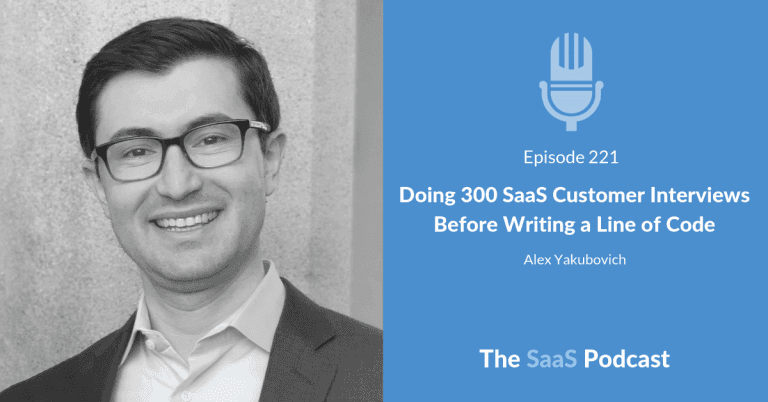
In this episode, I talk to Alex Yakubovich, the co founder and CEO of Scout RFP, a SaaS product that helps companies with their strategic sourcing and procurement.
Alex started a web development company when he was still in college.
Initially it was just a way for him and his friends to make beer and pizza money.
But over time it evolved into an online ordering software product that the team sold to restaurant chains and by the time they graduated, the business was making six figures in annual revenue.
And over the next five years, as they all worked full time on the business, revenue grew to several million dollars and eventually they sold the business.
While working on this business, Alex had to deal with hundreds of requests for proposals or RFPs and quickly became frustrated with how clunky and manual the RFP procurement process was for most companies.
So in 2014, he and his co founders started working on their next startup.
With a successful exit and money in the bank, it would have been easy for the team to feel confident or maybe overconfident that they could solve the problems and start building a product right away.
Instead, they agreed they wouldn't build anything until they talked to at least 200 people who worked in procurement.
They actually ended up talking to almost 300 people and those conversations helped them to build a really deep understanding of the space and the customer problems.
Although there were a lot of players in the market, including some really big companies, the founders decided to focus initially on a really small problem.
Their MVP was a one page application and so minimal that prospective customers would often say, is that it?
But once people use the product, they love the simplicity and how this one feature saved them so much time.
And from that simple, almost too minimal mvp, their company has now grown into a business with over 150 employees and they've raised over $60 million in funding.
There are some great lessons in this interview about the importance of listening to your customers, not jumping into building a product straight away, and being really focused with your MVP by solving a really small problem at the start.
So I hope you enjoy it.
Alex, welcome to the show.
Alex Yakubovich (02:51.680)
Thanks Homer.
Great to be on.
Thanks for having me.
Omer (02:55.360)
So I always like to start by asking my guests what gets them out of bed, what motivates or drives them.
Is there a favorite quote that you can share with us?
Alex Yakubovich (03:01.920)
I do.
I mean Just in terms of what drives us.
I obsess over the customers is our first value.
And it's a quote that I love and one that we go back to quite often.
And another one that I do end up reading, I have this on my phone, just The Dalai Lama's 18 Rules for Living, which I also go back to quite often whenever I'm maybe feeling stressed or something like that.
Omer (03:23.390)
I've never come across that before.
Alex Yakubovich (03:25.710)
Check it out.
Yeah, just Google it.
It's really good.
Omer (03:30.030)
That sounds something like I should definitely have on my phone as well.
Alex Yakubovich (03:35.250)
If we have time at the end of the program, I'll, I'll go through them with you.
Omer (03:38.450)
Okay, cool.
Now, for people who aren't familiar with Scout rfp, can you tell us about, like, what does the product do, who's it for, and what's the problem that you're solving?
Alex Yakubovich (03:52.610)
Yeah, so what we do is with large enterprises, when they go out to source something, which means when they go out to buy something for the first time, or maybe they have some provider that's giving them services or goods and they're not happy or want to see what's out in the market, they go out to buy something and they typically put out an rfp, rfi, rfq.
And we help to automate that process as well as do supplier management, contract management, and the strategic sourcing planning process as well.
So we, we do the strategic sourcing process and we provide, specifically, we provide software for helping large enterprises automate their strategic sourcing.
Omer (04:32.320)
Great.
So we're going to dig into that, like how you came up with the idea and how you've built that business.
But before we do that, I want to kind of start the story a little earlier.
Well, actually much earlier.
Like, you were born in Russia and then at what age did you move
Alex Yakubovich (04:47.679)
to the US so I was six.
It was the early 90s, pretty soon after the fall of the Soviet Union.
Omer (04:56.160)
And why did your parents decide to move?
Alex Yakubovich (04:58.840)
Great question.
I mean, they, they knew that there were.
So we had family in America, in Ohio, which is why we ended up moving to Ohio first.
And they knew that America had a lot of opportunity and they wanted to raise their kids in a free country that, that had that opportunity.
You know, as a six year old, you don't understand all of that.
So I remember as we were preparing to leave Russia, my family was packing, you know, the pillows and the frying pans, and I was like, whoa, whoa, whoa.
If wherever we're going doesn't have pillows and frying pans, like, we should reconsider fol.
Ultimately, it ended up being a great decision.
Obviously.
Omer (05:34.500)
Now, your parents didn't speak much English.
Alex Yakubovich (05:37.540)
No.
Omer (05:38.260)
And what about you?
Alex Yakubovich (05:40.180)
I spoke no English.
I think I knew how to say yes, no.
And where is the bathroom?
Where's the bathroom line is a critical thing to know before you move to any country.
I remember my parents teaching me that.
It was pretty funny.
Omer (05:55.940)
That's an essential.
Alex Yakubovich (05:57.220)
Yeah, yeah.
Omer (05:58.850)
So I'm curious, like, what was it like in school?
Alex Yakubovich (06:01.650)
Well, I mean, being a six year old, you pick up a language like a sponge.
So I mean, as soon as we got here and I remember, you know, the family that was here, one of the biggest pieces of advice that they gave us is like every word that you learn, like every word that you add to vocabulary, it's like putting a dollar in your pocket.
So I remember that even going back then.
And I would agree with that, you know, just in terms of your ability to communicate being so important for anybody.
And so we really worked hard to, as a family to learn the language.
And because we were immersed in English right from the beginning, it was pretty quick to pick it up.
But yeah, I certainly had the early challenges and awkward moments of being an immigrant in a new country.
Omer (06:46.380)
Now you started your first business when you were in college, right?
Alex Yakubovich (06:51.820)
Correct.
Omer (06:53.890)
Tell me a little bit about that.
Like what was the business and how did you come up with the idea for that?
Alex Yakubovich (06:58.370)
Yeah, definitely.
So my co founders in that business, we all went to school in Cleveland, Ohio.
We're all from Cleveland, Ohio.
And we built a business doing online ordering for restaurant chains.
But what really happened is we were college freshmen and we started a web development company.
Because early 2000s, Cleveland, Ohio, a lot of companies, especially small businesses, didn't have websites.
We were college students, you know, we were looking to make pizza and beer money.
And so we went and started building web.
We literally like put on shirt and tie and went door to door to small businesses, knocking on doors and asking if they needed websites.
And we built businesses for like everybody.
I mean, like our first website was for a gynecologist.
You know, we did stuff for upholsters and furniture stores and, you know, I mean, all kinds of places.
But the projects got bigger and before long we were building software for large enterprises and we were doing, you know, pretty good projects.
So freshman year of college where we had like nice six figure consulting business, but we knew that we wanted to get into enterprise SaaS because Salesforce was, was just getting big and it just, we loved the concept of building One piece of software and then being able to very much focus on your customers and grow one piece of software and focus on a business line.
And we also love the idea of enterprise SaaS as a business model as well, just because it has so many advantages to the customer and to the business in terms of predictability as well.
And so the only thing we didn't have is idea.
And then one of our customers was a local pizza chain that asked us to build their website with online ordering in it.
And we loved ordering online.
We were college students.
Pizza being near and dear to our heart, we said, why doesn't every restaurant chain have this?
And so we started building that.
And that was right before the iPhone came out.
And then that was the same year that we graduated.
So it really became.
We graduated in 2007.
We became this great catalyst as we transitioned our whole business to just doing online ordering for restaurant chains.
And that was a great experience.
Omer (08:57.440)
So how much money were you guys making once you.
You graduated?
Alex Yakubovich (09:01.280)
So when we graduated, our online ordering revenues were in the hundreds of thousands.
It was like the.
At that point, but it scaled pretty quickly into the millions after that.
And then we were acquired by Living Social in 2012.
We got term sheet in 2011, so it was only a few years after we graduated that we got the term sheet to be acquired.
And we had really great growth.
We were in thousands of restaurant chains.
We were working with everybody from Panera to Jersey Mike's to Boston Pizza International, kfc, Outback, Carrabba's, Corner Bakery, Cafe, you name it.
We had 50 restaurant chains.
We were processing hundreds of millions of dollars in transactions.
It was a great business.
Omer (09:43.190)
How much time were you spending on this business when you were in college?
Alex Yakubovich (09:46.470)
So in college we were spending quite a bit of time on this just because we were getting it off the ground.
And it was quite interesting because I was getting an engineering degree, trying to graduate in three years so that we could go and run this business together.
So while trying to get all these customers wrap up the web design business, it was quite a lot of things.
And we ended up raising half a million dollars in angel investment just as we graduated, which was great because it allows us to get right out of college and really start to grow our business.
So that was all the money we ever raised too.
So we just raised half a million dollars in angel capital.
We actually never ended up even spending it.
So we really bootstrapped that business to a good size.
Omer (10:33.670)
And how are you growing and reaching restaurants?
Like you weren't going around and still walking into restaurants, were you?
Alex Yakubovich (10:40.920)
In the very early days, we were, because we didn't know we wanted to focus on restaurant chains, so we would go into individual restaurants and try to sell them.
So we got thrown out of our fair share of pizza shops.
But once we figured out that we were selling to chains only, then what happened is we shifted to an enterprise sales motion.
And then our business really started to click.
We also realized, I mean, just in talking to our customers, it was almost just as hard to sell one restaurant as it was to sell a chain.
And so we.
We did that.
And then after that, we didn't go into individual restaurants too much because we were going to the corporate headquarters.
But yeah, we've been to a lot of.
A lot of sandwich and pizza shops up to that point.
Omer (11:21.860)
Yeah, I was going to say it must be great training to build your resilience, right?
Alex Yakubovich (11:27.300)
Oh, 100%.
And even as college freshmen, when we put on the shirt and tie and people would make fun of us, they'd call us the IBM kids.
But you're absolutely right.
I mean, you go into a place, you've never met somebody before, but you show up in person, you be professional, you be polite, and you just ask them if they have any kind of needs that you can help them solve.
And I would say 90% of the time, people were really polite to us.
One out of 10 times, people did not like that.
People were certainly very polite.
And we didn't have a high hit rate, but it was a lot of work to get to our first few clients.
But once you get your first few clients, then the word of mouth can start to really spread if you do a great job, which we were committed to doing from the very beginning.
Omer (12:11.770)
And then you sold the business to Living Social In 2000, 2012, how much did you sell that business for?
Alex Yakubovich (12:19.130)
It's private, but it's in the tens of millions.
Omer (12:21.370)
So that's a nice paycheck.
Just a few years after college.
Alex Yakubovich (12:25.530)
Yeah, for sure.
It was life changing.
Omer (12:29.770)
And then what did you do?
Like, so 2012 that happened.
And when did you launch Scout RFP?
Alex Yakubovich (12:37.220)
Yeah, so we stayed at Living Social for a few years, and it was a great experience.
They had a great team.
They were scaling really, really quickly.
We learned a lot about growth and teams, and it was our first real job.
Like, our parents were finally like, oh, you guys are going to have a real job at a real company.
They had 5,000 employees at the time.
So, yeah, after we got acquired, the first thing we did was pay off our student loans.
But the second thing we did was dig in and make sure that that business continued to be successful in the transition and our customers were well taken care of.
But then a few years down the road, what we had seen is that the procurement process, and we saw this as we were building the restaurant chain business.
So when you're selling six to seven figure deals to large restaurant chains, your especially since what we were doing was so core to the business.
I mean, we were the e commerce platform that you as a consumer would see when you'd order your food online.
And then at the same time, we were tied into the point of sale system in the back of the house and we were also tied into their paper bin processing system.
So these are, you know, these are, these are systems that cannot go down 24 7, 365 because restaurants are also open at all hours.
And we were international.
So every single time that we were selling into one of these large publicly traded restaurant chains, we were going through the RFP process and we hated it.
And then when we just like pretty much every enterprise SaaS person hates, or any person who's ever sold into the enterprise hates the RFP process.
But then we also noticed internally when we were making bigger purchases, just the friction in dealing with procurement and the lack of visibility that we had seen in a company that we felt 5,000 employees, they were pretty sizable business and they were certainly spending a lot of money internally at Living Social.
So we thought we knew the procurement people and we really liked them.
They were good people, they had pride in their craft, they were excellent folks.
But they were struggling to get the volume of work that they had done.
And we were struggling on the other side as salespeople trying to sell into these people.
So we thought there's got to be an opportunity here to do something better.
So that's kind of how the idea came around.
Omer (14:56.710)
Okay, and then.
So how did you get started?
Alex Yakubovich (14:58.870)
You know, the interesting thing is we're not procurement people.
So the first thing that we did is we started talking to people who are procurement people and are real experts in the field.
And I think that gave us a real competitive advantage here at Scout.
Because what we did is rather than coming at it from a I know what the problem is, I know how to fix it perspective, we instead came at it from a let's learn as much as we can about everybody from these different industries, and let's just really make sure to listen to the individual users and the people in the field.
And so my co founder Stan said, hey, let's not build anything, let's not do anything until we talk to at least 200 people in procurement.
And we ended up talking to close to 300 people.
We did this big study and what we found out is one, there's a ton of procurement software out there.
The space is about 20 something years old.
So there's a lot of procurement software out there.
They're big players.
I mean, SAP has products, Oracle has products, there's Coupa, Jagger, there's these really large platforms, and then there's a whole long tail of other providers that are still really big software providers providing this to companies.
So what was curious to us though is that we'd never seen an RFP that was automated.
And so it was a little bit of a disconnect because there was so much software out there and yet nobody seemed to be using it.
And that's what we had seen in our study as we talked to these hundreds of procurement people and as we talked to Gartner and Forrester.
And what we found out is in listening to customers, because we'd asked them what they were using to manage their sourcing process and they would tell us that they have X platform, whatever big platform that they had.
And that was really interesting because we'd ask them what they use and they'd tell us what they'd have, but not what they were using.
And then when we dug into what they were using, they would tell us that they were doing things really manually.
And so when we looked at some of these tools, what we saw is they were just super clunky.
And that was the word that everybody told us as we were doing the study is that the tools themselves that have been provided historically have been just really not user friendly.
And that just really resonated with us, especially since, you know, Salesforce is a company that we really admire.
And so much of what they did is just build software that made it, especially at the time, was so user friendly and user centric.
And that's what we wanted to do as well, just bring this accessible software to folks.
So inspiration for us was TurboTax by Intuit.
And we said if Intuit could build software that you use once a year to do something that's really complicated, like the US Tax code to do your taxes, and anybody can do it, we should be able to build software to make sourcing tools really easy and user friendly for procurement people.
Procurement tools that people really love.
Or as we put it internally, we didn't put this out of marketing, but we wanted procurement tools that were sexy because our friends and as we talked to other co founders and advisors about this, they said, why would you want to sell it to procurement?
That's such a boring, sleepy space.
And we said, it really isn't.
The people, when you go talk to the people, they're so passionate.
They just don't have the tools that they deserve.
And you know, if we can make procurement sexy, then that's something that we could really get behind.
So that's how we got started.
We spoke to hundreds of people and then we started building tools that were based off of adoption as opposed to based off of bells and whistles, which is historically how the industry was built.
Omer (18:27.040)
Can you elaborate on that?
Alex Yakubovich (18:28.640)
Yeah, well, historically, the way that a lot of the capabilities have been built is just people, they were sold on bells and whistles, so it was all based on capabilities.
And we said right from the beginning, it doesn't matter what bells and whistles our platform has if people don't use it.
So we said whatever we build has to be really easy to adopt.
And the litmus test we put on it is no training manual and no training required.
People should be able to get up and running on them right away.
And so we have customers like Uber Salesforce who have these large teams that are distributed and you know, in both of their cases they were up and running.
You know, we came in, we, we set them up, it took all of a day and they were off and running and literally launching their sourcing events that day, which is so different than some of these legacy platforms that would take weeks to launch and then have low adoption.
And you would have to go through, you know, weeks of training and.
Well, it would be weeks of training and then it would be like a multi quarter launch process and you just lose so much momentum then.
And we went at it the other way.
We just said, you know, it's the time to value has to be super short.
People have to be able to see value right away and they have to able to use it and has to make their lives actually easier, otherwise the adoption will drop off a cliff.
And it doesn't matter how many features we have.
Since then we've built a ton of functionality.
So that, I mean, that was almost five years ago that we did that.
We released an RFP tool and it was just designed to do RFPs.
And we went with the philosophy that we would rather have one tool that does one thing really well that our customers love as opposed to trying to build some big thing that people kind of like, but people don't really gravitate towards or evangelize.
Omer (20:10.630)
Now, we often hear, you know, sort of the conventional advice for founders is, you know, focus on a, on a market or a space that you're passionate about because you could be in this business for, you know, the next five, ten plus years.
So it's going to be something that really excites you.
And then as you just described procurement, it doesn't sound like the most exciting of places.
So were you guys passionate about this space or did you, Was that something you.
It sort of grew on you and like, how did that sort of work out?
Alex Yakubovich (20:39.800)
Oh, we were so passionate about it because we had been selling into procurement all these years and we were frustrated by the process on our side and we only had to work with one buyer.
They had to work with, you know, upwards of 50 people at times.
I mean, some, some of the RFPs that we've done have had suppliers in the number, in the hundreds.
So as a supplier, you basically set something in and then you wait.
And then internally, as a stakeholder, you also don't get visibility into it.
So we experienced the frustrations of it from a number of different angles.
So we were passionate about solving a business problem.
But what we didn't have at the time is we didn't grasp how much we would love the people behind it.
Because procurement people have this reputation of being prickly, like a little bit hard to.
They're trained negotiators.
Right.
So that was the, the thing that we didn't quite understand is how much we would love the people once we got into it.
Because once you get to know these folks, they're so passionate and they have so much pride in what they're doing and how they're serving their internal customers, which is the business.
It's really quite contagious.
And they're, they're amazing, super talented people that don't get enough credit for what they do.
So, yeah, it's easy to get up in the morning and serve those kind of folks.
Omer (21:53.110)
And then the other thing was a lot of founders would go out and, well, they wouldn't talk to customers, but the ones that would go and talk to customers might go and talk to 10, maybe 20, but to kind of say, okay, we're not going to do anything until we talk to 200 customers.
That's a huge number.
And why did you guys decide that you wanted to talk to so many people?
Alex Yakubovich (22:19.410)
So there was a number of reasons for that.
One of them is just we wanted to understand the market really well and It's a huge market, right?
I mean, like, we sell to companies that buy stuff, so that's a really big market.
And as a result, when.
When we went out to speak to people, 200 customers sounds like a lot, but when you start breaking up into, okay, well, that's, you know, X number of manufacturing customers, X number of CP customers, X number of customers in financial, this number of government customers, this number of education.
It actually, like your sample size per vertical is really small.
And it was so important for us to make sure that we were building a platform that would be that.
Well, at least that we would know how different it was and whether we had to go after a vertical market or whether we could build a more horizontal solution and how similar were the problems across the board?
So I think once you break it down one, it's super critical to talk to that many customers if you're going into a really big market, to really understand who you're going to serve and where you should enter into it.
But then the other thing to be, we are a little crazy.
And our number one value is obsess over the customers.
So we wanted to make sure that as we start the company, we start it right, and we go and really get a strong empathy for the people and the challenges that they were facing.
Omer (23:44.160)
How long did it take you guys to get through?
I mean, you said you ended up doing like 300 interviews, right?
Alex Yakubovich (23:49.120)
Yeah, it took months and months.
I want to say the whole study took us right around six months just to get to 200 customers.
And then we had set up a lot more interviews after that.
So we continued to do that, but we didn't even start working on, like, the early drawings and prototypes until we were 200 customers into the interviews.
So it took six months before we even started to build anything or design anything.
Omer (24:16.620)
Okay, so you're a bunch of guys.
You don't have any experience in the procurement space.
You don't have a product.
How are you reaching out to these people, and how are you getting them to say yes to spending time talking to you?
Alex Yakubovich (24:30.460)
Yeah, great question.
So this is where you beg, borrow, and steal as a founder.
And I still remember the template that we had, which was basically like, hey, I'm a founder.
I have this idea.
We're not selling anything.
We don't even have anything to sell to you.
But you're somebody that looks like would be a real expert in this space.
And we just want to understand the industry before we.
We go and do anything.
And this is, you know, I talked about how awesome the procurement folks are.
I mean, they so generously gave.
I think we asked them for half an hour of their time, and then so often we'd be on the phone an hour in and they would.
They would still be, you know, filling us in on what they'd seen and their history and all of these things.
It was.
And you could feel the warmth and the.
The excitement about the fact that, like, hey, there's.
There's so much opportunity here if you just focus on their needs and their pain points.
So I think if you're genuine when you reach out to people and then what happens is they'll refer you to other people that you should speak to, and then it becomes really easy once you get the referrals going.
But the first, probably 50 people we reached out to, we.
We just had to do it either through our network or through cold outreach.
And they were.
They were pretty good.
I mean, people are open to talking to you if you're asking for their advice.
Omer (25:49.280)
Cool.
So, okay, you've done these 300 interviews, which sounds exhausting, but that's really impressive.
And then you decide that you're going to start building the product.
How did you go about selling the product once you launched it?
Were you going back to these same people that you had interviewed or doing different things?
Alex Yakubovich (26:08.800)
Well, so, yes, in many cases we did.
And that was where it was also so helpful to have done the interviews, because you could kind of tell where the pain was the highest for what we could solve with the most minimally viable product.
And, you know, I think one of the things that we've done right is we released our first product was just so minimal, but it was because we'd done these interviews.
What we did is we designed the product to go right at the heart of the challenges that they were facing and to focus on just making it super easy to use.
So the people that use that, you know, the first thing they would ask is like, is that's it?
Because we put everything on one page?
And then the second thing that after they would use it, they would be like, this is awesome.
Like, this.
This actually saved me a ton of time and headache.
But, you know, I know when we released the product, we were definitely embarrassed by how little it did and how small it looked, especially since we were up against, you know, SAP and Oracle and having products in the same space that looked, that were significantly more mature, obviously, but customers just.
Just loved how simple it was, and they didn't take the lack of features as a problem.
They knew we'd we'd continue to iterate on them.
Omer (27:25.430)
I guess that's one of the.
For a new founder or an early stage, that's one of the biggest fears, right?
That you're going to build an MVP and your customer's going to say, that's it.
And so there's this temptation and so like, no, no, we should add on more.
And it's sticking up features.
And you guys didn't do that?
Alex Yakubovich (27:42.070)
No.
Omer (27:42.630)
What was that first version like, what did it actually do?
Alex Yakubovich (27:45.670)
Very little.
So the challenges that we saw from our customers were, hey, I'm emailing out these large RFP to a lot of suppliers.
And so the problems that you get with that are, one, if you have attachments, those attachments are bouncing in a bunch of inboxes.
Number two, you don't know whether the suppliers have received the RFP and whether they're intending to bid.
Number three, you don't have a means of communicating with them where the question and answers that come back.
So if you can imagine, you have 20 suppliers, so you get 20 sets of questions back.
So we built this really simple message center that allowed you to manage the questions that came in from the suppliers and respond to all of them and make sure to keep all the suppliers abreast of the answers in real time and then just set your timeline and just enforce that timeline as well.
So we had this one page interface that just did these really simple, easy things and we definitely had internal arguments about like, there's no way we can go out and try to sell this.
But I was, and we were adamant as a team to launch early.
And that's exactly what we did.
And it worked.
And the beauty of doing it that way too is you get real customer driven development because what you get from customers is feedback of, wow, this was great, but.
Or I would love to use this, but I can't because.
And those are things that we look for even today whenever we launch new functionality, because that's like real customers telling you, I would love to use this if you just had this.
And I would much rather build that than sit in a room, pontificate about it.
Build something and move it out.
Because that's not driven by what customers pain points are.
Omer (29:26.480)
Yeah, yeah.
Did you charge for the product, like this sort of simple initial version that you launched, did you start charging right away?
Alex Yakubovich (29:34.560)
Pretty much.
Omer (29:35.920)
Do you remember how much you were
Alex Yakubovich (29:37.000)
charging in the early days?
It was just whatever kind of dollar amount we could get for that early product.
It did so little.
It was just important for us to be paid.
I want to say it was like $89 a month or something like that, but it also did almost nothing.
The biggest thing for us was to validate that people were willing to pay to solve a use case.
Omer (29:56.470)
Yeah.
Alex Yakubovich (29:57.110)
And also just start to get the initial motions of what the sales process would look like, because, you know, we found out very quickly that it didn't matter if you were selling it for 50 cents, you still had to go through the entire procurement process because we were selling a procurement.
So.
Omer (30:12.990)
Oh, man, I didn't think about that.
Yeah, yeah.
Alex Yakubovich (30:16.870)
Selling to procurement is actually wonderful, but once you understand how to do it, like I said, they're trained negotiators and they do not take bs.
They're like human BS detectors.
So you got to be very, very upfront, very open with them.
Like, trust is hugely important.
Anyway, that's a whole different podcast where I talk about selling to them, but it's actually.
It's actually great once you do it the way that they want to buy.
Omer (30:43.820)
Okay, so you were charging less than 100 bucks a month.
The product didn't do that much.
Did you get much pushback or were people generally happy to buy?
Alex Yakubovich (30:55.020)
In the beginning, we were trying to sell.
We had the early.
The early crossing the chasm issues that everybody has.
So we were trying to sell it to anybody and anybody that would pay for it.
We had early hypotheses about, based on our study, on who it would be most useful for, but not, you know, as you're going through and you're experimenting it.
So we had all the early stage challenges of just understanding how to sell it, who to sell it to, who in the organization buys it, etc.
Yeah, I would say it was pretty challenging to figure out in the beginning.
Omer (31:28.610)
And so in the early days, it was you guys kind of going out there and doing sales, and then eventually you hired and built a sales team.
Alex Yakubovich (31:39.390)
Correct.
Omer (31:40.190)
And from those kind of humble beginnings of a product that didn't do very much, you now have, you know, a company, what, like 150 people, over 200 customers, and you've raised over $60 million.
Alex Yakubovich (31:54.110)
That's right.
Omer (31:54.990)
And I kind of look through, you know, your website in terms of, you have a page in terms of meet our customers, and there are so many brand logos on that page.
And most SaaS founders would kill just to have a few of these.
You know, I just gotta look through.
You got Adobe, Levi's, Salesforce, Starbucks, Airbnb, Uber.
Drop.
The list.
Just goes on.
How did you go about landing These kinds of types of brands, was it you guys kind of still just getting out and, and hustling or did this kind of evolve in terms of once the product grew and you had a sales team on board?
Alex Yakubovich (32:38.310)
So one of it is we sell to procurement and we solve a pain point for large sourcing teams.
So you're inherently going after somewhat larger organizations, which is great for us because once you get a few of the larger brands, you can really start to market to other ones.
So we were pretty much going after enterprises from the very beginning, but in the very beginning it was very much founder led sales because our product was not quite at the point where it was ready for true enterprise.
So a lot of times we go to customers and we had so many customers that said, I'm going to take a chance on this smaller company because I really believe in the vision and the, the founders and the where the product is going.
And so it was a lot of founder led sales.
And then after we hired our first salespeople, we still asked founders, did a lot of hustling and going to trade shows and chasing people down in the halls and just making sure that we could tell our story.
And fortunately, so many of these wonderful enterprises that you just named gave us a shot and have been really happy ever since.
The key to that, I think, is when you make that commitment as a founder to say if you buy this, you will be happy, or if you buy this, I know the product isn't quite at this point, but it will be and we're going to work with you.
You have to deliver on those promises and commitments because every single one of these businesses, and especially in our field, it's built on trust and you have to deliver on that, any kind of commitment that you make.
And we've worked really hard to make sure that we do that and try to over deliver where we can.
Omer (34:15.920)
So these days, as I understand, a lot of your marketing is focused on two things, content marketing and events.
Is that how you generate the majority of leads these days?
Alex Yakubovich (34:27.500)
That's exactly right.
And like I said in the beginning it was very much of just, you know, founder reaching out, hustling, you know, just getting connected to people any way that we could.
But then over time, you know, one we started, our sales team really started doing that and you know, taking over a lot of the reaching out and growing that.
But quickly after that we started doing content marketing.
And first we were buying content and doing it in conjunction with other outlets, but then we have since been really good about developing content ourselves.
While also still partnering with a lot of experts in the field to put out really quality content for our customers.
And that's been a huge lead source for us and has also turned us into an industry expert and a voice that folks listen to.
Omer (35:16.450)
So with content marketing, there's like, obviously there's a big focus in terms of, you know, the content and what to create.
And I know you guys do a lot in terms of, you know, webinars and case studies and white papers and stuff like that.
But the just as important part of content marketing is the distribution.
Like, how do I get this in content in front of my target customers?
Alex Yakubovich (35:38.330)
Yes.
Omer (35:38.770)
Now you have a very focused, targeted customer base.
You know exactly who these people are.
So once you created this content, what did your sort of content distribution strategy look like?
Alex Yakubovich (35:52.360)
It's shifted over time and I think every business has to really understand where their customers go to read content.
For us, it's really varied a little bit.
But the two big things for us, one is LinkedIn.
We've done a lot of LinkedIn marketing because that's where a lot of our customers are.
You know, get a lot of the content for them or we'll see it.
We've certainly done Google, we've done some stuff on Facebook, Twitter.
I mean, we use all the different distribution channels, but I would say primarily it's LinkedIn.
And then the other one, we built a really strong email database.
And then we do a lot of webinars which deliver a lot of content to our customers on their terms.
But we've, we've built a good way of just making sure that folks can sign up to the webinars as well.
And then the other way is we've started doing our own events.
And the big one for us is Spark.
This year it's February 24th, it'll be at Pier 27 in downtown San Francisco.
So it's this amazing event.
Last year it was at the SF Jazz Center.
We had hundreds of sourcing and procurement professionals and we put a lot of industry leaders up on stage.
But we also brought in Jeff Immelt and other experts from around the field just for educational, not just talking about procurement, but talking about things that would really enrich procurement individuals lives.
So anyway, we brought a lot of great content to customers through either speaking events, webinars, and certainly content that we reach out through LinkedIn or email or Google or other channels.
Omer (37:26.130)
So how long have you been putting on this event?
Alex Yakubovich (37:28.690)
So this will be our third year.
This February was our second year and it was just A hugely successful event.
And the big thing that we focus on is a lot of events are driven around like commercials and trying to sell and make it a commercial for the organization.
And we're again, our first value is obsess over the customer.
So everything that we do around the event is through the lens of what's going to provide value for the attendees.
And yeah, so it's our third one, and that will be up this February 24th.
And we ran out of space last year, so we're.
We're hoping we have a big enough venue this year.
Omer (38:05.190)
How many people are you expecting this year?
Alex Yakubovich (38:06.950)
It'll be under, like, we're expecting just under a thousand.
Omer (38:11.590)
Well, and so before you were putting on the.
I mean, this is great, right?
I mean, this is ideal in terms of having your own industry event where you can attract your.
Your ideal buyers.
Before that, like, what was your sort of event strategy?
Were you sponsoring events?
Alex Yakubovich (38:26.790)
Were you, like, that's it, just going to trade shows?
Omer (38:29.880)
And how effective was that?
Alex Yakubovich (38:31.400)
It was really effective.
It was really effective.
And, you know, to this day, we still go to a lot of trade shows.
At the time, we were going to try to meet new customers and prospects.
And now a lot of times when we go to trade shows, so many of our customers are there that it's a great opportunity for us to catch up with our customers, make sure that they're happy, just buy them coffee, that kind of thing.
Omer (38:52.120)
So what do you do?
Do you sponsor the events?
Do you have a booth?
Do you just turn up and hang out?
Like, what's what or what were you doing in those days?
Alex Yakubovich (38:59.250)
Mixture.
In the early days when you don't have any money, you stand outside.
Yeah.
And then as you get bigger, you can, you know, you can afford a booth.
But either way, like, even today, we, we're not big advocates of sitting at the booth.
We're big advocates of getting out there, seeing the sessions, meeting people.
You know, that's.
That's really where you get a lot of value.
Omer (39:18.290)
Yeah.
So looking back, you've kind of achieved a lot with this business in a fairly short amount of time.
What do you wish you'd done differently?
Alex Yakubovich (39:32.180)
Yeah, so things would have done differently is.
There's a couple of things, I think, over the years, but the things that really stand out is as leaders, we've sometimes not gotten the balance right of how much you hand off to the team before you really figure out on your own.
And so we had, you know, one of our board members would always say, you got to figure this out yourself before you can hand it off, especially in the early days.
And then the only other thing that I would say, you know, anytime that I would say this probably goes back a little bit more towards like in our prior life and this was a good lesson, is sometimes customers would, would ask us for things or we would try to take a roadmap in a direction that wasn't in line necessarily with what the customers were thinking because we thought we were clever or smart.
And I think anytime we've deviated away from really obsessing over our customers, that's where we get into trouble.
So certainly with Scout as a leadership team, we're just so laser focused on just listening to them and making sure that whatever we build, however we service our customers, is in line with what we're hearing, especially as those things change so rapidly these days.
Omer (40:42.320)
So give me an example of what happened when you didn't listen.
Alex Yakubovich (40:45.040)
We had one customer who came to us and they asked us if we could have build basically the backbone of their entire ordering system on top of our platform.
This is back in the ordering days, but it would have taken just a ton of work on our part and we had our plate pretty full.
So we told them we weren't willing to do that without really digging into why they wanted to do it or what they needed to do.
And they were certainly a challenging customer because they were somewhat bigger and had needs beyond what we could provide.
So then they went and spent I think like hundreds of millions of dollars building that what they wanted.
And I think, you know, had we known what kind of pain points they were trying to solve and how big the need was, we would have probably stretched and done a much bigger engagement with them, which I think would have also served all of our other customers as well because it would may we would have built a much bigger, more scalable system based on the budget that they had.
But we never, we didn't, we didn't take the time to ask and really understand and, and learn about them.
So that was a huge missed opportunity.
You obviously can't go off and veer for any one customer just when people need things.
But you should always understand your customers needs because their needs are always right.
Even if what they're asking for may not be completely aligned with where you're going at the moment.
It's just one example.
Omer (42:03.660)
Yeah, yeah.
No, I mean, I think we all kind of here, you know, talk to customers, understand your customers needs.
But when you tell me you went out and interviewed 300 potential customers, then I really believe that you buy into that.
Alex Yakubovich (42:17.370)
That's pretty impressive.
Yeah.
Omer (42:19.530)
All right, cool.
We should wrap up.
So I'm going to move on to the lightning round, and I'm going to ask you seven quick fire questions.
So just try to answer these as quickly as you can.
You ready?
Alex Yakubovich (42:31.210)
Ready.
Omer (42:31.850)
Okay.
What's the best piece of business advice you've ever received?
Alex Yakubovich (42:35.770)
Put culture above anything.
No one person is worth making everybody else miserable and slowing everything else down.
So put culture first.
Omer (42:45.220)
What book would you recommend to our audience and why?
Alex Yakubovich (42:48.420)
High Output Management by Andy Grove.
Anything by Andy Grove is just excellent.
He also is more famous for Only the Paranoid Survive.
But High Output Management is just really clear, clean advice on how to run a team in a company.
It's excellent.
Omer (43:04.900)
I think I still have a copy of that.
Only the Paranoid Survive.
It's like over 20 years old.
Alex Yakubovich (43:10.740)
Also excellent.
Yeah.
And he's got this very clean, clear style of giving advice that's just outstanding and still very timely to this day.
Omer (43:20.580)
What's one attribute or characteristic in your mind of a successful entrepreneur?
Alex Yakubovich (43:25.300)
Grit.
You are going to hit so many potholes along the way and so many challenges, and really, you could have everything else.
If you don't have grit, you won't get there.
Omer (43:35.610)
What's your favorite personal productivity tool or habit?
Alex Yakubovich (43:39.610)
I am crazy about to do lists.
I make one every single day and I pretty much run my life on it.
I use a pen and paper because that's just how I center everything every day, and it totally works for me.
Omer (43:54.890)
Yeah, yeah, don't worry.
Knock it if it works, right.
I don't want to detract too much, but it's just like, I've been in that situation so many times where I'm so struggling with a problem, staring at a blank screen on my computer, and I go away and sit down with a pen and paper, and suddenly the answers just come, like, effortlessly.
It's magic.
Magical.
Alex Yakubovich (44:14.130)
Yeah.
Omer (44:15.010)
What's a new or crazy business idea you'd love to pursue if you had the extra time?
Alex Yakubovich (44:19.170)
You know, from listening to your other podcast, I knew you were going to ask this question.
I don't have a good answer for you, but I will tell you.
I feel like there's something around recruiting where it's.
We use a lot of recruiters and external recruiters as we're growing rapidly, and there's just got to be an easier way to connect people who are looking for great opportunities with great opportunities.
So, anyway, I don't have a great answer for a great business idea, but I feel like there's.
There's just a lot of friction there, and I think it's easy to.
Omer (44:46.440)
Yeah, there's.
There's a seed there.
And if someone's listening and interested, go out and interview a few hundred people.
Alex Yakubovich (44:52.280)
Please do find it.
Please do start with me.
Yeah.
Omer (44:55.920)
What's an interesting or fun fact about you that most people don't know?
Alex Yakubovich (44:58.800)
I can do a really good Jack Nicholson impersonation.
Omer (45:01.520)
Can you hear me?
Alex Yakubovich (45:03.040)
Don't ask me to do it now.
Omer (45:05.040)
You can do it afterwards.
Alex Yakubovich (45:06.160)
Okay.
Omer (45:07.120)
And finally, what's one of your most important passions outside of your work?
Alex Yakubovich (45:10.720)
I like to go running and clears my head.
It's healthy.
I've been doing it for years and years and.
Yeah, Cool.
Omer (45:19.680)
Great.
Alex, thank you for joining me.
It's been a pleasure.
Alex Yakubovich (45:22.630)
Thank you, Omer.
Thanks for having me.
This is a lot of fun.
Omer (45:25.670)
Now, if people want to find out more about Scout RFP, they can go to ScoutRFP.com exactly.
And if they want to get in touch with you, what's the best way for them to do that?
Alex Yakubovich (45:35.430)
Alexcoutrfp.com Real easy.
Omer (45:38.630)
Awesome.
Thank you again, my friend.
It's been a pleasure, and I wish you all the best.
Alex Yakubovich (45:42.150)
Thank you so much.
Omer (45:43.670)
Cheers.